If you’ve ever wondered if i look forward to it sounds natural or polite then you’re not alone. English speakers use this phrase often. Yet the grammar behind it can confuse learners because the words look simple while the meaning depends on context.
The phrase means that you feel happy or excited about something that will happen in the future. You can use it when someone tells you about a meeting. You can also use it after making plans with a friend. It can sound warm and friendly or polite and professional.
The key point is that the phrase shows positive feelings about a future event. It tells another person that you expect something with interest or pleasure. The exact tone depends on the situation and the words around it.
This guide explains the meaning and grammar of the phrase. You’ll also see natural examples. We’ll look at formal and casual situations. You’ll learn the difference between similar expressions and the mistakes that often cause trouble.
Quick Definition
The phrase i look forward to it means that you are pleased or excited about something that will happen in the future. It often expresses friendly anticipation. The phrase works in both personal and professional English.
Direct Answer
Yes. i look forward to it is grammatically correct and natural English. It means that you are happy about a future event and expect it with interest or pleasure.
What The Phrase Really Means
The phrase has a simple idea behind it. You are thinking about something that will happen later and you feel positive about it.
Imagine a friend says that you’ll meet for lunch next Saturday. You could say that you’re looking forward to the lunch. You’re telling your friend that you expect the meeting to be enjoyable.
The phrase can also show polite interest. Suppose a company invites you to an interview. You may say that you look forward to meeting the hiring manager. That sentence sounds professional without sounding cold.
The expression does not always mean strong excitement. It can show mild pleasure too. The feeling can range from simple interest to genuine excitement.
For example:
- I look forward to seeing you next week.
- This sounds warm and polite. It tells the other person that you expect the meeting to be pleasant.
Another example is:
- I look forward to hearing your thoughts.
- This can work in a work email. It shows that you expect a response and value the other person’s opinion.
- The phrase can also refer to events that have already been arranged.
- I look forward to our dinner on Friday.
The dinner is in the future. You feel positive about it. That makes the expression a good fit.
Why People Find The Grammar Confusing
The main problem comes from the word to.
Many English learners learn that to usually comes before a verb in its basic form.
For example:
- I want to leave.
- I need to study.
- I plan to travel.
Because of this pattern some learners assume that the same rule applies to look forward to. It doesn’t.
In the expression look forward to the word to acts as a preposition. That means it can be followed by a noun or by a verb ending in ing.
You can say:
- I look forward to the meeting.
- You can also say:
- I look forward to meeting you.
- You should not write:
- I look forward to meet you.
- That form is incorrect in standard English.
This small grammar point causes many mistakes. Once you understand the role of to the pattern becomes much easier to remember.
Look Forward To Is Followed By A Noun
When you use a noun after the phrase the grammar is straightforward.
- I look forward to the weekend.
- I look forward to the concert.
- I look forward to your visit.
- I look forward to the meeting.
- I look forward to our trip.
In each sentence the word after to is a noun or noun phrase.
The meaning stays the same. You feel positive about something that will happen later.
You can also use pronouns.
- I look forward to it.
- I look forward to that.
- I look forward to this.
The pronoun it is useful when both people already know what they are talking about. It keeps the sentence short and natural.
For example:
- Are you still coming to the party?
- Yes. I look forward to it.
The word it refers to the party. You don’t need to repeat the full idea.
Look Forward To Is Followed By An Ing Verb
You can also follow the phrase with an activity.
- I look forward to meeting you.
- I look forward to hearing from you.
- I look forward to working with you.
- I look forward to visiting your office.
- I look forward to talking with you.
The ing form works because the verb acts like a noun in this structure.
This is called a gerund. You don’t need to remember the grammar term to use the pattern correctly. Just remember this simple rule.
- After look forward to use a noun or an ing form.
- That one rule will prevent most common errors.
How To Use The Phrase In Real Conversations
The expression fits many everyday situations. The tone changes slightly depending on the setting.
- With friends it can sound warm and relaxed.
- I look forward to seeing you this weekend.
- I look forward to our road trip.
- I look forward to hanging out soon.
- With coworkers it can sound polite and professional.
- I look forward to working with you.
- I look forward to discussing the project.
- I look forward to meeting the team.
- With clients it can show respect and positive interest.
- I look forward to speaking with you.
- I look forward to our next meeting.
- I look forward to helping you with this matter.
The expression is useful because it does not sound too casual or too formal. You can adjust the tone through the rest of the sentence.
Formal Uses
You’ll often see this expression in business emails. It commonly appears near the end of a message.
For example:
- Thank you for your time. I look forward to speaking with you next week.
- This sounds professional and friendly.
Another example:
- Thank you for sending the information. I look forward to reviewing it.
- This tells the reader that you expect to review the material and that you appreciate receiving it.
- You can also use the phrase after an invitation.
- Thank you for the invitation. I look forward to attending the event.
The sentence works well because it combines appreciation with positive anticipation.
Casual Uses
The expression also works in everyday speech. Still it can sound a little more polished than some casual alternatives.
For example:
- I’m looking forward to seeing you.
- That sounds very natural in conversation.
- You might also say:
- Can’t wait to see you.
- That sounds more excited and casual.
Or:
- I’m excited to see you.
- That directly shows stronger excitement.
- The choice depends on the relationship and situation.
A message to a close friend might sound better with I can’t wait to see you. A message to a client might sound better with I look forward to speaking with you.
I Look Forward To It Vs I’m Looking Forward To It
These two forms are close in meaning but they can feel different.
- I look forward to it.
- This can sound polite and slightly formal. It often appears in professional writing.
- I’m looking forward to it.
- This sounds more conversational. It works naturally in speech and casual messages.
- Consider this example:
- Thanks for inviting me. I look forward to it.
- This sounds polite.
- Now compare it with:
- Thanks for inviting me. I’m looking forward to it.
- This feels warmer and more personal.
- Both are correct. The difference comes mainly from tone and context.
- The present continuous form can also suggest that your anticipation is already happening.
- I’m looking forward to the trip.
- You are thinking positively about the trip now.
- The simple present form can sound more like a polite statement.
- I look forward to the trip.
- That version is still correct. It just has a slightly more formal feel.
I Look Forward To It Vs I Can’t Wait
These expressions share a basic idea. Both show excitement about the future.
- I can’t wait to see you.
- This usually shows stronger excitement.
- I’m looking forward to seeing you.
- This sounds calmer and more measured.
The first phrase feels emotional and casual. The second can work in casual or professional settings.
You would probably say I can’t wait to see you to a close friend. You might say I look forward to seeing you to a client.
That does not mean one phrase is better. They simply create different impressions.
I Look Forward To It Vs I’m Excited About It
These phrases can also express positive feelings about the future.
- I’m excited about the trip.
- This clearly shows excitement.
- I’m looking forward to the trip.
This shows pleasant anticipation. The feeling may be strong or mild.
The word excited often sounds more energetic. Look forward to can sound more calm and polite.
For example:
- I’m excited about my new job.
- This suggests strong enthusiasm.
- I look forward to starting my new job.
- This sounds more measured.
Both sentences work. The best choice depends on the feeling you want to communicate.
I Look Forward To It Vs I Await It
Await is a real English word but it sounds much more formal.
- I await your response.
- This can sound stiff in everyday communication.
- I look forward to hearing from you.
- This feels warmer and more natural.
- Await also does not always carry the same positive feeling. It mainly means that you expect something to happen.
- Look forward to adds the idea that you feel good about what is coming.
- That difference matters.
Common Grammar Mistakes
- The most common mistake is using the basic verb after to.
- Incorrect:
- I look forward to meet you.
- Correct:
- I look forward to meeting you.
- Another common mistake is dropping to.
- Incorrect:
- I look forward meeting you.
- Correct:
- I look forward to meeting you.
- The third mistake involves changing the structure in an awkward way.
- Incorrect:
- I look forward to see you soon.
- Correct:
- I look forward to seeing you soon.
These errors are easy to avoid once you remember that to is a preposition in this expression.
Why Meeting Becomes Meeting
- The form can seem strange at first.
- You might think that meet should follow to because that pattern appears in many English sentences.
- But the phrase works differently.
- Look forward to meeting you.
Here meeting names the activity you expect. The action becomes the thing you are looking forward to.
Think of it like this:
- I look forward to the meeting.
- I look forward to meeting you.
- The two sentences follow almost the same structure.
- The first uses a noun. The second uses an ing form.
- This is why the grammar works.
Common Sentence Patterns
Learning a few useful patterns can make the expression easier to use.
- The first pattern is:
- I look forward to + noun.
Example:
- I look forward to the weekend.
- The second pattern is:
- I look forward to + ing verb.
Example:
- I look forward to seeing you.
- The third pattern is:
- I look forward to + pronoun.
Examples For Work Emails
- Professional writing often uses this phrase because it creates a positive closing.
- Thank you for your help. I look forward to hearing from you.
- Thank you for considering my application. I look forward to discussing the position with you.
- I appreciate your time. I look forward to speaking with you next week.
- Thank you for the update. I look forward to working with your team.
- I appreciate the invitation. I look forward to attending the meeting.
- These sentences are polite without sounding overly complicated.
Still you don’t need to use the phrase in every email. Repeating the same closing can make your writing feel mechanical.
You can also write:
- I’d be happy to discuss this further.
- Please let me know your thoughts.
- I’d be glad to speak with you.
- Thanks again for your time.
- Good writing gives you options.
Examples For Text Messages
Text messages usually call for a more relaxed tone.
- I’m looking forward to it.
- Can’t wait.
- I’m excited about it.
- I’m looking forward to seeing you.
- I can’t wait to see everyone.
- The shorter forms sound natural because texting usually favors simple language.
- If a friend tells you that they bought tickets for a concert you might reply:
- I’m looking forward to it.
- If you’re very excited you might say:
- I can’t wait.
- Both are natural.
Examples For Invitations
- The phrase can work well when accepting an invitation.
- Thanks for inviting me. I look forward to attending.
- Thanks for having me. I’m looking forward to it.
- I’d love to come. I look forward to seeing everyone.
- Thank you for the invitation. I look forward to joining you.
- The choice depends on how formal the invitation feels.
Examples For Travel Plans
Travel gives you many natural chances to use this expression.
- I’m looking forward to visiting New York.
- I look forward to seeing the Grand Canyon.
- I’m looking forward to our trip.
- I can’t wait to explore the city.
- I’m really looking forward to the vacation.
These sentences all express anticipation. The tone changes based on the wording.
Examples For Meetings
- The phrase works well before meetings too.
- I look forward to meeting you tomorrow.
- I’m looking forward to our meeting.
- I look forward to discussing the proposal.
- I look forward to talking with you.
- I’m looking forward to meeting the rest of the team.
- These forms are common in professional English.
Examples For Future Events
You can use the expression for almost any future event that you expect positively.
- I look forward to the concert.
- I look forward to the ceremony.
- I look forward to your visit.
- I look forward to the holidays.
- I look forward to our next conversation.
- I look forward to seeing everyone again.
- The important idea is future anticipation.
When The Phrase Can Sound Too Formal
The expression is not wrong in casual English. Still some situations call for something more relaxed.
- Imagine your best friend asks:
- Do you want to grab pizza tonight?
- You could answer:
- I look forward to it.
- That is grammatically correct. But it may sound unusually formal for such a simple plan.
- A more natural answer would be:
- Sounds good.
- I’m looking forward to it.
- Can’t wait.
- Sure. I’d love to.
- The setting matters as much as grammar.
How To Make The Phrase Sound More Natural
You can make the sentence feel warmer by adding a specific detail.
Instead of:
I look forward to it.
Try:
I’m really looking forward to the concert.
Or:
- I’m looking forward to seeing you next Saturday.
- Specific details make your writing feel more personal.
- You can also use contractions in casual situations.
- I’m looking forward to it.
- I’m looking forward to seeing you.
- I’d love to see you there.
- The contraction I’m sounds natural in everyday American English.
- In formal writing you can still use contractions. Modern professional English does not require every sentence to sound stiff.
The Role Of Context
The same phrase can communicate different levels of emotion.
- Suppose a coworker says:
- We’ll meet tomorrow at 10.
- You reply:
- I look forward to it.
- This probably means you’re pleased about the meeting.
- Now imagine a close friend says:
- We finally got tickets to the concert.
- You reply:
- I look forward to it.
- The meaning is still positive. But the phrase may sound more formal than your relationship requires.
- Context controls tone.
That is why good English writing is not only about grammar. It is also about choosing words that fit the situation.
How To Remember The Grammar
- The easiest memory trick is simple.
- Think of look forward to as one complete expression.
- Don’t treat to like the to in I want to go.
- Instead think:
- look forward to + thing.
- The thing can be a noun.
- I look forward to the meeting.
- Or the thing can be an activity.
- I look forward to meeting you.
Once you learn this pattern you can create many sentences without memorizing each one.
A Simple Test
- If you’re unsure about the grammar ask yourself what comes after to.
- If it is a noun the sentence can work.
- I look forward to the event.
- If it is an ing form the sentence can work.
- I look forward to attending the event.
- If it is the basic verb form the sentence is probably wrong.
- I look forward to attend the event.
- Change attend to attending.
- That quick check can help you catch the mistake before you send an email or message.
Can You Use It With A Person
Yes. You can use the expression with a person when you mean that you are happy about seeing or meeting that person.
- I look forward to seeing you.
- I look forward to meeting you.
- I’m looking forward to seeing everyone.
- Notice the ing form.
- You should not say:
- I look forward to see you.
- Use seeing instead.
- The phrase can also refer to a person indirectly.
- I look forward to your visit.
- Here the noun visit tells us what you expect.
Can You Use It With An Event
- Yes. Events are a natural match.
- I look forward to the wedding.
- I look forward to the conference.
- I look forward to the concert.
- I’m looking forward to the game.
- I’m looking forward to the party.
- The event itself acts as the object of to.
Can You Use It At The End Of An Email
Yes. This is one of its most common uses.
For example:
- Thank you for your time. I look forward to hearing from you.
- This is a standard professional closing sentence.
You can also write:
- I look forward to speaking with you soon.
- I look forward to your response.
- I look forward to discussing this with you.
These sentences work best when you genuinely expect future contact.
Is It Polite
Yes. The expression is generally polite.
It can show interest without sounding overly emotional. That makes it useful in professional settings.
For example:
- I look forward to speaking with you.
- This sounds respectful and positive.
Still politeness comes from the whole message. A polite phrase cannot fix an otherwise rude or demanding email.
The words around the expression still matter.
Is It Too Formal For American English
Not usually. American English uses the phrase often.
You’ll see it in business emails. You’ll hear it in professional conversations. You may also see it in invitations and personal messages.
The simple present form can sound more formal than the continuous form.
- I look forward to seeing you.
- I’m looking forward to seeing you.
- The second version often sounds more relaxed.
- That small difference can help you match the tone to the situation.
Can You Say I Look Forward To It In A Text
Yes. You can.
Still the phrase may sound polished compared with everyday text language.
For example:
- Are you still coming Saturday?
- Yes. I look forward to it.
This is correct.
- A more casual response could be:
- Yep. I’m looking forward to it.
Or:
- Absolutely. Can’t wait.
- Choose the version that sounds like you.
Can You Say I Look Forward To Hearing From You
Yes. This is one of the most common professional uses.
It means that you expect the person to contact you and you feel positive about receiving their response.
For example:
Thank you for reviewing my application. I look forward to hearing from you.
The phrase is especially common in job applications and business emails.
Still you should avoid using it when you do not actually need a reply. If the message is simply informational then a closing like Thanks again may be enough.
Can You Say I Look Forward To Your Response
- Yes. It is grammatically correct.
- I look forward to your response.
- It tells the reader that you expect an answer.
- However it can sometimes sound demanding if the rest of the message already feels forceful.
- A softer option is:
- I’d appreciate your thoughts when you have a chance.
- That sounds less direct.
- The best choice depends on your relationship with the reader and the purpose of the message.
Common Mistakes With Tone
Grammar is only part of using this phrase well.
One mistake is using it for something you clearly dislike.
For example:
- I look forward to another three hour meeting.
- If the speaker actually dislikes the meeting then the sentence may sound sarcastic.
- Another issue is using the phrase too often.
- If every professional email ends with the same sentence then your writing may feel repetitive.
- Try to match the closing to the message.
For example:
- Thanks for your help.
- I appreciate your time.
- I’m glad we could connect.
- I’d be happy to discuss this.
- I look forward to speaking with you.
These options give your writing more variety.
Common Mistakes With Meaning
Some learners think look forward to means simply wait for something.
That is not quite right.
The phrase adds a positive feeling.
If you say:
I look forward to the weekend.
You are not only saying that the weekend will arrive. You are saying that you are happy about it.
That positive meaning is a key part of the expression.
Does It Always Mean Excited
No. The phrase can show excitement but it does not have to.
It can express mild positive anticipation.
For example:
I look forward to our next meeting.
This does not necessarily mean that you are extremely excited. It simply shows that you expect the meeting positively.
- If you want stronger emotion you can say:
- I’m really looking forward to it.
- I’m very excited about it.
- I can’t wait.
These forms show more energy.
Look Forward To Something That Has Not Been Planned
You can sometimes use the phrase for a future event that has not been fully arranged.
For example:
- I look forward to visiting Japan someday.
- The trip may not have a date yet. You still expect it positively.
Another example:
- I look forward to seeing you again.
- You may not know exactly when that will happen.
The expression can therefore describe future hopes as well as fixed plans.
Look Forward To Something In The Past
The phrase normally points toward the future from the time of speaking.
If you are talking about something that already happened you usually need a different structure.
For example:
- I looked forward to the trip.
- This means you felt excited about the trip before it happened.
Now compare:
- I look forward to the trip.
- The trip is still in the future.
- The verb tense changes the time reference.
Looked Forward To
You can use looked forward to when describing past anticipation.
For example:
- I looked forward to visiting my grandparents every summer.
- This means that in the past you felt happy about those visits.
You can also say:
- She looked forward to the weekend.
- The weekend was in the future from her past point of view.
- The same grammar rule still applies.
- I looked forward to seeing him.
Not:
- I looked forward to see him.
- The ing form remains correct.
Looking Forward To
The continuous form is extremely common.
- I’m looking forward to it.
- I’m looking forward to meeting you.
- We’re looking forward to the trip.
- They’re looking forward to the event.
- You’re looking forward to the weekend.
- This form often feels more natural in everyday conversation.
- It emphasizes the current feeling of anticipation.
Look Forward To It In Professional Writing
- Professional writing benefits from clear and direct language.
- The phrase works well because readers understand it quickly.
For example:
- Thank you for the opportunity. I look forward to contributing to the team.
- That sounds positive without making an exaggerated promise.
Another example:
- Thank you for your feedback. I look forward to discussing the next steps.
- This keeps the tone professional and friendly.
Look Forward To It In Personal Writing
- Personal writing gives you more freedom.
- You might say:
- I look forward to it.
- I’m really looking forward to it.
- I can’t wait.
- I’m excited.
- I’m counting down the days.
- These phrases all express anticipation but they carry different levels of energy.
- I’m counting down the days sounds especially excited.
- I look forward to it sounds calmer.
Better Alternatives For Different Situations
Sometimes another phrase will sound more natural.
For strong excitement use:
- I can’t wait.
- I’m really excited.
- I’m counting down the days.
- For polite professional writing use:
- I look forward to speaking with you.
- I look forward to hearing from you.
- I look forward to working with you.
- For casual conversation use:
- I’m looking forward to it.
- Can’t wait.
- Sounds good.
- I’m excited about it.
- For a warm personal message use:
- I’m really looking forward to seeing you.
- I can’t wait to catch up.
- It’ll be great to see you again.
The goal is not to find one perfect phrase. The goal is to choose language that fits the moment.
Examples With Different Levels Of Formality
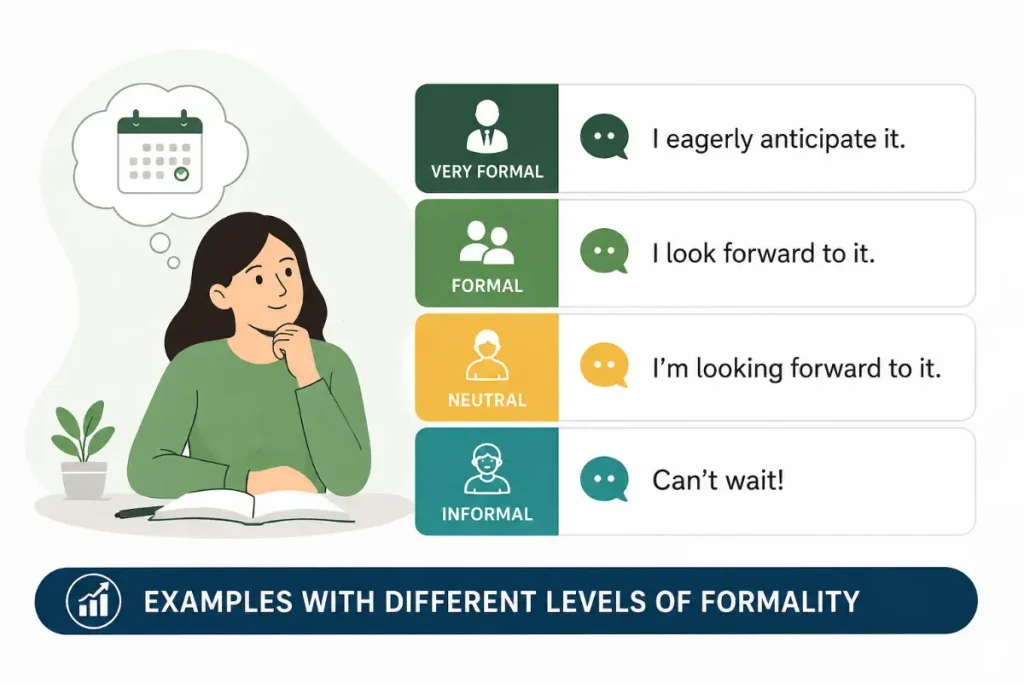
Formal:
- I look forward to meeting with you next week.
- Professional but warm:
- I’m looking forward to meeting with you next week.
Casual:
I’m really looking forward to seeing you next week.
Very casual:
- Can’t wait to see you next week.
- All four can be correct. They simply sound different.
A Practical Grammar Rule
Here is the rule worth remembering.
Look forward to is followed by a noun or an ing form.
Noun:
I look forward to the meeting.
Ing form:
I look forward to meeting you.
Pronoun:
- I look forward to it.
- Avoid the basic verb form after to in this expression.
- That rule applies to common phrases such as:
- I look forward to hearing from you.
- I look forward to seeing you.
- I look forward to working with you.
- I look forward to learning more.
- I look forward to receiving your reply.
FAQs
What does i look forward to it mean?
It means you feel positive about something that will happen in the future. It can show interest pleasure or anticipation. The phrase works in personal and professional situations.
Is I look forward to it correct grammar?
Yes. The sentence is grammatically correct. The word it refers to something already mentioned or understood from the conversation.
Should I say look forward to meeting or look forward to meet?
Use look forward to meeting. The word to acts as a preposition in this expression. Follow it with a noun or an ing form.
Is I look forward to it formal?
It can sound polite and somewhat formal. It is common in professional emails and business conversations. The more casual form I’m looking forward to it often feels warmer in everyday speech.
Can I use I look forward to it with friends?
Yes. Your friends will understand it clearly. Still a phrase like I’m looking forward to it or can’t wait may sound more relaxed in casual conversation.
What is the difference between I look forward to it and I’m looking forward to it?
Both phrases express positive anticipation. I look forward to it often sounds a little more formal. I’m looking forward to it usually sounds more conversational.
Can I say I look forward to seeing you?
Yes. This is a common and natural sentence. The ing form seeing is correct because to functions as a preposition in this expression.
Is I look forward to hearing from you polite?
Yes. It is a standard polite phrase in professional English. It tells the reader that you expect a future response and welcome it.
Conclusion
i look forward to it is a correct and useful English phrase. It tells someone that you feel positive about something that will happen in the future. You can use it for plans events meetings visits and other future activities.
The main grammar rule is easy to remember. After look forward to use a noun an object pronoun or an ing form. Say I look forward to the meeting. Say I look forward to it. Do not use the basic verb form after to in this structure.
Tone also matters. I look forward to it can sound polished and polite. I’m looking forward to it often feels more natural in casual American English. I can’t wait shows stronger excitement.
When you’re unsure which form to use focus on the situation first. Then check the word after to. If you’re talking about a thing use a noun. If you’re talking about an activity use the ing form. That simple habit will keep your sentence natural and grammatically correct.

Dr. Arthur Pendelton is a veteran historical linguist and grammar expert with over 30 years of experience in academic editing. A retired professor, Arthur specializes in the etymology and evolution of the English language. He is passionate about “unpacking the history behind the rules,” helping readers understand why we spell, punctuate, and phrase things the way we do today. Whether he’s settling debates on archaic usage or explaining complex linguistic shifts, Dr. Pendelton brings scholarly precision to every article.
1 thought on “I Look Forward To It Meaning And Usage”