
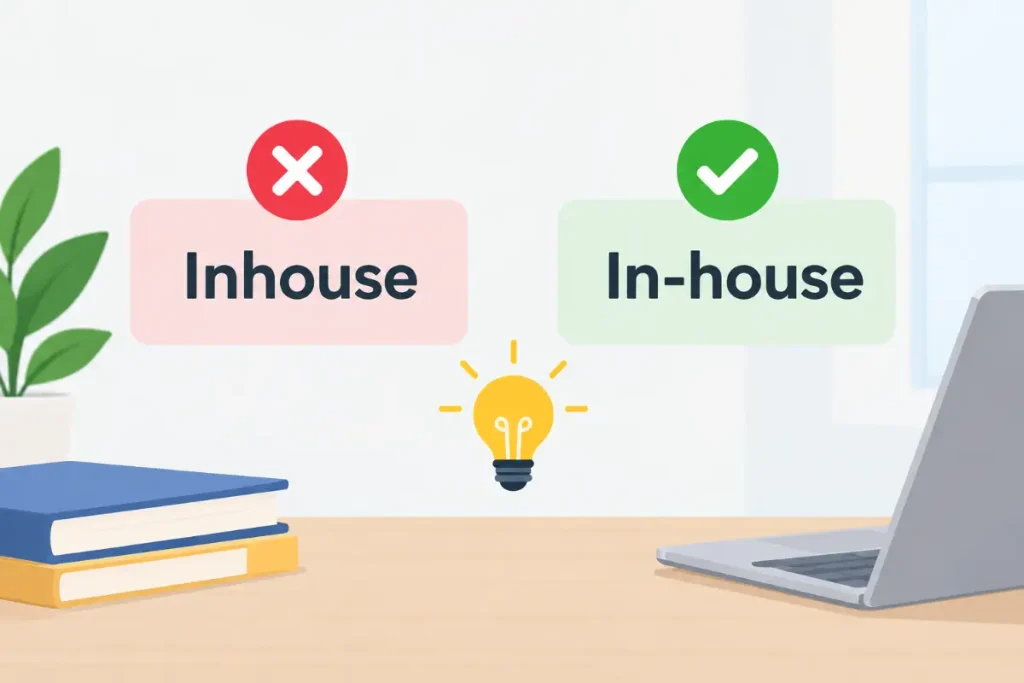
If you’re asking inhouse or in-house, the standard spelling for the meaning connected to work done inside a company or organization is in-house. Major dictionaries such as Cambridge, Oxford, and Collins list in-house as an adjective and adverb. Cambridge also records inhouse as a form in its Business English material, but the hyphenated form is the safer choice for standard US professional writing.
The confusion makes sense. English has many compounds that start as two separate words and later settle into a single spelling or a hyphenated form. In this case, the form you choose can affect how polished your writing looks, especially in resumes, business emails, reports, job descriptions, and company documents.
There is also a small twist. In house can appear as two separate words when the phrase has its ordinary literal meaning. That is different from the established term in-house, which usually means something is done by an organization’s own staff or resources rather than by an outside provider.
This guide explains the spelling, meaning, grammar, punctuation, and everyday use. You’ll see examples that show exactly when the hyphen belongs and when two separate words make more sense.
Quick Definition
In-house is the standard form when you mean done or handled within a company or organization by its own employees or resources. It works as an adjective and an adverb. Inhouse appears in some English usage, including Cambridge Business English, but in-house is the clearer standard choice for most US writing.
Direct Answer
Use in-house for the standard term that means done within an organization by its own staff or resources. Use in house as two words only when the words have a separate literal meaning rather than forming the established compound.
Spelling Comparison
| Word or phrase | Meaning | Example sentence | When to use it |
|---|---|---|---|
| In-house | Done within an organization or by its own staff | We have an in-house design team. | Use for the established adjective or adverb. |
| Inhouse | A less common one-word form | Some style systems may allow inhouse. | Avoid it in most standard US professional writing. |
| In house | Two separate words with a literal meaning | The workers stayed in the house during the storm. | Use when in and house keep their separate meanings. |
Why The Standard Form Is Clear
The hyphen in in-house helps turn two words into one compound expression. Instead of treating in and house as separate pieces, readers understand them together as a single term that describes something internal to an organization.
Oxford lists in-house as an adjective meaning existing or happening within a company or organization. Oxford also lists it as an adverb meaning within a company or organization. Cambridge gives the same basic meaning and shows the form as both an adjective and an adverb. Collins also lists in-house in both roles.
That dictionary evidence matters because spelling questions are not solved only by asking what looks familiar. Standard dictionaries show how established English treats a term. In this case, the hyphenated form has strong dictionary support.
Consider these examples.
The company has an in-house accountant.
Our in-house team handles customer support.
The software was developed in-house.
We provide in-house training for new employees.
The firm hired an in-house attorney.
In each sentence, the term points to work or people connected to the organization itself. The meaning is not simply inside a physical house.
That distinction is the heart of the issue.
What In-House Means
In-house means within a company, organization, group, or institution. It often tells the reader that the organization uses its own employees, department, facilities, or resources instead of bringing in an outside person or company.
For example, an in-house designer works for the organization. An outside design agency does not.
An in-house legal team works directly for the company. An outside law firm serves the company from outside the organization.
An in-house training program is created or delivered by the organization itself. It may take place at the workplace or online. The main point is who provides it, not simply where the training happens.
The phrase can describe people, services, work, systems, research, training, production, and many other things.
Here are some natural examples.
Our in-house editor checks every article before publication.
The hospital has an in-house pharmacy.
The company offers in-house training to new managers.
The team built the reporting system in-house.
We use an in-house payroll department.
The school provides in-house professional development.
The restaurant makes its sauces in-house.
The manufacturer now handles repairs in-house.
These examples all share one idea. The work stays inside the organization instead of being handed to an outside provider.
In-House As An Adjective
An adjective describes a noun. In-house often works this way when it comes before a noun.
You might see phrases such as these.
In-house counsel.
In-house designer.
The compound acts as a unit. It tells the reader what kind of person, team, service, or activity you mean.
Look at the difference between these sentences.
The company hired an in-house designer.
The company hired a designer from an outside agency.
The first sentence tells us that the designer is part of the company. The second tells us that the designer comes from outside.
Here are a few more examples.
She works with our in-house marketing team.
We need an in-house technical expert.
The university created an in-house training program.
They hired an in-house attorney to handle routine legal work.
The business has an in-house content department.
In each case, the compound sits directly before a noun and describes it.
In-House As An Adverb
In-house can also work as an adverb. In that use, it usually comes after a verb and tells us that an action happens within an organization.
For example.
- We produce the videos in-house.
- The company developed the software in-house.
- Our team handles payroll in-house.
- The engineers built the tool in-house.
- The restaurant prepares its desserts in-house.
- The company manages its support service in-house.
The phrase answers a simple question. Where or by whom is the work handled? The answer is inside the organization using its own people or resources.
Oxford lists in-house as an adverb and gives examples involving products designed and produced within a company. Cambridge also gives examples such as advertising material being designed in-house.
Notice the difference between adjective and adverb use.
- We have an in-house developer.
- In-house describes developer.
- Our developer builds the app in-house.
- In-house describes how the app is built.
That small grammar difference helps you understand why the same term appears in many business sentences.
Why The Hyphen Matters
A hyphen can show that two words belong together as one compound expression. That is exactly what happens with in-house in its established business meaning.
Compare these examples.
- We hired an in-house designer.
- We hired a designer who works in the house.
The first sentence refers to an employee who works within the organization. The second sentence has a different and much more literal meaning. It suggests a person who works inside a particular house.
- The context makes the difference clear.
- Another example can make this easier.
- The company offers in-house training.
Here, in-house modifies training. It means the organization provides the training itself.
Now consider a sentence such as this.
The children played in the house.
Here, in the house is simply a prepositional phrase. It tells us where the children played. There is no compound adjective.
This is why punctuation should follow meaning. Do not add a hyphen simply because two words happen to appear next to each other. Use the established compound when the words work together as a single term.
Is Inhouse A Correct Word
Inhouse is not simply a random spelling invented by people who forgot the hyphen. It does appear in English usage. Cambridge’s Business English material lists inhouse as an alternative form in some of its entries. However, Cambridge’s main entry and Oxford’s entries use in-house as the standard form.
That gives you a useful practical rule.
You may encounter inhouse, but you should normally write in-house in standard US professional English.
This is especially true when you are writing something that needs to look polished. Think about resumes, cover letters, business reports, company websites, school papers, formal emails, and published articles.
For example, write this.
She joined the company as an in-house attorney.
Not this.
She joined the company as an inhouse attorney.
The hyphenated form is familiar, easy to read, and strongly supported by major dictionaries.
Language changes over time, so you will sometimes see closed forms that compete with older hyphenated forms. That does not mean every version has equal status in every style. A good editor usually chooses the form that is clear, established, and appropriate for the audience.
For US professional writing, in-house is the dependable choice.
Can You Write In House Without A Hyphen
Yes, but the answer depends on the meaning.
If you mean the established term for work done within an organization, use in-house.
If you mean the words in and house separately, they can appear without a hyphen.
Oxford gives a useful example in its entry for house. It notes that I work in house can mean that someone works in the offices of the company rather than at home. In that construction, in and house keep their separate grammatical roles.
That is different from the compound adjective in-house.
Consider these examples.
She works in-house for the company.
She works in the house.
The first sentence uses the established term. The second sentence means she works inside a particular house.
The difference becomes even clearer with physical locations.
The contractor worked in the house all afternoon.
This sentence could describe work inside a residential building.
The contractor worked in-house for the company.
This sentence means the contractor worked as part of the company rather than as an outside provider, assuming the context supports that meaning.
In ordinary business writing, the second meaning is usually written in-house.
Common Uses Of In-House
The term appears across many areas of work. It is common in business, law, education, technology, marketing, health care, manufacturing, and creative work.
In-House Team
An in-house team is a group of employees who work directly for an organization.
Example.
Our in-house marketing team manages the company website.
The opposite could be an outside marketing agency.
In-House Lawyer
An in-house lawyer works directly for a company or organization rather than serving as an outside attorney at a law firm.
Example.
The company asked its in-house lawyer to review the contract.
In-House Training
In-house training is training provided by an organization for its own employees.
Example.
All new employees complete in-house safety training.
The training may happen in an office, a classroom, or online. The important point is that it is provided within the organization.
In-House Design
In-house design means design work handled by the organization’s own staff.
Example.
The brand uses an in-house designer for most of its marketing materials.
In-House Development
In-house development means a company uses its own developers or technical staff to create or maintain something.
Example.
The company developed the customer portal in-house.
In-House Production
In-house production means the organization produces something using its own people or facilities.
Example.
The studio handles most of its video production in-house.
In-House Support
In-house support means support is provided by the organization’s own team rather than an outside service.
Example.
We have an in-house support team available during business hours.
These combinations are natural because the compound has a clear and useful meaning. It tells the reader that the organization keeps the work inside its own operation.
In-House And Outsourced
In-house and outsourced describe two different ways of handling work.
For example.
The company handles payroll in-house.
The company outsourced payroll to an external provider.
The first sentence says the company uses its own staff or resources. The second says another provider performs the work.
This contrast explains why in-house is so common in business writing. Companies often need to describe the difference between internal work and outside services.
You might see sentences like these.
We handle customer service in-house but outsource payroll.
The company moved software testing in-house after using an outside vendor.
The marketing department keeps content creation in-house.
The firm uses outside consultants for projects that require special expertise.
The word does not tell you that one approach is better. It simply describes where the work is handled and who performs it.
In-House And Internal
In-house and internal are close in meaning, but they are not always interchangeable.
Internal is a broad word. It can describe something inside an organization, system, group, or structure.
In-house is more specific. It often points to work, services, employees, or resources handled by the organization itself.
For example.
The company has an internal policy.
The company has an in-house legal team.
Both sentences are correct, but they do different jobs.
Internal policy tells us the policy belongs to the organization. In-house legal team tells us the lawyers work within the organization rather than for an outside law firm.
You can often replace in-house with internal in casual writing, but the result may lose some of the original meaning.
That is why the two terms should not be treated as perfect synonyms.
Inhouse Or In-House In Real Sentences
The fastest way to understand this spelling issue is to look at complete sentences.
The company hired an in-house accountant.
This means the accountant works directly for the company.
The company completed the audit in-house.
This means the company handled the audit using its own staff or resources.
The workers stayed in the house during the storm.
This describes a physical location.
She works in-house rather than for an outside agency.
This describes her work arrangement.
The house has an in-house security system.
This sentence can be ambiguous because in-house may mean the system belongs to the house or was created internally. Context matters.
The company has an in-house security team.
This clearly means the security team works for the company.
The designer created the logo in-house.
This means the company’s own people created it.
The designer created the logo in the house.
This means the creation happened physically inside a house. The meaning is very different.
When you read the sentence aloud, the intended meaning may feel obvious. On the page, the hyphen helps the reader see the compound quickly.
Common Mistakes With In-House
A few mistakes appear again and again.
Writing Inhouse In Formal Work
The most common problem is closing the term into one word.
Incorrect for most standard US professional writing.
Our company has an inhouse design team.
Better.
Our company has an in-house design team.
The closed form does appear in some usage, but the hyphenated form is more established in the major learner and general dictionaries checked for this guide.
Writing In House For The Business Meaning
Another common mistake is leaving out the hyphen.
Incorrect in the usual compound sense.
We provide in house training.
Better.
We provide in-house training.
The hyphen makes it clear that in-house describes training as one unit.
Adding A Hyphen To Every Use Of In And House
The opposite mistake is treating every occurrence of the words as a compound.
For example.
- The children stayed in-house during the storm.
- If you mean they stayed inside the house, the natural wording is.
- The children stayed in the house during the storm.
- The first version changes the meaning and may sound like business language.
Confusing Meaning With Location
In-house does not simply mean physically inside a building.
An in-house legal team could work remotely. An in-house designer could work from home. The phrase focuses mainly on the relationship between the worker and the organization.
That is why the word can still be correct even when the employee is not sitting inside the company’s office.
How To Remember The Spelling
A simple memory trick can save you from second guessing this word.
Think of in-house as a team that belongs to the company.
If the work belongs to the company’s own operation, use the hyphen.
- In-house team.
- In-house lawyer.
If you are talking about a physical house, keep the words separate when they need to stay separate.
The kids are in the house.
The dog is in the house.
The workers repaired the roof in the house.
You can also use the outside test.
Ask yourself. Is this work done by the organization’s own people or resources?
If yes, in-house is probably the form you need.
Ask another question. Am I talking about something physically inside a house?
If yes, you probably need the separate phrase in the house or another literal construction.
That two question check handles most everyday cases.
When To Use In-House In Business Writing
In-house is especially useful when you need to explain that an organization handles something itself.
- It works well in resumes.
- I supported an in-house legal team.
- It works well in job descriptions.
- We are looking for an in-house content writer.
- It works well in company websites.
- Our in-house specialists help clients with technical questions.
- It works well in reports.
- The company moved its customer support operation in-house.
- It works well in emails.
- We can handle this request in-house.
- It also works well in academic and professional writing when the term fits the subject.
- The university developed an in-house research program.
- The department provides in-house training for staff.
- The research center maintains an in-house database.
- The word is useful because it says a lot with very little space.
Is In-House Formal Or Informal
In-house is neutral and widely used in professional English. It does not sound slangy, and it does not require an informal setting.
- You can use it in a business report.
- The company expanded its in-house training program.
- You can use it in a resume.
- Worked with an in-house marketing team to produce customer materials.
- You can use it in a formal email.
- Our in-house team will review the request.
- You can also use it in everyday conversation.
- We handle most of that work in-house.
That flexibility is one reason the term has become so common.
Pronunciation Of In-House
In-house is pronounced like the words in and house spoken as one compound expression. The stress pattern can vary slightly by speech style, but the main sound is familiar to most US English speakers.
Cambridge gives the US pronunciation as approximately in howss. Oxford also provides pronunciation information for the adjective and adverb.
You do not need to change the pronunciation because of the hyphen. The hyphen is a writing mark. It does not create a special spoken pause.
For example.
- In-house team.
- In-house training.
- Developed in-house.
The pronunciation remains natural in all three uses.
Why The Term Causes So Much Confusion
The confusion comes from English spelling patterns.
English uses compounds in several ways. Some compounds stay open as two words. Some become one word over time.
Examples include different patterns such as email, part-time, and post office. The spelling is not always predictable from logic alone.
That means you cannot safely assume that inhouse must be correct just because other compounds have become one word.
You also cannot assume that in house must always be correct because in and house are ordinary words.
The safest approach is to check the established form for the specific expression. Major dictionaries give in-house strong support for the meaning discussed here.
There is another reason the term can feel confusing. In-house works as both an adjective and an adverb.
That means you may see it before a noun.
In-house counsel.
Or after a verb.
We developed it in-house.
Once you recognize those two patterns, the spelling becomes much easier to remember.
When Inhouse May Appear
You may see inhouse in company names, branding, informal digital content, specialized publications, or sources that follow their own house style.
Cambridge Business English records inhouse as an alternative form in some entries. That shows the spelling exists in real usage. It does not mean you need to replace the more established hyphenated form in your own writing.
A company may choose a closed spelling for branding. A publication may follow a different style guide. A specific industry may also develop its own preferences.
That is normal in English.
Still, if you are writing for a general US audience and you want a spelling that readers and editors will recognize quickly, in-house is the safer choice.
How Editors Treat The Spelling
Editors usually care about three things here.
First, they want the meaning to be clear.
Second, they want the spelling to match an accepted dictionary or style guide.
Third, they want the same choice used consistently throughout the document.
If your report uses in-house in one paragraph and inhouse in another, the inconsistency can distract readers. It may look like a typo even if both forms can be found online.
Consistency matters in professional writing.
If you are editing a company document, follow the organization’s established style guide when one exists. If there is no special rule, the standard dictionary form is a sensible starting point.
For general US English, that usually means in-house.
Examples You Can Copy
Here are practical sentences you can use as models.
- Our company has an in-house design team.
- The marketing department handles social media in-house.
- We provide in-house training for new employees.
- She works as an in-house attorney.
- The engineers developed the software in-house.
- The hospital operates an in-house pharmacy.
- The school offers in-house professional development.
- Our in-house specialists can answer technical questions.
- The company moved customer support in-house.
- The restaurant makes its bread in-house.
- The studio handles most of its editing in-house.
- We hired an in-house accountant last year.
- The organization has strong in-house expertise.
- The firm built an in-house research team.
- The company created the new system in-house.
These sentences show the two main patterns. Before a noun, the term acts as an adjective. After a verb, it often acts as an adverb.
Examples Of Literal In House Use
Now look at examples where the words have a separate literal meaning.
The children played in the house.
The workers stayed in the house during the storm.
She left her keys in the house.
The cat was sleeping in the house.
The family spent the afternoon in the house.
These sentences are about a physical building. They do not use the business term.
That distinction is useful because it prevents a common mistake. Do not turn every phrase containing in and house into the business compound.
The words can work independently when the sentence needs a literal location.
A Simple Editing Test
When editing your own sentence, try this quick test.
First, look at the words after in-house.
If they form a business or organizational term such as team, training, counsel, staff, research, or production, the hyphenated form is likely right.
Second, look at the verb.
If the sentence says a company created, handled, produced, managed, or developed something internally, in-house is likely right.
Third, ask if you mean a physical house.
If you do, the words may need to stay separate.
For example.
- The company developed the software in-house.
- That is internal company work.
- The technician worked in the house.
- That is a physical location.
- The difference is simple once you focus on meaning instead of appearance.

Inhouse Or In-House In A Resume
For a resume, use in-house.
It is common in job titles and descriptions.
Examples include.
In-house Counsel.
In-house Recruiter.
You might write.
Worked with an in-house legal team to review contracts.
Or.
Managed projects for an in-house marketing department.
A resume needs clean and familiar language. The hyphenated form makes the intended meaning clear to recruiters and hiring managers.
In-House In A Cover Letter
The same rule applies to cover letters.
You might write.
I have experience working with an in-house marketing team.
Or.
My previous role involved supporting an in-house legal department.
The spelling looks professional and matches the form used by major dictionaries.
Avoid switching between inhouse and in-house in the same document. One consistent form looks cleaner.
In-House In Academic Writing
For academic writing, in-house is also the safer general choice.
For example.
The university created an in-house research center.
The department offers in-house training for graduate assistants.
The researchers developed an in-house testing method.
If your university or journal has a style guide, follow that guide. Otherwise, standard dictionary usage gives you a strong basis for choosing in-house.
In-House In A Business Email
Business emails benefit from simple wording.
You can write.
Our in-house team is reviewing the request.
We can handle the update in-house.
The company uses an in-house support system.
These sentences are short and clear. The hyphen does its job without drawing attention to itself.
That is often what good punctuation should do. It helps the reader without becoming the focus of the sentence.
Related Terms To Know
Understanding a few related terms can make this topic easier.
Outsourced
Outsourced means work is given to an outside person or company.
Example.
The company outsourced its payroll service.
External
External means coming from outside an organization or system.
Example.
We hired an external consultant.
Internal
Internal means belonging to or existing within an organization.
Example.
The company shared the information through an internal memo.
In-House
In-house usually means work or services are handled within the organization using its own staff or resources.
Example.
The company provides in-house technical support.
These words overlap, but they are not identical. In-house is especially useful when the focus is on work being performed by the organization itself.
FAQs
Is inhouse or in-house correct?
The standard spelling for the business meaning is in-house. Major dictionaries such as Oxford, Cambridge, and Collins list the hyphenated form. Cambridge also records inhouse as an alternative in some Business English material, but in-house is the safer choice for standard US professional writing.
Is in-house one word or two words?
In-house is normally written with a hyphen when it means something done within an organization. In house can appear as two separate words when the phrase has a literal meaning or follows a different grammatical structure.
Is in-house an adjective?
Yes. In-house can work as an adjective before a noun. Examples include in-house team, in-house training, and in-house counsel. Oxford lists the adjective as meaning existing or happening within a company or organization.
Is in-house an adverb?
Yes. In-house can also work as an adverb. In a sentence such as We developed the software in-house, it tells the reader that the company developed the software internally. Cambridge and Oxford both list this adverb use.
Should I write in-house in a resume?
Yes. In-house is the clearest standard form for a US resume. You can use it in phrases such as in-house counsel, in-house designer, or in-house marketing team.
Is in house ever correct?
Yes. In house can be correct when in and house have separate meanings. For example, The children played in the house refers to a physical house. Do not use the open form simply because the words appear next to each other in a business expression.
Is inhouse accepted in English?
Inhouse does appear in English usage, and Cambridge Business English records it as an alternative form in some entries. Still, the major dictionary entries used for standard reference generally present in-house as the established form. For general US writing, in-house is the safer choice.
What is the opposite of in-house?
The closest business opposite is outsourced or external. In-house work is handled by an organization’s own staff or resources, while outsourced work is handled by an outside provider. The exact opposite term depends on the sentence.
Conclusion
If you’re still deciding between inhouse or in-house, choose the hyphenated form for the standard business meaning. Write in-house team, in-house training, in-house lawyer, and developed in-house.
Use inhouse only if you are following a specific style or naming choice that accepts the closed form. It appears in real English usage, but it is not the form most general US readers expect in polished professional writing.
Remember the difference between the business term and the literal phrase. In-house describes work, people, services, or resources that belong to an organization. In house can describe something located inside a physical house.
When you are writing a resume, report, email, article, or business document, the practical rule is easy. If the company does the work itself, write in-house. If you are talking about something physically inside a house, use the separate words that the sentence requires.

Dr. Arthur Pendelton is a veteran historical linguist and grammar expert with over 30 years of experience in academic editing. A retired professor, Arthur specializes in the etymology and evolution of the English language. He is passionate about “unpacking the history behind the rules,” helping readers understand why we spell, punctuate, and phrase things the way we do today. Whether he’s settling debates on archaic usage or explaining complex linguistic shifts, Dr. Pendelton brings scholarly precision to every article.