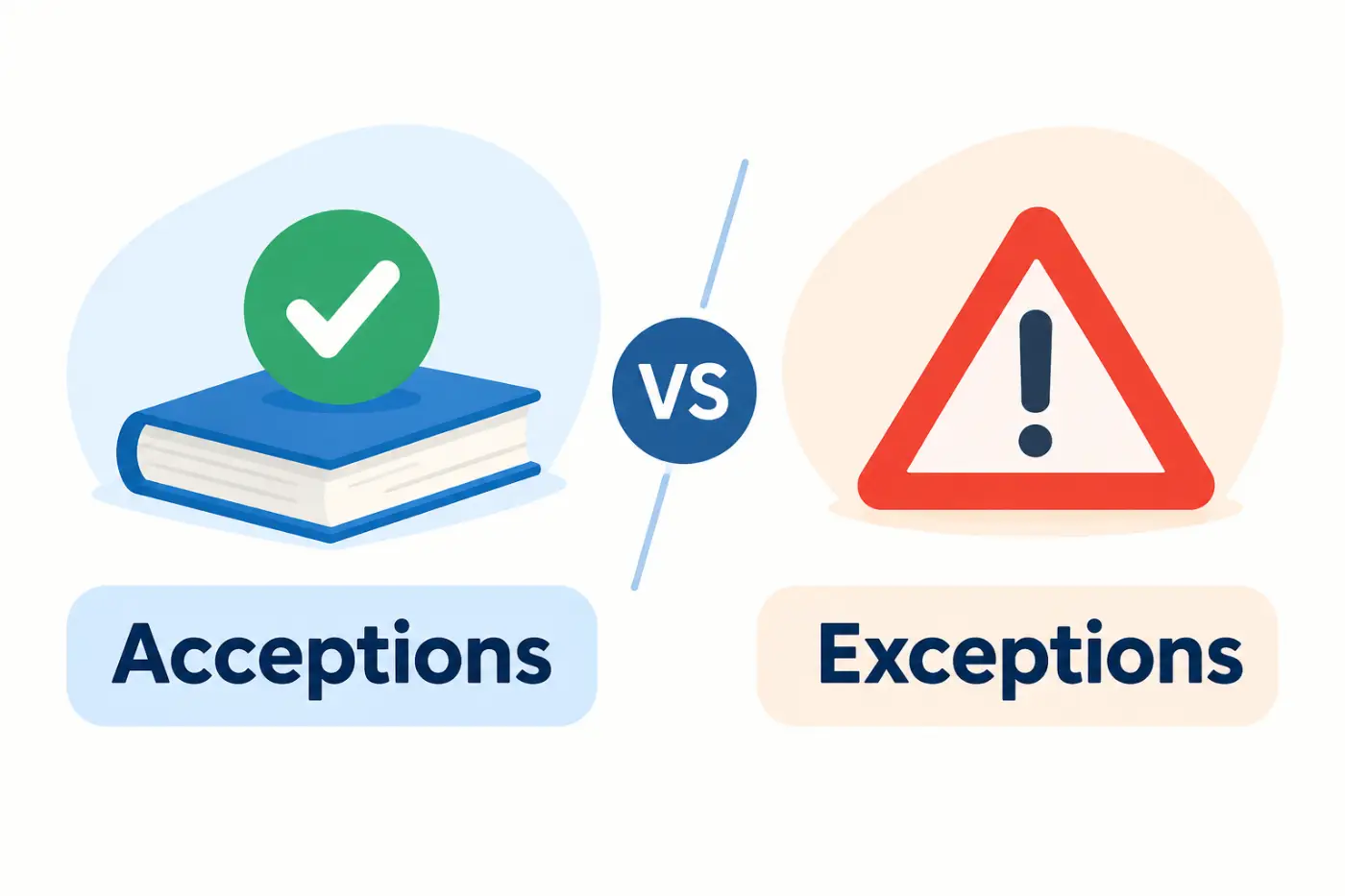
If you’re confused about acceptions vs exceptions, the correct word in almost every everyday situation is exceptions. However, acceptions is also a real word, though it’s rare and mainly used in specialized discussions about language.
The two words have different meanings. An exception is someone or something that doesn’t follow a general rule. An acception is a particular meaning or interpretation of a word. Most people use exceptions when they talk about rules, special cases, or things that don’t fit a pattern.
This spelling confusion is easy to understand. Both words look similar, and both are related to the idea of something being treated differently. Still, you can’t use them in place of each other.
In this guide, you’ll learn what each word means, how to spell it correctly, and when to use it. You’ll also see natural examples, common mistakes, memory tips, and answers to questions people often ask about these words.
Quick Definition
Acceptions is the plural of acception, a rare word that refers to a particular meaning or interpretation of a word or expression. Exceptions is the plural of exception, which refers to people or things that don’t follow a general rule or are excluded from it.
Direct Answer
Use exceptions when talking about special cases, rules, or things that don’t follow the usual pattern. Use acceptions only when discussing specific meanings of words in a specialized language or dictionary context.
For example, There are a few exceptions to the rule is correct when describing cases that don’t follow a rule. In a discussion of word meanings, The term has several acceptions may be correct, though meanings or senses would sound more natural in modern everyday English.
Acceptions vs Exceptions Comparison Table
| Word | Meaning | Example Sentence | When to Use It |
|---|---|---|---|
| Acception | A particular meaning of a word or phrase. | The old text uses the word in a rare acception. | In specialized discussions of language and word meanings. |
| Acceptions | More than one particular meaning of a word or phrase. | The dictionary lists several acceptions of the term. | When discussing distinct interpretations in a technical or historical context. |
| Exception | A person or thing that doesn’t follow a general rule. | This student is an exception to the rule. | When one case differs from the usual pattern. |
| Exceptions | Multiple cases that don’t follow a general rule. | The policy allows a few exceptions. | When discussing special cases, exclusions, or departures from a rule. |
The simplest way to remember the difference is to connect acception with word meaning and exception with a rule or general pattern. If you’re writing a school assignment, an email, a report, or an everyday message, you’ll usually want exception or exceptions.

Understanding the Meaning of Acception
The word acception refers to a particular sense or meaning of a word. It belongs to the field of language and word study, where people examine how words carry different meanings in different situations.
For example, a word can have one meaning in a general conversation and another in a technical discussion. A language scholar might describe these as separate acceptions of the word.
However, acception isn’t a common choice in modern English. Most readers are more familiar with words such as meaning, sense, and interpretation. These words express the same basic idea in a way that feels more natural to everyday readers.
What Acception Means in Plain English
Think of a word as a box that can hold several related ideas. The word head, for example, can refer to the part of your body above your neck. It can also refer to a leader, the top of something, or the front part of a line.
Each meaning is a separate sense of the word. In specialized language discussions, someone might refer to these different senses as acceptions.
Consider these examples.
- The word bright can describe a strong light.
- The word bright can describe someone who learns quickly.
- The word bright can describe a vivid color.
These examples show how one word can carry several meanings. In an academic discussion of word meanings, the term acception may be used to describe a particular meaning.
In ordinary writing, though, you’d usually say that bright has several meanings or senses. That wording is easier to understand and less likely to confuse your reader.
Is Acception a Real Word
Yes. Acception is a real English word. It’s not simply a spelling mistake made by people trying to write exception.
The word has appeared in historical and specialized uses related to the meaning or interpretation of words. However, it’s uncommon in modern everyday English.
This difference matters because a word can be valid without being the best choice for a particular sentence. English has many rare words that are technically correct but unfamiliar to most readers.
For example, you could use acception in a specialized discussion of language. But if you’re explaining a word to a friend, saying meaning or sense would usually make your point more clearly.
Compare these sentences.
- Specialized wording: The term has several acceptions in historical texts.
- Everyday wording: The term has several meanings in historical texts.
Both sentences communicate the idea of multiple meanings. The second sentence is more direct and easier for a general audience to understand.
When Should You Use Acceptions
Use acceptions only when the context calls for this rare term. It may fit a discussion of historical language, specialized dictionary terminology, or the study of different meanings attached to a word.
Even in these settings, make sure the word suits your audience. A technical term can be useful when it adds precision, but it can also make a sentence harder to read if a common word expresses the same idea.
Here are a few examples.
- The researcher examined several acceptions of a term used in an old manuscript.
- The article discussed the historical acceptions of a word that has changed over time.
- The scholar compared two acceptions found in different language records.
These sentences illustrate the kind of specialized context in which the word might appear. They aren’t examples of normal everyday usage.
If you’re writing a blog post, school essay, business email, or social media post, consider replacing acceptions with meanings or senses. Your readers will understand your point without needing to look up an unfamiliar word.
Understanding the Meaning of Exception
An exception is something that doesn’t follow a general rule, pattern, or expectation. It can also refer to a person or thing excluded from a rule or statement.
This word appears in everyday conversations, schoolwork, business documents, laws, policies, and many other forms of writing.
For example, imagine a store that normally opens at 9 a.m. but opens at 10 a.m. on a holiday. The holiday schedule is an exception to the usual opening time.
The same idea applies to a classroom rule, a workplace policy, or a general statement about people and things.
What Exception Means in Plain English
An exception is a special case that differs from what normally happens.
Imagine that your teacher says every student must submit an assignment by Friday. One student receives permission to submit it on Monday because of a special situation. That student has an exception to the deadline.
Here are more examples.
- The library is closed on Sundays, with one exception during the annual book fair.
- Everyone on the team attended the meeting except Maria.
- The company makes no exceptions to its safety rules.
- This small town is an exception to the region’s usual weather pattern.
Each sentence describes a case that differs from the usual rule or pattern.
Notice that an exception doesn’t always mean someone has broken a rule. Sometimes the rule itself allows special cases. In other situations, an exception is granted because a person or event has unusual circumstances.
What Exceptions Means
Exceptions is simply the plural form of exception. Use it when you’re talking about two or more special cases.
For example, a school may have several exceptions to its attendance policy. A store may allow exceptions to its return policy under certain conditions. A scientific study may identify exceptions to a pattern that usually holds true.
Here are some natural sentences.
- The teacher explained the rules and their exceptions.
- There are two exceptions to the parking policy.
- The report lists several exceptions to the general trend.
- We usually take the train, with a few exceptions during holidays.
The word works in both formal and informal English. You can use it in a conversation with a friend or in a professional report without sounding unusual.
Common Types of Exceptions
Exceptions appear in many parts of life. Understanding these common uses can help you choose the word correctly.
Exceptions to rules.
These occur when a rule doesn’t apply to a particular case.
Example: The school allows exceptions to the uniform policy for certain activities.
Exceptions to policies.
These occur when an organization allows a person or situation to receive different treatment under a policy.
Example: The manager approved two exceptions to the company’s travel policy.
Exceptions to general statements.
These occur when a statement describes most cases but doesn’t apply to every case.
Example: Most birds can fly, but penguins are a familiar exception to that general statement.
Exceptions in grammar.
These occur when a word or sentence doesn’t follow a pattern that usually applies.
Example: English spelling has exceptions to many common letter patterns.
Exceptions in schedules.
These occur when a regular schedule changes for a particular day or event.
Example: The bus runs every hour, with a few exceptions on public holidays.
All these examples share one central idea. An exception is a case that differs from what normally applies.
Why Acceptions and Exceptions Get Confused
The spelling difference between acceptions and exceptions is small. Both words end in ceptions, and both can appear in formal writing. A quick glance may make them seem interchangeable.
Their meanings, however, are different. One relates to a particular meaning of a word. The other relates to a special case that differs from a general rule.
Their Spellings Look Similar
Both words contain many of the same letters. The beginning is the main visual difference.
- Acceptions begins with ac.
- Exceptions begins with ex.
That small change creates two distinct words. It’s easy to overlook the difference when typing quickly or checking a long document.
Autocorrect can also make spelling checks confusing. A rare word may be flagged as unfamiliar, while a common word may be accepted automatically. That doesn’t mean the common word fits the sentence.
The best solution is to check the meaning rather than relying only on the spelling checker.
They Belong to Different Contexts
Another reason people confuse the words is that both can appear in formal discussions.
A person studying language may use acception to refer to a particular word meaning. A person discussing workplace rules may use exception to refer to a special case.
The subject of the sentence often reveals the correct choice.
Consider these two sentences.
- The dictionary records several acceptions of the term.
- The policy allows several exceptions to the rule.
The first sentence focuses on meanings. The second focuses on cases that don’t follow a rule.
If your sentence discusses a rule, policy, deadline, or unusual case, exception is probably the word you need. If it discusses a specialized account of word meanings, acception may fit.
Everyday English Favors Exception
The word exception is common in modern English. People use it when talking about rules, habits, schedules, policies, and general statements.
By contrast, acception is rare. Many readers won’t recognize it, even if they know a great deal about English.
That difference in frequency explains why exceptions is usually the safer choice in everyday writing. Still, frequency alone doesn’t decide correctness. The meaning of the sentence must come first.
For example, if you’re writing about different meanings of a word, exceptions won’t express the same idea. You should use meanings or senses instead, unless the specialized term acceptions is needed.
How to Choose the Correct Word
You don’t need to memorize a long list of rules to tell these words apart. Start by asking what your sentence is trying to say.
Check If You’re Talking About a Rule
If your sentence describes a rule, a policy, a pattern, or something that normally happens, you probably need exception or exceptions.
For example:
- There are exceptions to the school rules.
- The store makes no exceptions to its return policy.
- Most people arrived on time, with one exception.
- The schedule has three exceptions next month.
Each sentence refers to a special case or a departure from the usual pattern.
Check If You’re Talking About Word Meaning
If your sentence focuses on the meaning of a word or expression, consider meaning, sense, or interpretation first.
For example:
- The word has several meanings.
- The dictionary lists three senses of the term.
- The phrase has a different interpretation in this passage.
These sentences communicate the idea clearly without relying on a rare word.
If your work specifically uses acception as a technical term, you can use it when appropriate. Otherwise, common alternatives are usually better.
Read the Whole Sentence
Sometimes a single word doesn’t give you enough information. Read the full sentence and identify the relationship between its parts.
Consider this example.
Incorrect for the intended meaning: The teacher made several acceptions to the classroom rules.
Correct: The teacher made several exceptions to the classroom rules.
The sentence discusses rules, so exceptions is the correct choice.
Now consider another example.
Unclear for a discussion of word meanings: The writer compared several exceptions of the term.
Clearer: The writer compared several meanings of the term.
Here, meanings is the natural choice. If the writer is using a specialized linguistic term, acceptions might be appropriate instead.
The goal isn’t to choose the word that looks familiar. It’s to choose the word that conveys your intended meaning.
Common Mistakes to Avoid
Even confident writers can mix up similar words. A quick review can help you avoid the most common errors with these spellings.
Using Acceptions When You Mean Exceptions
This is the main mistake to watch for. People sometimes write acceptions when they mean special cases or departures from a rule.
Incorrect: There are no acceptions to the company policy.
Correct: There are no exceptions to the company policy.
The corrected sentence makes sense because it refers to a policy. The writer wants to say that the policy applies in every case.
Here’s another example.
Incorrect: The teacher allowed two acceptions to the deadline.
Correct: The teacher allowed two exceptions to the deadline.
The second sentence clearly states that two special cases received different treatment.
Using Exceptions When You Mean Meanings
The opposite mistake happens when someone uses exceptions to discuss the different meanings of a word.
For example, imagine you’re writing about the word run. It can describe moving quickly on foot, operating a machine, managing a business, or competing in an election.
These are different meanings of the same word. They aren’t exceptions to a rule.
A clearer sentence would be: The word run has several meanings.
You could use senses instead of meanings in a more formal discussion. Both options are familiar and natural.
Assuming Rare Words Are Always Incorrect
Some writers assume that an unfamiliar word must be a spelling error. That’s not always true.
Acception is a valid but uncommon word. Its rarity doesn’t make it incorrect in every context.
The problem comes from using it in a sentence that needs a different meaning. A rare word may be correct in a specialized discussion but confusing in everyday writing.
For example, a language scholar may use acception to describe a particular word meaning. A student writing about school rules should use exception instead.
Always consider the context before changing an unfamiliar word.
Relying Only on Spell Check
Spell check can catch many typing mistakes, but it can’t always tell what you want to say.
Both acceptions and exceptions can be valid words. A spelling tool may accept either one without recognizing that you’ve used the wrong word for your sentence.
For example, a document might contain the sentence, The manager approved three acceptions to the policy. A spell checker may not flag the word because it exists in some dictionaries. Yet exceptions is the appropriate choice for this meaning.
Read your sentence aloud and ask yourself what it means. That simple habit can catch errors that automated tools miss.
Easy Ways to Remember the Difference
A simple memory trick can help you choose the right word without stopping to think for too long.
Connect Exceptions With Excluding a Case
An exception often marks a case that is excluded from a general rule.
Think of a school rule that applies to everyone except students who have special permission. Those students fall under an exception to the rule.
The words exception and exclude both begin with ex. This connection can help you remember that an exception involves a case that is treated differently or left outside the usual rule.
For example, if you write about exceptions to a deadline, you’re describing situations in which the normal deadline doesn’t apply.
Connect Acception With Acceptance of Meaning
You can remember acception by linking it to the idea of accepting a particular meaning or interpretation.
This is only a memory aid. The word doesn’t mean ordinary acceptance or approval. Its specialized use concerns a particular sense of a word.
When you see acception, think about dictionaries, language study, and word meanings. When you see exception, think about rules, policies, and special cases.
That mental distinction makes the two words easier to separate.
Use a Simple Question
Before choosing either word, ask yourself one question.
Am I talking about a meaning or a special case?
If you’re talking about a special case, use exception or exceptions.
If you’re discussing a particular meaning of a word in a specialized context, acception or acceptions may fit. In ordinary writing, meaning or sense will usually be clearer.
Try this quick practice.
- The school allows three special cases under its attendance policy. Use exceptions.
- The dictionary records several meanings of an old word. Use meanings or, in a specialized context, acceptions.
- The manager approved a change to the usual procedure. Use exception.
- The researcher compared different interpretations of a phrase. Use interpretations or senses.
With a little practice, the difference becomes much easier to spot.
Related Words That Can Cause Confusion
Understanding a few related words can help you write more clearly. These terms overlap in some contexts, but they don’t all mean the same thing.
Exception vs Exemption
An exception is a special case that differs from a general rule. An exemption is permission to avoid a requirement, duty, or obligation.
For example:
- The school made an exception to its usual schedule.
- The student received an exemption from the required course.
The first sentence describes a departure from a rule. The second describes freedom from a requirement.
These words sometimes appear in similar situations, but exemption is more specific when someone doesn’t have to meet a requirement.
Exception vs Exclusion
An exception identifies a case that doesn’t follow the usual rule or is treated differently. An exclusion refers to leaving someone or something out.
For example:
- The policy has an exception for emergency cases.
- The list contains an exclusion for items that aren’t eligible.
The first sentence describes a special condition in a policy. The second describes something left out of a list or group.
The best word depends on the action or relationship you’re describing.
Meaning vs Sense
Meaning is the general idea conveyed by a word, phrase, sign, or statement. Sense can refer to a particular meaning of a word, especially when one word has several uses.
For example:
- What is the meaning of this sentence?
- The word light has several senses.
Both words are common in English. They’re also more accessible than acception for most readers.
Accept vs Except
These two words are often confused because they sound similar, but they have different jobs in a sentence.
Accept is a verb that means to receive, agree to, or approve something.
Except usually means excluding someone or something.
Compare these examples.
- I accept your invitation.
- Everyone came except Daniel.
In the first sentence, accept describes receiving an invitation. In the second, except identifies the person who didn’t come.
Remember that acception is related to a specialized use involving word meanings. It isn’t simply another form of the everyday verb accept.
Exception vs Expectation
An exception is a special case. An expectation is something you believe will happen or something you think should happen.
For example:
- The company made an exception to the rule.
- The company met our expectations.
The first sentence concerns a rule. The second concerns what someone anticipated or hoped for.
These words can appear in the same discussion, but their meanings are distinct.

How These Words Work in Different Types of Writing
The best word choice also depends on your audience and purpose. A term that fits an academic paper may sound strange in a casual message.
In School Assignments
For most school assignments, use exception when discussing a rule or unusual case.
Example: There are several exceptions to the grammar rule.
If you’re writing about word meanings, choose meaning or sense unless your assignment specifically requires the term acception.
This approach keeps your writing clear and makes it easier for your teacher to understand your point.
In Business Writing
Business documents often discuss policies, procedures, deadlines, and requirements. In these contexts, exception is the natural choice.
For example, a manager might write, Please contact the department if you need an exception to the standard procedure.
The word tells the reader that a special arrangement may be allowed.
Acception would be unusual in this context because the sentence isn’t about word meanings. Using it could distract readers or make the message unclear.
In Academic Writing
Academic writing sometimes requires specialized terms. If you’re studying the history of a word or analyzing how a term has been used, acception may appear in a relevant source.
However, don’t use a rare term just to make your writing sound more formal. Precision matters more than complexity.
If meaning communicates the idea accurately, it’s often the better choice. Use acception only when the technical context supports it and your readers can understand the term.
In Everyday Conversations
In daily conversations, exception is common and easy to understand.
You might say, I’ll usually eat at home, with a few exceptions. You could also say, The store doesn’t make exceptions to its return policy.
Most people wouldn’t use acception in an ordinary conversation. If you’re talking about a word’s meaning, you’d probably say meaning or sense instead.
Choose the wording that helps your listener understand you without extra effort.
Practice Examples to Test Your Understanding
The best way to remember a word is to use it. Read each example and consider which word fits the intended meaning.
Example One
The manager approved two ______ to the usual procedure.
Correct answer: exceptions.
The sentence describes special cases that differ from the normal procedure. It has nothing to do with the meaning of a word.
Example Two
The researcher studied the different ______ of a term in historical documents.
Possible answer: acceptions.
This sentence describes a specialized study of word meanings. Still, meanings or senses would usually sound more natural.
Example Three
The store is open every day, with a few ______ during public holidays.
Correct answer: exceptions.
The sentence describes days that don’t follow the usual schedule.
Example Four
What is the ______ of this phrase in the passage?
Correct answer: meaning.
The sentence asks for an explanation of a phrase. Neither acception nor exception is needed in this everyday question.
Example Five
The school makes no ______ to its safety rules.
Correct answer: exceptions.
The sentence means that the safety rules apply without special cases.
Example Six
The dictionary describes several ______ of the term in older English.
Possible answer: acceptions.
This specialized sentence focuses on historical word meanings. Depending on the source and intended audience, senses or meanings may still be preferable.
What the Examples Teach You
Most sentences involving rules, policies, schedules, or special cases require exception or exceptions. Sentences about the meaning of a word usually need meaning, sense, or interpretation.
The rare term acception has a narrower use. You don’t need to use it just because you’re discussing words.
FAQs
Is Acceptions a Correct English Word?
Yes. Acceptions is the plural of acception, a rare word used for particular meanings or interpretations of words. It’s valid in specialized contexts, but meanings and senses are more common in everyday English.
Is Exceptions the Correct Word for Special Cases?
Yes. Exceptions is the correct plural form when you mean special cases that don’t follow a general rule or are treated differently. For example, a policy may allow exceptions for unusual circumstances.
What Is the Main Difference Between Acceptions and Exceptions?
The main difference is their meaning. Acceptions refers to particular word meanings in specialized usage, while exceptions refers to cases that differ from a general rule or are excluded from it.
Can I Use Acceptions in Everyday Writing?
You can, but it’s rarely the clearest choice. Most readers will understand meanings or senses more easily. Save acceptions for contexts where the specialized term is useful.
What Is the Singular Form of Exceptions?
The singular form is exception. Use exception for one special case and exceptions for two or more. For example, This is one exception and These are three exceptions are both correct.
What Is the Difference Between Accept and Except?
Accept means to receive, agree to, or approve something. Except means excluding someone or something. For example, I accept the offer and Everyone came except Sam use the words correctly.
How Can I Remember the Difference Between Acception and Exception?
Connect exception with rules and special cases. Connect acception with word meanings in specialized language discussions. If you’re unsure, ask yourself if the sentence is about a rule or a meaning.
Is Acception the Same as Acceptance?
No. Acceptance usually refers to receiving or agreeing to something, or to the state of being accepted. Acception is a rare term related to a particular meaning or interpretation of a word. They look similar but serve different purposes.
Conclusion
The difference between acceptions vs exceptions comes down to meaning. Acceptions is a rare word associated with particular word meanings. Exceptions is the familiar plural of exception and refers to special cases that don’t follow a general rule.
For most everyday writing, exceptions is the word you’ll need when discussing rules, policies, deadlines, schedules, or unusual situations. If you’re writing about the meanings of words, meanings and senses will usually express your point more clearly than acceptions.
Before you finish your next sentence, check what you’re trying to describe. If it’s a special case, choose exception. If it’s a word’s meaning, choose meaning or sense, unless a specialized discussion calls for acception.

Dr. Arthur Pendelton is a veteran historical linguist and grammar expert with over 30 years of experience in academic editing. A retired professor, Arthur specializes in the etymology and evolution of the English language. He is passionate about “unpacking the history behind the rules,” helping readers understand why we spell, punctuate, and phrase things the way we do today. Whether he’s settling debates on archaic usage or explaining complex linguistic shifts, Dr. Pendelton brings scholarly precision to every article.