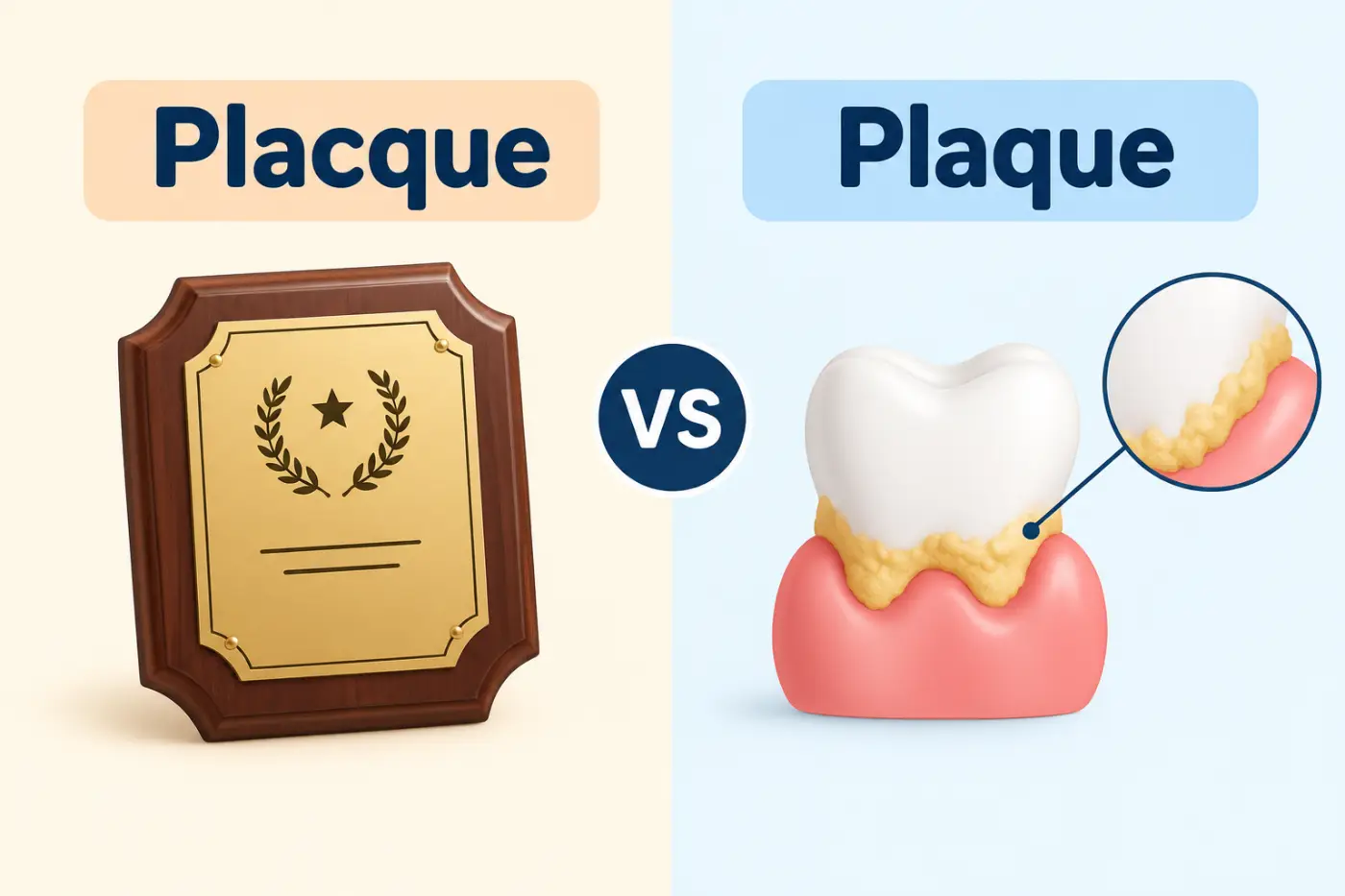
If you have ever stopped while writing and wondered about placque vs plaque, you’re not alone. These two spellings look almost identical. The extra c in one version is easy to miss, yet only one spelling is normally correct in standard English.
The correct spelling is plaque. The spelling placque is generally considered a misspelling. Plaque is a noun that can refer to a decorative or commemorative tablet, a buildup on teeth, or a deposit that forms in the body in certain medical conditions.
This small spelling difference matters because a single extra letter can make your writing look careless. The good news is that the rule is simple. Once you know the correct form and understand what it means, you won’t have to stop and second guess yourself again.
This guide explains the difference between the two spellings, shows you how to use the correct word in real sentences, and looks at the different meanings of plaque. You’ll also learn why people sometimes write the incorrect form and how to remember the right spelling.
Quick Definition
Plaque is the correct English spelling. It can describe a flat tablet or sign that honors a person or event, a sticky film that builds up on teeth, or a deposit linked to certain medical conditions.
Placque is not the standard spelling of the word. If you’re writing in standard American English, use plaque.
Direct Answer
The correct spelling is plaque, not placque. Use plaque when you mean a commemorative tablet, dental buildup, or a medical deposit.
Comparison Table
| Word or Phrase | Meaning | Example Sentence | When to Use It |
|---|---|---|---|
| Plaque | A tablet or sign that honors a person or event | The school placed a plaque on the wall. | Use this spelling in standard English. |
| Plaque | A sticky film that forms on teeth | Daily brushing helps remove plaque. | Use it when talking about dental health. |
| Plaque | A deposit that forms in the body | The doctor explained how plaque can affect arteries. | Use it in medical contexts. |
| Placque | Nonstandard spelling | Placque is usually marked as a spelling error. | Avoid this spelling in standard writing. |
Why The Spelling Causes Confusion
The confusion comes from how the word looks and sounds.
Plaque has a combination of letters that can feel unusual to English speakers. The word starts with pla and ends with que. When people hear the word spoken aloud, they don’t hear the spelling. They only hear a sound that is close to plak.
That makes it easy to imagine an extra c before the q.
People also encounter other English words that contain repeated consonants or unusual letter patterns. For example, words such as antique, unique, technique, and plaque all use the letter combination que in ways that may not feel obvious if you are spelling them from sound alone.
The incorrect spelling can also look believable. That’s often what makes spelling mistakes tricky. A misspelled word doesn’t always look strange. Sometimes it looks perfectly reasonable until you compare it with the accepted form.
The key point is simple.
There is no standard English spelling rule that changes plaque into placque. The extra c does not belong there.
If you mean the word for a memorial tablet, dental buildup, or certain kinds of bodily deposits, write plaque.
The Correct Spelling Is Plaque
Plaque is the standard spelling used in American English and British English.
The word can have several meanings, but the spelling stays the same.
For example, you might see a plaque on a building that explains an important historical event. You might hear a dentist talk about plaque on your teeth. You might read about plaque in an article about blood vessels or the brain.
The meaning changes with the context. The spelling does not.
Here are a few simple examples.
- The city placed a plaque outside the historic building.
- The dentist showed me how to remove plaque from my teeth.
- The museum added a plaque explaining the history of the site.
- Scientists study the role of plaque in some brain diseases.
- The award included a small wooden plaque.
Each sentence uses the same spelling.
That consistency makes the word easier to remember. You don’t need a different spelling for each meaning.
What Does Plaque Mean
Plaque has more than one common meaning. Understanding these meanings can make the spelling much easier to remember because you’ll recognize the word in different settings.
Plaque As A Commemorative Tablet
One common meaning is a flat piece of metal, stone, wood, or another material that carries words, names, dates, or images.
People often use plaques to honor someone, remember an event, mark a historic location, or recognize an achievement.
You might see a plaque attached to the outside wall of an old building. A school may install a plaque to honor a former principal. A city might place one at the site of an important historical event.
For example.
- A bronze plaque marks the birthplace of the famous author.
- The university presented her with a plaque for her years of service.
- A small plaque hangs beside the entrance to the theater.
- The park has a plaque honoring local firefighters.
In this sense, a plaque is often permanent or intended to last for many years.
It can be decorative, but its main purpose is usually to communicate information or recognition.
Plaque In Dental Health
Plaque also has a very common dental meaning.
Dental plaque is a soft, sticky film that forms on teeth. It contains bacteria and other substances that collect on the surface of the teeth.
If plaque remains on the teeth for too long, it can contribute to tooth decay and gum problems. Regular brushing and flossing help remove it.
- You may hear a dentist say something like this.
- Plaque has built up around your gums.
- You need to brush more carefully to remove plaque.
- The hygienist removed plaque during the cleaning.
- This meaning is especially common in everyday health conversations.
It’s also one reason people may encounter the word often even if they rarely see it used for memorial signs.
Plaque In Medicine
The word has another important meaning in medicine.
A plaque can refer to an abnormal deposit that forms in body tissue. One familiar example is arterial plaque. This material can build up inside arteries and may affect blood flow.
The word also appears in discussions about certain conditions involving the brain.
Medical plaque is a specialized use of a common word. The basic idea is still a deposit or buildup.
For example.
- The scan showed plaque in the artery.
- The doctor explained how arterial plaque can affect circulation.
- Researchers are studying the formation of plaque in the brain.
The meaning comes from the idea of something accumulating or forming as a layer or deposit.
Why Placque Is Usually Incorrect
The spelling placque adds an extra c.
That extra letter may seem harmless, but it changes the spelling from the accepted English form.
In standard writing, you should use plaque.
You might occasionally see placque in informal writing, old documents, names, or other unusual contexts. A specific name can have its own spelling, so proper names should always be checked individually. But that doesn’t make placque the standard spelling of the common English noun.
For normal writing, the rule is easy.
- Write plaque.
- Avoid placque.
This applies to school assignments, emails, articles, reports, business writing, and most other forms of standard English.
How To Pronounce Plaque
Plaque is usually pronounced like plak.
The word has one syllable.
It does not sound like the word plate. It also does not have a separate sound for the letters in que.
Think of the pronunciation as a sound similar to black without the b.
That pronunciation can actually help you understand why the spelling is easy to get wrong. English spelling often contains letters that aren’t pronounced in the way learners expect.
The q is followed by u in the written word, but the ending does not create a separate sound.
You can say it simply.
- Plaque.
- One syllable.
This pronunciation stays the same across its common meanings.
How To Remember The Correct Spelling
A simple memory trick can help.
Think of plaque as ending in que.
You can connect it mentally with other familiar words that end in the same letters.
- Unique.
- Antique.
- Technique.
- Plaque.
The words don’t share the same meaning or pronunciation pattern, but they can help you remember that plaque ends with que rather than cque.
Another useful trick is to picture a physical plaque.
Imagine a bronze plaque attached to a brick wall. Picture the word PLAQUE printed across it.
That visual connection can make the correct spelling stick.
For dental plaque, you can use the same mental image. Picture a dentist pointing to a diagram with the word plaque written correctly.
The goal is not to memorize a complicated spelling rule. There really isn’t one that explains the extra c in the incorrect version.
Instead, remember the word as one complete spelling.
Plaque.
Examples Of Plaque In Real Sentences
Seeing the word in natural sentences is one of the best ways to understand how it works.
Here are examples from different contexts.
- The bronze plaque was placed near the entrance.
- A small plaque explains who built the house.
- The mayor unveiled a plaque honoring the community leader.
- The museum has a plaque beside each major exhibit.
- The school gave the retiring teacher a plaque.
- The dentist warned that plaque can damage the gums.
- Brushing twice a day helps control dental plaque.
- The hygienist removed a large amount of plaque.
- Plaque can form on the teeth when bacteria collect there.
- The doctor discussed plaque buildup in the artery.
- Researchers are examining how plaque develops in the brain.
- Each sentence uses the same spelling.
The context tells you which meaning the writer intends.
Plaque In Historical And Public Places
You’ll often find plaques in places with historical or cultural importance.
A plaque may identify the location of an important event. It may honor a person who lived there. It can also provide a short explanation of a building’s history.
For example, a historic home may have a plaque outside the front door.
The plaque might include the name of the person who lived there, the year the building was constructed, and a short description of its importance.
Cities often use plaques in this way because they can provide information without taking up much space.
A plaque might say that a building once served as a hospital during a major event. Another might identify the birthplace of an author, politician, artist, or inventor.
In these situations, the word has nothing to do with teeth or medicine.
It simply refers to a physical tablet or sign used to mark or honor something.
That difference comes from context.
Plaque As An Award
A plaque can also be an award.
Schools, companies, clubs, sports groups, and other organizations often give plaques to recognize achievement.
For example, an athlete might receive a plaque for winning a tournament. An employee might receive one for years of service. A business might display a plaque recognizing an award.
You could write.
- The coach gave each player a plaque after the championship.
- The company presented him with a plaque for twenty years of service.
- She keeps the award plaque on her office shelf.
- In this use, plaque often refers to the physical award itself.
- It can be made from wood, metal, glass, or another material.
- The shape and design can vary widely. The word remains the same.
Common Spelling Mistakes
The most common mistake is adding the extra c.
Placque looks close to the correct form, so it can slip into writing unnoticed.
Another mistake is changing the ending.
Some writers may try spellings such as plack or plak because they are spelling the word based on pronunciation. Those forms are not the standard spelling for the common noun.
English has many words that cannot be spelled accurately just by listening to them.
Plaque is one of them.
The safest approach is to remember its written form rather than trying to build the spelling from its sound.
Why People Write Placque
There are several simple reasons people make this mistake.
First, the word has an unusual spelling.
Second, the pronunciation does not clearly reveal every letter.
Third, the incorrect form looks believable.
That third point matters more than it seems.
When a spelling looks obviously wrong, people usually catch it. When a spelling looks almost right, the brain can read past it.
This happens with many commonly confused words.
A writer may know the word perfectly well but still type the wrong letters out of habit.
That doesn’t mean the writer doesn’t understand the meaning.
It simply means the spelling needs a quick check.
A Simple Rule For Writers
If you’re writing about a memorial tablet, an award, dental buildup, or a medical deposit, use plaque.
That single rule covers the normal uses of the word.
You don’t need to remember separate spellings for different meanings.
Here are a few quick examples.
- A memorial plaque.
- A bronze plaque.
- An award plaque.
- Dental plaque.
- Arterial plaque.
- Brain plaque.
All use the same spelling.
The word changes meaning based on the words around it.
Related Words That Can Cause Confusion
Plaque is not the only English word that can cause trouble because of its spelling.
English contains many words whose spelling cannot be predicted perfectly from pronunciation.
Knowing this can help you become a better speller. Instead of assuming every sound has one obvious spelling, learn common word patterns and remember unusual words as complete units.
Plaque is especially easy to recognize once you see it often.
You’ll start noticing the spelling in dental offices, museums, historic buildings, awards, books, and medical articles.
Repeated exposure does a lot of the work.
Plaque And Dental Terms
Dental writing uses several related words that are worth knowing.
Plaque
Plaque is the soft film that forms on teeth.
It can contain bacteria and other material.
Tartar
Tartar is hardened dental plaque. Dentists may also call it calculus.
Unlike soft plaque, hardened tartar cannot usually be removed completely with normal brushing. A dental professional may need to remove it.
Gingivitis
Gingivitis is inflammation of the gums. Plaque buildup can contribute to this condition.
These terms often appear together in dental advice.
For example, a dentist may explain that poor plaque control can lead to gum inflammation and eventually more serious dental problems.
Knowing these related terms can help you understand health information more clearly.
Plaque And Arterial Health
The word also appears frequently in discussions about cardiovascular health.
Arterial plaque refers to material that builds up inside an artery. This buildup can narrow the space through which blood flows.
Medical articles may use terms such as plaque buildup, arterial plaque, cholesterol plaque, or atherosclerotic plaque.
These phrases all relate to the same general idea of material accumulating in an artery.
For example.
- The doctor found evidence of plaque buildup.
- The patient was advised to manage risk factors linked to arterial disease.
- Researchers continue to study how arterial plaque develops.
The exact medical meaning depends on the context, but the spelling remains plaque.
Plaque In Brain Research
You may also see plaque in articles about brain health.
In some research and medical discussions, plaque refers to abnormal protein deposits associated with certain neurological diseases.
One well known example is amyloid plaque.
This is a specialized medical use, so the average reader may not encounter it often. Still, it is useful to know because it appears in health reporting and scientific writing.
Again, the same spelling applies.
Plaque.
The word may describe something on a tooth, inside an artery, or in brain tissue. Context tells you which kind of plaque the writer means.
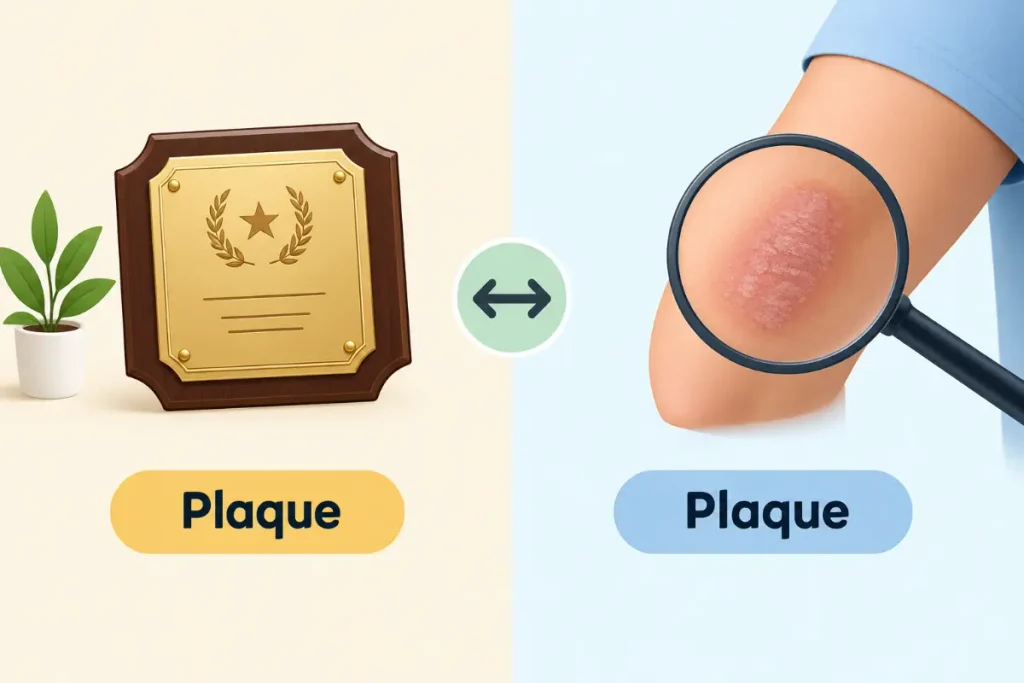
How Context Changes The Meaning
A useful way to understand the word is to look at the words around it.
Consider these examples.
- The plaque hangs on the wall.
- The plaque covers the surface of the tooth.
- The scan showed plaque in the artery.
- The first sentence clearly refers to a physical sign or tablet.
- The second refers to dental buildup.
- The third refers to a medical deposit.
- The noun stays the same. The surrounding words provide the meaning.
This is common in English. Many words have more than one meaning, and readers use context to figure out which meaning applies.
When To Use Plaque In Formal Writing
Use plaque whenever you need the standard spelling in formal or professional writing.
This includes essays, school papers, news articles, medical documents, business reports, websites, and public information.
For example.
- The organization installed a plaque to recognize the volunteers.
- The dentist explained the effects of plaque on oral health.
- The historic site features a plaque describing the building’s past.
- The report discusses the effects of arterial plaque.
These sentences are clear and natural.
The incorrect spelling can distract readers, especially in professional writing.
When A Dictionary Check Helps
Even strong writers sometimes need to check a word.
That’s normal.
If you suddenly wonder about the spelling, look it up instead of trusting what feels familiar.
A dictionary will show the standard form as plaque.
This is especially useful when working with words that contain silent letters or unusual combinations.
A quick check can prevent a small spelling mistake from appearing in an otherwise polished piece of writing.
For editors, the same habit matters.
Never assume a familiar looking spelling is correct simply because you’ve seen it before. Check the accepted form when something looks uncertain.
Is Placque Ever Correct
For the ordinary English word discussed in this article, placque is not the standard spelling.
There may be rare cases where an unusual spelling appears as part of a proper name, brand, historical record, or other specific name. Proper names can follow their own spelling conventions.
That does not make placque the normal spelling of the English noun.
If you’re writing your own sentence and mean a memorial tablet, dental film, or medical deposit, use plaque.
That is the form your readers will expect.
A Few Fast Examples
If you want a quick reference, keep these examples in mind.
- Correct.
- The museum placed a plaque near the entrance.
- Correct.
- The dentist removed plaque from my teeth.
- Correct.
- The award came with a wooden plaque.
- Correct.
- The doctor explained the risks linked to arterial plaque.
- Incorrect.
- The museum placed a placque near the entrance.
- Incorrect.
- The dentist removed placque from my teeth.
The difference is just one letter, but only the first spelling is standard.
How To Avoid The Mistake
The best method is simple repetition.
Write plaque several times.
Read it in context.
Connect it with the idea of a tablet, dental buildup, or medical deposit.
You can also remember that the word ends in que.
If you see yourself writing placque, stop and remove the extra c.
That tiny check can save you from repeating the mistake.
Another useful habit is to use spelling tools during editing. A good spell checker will usually flag placque because it is not the standard spelling of the common word.
Still, don’t rely only on software.
Spell checkers can miss errors when a wrong word looks like a real word. Human attention still matters.
Why Correct Spelling Matters
A single spelling mistake rarely destroys the meaning of a sentence.
Most readers will understand what you mean.
Still, correct spelling matters because it builds trust.
Imagine reading a medical article that repeatedly spells plaque incorrectly. You might start questioning the rest of the article even if the medical information is accurate.
The same thing can happen with a business website, school paper, or professional report.
Good spelling tells readers that the writer paid attention.
It also makes reading easier.
When readers recognize familiar words in their standard form, they can move through the text without stopping.
That is especially important for online writing.
Clear writing should feel easy to read. Correct spelling supports that goal.
FAQs
Is plaque the correct spelling
Yes. Plaque is the standard spelling in English. Placque is generally considered a misspelling of the common word.
What is the difference between placque vs plaque?
The difference is spelling only. Plaque is the correct standard form, while placque contains an extra c and should normally be avoided.
How do you spell plaque correctly?
Spell it P L A Q U E. The word has six letters and ends with que.
How do you pronounce plaque?
Plaque is usually pronounced like plak. It has one syllable, and the ending que does not create a separate sound.
Is plaque used for teeth?
Yes. Dental plaque is a sticky film that forms on the teeth. Regular brushing and flossing help remove it.
Can plaque mean an award?
Yes. A plaque can be an award given to recognize an achievement, service, participation, or another accomplishment.
Can plaque refer to a medical condition?
Plaque can refer to a deposit that forms in body tissue. The term appears in medical discussions about areas such as arteries and the brain.
Why do people spell plaque as placque?
The incorrect spelling is easy to create because the word has an unusual letter pattern. The extra c can seem natural even though it does not belong in the standard spelling.
Conclusion
The answer to placque vs plaque is straightforward. Plaque is the correct standard spelling. Use it for a commemorative tablet, an award, dental buildup, or certain medical deposits.
The incorrect form adds an unnecessary c. That extra letter doesn’t change the basic meaning, but it does make the word nonstandard in ordinary English writing.
The easiest way to remember the correct form is to think of plaque as ending in que. Picture a bronze plaque on a historic building or a dentist talking about dental plaque. Both images use the same spelling.
So the next time you pause over this word, choose plaque. Keep the extra c out, and your sentence will be ready to go.

Dr. Arthur Pendelton is a veteran historical linguist and grammar expert with over 30 years of experience in academic editing. A retired professor, Arthur specializes in the etymology and evolution of the English language. He is passionate about “unpacking the history behind the rules,” helping readers understand why we spell, punctuate, and phrase things the way we do today. Whether he’s settling debates on archaic usage or explaining complex linguistic shifts, Dr. Pendelton brings scholarly precision to every article.
1 thought on “Placque vs Plaque Which Spelling Is Correct”