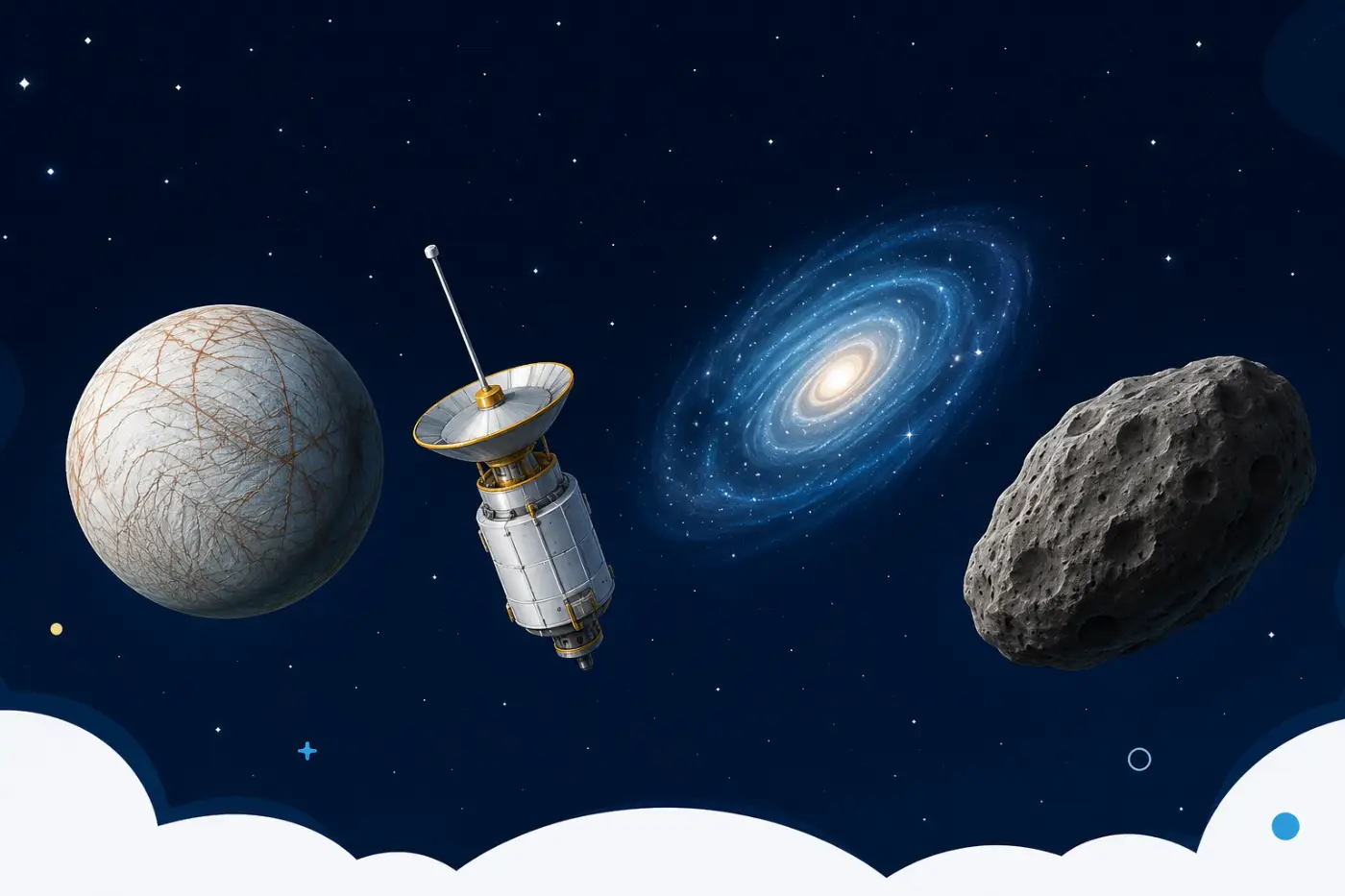
If you need space words that start with i, you have more choices than you might expect. Some describe objects in space, while others explain motion, light, matter, or places beyond Earth. Common examples include ice, icy, impact crater, infrared, ion, ionosphere, interplanetary, and interstellar.
The tricky part is knowing which words truly belong to space vocabulary. A word like ice is a normal everyday word, but it also has a strong connection to comets, moons, and planets. A term like interstellar is much more specific because it describes the space between stars.
This guide gives you a useful list of space terms beginning with the letter I. You will find simple meanings, natural example sentences, and explanations that show how each word fits into astronomy and space science.
You will also learn the difference between related terms such as interplanetary and interstellar. By the end, you should be able to choose the right word for a school project, vocabulary list, science activity, crossword puzzle, or creative writing task.
Quick Definition
Space words that start with i are words and phrases beginning with the letter I that relate to outer space, astronomy, planets, stars, spacecraft, or space science. They can describe objects, locations, processes, forms of matter, types of radiation, or scientific ideas.
Direct Answer
Some useful space words beginning with I include ice, icy, impact crater, infrared, ion, ionosphere, interplanetary, interstellar, asteroid inclination, and irradiation. The best choice depends on the part of space you want to describe.
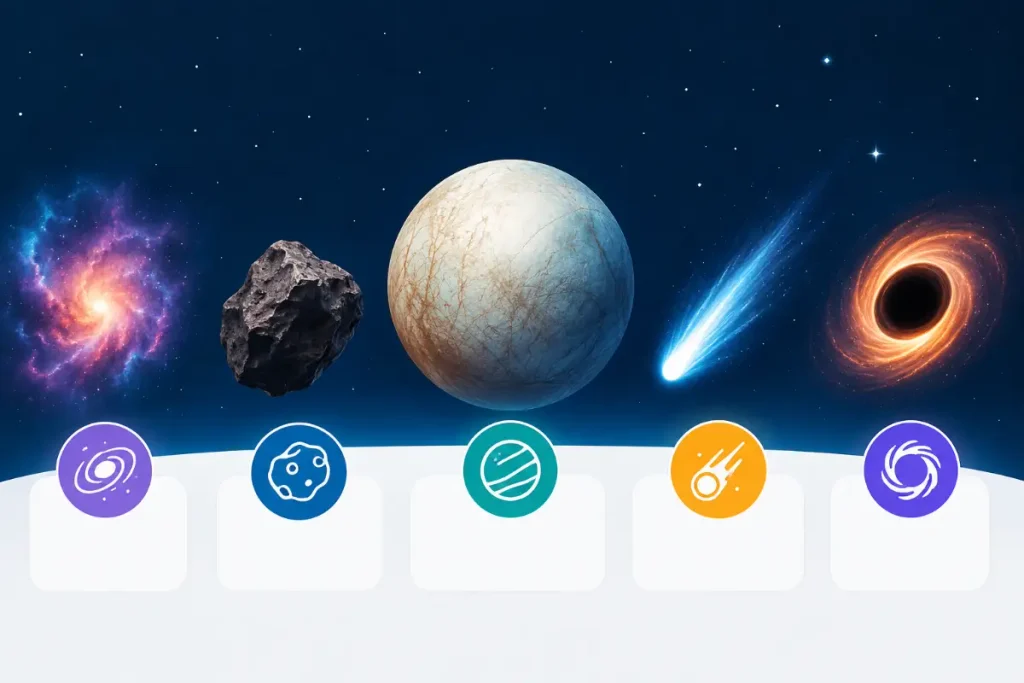
Space Terms Beginning With I
The letter I gives you a surprisingly useful group of astronomy terms. Many of these words come from scientific language, so their meanings can seem difficult at first.
Once you connect each term to a simple idea, they become much easier to remember.
Ice
Ice is frozen water. In space science, ice appears on planets, moons, comets, and other bodies.
Scientists have found evidence of water ice in many parts of the solar system. Some icy moons may even have oceans beneath their frozen surfaces.
For example, Jupiter’s moon Europa has a thick outer layer of ice. Scientists think a large ocean may exist below that surface.
Example sentence.
Europa has a thick layer of ice covering much of its surface.
Ice also plays a major role in comets. A comet can contain frozen water along with dust and other materials. When a comet travels close to the Sun, heat can cause some of its frozen material to turn into gas.
That process helps create the glowing coma and tail that make comets easy to recognize.
Icy
Icy means covered with ice or made partly from frozen material.
Astronomers often use this word when describing distant moons, comets, dwarf planets, and other cold objects.
Example sentence.
Scientists study icy moons to learn more about possible oceans beneath their surfaces.
Icy is especially useful when you need an adjective instead of a noun. You can say icy moon, icy surface, or icy body.
The word is simple, but it connects to an important part of planetary science. Many distant objects in our solar system contain large amounts of frozen water and other volatile materials.
Impact Crater
An impact crater is a hole or depression created when an object from space strikes a larger body.
Asteroids, comets, and smaller pieces of rock can hit planets and moons at very high speeds. The collision can release enormous amounts of energy.
The Moon has many impact craters because it has little atmosphere and no active surface processes like those found on Earth. Old craters can remain visible for millions or even billions of years.
Example sentence.
The Moon’s surface is covered with impact craters of many sizes.
Earth also has impact craters. Some have been hidden by erosion, plants, oceans, buildings, or other changes to the surface.
Impact craters help scientists study the history of planets and moons. Their size, shape, and age can reveal information about past collisions.
Infrared
Infrared is a type of electromagnetic radiation with wavelengths longer than visible red light.
Human eyes cannot see infrared light. Scientists can still detect it with special instruments.
Infrared astronomy is extremely useful because many objects in space release infrared radiation. Cool clouds of gas and dust can glow strongly in infrared wavelengths. Infrared observations can also help scientists study young stars and planets.
Example sentence.
An infrared telescope can reveal objects hidden behind clouds of cosmic dust.
The James Webb Space Telescope is famous for its ability to observe infrared light. This allows astronomers to study distant galaxies, stars, planets, and other objects.
If you need one strong science term beginning with I, infrared is an excellent choice.
Ion
An ion is an atom or molecule that has an electric charge because it has gained or lost one or more electrons.
Ions are common in space. They can exist in stars, planetary atmospheres, solar wind, and clouds of gas.
Example sentence.
The solar wind carries charged particles and ions away from the Sun.
The Sun produces huge amounts of ionized material. This material flows outward through the solar system as the solar wind.
Ions also matter when scientists study magnetic fields and plasma. Much of the visible matter in stars exists as plasma, which contains free electrons and ions.
Ionosphere
The ionosphere is a region of Earth’s upper atmosphere that contains many charged particles.
It begins high above the surface and extends through several layers of the atmosphere. Its exact boundaries change because solar activity affects it.
Example sentence.
Solar activity can change conditions in Earth’s ionosphere.
The ionosphere matters to both Earth science and space science. It can affect radio signals, satellite communication, and navigation systems.
The Sun constantly sends energy toward Earth. Strong solar events can disturb the ionosphere and create effects known as space weather.
Interplanetary
Interplanetary means existing or happening between planets.
The word often appears in discussions about spacecraft, dust, gas, and particles moving through our solar system.
Example sentence.
The spacecraft traveled through interplanetary space on its journey to another planet.
Interplanetary space is not completely empty. It contains dust, charged particles, magnetic fields, and extremely thin gas.
The term is useful because it describes the region between planets rather than the space between stars.
Interstellar
Interstellar means existing or happening between stars.
The word comes from the idea of inter meaning between and stellar meaning related to stars.
Example sentence.
The probe entered a region of interstellar space beyond the main influence of the solar wind.
Interstellar space is the huge region between stars. It contains extremely thin gas, dust, radiation, magnetic fields, and other material.
This word is often confused with interplanetary. The difference is simple. Interplanetary describes space between planets. Interstellar describes space between stars.
Interstellar Medium
The interstellar medium is the material found between stars.
It contains gas, dust, charged particles, magnetic fields, and other forms of matter and energy.
Example sentence.
Stars form from dense regions inside the interstellar medium.
Most of the interstellar medium is extremely thin. Still, some regions can become dense enough for gravity to pull material together and begin the process of star formation.
This term is especially useful for astronomy projects because it connects stars, gas clouds, dust, and the larger structure of galaxies.
Inclination
Inclination describes the tilt of an orbit compared with a chosen reference plane.
Astronomers use orbital inclination to describe how an object’s orbit is positioned in space.
Example sentence.
- Scientists measured the inclination of the planet’s orbit around its star.
- Earth’s orbit around the Sun is used as an important reference plane in many solar system calculations.
- Inclination can also help scientists understand how planets, moons, asteroids, and spacecraft move through space.
Inertia
Inertia is the tendency of an object to resist changes in its motion.
It is one of the basic ideas behind classical physics. An object at rest tends to stay at rest, while an object moving in a straight line tends to keep moving in that direction unless a force changes its motion.
Example sentence.
A spacecraft continues moving through space because of its inertia.
Spacecraft still need engines for many parts of a mission. They may use engines to change speed, direction, or orbit. Once they are moving, though, they do not need to keep firing their engines simply to continue moving.
Inertia helps explain why spacecraft can travel enormous distances while using carefully planned bursts of thrust.
Inertial Frame
An inertial frame is a reference frame in which an object with no net force keeps moving at a constant speed in a straight line.
That idea sounds technical, but the basic concept is simple. Scientists need a stable way to describe motion.
Example sentence.
Astronomers can use an inertial frame to study the motion of a spacecraft.
The term appears often in physics and orbital mechanics. It helps scientists describe how objects move without adding unnecessary effects caused by an accelerating reference frame.
Irradiation
Irradiation means exposure to radiation.
In space science, irradiation can describe how planets, moons, spacecraft, or other materials receive energy from sources such as the Sun or cosmic radiation.
Example sentence.
- Long term irradiation can change the surface of an airless moon.
- Radiation can affect materials in space. It can also change the chemistry of surfaces and ice.
- This makes irradiation useful when discussing the harsh environment around planets and moons.
Isotope
An isotope is a form of an element that has the same number of protons as other atoms of that element but a different number of neutrons.
Isotopes appear throughout astronomy.
Example sentence.
Scientists can use isotopes to study the history of material found in meteorites.
Some isotopes are stable. Others are radioactive and change over time.
Astronomers and planetary scientists use isotopes to study stars, meteorites, planets, and the early history of the solar system.
Io
Io is one of Jupiter’s four large Galilean moons.
It is famous for its intense volcanic activity. Io has hundreds of volcanoes and is one of the most volcanically active worlds known to science.
Example sentence.
Io has powerful volcanoes driven by tidal forces from Jupiter and other moons.
Io is an excellent example of how a space word beginning with I can also be the proper name of a specific world.
Its volcanic activity comes largely from tidal heating. Jupiter’s strong gravity pulls on Io while the other large moons affect its orbit. These forces create internal heat.
ISRO
ISRO is the Indian Space Research Organisation.
It is India’s national space agency and has worked on launch vehicles, satellites, lunar missions, planetary exploration, and other space programs.
Example sentence.
ISRO has sent spacecraft to study the Moon and Mars.
This term may be useful in a space vocabulary list that includes organizations as well as scientific terms.
ISS
ISS stands for the International Space Station.
The ISS is a large research station that orbits Earth. Astronauts from different countries have lived and worked aboard the station.
Example sentence.
Astronauts conduct scientific experiments aboard the ISS.
The station provides a unique laboratory because experiments can be performed in microgravity.
If your assignment allows abbreviations and proper names, ISS is one of the most recognizable space terms beginning with I.
Understanding The Main Differences
Some space terms beginning with I look or sound similar. That can make them easy to mix up.
The good news is that most of these differences follow a simple pattern.
Interplanetary And Interstellar
Interplanetary means between planets.
Interstellar means between stars.
Example sentence.
A spacecraft traveling from Earth to Mars moves through interplanetary space.
Example sentence.
A spacecraft traveling beyond our solar system can eventually enter interstellar space.
Think of planet and star as the key words. If the subject involves planets, use interplanetary. If it involves stars, use interstellar.
Ice And Icy
- Ice is a noun.
- Icy is an adjective.
You can say that a moon contains ice. You can also say that the moon has an icy surface.
Example sentence.
The spacecraft detected ice beneath the surface.
Example sentence.
The spacecraft studied an icy moon.
The difference is small but useful. If you are naming the frozen material, use ice. If you are describing something covered with or made from ice, use icy.
Ion And Ionosphere
An ion is a charged atom or molecule.
The ionosphere is a region of Earth’s upper atmosphere that contains many charged particles.
Example sentence.
An ion carries an electric charge.
Example sentence.
The ionosphere can affect radio communication.
Remember that an ion is a particle. The ionosphere is a region of the atmosphere.
Inertia And Inclination
Inertia and inclination sound somewhat alike, but they describe completely different ideas.
Inclination deals with the tilt of an orbit.
Example sentence.
Inertia helps a spacecraft keep moving.
Example sentence.
Inclination describes the tilt of the spacecraft’s orbit.
If you are talking about motion staying the same, think inertia. If you are talking about an orbit’s tilt, think inclination.
Why These Terms Matter In Astronomy
Space vocabulary can seem like a pile of difficult science words. In reality, each term gives you a shortcut to a specific idea.
The word infrared points to a kind of light. Ion points to charged matter. Inclination points to orbital tilt. Interstellar points to the space between stars.
That precision matters.
Scientists need specific words because space is full of objects and processes that cannot be described clearly with everyday language alone.
For example, saying that a spacecraft is in space tells you very little. Saying that it is traveling through interplanetary space gives you a much clearer picture.
The same applies to planets and moons. Calling a moon cold is simple. Calling it an icy moon can tell you that frozen material plays an important role in its surface or structure.
Good vocabulary makes science easier to understand because it gives each idea a clear label.
Space Words That Start With I For Students
Students often need space vocabulary for science projects, classroom activities, word searches, or writing assignments.
The best words depend on the level of the assignment.
For a younger student, simple words such as ice, icy, Io, and ion may work well.
For a middle school science project, terms such as infrared, ionosphere, interplanetary, interstellar, and impact crater can add more detail.
A strong vocabulary list does not need to contain only difficult words. Simple words can be just as useful when they connect clearly to the topic.
For example, ice is easier to understand than interstellar medium, but it can lead to an interesting discussion about comets, icy moons, planetary surfaces, and the search for water beyond Earth.
Space Words That Start With I For Writing
Creative writers can also use these terms to make a space scene more vivid.
Instead of writing that a spaceship moved through empty space, you could describe it traveling through interplanetary darkness.
Instead of saying that a planet was cold, you could describe its icy surface.
The trick is to use technical terms only when they add meaning. A story does not become better just because it contains more science words.
A good term should help the reader picture the scene or understand what is happening.
For example.
- The probe crossed the icy plain beneath a pale orange sky.
- That sentence gives the reader a clear image without loading the scene with technical language.
- A more scientific sentence could be.
- The telescope detected infrared radiation coming from a cloud of cold dust.
- Both styles work. The right choice depends on your purpose.
Common Mistakes To Avoid
Space vocabulary has several easy traps.
Using Interstellar For Planets
- One common mistake is using interstellar when talking about travel between planets.
- A trip from Earth to Mars is interplanetary.
- A journey between stars is interstellar.
- This distinction is worth remembering because the two terms appear often in science writing.
Treating Ice And Icy As The Same Grammar Form
- Ice and icy are related but they do different jobs in a sentence.
- You can say a moon contains ice.
- You can say the moon has an icy surface.
- You cannot normally swap the two words without changing the sentence structure.
Confusing The Ionosphere With Outer Space
- The ionosphere is part of Earth’s upper atmosphere. It is not simply another name for outer space.
- It reaches high above Earth and interacts with solar radiation and charged particles.
- Scientists study it because it affects communication, satellites, and space weather.
Using ISS Without Explaining It
- ISS is widely known in space science, but some readers may not recognize the abbreviation.
- If your audience is unfamiliar with it, write International Space Station first. Then use ISS later.
- This small step makes your writing easier to follow.
Using Technical Words Without Context
Words such as inclination and irradiation can sound impressive, but they do not help much if the reader cannot understand them.
Give the term a plain explanation the first time you use it.
For example.
Orbital inclination describes how much an orbit is tilted compared with a reference plane.
That sentence gives the reader enough information to keep going.
A Simple Way To Remember These Words
You do not need to memorize every term at once.
Group them by idea.
- Think about frozen material when you see ice and icy.
- Think about collisions when you see impact crater.
- Think about light when you see infrared.
- Think about charged particles when you see ion and ionosphere.
- Think about planets when you see interplanetary.
- Think about stars when you see interstellar.
- Think about motion when you see inertia.
- Think about orbital tilt when you see inclination.
- Think about Jupiter when you see Io.
- Think about research in orbit when you see ISS.
This method works better than memorizing a long list because each word has a mental hook.
A Useful List Of I Space Terms
Here is a quick reference for the main terms covered in this guide.
| Word or phrase | Simple meaning | Example sentence | Best use |
|---|---|---|---|
| Ice | Frozen water or other frozen material | Europa may contain large amounts of ice. | Planets and moons |
| Icy | Covered with or containing ice | The moon has an icy surface. | Descriptions |
| Impact crater | A depression made by a space collision | The Moon has many impact craters. | Planetary science |
| Infrared | Radiation beyond visible red light | The telescope detected infrared light. | Astronomy |
| Ion | A charged atom or molecule | The solar wind contains ions. | Space physics |
| Ionosphere | A charged region of Earth’s upper atmosphere | Solar activity can disturb the ionosphere. | Earth and space science |
| Interplanetary | Between planets | The probe traveled through interplanetary space. | Solar system studies |
| Interstellar | Between stars | The craft entered interstellar space. | Deep space |
| Interstellar medium | Matter between stars | Stars can form from dense clouds in the interstellar medium. | Astronomy |
| Inclination | The tilt of an orbit | Scientists measured the orbit’s inclination. | Orbital science |
| Inertia | Resistance to changes in motion | Inertia helps a spacecraft continue moving. | Physics |
| Inertial frame | A reference frame used to describe motion without acceleration effects | The orbit was modeled in an inertial frame. | Physics |
| Irradiation | Exposure to radiation | Irradiation can alter an icy surface. | Space environment |
| Isotope | A form of an element with a different neutron count | Scientists studied isotopes in a meteorite. | Planetary science |
| Io | A volcanic moon of Jupiter | Io has many active volcanoes. | Solar system |
| ISRO | India’s national space agency | ISRO has launched several planetary missions. | Space exploration |
| ISS | International Space Station | Astronauts perform research on the ISS. | Human spaceflight |
This list gives you both everyday and advanced choices.
If you only need a few easy words, choose ice, icy, ion, Io, and ISS.
If you need stronger science vocabulary, choose infrared, ionosphere, inclination, interplanetary, and interstellar.
How To Choose The Right Word
Start by asking what you want the word to describe.
- If you are describing frozen material, choose ice.
- If you are describing something frozen, choose icy.
- If you are describing a collision, choose impact crater.
- If you are describing a type of radiation, choose infrared.
- If you are describing a charged particle, choose ion.
- If you are describing Earth’s charged upper atmosphere, choose ionosphere.
- If you are describing the region between planets, choose interplanetary.
- If you are describing the region between stars, choose interstellar.
- If you are describing orbital tilt, choose inclination.
- If you are describing resistance to changes in motion, choose inertia.
- If you are describing a volcanic moon of Jupiter, choose Io.
This simple approach can help you avoid most vocabulary mistakes.
How These Words Appear In Real Sentences
Seeing a word inside a normal sentence can make its meaning easier to remember.
- The comet contains ice that can turn into gas as it approaches the Sun.
- The spacecraft landed on an icy surface.
- The Moon has countless impact craters.
- The telescope used infrared observations to study distant objects.
- The solar wind carries ions through the solar system.
- Changes in solar activity can affect the ionosphere.
- The spacecraft spent years traveling through interplanetary space.
- The probe eventually crossed into interstellar space.
- Dense clouds in the interstellar medium can give birth to stars.
- The researchers calculated the inclination of the orbit.
- Inertia allows a moving spacecraft to keep traveling without constant engine thrust.
- Radiation can cause irradiation damage to materials exposed to space for long periods.
- Scientists can compare isotopes in meteorites to study ancient material.
- Io is famous for its powerful volcanic activity.
- The ISS serves as a laboratory in low Earth orbit.
Notice how each sentence gives the word a clear job. That is a better way to learn vocabulary than memorizing definitions alone.
Choosing Terms For A School Assignment
If your teacher asks for words related to space that begin with I, you can create a balanced list.
Start with common words.
- Ice.
- Icy.
- Ion.
Then add more scientific terms.
- Infrared.
- Ionosphere.
- Interplanetary.
- Interstellar.
After that, include a few advanced choices if your assignment allows them.
- Inclination.
- Interstellar medium.
- Inertial frame.
- Irradiation.
- Isotope.
You can also include proper names and organizations such as Io, ISRO, and ISS if the assignment accepts names and abbreviations.
Always check the assignment rules before using abbreviations or proper nouns. Some word lists ask only for common nouns.
Why I Is A Useful Letter For Space Vocabulary
- The letter I connects to several major ideas in astronomy.
- It gives us terms about light, matter, motion, distance, and planetary science.
- Infrared helps scientists study light that human eyes cannot see.
- Ion and ionosphere help explain charged particles and Earth’s upper atmosphere.
- Interplanetary and interstellar describe huge regions of space.
- Inertia and inclination help explain motion.
- Ice connects to the search for water and the study of distant worlds.
- Io gives us a specific example of a fascinating moon.
- That range makes the letter I especially useful for science vocabulary.
FAQs
What are some space words that start with i?
Useful examples include ice, icy, impact crater, infrared, ion, ionosphere, interplanetary, interstellar, inclination, inertia, Io, and ISS. Each word connects to a different part of astronomy or space science.
What is an easy space word that starts with i?
Ice is one of the easiest choices. It connects to comets, moons, planets, and other objects in space.
What is an astronomy word that starts with i?
Infrared is a strong astronomy term beginning with I. It describes a type of electromagnetic radiation that astronomers can detect with special instruments.
What is a space word that starts with i for kids?
Ice, icy, ion, and Io are simple choices. They are easy to say and can introduce children to ideas about planets, moons, and space matter.
Is interplanetary a space word?
Yes. Interplanetary describes something that exists or happens between planets. For example, a spacecraft traveling from Earth to Mars moves through interplanetary space.
Is interstellar the same as interplanetary?
No. Interplanetary means between planets, while interstellar means between stars. A trip from Earth to Mars is interplanetary, while travel from one star system toward another is interstellar.
What space word starts with i and describes light?
Infrared is the main choice. Infrared radiation has longer wavelengths than visible red light and is widely used in astronomy.
What space word starts with i and describes motion?
Inertia is a strong choice. It describes an object’s tendency to resist changes in its motion.
What is an I space word related to Jupiter?
Io is the clearest answer. Io is one of Jupiter’s large moons and is known for its intense volcanic activity.
Conclusion
The best space words that start with i depend on the idea you want to describe. Ice and icy work well for frozen worlds. Infrared works for radiation and astronomy. Ion and ionosphere relate to charged particles and Earth’s upper atmosphere.
For large scale space regions, interplanetary and interstellar are two of the most useful terms to remember. Interplanetary means between planets. Interstellar means between stars. That one distinction can prevent a common vocabulary mistake.
You also have more advanced choices such as inclination, inertia, interstellar medium, irradiation, and isotope. These terms can make a science project more precise, as long as you explain them in simple language.
For a quick vocabulary list, start with ice, icy, infrared, ion, Io, interplanetary, and interstellar. Then add more technical terms based on your assignment. The best word is not the fanciest one. It is the one that says exactly what you mean.
Meta Description: Explore space words that start with i with simple meanings, examples, science terms, and useful vocabulary for school and writing.

Dr. Arthur Pendelton is a veteran historical linguist and grammar expert with over 30 years of experience in academic editing. A retired professor, Arthur specializes in the etymology and evolution of the English language. He is passionate about “unpacking the history behind the rules,” helping readers understand why we spell, punctuate, and phrase things the way we do today. Whether he’s settling debates on archaic usage or explaining complex linguistic shifts, Dr. Pendelton brings scholarly precision to every article.
1 thought on “Space Words That Start With I 35 Words to Know”