
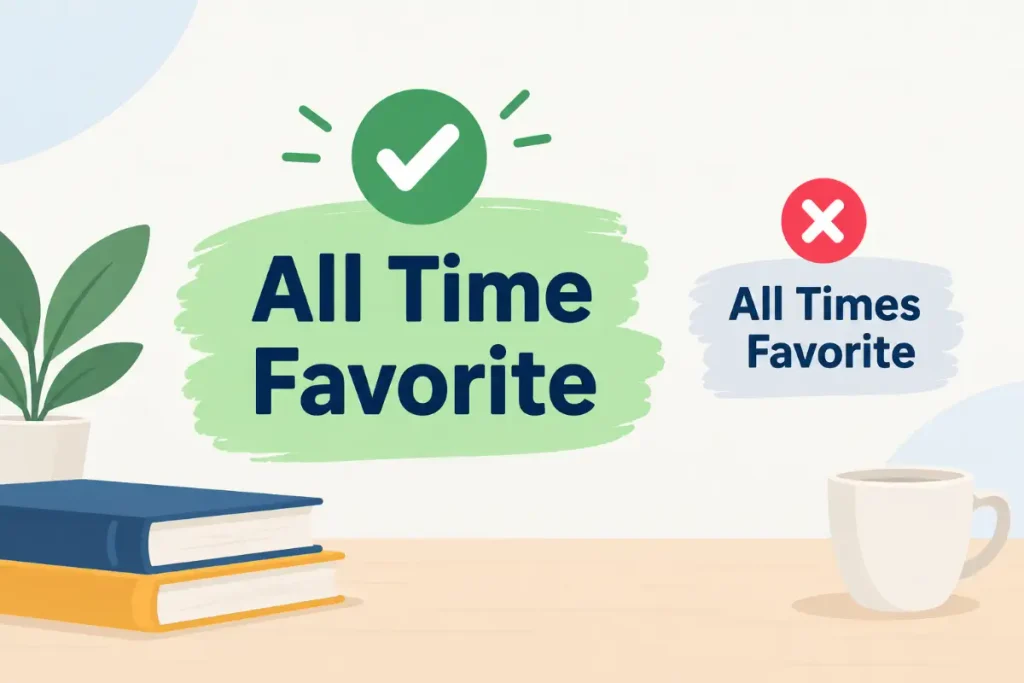
If you’re wondering about all-time favorite or all-times favorite, the correct phrase is all-time favorite. The word all-time works as a compound adjective before favorite, so it describes something you have liked more than anything else over a period of time. All-times favorite is not the standard form.
This small spelling difference causes a surprising amount of confusion. The phrase sounds natural when spoken, so it can be hard to tell where the problem is when you see it written down. The key is understanding how all-time works as a fixed adjective.
In this guide, you’ll learn why all-time favorite is correct, why all-times favorite is wrong, and how to use the phrase naturally in everyday American English. You’ll also see clear examples, common mistakes, related expressions, and simple ways to remember the rule.
Quick Definition
All-time favorite means the favorite thing, person, place, song, movie, food, or experience someone has had over their entire experience or over a long period. The phrase treats all-time as one compound adjective, so time stays singular. All-times favorite is not the standard English expression.
Direct Answer
The correct phrase is all-time favorite. Use all-time with a singular time because the phrase means something has been a favorite across the whole period of time being considered.
All Time Favorite And All Times Favorite Compared
| Word or Phrase | Meaning | Example Sentence | When to Use It |
|---|---|---|---|
| All-time favorite | Your favorite across your whole experience or over a long period | This is my all-time favorite movie. | Use this standard phrase when naming a lasting favorite. |
| All-times favorite | Not a standard English expression | This is my all-times favorite movie. | Avoid this form in standard English. |
| Favorite | The thing you like best | Pizza is my favorite food. | Use it for a general or current preference. |
| Lifetime favorite | Something you have favored throughout your life | That song is a lifetime favorite. | Use it when the focus is specifically on your life. |
| Longtime favorite | Something that has been popular or favored for a long time | This restaurant is a longtime favorite. | Use it for a choice that has remained popular over time. |
Why All Time Favorite Is Correct
The main reason all-time favorite is correct comes down to the way the phrase is built.
The word all can describe a complete amount or period. In this expression, all-time means something connected with the whole period of time being considered. Together, all and time form a compound modifier before the noun favorite.
Think about this sentence.
This is my all-time favorite book.
The phrase all-time tells us how strong and lasting the preference is. It doesn’t mean that the book is your favorite during several separate times. It means that when you consider your experience as a whole, this book stands out as your favorite.
That distinction explains why times doesn’t belong in the standard phrase.
The plural form times usually refers to separate occasions or periods. For example, you might say:
I’ve visited that city several times.
Here, times means separate occasions. You visited the city more than once.
But all-time favorite has a different structure. It refers to the whole period rather than separate occasions. The singular form time is part of a fixed compound expression.
This is similar to other familiar expressions that use time in the singular.
You might say:
This is an all-time record.
You might also say:
She is one of the all-time great players.
In both cases, all-time works as a compound adjective.
The same pattern appears in all-time favorite.
What All Time Means In This Phrase
The phrase all-time means across the entire period being considered.
The period doesn’t always have to mean your entire life. Context decides the scope.
For example:
That was my all-time favorite summer vacation.
Here, the speaker may be thinking about all the vacations they’ve taken.
Now consider:
This is one of the team’s all-time best seasons.
The writer is talking about the team’s entire history.
The phrase can cover a person’s life, a company’s history, a team’s history, a music genre, or another defined period.
That’s why all-time has such a broad use.
It can describe something that has reached the highest level or become the strongest example within a complete period.
Why Times Does Not Work Here
The word times is simply the wrong form for this expression.
When you write all-times favorite, the plural noun suggests several separate times. That doesn’t match the intended meaning.
Compare these sentences.
I have watched that movie many times.
This sentence is correct. Times means separate occasions.
Now look at this sentence.
It is my all-time favorite movie.
This sentence is also correct. Time refers to the complete period used to judge your preference.
The two expressions contain similar words, but they perform different jobs.
That difference is easy to miss because English has many phrases where singular and plural forms change the meaning.
Consider longtime friend and many times.
He is my longtime friend.
I’ve spoken to him many times.
The first phrase describes the length of a relationship. The second counts separate occasions.
The same basic idea helps with all-time favorite.
All Time Works As One Modifier
One useful way to understand the phrase is to treat all-time as a single unit.
A compound adjective is made from two or more words that work together to describe a noun. In this case, all-time describes favorite.
You can see the relationship clearly here:
all-time + favorite
The phrase means your favorite across the whole period being considered.
Other examples follow the same pattern.
- all-time record
- all-time high
These expressions are common in English because all-time has a clear established meaning.
Once you recognize all-time as a compound modifier, the spelling becomes much easier to remember.
What Does All Time Favorite Mean
An all-time favorite is something you consider one of your strongest or most lasting favorites.
It could be almost anything.
- A movie can be an all-time favorite.
- A book can be an all-time favorite.
- A restaurant can be an all-time favorite.
- A song can be an all-time favorite.
- A vacation spot can be an all-time favorite.
Even a simple meal can earn that description.
For example:
Chocolate cake is one of my all-time favorites.
The speaker is saying that chocolate cake has remained among their favorite things over a broad period.
Notice that favorite can be singular or plural depending on the sentence.
You can say:
This is my all-time favorite song.
You can also say:
- These are my all-time favorite songs.
- The compound adjective all-time stays the same.
- The noun changes from singular to plural.
- That distinction matters.
Singular Favorite
Use all-time favorite when you are talking about one favorite thing.
For example:
This is my all-time favorite restaurant.
That was my all-time favorite vacation.
She is my all-time favorite actress.
This is his all-time favorite book.
Each sentence focuses on one item.
Plural Favorites
Use all-time favorites when you are talking about several favorite things.
For example:
These are my all-time favorite movies.
Those songs are among my all-time favorites.
Pasta and tacos are two of my all-time favorites.
The word favorites becomes plural because you are talking about more than one favorite.
The word time still remains singular.
That’s a useful rule to keep in mind.
You can have all-time favorite or all-time favorites.
You don’t normally change all-time to all-times.
All Time Favorite In Real Sentences
Seeing the phrase in natural sentences makes the pattern easier to understand.
Here are examples from different situations.
Talking About Movies
The Shawshank Redemption is one of my all-time favorite movies.
The speaker has a strong and lasting preference for the movie.
Talking About Music
This song is still one of my all-time favorites.
The word still suggests that the preference has lasted over time.
Talking About Food
My grandmother’s apple pie is my all-time favorite dessert.
The speaker considers that dessert the favorite among all the desserts they’ve experienced.
Talking About Books
That novel became one of my all-time favorite books.
The phrase suggests a strong preference that has lasted.
Talking About Places
San Diego is one of my all-time favorite cities.
The speaker is comparing it with many other cities they’ve experienced.
Talking About Sports
That was one of the all-time great games.
Here, all-time means the game ranks among the great games across the period being considered.
Talking About People
She’s one of my all-time favorite comedians.
The speaker is describing a lasting personal preference.
Talking About Experiences
That road trip was one of my all-time favorite vacations.
The speaker is comparing the trip with other vacations they’ve taken.
Each example follows the same basic pattern.
All-time describes the strength or lasting nature of the preference.
Common Mistakes With All Time Favorite
The most common mistake is adding s to time.
People sometimes write:
This is my all-times favorite song.
The standard form is:
This is my all-time favorite song.
The mistake often happens because people see all and assume the noun after it should be plural.
That idea works in many situations.
For example:
- All students must attend.
- All books were returned.
But all-time is a fixed compound expression. You can’t apply the normal plural rule to it.
The phrase has its own established structure.
That’s why all-time remains singular.
Mistake One
Writing All Times Favorite
This is the most common error.
Incorrect:
That is my all-times favorite song.
Correct:
That is my all-time favorite song.
The correct form uses time without s.
Mistake Two
Writing All Time Favorite Without The Hyphen
In ordinary sentence writing, the standard compound adjective is usually written all-time before a noun.
For example:
This is my all-time favorite movie.
The hyphen helps readers see that all-time works as one modifier.
However, you may sometimes see all time written without a hyphen in informal text or in other grammatical positions. Context matters.
For example:
It was the best movie of all time.
Here, all time comes after the noun phrase and doesn’t directly modify movie.
Compare the two structures.
- It is my all-time favorite movie.
- It is the best movie of all time.
- Both sentences are natural. Their grammar is slightly different.
- The first uses all-time as a compound modifier before favorite.
- The second uses of all time as a phrase after the superlative expression.
This difference explains why you shouldn’t automatically add or remove a hyphen based on the sound of the phrase.
Mistake Three
Confusing All Time With Every Time
All-time and every time don’t mean the same thing.
Consider:
This is my all-time favorite song.
The speaker is naming a lasting favorite.
Now consider:
I listen to this song every time I drive.
The speaker is describing a repeated action.
Every time means each occasion.
All-time means across the complete period being considered.
They may appear in the same conversation, but they serve different purposes.
For example:
This is my all-time favorite restaurant. I eat there every time I visit Chicago.
The first sentence describes a lasting preference.
The second describes repeated behavior.
All Time Favorite Vs Favorite
You don’t always need all-time.
Sometimes favorite is enough.
For example:
Pizza is my favorite food.
This sentence simply tells the reader your preferred food.
Now compare it with:
Pizza is my all-time favorite food.
The second sentence sounds stronger. It suggests that pizza has remained your top choice across your experience.
The difference is small but useful.
Favorite can describe a current preference.
All-time favorite usually emphasizes a long lasting or broad preference.
Imagine someone asks:
What’s your favorite movie?
You might answer:
My favorite movie is The Godfather.
If you want to emphasize that the choice has stood the test of time, you might say:
The Godfather is my all-time favorite movie.
The second answer carries more weight.
It suggests that the choice isn’t just based on what you like right now.
All Time Favorite Vs Longtime Favorite
These expressions look similar, but they don’t mean exactly the same thing.
All-time favorite means something ranks as a top favorite across a broad period.
Longtime favorite means something has been favored for a long time.
For example:
This is my all-time favorite restaurant.
The speaker is saying it is the favorite among all the restaurants they have considered.
Now look at:
This has been a longtime favorite restaurant.
The speaker is emphasizing how long the restaurant has been favored.
The distinction becomes clearer with a comparison.
You could have a longtime favorite that isn’t your all-time favorite.
For instance, maybe you’ve loved a local restaurant for twenty years. But after traveling widely, you might decide another restaurant is your all-time favorite.
The two expressions overlap, but they focus on different ideas.
All Time Favorite Vs Lifetime Favorite
Lifetime favorite is another useful expression.
A lifetime favorite is something you have loved or preferred throughout your life.
For example:
Jazz has been a lifetime favorite of mine.
This focuses strongly on the person’s life.
All-time favorite is broader.
It can refer to a favorite across someone’s life, but it can also refer to a different period.
For example:
That was the team’s all-time best season.
The phrase has nothing to do with one person’s lifetime.
It means the best season in the team’s history.
That’s why all-time is more flexible.
All Time Favorite Vs Best Of All Time
These expressions are related but not identical.
- All-time favorite usually describes personal preference.
- Best of all time usually describes a judgment about quality or achievement.
- Consider these examples.
- This is my all-time favorite movie.
- The statement is personal.
- Another person can have a completely different favorite.
Now consider:
Many fans consider it one of the best movies of all time.
That sentence makes a broader claim about quality. The judgment may come from critics, fans, rankings, awards, sales, or other measures.
You can also combine the ideas.
It isn’t necessarily the best movie of all time, but it’s my all-time favorite.
This sentence makes the distinction very clear.
Your favorite doesn’t have to be the objectively best thing in a category.
A personal favorite is about what you enjoy most.
When To Use All Time Favorite
Use all-time favorite when you want to describe a strong preference that stands out across a broad period.
It’s especially common in casual conversation, reviews, interviews, social media posts, and personal writing.
You might say:
- What’s your all-time favorite book?
- That’s one of my all-time favorite songs.
- This has become an all-time favorite in our family.
- She’s one of my all-time favorite actors.
The expression feels natural because English speakers use it often to describe lasting favorites.
It also works well when someone asks for a single choice from a large group.
For example:
What’s your all-time favorite dessert?
This question asks you to think beyond your current mood.
The speaker wants to know the dessert that stands out across your experience.
How To Remember The Correct Form
A simple memory trick can help.
Think of all-time as a single label.
Don’t think of it as all + times.
Think of it as:
all-time = across the whole period
Then attach it to the noun.
- all-time favorite
- all-time record
The word time stays singular in each expression.
Another trick is to remember the phrase of all time.
For example:
- one of the best songs of all time
- Now turn that idea into a modifier.
- an all-time favorite song
- The meaning is related.
The singular form time remains.
Why English Has This Pattern
English often combines words into compound adjectives.
These combinations don’t always follow the rules you might expect from ordinary nouns.
- Consider:
- full-time job
- part-time worker
- long-term plan
- short-term goal
- first-rate service
- high-quality product
These phrases contain words that work together as modifiers.
All-time follows the same basic idea.
The compound form gives the reader a compact way to understand the relationship between the words.
Instead of writing a longer explanation, English uses all-time to express the idea of something ranking across an entire period.
That’s why it appears so often in headlines, sports writing, entertainment reviews, and everyday speech.
Is All Time Favorite Always Personal
Not always.
The word favorite usually points to preference, so it often has a personal meaning.
For example:
- This is my all-time favorite album.
- That’s clearly personal.
But people can also talk about an all-time favorite among a group.
For example:
- The restaurant became a family all-time favorite.
- A more natural version would often be:
- The restaurant became one of our family’s all-time favorites.
- The second version makes the meaning clearer.
- Writers can also use the expression in reviews and discussions.
For example:
- This has become an all-time favorite among fans.
- That sentence describes a broad group preference.
Still, the phrase generally carries an element of personal or group liking rather than an objective measurement.
Can You Say All Time Favorites
Yes.
You can say all-time favorites when you mean several things that are among your strongest favorites.
For example:
- These are my all-time favorite books.
- Those are some of my all-time favorites.
- Pizza and tacos are two of my all-time favorites.
- Notice the structure.
- The adjective remains all-time.
- Only favorite becomes plural.
This is one of the easiest ways to avoid the common mistake.
Don’t change time when you make the noun plural.
- Correct:
- all-time favorite
- Correct:
- all-time favorites
- Incorrect:
- all-times favorite
- Incorrect:
- all-times favorites
The plural belongs to favorite, not time.

Can All Time Favorite Describe A Person
Yes.
You can use the phrase for a person you especially admire or enjoy.
For example:
- She is my all-time favorite singer.
- He is one of my all-time favorite writers.
- That actor is an all-time favorite in my family.
- The expression doesn’t mean the person is universally the best.
- It means the speaker places that person among their strongest personal favorites.
That’s an important distinction.
If you say:
- She is my all-time favorite singer.
- You’re talking about your own preference.
- You aren’t necessarily claiming that she is the greatest singer in history.
The phrase gives you room to express strong personal appreciation without making a universal claim.
Can You Use All Time Favorite In Formal Writing
Yes.
All-time favorite is a standard English expression and works in both casual and formal contexts.
Still, tone matters.
In a formal report, you might prefer more precise wording if you’re making an analytical point.
For example:
The novel has remained one of the author’s most popular works.
That sentence may fit a formal analysis better than:
The novel is my all-time favorite.
But there is nothing grammatically wrong with the phrase.
In an interview, review, essay, article, email, or personal statement, it can work perfectly well when the context calls for personal preference.
More Examples To Make The Rule Stick
The easiest way to master this expression is to see it used naturally in different settings.
Movies And Television
Friends is one of my all-time favorite shows.
That was one of my all-time favorite movie scenes.
This remains my all-time favorite comedy.
She played one of my all-time favorite characters.
Each sentence uses all-time before a noun.
Books And Writing
That novel is one of my all-time favorite books.
Shakespeare remains one of my all-time favorite writers.
This is an all-time favorite story in our family.
The same rule applies.
Food And Restaurants
Pizza is one of my all-time favorite foods.
That little cafe is an all-time favorite with local residents.
Her chocolate cake is my all-time favorite dessert.
Again, time stays singular.
Music
This album is one of my all-time favorites.
That’s still my all-time favorite song.
He is one of my all-time favorite musicians.
The noun can change from singular to plural. The compound adjective does not.
Sports
That match is one of my all-time favorite games.
He is one of my all-time favorite players.
That remains one of the all-time great performances.
Sports writing uses all-time frequently because people often compare records and achievements across long periods.
Everyday Life
That beach is one of my all-time favorite places.
Sunday mornings are among my all-time favorite times of the week.
That trip became one of my all-time favorite memories.
These examples show that the expression isn’t limited to entertainment.
Related Expressions Worth Knowing
Understanding nearby phrases can make the rule even clearer.
All Time High
All-time high means the highest level ever reached during the period being considered.
For example:
The stock reached an all-time high.
The word time remains singular.
All Time Low
All-time low means the lowest level ever reached.
For example:
The company reported an all-time low in sales.
Again, all-time stays unchanged.
All Time Record
All-time record refers to the highest or lowest recorded result across a period.
For example:
The athlete set an all-time record.
The phrase follows the same pattern as all-time favorite.
All Time Great
All-time great describes someone or something considered among the greatest across a broad period.
For example:
Many fans regard her as an all-time great.
This phrase also keeps time singular.
Seeing these expressions together makes the spelling pattern much easier to remember.
A Simple Grammar Test
If you’re unsure about the phrase, try replacing all-time with across the whole period.
Take this sentence:
This is my all-time favorite movie.
You can think of it as:
This is my favorite movie across the whole period I’ve considered.
The wording is longer, but the meaning becomes clear.
Now try the same test with all-times favorite.
This is my favorite movie across all separate times.
That doesn’t express the intended meaning.
The singular form makes sense because you’re referring to the complete period as one broad span.
This little mental test can help you catch the error when proofreading.
A Quick Editing Checklist
When you write this expression, check three things.
First, use all-time before the noun.
Second, keep time singular.
Third, make favorite singular or plural based on the number of things you’re describing.
For example:
- my all-time favorite movie
- One movie.
- my all-time favorite movies
- Several movies.
- two of my all-time favorites
- Several favorites.
- Avoid:
- my all-times favorite movie
- Avoid:
- my all-times favorite movies
The problem in both examples is the extra s in times.
The Easiest Rule To Remember
Think of all-time as a fixed compound adjective.
It describes something that stands out across a complete period.
That means you write:
all-time favorite
Not:
all-times favorite
The noun favorite can change to favorites when you are talking about more than one thing.
The word time doesn’t need to change.
Once you learn that pattern, the confusion disappears.
FAQs
Is all-time favorite correct?
Yes. All-time favorite is the standard expression. Use the singular time because all-time functions as a compound adjective.
Is all-times favorite correct?
No. All-times favorite isn’t the standard form in English. The correct expression is all-time favorite.
Should all-time favorite have a hyphen?
Yes, when all-time directly modifies a noun or noun phrase. For example, write my all-time favorite song.
Can I say all-time favorites?
Yes. Use all-time favorites when you mean several favorite things. The word favorites becomes plural, while all-time stays unchanged.
What does all-time favorite mean?
It means something you consider a top favorite across a broad period of time. It often describes a preference that has lasted or stands out from many other choices.
Is all-time favorite the same as best of all time?
No. All-time favorite usually expresses personal preference. Best of all time usually makes a broader claim about quality or achievement.
What is the difference between all-time favorite and longtime favorite?
An all-time favorite is a top favorite across a broad period. A longtime favorite is something you’ve favored for a long period. One describes ranking among favorites, while the other emphasizes duration.
Can all-time favorite refer to a movie?
Yes. You can say This is my all-time favorite movie when a movie stands out as your top personal choice across your experience.
Conclusion
The correct expression is all-time favorite. It describes something that ranks as a person’s strongest favorite across a broad period of time. The phrase can describe a movie, song, book, food, person, place, experience, or almost anything else someone can favor.
The incorrect form all-times favorite comes from treating times like an ordinary plural noun. In this expression, all-time works as a compound adjective, so time stays singular.
You can also use all-time favorites when talking about several things. In that form, favorite becomes plural while all-time stays the same.
When you’re proofreading your writing, remember one simple pattern: all-time stays together and time stays singular. That rule will keep your sentence natural and grammatically correct.

Dr. Arthur Pendelton is a veteran historical linguist and grammar expert with over 30 years of experience in academic editing. A retired professor, Arthur specializes in the etymology and evolution of the English language. He is passionate about “unpacking the history behind the rules,” helping readers understand why we spell, punctuate, and phrase things the way we do today. Whether he’s settling debates on archaic usage or explaining complex linguistic shifts, Dr. Pendelton brings scholarly precision to every article.