
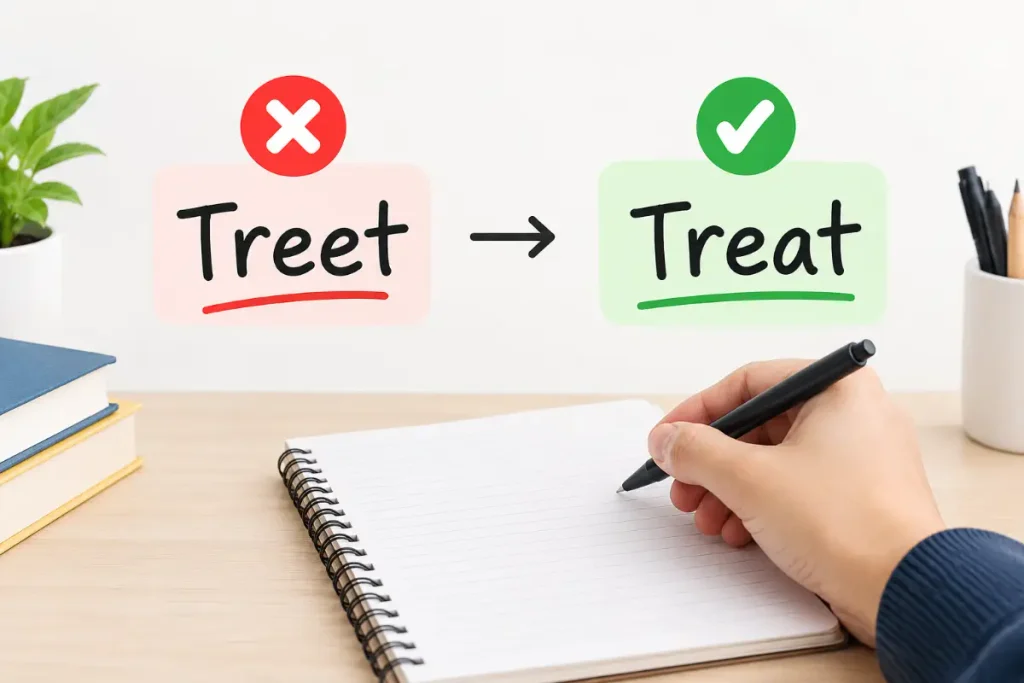
If you are searching for treet vs treat, you probably want one simple answer. The correct spelling in standard English is treat. Treet is generally not the standard spelling of this word. Cambridge Dictionary lists treat as both a noun and a verb with several common meanings.
The confusion is easy to understand. Treat is pronounced with a long e sound, so it can sound like it should be spelled treet. English spelling does not always match pronunciation in a neat one to one way. That is why this small spelling mistake can catch people off guard.
Treat is a useful word because it can do several jobs in a sentence. It can describe something enjoyable such as a piece of candy or a special experience. It can also mean to behave toward someone in a certain way. In other contexts it can mean to provide medical care or pay for something for another person.
This guide explains the difference clearly. You will see the correct spelling, the main meanings of treat, common examples, the reason treet looks tempting, easy memory tricks, and several related spelling mistakes. By the end, you should have no trouble choosing the right form.
Quick Definition
Treat is the standard English word. As a noun, it can mean something special or enjoyable. As a verb, it can mean to behave toward someone, provide care, pay for something, or handle something in a particular way.
Treet is not the standard spelling of this word in modern English. If you mean something enjoyable, a reward, medical care, or an action toward another person, use treat.
Direct Answer
The correct spelling is treat. Use treat in normal American English writing when you mean something enjoyable or when you mean to behave toward, care for, or pay for something for someone.
Comparison Table
| Word or Phrase | Meaning | Example Sentence | When to Use It |
|---|---|---|---|
| Treat | Something special or enjoyable | The ice cream was a nice treat. | Use it for a reward or enjoyable thing. |
| Treat | To behave toward someone in a certain way | Please treat everyone with respect. | Use it as a verb about behavior. |
| Treat | To provide medical care | Doctors treat sick patients. | Use it for illness or injury. |
| Treat | To pay for something for another person | Dinner is my treat. | Use it when offering to pay. |
| Treet | Not the standard spelling of treat | The dog got a treat. | Do not use treet for standard English. |

Why The Correct Spelling Is Treat
The easiest way to settle the question is to look at how the word works in real English.
Treat is an established English word with several meanings. Cambridge Dictionary gives both noun and verb definitions for it. As a verb, it can describe how someone behaves toward another person. It can also refer to medical care, payment, or a process used to change or protect a material. As a noun, it can describe something special or enjoyable.
For example, consider these sentences.
I bought myself a small treat.
The nurse treated the patient carefully.
Please treat your guests with respect.
The wood was treated to protect it from damage.
It is my treat tonight.
The word stays the same in each sentence. The meaning changes because the context changes.
That is one reason treat is worth learning as a complete word rather than memorizing only one definition.
What Does Treat Mean
Treat has several everyday meanings. Most are easy to understand once you see them in context.
Treat As A Noun
As a noun, treat can mean something special that gives pleasure.
A child might receive a treat after doing something helpful. A person might buy a favorite dessert as a treat after a long week. You can also call an enjoyable event or experience a treat.
Consider these examples.
The children received a treat after the game.
That concert was a real treat.
I saved the last cookie as a special treat.
The weekend trip was a wonderful treat.
In each sentence, treat refers to something enjoyable or special.
A treat does not have to be food. That is a common misunderstanding.
A slice of cake can be a treat. So can a movie. A relaxing afternoon can be a treat. A surprise visit from a close friend can also be a treat.
The basic idea is something pleasant that feels special.
Treat As A Verb
Treat can also work as a verb.
As a verb, it often describes how someone acts toward another person.
For example:
She treats everyone kindly.
He treated his employees with respect.
Please treat your guests well.
The teacher treats her students fairly.
In these examples, treat does not mean food or a reward. It means to behave toward someone in a particular way. Cambridge Dictionary gives this as one of the main verb meanings of treat.
This meaning appears in many common expressions.
Treat someone with respect.
Treat someone fairly.
The meaning depends on what follows the verb.
Treat In Medical English
Treat also has an important medical meaning.
Doctors treat illnesses. Nurses treat injuries. Hospitals treat patients. A medicine can be used to treat a condition.
For example:
The doctor treated his infection.
The hospital treats hundreds of patients each day.
The medicine can treat the symptoms.
The nurse treated the wound.
Here, treat means to provide medical care or take action to improve a health problem. Cambridge Dictionary includes this meaning in its American English entry.
This is another reason spelling the word correctly matters. A misspelling can make a sentence look careless even when the meaning is obvious.
Treat When Someone Pays
You may also hear someone say my treat.
This expression means that the speaker will pay for something.
For example:
Dinner is my treat.
Let me buy you coffee. It is my treat.
You paid last time. This time it is my treat.
In this use, treat refers to paying for another person as a kind gesture. Cambridge Dictionary lists this meaning as well.
This expression is common in everyday American English. You might hear it between friends, family members, or coworkers.
It can be a simple way to offer something without making the moment sound formal.
Treat For Materials And Objects
Treat does not only apply to people and experiences.
It can also describe putting a substance on something or using a process to protect or change it.
For example:
The company treated the wood with a protective coating.
The fabric was treated to make it more resistant to water.
The metal was treated to prevent damage.
In these sentences, treat means to process or handle a material in a particular way. Cambridge Dictionary includes this meaning for materials such as wood, cloth, and metal.
So the word has a much wider range than many learners first realize.
Why Treet Looks Like A Real Word
The spelling treet looks believable at first glance.
That happens because the pronunciation of treat can lead people toward the spelling they think they hear. Cambridge gives the pronunciation of treat as /triːt/.
When someone hears the word, they may connect the long e sound with words such as tree or green. From there, treet can seem like a logical spelling.
But English spelling often works differently from simple sound based spelling.
Think about words such as:
- Meet.
- Meat.
- Week.
- Weak.
- Sea.
- See.
These pairs show that the same sound can appear through different spelling patterns.
The reverse can happen too. The same letter combination can have different sounds in different words.
That is why spelling by sound alone can lead you into trouble.
Treat is one of those words that you need to remember in its standard written form.
The Simple Spelling Pattern To Remember
Look closely at the middle of treat.
T R E A T.
The word contains eat.
T R plus E A T gives you TREAT.
That makes a useful memory trick because many treats are things you eat.
Think of this sentence:
A treat can be something you eat.
The word eat sits right inside treat.
That connection makes the spelling easier to remember.
For example:
I bought a treat.
I bought something to eat.
Both ideas can connect in your memory.
The trick does not explain every meaning of treat. You can treat a patient or treat someone kindly without eating anything. Still, it is a quick way to remember the spelling when the word means a special food or reward.
Treat In Everyday Sentences
Seeing the word in natural sentences is one of the fastest ways to make the spelling stick.
Here are several examples.
The children got a sweet treat after dinner.
She bought herself a small treat at the bakery.
That movie was a real treat.
The dog gets a treat after each training session.
My parents treated us to dinner.
Please treat people with kindness.
The doctor treated the injury quickly.
We need to treat the problem seriously.
The wood was treated to protect it from moisture.
Tonight is my treat.
Notice how the meaning shifts from sentence to sentence.
In the first four examples, treat is a noun.
In the next six examples, treat is a verb or part of a common expression.
The spelling does not change.
That is the key point to remember.
Treet vs Treat In Standard English
For normal US English writing, use treat.
If you are writing an email, school assignment, article, social media post, text message, or professional document, treat is the form you want when you mean the standard English word.
Treet can appear in other contexts. For example, it may occur as a name, a brand name, a place name, or in historical or dialect material. That does not make it the standard spelling of the everyday English word treat. A word used as a proper name is different from a regular vocabulary word.
This distinction is useful because you may occasionally see treet somewhere online and wonder if dictionaries have missed a second spelling.
They have not.
Seeing an unusual spelling does not automatically mean that the spelling is accepted in standard English.
Names can be unusual. Company names can be unusual. Product names can be unusual. Historical texts can contain forms that are not part of modern standard English.
For everyday writing, the answer stays simple.
Use treat.
Why English Spelling Does Not Always Match Pronunciation
English spelling has many patterns that make sense once you learn them. It also has many patterns that need to be memorized.
Treat belongs to the second group for many learners.
The word is pronounced with the long e sound. That sound appears in many different spelling patterns.
Consider these examples:
- Tree.
- Free.
- Meet.
- Street.
- Piece.
- Receive.
These words do not all use the same letters to create the sound.
That is why listening carefully is not always enough to spell a word correctly.
You need to know the written form too.
The spelling treat uses ea.
T R E A T.
The spelling treet uses ee.
T R E E T.
Both may look possible if you are thinking mainly about sound. Only one is the normal written form for the word meaning a reward, special experience, care, or treatment.
This is a small example of a much larger fact about English.
Pronunciation can help with spelling, but it cannot always decide spelling.
Common Mistakes With Treat
People can make several mistakes around this word. Most are simple spelling or usage errors.
Writing Treet For A Reward
Incorrect:
I bought a treet for the kids.
Correct:
I bought a treat for the kids.
The second sentence uses the standard spelling.
Writing Treet In The Halloween Phrase
The familiar Halloween expression is trick or treat.
For example:
The children went door to door on Halloween.
They shouted trick or treat.
The spelling treat stays the same.
This phrase is so common that it can be a useful memory aid. If you remember trick or treat, you can also remember the spelling of the word.
Using Treat Only For Food
Some learners think treat must mean candy, cake, or another type of food.
That is too narrow.
A treat can be an enjoyable experience.
For example:
Seeing my old friends was a real treat.
The concert was a treat for music fans.
The weekend away was a special treat.
Treat can also work as a verb.
For example:
She treated me kindly.
The doctor treated the patient.
He treated the issue seriously.
So do not limit the word to desserts or snacks.
Confusing Treat With Treatment
Treat and treatment are related, but they do different jobs.
Treat is often a verb.
The doctor will treat the patient.
Treatment is a noun.
The patient received treatment.
Here is another example:
The doctor treated my injury.
The treatment helped me recover.
The first word describes the action. The second names the process or care.
Learning this difference can help you write more clearly in medical and professional contexts.
Treat And Treated
Another useful point is the verb forms.
The base form is treat.
The past tense is treated.
The present participle is treating.
The third person singular form is treats.
Examples include:
- I treat my guests well.
- She treats everyone fairly.
- The doctor treated the patient.
- They are treating the problem carefully.
- He has treated the issue seriously.
Notice the spelling pattern.
- Treat.
- Treated.
- Treating.
- Treats.
The core spelling stays connected to treat.
This can help reinforce the correct form in your memory.
Treat And Treats
Treat can be singular or plural when it works as a noun.
For example:
- The child received one treat.
- The children received several treats.
- We bought some treats for the party.
The dog loves its treats.
When treat works as a verb, treats can be the third person singular form.
For example:
- She treats everyone with respect.
- He treats his dog well.
- The doctor treats many patients.
Context tells you the grammatical role.
Treat And Treating
Treating is the form used with certain verb structures.
For example:
The doctor is treating the patient.
She is treating everyone fairly.
We are treating this issue as a priority.
The company is treating the wood with a protective substance.
The spelling still comes from treat.
You do not replace the ea with ee.
That gives you a simple pattern to remember.
- Treat.
- Treating.
- Not treet.
Treat And Treatment
These words often appear together.
Treat is a verb.
Treatment is a noun.
Compare these examples.
- The doctor will treat the infection.
- The treatment worked well.
- The hospital treats many patients.
- The patient received treatment.
- The words share the same basic spelling pattern.
This can help you remember the middle of treat. The letters ea remain visible in treatment too.
Treat And Treatable
Treatable is another related word.
It usually means that something can be treated.
For example:
- The condition is treatable.
- The infection is treatable with proper care.
- The doctor said the injury was treatable.
Again, the spelling begins with treat.
This gives you another useful spelling family.
- Treat.
- Treated.
- Treating.
- Treatment.
- Treatable.
Learning a group of related words can be easier than memorizing each word separately.
Treat And Retreat
Retreat contains the letters treat, but the meanings are different.
Retreat can mean to move back from a place or situation. It can also mean a period spent away from normal activities for rest or reflection.
For example:
- The soldiers began to retreat.
- She went on a weekend retreat.
- The word retreat is not simply another form of treat. It has its own meaning and history.
- Still, seeing treat inside retreat can help you recognize the spelling pattern.
The important point is that treat always keeps the ea spelling in this word family.
Treat And Street
Street is another word that may contribute to the spelling confusion.
Street has the long e sound and ends with eet.
Treat has the same general vowel sound but uses ea.
Compare them.
- Street.
- Treat.
- Meet.
- Great.
The sound does not tell you the exact spelling.
That is why it is better to remember treat as a whole word.
Treat And Threat
Treat and threat look similar, but their meanings are completely different.
Threat means a possible source of danger or harm.
Compare these sentences:
The nurse treated the patient.
The storm was a threat to the town.
The difference is only one letter in the middle, but the meanings are far apart.
This is a good reminder that one letter can change a word completely.
Treat And Tread
Treat and tread are also easy to mix up when writing quickly.
Tread can mean to walk on something or step on it.
For example:
Be careful not to tread on the flowers.
Treat has a different meaning.
Please treat the flowers gently.
These words may appear close on the page, but they are not interchangeable.
Treat And Great
Great is another word that shows why English spelling cannot always be predicted from sound.
Treat and great both contain ea.
Yet they have different vowel sounds.
Treat sounds like the vowel sound in meet.
Great has a different sound.
This is one more reason not to rely on a simple rule such as one spelling always equals one sound.
English has patterns, but it also has exceptions and older spelling choices.
Common Sentences Using Treat
The best way to become comfortable with a word is to see it in real situations.
Here are more natural examples.
Treat As Something Enjoyable
- The new restaurant was a real treat.
- The kids got a special treat after the game.
- Fresh strawberries are a summer treat.
- That quiet morning was a treat.
The vacation was an unexpected treat.
Treat As A Kind Action
- She treated me with respect.
- He treated everyone fairly.
- Please treat your guests kindly.
- The staff treated us very well.
Good leaders treat people with respect.
Treat As Medical Care
- The doctor treated the infection.
- The nurse treated the wound.
- The clinic treats minor injuries.
- The medicine is used to treat the condition.
- The doctors treated him for dehydration.
Treat As Payment
- Dinner is my treat.
- I will treat you to lunch.
- She treated her parents to a nice meal.
- Let me treat you to coffee.
He said the tickets were his treat.
Treat As A Process
- The wood was treated to prevent damage.
- The fabric was treated with a special substance.
- The material needs to be treated before use.
- The company treats the surface to make it more durable.
These examples show how flexible the word can be.
A Simple Memory Trick
Use the phrase TREAT has EAT inside it.
Look at the spelling.
T R E A T.
The letters EAT are right in the middle.
That can remind you of a treat you can eat.
For example:
- I bought a treat.
- I bought something to eat.
The connection is simple and easy to remember.
There is another trick that works for other meanings too.
Think of the A in treat as a small anchor.
If you are writing the common English word for a reward, special experience, care, or kind action, remember that A belongs in the middle.
Treat.
Not treet.
A Quick Spelling Test
Try completing these sentences.
- The dog received a ______ after sitting.
- The doctor will ______ the injury.
- Dinner is my ______ tonight.
- The concert was a real ______.
- The teacher asked us to ______ everyone fairly.
The correct answer is treat in every sentence.
That is because all five sentences use the standard word treat.
Now try the same test with treet.
The result sounds wrong in standard English writing.
That quick mental check can save you from the mistake.
How To Avoid This Error In Your Writing
If you often type treet by mistake, do not rely only on spellcheck.
Build a memory link instead.
Think of treat as a word containing eat.
When you type the word, pause for half a second if needed.
Ask yourself what you mean.
If you mean a reward, special experience, kind action, medical care, or payment, write treat.
You can also remember the phrase trick or treat.
That phrase appears often enough that it can become a strong visual memory.
Finally, learn the related forms.
- Treat.
- Treated.
- Treating.
- Treatment.
- Treatable.
Once the spelling becomes familiar, the extra e in treet will start to look strange.
Why Correct Spelling Matters
A spelling mistake does not always make a sentence impossible to understand. Readers can often guess what you mean from context.
Still, correct spelling matters.
Imagine writing this in a school assignment:
My favorite treet is chocolate cake.
The reader will probably understand the sentence. The spelling error is still obvious.
Now imagine writing:
Thank you for the birthday treet.
Again, the meaning is clear. But the wrong spelling can make the message look rushed.
The same problem can appear in a professional email, website, application, article, or social media post.
Good spelling helps your writing feel clear and polished.
You do not need complicated words to sound educated. You need the right words spelled correctly.
When Treet Can Appear
There is one useful detail to keep in mind.
Treet can appear in contexts where it is a name or another special form. It has also appeared in historical and dialect material. That does not make it the standard modern spelling of treat.
This distinction matters because English contains many proper names that look unusual.
- A business might choose a creative spelling.
- A product might use a modified spelling.
- A family name might have an uncommon spelling.
- A place can also have a name that looks like an ordinary English word.
You should not change an official name simply because it does not follow ordinary spelling rules.
For normal writing, though, use treat when you mean the common English word.
What To Use In School Writing
In school writing, use treat.
For example:
- The puppy received a treat.
- The story was a real treat to read.
- The doctor treated the patient.
- The teacher treated everyone fairly.
- Avoid using treet as a spelling variation.
Teachers expect standard English spelling in essays, assignments, tests, and other formal work.
The same advice applies to college writing and most professional communication.
What To Use In Professional Writing
Professional writing should also use treat.
For example:
- The medication is used to treat the condition.
- The company treated the issue as a priority.
- The wood was treated before installation.
- The dinner was my treat.
- The event was a special treat for our customers.
- The right spelling keeps the message clear.
It also prevents readers from stopping to wonder if you meant something else.
What To Use In Casual Messages
Casual writing still benefits from correct spelling.
- You might text a friend:
- Dinner is my treat.
- That is simple and natural.
- You might also say:
- The movie was such a treat.
Or:
I bought the kids a little treat.
There is no need to use a different spelling just because the message is casual.
Treat works in both informal and formal settings.
Is Treat Always About Something Good
Not always.
When treat is a noun, it often refers to something pleasant.
But when treat is a verb, it can have neutral or negative meanings.
For example:
- He treated me badly.
- The company treated the complaint seriously.
- The doctor treated the injury.
- These sentences do not describe a reward.
- They describe an action or manner of handling someone or something.
- This is an important part of understanding the word.
- The meaning comes from context.
Does Treat Mean Give
Sometimes.
When you say I will treat you to lunch, treat means you will pay for or provide the lunch.
But treat does not always mean give.
Consider:
She treated me kindly.
Here, treat means she behaved kindly toward me.
Now consider:
The doctor treated the patient.
Here, treat means the doctor provided medical care.
So it is better to learn the different meanings instead of trying to replace treat with one single synonym.
Does Treat Mean Reward
Sometimes.
A treat can be a reward.
For example:
The dog received a treat for following the command.
The child earned a special treat.
But treat can also describe something that is simply enjoyable.
For example:
The concert was a treat.
Nobody necessarily earned the concert as a reward. The speaker simply found it enjoyable.
That small difference can help you understand the word more naturally.
Does Treat Work With People And Things
Yes.
- You can treat people in certain ways.
- She treated her guests kindly.
- You can treat illnesses.
- The doctor treated the infection.
- You can treat materials.
- The factory treated the metal.
- You can also treat ideas or situations in a certain way.
- We should treat the issue seriously.
- The writer treated the subject with care.
This wide range of uses makes treat a common and useful English word.
A Short Rule To Remember
If you need the standard English word for something special, enjoyable, caring, medical, or handled in a particular way, think of treat.
Remember the letters.
T R E A T.
The middle contains EAT.
That small trick can help you avoid writing treet.
If you are writing a name or a title that officially uses Treet, keep the official spelling. Names follow their own rules.
For ordinary English vocabulary, stick with treat.
FAQs
Is treet vs treat a spelling question?
Yes. In standard modern US English, treat is the normal spelling for the word. Treet is generally not used as the standard spelling of that word.
Is treet a real English word?
Treet is not a standard modern English word for the meanings normally associated with treat. It can appear as a name or in historical and dialect sources, so its appearance does not always mean that someone made a spelling mistake.
What is the correct spelling of treat?
The correct spelling is T R E A T. The word treat can be a noun or a verb and has several common meanings in English.
What does treat mean?
As a noun, treat can mean something special or enjoyable. As a verb, it can mean to behave toward someone, provide medical care, pay for something, or process a material.
Is treat a noun or a verb?
Treat can be both. In The cake was a treat, it is a noun. In The doctor will treat the patient, it is a verb.
Why do people spell treat as treet?
The mistake often comes from pronunciation. Treat is pronounced with a long e sound, so someone may spell it based on the sound they hear instead of remembering the standard ea spelling.
Is my treat correct English?
Yes. My treat is a common expression meaning that the speaker will pay for something. For example, you can say Dinner is my treat when you want to tell someone that you will pay.
Is treat used for food only?
No. A treat can be food, but it can also be an enjoyable experience or something special. The verb treat has several other meanings related to behavior, medical care, payment, and processing.
Conclusion
The answer to the spelling question is simple. Treat is the standard English word. Treet is not the normal spelling when you mean something special or enjoyable, an action toward someone, medical care, payment, or the processing of a material.
The easiest way to remember the spelling is to notice that treat contains eat. T R plus E A T gives you TREAT. This is especially useful when treat means a food or reward.
Treat is also much more flexible than it may first appear. You can treat someone kindly. A doctor can treat an illness. You can treat yourself to dinner. You can say that dinner is my treat when you plan to pay.
So when you pause over treet vs treat, choose treat for standard English writing. Keep the ea in the middle and you will have the spelling you need.

Dr. Arthur Pendelton is a veteran historical linguist and grammar expert with over 30 years of experience in academic editing. A retired professor, Arthur specializes in the etymology and evolution of the English language. He is passionate about “unpacking the history behind the rules,” helping readers understand why we spell, punctuate, and phrase things the way we do today. Whether he’s settling debates on archaic usage or explaining complex linguistic shifts, Dr. Pendelton brings scholarly precision to every article.