
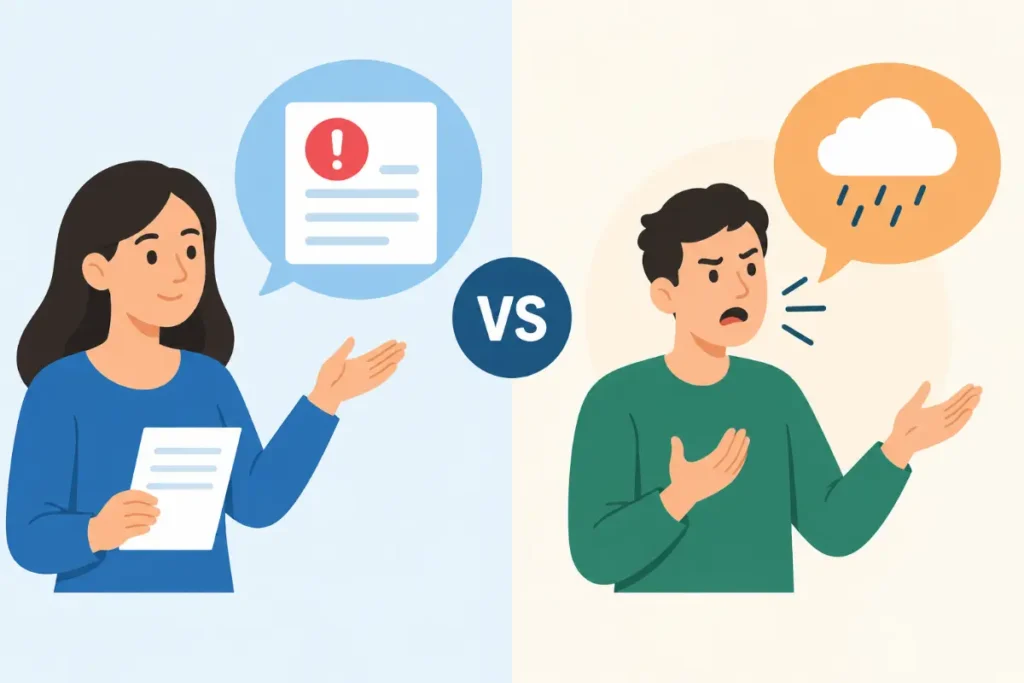
If you are stuck on complaint vs complain, the difference is simple. Complaint is usually a noun. Complain is a verb. You use complaint to name an expression of dissatisfaction, while you use complain to describe the act of expressing that dissatisfaction.
For example, you can say, “I have a complaint about the service.” You can also say, “I want to complain about the service.” Both sentences are correct, but the words do different jobs.
This small difference causes a lot of trouble because the two words look and sound closely related. They also appear in many of the same situations. You may complain about a noisy neighbor, file a complaint with a company, or hear someone make a complaint at work.
Once you understand the part of speech, the choice becomes much easier. This guide explains the difference, shows you how each word works in real sentences, covers common mistakes, and gives you a few simple ways to remember the rule.
Quick Definition
Complaint is a noun that means an expression of dissatisfaction or an issue someone reports. Complain is a verb that means to say or show that you are unhappy about something. In simple terms, you make or file a complaint, but you complain about a problem.
Direct Answer
Use complain when you need a verb for the action of expressing dissatisfaction. Use complaint when you need a noun for the concern or statement itself.

Why These Words Cause Confusion
The two words share the same basic idea. Both connect to dissatisfaction, criticism, or a problem that someone wants to mention. The main difference is not the topic. It is the grammatical job the word does in a sentence.
Think about the difference between action and thing.
Complain names an action. It tells us what someone does.
Complaint names a thing or idea. It tells us what someone makes, files, raises, or has.
That distinction works in many everyday examples.
You might say:
“I need to complain about my internet bill.”
Here, complain is an action. The speaker plans to express dissatisfaction.
Now look at this sentence:
“I sent a complaint about my internet bill.”
Complaint is the noun. It names the concern that the speaker sent.
The meaning is closely related, but the grammar changes.
Complain Is a Verb
A verb tells us about an action, event, or state. Complain is the verb in this word pair.
You can use it after a subject.
- “I complain when the food arrives cold.”
- “She complained about the noise.”
- “They are complaining about the price.”
- “He complained to the manager.”
In each sentence, someone is doing the action. That is why complain fits.
The verb can appear in several forms.
- Present tense: complain.
- Past tense: complained.
- Present participle: complaining.
Third person singular: complains.
These forms all come from the same verb.
- “I complain about slow service.”
- “She complains about slow service.”
- “They complained yesterday.”
- “He is complaining right now.”
Notice the spelling in the past tense. You do not write “complained” with an extra letter before the ending. The word changes from complain to complained.
Complaint Is a Noun
A noun can name a person, place, thing, idea, or issue. Complaint is a noun.
You can use it after articles and other words that commonly introduce nouns.
- “I have a complaint.”
- “She made a complaint.”
- “We received a complaint.”
- “The complaint was serious.”
In these examples, complaint names the concern itself.
You can also use complaint with verbs such as file, make, raise, receive, handle, investigate, and address.
- “I filed a complaint with the company.”
- “The manager received a complaint.”
- “The office will investigate the complaint.”
- “The staff handled the complaint quickly.”
These patterns are useful because they make the noun easy to recognize.
The Easiest Grammar Test
When you are unsure which word to use, ask yourself one simple question.
Am I talking about the action of expressing dissatisfaction, or am I naming the concern?
- If you are talking about the action, use complain.
- If you are naming the concern, use complaint.
Compare these two sentences.
- “I want to complain about the delivery.”
- “I want to file a complaint about the delivery.”
The first sentence focuses on the action. The second focuses on the formal concern.
Both can describe the same situation. The grammar determines the word.
Common Sentence Patterns With Complain
Complain often appears with about.
- “I complained about the noise.”
- “She complained about the delay.”
- “They complain about the weather.”
- “He complained about the food.”
The word can also appear with to when you identify the person who receives the complaint.
- “She complained to the manager.”
- “I complained to the landlord.”
- “They complained to the airline.”
You can use both words in the same sentence when you need to describe the action and the concern.
“I complained to the manager about my order.”
Here, complained is the verb. Manager identifies the person who heard the concern. The phrase about my order identifies the subject of the complaint.
Common Sentence Patterns With Complaint
Complaint often appears with a and the.
- “I have a complaint.”
- “The customer made a complaint.”
- “She filed a complaint.”
It can also appear in fixed phrases.
- “customer complaint”
- “formal complaint”
- “written complaint”
- “official complaint”
- “complaint form”
- “complaint department”
These combinations are common in business, customer service, schools, workplaces, and government offices.
For example:
- “Please complete the complaint form.”
- “The company received several customer complaints.”
- “She submitted a formal complaint to the office.”
In each case, complaint is a noun.
Below is the complete article split into three sections for consistency and accuracy. The sections are continuous parts of one ready to publish article.
Complaint vs Complain in Real Sentences
Seeing the difference in real sentences can make the rule stick.
Consider this short situation.
Your hotel room is too noisy. You want the front desk to know.
You could say:
- “I want to complain about the noise.”
- You could also say:
- “I have a complaint about the noise.”
The first sentence says what you want to do. The second sentence names the issue you want to report.
Now imagine that the front desk asks you what happened.
You might say:
- “I complained to the front desk because the room was noisy.”
- You could also say:
- “The front desk received my complaint.”
The first sentence uses the verb. The second uses the noun.
Examples With Complain
Here are natural examples of complain in everyday English.
- “I need to complain about this charge.”
- “She complained about the long wait.”
- “We complained to the waiter.”
- “He complains whenever the room is too cold.”
- “They complained about the new policy.”
- “My neighbor complained about the music.”
- “The customer is complaining about the refund.”
- “I complained because my package arrived damaged.”
These sentences all describe an action. Someone is expressing dissatisfaction.
Examples With Complaint
Now look at examples using the noun.
- “I have a complaint about my order.”
- “She filed a complaint with the company.”
- “The customer made a complaint about the service.”
- “We received a complaint from a neighbor.”
- “His complaint was about the billing error.”
- “The manager reviewed the complaint.”
- “The office has a process for handling complaints.”
These sentences name a concern or report. That is why the noun form works.
Examples Using Both Words
Sometimes both forms belong in the same sentence.
- “The customer complained about the service and filed a complaint.”
- “She complained to the manager after her complaint was ignored.”
- “We received a complaint after several customers complained about the delay.”
These sentences show why knowing the difference matters. The words are related, but you cannot freely swap them.
A Simple Way to Spot the Verb
Look at what comes before the word.
A subject can perform an action. That action can be complain.
- “I complain.”
- “You complain.”
- “We complain.”
- “They complain.”
- “She complains.”
- “He complains.”
If the sentence tells you what someone does, complain may be the word you need.
You can also put helping verbs before it.
- “I am complaining.”
- “She was complaining.”
- “They have complained.”
- “He will complain.”
These patterns clearly show that complain is a verb.
A Simple Way to Spot the Noun
Now look at words that commonly come before complaint.
- “A complaint.”
- “The complaint.”
- “My complaint.”
- “Your complaint.”
- “Her complaint.”
- “His complaint.”
- “Several complaints.”
- “A serious complaint.”
These phrases use complaint as a noun.
You can also place an adjective before it.
- “formal complaint”
- “written complaint”
- “customer complaint”
- “valid complaint”
- “reasonable complaint”
The adjective describes the complaint. That is another strong clue that you are dealing with a noun.
The Plural Form Is Complaints
The noun complaint can become plural.
- “She filed two complaints.”
- “The company received several complaints.”
- “We reviewed all customer complaints.”
The plural form is complaints.
Do not confuse complaints with the verb form complains.
- “She complains about the noise.”
- “She has two complaints about the noise.”
The first sentence uses a verb. The second uses a noun.
The spelling is close, but the grammar is different.
The Third Person Verb Form Is Complains
This is one of the most common sources of confusion.
When the subject is he, she, or it in the present tense, complain becomes complains.
- “He complains about everything.”
- “She complains about the temperature.”
- “The customer complains every time there is a delay.”
That final s does not turn the verb into a noun. It is simply the third person singular form of the verb.
Compare:
- “She complains about the service.”
- “She has a complaint about the service.”
The first sentence describes an action. The second names a concern.
The Past Tense Is Complained
The past tense of complain is complained.
- “I complained yesterday.”
- “She complained to the manager.”
- “They complained about the bill.”
The noun does not become complained. The noun remains complaint.
“I made a complaint yesterday.”
Both sentences can describe a past event, but they use different grammar.
Why The Ending Matters
The ending of a word can give you a useful clue, but you should not rely on spelling alone.
Complaint ends with the sound and spelling pattern associated with a noun in this word family.
Complain ends in the sound and spelling pattern used by the verb.
You do not need to memorize complicated grammar terms to use them correctly. Just learn the common sentence patterns.
- You complain about something.
- You make a complaint about something.
That small set of patterns covers a large share of everyday use.
Common Mistakes
A frequent mistake is using complaint after want to.
Incorrect:
“I want to complaint about the service.”
Correct:
“I want to complain about the service.”
Why?
The phrase want to is followed by a base verb. Complain is the verb. Complaint is a noun.
Another common mistake is using complain after have.
Incorrect:
“I have a complain.”
Correct:
“I have a complaint.”
The phrase have a needs a noun here. Complaint is the noun.
Another mistake appears after file.
Incorrect:
“I filed a complain.”
Correct:
“I filed a complaint.”
File is commonly followed by a noun in this pattern. A complaint is something you can file.
Common Mistakes With Make
The phrase make a complaint is grammatically correct.
“I made a complaint to the manager.”
You can also say:
“I complained to the manager.”
The first version uses the noun. The second uses the verb.
In casual American English, the verb complain often sounds more direct.
“I complained about the bill.”
In formal settings, the noun may appear more often.
“We received a formal complaint from the customer.”
The choice depends on the sentence and the tone you want.
Common Mistakes With Want To
This rule is worth remembering because it solves many errors.
After want to, use the base form of a verb.
- “I want to complain.”
- “She wants to complain.”
- “They want to complain.”
Do not use the noun after want to.
“I want to complaint.”
That form is incorrect because complaint is not a verb.
The same idea works with other verb patterns.
- “I plan to complain.”
- “I need to complain.”
In all four sentences, complain follows a structure that calls for a verb.
Common Mistakes With A and An
The word complaint can take an article.
- “I have a complaint.”
- “She made a complaint.”
You cannot normally use a before complain when you mean the verb.
“I have a complain.”
That sentence is incorrect.
This gives you another useful test. If the sentence needs a noun after a or the, complaint is likely the correct choice.
Formal and Informal Use
Both words are common in everyday English. The difference is grammatical rather than a simple formal versus informal choice.
Complain works naturally in casual speech.
“I need to complain about this.”
Complaint often appears in formal documents and official processes.
“Please submit your complaint in writing.”
That does not mean complaint is always formal. People use it in casual conversation too.
“I have one complaint about this movie.”
Likewise, complain can appear in formal writing.
“The report states that several residents complained about the noise.”
The sentence structure matters more than the level of formality.
Customer Service Examples
Customer service is one place where you will see both forms often.
A customer might say:
“I want to complain about my order.”
The company might respond:
- “We received your complaint.”
- The customer could then say:
- “I complained last week and still have not received a response.”
The company might write:
“We are reviewing your complaint.”
These examples show a useful pattern.
- The customer complains.
- The company receives a complaint.
- The customer may file a complaint.
- The company may investigate the complaint.
The customer may complain again if the problem continues.
Workplace Examples
The same rule applies at work.
- “She complained about the schedule.”
- “She submitted a complaint about the schedule.”
- “The manager received her complaint.”
- “The employees complained about the change.”
There is no special grammar rule for workplace English. The word still depends on its role in the sentence.
School Examples
You may also see these words in school settings.
- “The student complained about the assignment.”
- “The parent made a complaint about the school bus.”
- “The teacher received a complaint from a parent.”
- “Several students complained about the classroom temperature.”
Again, the verb describes an action. The noun names the concern.
How to Remember the Difference
You do not need a complicated memory trick.
Think of complain as something you do.
Think of complaint as something you have or make.
You complain.
You have a complaint.
This pattern is easy to remember because it matches real life.
Another useful trick is to connect the words to simple questions.
Ask:
- “What are you doing?”
- “I am complaining.”
Ask:
- “What do you have?”
- “I have a complaint.”
That small test can help you choose the correct word quickly.
Think Action Versus Thing
The action versus thing idea works well beyond this pair.
- “decide” is a verb.
- “decision” is a noun.
- “inform” is a verb.
- “information” is a noun.
- “complain” is a verb.
- “complaint” is a noun.
You do not need to memorize every grammar label. You only need to see the job each word performs.
A Quick Substitution Test
If you are still unsure, replace the word with a clear verb such as speak or report.
“I want to report the problem.”
If that structure works, you probably need a verb.
“I want to complain about the problem.”
Now try a noun.
- “I have a report about the problem.”
- “I have a complaint about the problem.”
The substitution can help you hear the grammar.
Pay Attention to Common Phrases
English becomes easier when you learn common word combinations as complete patterns.
For complain, remember:
- complain about something.
- complain to someone.
For complaint, remember:
- have a complaint.
- make a complaint.
- file a complaint.
- receive a complaint.
- raise a complaint.
- handle a complaint.
- investigate a complaint.
These patterns give you a practical framework. You do not have to stop and think about grammar every time you write.
Complain About Something
The most common structure is complain about.
- “She complained about the noise.”
- “I complained about the price.”
- “They complained about the service.”
- You can also use complain about a person.
- “He complained about his boss.”
- “She complained about her neighbor.”
In these examples, about introduces the topic of the complaint.
Complain To Someone
Use complain to when you identify the person who hears the complaint.
- “I complained to the manager.”
- “She complained to her teacher.”
- “They complained to the landlord.”
You can combine to and about.
“I complained to the manager about the bill.”
Here, to tells us who received the complaint. About tells us what the complaint concerned.
Complain That Something Happened
Complain can also be followed by a clause beginning with that.
- “She complained that the room was too cold.”
- “He complained that the bill was incorrect.”
- “They complained that the service was too slow.”
- In everyday speech, people often leave out that.
- “She complained the room was too cold.”
The version with that is often clearer in careful writing.
Complaint About Something
The noun complaint can also be followed by about.
- “We received a complaint about the noise.”
- “She filed a complaint about the charge.”
- “The customer has a complaint about the order.”
This is one of the easiest noun patterns to learn.
Complaint Against Someone
In formal contexts, you may see complaint against.
- “She filed a complaint against the company.”
- “The office received a complaint against the employee.”
This pattern appears in legal, workplace, academic, and official settings. The exact meaning can depend on the process involved.
Complaint To Someone
You can also use complaint with to when naming the person or group that receives it.
- “She sent a complaint to the company.”
- “He submitted a complaint to the manager.”
- “They delivered a written complaint to the office.”
The noun still names the concern. The phrase to the company identifies the recipient.
Complaint About Versus Complain About
These patterns look almost identical.
- “I complained about the delay.”
- “I made a complaint about the delay.”
The topic is the same. The first sentence uses a verb. The second uses a noun.
This is why learners sometimes swap the words by mistake. They focus on meaning and forget to check grammar.
The fix is simple. Look at the words around the target word.
- If you need an action, use complain.
- If you need a noun, use complaint.
Is Complain Always Negative
Complain usually carries a negative meaning because it involves expressing dissatisfaction or describing a problem.
- Still, the strength of the complaint can vary.
- “I complained about the cold coffee.”
- That could be a minor annoyance.
- “She complained about unsafe conditions.”
- That could describe a serious concern.
The word itself does not tell you how serious the issue is. The context does.
Is Complaint Always Formal
No. Complaint can be casual.
“My only complaint is that the movie was too long.”
That sentence sounds completely natural in everyday conversation.
The word becomes more formal in phrases such as formal complaint, written complaint, or official complaint. The surrounding words and situation create the tone.
Can Complaint Be Used as a Verb
In standard modern English, complaint is not the verb you want when you mean express dissatisfaction.
Use complain.
“I want to complain about the service.”
Do not write:
“I want to complaint about the service.”
Complaint is the noun form.
This is one of those errors that can look reasonable because the words are so closely related. The grammar rule keeps the choice clear.
Can Complain Be Used as a Noun
In standard English, complain is not normally used as the noun for an expression of dissatisfaction.
Use complaint.
“I have a complaint.”
Do not write:
“I have a complain.”
The noun form is complaint.
Related Word Forms
Learning the whole word family can make the distinction easier.
- Complain is the base verb.
- Complains is the present form used with he, she, or it.
- Complained is the past tense and past participle.
- Complaining is the present participle.
- Complaint is the noun.
- Complaints is the plural noun.
Seeing the family together helps explain why the words look alike while serving different grammatical roles.
Pronunciation Can Help
The two words also have a slightly different ending sound.
- Complain ends with the long a sound followed by an n sound.
- Complaint ends with a t sound at the end.
You can hear the difference when you say them slowly.
- Complain.
- Complaint.
The final t in complaint is a useful reminder that you are using the noun form.
Still, pronunciation should support your grammar knowledge rather than replace it. The sentence pattern is the stronger clue.
A Short Practice Test
Try choosing the correct word in each sentence.
- I want to complain about the noise.
- I have a complaint about the noise.
- She complained to the manager.
- The manager received a complaint.
- They complained about the price.
- They filed a complaint about the price.
- He complains about traffic.
- He has several complaints about traffic.
The pattern should now feel clear. The verb describes the act. The noun names the concern.
FAQs
Is complaint vs complain a grammar question?
Yes. The main issue is the grammatical role of each word. Complaint is a noun while complain is a verb.
Is complaint a noun or a verb?
Complaint is a noun. It names an expression of dissatisfaction or a reported concern.
Is complain a noun or a verb?
Complain is a verb. It describes the action of expressing dissatisfaction.
Which form should I use after want to?
Use complain after want to. You can say “I want to complain about the service.” Do not use complaint in that structure.
Can I say I have a complaint?
Yes. “I have a complaint” is grammatically correct and very common. The noun complaint names the issue or concern.
Can I say I have a complain?
No. The standard noun is complaint. Say “I have a complaint.”
Can I say I want to complaint?
No. After want to, use the base verb complain. The correct sentence is “I want to complain.”
Is complaint more formal than complain?
Not by itself. Complaint is a noun and complain is a verb. Complaint may appear often in formal settings because official processes involve complaints, but both words are common in everyday English.
What is the difference between complain and complaint?
Complain describes the action of expressing dissatisfaction. Complaint names the concern or expression of dissatisfaction itself.
Conclusion
The main difference between complaint vs complain is simple once you focus on grammar. Complain is a verb. Complaint is a noun. You complain about a problem, while you can have, make, or file a complaint about that same problem.
When you see want to, need to, plan to, or decide to before the word, choose complain. When you see a, the, my, your, several, file, make, or receive before the word, complaint will often be the right choice.
You can also remember the pair with one short idea. You have or make the thing when you have or make a complaint.
Keep that pattern in mind and you will avoid most mistakes. If you can ask yourself “Is this an action or a thing?” you can usually choose the correct form in seconds.

Dr. Arthur Pendelton is a veteran historical linguist and grammar expert with over 30 years of experience in academic editing. A retired professor, Arthur specializes in the etymology and evolution of the English language. He is passionate about “unpacking the history behind the rules,” helping readers understand why we spell, punctuate, and phrase things the way we do today. Whether he’s settling debates on archaic usage or explaining complex linguistic shifts, Dr. Pendelton brings scholarly precision to every article.