
Have you ever paused while writing the word reinforce and wondered if reenforce might be correct? You’re not alone. These two spellings look almost identical, and both appear in written English. However, one is far more common and is the preferred choice for modern American English.
The difference between reinforce vs reenforce comes down to spelling preference and common usage. Both forms have appeared in English, but reinforce is the standard spelling you’ll find in most modern dictionaries and professional writing. It means to make something stronger, support an idea, or strengthen a structure.
If you’re writing an email, school assignment, business report, or blog post, choosing the right spelling helps your writing look polished and professional. The good news is that you don’t need to memorize a complicated rule to get this one right.
This guide explains the meaning of both spellings, shows you how to use reinforce in everyday sentences, and clears up common questions about its forms, synonyms, and related words.
Quick Definition
Reinforce is a verb that means to make something stronger, provide extra support, or strengthen an idea or belief. For example, a teacher may reinforce a lesson by giving students more practice.
Reenforce is a less common spelling variant of the same word. In modern American English, reinforce is the safer and more widely accepted choice for everyday and professional writing.
Direct Answer
Reinforce is the preferred spelling in modern American English. Although reenforce has been used as a variant, choose reinforce for schoolwork, business writing, online content, and most other situations.
Comparison Table
| Word or Phrase | Meaning | Example Sentence | When to Use It |
|---|---|---|---|
| Reinforce | To make something stronger or provide more support. | The coach used extra drills to reinforce the team’s skills. | Use this spelling in almost all modern writing. |
| Reenforce | A less common spelling variant of reinforce. | Some older texts use the spelling reenforce. | Recognize it when reading, but generally prefer reinforce in your own writing. |
| Reinforcement | Extra support or the act of making something stronger. | The wall needs reinforcement before winter. | Use it as a noun. |
| Reinforced | Made stronger or supported. | The workers installed a reinforced door. | Use it as the past tense or past participle of reinforce, or as an adjective. |
| Reinforcing | Making something stronger or providing support. | Repeating the rule is reinforcing the lesson. | Use it as the present participle or gerund. |
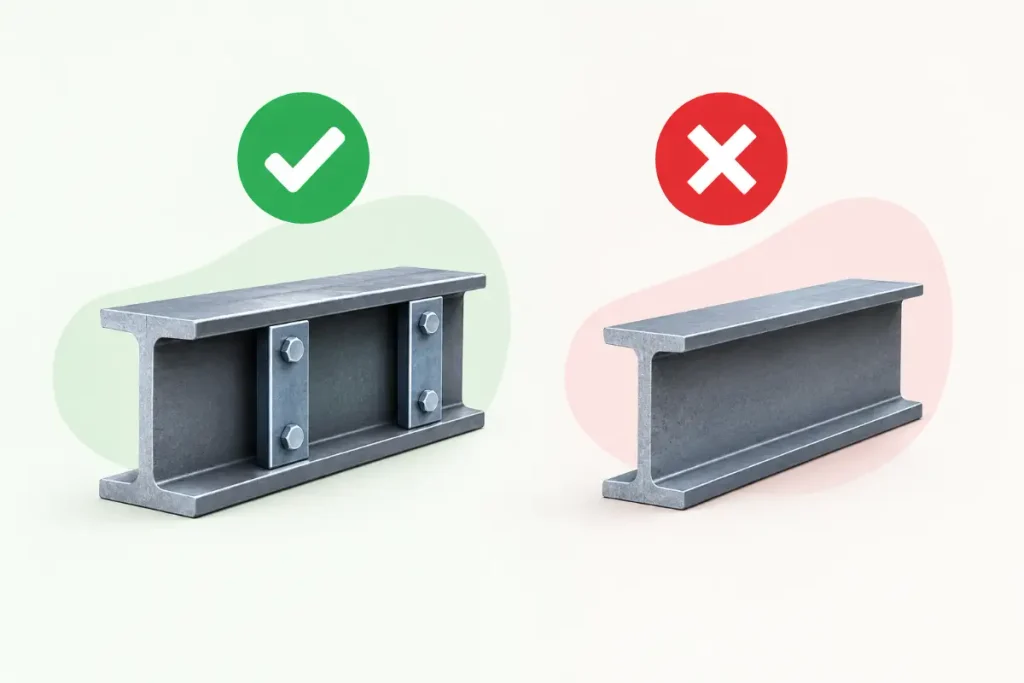
Why Reinforce Is the Preferred Spelling
English contains many words that sound alike or share similar letter patterns. Some have two accepted spellings, while others have one spelling that most modern writers should use. Reinforce belongs to a group of words that can cause doubt because its spelling doesn’t always feel obvious.
The prefix re often means again or back. When people see it before another part of a word, they may wonder if the letters should be repeated. That can lead some writers to choose reenforce instead of reinforce.
However, the spelling of a word isn’t always determined by how its parts look when placed together. English spelling has developed over centuries, and common usage often settles on one form.
What Makes Reinforce the Better Choice
The spelling reinforce is firmly established in modern American English. It appears in general dictionaries, educational materials, workplace documents, and professional publications.
The word also belongs to a familiar family of related forms. These include reinforcement, reinforced, and reinforcing. Learning this spelling helps you use all these forms correctly.
For example:
- The manager wants to reinforce the company’s safety rules.
- The new evidence reinforced the scientist’s original theory.
- The bridge needs additional reinforcement.
- The reinforced packaging protects the product during shipping.
- The teacher is reinforcing the spelling rule with a short quiz.
Each sentence uses a form of the same word. The spelling stays consistent throughout the word family.
Is Reenforce Actually a Word
Yes. Reenforce has appeared as a variant spelling of reinforce. You may encounter it in older books, historical documents, or sources that follow a less common spelling preference.
However, recognizing a spelling doesn’t mean you should choose it for your own writing. Many words have unusual or historical variants that readers can understand, even though one form is much more common today.
Think of it this way. If you see reenforce in an old document, you don’t need to assume the writer made a mistake. The text may reflect a spelling choice from a different period or editorial tradition.
Still, if you’re writing a modern article or report, reinforce is the clearest option. It matches the spelling most readers expect and reduces the chance of confusion.
Does American English Prefer Reinforce
Yes. Reinforce is the standard choice in American English. It is appropriate for formal writing, casual messages, educational materials, and professional communication.
You don’t need to switch to reenforce for a special American usage rule. In fact, using the less common variant may distract readers who are familiar with the standard form.
Consider these examples:
- Correct for modern American writing: The trainer will reinforce the importance of proper form.
- Preferred for modern American writing: The company introduced new rules to reinforce data security.
- Preferred for modern American writing: Parents can reinforce good habits by setting clear routines.
The spelling remains the same across different subjects. You can use reinforce when discussing education, health and safety, construction, relationships, or business.
What About British English
The spelling reinforce is also widely used in British English. It isn’t a word that normally changes spelling between American and British English.
Some English words have familiar regional differences. For example, American English uses color, while British English often uses colour. American English generally uses organize, while British publications may use organise, depending on their style guide.
Reinforce doesn’t follow that same pattern. Writers in both countries commonly use this spelling.
If you’re writing for an American audience, use reinforce. If you’re writing for a British audience, reinforce is also a sound choice.
The main difference to remember is between the standard spelling and its less common variant, not between two national spelling systems.
What Reinforce Means
Knowing the correct spelling is only half the job. To use a word well, you also need to understand its meaning and the situations where it fits.
Reinforce has several related meanings. In each case, the central idea is to make something stronger, firmer, or more effective.
To Make Something Physically Stronger
The first meaning is literal. You reinforce something when you add support to make it stronger or more resistant to damage.
Builders, engineers, and repair workers often use the word in this sense. They may reinforce a wall, roof, bridge, floor, or door.
Examples include:
- The builders reinforced the basement walls before the heavy rain arrived.
- The engineer recommended steel bars to reinforce the concrete.
- We reinforced the wooden shelf because it was starting to bend.
- The company uses reinforced boxes to protect fragile items.
- Workers added extra beams to reinforce the old roof.
In these sentences, the word describes a physical improvement. Something receives extra support so it can handle more pressure, weight, or stress.
You may also see reinforced used as an adjective. A reinforced door, for example, is a door designed or modified to provide extra strength.
To Strengthen an Idea or Belief
You can also reinforce something that has no physical shape. Ideas, opinions, beliefs, and expectations can become stronger when people receive more evidence or support.
For example, a study may reinforce an existing theory. A personal experience may reinforce someone’s belief about a situation. A clear argument may reinforce the main point of an essay.
Consider these sentences:
- The latest research reinforced the doctor’s recommendation.
- Her experience reinforced her belief in careful planning.
- The witness’s statement reinforced the lawyer’s argument.
- The survey results reinforced the need for better public transport.
- His apology reinforced the idea that he valued their friendship.
In each case, the word describes added support for an idea or belief. The support might come from facts, actions, experiences, or other people’s words.
A useful way to remember this meaning is to picture a chair with an extra leg. The extra leg makes the chair more stable. In the same way, evidence can make an argument more convincing.
To Encourage a Behavior
Another common meaning involves behavior. You reinforce a behavior when your response makes that behavior more likely to happen again.
Parents, teachers, coaches, and managers often use this idea. Praise, rewards, feedback, and recognition can reinforce actions that they want people to repeat.
Examples:
- The teacher praised the students to reinforce their habit of helping one another.
- Parents can reinforce good manners by modeling respectful behavior.
- The coach used positive feedback to reinforce the players’ teamwork.
- The manager recognized the employee’s effort to reinforce a culture of accountability.
- A reward can reinforce a child’s habit of completing homework on time.
This meaning often appears in discussions about learning and behavior. The response that follows an action can influence what happens next.
However, reinforcement doesn’t always involve a prize or a reward. A teacher can reinforce a lesson through practice. A supervisor can reinforce a safety rule by repeating it and explaining why it matters.
The shared idea is strengthening a behavior, habit, or pattern.
To Emphasize a Message
Sometimes, people reinforce a message by repeating it or supporting it with examples. The goal is to make the message clearer and easier to remember.
For instance, a teacher might explain a grammar rule, provide examples, and ask students to practice it. Those steps reinforce the original lesson.
Here are more examples:
- The speaker used a personal story to reinforce her main point.
- The final paragraph reinforces the article’s central message.
- The signs around the building reinforce the need to wash your hands.
- The campaign uses simple images to reinforce its safety message.
- The manager repeated the instructions to reinforce the new procedure.
In this context, reinforce is stronger than simply saying something again. It suggests that the repeated message adds weight, clarity, or support.
If a sentence only describes repetition without added emphasis or support, repeat may be the better word. But when the repetition strengthens the message, reinforce fits well.
How to Use Reinforce in a Sentence
The verb reinforce works in several sentence patterns. Once you learn the most common patterns, using it becomes much easier.
Reinforce Something
This is one of the simplest patterns. Place the thing being strengthened after the verb.
Examples:
- We need to reinforce the fence before the storm.
- The report reinforces the need for regular inspections.
- The teacher used examples to reinforce the rule.
- New evidence reinforced the original claim.
- The company plans to reinforce its privacy policy.
The object can be a physical thing, an idea, a rule, a habit, or a message.
Reinforce Something With Something
Use this pattern when you want to explain what provides the extra support.
Examples:
- The teacher reinforced the lesson with a short activity.
- The builders reinforced the floor with steel supports.
- She reinforced her argument with facts and clear examples.
- The coach reinforced the team’s confidence with positive feedback.
- The company reinforced its safety training with practical exercises.
The word with introduces the tool, material, or method used to strengthen something.
Reinforce Something Through Something
This pattern highlights a process or method.
Examples:
- Parents can reinforce good habits through daily practice.
- The school reinforces reading skills through group activities.
- The team reinforced trust through honest communication.
- The program reinforces healthy routines through regular reminders.
Use through when you want to focus on the process that produces the extra support.
Reinforce That Something Is True
You can use reinforce before a clause that explains the idea being supported. In this structure, that often introduces the message.
Examples:
- The results reinforce that careful planning saves time.
- Her actions reinforced that she could be trusted.
- The report reinforces that regular maintenance reduces risk.
In everyday writing, this structure can sometimes sound less natural than a direct object. For example, The results reinforce the value of careful planning is often smoother than The results reinforce that careful planning is valuable.
Choose the structure that makes your sentence easiest to understand.
The Different Forms of Reinforce
Learning the main forms of a word helps you avoid spelling mistakes in longer sentences. The spelling of reinforce stays consistent as you change its grammatical form.
| Form | Part of Speech or Use | Example |
|---|---|---|
| Reinforce | Base verb | We reinforce the rules every week. |
| Reinforces | Present tense with a singular subject | The example reinforces the lesson. |
| Reinforced | Past tense or past participle | The new evidence reinforced her point. |
| Reinforcing | Present participle or gerund | Repeating the rule is reinforcing the lesson. |
| Reinforcement | Noun | The wall needs reinforcement. |
Reinforce
Use the base form after to or with subjects that take the base verb in the present tense.
Examples:
- We want to reinforce the message.
- They reinforce the structure with extra supports.
- The coach will reinforce the team’s strengths.
Reinforces
Add s when the subject is singular and the sentence uses the simple present tense.
Examples:
- This example reinforces the main point.
- The policy reinforces the company’s values.
- Her feedback reinforces the student’s progress.
A common error is writing the policy reinforce. In a simple present sentence with a singular subject, the correct form is the policy reinforces.
Reinforced
Use this form for the past tense or with a helping verb such as has, have, or had.
Examples:
- The team reinforced its defense last season.
- The new findings have reinforced the original conclusion.
- The workers had reinforced the gate before the storm.
You can also use reinforced as an adjective.
For example, reinforced concrete describes concrete strengthened with materials such as steel bars.
Reinforcing
Use reinforcing when describing an ongoing action or when the word functions as a noun.
Examples:
- The school is reinforcing its reading program.
- The evidence is reinforcing the original claim.
- Reinforcing good habits takes patience.
The final e in reinforce is dropped before adding ing. That’s why the correct spelling is reinforcing, not reinforceing.
Reinforcement
Reinforcement is the noun form. It refers to extra support or the process of strengthening something.
Examples:
- The bridge requires reinforcement.
- Positive reinforcement can encourage helpful behavior.
- The teacher provided reinforcement through extra practice.
- The soldiers requested reinforcement from nearby units.
The noun can refer to physical support, extra help, or a method that strengthens a behavior or idea.
Don’t confuse reinforcement with reinforcements. The plural form can refer to additional people or resources sent to help an existing group.
For example, The firefighters called for reinforcements means they requested more people to help.
Common Mistakes to Avoid
Even when you know the preferred spelling, a few related mistakes can creep into your writing. These errors often happen when writers focus on how a word looks or sounds instead of how it works in a sentence.
Using Reenforce in Formal Writing
The most relevant mistake for this topic is choosing reenforce when reinforce is the expected spelling.
For example:
Incorrect for standard modern writing: The new rules will reenforce the safety policy.
Preferred: The new rules will reinforce the safety policy.
The meaning is easy to understand in both versions. However, the standard spelling is the better choice for essays, reports, websites, and professional emails.
If you see the less common spelling in an older source, you can understand it without copying it into your own writing.
Writing Reinforceing Instead of Reinforcing
Some writers keep the final e when adding ing. That creates the misspelling reinforceing.
The correct form is reinforcing.
Examples:
- Incorrect: The teacher is reinforceing the lesson.
- Correct: The teacher is reinforcing the lesson.
A useful spelling rule explains why. For many verbs ending in a silent e, you drop that final letter before adding ing. The same pattern appears in words such as make and making, or write and writing.
Confusing Reinforce With Reinforcement
These words belong to the same word family, but they serve different roles in a sentence.
Reinforce is a verb. It describes an action.
Reinforcement is a noun. It names the support or process.
Compare these examples:
- The builders will reinforce the wall.
- The wall needs reinforcement.
The first sentence describes what the builders will do. The second names what the wall needs.
You can’t always replace one form with the other without changing the sentence structure.
Using Reinforce When Support Is Not the Meaning
The word reinforce is useful, but it isn’t the right choice for every situation involving repetition or explanation.
For example, if you tell someone the same phone number twice, you may simply be repeating it. You are reinforcing it only if the second telling strengthens their understanding or memory.
Compare these sentences:
- I repeated the address because she didn’t hear it.
- I reinforced the safety message by explaining the risks and showing examples.
The first sentence focuses on saying something again. The second describes extra support for a message.
Choosing a precise verb makes your writing clearer and less repetitive.
Forgetting Subject Verb Agreement
The word changes form depending on the subject and tense.
Examples:
- Incorrect: The new rule reinforce the message.
- Correct: The new rule reinforces the message.
- Correct: The new rules reinforce the message.
A singular subject usually takes reinforces in the simple present tense. A plural subject takes reinforce.
This is a grammar issue rather than a spelling preference, but it matters if you want your writing to sound polished.
Synonyms for Reinforce
Sometimes, the best way to improve a sentence is to replace a repeated word with a more precise one. Several words can express a meaning similar to reinforce, but each has its own shade of meaning.
| Synonym | Meaning | Example Sentence |
|---|---|---|
| Strengthen | Make something stronger. | The new beams will strengthen the roof. |
| Support | Help maintain or prove something. | The facts support her argument. |
| Bolster | Give extra help or confidence. | The positive results bolstered the team’s confidence. |
| Fortify | Make something stronger or more secure. | The workers fortified the outer wall. |
| Confirm | Show that something is true or correct. | The second test confirmed the results. |
| Emphasize | Give special importance to an idea. | The teacher emphasized the value of practice. |
| Back up | Provide evidence or support. | The figures back up the manager’s claim. |
| Encourage | Help someone feel willing or confident to act. | Her feedback encouraged the student to keep trying. |
| Reaffirm | State or confirm a belief or commitment again. | The director reaffirmed the company’s commitment to safety. |
| Deepen | Make a feeling, understanding, or relationship stronger. | The discussion deepened their understanding of the issue. |
When to Use Strengthen
Strengthen is often the closest everyday synonym. It works for physical objects, relationships, arguments, and skills.
For example, The exercise will strengthen your muscles is a natural sentence. So is The new evidence will strengthen the argument.
Use strengthen when you want a simple word that communicates a clear increase in strength.
When to Use Support
Support works well when something helps an idea, person, or structure remain firm.
For example, The documents support the claim means the documents provide evidence for it.
However, support doesn’t always mean that something becomes stronger. It can also mean helping a person or keeping an object in place.
When to Use Bolster
Bolster often describes an increase in confidence, support, or strength. It can make a sentence sound more formal than help or support.
For example, The positive review bolstered the team’s confidence describes an increase in confidence.
Use it when you want to emphasize the added help that makes something more secure or convincing.
When to Use Confirm
Confirm means to establish that something is correct or true. It overlaps with reinforce when new information supports an existing belief.
For example, The test confirmed the diagnosis focuses on showing that a conclusion is correct. The test reinforced the doctor’s confidence in the conclusion focuses on adding support to an existing view.
These meanings are related, but they aren’t identical. Choose the verb that best matches the point you want to make.
Antonyms of Reinforce
An antonym is a word with an opposite or contrasting meaning. The best opposite of reinforce depends on the context.
| Antonym | Meaning | Example Sentence |
|---|---|---|
| Weaken | Make something less strong. | The repeated failures weakened public confidence. |
| Undermine | Reduce the strength or credibility of something. | The missing evidence undermined the argument. |
| Damage | Harm something physically or mentally. | The storm damaged the old fence. |
| Reduce | Make something smaller or lower. | The changes reduced the need for extra support. |
| Discourage | Make someone less likely to act. | Harsh criticism discouraged the student from participating. |
| Contradict | State or show the opposite of a claim. | The new report contradicted the earlier statement. |
Notice that these words aren’t interchangeable in every sentence.
You can weaken a structure or an argument. You can undermine trust or credibility.
The context determines the best choice.

Memory Tricks to Remember the Correct Spelling
A simple memory trick can save you time when you write. You don’t need to memorize the history of the word to remember its standard spelling.
Remember the Familiar Form
Think of the word reinforce as a complete word rather than trying to rebuild it from its parts. This reduces the temptation to add another e.
Repeat this short reminder:
Reinforce is the standard spelling. Reenforce is the less common variant.
You can keep this rule in mind for school assignments, emails, reports, and other writing tasks.
Connect Reinforce With Strength
Think of a weak fence receiving extra boards. The new boards reinforce the fence.
Now connect the image with the spelling. Picture the word reinforce written on one of those boards.
The physical image helps link the word’s meaning to its standard form. It’s a small trick, but it can make the spelling easier to recall.
Learn the Word Family Together
Memorizing related words can help you recognize the correct spelling more quickly.
Practice these forms together:
- Reinforce.
- Reinforces.
- Reinforced.
- Reinforcing.
- Reinforcement.
Once the base spelling becomes familiar, the other forms feel more natural. You also become less likely to make mistakes such as reinforceing.
Read Your Sentence Aloud
Reading a sentence aloud can help you catch awkward grammar, but it won’t always reveal a spelling difference. Reinforce and reenforce are pronounced the same way in common usage.
For that reason, use both proofreading and a spelling checker when needed. A dictionary can confirm the preferred spelling if you remain unsure.
Practice Examples
The best way to learn a word is to see how people use it. The examples below cover several common situations.
Everyday Examples
- I want to reinforce my English skills by reading every day.
- A quick review can reinforce what you learned in class.
- The family worked together to reinforce their shared values.
- The extra screws will reinforce the loose shelf.
- Her kind words reinforced his confidence.
School and Education Examples
- Teachers often reinforce difficult concepts with simple examples.
- The worksheet reinforces the spelling rules from the lesson.
- Students practiced the problem again to reinforce their understanding.
- The teacher reinforced the importance of checking each answer.
- Regular reading reinforces vocabulary and comprehension skills.
Business and Workplace Examples
- The company introduced training to reinforce its privacy policy.
- The supervisor reinforced the safety instructions before the shift.
- The new report reinforces the need for better planning.
- Managers should reinforce clear expectations with regular feedback.
- The meeting reinforced the team’s commitment to the project.
Construction and Engineering Examples
- The engineers reinforced the bridge to handle heavier loads.
- The contractor used steel bars to reinforce the concrete.
- The workers reinforced the damaged section of the roof.
- The reinforced frame made the structure more stable.
- The inspection showed that the foundation needed reinforcement.
Relationships and Personal Growth Examples
- Honest conversations can reinforce trust between friends.
- Keeping promises reinforces a sense of reliability.
- Small acts of kindness reinforce strong relationships.
- Daily practice reinforces a positive habit.
- Her progress reinforced her belief that patience pays off.
Examples With Different Verb Forms
- Present tense: The evidence reinforces the main argument.
- Past tense: The evidence reinforced the main argument.
- Future tense: The evidence will reinforce the main argument.
- Present continuous: The new study is reinforcing the original findings.
- Present perfect: The new study has reinforced the original findings.
- Noun form: The new study provides reinforcement for the original findings.
These examples show how the word fits into different tenses and sentence structures. The central meaning remains the same: adding strength, support, or emphasis.
FAQs
Is Reinforce or Reenforce Correct?
Reinforce is the preferred spelling in modern American English. Reenforce has been used as a variant, but it is much less common. Use reinforce for most everyday and professional writing.
Is Reenforce a Misspelling?
Not necessarily. Reenforce has appeared as a variant spelling of reinforce. However, it isn’t the usual choice in modern American writing, so reinforce is the better option for most readers.
What Does Reinforce Mean in Simple Words?
To reinforce means to make something stronger or give it extra support. You can reinforce a wall, an idea, a belief, or a habit. For example, practicing a skill reinforces what you’ve learned.
How Do You Spell Reinforcement?
The correct spelling is reinforcement. It is the noun form of reinforce and refers to extra support or the process of making something stronger. For example, the bridge needs reinforcement.
Is Reinforcing Spelled With One E or Two?
The correct spelling is reinforcing. You drop the final e from reinforce before adding ing. The form reinforceing is incorrect.
Is Reinforce the Same in American and British English?
Yes. Reinforce is widely used in both American and British English. You don’t need a different spelling for either audience.
What Is Another Word for Reinforce?
Common alternatives include strengthen, support, bolster, fortify, and reinforce a message can sometimes be replaced with emphasize. The best synonym depends on what you’re describing. For example, strengthen works for a structure, while confirm may fit better when new evidence supports a conclusion.
Conclusion
When comparing reinforce vs reenforce, the choice is simple for most modern writing. Reinforce is the standard spelling in American English and is also widely used in British English. The alternative spelling reenforce exists, but it’s much less common.
Remember that reinforce means to make something stronger, add support, or strengthen an idea or behavior. You can reinforce a wall with extra materials, reinforce a lesson with practice, or reinforce trust through honest actions.
The easiest way to avoid confusion is to learn the main word family together reinforce, reinforces, reinforced, reinforcing, and reinforcement. When you’re unsure, choose reinforce. It’s the spelling most readers expect, and it will serve you well in almost any writing situation.

Dr. Arthur Pendelton is a veteran historical linguist and grammar expert with over 30 years of experience in academic editing. A retired professor, Arthur specializes in the etymology and evolution of the English language. He is passionate about “unpacking the history behind the rules,” helping readers understand why we spell, punctuate, and phrase things the way we do today. Whether he’s settling debates on archaic usage or explaining complex linguistic shifts, Dr. Pendelton brings scholarly precision to every article.