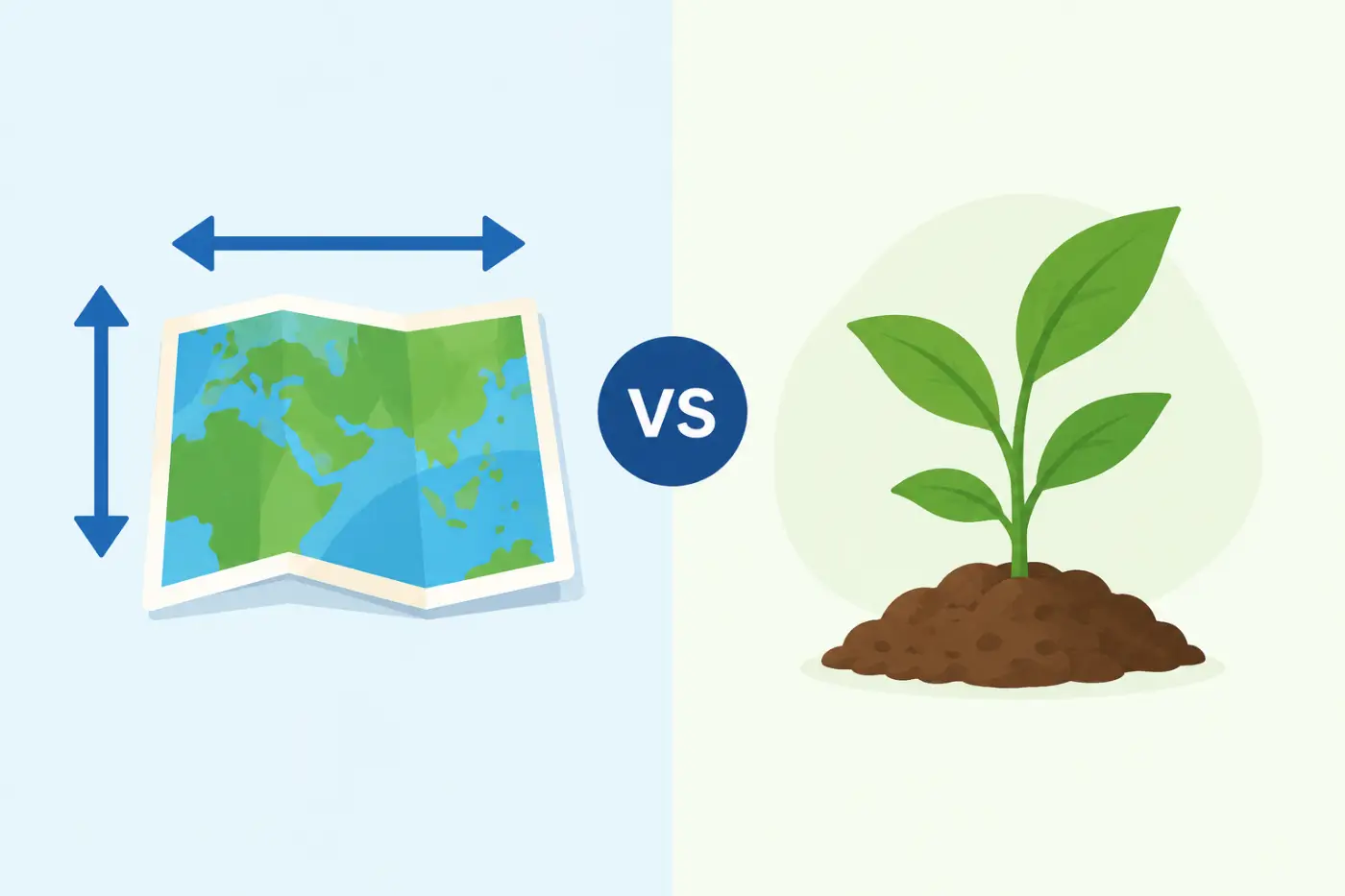
The difference between extent vs extant comes down to meaning. Extent refers to the size, amount, or degree of something. Extant means still existing or surviving, especially when something is old, rare, or no longer common.
These words look similar and sound somewhat alike. However, they serve different purposes in a sentence. If you want to describe how much damage a storm caused, use extent. If you want to describe an old document that still exists, use extant.
The good news is that you only need to remember one simple rule. Extent tells you how much or how far something goes. Extant tells you that something still exists.
This guide explains both words in plain English. You’ll learn their definitions, pronunciation, grammatical roles, common uses, and differences through natural examples. You’ll also find simple memory tricks to help you choose the right word when writing.
Quick Definition
Extent is a noun that means the size, amount, range, or degree of something. For example, We don’t know the extent of the damage.
Extant is an adjective that describes something that still exists. For example, The library holds several extant copies of the ancient text.
Direct Answer
Use extent when you mean the size, degree, or range of something. Use extant when you mean that something still exists.
- Correct: The full extent of the problem became clear later.
- Correct: Only a few extant copies of the book remain.
Remember that extent answers a question about amount or degree. Extant answers a question about continued existence.
Extent vs Extant Comparison Table
| Word | Meaning | Example Sentence | When to Use It |
|---|---|---|---|
| Extent | Size, amount, range, or degree | We measured the extent of the flood damage. | When describing how much or how far something reaches. |
| Extant | Still existing or surviving | The museum displays an extant letter from the 18th century. | When describing something that has survived and still exists. |
The easiest way to tell these words apart is to focus on what the sentence needs to express. If you are talking about the amount of something, choose extent. If you are talking about something that remains in existence, choose extant.

What Extent Means
Extent is a noun. It describes how much of something exists, how far something reaches, or how serious or large something is.
You can use it when talking about physical size, damage, knowledge, responsibility, influence, or the reach of an event. The exact meaning depends on the sentence, but the central idea stays the same: extent measures a range or degree.
Extent as Size or Range
Sometimes, extent refers to the physical size or reach of something.
For example:
- The extent of the forest surprised the hikers.
- We walked across the full extent of the property.
- The map shows the extent of the flooded area.
- The road’s extent reaches beyond the town limits.
- Researchers measured the extent of the ice sheet.
In each sentence, the word describes how far something stretches or how much space it covers.
Imagine looking at a map of a wildfire. The burned area shows the extent of the fire. The word doesn’t tell you that the fire still exists. It describes the area affected by it.
Extent as Amount or Degree
Extent can also describe the amount or degree of something that may not have a physical size.
For example:
- The teacher understood the extent of the student’s difficulty.
- We underestimated the extent of the damage.
- The report explains the extent of the company’s losses.
- Her success surprised everyone because of its extent.
- The doctor assessed the extent of the injury.
Here, the word describes how serious, large, or widespread something is.
You can use it for good things and bad things. The extent of a person’s knowledge may be impressive. The extent of a storm’s damage may be worrying. The word itself doesn’t carry a positive or negative meaning.
Extent in the Phrase To What Extent
One of the most common uses of extent appears in the question to what extent. This phrase asks about the degree, amount, or level of something.
For example:
- To what extent did the new policy improve safety?
- To what extent can exercise help reduce stress?
- To what extent was the team responsible for the mistake?
- To what extent does the evidence support the claim?
These questions ask you to judge how much something happened, mattered, or contributed to a result.
Suppose a school introduces a new reading program. Asking Did the program help? calls for a general answer. Asking To what extent did the program help? asks for a more precise judgment about the size of its effect.
You can answer with words such as slightly, partly, greatly, or completely. You can also provide numbers or other evidence.
Extent in Everyday Writing
You don’t need formal or academic writing to use extent. It works well in everyday conversations and messages.
Consider these examples:
- I didn’t realize the extent of the mess.
- We need to check the extent of the leak.
- She knows the extent of my support.
- The manager explained the extent of the delay.
- They were shocked by the extent of the damage.
Each example describes an amount or degree. The word helps you explain the scale of a situation instead of simply saying that something happened.
For instance, The house was damaged gives basic information. The extent of the damage was greater than expected tells the reader that the damage was more serious or widespread than people first thought.
Common Phrases With Extent
Learning common word combinations makes it easier to use extent naturally. These combinations appear often in speech, school assignments, news reports, and professional writing.
| Phrase | Meaning | Example |
|---|---|---|
| To some extent | Partly or to a certain degree | I agree with your point to some extent. |
| To a great extent | To a large degree | The outcome depended to a great extent on teamwork. |
| To what extent | How much or how far | To what extent did the changes affect sales? |
| Full extent | The complete size or degree | We haven’t seen the full extent of the damage. |
| Extent of the damage | How much damage occurred | Workers assessed the extent of the damage. |
| Beyond the extent of | Outside a particular range or limit | The repair work went beyond the extent of the original plan. |
The last phrase is less common than the others. In many situations, beyond the scope of is a more natural choice when you mean that something falls outside a task or subject.
The phrase to some extent is especially useful when you agree with part of an idea but not all of it.
For example, you might say, To some extent, I understand why she left. This means you understand some of her reasons, but you may not understand everything about her decision.
What Extant Means
Extant is an adjective. It describes something that still exists, remains available, or has survived from an earlier time.
The word often appears in discussions of history, books, art, science, law, and old records. However, you can use it for any thing that continues to exist.
For example:
- The historian studied the extant letters of the president.
- Only three extant copies of the original edition are known.
- The researcher compared extant species with fossil records.
- The museum protects several extant works by the artist.
- The report lists all extant versions of the document.
In each example, extant tells the reader that something still exists. It doesn’t tell the reader how large, important, or valuable that thing is.
Extant in Historical Writing
Historians often use extant to describe documents, records, books, buildings, and other objects that have survived from the past.
Imagine an author wrote a book 500 years ago. Many copies may have been lost, destroyed, or damaged over time. If two copies still exist, those copies are extant.
For example:
The scholar examined the extant records from the medieval court.
This sentence means that the scholar examined the records that have survived and are still available.
The word can also describe surviving parts of a larger work. An ancient play may have survived only in fragments. Those fragments are extant even if the complete play no longer exists.
This distinction matters in historical research. A record that once existed but has been lost isn’t extant today. A record that survived and can still be found is extant.
Extant in Science
Scientists use extant to describe living species or groups that still exist, especially when comparing them with extinct species.
For example:
- The study examines extant species of wild cats.
- Scientists compared the fossil with extant birds.
- Several extant members of the group live in tropical regions.
- The report identifies the oldest extant population in the area.
The contrast between extant and extinct is especially useful here.
An extant species still exists. An extinct species has no living members left.
For instance, the dodo is extinct. Many species of penguins are extant. The terms describe their current status, not their size or the number of individuals that once lived.
Be careful with the distinction between a species and an individual organism. If a species survives, it is extant even if its population is small. The word doesn’t automatically mean that the species is common, healthy, or safe from extinction.
Extant in Art and Literature
The word also appears in writing about paintings, sculptures, music, plays, and books.
For example:
- The gallery owns an extant painting from the artist’s early career.
- Researchers found an extant version of the lost composition.
- The archive preserves several extant manuscripts.
- Only a few extant examples of the design remain.
These sentences focus on survival. The painting, composition, manuscripts, or designs still exist in some form.
An extant work doesn’t have to be complete. A damaged painting may be extant because it survives. A fragment of a manuscript may be extant even if most of the original text has disappeared.
The word also doesn’t guarantee that the item is available for public viewing. A document held in a private collection can still be extant, as long as it continues to exist.
Extant in Legal and Official Writing
You may also see extant in legal records, official reports, and formal documents.
For example:
- The lawyer reviewed the extant regulations.
- The agency searched its extant records.
- The archive retains all extant copies of the agreement.
- The report refers to extant laws governing the issue.
In these cases, the word refers to rules, records, or documents that remain in existence or force.
However, the exact meaning depends on the subject. An extant document still exists physically or as a record. An extant law remains in force. Those are related ideas, but they aren’t identical.
In everyday writing, simpler words such as existing, remaining, or still in effect may sound more natural. Use extant when its precise meaning suits the context or when you’re writing in a formal or academic style.
The Main Differences Between Extent and Extant
Now that you know what each word means, the next step is learning how to choose between them in real sentences.
The difference between extent and extant isn’t just a spelling difference. The words have different meanings and grammatical roles. One describes an amount or degree. The other describes continued existence.
One Is a Noun and the Other Is an Adjective
The first difference is their part of speech. A part of speech tells you how a word works in a sentence.
Extent is a noun. It names the size, range, amount, or degree of something.
For example:
The extent of the damage shocked the residents.
The noun extent identifies the degree of damage.
Extant is an adjective. It describes a noun by telling you that something still exists.
For example:
The museum owns an extant copy of the original book.
The adjective extant describes the noun copy.
This grammatical difference can help you choose the correct word. If your sentence needs a noun that expresses the scale of something, extent may fit. If you need an adjective to describe a surviving object or an existing condition, extant may be the right choice.
They Answer Different Questions
Another simple way to separate the words is to ask what information you want to give the reader.
Extent answers questions such as these.
- How much?
- How far?
- How large?
- How serious?
- To what degree?
Extant answers a different question.
– Does it still exist?
Look at these examples.
The researchers measured the extent of the damage.
This sentence tells you that the researchers measured how much damage occurred.
The researchers studied the extant records.
This sentence tells you that the researchers studied records that still exist.
Both sentences could appear in the same research report. However, each word communicates a different fact.
One Measures and the Other Describes Survival
Think of extent as a measuring tool. It helps you describe the scale of something. Think of extant as a label that tells you something has survived or continues to exist.
Imagine a historic building damaged by an earthquake. An engineer might study the extent of the damage to determine how much of the building needs repair. A historian might examine extant plans and photographs to learn what the building looked like before the earthquake.
The two words work together because they answer separate questions about the same situation.
The extent of the damage describes its scale. The extant photographs describe records that have survived.
Extant Does Not Mean Extensive
One common source of confusion is the similarity between extant and extensive. The words look alike, but they have different meanings.
Extensive means large in size, range, or amount. It often describes something that covers a wide area or involves many parts.
For example:
The storm caused extensive damage across the county.
This means the storm caused a large amount of damage over a wide area.
Extant means still existing.
For example:
The archive contains extant reports from the same year.
This means the reports still exist.
A report can be extant without being extensive. It can also be extensive without being extant today. The words describe different qualities, so don’t use them as substitutes.
Common Mistakes With Extent and Extant
Even careful writers can confuse words that look similar. The best way to avoid errors is to understand the meaning you need before choosing the spelling.
Using Extant When You Mean Extent
This mistake happens when a writer wants to describe the size or seriousness of something but chooses extant instead.
- Incorrect: We were surprised by the extant of the damage.
- Correct: We were surprised by the extent of the damage.
The correct sentence describes how serious or widespread the damage was.
Here’s another example.
- Incorrect: The team needs to understand the extant of the problem.
- Correct: The team needs to understand the extent of the problem.
The team needs to know how large or serious the problem is. It doesn’t need to know that the problem still exists.
Using Extent When You Mean Extant
The opposite mistake happens when a writer wants to describe something that survives but uses the noun extent.
- Incorrect: The library holds several extent copies of the manuscript.
- Correct: The library holds several extant copies of the manuscript.
The correct sentence says that the copies still exist.
Another example makes the difference clear.
- Incorrect: Scientists studied the extent species of the region.
- Correct: Scientists studied the extant species of the region.
The scientists studied species that still exist in the region.
Confusing Extant With Extinct
Extant and extinct are related in meaning, but they describe opposite states.
- Extant means still existing.
- Extinct means no longer existing as a living species or group.
For example:
The researchers studied extant mammals in the forest.
This means the mammals still exist.
The researchers studied extinct mammals through fossil evidence.
This means the mammals no longer exist as living species.
The distinction also matters outside science. A historical custom may no longer be practiced, but surviving records about it can still be extant. The custom and the records have different statuses.
Don’t assume that extant means old, rare, or nearly extinct. It only tells you that something continues to exist.
Using Extant in Casual Conversation
Extant is a correct English word, but it can sound formal in everyday conversation.
For example, this sentence is grammatically correct.
Several extant copies of the book remain in private collections.
However, many readers may find this version more natural.
Several copies of the book still exist in private collections.
Both sentences communicate the same basic idea. The first sounds more formal and may fit an academic paper. The second works well in a casual conversation or a general article.
You don’t need to avoid extant. Just choose it when it adds precision or suits your audience.
Using Extent Without Explaining the Degree
Although extent is often the correct word, the sentence may still lack useful detail.
For example:
The company investigated the extent of the issue.
This sentence is correct, but it doesn’t tell readers what the investigation found.
A more informative sentence would be:
The company found that the issue affected three departments and delayed 200 orders.
The second sentence gives specific information about the scale of the problem.
This is especially useful in reports, essays, and news writing. Use extent when you need to describe a degree, then provide details when they help the reader understand that degree.
How to Remember the Difference
A simple memory trick can save you time when you’re writing. You don’t need to memorize complicated definitions. Focus on the main idea behind each word.
Remember Extent With Amount
Connect extent with words such as amount, degree, and range.
For example:
- The extent of the damage.
- The extent of her knowledge.
- The extent of the forest.
- The extent of the delay.
Each phrase describes how much, how far, or how serious something is.
You can also remember the common phrase to what extent. When someone asks this question, they’re asking how much something matters or how far something goes.
If your sentence could naturally use amount or degree in a similar way, extent may be the word you need.
Remember Extant With Existing
Connect extant with existing. Both words describe something that is still present or available.
For example:
- Extant records are records that still exist.
- Extant books are books that have survived.
- Extant species are species that still exist.
- Extant laws are laws that remain in force.
The word existing is usually more familiar, so you can use it as a quick test.
Try replacing extant with still existing. If the sentence keeps its intended meaning, extant may be appropriate.
For instance, The archive holds extant letters means that the archive holds letters that still exist.
Use Two Short Questions
When you’re unsure, ask yourself these questions.
- Am I describing how much or how far something goes?
- Am I describing something that still exists?
The first points to extent. The second points to extant.
Consider this pair.
The extent of the forest surprised us.
This describes the size or reach of the forest.
The extant trees survived the fire.
This describes trees that still exist after the fire.
The difference becomes much easier to spot once you focus on meaning instead of spelling.

Practice With Extent and Extant
Try choosing the correct word in each sentence before checking the answers. This quick exercise will help you apply the rule instead of just memorizing it.
Choose the correct word
0 of 6 answered
- The report explained the _____ of the financial losses.
- extent
- extant
- Only a few _____ copies of the ancient book remain.
- extent
- extant
- Scientists studied the _____ species living on the island.
- extent
- extant
- We didn’t understand the full _____ of the problem.
- extent
- extant
- The historian searched for _____ letters written by the explorer.
- extent
- extant
- To what _____ did the new rule affect the workers?
- extent
- extant
Check answers
The pattern should now be clear. Use extent when the sentence focuses on an amount, degree, or range. Use extant when it focuses on something that continues to exist.
Related Words You Should Know
Understanding a few related words can prevent other spelling and meaning mistakes. Some look similar to extent or extant, but they express different ideas.
Extent vs Extensive
Extent is a noun. Extensive is an adjective that means large in size, amount, or range.
Examples:
- The extent of the damage was unclear.
- The storm caused extensive damage.
In the first sentence, extent names the degree of the damage. In the second, extensive describes the damage as widespread or large.
A useful way to remember the difference is to look at the word’s job in the sentence. If you need to name the scale of something, use extent. If you need to describe something as large or widespread, use extensive.
Extant vs Existing
Extant and existing can often express the same basic idea. Both refer to something that remains in existence.
Examples:
- The museum preserves extant documents.
- The museum preserves existing documents.
The first version sounds more formal. The second is more common in everyday English.
However, existing can sometimes refer to a current arrangement or condition, while extant often emphasizes survival or continued existence. Choose the word that best fits the context and the level of formality you want.
Extant vs Extinct
These words describe opposite conditions.
Extant means still existing. Extinct means no longer existing as a living species.
Examples:
- The study compares extant animals with fossils of extinct animals.
- Extant records describe an extinct civilization.
The second sentence shows why context matters. The civilization may no longer exist, but the records about it can still survive.
Extent vs Intensity
Extent and intensity are related, but they don’t mean exactly the same thing.
Extent refers to the size, reach, or degree of something. Intensity refers to how strong, powerful, or concentrated something is.
For example:
The extent of the fire covered several acres.
This sentence focuses on the area affected.
The intensity of the fire made it difficult to control.
This sentence focuses on how strong the fire was.
A fire can cover a large area without burning with equal intensity everywhere. Likewise, a small fire can burn intensely in one place. The two words describe separate features of the same event.
Extent vs Scope
Extent and scope sometimes overlap. Both can refer to the range or reach of something.
However, scope often refers to the limits or subject matter of a task, project, study, or plan. Extent often emphasizes the amount, degree, or reach of an effect or condition.
For example:
The scope of the study includes three age groups.
This tells you what the study covers.
The extent of the study’s findings surprised the researchers.
This describes the reach or degree of the findings.
In some sentences, both words may work, but the meaning can change slightly. Choose the one that expresses your intended point most clearly.
FAQs
What is the difference between extent and extant?
Extent means the size, amount, range, or degree of something. Extant means still existing or surviving. Use extent to describe how much or how far something goes, and use extant to describe something that remains in existence.
Is extant a real word?
Yes. Extant is a standard English adjective. It often appears in history, science, literature, and formal writing to describe something that still exists. For example, The archive contains several extant manuscripts.
Does extant mean extinct?
No. The words have opposite meanings in discussions of living species. Extant means still existing, while extinct means no longer existing as a living species. An extant species may be rare or endangered, but it still has living members.
How do you use extent in a sentence?
Use extent as a noun to describe the amount, range, or degree of something. For example, We didn’t realize the extent of the damage until morning. You can also use it in the common phrase to what extent, which asks how much something happened or mattered.
Is extent the same as extensive?
No. Extent is a noun that refers to the size or degree of something. Extensive is an adjective that means large or widespread. For example, the extent of the damage names its scale, while extensive damage describes damage that is widespread or large.
What does extant mean in history?
In history, extant describes documents, buildings, artwork, or other objects that have survived and still exist. An extant letter from the 16th century is a letter from that period that remains available today. It doesn’t have to be complete or in perfect condition.
What is a simple way to remember extent vs extant?
Remember extent as a word about amount or degree. Remember extant as a word about something that still exists. Ask yourself if the sentence describes how much something is or if it describes something that has survived.
Conclusion
The difference between extent vs extant is simple once you focus on meaning. Extent is a noun that describes size, amount, range, or degree. Extant is an adjective that describes something that still exists.
Use extent when talking about the extent of damage, the range of a forest, the degree of a problem, or the amount of someone’s knowledge. Use extant when describing surviving documents, existing species, historical objects, or records that remain available.
When you get stuck, replace extent with amount or degree. Then replace extant with still existing. The word that preserves your intended meaning is usually the right choice.
Before you submit your next email, report, or essay, read the sentence once and ask what you want to tell the reader. If you’re describing how much something matters, choose extent. If you’re describing something that remains in existence, choose extant. That small check can prevent a common spelling mistake and make your writing clearer.

Dr. Arthur Pendelton is a veteran historical linguist and grammar expert with over 30 years of experience in academic editing. A retired professor, Arthur specializes in the etymology and evolution of the English language. He is passionate about “unpacking the history behind the rules,” helping readers understand why we spell, punctuate, and phrase things the way we do today. Whether he’s settling debates on archaic usage or explaining complex linguistic shifts, Dr. Pendelton brings scholarly precision to every article.