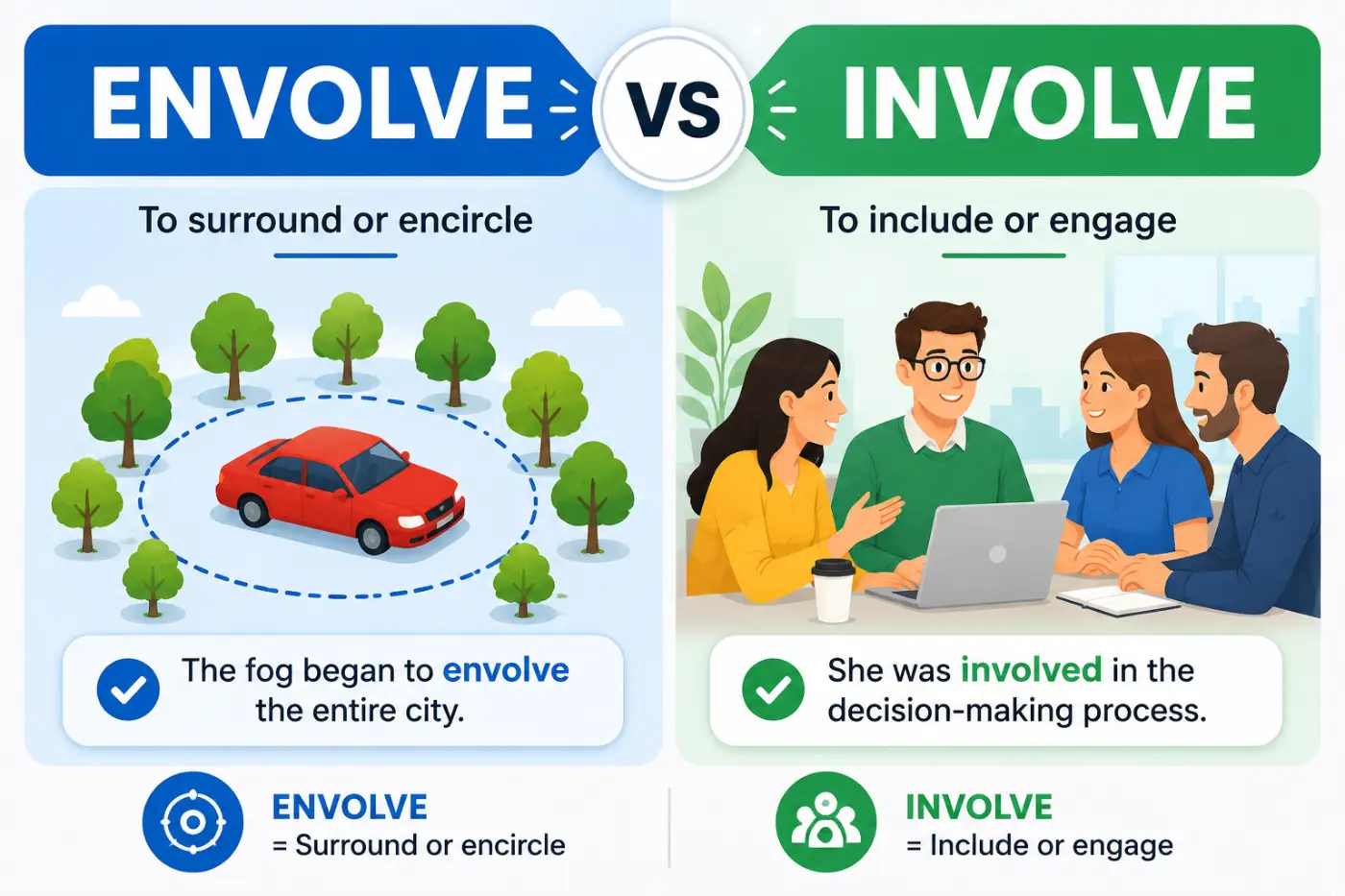
If you searched for envolve vs involve you probably want to know one simple thing. Which spelling is correct in English.
The correct word in modern English is involve. The spelling envolve is not the standard English form you should use in normal writing. You may still see envolve in older texts or in other languages. In modern American English it is generally treated as an incorrect spelling of involve.
Involve is a common verb with several useful meanings. It can mean to include someone or something. It can also mean to require something as part of a task.
This guide explains the difference in plain English. You will learn why the spelling causes confusion. You will also see real sentence examples. By the end you will know exactly when to use involve and how to avoid the common spelling mistake.
Quick Definition
Involve is the standard English spelling. It means to include someone or something in an activity or situation. It can also mean that an action or task requires something as a necessary part.
Envolve is not the normal modern English spelling of this verb. Some dictionaries and historical sources show it as an obsolete form connected to involve.
Direct Answer
Use involve in modern English. Do not use envolve as the spelling of this verb in standard American English.
Involve And Envolve At A Glance
| Word or phrase | Meaning | Example sentence | When to use it |
|---|---|---|---|
| Involve | Include or require something | The job will involve some travel. | Use this in modern English |
| Involved | Included or taking part | She was involved in the project. | Use this as the past form or adjective |
| Involving | Including or requiring | The task is involving several teams. | Use this as the present participle |
| Envolve | Obsolete spelling of involve | Rare historical use | Avoid it in normal modern English |
The key point is simple. Involve is the word you want in everyday writing, schoolwork, business communication, articles, emails, and conversation.
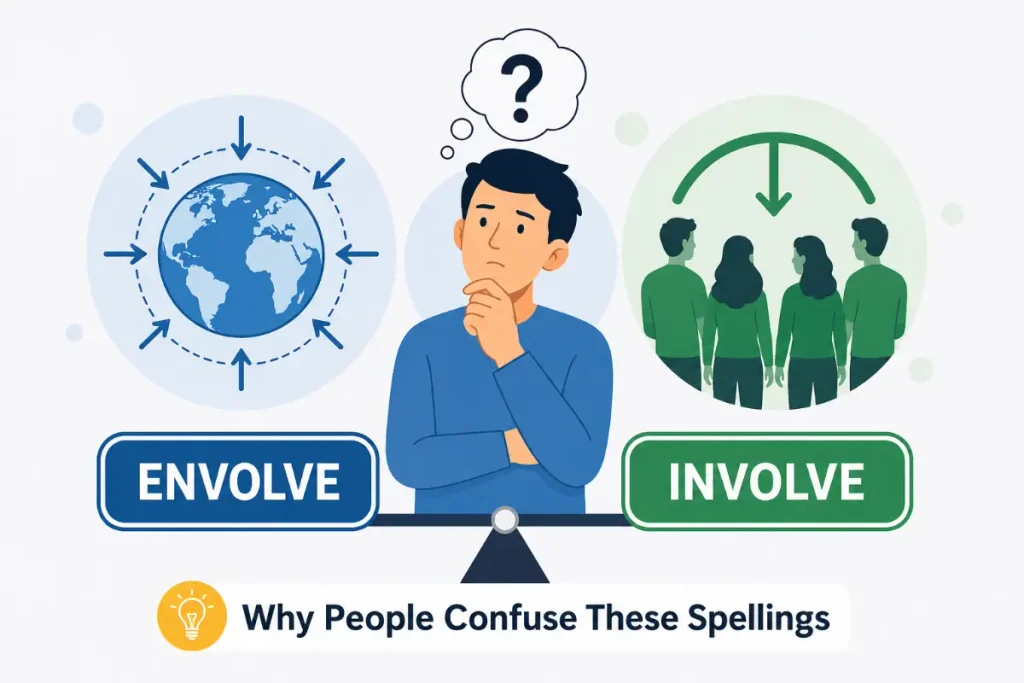
Why People Confuse These Spellings
The confusion has a real reason. It is not simply a random spelling error.
The word has a long history. Oxford notes that involve came into English from Latin and that envolve was formerly used as a spelling. Merriam Webster also traces the modern word through Middle English forms that included envolven and involven.
That history can make the older spelling look legitimate. In a historical text it may be legitimate. In modern American English it is not the form you should choose.
Another reason is pronunciation.
When people hear involve, the beginning can sound less clear than the spelling suggests. A learner may remember the sound and write the word as envolve. The final part also looks similar to words such as evolve and revolve. That can make the wrong spelling feel natural.
There is also a language connection worth knowing.
In Portuguese, envolve is a real form of the verb envolver. In Spanish, the related verb envolver can translate to involve in English depending on the context. That means English learners who know another language may encounter envolve outside English.
So if you have seen envolve before, you are not imagining it. The word can exist in other language systems or in older English usage. The issue is choosing the right form for modern English.
What Involve Means
Involve has more than one common meaning. That is one reason it appears so often in English.
The basic idea is connection.
Something can involve a person. It can involve an activity. It can involve a certain amount of work.
Oxford gives several modern uses. An activity can involve something as an important or necessary part. A person can be involved because they take part in something or are affected by it. The verb can also mean to make someone take part in an activity.
Here are the main uses.
Involve Can Mean Include
Use involve when something contains another thing as part of the situation.
For example.
- The course involves weekly reading.
- This means weekly reading is part of the course.
- The job involves customer service.
- Customer service is part of the job.
- The trip involves three days of hiking.
- Hiking is part of the trip.
This meaning is close to include. However, involve often suggests that the thing is naturally part of the activity or is required by it. Merriam Webster explains that involve can suggest inclusion because something is a natural or necessary consequence of the larger situation.
Involve Can Mean Require
Involve can also tell you what a task needs.
For example.
- The repair will involve replacing the damaged pipe.
- The move will involve renting a truck.
- The application process involves answering several questions.
- The word does not simply say that something is present. It often tells the reader that the activity cannot happen without that part.
- If a job involves travel, travel is one of the duties or conditions connected to the job.
- If a repair involves replacing a part, that replacement is part of the work needed.
Involve Can Mean Include People
You can use involve when people take part in something.
For example.
- The teacher involved the students in the discussion.
- The coach involved every player in the practice.
- We want to involve local residents in the planning process.
- Here the verb describes active participation.
- The people are not simply nearby. They are part of the activity.
- Cambridge gives this sense as including someone in an activity or making them take part in it.
Involve Can Mean Affect Someone
The word can also describe a situation that concerns or affects a person.
For example.
- This decision does not involve you.
- The accident involved several people.
- The case involved two companies.
- In these sentences, involve connects people or groups to an event or issue.
- Merriam Webster lists affect and concern among the close meanings of involve.
How To Use Involve Correctly
- The most useful way to learn this word is to see the patterns it follows.
- You will often see involve followed by a noun.
- The project involves careful planning.
- The story involves a young family.
- The investigation involved several witnesses.
- You can also use involve with a verb ending in ing.
- The job involves working with children.
- The process involves checking every document.
- The course involves writing a short report.
- Oxford specifically lists the pattern involve something and the pattern involve doing something.
- Another common structure is involve someone in something.
- The manager involved me in the decision.
- She involved her parents in the discussion.
Involve In Everyday Sentences
Learning a word becomes easier when you see it in situations you actually recognize.
Here are natural examples.
At Work
- The new position involves working with customers.
- The project involves several departments.
- My role involves answering emails and preparing reports.
- The job may involve occasional travel.
- The meeting involved a long discussion about the budget.
These examples show that involve often describes duties and responsibilities.
At School
- The assignment involves reading two chapters.
- The teacher wants to involve students in class discussions.
- The science project involves collecting and comparing data.
- The activity involves working with a partner.
- The course involves a lot of practice.
Notice how often the word connects an activity with something required for that activity.
In Daily Life
- Moving to a new apartment involves a lot of planning.
- Cooking this meal involves several steps.
- The trip involves a long drive.
- The repair involves removing the old part.
- Planning a wedding can involve a lot of decisions.
These sentences sound natural because involve connects the main activity with the work or conditions that come with it.
In News And Public Issues
- The investigation involved several agencies.
- The case involves a dispute between two companies.
- The accident involved three vehicles.
- The decision could involve major changes to the policy.
- Many people were involved in the response.
This use is common in news writing because it gives a clear way to show who or what is connected to an event.
Involve Versus Include
These words overlap. That can make them hard to separate.
Include usually means that something is part of a larger group or whole.
- The price includes breakfast.
- The package includes two tickets.
- The report includes several charts.
Involve can also mean include. But it often carries the idea that something is connected to an activity, result, process, or requirement.
- The job involves customer service.
- The repair involves replacing the battery.
- The project involves three different teams.
A simple memory trick can help.
- Think of include as showing what is inside a group.
- Think of involve as showing what is connected to an activity or situation.
For example.
- The meal includes dessert.
- The meal involves several courses.
- The first sentence tells you what is part of the meal.
The second sentence describes how the meal is structured or what it requires.
The distinction is not always strict. Native speakers use the words in overlapping ways. The best choice depends on the relationship you want to describe. Merriam Webster lists include as a close synonym while pointing out that involve can suggest inclusion as a natural or necessary part of something.
Involve Versus Entail
Entail is another word that sometimes overlaps with involve.
If something entails an action, that action is a necessary result or condition.
For example.
- The new rules entail extra paperwork.
- This means the new rules necessarily bring extra paperwork.
- You can often use involve in a similar sentence.
- The new rules involve extra paperwork.
- The difference is small but useful.
Involve is more common in everyday English. Entail often sounds more formal. You will see entail more often in academic writing, legal writing, and formal explanations.
If your goal is clear everyday English, involve is usually the easier choice.
Involve Versus Affect
These words can also overlap.
- If something affects you, it has an effect on you.
- If something involves you, you are connected to it or included in it.
Compare these examples.
- The new schedule affects all employees.
- The new schedule involves all employees in the planning process.
- The first sentence focuses on the effect.
- The second focuses on participation or connection.
Another example makes the difference clearer.
- The decision affected my family.
- The decision involved my family.
- The first says the decision had an effect on the family.
- The second says the family was connected to the decision.
- That small difference can change the meaning of a sentence.
The Correct Forms Of Involve
- Once you know the main verb, the other forms are easy.
- The base form is involve.
- The third person singular form is involves.
- The past form is involved.
- The past participle is involved.
- The present participle is involving.
- Oxford lists these standard forms as involve, involves, involved, and involving.
- Here they are in natural sentences.
- I involve my team in major decisions.
- She involves her staff in the process.
- They involved several experts in the project.
- He was involved in the discussion.
- The task is involving several departments.
The last example is grammatically possible but often sounds less natural than a clearer construction such as The task involves several departments. That is a useful point for learners. Knowing a word does not mean every grammatical form will sound equally natural in every sentence.
Involved As An Adjective
Involved does more than act as the past form of involve. It can also work as an adjective.
If someone is involved in something, that person takes part in it or has a connection to it.
For example.
- She is involved in the project.
- He is involved in community work.
- They are deeply involved in the organization.
- Merriam Webster defines involved as having a part in something or actively participating in it.
- Involved can also mean complicated.
For example.
- The instructions are very involved.
- That means the instructions are complex and may be difficult to follow.
- The case became an involved legal matter.
- Here involved does not mean that a person participated. It describes complexity.
- That second meaning can surprise English learners.
Common Mistakes With Involve
Many mistakes happen because learners know the meaning but not the standard spelling or sentence pattern.
Writing Envolve Instead Of Involve
This is the main spelling problem.
Incorrect.
The project will envolve several teams.
Correct.
The project will involve several teams.
The correct modern English form is involve. Historical sources explain that envolve appeared as an older form, but it is not the standard spelling for current English.
Using Involve When Include Is Clearer
Sometimes writers use involve simply because it sounds more advanced.
That can make a sentence less direct.
For example.
- The price involves tax and shipping.
- A clearer sentence is.
- The price includes tax and shipping.
Use the word that expresses the relationship most clearly. You do not need a bigger word just to sound formal.
Forgetting The Preposition In
When you talk about participation, involve often appears with in.
She is involved in the project.
He became involved in the organization.
They involved us in the discussion.
A common mistake is to leave out in.
Incorrect.
She is involved the project.
Correct.
She is involved in the project.
The phrase involved in is extremely common in natural English.
Using A To Form After Involve
When involve describes an activity, English normally uses a verb ending in ing after it.
Correct.
The job involves working with customers.
Correct.
- The process involves checking the records.
- A sentence such as The job involves to work with customers is not standard English.
- Remember the pattern.
- Involve plus noun.
- Involve plus verb ending in ing.
For example.
- The job involves travel.
- The job involves traveling.
Both can work depending on the meaning and context.
Why Involve Is The Safe Choice
If you are writing an email, essay, article, resume, school assignment, report, or social media post, choose involve.
It is the standard modern form. Major English dictionaries define it as a current verb and give its common meanings and grammatical forms.
You do not need to worry about the older spelling unless you are reading historical material or studying language history.
For normal communication, the rule is easy.
Use involve.
Avoid envolve.
That simple choice will keep your writing correct.
A Simple Memory Trick
- If you keep mixing up the two spellings, use a visual trick.
- Think of the word involve as having in at the beginning.
- The idea behind the word often connects to being inside or part of something.
- You can be involved in a project.
- You can involve someone in a discussion.
- A job can involve several tasks.
- The spelling starts with in and then uses volve.
- So write it as.
- in plus volve equals involve.
- Do not change the first part to en.
This is not a perfect explanation of the word’s full history. It is simply a useful spelling reminder.
Another trick is to connect involve with its common forms.
- Involve.
- Involved.
- Involving.
- Involves.
All four keep the same core spelling.
Once you remember that family, the spelling becomes much easier.
The History Behind The Word
The history of involve explains why the spelling question exists.
Oxford traces the word to Latin involvere. The Latin word carried ideas connected with rolling something inward, wrapping, surrounding, or enfolding. The English word later developed several related meanings.
Merriam Webster gives the first known use of involve in the 14th century. It also traces the word through Middle English forms including envolven and involven.
The meaning changed over time.
Early uses were connected with ideas such as covering, surrounding, or wrapping. Later uses developed toward ideas of engaging someone, connecting someone to an event, and including something as part of a situation.
That history makes the older spelling easier to understand.
It does not make the spelling equally useful today.
English changes over time. A spelling that once appeared in English can disappear from normal use. That is exactly the kind of change that can create confusing word pairs for modern readers.
Is Envolve Ever Correct
In modern standard English, you should not use envolve as the normal spelling of involve.
There is a small historical detail to keep in mind.
Wiktionary records envolve as an obsolete spelling of involve. Oxford also notes that involve was formerly written as envolve.
So the spelling has a place in language history.
If you are writing a modern article or school paper, though, using envolve will likely look like a spelling mistake.
There is also a separate issue involving other languages. Envolve or related forms can appear in languages such as Portuguese and Spanish. In those cases the word belongs to that language and does not follow modern English spelling rules.
Context matters.
English writing requires involve.
Examples To Copy And Learn From
The fastest way to make a spelling choice stick is to see the word used correctly many times.
Here are useful examples.
- The project will involve several local businesses.
- The job involves working with children.
- The course involves reading and writing every week.
- She wants to involve her team in the decision.
- He became involved in the community.
- The accident involved two vehicles.
- The investigation involved several witnesses.
- This issue does not involve you.
- The new plan involves some extra costs.
- The repair involves replacing the damaged part.
- The event involved hundreds of people.
- The process involves careful planning.
- The company involved customers in the testing process.
- Parents should be involved in their children’s education.
- The case became more involved than expected.
- The instructions are too involved for a simple task.
How Native Speakers Think About The Word
- Native speakers usually do not stop to translate involve in their heads.
- They see the word as a connection word.
- Something is involved in something else.
- A person is involved in an activity.
- A task involves certain steps.
- A situation involves certain people.
- An event involves a group.
- That mental picture can help you use the word naturally.
- Think about a project.
- The project is the main activity.
- Several people work on it.
- Certain tasks are required.
- Some costs may come with it.
- Several decisions may affect it.
That is the core idea. Something is connected to the larger situation as a part of it or as something required by it.
When To Use Include Instead
- If you are unsure between involve and include, ask yourself a simple question.
- Am I simply listing something that is part of a group or package.
- If yes, include may be the better choice.
- The box includes a charger.
- The meal includes dessert.
- The report includes three charts.
- The price includes delivery.
- If you are describing an activity and the things connected to it, involve often sounds better.
- The job involves driving.
- The repair involves replacing a part.
- The project involves three departments.
- The course involves weekly practice.
This quick test will not solve every sentence. English has plenty of overlap. It will help you make a clear choice in many everyday situations.

When To Use Involved
- Use involved when you describe participation or connection.
- She is involved in the project.
- They were involved in the event.
- He is involved in local politics.
- Several people were involved in the discussion.
- You can also use involved to describe complexity.
- The process is quite involved.
- The instructions are involved and difficult to follow.
- The two meanings are easy to separate from context.
- If you can replace involved with participating or connected, it probably describes participation.
- If you can replace it with complicated, it probably describes complexity.
FAQs
Is envolve a correct English word?
Envolve is not the standard modern English spelling of the verb. It appears as an obsolete historical spelling of involve and can also appear as a form in other languages. For normal English writing, use involve.
Is involve or envolve correct?
Involve is correct in modern English. Envolve should not be used as the normal spelling of this verb. Major English dictionaries list involve as the standard current form.
What does involve mean?
Involve can mean to include someone or something in an activity or situation. It can also mean that something is a necessary part of a task or process. It can describe participation or connection to an event.
How do you use involve in a sentence?
You can use involve with a noun or with a verb ending in ing. For example, The job involves travel and The job involves traveling are both natural constructions. You can also use involve someone in something to describe active participation.
What is the past tense of involve?
The past tense is involved. For example, The project involved several people. Involved is also used as an adjective in sentences such as She was involved in the project.
What is the difference between involve and include?
Include usually focuses on something being part of a group or whole. Involve often focuses on something being connected to an activity, process, result, or situation. The two words can overlap in many sentences.
Why do people spell involve as envolve?
The spelling can be confusing because envolve appeared as an older English form. It can also appear in other languages. Modern English uses involve as the standard spelling.
Is involve a common word in American English?
Yes. Involve is a common verb in American English. People use it when talking about work, school, activities, relationships, events, costs, processes, and many other situations. Cambridge and Merriam Webster both list several common meanings for the word.
Conclusion
The answer to envolve vs involve is straightforward. Use involve in modern English. It is the standard spelling used for the verb.
Remember the main meanings. Involve can mean include. It can mean require. It can mean take part in something or connect someone to an activity. The word can describe people, tasks, events, costs, decisions, and many other kinds of connections.
The spelling becomes easier once you connect it with its common forms. Involve becomes involves, involved, and involving. Keep the core spelling the same.

Dr. Arthur Pendelton is a veteran historical linguist and grammar expert with over 30 years of experience in academic editing. A retired professor, Arthur specializes in the etymology and evolution of the English language. He is passionate about “unpacking the history behind the rules,” helping readers understand why we spell, punctuate, and phrase things the way we do today. Whether he’s settling debates on archaic usage or explaining complex linguistic shifts, Dr. Pendelton brings scholarly precision to every article.