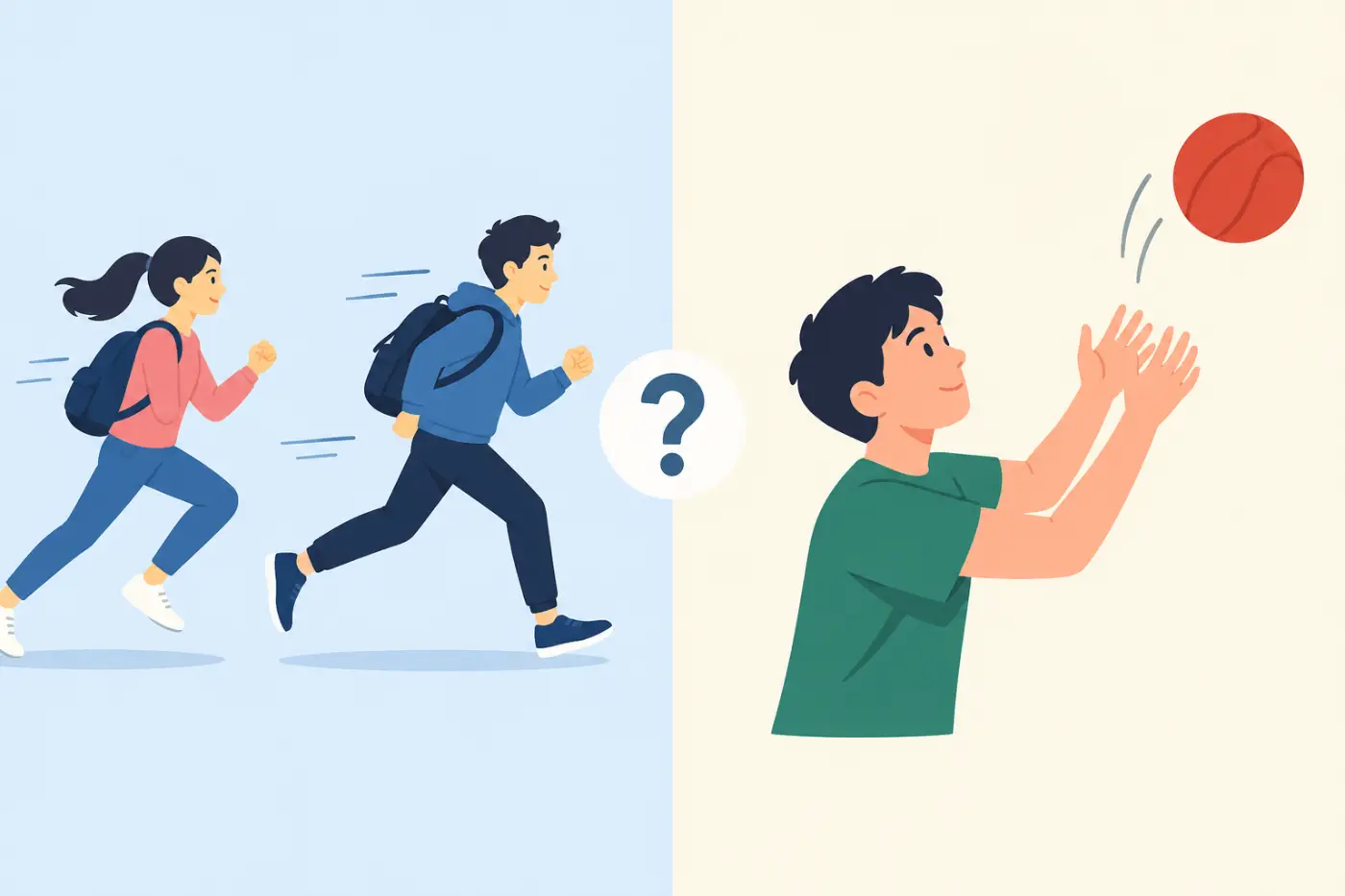
If you have ever stopped while writing a sentence and wondered about catchup or catch up you are not alone. The two forms look almost identical when you see them on a screen. The small space can still change the role and meaning of the word.
For the verb meaning to reach someone who is ahead of you or to finish work you missed the correct form is catch up. It is written as two separate words. For example, you can say “I need to catch up on my work” or “She ran faster to catch up with us.” Cambridge Dictionary lists catch up as a phrasal verb with these meanings.
The form catchup has a different use. In American English, Cambridge Dictionary lists catchup as a noun meaning another spelling of ketchup. Dictionaries also show noun uses connected with reaching the same level or having a conversation to exchange news. Those noun uses can vary by dictionary and style.
This guide explains the difference in plain English. You will learn the main rule for the verb, how to use the phrase with on and with, when a noun form can appear, and which mistakes to avoid. You will also see plenty of natural examples that show how people actually use these forms.
Quick Definition
Catch up is the standard two word form when it works as a verb. It can mean reaching someone who is ahead, reaching the same level as someone else, finishing work that you missed, or getting recent news from someone. Catchup is a noun in some uses and is also a US spelling of ketchup.
Direct Answer
If you are using the phrase as a verb, write catch up as two words. Catchup is not the standard spelling of the verb.
Comparison Table
| Word or Phrase | Meaning | Example Sentence | When to Use It |
|---|---|---|---|
| catch up | Reach someone or something ahead of you | I walked faster to catch up with my friends. | Use it as a verb. |
| catch up | Reach the same level or standard | I missed two classes and need to catch up. | Use it for progress or lost work. |
| catch up | Finish something you missed or delayed | I stayed late to catch up on emails. | Use it with tasks or work. |
| catch up | Get recent news from someone | We talked after work to catch up. | Use it for social conversation. |
| catchup | Another spelling of ketchup in US English | The restaurant serves catchup with fries. | Use it only for the sauce meaning when that spelling fits the style. |
| catchup | A noun form found in some informal usage | We had a quick catchup after lunch. | Use it carefully because formal dictionaries and styles vary. |

Catchup or Catch Up in English
The easiest way to remember the main rule is to ask one simple question. Are you using the word as a verb?
If the answer is yes, use catch up.
The phrase is a phrasal verb. A phrasal verb combines a verb with another small word that changes or completes its meaning. In this case, catch combines with up.
For example:
- “I need to catch up.”
- “She is trying to catch up.”
- “We should catch up soon.”
- “He stayed home to catch up on his reading.”
In all four sentences, catch up describes an action. That is why it stays as two words.
Cambridge Dictionary identifies catch up as a phrasal verb in American English. It gives meanings that include reaching another person or thing, reaching the same standard, doing something that you did not have time to do earlier, and talking with someone to exchange news.
That pattern is easy to apply once you see it.
Why Catch Up Has Two Words
English has many phrasal verbs that look like they could become one word. They often do not.
Consider these examples.
- “Please sit down.”
- “I need to wake up.”
- “Can you slow down?”
- “We should get together.”
- “I need to catch up.”
The verb and the second word work together. Still, they remain separate words when the phrase functions as a verb.
This is why writing “I need to catchup” is incorrect in standard English.
The same rule applies in different tenses.
- “I need to catch up.”
- “I am catching up.”
Notice that the second word stays separate in each form. The verb changes, but the structure remains clear.
Catch Up Means Reach Someone
One common meaning involves physical movement.
Imagine that your friend walks ahead of you. You start walking faster because you want to reach your friend. You are trying to catch up.
For example:
- “I walked faster to catch up with my sister.”
- “The other runners are starting to catch up.”
- “Wait for me. I need to catch up.”
- “She left five minutes earlier, but I caught up with her near the station.”
This meaning is very easy to picture. Someone is ahead. You move faster. Then you reach the same point.
Cambridge gives this basic meaning as reaching someone or something in front of you by moving faster.
The phrase can also work with things rather than people.
- “The second car caught up with the first one.”
- “Technology is changing so quickly that older systems struggle to catch up.”
- “The smaller company is trying to catch up with its larger competitors.”
In these examples, the idea stays the same. Something is behind and tries to reach something that is ahead.
Catch Up Means Reach the Same Level
The phrase also has a broader meaning. You can use it when someone falls behind in school, work, sports, business, or another area.
For example:
- “I missed several classes, so I need to catch up.”
- “She studied all weekend to catch up with the rest of the class.”
- “Our team is behind, but we still have time to catch up.”
- “He took a break from training and now needs to catch up.”
This meaning does not involve physical movement. Instead, it describes progress.
Think of a race. One person is far ahead. Another person is behind. The person behind works harder and slowly closes the gap.
That person is catching up.
The same idea works in everyday life. You might fall behind on homework, emails, bills, reading, or chores. You then spend time catching up.
Catch Up Means Finish Missed Work
This is one of the most common uses in American English.
You can catch up on work that you did not finish earlier.
For example:
- “I need to catch up on my emails.”
- “She spent Saturday catching up on paperwork.”
- “I am behind on my reading and need to catch up.”
- “After being sick for a week, he had a lot of schoolwork to catch up on.”
The phrase often appears with on when you are talking about unfinished work or information.
The basic pattern is:
catch up on + task or information
Examples include:
“catch up on homework”
“catch up on reading”
Cambridge lists this use as doing something you did not have time to do earlier.
There is a useful mental picture here. You have a pile of unfinished things sitting behind you. You work through that pile until you are no longer behind.
Catch Up Means Get Recent News
There is another very common use that has nothing to do with being behind.
You can catch up with a friend after you have not talked for some time. The goal is to learn what has happened in that person’s life.
For example:
- “I called my cousin so we could catch up.”
- “We should catch up over coffee.”
- “I haven’t talked to Jake in months. I need to catch up with him.”
- “We spent an hour catching up after the meeting.”
Cambridge defines this use as learning or discussing the latest news.
This is especially common in casual American conversation.
Someone might say:
“Let’s catch up sometime.”
That does not usually mean that one person is physically chasing another. It means they want to talk and share news.
The meaning comes from context.
The Main Rule for Catch Up
The simplest rule is worth repeating because it solves most spelling questions.
Use catch up as two words when it is a verb.
That rule works in sentences such as:
- “I need to catch up.”
- “She wants to catch up with her friends.”
- “He is trying to catch up with the other students.”
- “We need to catch up on our work.”
- “They finally caught up with us.”
The tense can change, but the two word structure stays in place.
You can also put another word between parts of the phrase in some structures.
For example:
- “I need to catch him up.”
- “She tried to catch me up on the latest news.”
This structure has a different grammar pattern. Still, the words remain separate.
Catch Up With Someone
The phrase catch up with has several meanings.
The first is physical.
“I ran to catch up with my brother.”
The second means reaching the same level.
“Our team is working hard to catch up with the leaders.”
The third means talking with someone and sharing recent news.
“I caught up with an old friend last weekend.”
Cambridge lists all of these uses. It also shows that catch up with can have another meaning when something negative eventually causes problems for someone.
For example:
“His bad habits finally caught up with him.”
That sentence does not mean that someone ran after him. It means the results of his actions eventually affected him.
Context does a lot of work with this phrase.
Catch Up On Something
Use catch up on when you mean completing or reviewing something that you missed.
Examples include:
- “I need to catch up on my homework.”
- “She is catching up on the latest news.”
- “I spent Sunday catching up on emails.”
- “We watched the recordings to catch up on the lessons.”
- “He took the weekend to catch up on sleep.”
The object after on tells you what you are trying to recover or review.
A useful shortcut is this.
Use catch up with for a person or something you are trying to reach.
Use catch up on for work, information, activities, or things you missed.
That is not an absolute rule for every sentence in English, but it covers the most common everyday patterns.
When Catchup Can Be Correct
Now we reach the part that causes most confusion.
Catchup is a real English word. It is not simply a bad version of catch up in every situation.
Cambridge Dictionary lists catchup as a noun in US English meaning another spelling of ketchup.
For example:
- “I asked for catchup with my fries.”
- “The burger came with catchup and mustard.”
That use has nothing to do with the verb catch up.
It refers to the tomato sauce.
So if someone writes “catchup” in a sentence about food, the spelling can be correct.
The problem starts when someone uses catchup as the verb.
For example:
“I need to catchup on work.”
That spelling is not standard.
The correct sentence is:
“I need to catch up on work.”
The distinction is simple once you focus on the grammatical role.
Catchup as a Noun
English also has noun uses connected with the idea of catching up.
Dictionaries differ in how they present this form. Cambridge lists a noun entry using catch up in some American English definitions and also records catchup in other dictionary entries. Collins lists the noun as catch up with a hyphen in its standard dictionary presentation.
Because you are writing for a US audience, the safest approach is to look at the exact style of your publication when you need the noun.
For ordinary verb use, there is no need to worry.
Use catch up.
For example:
- “I need to catch up with my team.”
- “We should catch up soon.”
- “She stayed late to catch up on her work.”
These forms are clear and standard.
Catchup or Catch Up in a Sentence
If you are choosing between the two forms in an ordinary sentence, catch up is almost always the form you want when the word describes an action.
Look at these examples.
- Incorrect:
- “I have to catchup on my work.”
- Correct:
- “I have to catch up on my work.”
- Incorrect:
- “She needs to catchup with the class.”
- Correct:
- “She needs to catch up with the class.”
- Incorrect:
- “We should catchup later.”
- Correct:
- “We should catch up later.”
- Incorrect:
- “He is trying to catchup with the other runners.”
- Correct:
- “He is trying to catch up with the other runners.”
The problem in each incorrect sentence is the same. The writer has turned a two word verb into one word.
That is why it helps to identify the verb before thinking about spelling.
Common Mistake With Catch Up
One common mistake is writing the phrase as one word because it sounds like one unit when spoken.
English has many expressions that sound tightly connected even though they contain separate words.
Catch up is one of them.
When you say it aloud, you may not hear the space. Writing is different. Written English depends on the standard form of the phrase.
This is also why spell check can sometimes be confusing. A spell checker may recognize catchup as a valid word because catchup has a legitimate dictionary meaning. That does not mean it works in every sentence.
A dictionary can tell you that a word exists. Grammar tells you if that word fits the sentence.
Those are two different questions.
Common Mistake With Catch Up On
Another mistake is leaving out on when the meaning involves unfinished work.
For example:
“I need to catch up my emails.”
That sentence does not express the intended meaning.
The natural form is:
- “I need to catch up on my emails.”
- The same pattern appears in many sentences.
- “I need to catch up on my reading.”
- “She needs to catch up on her assignments.”
- “He spent the evening catching up on the news.”
- “We have to catch up on our reports.”
The word on connects the phrase to the activity or information you missed.
Common Mistake With Catch Up With
Writers sometimes use the wrong preposition after catch up.
For example:
- “I need to catch up my friend.”
- The natural form for the social meaning is:
- “I need to catch up with my friend.”
You can also say:
- “I need to catch up with Sarah.”
- “We caught up with our neighbors.”
- “She wants to catch up with her old classmates.”
The phrase catch up with someone is common when you mean reaching a person or talking with them after some time apart.
Catch Up To Someone
American English also uses catch up to when someone is trying to reach another person or group.
For example:
- “The younger runner is starting to catch up to the leader.”
- “I hurried so I could catch up to my friends.”
- “Our company is trying to catch up to its biggest competitor.”
Cambridge’s American Dictionary includes catch up to in the sense of reaching someone or something by moving faster.
You will also see catch up with in similar situations.
For everyday writing, both can be natural. The choice often depends on the sentence and the variety of English being used.
The important point is that the verb remains catch up.
Real Examples You Can Copy
Seeing the phrase in real sentences makes the rule easier to remember.
Everyday Conversation
- “I haven’t seen you in ages. We should catch up.”
- “Call me tonight so we can catch up.”
- “I need to catch up with my sister.”
- “We caught up over coffee.”
- “She called an old friend to catch up.”
These sentences use catch up as a social verb.
School
- “I missed two days of school, so I need to catch up.”
- “Sam stayed after class to catch up on his work.”
- “She studied all weekend to catch up with the rest of the class.”
- “The teacher gave him extra work to help him catch up.”
- “After being sick, I had to catch up on several lessons.”
Work
- “I need to catch up on my emails.”
- “We spent the morning catching up on reports.”
- “She stayed late to catch up with her workload.”
- “Our team is trying to catch up with the new schedule.”
- “I have been away for three days, so I have a lot to catch up on.”
Travel
- “Go ahead. I will catch up with you at the hotel.”
- “We walked faster to catch up with the group.”
- “He took a shortcut and caught up with us later.”
- “The second car caught up with the first car.”
News
- “I need to catch up on the latest news.”
- “We talked for an hour and caught up on everything.”
- “I watched the recorded episodes to catch up.”
- “She spent the evening catching up on the news.”
Sports
- “Our team fell behind early but managed to catch up.”
- “The runner is slowly catching up with the leader.”
- “They need two more goals to catch up.”
- “He trained hard to catch up with the other players.”
These examples show how flexible the phrase can be. The core idea is always connected to reaching something that was ahead or recovering something that was missed.
How the Phrase Changes With Tense
The phrase stays separate when the tense changes.
Present:
“I catch up with my friends every few weeks.”
Present continuous:
“I am catching up with my friends tonight.”
Past:
“I caught up with my friends yesterday.”
Present perfect:
“I have caught up with most of my work.”
Past perfect:
“I had caught up before the deadline.”
Future:
“I will catch up tomorrow.”
Infinitive:
“I need to catch up.”
Notice that none of these forms turns catch up into one word.
This is a useful test when you are unsure. Put the phrase into another tense. If it describes an action, keep the words separate.
A Simple Memory Trick
Think of catch and up as two people holding hands.
Catch tells you about reaching something.
Up adds the idea of moving toward a higher point or closing a gap.
The words work together, but they still have their own jobs.
So when you are using the phrase as a verb, picture two separate words.
Catch + up = catch up.
You can use the same trick with examples.
- “I need to catch up.”
- “I will catch up.”
That small visual reminder can prevent a surprising number of spelling mistakes.
Catch Up And Related Expressions
Once you understand the main phrase, several related expressions become much easier.
Catch Up With Work
This expression means dealing with work that has built up.
For example:
- “I need to catch up with my work.”
- “She spent the afternoon catching up with her tasks.”
- “We are finally caught up with the paperwork.”
- You can also use catch up on with work.
- “I need to catch up on my work.”
Both patterns appear in English. The exact preposition depends on the sentence and the intended meaning.
Catch Up On Sleep
This is a very common phrase.
If you did not get enough sleep, you may say:
- “I need to catch up on sleep.”
- “I slept late Saturday to catch up on sleep.”
- “After several late nights, she needed to catch up on her sleep.”
Here the phrase means getting enough rest to make up for earlier lost sleep.
Catch Up On The News
This phrase means learning recent information.
- “I watched the morning news to catch up.”
- “I need to catch up on the latest news.”
- “We talked for an hour and caught up on everything that happened.”
This use is common in everyday conversation, work, and media.
Catch Up With Friends
This is one of the most natural social uses.
- “I am meeting my friends tonight to catch up.”
- “I caught up with an old friend yesterday.”
- “We should catch up soon.”
In these sentences, the phrase means talking and sharing recent news.
Cambridge specifically includes this social meaning in its American English entry.
Catch Up With A Person Who Is Ahead
The physical meaning is also common.
- “I ran to catch up with my brother.”
- “She walked faster to catch up with us.”
- “The police car caught up with the driver.”
- “The cyclist caught up with the group.”
Here catch up means reaching someone who is ahead.
Catch Up With A Standard
The phrase can describe progress.
- “The student worked hard to catch up with the class.”
- “The company is trying to catch up with its competitors.”
- “He needs more practice to catch up with the other players.”
This use is especially common when someone or something has fallen behind.
Is Catchup Ever Used For A Meeting
Yes. You may see catchup used as an informal noun for a meeting or conversation.
For example:
- “We had a quick catchup after lunch.”
- “I scheduled a catchup with my manager.”
- “I had a catchup with an old friend.”
However, noun spelling is less consistent than verb spelling. Cambridge has dictionary entries that record catchup as a noun in some contexts and catch up as a noun in others. Collins uses a different dictionary form for the noun.
That variation is useful to know because you may see all kinds of forms online.
For careful US English writing, the safest choice is to follow the style guide used by your publication.
If you simply mean the action of reaching someone or completing missed work, there is no debate.
Write catch up.
Is Catchup The Same As Ketchup
In US English, catchup can be another spelling of ketchup.
Cambridge Dictionary lists catchup as a noun meaning the sauce commonly called ketchup.
For example:
- “Please pass the catchup.”
- “The fries came with catchup.”
This meaning is completely different from the verb catch up.
That distinction matters because the words look similar but belong to different grammatical categories.
If you are writing about food, catchup can make sense.
If you are writing about finishing missed work, reaching someone, or talking with a friend, use catch up.
Is Catch Up Formal Or Informal
Catch up is normal everyday English. It works in casual conversation and in many forms of professional and academic writing.
For example:
“I need to catch up on my reading.”
That sentence sounds natural in both everyday speech and ordinary writing.
You can also use it in a formal context.
“The team needs additional time to catch up with the revised schedule.”
The phrase itself is not slang. It is a standard phrasal verb.
In very formal writing, you might choose a more precise phrase depending on the sentence. You could use words such as recover lost ground, reach the same level, complete delayed work, or obtain recent information.
Still, there is usually no reason to avoid catch up. It is clear and widely understood.
Why People Confuse The Two Forms
The confusion comes from pronunciation.
When people speak quickly, catch up can sound almost like one word. The two sounds blend together.
That happens often in English.
Speech does not always reveal where one written word ends and another begins.
The same issue appears with many phrasal verbs.
For example:
- “pick up”
- “wake up”
- “set up”
- “clean up”
- “look up”
- “find out”
- “give up”
- “turn off”
These expressions can sound like single units in natural speech. On the page, they still follow their standard spelling patterns.
Catch up works the same way.
The fact that it sounds connected does not mean you should join the words when you write them.
A Fast Test For Writers
When you are unsure about catchup or catch up use this three step check.
First, look at the word after it.
If you are talking about an action such as reaching someone, finishing work, or talking with a friend, you probably need catch up.
Second, check the sentence tense.
If you can change it to caught up, catching up, or will catch up, you are dealing with the verb.
Third, ask what the phrase means.
If it means reaching, recovering, finishing, or getting recent news, use the two word verb.
For example:
“I need to catch up on my reading.”
Change the tense:
“I caught up on my reading.”
The phrase clearly works as a verb.
Now consider:
“The restaurant serves catchup with fries.”
You cannot change catchup into caught up without destroying the meaning. It refers to a noun.
That quick test usually gives you the answer.

What About Catching Up
The phrase also appears as catching up when the verb is in the continuous form.
For example:
- “I am catching up on my work.”
- “She is catching up with the class.”
- “We are catching up with old friends.”
- “They are catching up on the latest news.”
The base form is catch up. When the verb takes the ing ending, catching and up remain connected in the same phrase but are still separate words.
The same applies to the past form.
- “I caught up with him yesterday.”
- “She caught up with the rest of the group.”
- “We finally caught up on our work.”
There is no reason to join the words.
What About Caught Up
Caught up is another common form.
For example:
- “I am caught up on my emails.”
- “She is caught up with her work.”
- “We finally got caught up.”
Here caught is the past participle of catch.
The phrase still contains two words.
This form can also describe being deeply involved in something.
For example:
- “He got caught up in the excitement.”
- “She was caught up in the story.”
That meaning is related to the broader idea of becoming involved or absorbed. Collins includes this use in its entry for catch up.
What About Get Caught Up
You may also hear get caught up.
This phrase often means becoming current after falling behind.
For example:
- “I need to get caught up on my work.”
- “She took Friday off to get caught up.”
- “We finally got caught up with the project.”
It can also mean becoming involved in something.
“He got caught up in the argument.”
Again, the words stay separate.
Style Advice For Editors
If you are editing a sentence that contains catchup, do not automatically change it.
First, identify its role.
If it is a verb, use catch up.
If it is the US noun meaning ketchup, catchup can be correct.
This matters for SEO content because search results often contain informal writing. A form can appear frequently online without being the best choice for polished editorial content.
Good editing is not about copying the most common spelling you happen to see.
It is about choosing the form that fits the grammar, meaning, audience, and style.
For a US audience, the safest everyday rule remains simple.
Use catch up for the verb.
FAQs
Is catchup or catch up correct?
For the verb, catch up is correct. Use it when you mean reaching someone, reaching the same level, finishing missed work, or getting recent news. Catchup has separate noun uses and can also be a US spelling of ketchup.
Is catch up one word?
No. When catch up functions as a verb, write it as two words. For example, write “I need to catch up on my work” rather than joining the two words.
Is catchup a real word?
Yes. Catchup is a real word in some uses. Cambridge lists it in US English as another spelling of ketchup, and other dictionary entries also record noun uses connected with the idea of catching up.
Should I say catch up with or catch up on?
Use catch up with when you mean reaching a person or talking with someone. Use catch up on when you mean completing or reviewing work, information, or another activity you missed. For example, you can catch up with a friend and catch up on your emails.
Is it correct to say catch up with a friend?
Yes. Catch up with a friend is a natural and common expression. It usually means talking with the friend and learning what has happened since you last spoke.
Can catch up mean finish work?
Yes. Catch up can mean finishing work or another task that you did not complete earlier. For example, “I stayed late to catch up on my reports” means you spent extra time completing delayed work.
Can catchup mean ketchup?
Yes. In US English, catchup is listed as another spelling of ketchup. This meaning has nothing to do with the verb catch up.
What is the past tense of catch up?
The past form is caught up. For example, “I caught up with my classmates” and “She caught up on her reading.” The word catch changes to caught, but up stays separate.
Conclusion
The main answer to catchup or catch up is simple. When you use the phrase as a verb, write catch up as two words. This is the form you need for reaching someone, reaching the same level, finishing missed work, or talking with someone to exchange news.
The form catchup is not simply a careless version of catch up. It has legitimate noun uses. In US English, it can refer to ketchup, and dictionaries also record noun uses related to meetings and recovering lost ground. Those noun forms can vary by dictionary and editorial style.
For everyday writing, focus on the verb first. If you can say “I caught up,” “I am catching up,” or “I will catch up,” you are using the phrasal verb, so keep catch and up separate.
The easiest rule to remember is this. Catch up is the verb. Catchup has separate noun uses. When you are writing about work, school, friends, news, progress, or reaching someone who is ahead, two words will almost always be the form you need.

Dr. Arthur Pendelton is a veteran historical linguist and grammar expert with over 30 years of experience in academic editing. A retired professor, Arthur specializes in the etymology and evolution of the English language. He is passionate about “unpacking the history behind the rules,” helping readers understand why we spell, punctuate, and phrase things the way we do today. Whether he’s settling debates on archaic usage or explaining complex linguistic shifts, Dr. Pendelton brings scholarly precision to every article.