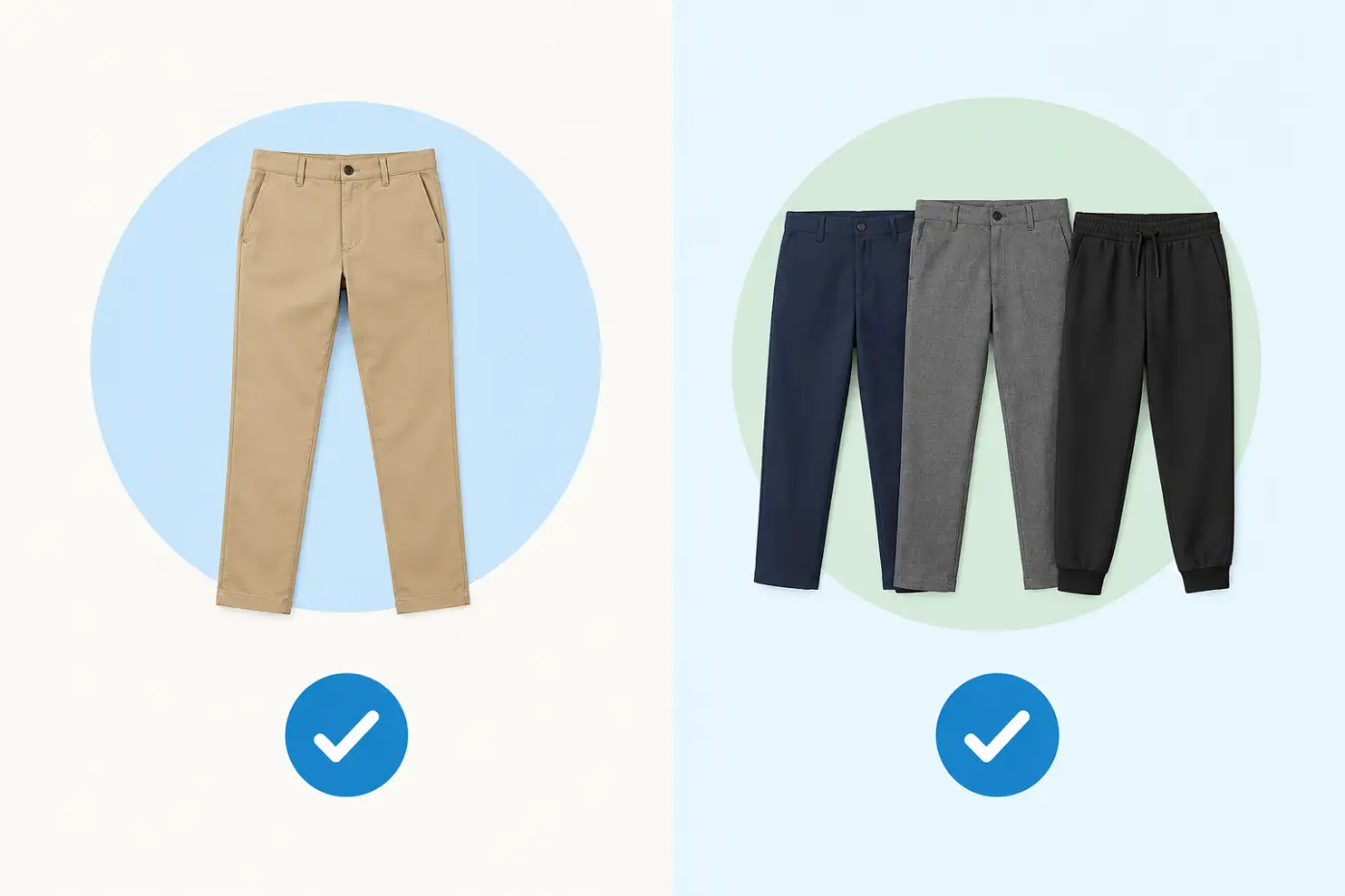
If you’re confused by pent vs pants, you’re not alone. The two words look somewhat similar, but they have completely different meanings. One describes something that is shut in or held back. The other usually refers to clothing worn on the lower body in American English.
The confusion often comes from spelling. Both words are short. Both contain the letters p, n, and t. Yet they don’t belong to the same word family, and you can’t swap one for the other in a sentence.
In American English, pants is the normal word for clothing that covers each leg from the waist downward. Pent is a less common word that means confined, shut in, or held back. Merriam Webster lists pent as an adjective, while pants is commonly used as a plural noun for clothing.
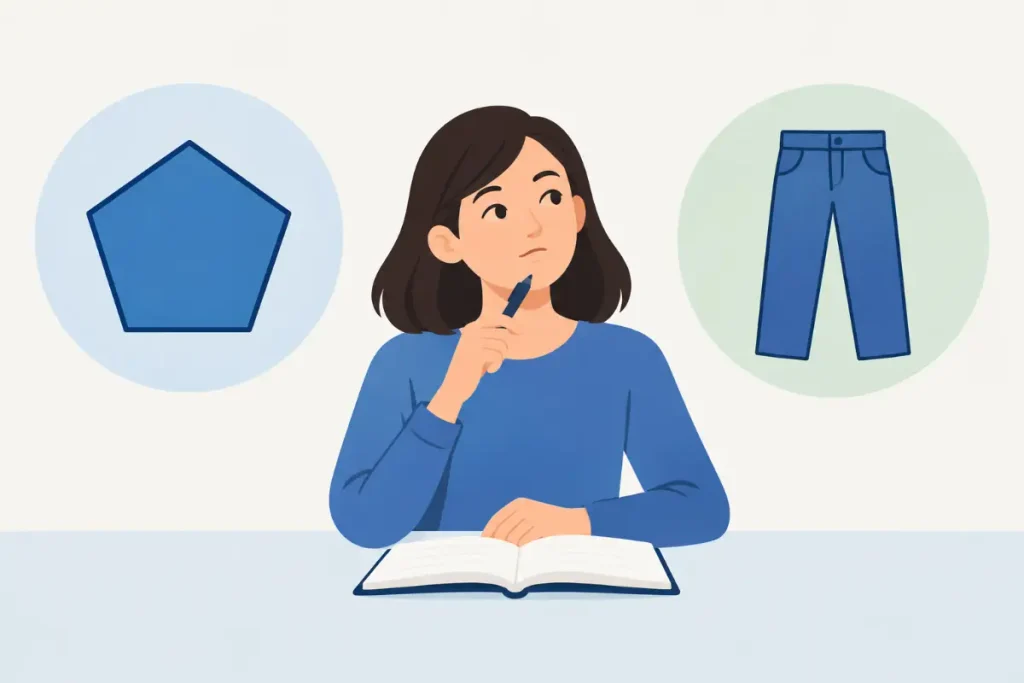
So if you’re writing about something you wear, use pants. If you’re describing feelings, pressure, people, or something being confined, pent may be the word you need. This guide explains the difference, shows how each word works in real sentences, and covers the mistakes that can cause confusion.
Quick Definition
Pent means confined, shut in, or held back. It often appears in the expression pent up, as in pent up anger or pent up frustration.
Pants usually means trousers in American English. It refers to clothing with separate sections for each leg.
Direct Answer
The correct word depends on your meaning. Use pants for clothing, and use pent when you mean confined, shut in, or held back.
Comparison Table
| Word | Meaning | Example Sentence | When to Use It |
|---|---|---|---|
| Pent | Confined or held back | He released his pent up anger. | Use it for feelings or things that have been held inside or confined. |
| Pants | Clothing worn on the lower body | I bought a new pair of pants. | Use it when talking about trousers or similar clothing. |

What Pent Means
Pent is an adjective that describes something kept inside or prevented from being freely expressed or released. It can describe feelings, energy, pressure, frustration, or other things that have been held back.
Merriam Webster defines pent as shut up, confined, or repressed. The word has been used in English for centuries and is commonly found in the phrase pent up.
- You might see sentences like these.
- She had years of pent up frustration.
- He finally expressed his pent up anger.
The workers released their pent up energy during the celebration.
The word carries the idea of something being trapped or held inside. Think of water behind a dam. The water is still there, but it cannot move freely. That basic idea can help you understand pent.
Pent Usually Describes Something Held Back
Pent often appears before a noun.
You might write:
- She struggled with pent up emotions.
- He was carrying pent up resentment.
- The team had plenty of pent up energy.
- The crowd released its pent up excitement.
In each sentence, something has been building inside. The feeling or force has not disappeared. It has simply been held back.
This is why pent often appears with emotional words. Anger, frustration, fear, excitement, resentment, and emotion can all build up over time.
Pent Can Describe More Than Feelings
Although emotions are common with this word, pent does not only describe feelings.
You can use it for anything that is confined or held in.
For example:
- The room was filled with pent heat.
- The old system created pent pressure.
- The device stored pent energy.
These uses are less common in everyday American speech than pent up anger or pent up frustration. Still, they follow the same basic idea. Something is being held back instead of moving or being released freely.
Pent Is Not a Clothing Word
This is one of the easiest ways to avoid confusion.
Pent has nothing to do with trousers, jeans, slacks, or other clothing. You would not say that someone bought a pair of pent.
You also would not say that someone wore pent to work.
Those sentences need pants.
If you remember only one rule from this section, remember this.
Pent describes something held in. Pants are something you wear.
What Pants Means
Pants is a common noun in American English. It refers to clothing that covers the lower part of the body and has a separate section for each leg. Cambridge Dictionary identifies pants as the usual American English word for what British English commonly calls trousers.
Here are some simple examples.
- I need a new pair of pants.
- These pants are too long.
- He wore black pants to the interview.
- My favorite pants are in the laundry.
She bought a pair of jeans and two pairs of pants.
In the United States, pants is an everyday word. You’ll hear it at home, at school, at work, and in clothing stores.
Pants Is Usually Plural
One interesting feature of pants is its grammar.
We normally say pants rather than pant when we mean the full item of clothing.
For example:
- These pants are comfortable.
- Those pants look expensive.
- My pants are wet.
- I need to wash my pants.
We also commonly use the phrase a pair of pants.
For example:
- I bought a pair of pants.
- He needs a new pair of pants.
- She wore a pair of black pants.
The word pair makes sense because the clothing has two leg sections joined at the top.
Merriam Webster notes that pant can sometimes be used in American English before another noun, as in pant leg. However, pants remains the common word for the full item of clothing.
Pants And Trousers
In American English, pants and trousers can refer to the same type of clothing. Pants is much more common in everyday American speech.
For example, an American speaker would normally say:
I need new pants.
A British speaker is more likely to say:
I need new trousers.
Cambridge Dictionary specifically lists trousers as the British term and pants as the usual American term.
This difference matters when you’re writing for a US audience. If your readers are Americans, pants will usually sound more natural than trousers.
Pants Can Have Different Meanings In English
Language gets interesting when you cross borders.
In American English, pants normally means trousers or similar outer clothing. In British English, pants commonly means underwear.
So the sentence can have a different meaning depending on the variety of English being used.
- An American might say:
- I bought new pants for work.
A British speaker could understand pants as underwear.
British English also has an informal use of pants meaning something poor or bad. Cambridge Dictionary lists this as UK slang.
That meaning is not the normal meaning of pants in American English.
For US focused writing, the safest everyday meaning is clothing worn on the lower body.
Pent vs Pants In Real Sentences
Seeing the words in context makes the difference much easier to remember.
Consider these examples.
- He bought new pants for his job interview.
- She kept her feelings pent up for years.
- The pants are too tight around the waist.
- He finally released his pent up frustration.
- I left my favorite pants at the dry cleaner.
The team had a lot of pent up energy after sitting indoors all day.
The meaning changes completely depending on the word.
Examples With Pent
Here are more natural examples using pent.
- She had pent up anger after the argument.
- He expressed his pent up emotions in his journal.
- The children had pent up energy after being stuck inside.
- Years of pent up frustration finally came out.
- The speech gave her a chance to release her pent up feelings.
- The pressure had been building because of pent up demand.
- He was tired of carrying around so much pent up resentment.
- The word describes something that has been contained or held back.
Examples With Pants
Now look at examples using pants.
- I need to buy new pants before the trip.
- These pants fit much better than my old pair.
- He wore dark pants with a white shirt.
- My pants got dirty during the hike.
- She folded her pants and put them in the drawer.
- Those pants are too short for him.
- I need a pair of pants that works for the office.
- These pants are made from lightweight fabric.
- The word refers to clothing.
Examples That Show The Contrast
You can make the distinction even clearer by putting the ideas side by side.
- He wore new pants to the meeting.
- He carried pent up frustration into the meeting.
- She bought black pants.
- She released her pent up anger.
- The pants were uncomfortable.
- The pent up pressure was difficult to ignore.
These examples show why the words cannot replace each other. They may look alike, but they perform completely different jobs.
Why People Confuse Pent And Pants
The main reason for the confusion is visual similarity.
Both words start with p and contain n and t. The only major difference is the vowel pattern and the final s in pants.
When people type quickly, they may choose the wrong spelling without thinking about meaning. Spellcheck can also miss some mistakes when the incorrect word is still a real English word.
That point matters.
If you type pent when you mean pants, a basic spellchecker may not always flag the mistake. Pent is a legitimate English word. It simply means something different.
This is why context matters more than spelling alone.
Similar Looking Words Can Have Different Meanings
English has many word pairs that look or sound close but mean different things.
For example:
- Accept and except.
- Affect and effect.
- Advice and advise.
- Lose and loose.
- Then and than.
Pent and pants belong to the same general type of spelling confusion. The words look similar enough to cause mistakes, but their meanings are far apart.
The best solution is not to memorize spelling alone. Learn what each word means and notice how it behaves in a sentence.
How To Remember The Difference
A simple memory trick can make this easy.
Think about the final s in pants.
Pants has an s because you are talking about clothing with two leg sections.
Then connect pent with the idea of something being penned in or confined.
The words pen and pent are related in a useful way because pen can mean to confine or shut something in. Merriam Webster lists the verb pen as meaning to shut in or confine.
That gives you a helpful mental link.
Pent means held in. Pants are worn.
Another memory trick is to think about a closet.
- Pants go in the closet.
- Pent feelings stay inside.
That small mental picture can help you choose the right word when you’re writing quickly.
The Phrase Pent Up
One of the most common places you will see pent is in pent up.
The phrase describes something that has been held back or kept inside for some time.
For example:
- She had pent up anger.
- He felt a need to release his pent up frustration.
- The children had pent up energy.
- The employee expressed years of pent up resentment.
- The crowd showed pent up excitement.
Merriam Webster specifically gives pent up feelings as a common use of the word.
Why Pent Up Is Common
Feelings often build over time.
Imagine someone who stays quiet during several arguments. They may not express their anger right away. Instead, the anger stays inside and grows.
That anger can be described as pent up.
The same idea applies to frustration.
A person may deal with small problems all day. Each problem adds a little more pressure. Eventually, the person may have pent up frustration that needs an outlet.
This is why the word appears so often in discussions about emotions.
Common Expressions With Pent
These are some useful combinations to know.
- Pent up anger.
- Pent up frustration.
- Pent up emotions.
- Pent up feelings.
- Pent up energy.
- Pent up resentment.
- Pent up excitement.
- Pent up demand.
The first few are especially common in everyday writing and speech.
The History Of Pants
The word pants has an interesting history.
Merriam Webster explains that pants is a shortened form of pantaloons. The longer word was connected to Pantalone, a character from Italian comic theater. Americans later shortened pantaloons to pants, and the shorter word became a standard term for the clothing.
Today, most Americans never think about that history when they say pants. It is simply a normal everyday word.
That history also explains why pants is connected to trousers and similar clothing terms.
The word has been around in English for a long time, but its meaning and use have developed over the years.
Pants In American English
For a US audience, pants is one of the most natural words for this type of clothing.
- You might hear:
- dress pants.
- work pants.
- casual pants.
- black pants.
- white pants.
- cargo pants.
- ski pants.
- sweatpants.
Cambridge Dictionary also lists many clothing terms that contain pants.
The exact style may change, but the basic noun stays the same.
Pants And Pant
There is another small point worth knowing.
Pants is the normal noun when you mean the full item.
Pant can appear in some expressions before another noun.
For example:
- pant leg.
- pant fabric.
- pant size.
Still, pants is the word you want in ordinary sentences such as:
- I bought new pants.
- Those pants fit well.
- My pants are in the closet.
Using pant instead of pants in these sentences would sound unnatural to most American speakers.
Common Mistakes With These Words
The most common mistake is using pent when you mean pants.
For example, this is incorrect:
- I bought a new pair of pent.
- The correct sentence is:
- I bought a new pair of pants.
Another common mistake happens when someone sees pent in a sentence and assumes it is a shortened form of pants.
It is not.
Pent has its own meaning and history. It is associated with confinement or something being held back. Pants refers to clothing in American English.
Mistake One
Incorrect:
She wore black pent to school.
Correct:
She wore black pants to school.
The sentence is about clothing, so pants is the right choice.
Mistake Two
Incorrect:
He had years of pants up anger.
Correct:
He had years of pent up anger.
The sentence is about anger being held inside, so pent is the correct word.
Mistake Three
Incorrect:
I need a new pair of pent.
Correct:
I need a new pair of pants.
The phrase pair of pants is a normal clothing expression in American English.
Mistake Four
Incorrect:
She finally released her pants up frustration.
Correct:
She finally released her pent up frustration.
The expression describes frustration that has been held back.
How To Choose The Right Word Quickly
You can solve the problem with one question.
Am I talking about clothing?
If the answer is yes, use pants.
If you’re talking about something being held inside or restrained, pent may be the right word.
For example:
- I need clean pants.
- This sentence is about clothing.
- She had pent up frustration.
This sentence is about a feeling that has been held back.
That simple meaning test is often faster than thinking about spelling.
Related Words You May Confuse
The confusion between pent and pants can lead to questions about several other words.
Understanding those words can make your overall English stronger.
Pant
Pant is a verb that means to breathe quickly or heavily. Merriam Webster also lists noun and adjective uses.
For example:
- The dog began to pant after running.
- She was panting after climbing the stairs.
- Do not confuse pant with pants in a clothing sentence.
- The verb pant is connected to breathing, not trousers.
Pen
Pen can be a writing tool, but it can also be a verb meaning to shut something in or confine it. Merriam Webster lists both meanings.
For example:
- She wrote the note with a pen.
- The farmer penned the animals inside the enclosure.
- That second meaning can help you remember pent.
If something is penned in, it is confined. Pent carries a similar idea of being shut in or held back.
Trousers
Trousers is another word for pants in American English. Cambridge Dictionary describes trousers as mainly British and says US speakers usually use pants.
For American readers, pants is normally the more natural choice.
Slacks
Slacks can also refer to pants, especially a type of loose fitting or dressier trousers.
For example:
- He wore black slacks to work.
- She bought a new pair of slacks.
The word slacks is more specific in some contexts, while pants is broader.
Jeans
Jeans are a type of pants made from denim.
For example:
- I wear jeans on weekends.
- She bought a new pair of jeans.
- So jeans fit under the larger category of pants.
Pent And Pants In Formal Writing
Both words can appear in formal writing, but they appear in very different contexts.
Pants is appropriate when discussing clothing.
For example:
- Employees must wear black pants and closed shoes.
- The company provides protective pants for workers.
Pent can appear in formal writing when describing restrained feelings, pressure, or demand.
For example:
The report described pent up demand among consumers.
The speaker addressed the community’s pent up frustration.
Still, pent is less common in everyday conversation than words such as held back or contained.
If your goal is plain English, you can sometimes replace pent with a simpler phrase.
Instead of:
She expressed her pent up anger.
You could write:
She expressed the anger she had been holding inside.
Both are correct. The second version may be easier for some readers.
The best choice depends on your audience and the tone of your writing.
How American English Uses Pants
Since this article is written for a US audience, it helps to understand the normal American usage.
Americans generally use pants for the clothing worn from the waist down with a separate section for each leg. Cambridge Dictionary gives this as the US meaning and lists trousers as the British term.
You will hear phrases such as:
- a pair of pants.
- a new pair of pants.
- dress pants.
- casual pants.
- black pants.
- pants size.
- pants pocket.
- pants leg.
The word is so common that most American speakers use it without thinking about the grammar.
Why We Say A Pair Of Pants
A pair of pants refers to one complete item with two leg sections.
The same idea appears in other clothing terms.
- A pair of shoes.
- A pair of socks.
- A pair of gloves.
The word pair highlights the two matching parts.
That is why a pair of pants sounds natural in American English.
You can also simply say pants.
For example:
These pants are comfortable.
- I like those pants.
- My pants are clean.
- Both patterns are normal.
Why Context Matters More Than Spelling
When two words look similar, many writers focus too much on spelling.
Meaning should come first.
Ask what the sentence is trying to say.
If the sentence involves a closet, shopping, clothing, size, fabric, pockets, or getting dressed, pants is likely the word you need.
If the sentence involves anger, frustration, emotions, pressure, restraint, or something being held inside, pent may fit.
This approach works because words live in context. You don’t use them in isolation.
Compare these two sentences.
He bought pants.
He released pent up anger.
The surrounding words make the meaning obvious.
You don’t need a complicated grammar rule.
You simply need to understand what the sentence is saying.
A Simple Test For Writers
If you’re editing an article or checking a sentence, try this test.
Replace the word with clothing.
If the sentence still makes sense, you probably need pants.
For example:
She bought new clothing.
That works.
So:
- She bought new pants.
- Also works.
- Now try the same test with pent.
- Replace it with held back.
For example:
- She expressed her held back anger.
- The wording is less natural, but the meaning is clear.
So:
She expressed her pent up anger.
works naturally.
This substitution test can help you catch mistakes before you publish.
FAQs
Is pent a correct English word?
Yes. Pent is a real English word. It means confined, shut in, or held back, and it commonly appears in the phrase pent up.
Is pants the correct word for clothing?
Yes. Pants is the normal American English word for this type of clothing. British English commonly uses trousers for the same outer garment.
Is pent the singular form of pants?
No. Pent is not the singular form of pants. The two words have different meanings and come from different word families.
What does pent up mean?
Pent up means held inside or prevented from being freely expressed or released. It often describes feelings such as anger, frustration, resentment, or excitement.
Is pants singular or plural?
Pants is normally treated as a plural noun when it refers to clothing. That is why we say these pants are comfortable and those pants look good. We also commonly say a pair of pants.
Is pant a word for one pair of pants?
Pant can be used in some American English expressions, especially before another noun, such as pant leg. However, pants is the normal word for the complete item of clothing.
What is the difference between pants and trousers?
In American English, pants is the common everyday word for this clothing. Trousers is more common in British English. The basic clothing item is the same.
Can pent describe emotions?
Yes. Pent often describes emotions that have been held inside or repressed. Pent up anger, pent up frustration, and pent up feelings are common examples.
Conclusion
The difference between pent vs pants becomes simple once you focus on meaning. Pants refers to clothing in American English. Pent describes something confined, shut in, or held back.
Use pants when you are talking about what someone wears. You can say, I need a new pair of pants. You can also say, Those pants fit well.
Use pent when something has been held inside. The most familiar example is pent up anger. The word can also describe frustration, emotions, energy, demand, and other things that build up without being released.
A quick memory trick can save you from the mistake. Think of pants as something that goes in your closet. Think of pent as something that stays held inside. Once you connect each word with its meaning, the spelling becomes much easier to remember.
The practical rule is simple. Pants are worn. Pent means held in. Keep that distinction in mind, and you’ll know which word to use the next time these two spellings cause trouble.

Dr. Arthur Pendelton is a veteran historical linguist and grammar expert with over 30 years of experience in academic editing. A retired professor, Arthur specializes in the etymology and evolution of the English language. He is passionate about “unpacking the history behind the rules,” helping readers understand why we spell, punctuate, and phrase things the way we do today. Whether he’s settling debates on archaic usage or explaining complex linguistic shifts, Dr. Pendelton brings scholarly precision to every article.
1 thought on “Pent vs Pants: 7 Key Differences Explained”