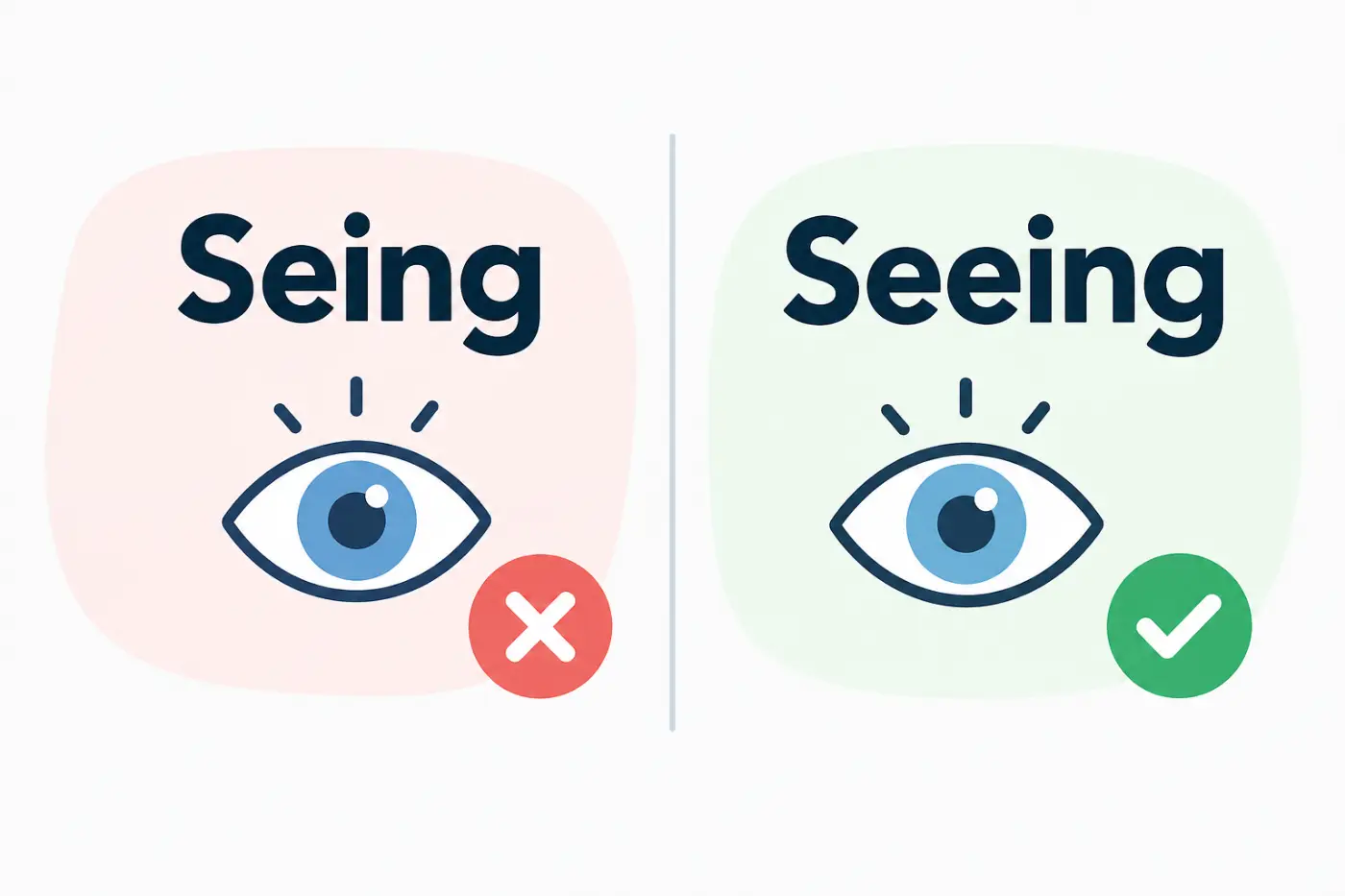
If you are unsure about seing vs seeing, the correct spelling is seeing. The word seing is a common spelling mistake and isn’t standard English. Seeing is the present participle of the verb see and is used when talking about the act of looking at something or noticing something.
This mistake happens because the word see already ends with two vowels. When people add ing, they sometimes drop one of the e letters and write seing. That may look reasonable at first glance, but English spelling rules don’t work that way here.
The good news is that you don’t need to memorize a complicated rule. Once you understand how see changes when you add ing, the correct spelling becomes easy to remember.
This guide explains why seeing is correct, why seing is wrong, how to use seeing in real sentences, and how it differs from similar forms such as see, saw, and seen. You’ll also learn a few simple tricks that can help you avoid this mistake in writing.
Quick Definition
Seeing is the correct spelling. It is the ing form of the verb see and can describe looking at something, noticing something, understanding something, or meeting someone. Seing is not the standard spelling of this word.
Direct Answer
The correct word is seeing. Use seeing when you need the ing form of see.
Comparison Table
Why Seeing Is The Correct Spelling
The main reason is simple. The base verb is see. When you add ing to this verb, you keep the spelling of the base word and add ing.
So the word develops like this.
See + ing = seeing.
The second e stays in place. You don’t remove it.
This may seem unusual because many English verbs change their spelling when they take an ending. For example, make becomes making. The final e disappears before ing. Write becomes writing for the same reason.
That rule can cause confusion with see.
You may remember that verbs ending in a silent e often drop that e before adding ing. Since see ends in e, it is easy to assume the same thing happens here. It doesn’t.
The spelling of see is different because the final e isn’t functioning like the silent e in words such as make or write.
Compare these examples.
- Make becomes making.
- Write becomes writing.
- Take becomes taking.
- See becomes seeing.
The first three words lose their final e. Seeing keeps both e letters from see.
That gives you a useful pattern to remember.
When you start with see, don’t change the spelling of the base word before adding ing.
Why Seing Looks Reasonable
The incorrect form can look natural because English has many words where a letter disappears when an ending is added.
A learner might think this way.
The word is see.
Add ing.
Remove one e.
The result appears to be seing.
The problem is that this spelling doesn’t follow the pattern used by the verb see.
English spelling contains many small patterns that don’t always match what seems logical. Native speakers often learn these patterns through reading and repeated use. Learners can understand them more easily by comparing related words.
Look at these examples.
- I see my neighbor every morning.
- I am seeing my neighbor later.
- She sees her parents every weekend.
- She saw her parents yesterday.
The spelling changes based on grammar. However, seeing always keeps both e letters.
What Seeing Means
Seeing can have several meanings depending on the sentence.
The most basic meaning involves using your eyes to notice or observe something.
For example.
- I am seeing a bird outside my window.
- She is seeing the ocean for the first time.
- They were seeing strange lights in the sky.
In these examples, seeing refers to visual experience.
However, seeing doesn’t always involve physical sight. English speakers also use the word when they mean understanding or recognizing an idea.
For example.
- I am seeing the problem now.
- She is seeing things differently.
- He is finally seeing why the plan failed.
In these sentences, seeing means understanding or recognizing something.
The word can also refer to meeting someone.
For example.
- I am seeing my dentist tomorrow.
- She is seeing her friends tonight.
- He has been seeing his coach every week.
- Here, seeing means meeting or visiting someone.
This makes the word useful in everyday speech. Its meaning depends on the context around it.

How To Use Seeing In A Sentence
Seeing can appear in several common sentence patterns.
The easiest pattern uses a form of be followed by seeing.
For example.
- I am seeing my cousin tonight.
- She is seeing a movie with her friends.
- They are seeing the new exhibit this weekend.
- We were seeing signs of improvement.
You can also use seeing after other verbs.
For example.
- I remember seeing that house.
- She enjoys seeing her family.
- He avoided seeing the final result.
- They talked about seeing the concert.
Seeing can also begin a phrase that gives a reason or condition.
For example.
- Seeing the rain outside, we decided to stay home.
- Seeing how tired she was, I offered to drive.
In these cases, seeing has a slightly different role. It introduces something the speaker noticed and then connects that observation to another action or conclusion.
Seeing As A Form Of See
The simplest way to understand seeing is to treat it as the ing form of see.
English verbs can take different forms to show time, grammar, or sentence structure.
- See is the base form.
- Sees is the third person singular present form.
- Saw is the simple past form.
- Seen is the past participle.
- Seeing is the present participle and gerund form.
These forms aren’t interchangeable.
For example, you can say.
- I see the car.
- She sees the car.
- I saw the car.
- I have seen the car.
Each sentence has a different grammatical structure and meaning.
The spelling of seeing is important because changing it to seing creates a spelling error.
Why The Word Has Two E Letters
The two e letters are part of the spelling of see. When you add ing, both remain.
This is one of those English spelling details that becomes easier once you see the pattern clearly.
Think of the word as a complete unit.
See.
Then attach the ending.
See + ing.
The result is.
Seeing.
Don’t think of it as removing one letter and then adding another ending. Think of it as adding ing to the existing verb.
This approach also helps when you are writing quickly.
If you stop and ask yourself what the base verb is, the answer is see. From there, the correct form is easy to build.
A Simple Memory Trick
Use this sentence in your head.
I see two e letters in seeing.
The phrase itself gives you the spelling.
You can also remember this pattern.
See has two e letters. Seeing keeps two e letters.
That small reminder can save you from the common mistake.
Another useful trick is to connect the word with familiar phrases.
- I am seeing it.
- Nice seeing you.
- I am seeing someone.
- Seeing is believing.
Once these phrases become familiar, the correct spelling starts to feel natural.
Common Mistakes With Seeing
The most obvious mistake is writing seing instead of seeing.
For example.
- Incorrect: I am seing my friend tonight.
- Correct: I am seeing my friend tonight.
- Incorrect: She is seing a doctor.
- Correct: She is seeing a doctor.
- Incorrect: We were seing the same problem.
- Correct: We were seeing the same problem.
- Incorrect: I enjoy seing new places.
- Correct: I enjoy seeing new places.
The mistake can appear in casual messages, school assignments, emails, reports, social posts, and professional writing.
Spell check tools may catch it. Still, you shouldn’t depend entirely on software. Knowing the correct form makes your writing stronger and helps you catch errors yourself.
Another Common Mistake
Some writers may confuse seeing with seen.
These words come from the same verb but serve different grammatical purposes.
You can say.
I am seeing the doctor tomorrow.
You can’t normally replace seeing with seen in that sentence.
You can say.
I have seen the doctor before.
Here, seen works because it follows have.
This distinction matters because both words are related to the same verb but don’t do the same job.
Seeing Vs See
See is the base form of the verb.
Use see after words such as can, could, will, would, should, and may.
For example.
- I can see the house.
- You should see this movie.
- We will see you tomorrow.
She could see the mountain from her room.
The word seeing has a different role.
For example.
I am seeing the house from my window.
She is seeing a movie tonight.
They are seeing their friends later.
A useful test is to look at the word before the verb.
If you have a form of be such as am, is, are, was, or were, the ing form may be needed.
For example.
- I am seeing.
- She is seeing.
- They are seeing.
- We were seeing.
This isn’t a rule that works in every sentence because English grammar depends on context. Still, it gives you a useful starting point.
Seeing Vs Saw
Saw is the simple past form of see.
Use saw when the action happened in the past.
For example.
I saw him yesterday.
She saw a fox in the park.
We saw that movie last weekend.
They saw the accident from across the street.
Seeing does not replace saw.
- You wouldn’t write.
- I seeing him yesterday.
- The correct sentence is.
- I saw him yesterday.
You can use seeing when the grammar calls for an ing form.
For example.
I was seeing him every Friday.
That sentence can describe a repeated activity during a past period.
The two forms may appear close in meaning, but they have different grammatical jobs.
Seeing Vs Seen
Seen is the past participle of see.
It commonly appears after have, has, or had.
For example.
- I have seen that movie.
- She has seen this problem before.
- They had seen the warning.
- We have seen better results.
Seeing usually appears after a form of be when it describes an ongoing action.
For example.
- I am seeing the doctor.
- She is seeing her family.
They were seeing the same pattern.
A quick comparison helps.
- I saw him yesterday.
- I have seen him before.
These three sentences all use forms of see. Each one has a different structure.
Seeing In Everyday English
You probably use seeing more often than you realize.
The word appears in everyday conversations about plans, relationships, health appointments, entertainment, travel, and personal experiences.
For example.
- Are you seeing anyone tonight.
- I’m seeing my sister after work.
- We’re seeing a movie on Friday.
- I’m seeing the doctor next week.
- Nice seeing you again.
- I wasn’t seeing the problem at first.
- She enjoys seeing new places.
They were seeing each other for a few months.
These examples show why the correct spelling matters. Seeing isn’t an unusual or rare word. It appears in ordinary speech and writing all the time.
Seeing Someone
The phrase seeing someone can have more than one meaning.
It can mean meeting or visiting someone.
For example.
- I’m seeing my brother this afternoon.
- It can also refer to a romantic relationship.
For example.
- She’s seeing someone from her college.
- The surrounding words usually make the meaning clear.
- This is a good example of how context shapes English.
Seeing A Doctor
Seeing is also common when talking about medical appointments.
For example.
- I’m seeing my doctor tomorrow.
- She is seeing a specialist next month.
- He needs to see a doctor.
- Notice the difference between seeing and see.
- I’m seeing my doctor tomorrow.
- I need to see my doctor.
The first sentence uses seeing because the phrase follows am. The second uses see because it follows need to.
Seeing In Common Expressions
Some expressions with seeing appear often in American English.
One familiar phrase is seeing is believing.
It means that you may need to see something yourself before you fully believe it.
For example.
You say the old house has been completely restored.
Seeing is believing.
Another common phrase is nice seeing you.
People use it when they meet someone again after some time apart or after an event.
For example.
It was nice seeing you at the party.
You may also hear seeing someone when talking about dating.
For example.
He’s seeing someone new.
These expressions make the correct spelling worth learning because you will encounter the word in many settings.
Why English Spelling Can Be Confusing
The confusion around this word comes from a larger problem with English spelling.
English uses many spelling patterns, but those patterns have exceptions and special cases. A rule that works for one group of words may not work for another.
For example, verbs such as make and write drop their final e before ing.
- Make becomes making.
- Write becomes writing.
- But see becomes seeing.
The reason is connected to the spelling and sound structure of the original word. See doesn’t behave like a typical verb ending in a silent e.
You don’t need to learn every historical reason behind this. For everyday writing, the practical rule is enough.
Remember the word as a whole.
See becomes seeing.
Don’t remove an e.
Compare Similar Forms
Looking at several forms together can make the spelling easier to remember.
- See.
- Seeing.
- Sees.
- Saw.
- Seen.
- Only seeing uses the ing ending.
- Only saw is the simple past form.
Seen usually needs a helping verb such as have, has, or had.
Once you know these five forms, many sentences become easier to build correctly.
How To Catch The Mistake While Editing
If you often type seing by accident, use a quick editing check.
- Search your document for seing.
- If you find it, replace it with seeing.
This works especially well in long documents. You can also add the correct spelling to your personal spelling list in your writing software.
Reading your work aloud can help too. You won’t always hear the spelling mistake because seing and seeing sound similar. However, reading aloud can help you notice awkward sentences around the word.
Another useful habit is to slow down when typing common words that you frequently misspell.
Seeing is a small word. A small spelling mistake can still make a sentence look careless.
Is Seing Ever Correct
In standard English, seing isn’t the accepted spelling of the common verb form.
If you’re writing an essay, email, article, application, school assignment, report, or professional message, use seeing.
You may encounter unusual spellings online, in usernames, names, old texts, or other special contexts. Those cases don’t change the standard English spelling.
For normal English writing, the choice is clear.
Use seeing.
Examples Of Seeing In Real Sentences
The best way to learn a spelling is to see it used naturally.
Here are several examples.
- I am seeing my parents this weekend.
- She is seeing a movie with her friends.
- We were seeing the same issue again and again.
- He is seeing a doctor tomorrow morning.
- I’m seeing better results now.
- They are seeing the ocean for the first time.
- I remember seeing that painting years ago.
- She enjoys seeing her old classmates.
- He kept seeing the same number everywhere.
- We talked about seeing the new exhibit.
- I wasn’t seeing the connection at first.
- Seeing the storm clouds, we headed home.
- Seeing her reaction, I knew something was wrong.
- I can’t wait to see you again.
- Nice seeing you here.
These sentences cover several meanings and grammar patterns. That variety is useful because it shows that seeing isn’t limited to one type of sentence.
Examples Of The Wrong Spelling
Seeing is the correct form. The following examples show common mistakes.
- Incorrect: I am seing a movie tonight.
- Correct: I am seeing a movie tonight.
- Incorrect: She is seing her parents tomorrow.
- Correct: She is seeing her parents tomorrow.
- Incorrect: We were seing strange lights.
- Correct: We were seeing strange lights.
- Incorrect: I enjoy seing new places.
- Correct: I enjoy seeing new places.
- Incorrect: He kept seing the same mistake.
- Correct: He kept seeing the same mistake.
The pattern is consistent. Keep both e letters from see when you add ing.
A Useful Rule For Learners
When a word feels uncertain, start with its base form.
Ask yourself what the main verb is.
For seeing, the answer is see.
Then add ing.
See plus ing gives you seeing.
This method is often more reliable than trying to remember a long list of spelling rules.
It also works for many other English words. Start with the base word, understand the grammar you need, and then apply the correct form.
The key is not to change letters without a reason.
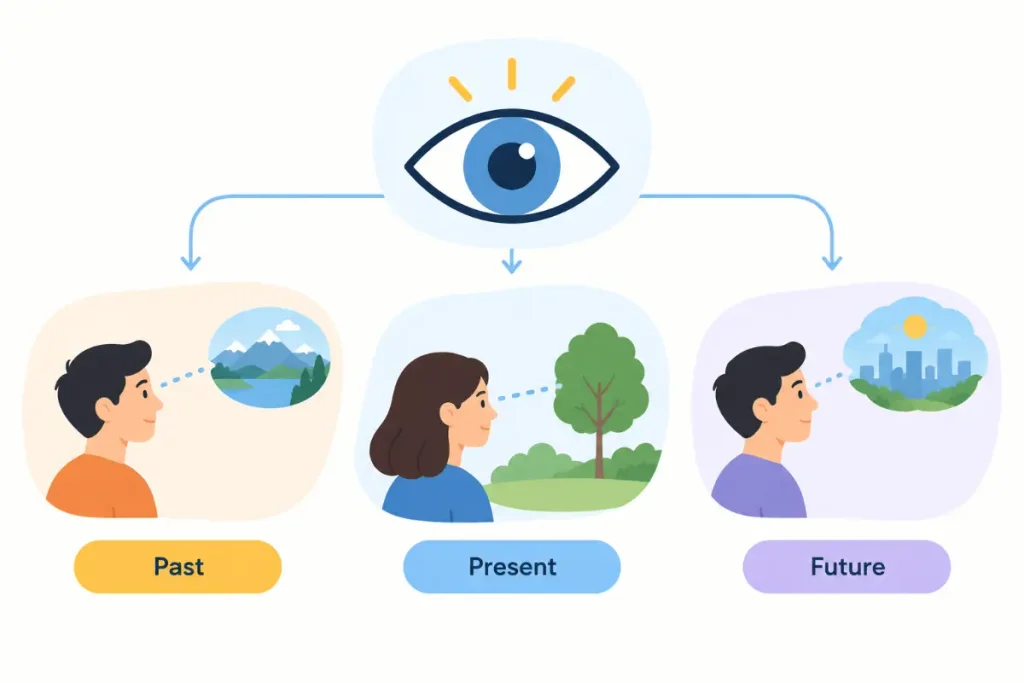
How Seeing Works In Different Tenses
Understanding the grammar behind the word can make the spelling easier.
- In the present simple, you may use see or sees.
- I see my neighbors often.
- She sees her friends every weekend.
- For the simple past, use saw.
- I saw him yesterday.
- For the present perfect, use have seen or has seen.
- I have seen that movie.
- She has seen the report.
- For the past perfect, use had seen.
- They had seen the warning before they entered.
- For an ongoing action, use a form of be with seeing.
- I am seeing my friend.
- She is seeing her doctor.
- They were seeing the same problem.
This gives you a clear family of forms.
- See.
- Sees.
- Saw.
- Seen.
- Seeing.
Learning the whole group can be more useful than memorizing one spelling in isolation.
A Closer Look At The Grammar
Seeing can act as a present participle or a gerund.
Those terms may sound technical, but the basic idea is simple.
A present participle often appears with a form of be to describe an action.
For example.
- She is seeing her friends.
- They are seeing the results.
- I was seeing things more clearly.
- A gerund uses an ing form as a noun.
For example.
- Seeing is believing.
- Seeing new places can change your view of the world.
- I enjoy seeing my family.
- In each case, the spelling stays the same.
The word doesn’t become seing simply because its grammatical role changes.
Why Spell Check Matters But Isn’t Enough
Modern writing tools can catch many spelling errors. That’s helpful, but you still need to know the correct form.
Some spelling tools may identify seing as an error. Others may not flag every unusual word depending on the software and context.
Human review still matters.
A clean article, email, or assignment should not depend entirely on automatic correction. If you know that see becomes seeing, you’ll spot the problem immediately.
The best writing process combines both skills.
- Write naturally.
- Review carefully.
- Use spell check.
- Read the final version.
That simple routine catches a lot of small errors.
How To Remember The Difference
You don’t need a complicated memory system.
Just remember this sentence.
Seeing keeps both e letters from see.
You can also picture the spelling visually.
SEEING.
There are two e letters in the middle.
The word begins with see.
Then ing is added.
SEE + ING.
Seeing.
Another way to remember it is through a familiar phrase.
Seeing is believing.
If you remember that phrase, you’ll always have a common example of the correct spelling.
You can also practice by writing three sentences.
I see the house.
I am seeing the house.
The three forms help you connect spelling with grammar.
Related Spelling Questions
People often search for this spelling because they have run into similar problems with other verbs.
A common question involves words that end in e.
Why does make become making while see becomes seeing.
The answer is that English spelling patterns vary by word. Make has a silent final e that drops before ing. See has a different spelling pattern and keeps both e letters.
Another common issue involves words ending in ee.
For example, agree becomes agreeing.
Free becomes freeing.
See follows a similar visual pattern because the existing e letters remain when ing is added.
These examples can help you build a stronger sense of English spelling.
See And Agree
- Compare these forms.
- See becomes seeing.
- Agree becomes agreeing.
- The e letters remain.
This can help you remember that adding ing doesn’t always mean removing an e.
See And Make
- Now compare these.
- See becomes seeing.
- Make becomes making.
- Make loses its final e.
- See does not.
That difference is exactly where many spelling mistakes begin.
Why Reading Helps With Spelling
One of the best ways to improve spelling is to read good English regularly.
When you repeatedly see a word written correctly, its shape becomes familiar. Eventually, an incorrect version can look strange even before you consciously identify the error.
Seeing appears frequently in books, articles, emails, conversations, subtitles, and online writing.
The more you encounter the correct form, the easier it becomes to recognize.
This is one reason experienced writers often notice spelling mistakes quickly. They have seen the correct forms thousands of times.
You can build that same skill.
Read often.
Pay attention to words that cause trouble.
Write them correctly several times.
Use them in real sentences.
Over time, the correct spelling becomes automatic.
A Quick Practice Exercise
Try filling in the missing word in each sentence.
- I am ______ my friend after work.
- She is ______ a movie tonight.
- They were ______ signs of progress.
- I remember ______ that building before.
- ______ is believing.
The answer is the same in every sentence.
Seeing.
Now try these.
- I can ______ the mountain.
- She ______ the problem immediately.
- I ______ him yesterday.
- I have ______ that movie before.
The answers are see, sees, saw, and seen.
This small exercise shows why grammar matters. The correct form depends on the structure of the sentence.
What To Use In Formal Writing
For formal writing, always use seeing.
This includes school papers, business emails, reports, articles, applications, presentations, and professional documents.
For example.
- Correct: The team is seeing strong growth this quarter.
- Correct: The patient is seeing a specialist next week.
Using seing in any of these sentences would be a spelling error.
The mistake may seem minor, but correct spelling supports credibility. Readers expect professional writing to be clean and accurate.
What To Remember
There are only a few points you really need to keep in mind.
- Seeing is the correct spelling.
- Seing is a spelling mistake in standard English.
- Seeing comes from the verb see.
When you add ing to see, keep both e letters.
- See becomes seeing.
- Saw is the past form.
- Seen is the past participle.
See and seeing can have different meanings and grammar roles depending on the sentence.
If you remember those points, you’ll have no trouble with this word again.
FAQs
Is seing or seeing correct?
Seeing is correct. Seing is a misspelling in standard English. The correct form is made by adding ing to see without removing either e.
Why is seeing spelled with two e letters?
The base verb is see and it keeps both e letters when ing is added. The correct spelling is see plus ing which produces seeing.
Is seing a real word?
Seing isn’t the standard English spelling of the ing form of see. If you mean the act of looking, noticing, understanding, or meeting someone, use seeing.
What is the difference between see and seeing?
See is the base form of the verb. Seeing is the ing form and often appears after a form of be or works as a noun in a sentence such as Seeing is believing.
What is the past tense of see?
The simple past form of see is saw. For example, you can say I saw him yesterday.
What is the past participle of see?
The past participle is seen. It usually appears with have, has, or had, as in I have seen that movie before.
Can I say I am seeing him?
Yes. I am seeing him is grammatically correct. It can mean that you plan to meet him or that you are currently dating him depending on the context.
How can I remember the spelling of seeing?
Remember that see keeps both e letters when you add ing. A useful phrase is Seeing is believing because it gives you the correct spelling in a familiar expression.
Conclusion
The answer to seing vs seeing is straightforward. Seeing is the correct spelling, while seing is a common spelling error. The easiest way to remember it is to start with the base verb see. Add ing without removing an e. See becomes seeing.
Don’t apply the same spelling change used by words such as make and write. Those verbs drop their final e before ing, but see doesn’t follow that pattern.
The word appears in everyday English all the time. You might be seeing a friend, seeing a doctor, seeing a movie, seeing a problem, or seeing something for the first time.
So when you type the word, remember the two e letters in the middle. Seeing is the form you want in standard English.

Dr. Arthur Pendelton is a veteran historical linguist and grammar expert with over 30 years of experience in academic editing. A retired professor, Arthur specializes in the etymology and evolution of the English language. He is passionate about “unpacking the history behind the rules,” helping readers understand why we spell, punctuate, and phrase things the way we do today. Whether he’s settling debates on archaic usage or explaining complex linguistic shifts, Dr. Pendelton brings scholarly precision to every article.