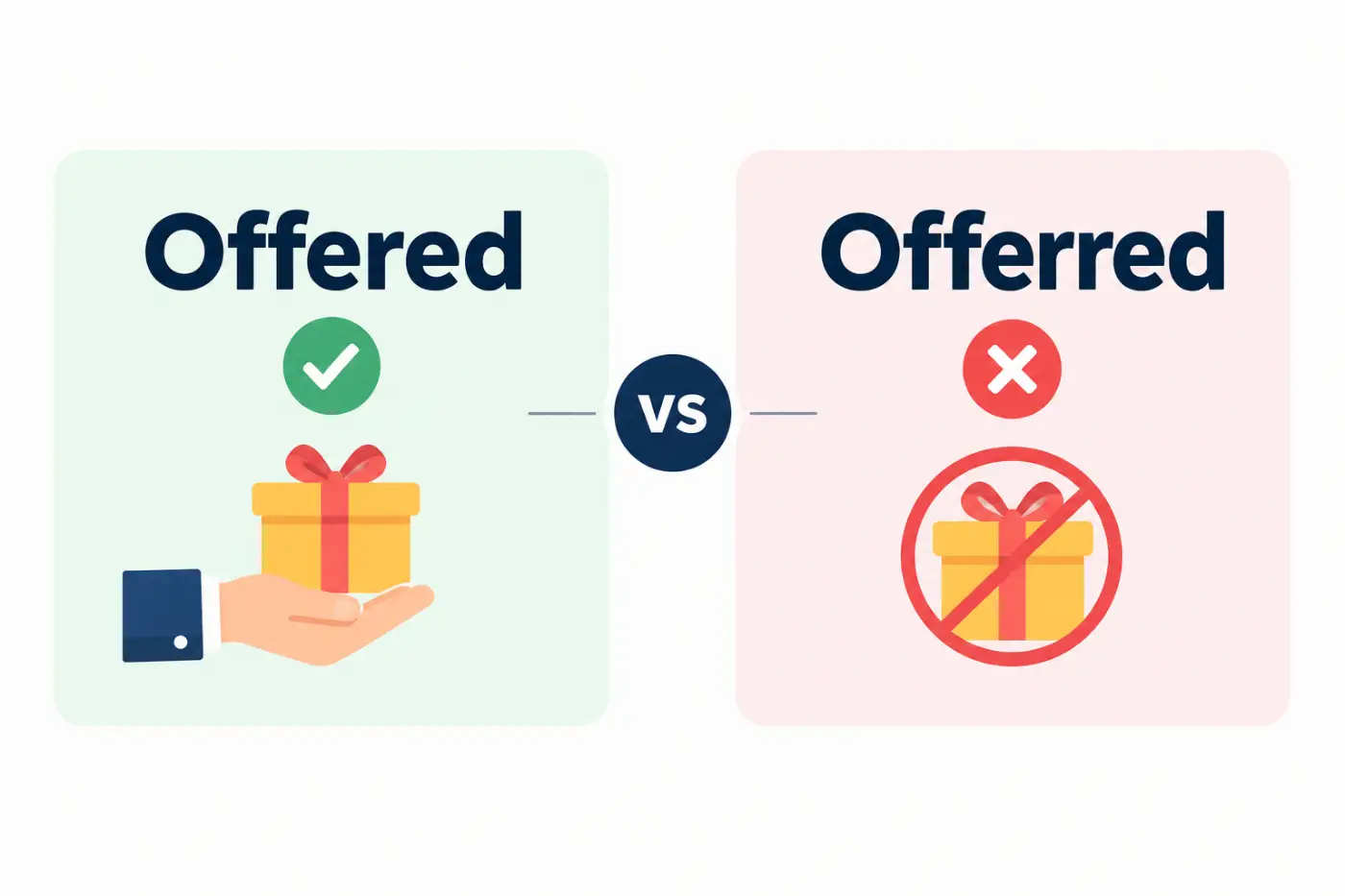
If you are stuck between offered vs offerred, the correct spelling is offered. The word offerred is incorrect in standard English.
The confusion usually comes from the spelling rule for words that end in a single consonant. Many English verbs double the final consonant before adding an ending such as ed. That rule is real, but it does not apply to every verb.
The correct form is simple. You write offer, then add ed to get offered. You do not add another r.
This guide explains why the spelling works this way. You will also see clear examples, the grammar behind the word, common mistakes, and a few easy ways to remember the correct form.
Quick Definition
Offered is the correct past tense and past participle of the verb offer. It means that someone gave something, suggested something, or made something available.
Offerred is not a standard English spelling. If you are writing an email, essay, report, application, or other formal text, use offered.
Direct Answer
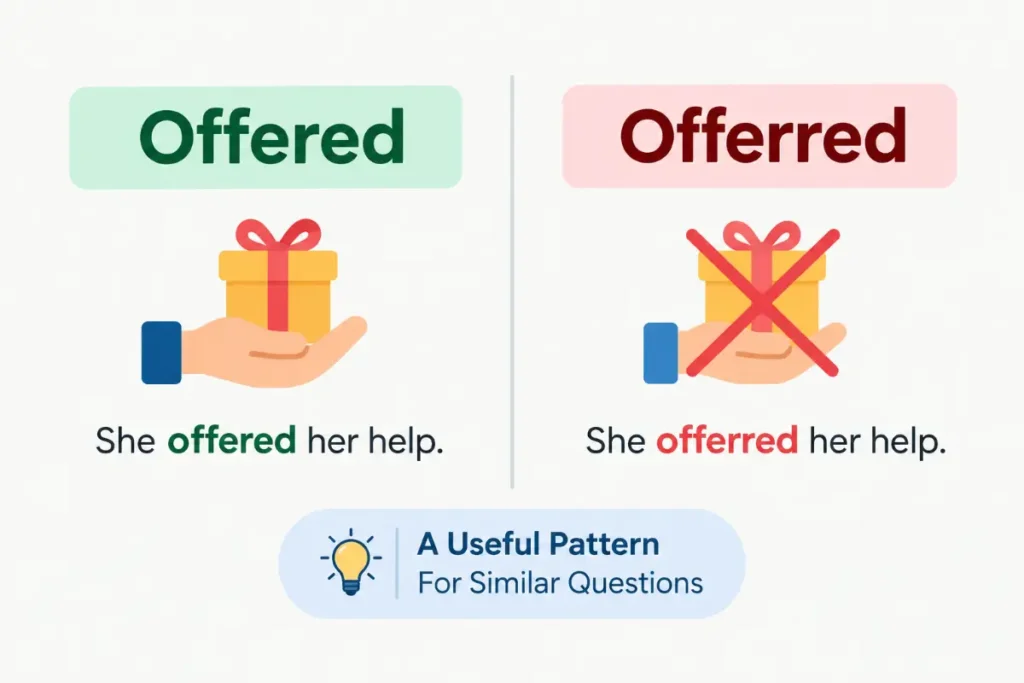
The correct spelling is offered. Offerred is incorrect because the final r in offer does not need to be doubled when you add ed.
Comparison Table
| Word or Phrase | Meaning | Example Sentence | When to Use It |
|---|---|---|---|
| Offered | Past tense or past participle of offer | She offered me some advice. | Use this in standard English. |
| Offerred | Incorrect spelling | She offerred me some advice. | Do not use this spelling. |
| Offer | Present form of the verb | They offer free samples. | Use for present actions. |
| Offering | Present participle or gerund form | The store is offering a discount. | Use for an action happening now or as a noun. |
| Offers | Present tense form for he she or it | The company offers great service. | Use with a singular third person subject. |

Why Offered Is Correct
The spelling becomes much easier once you look at the base word.
The base verb is offer. It has two parts that matter for spelling. The word ends in er, and the final letter is already part of the normal spelling of the verb.
When you form the past tense, you simply add ed.
Offer + ed = offered.
You do not need to add another r.
That gives you:
- offer
- offered
- offering
- offers
The spelling stays stable as the word changes form.
This is one reason offered can look strange to someone who is thinking about other verbs that double their final consonants.
For example, look at these words:
- stop → stopped
- plan → planned
- admit → admitted
- prefer → preferred
These verbs can double a final consonant before an ending is added. The spelling rule depends on the structure and stress pattern of the word.
Offer follows a different pattern.
The word already ends with er, and the final syllable is not stressed in the way needed for the usual consonant doubling rule. So the correct form is offered, not offerred.
That small spelling difference causes a surprising number of mistakes.
What Offered Means
The word offered can have several related meanings. The exact meaning depends on the sentence.
In general, it describes an action where someone gives something, makes something available, suggests help, or presents a choice.
Consider this sentence.
She offered me a glass of water.
Here, offered means that she gave or presented the water for the other person to accept.
Now consider this example.
The company offered him a new position.
In this sentence, the company proposed a job to him.
The word can also describe help.
My neighbor offered to drive me to the airport.
Here, the person volunteered to help.
It can also describe a suggestion.
He offered a simple solution to the problem.
In this case, he presented an idea that could solve the problem.
So offered does not have just one narrow meaning. It can describe giving, presenting, proposing, suggesting, or volunteering.
How Offer Changes Into Offered
The simplest way to understand the spelling is to start with the base verb.
The base form is offer.
To create the simple past tense, add ed.
Offer + ed = offered.
That is all you need.
You do not change the base spelling.
You do not remove a letter.
The same pattern appears in many common words.
- answer → answered
- enter → entered
- remember → remembered
- cover → covered
- discover → discovered
- deliver → delivered
- suffer → suffered
- offer → offered
Notice the pattern. These verbs end in er, but their past forms do not normally double the final r.
That can help you recognize the spelling pattern instead of trying to memorize one word at a time.
Why Offerred Looks Correct
The incorrect form can look convincing because English has many words that double a final consonant.
For example:
- stop → stopped
- shop → shopped
- drop → dropped
- plan → planned
- grab → grabbed
A learner may see offer and think the same rule should create offerred.
The problem is that English spelling rules depend on more than the final letter.
The doubling rule often applies to a short stressed vowel followed by a single final consonant. The exact pattern can vary based on syllables, stress, and the word’s spelling.
For offer, the final r does not need to be doubled.
So this is correct:
The store offered a discount.
This is incorrect:
The store offerred a discount.
The extra r has no role in the correct past tense.
The Spelling Rule Behind Offered
English spelling rules can feel inconsistent because they developed from many different sources. Still, there are useful patterns that can help.
One common rule says that a short one syllable verb can double its final consonant before adding ed or ing when the word ends in a consonant after a short vowel.
Look at stop.
The word has a short vowel sound followed by one final consonant.
- stop → stopped
- Look at plan.
- plan → planned
- Now look at offer.
The structure is different. The final consonant is part of the ending er, and the word does not fit the same short one syllable pattern.
So we write:
offer → offered
The important lesson is not to double a consonant simply because a word ends in a consonant sound.
Check the complete spelling pattern first.
Examples Of Offered In Everyday English
The word appears often in normal conversation and writing.
Here are natural examples.
- She offered me a seat on the bus.
- He offered to help with the project.
- The restaurant offered several vegetarian dishes.
- They offered us a better price.
- My teacher offered some useful advice.
- The company offered her a full time position.
- We offered our guests something to eat.
- The hotel offered free breakfast.
- He offered an honest explanation.
- The manager offered to replace the damaged item.
- Each sentence uses the same past form.
- The spelling stays offered.
- You do not need to change it based on the meaning.
Offered As A Past Tense Verb
The most common use of offered is as the simple past tense of offer.
Use it when an offer happened in the past.
For example:
She offered me a job last week.
The action happened last week, so the past form offered is appropriate.
Another example is:
He offered to pay for dinner.
The offer happened in the past.
You can also use the word with a specific past time.
- The store offered a large discount yesterday.
- The school offered extra classes last semester.
- My friend offered to pick me up this morning.
The word can also appear without a time expression when the past meaning is clear from context.
She offered to help, but I declined.
The two actions happened in the past, so offered fits naturally.
Offered As A Past Participle
Offered is also the past participle of offer.
You often see the past participle with forms of have.
For example:
- The company has offered me a new contract.
- They have offered several solutions.
- She had offered to help before I asked.
- We have offered our support.
The spelling remains the same.
The grammar changes, but the word does not.
That means you do not need a separate spelling for the past participle.
The forms are:
- offer
- offers
- offered
- offering
There is no standard form called offerred.
Offered With To
A common structure is offered to followed by a verb.
For example:
- She offered to help me.
- He offered to drive us home.
- They offered to pay the bill.
- I offered to explain the problem.
- The manager offered to replace the product.
This structure means someone volunteered or agreed to do something.
The verb after to stays in its base form.
So you write:
She offered to help.
Not:
She offered to helped.
The first verb carries the past tense. The second verb remains in its base form.
Offered Something To Someone
Another common structure uses a thing followed by the person receiving the offer.
For example:
- She offered me some coffee.
- He offered his friend a ride.
- They offered us a discount.
The waiter offered the customers another table.
You can also use to before the person.
- She offered some coffee to me.
- He offered a ride to his friend.
- They offered a discount to us.
Both structures can work. The shorter version often sounds more natural in everyday conversation.
Offered For A Job
The word is common when talking about employment.
You may say:
I was offered a job yesterday.
This sentence uses offered as a past participle in the passive voice.
It means someone gave you a job opportunity.
You might also write:
The company offered me a position.
Here, the company is the subject.
Another example is:
She was offered a promotion after five years with the company.
The spelling stays the same in every case.
This is useful to remember because job related writing often needs clear and correct English.
Offered In Business Writing
You will see offered often in emails, reports, contracts, advertisements, and business documents.
For example:
- The company offered a refund to affected customers.
- The seller offered a lower price.
- The bank offered several financing options.
- The school offered additional support to students.
- The service provider offered a free trial.
These sentences sound natural because offered is the standard past form.
Using offerred would make the writing look careless and can distract the reader from the message.
That matters in professional writing. A small spelling mistake can weaken an otherwise strong piece of writing.
Offered In Academic Writing
Students also use the word frequently.
You might write:
- The study offered new evidence about the issue.
- The professor offered a different explanation.
- The research offered useful information for future studies.
- The article offered several possible answers.
In academic writing, clarity matters more than complicated wording.
If you are unsure about the spelling, remember the basic form.
Offer becomes offered.
You do not need an unusual spelling to make the sentence sound formal.
Common Sentences With Offered
Here are more examples you can use as models.
- The teacher offered extra help after class.
- The company offered a refund to the customer.
- She offered me a chance to explain.
- He offered to carry the bags.
- The store offered free delivery.
- They offered us a place to stay.
- My brother offered some good advice.
- The hotel offered a lower rate.
- The doctor offered several possible treatments.
- The manager offered an apology.
- The school offered new courses.
- The organization offered support to local families.
- The seller offered to replace the item.
- The restaurant offered a special menu.
- She offered her opinion during the meeting.
Every example uses offered with one r after the o and one r before the ed ending.
Common Mistakes With This Word
- The most obvious mistake is adding an extra r.
- Incorrect:
- The company offerred me a position.
- Correct:
- The company offered me a position.
- Another mistake is changing the vowel or removing part of the base word.
- Incorrect:
- The company oferred me a position.
- Correct:
- The company offered me a position.
- You should keep the base word intact.
- offer + ed = offered.
- A third mistake is using the wrong ending.
- Incorrect:
- She offer to help yesterday.
- Correct:
- She offered to help yesterday.
- The past tense requires ed.
- Another mistake is writing offered to helped.
- Incorrect:
- He offered to helped me.
- Correct:
- He offered to help me.
- After to, use the base form help.
How To Remember The Correct Spelling
A simple memory trick can save you from this mistake.
Think of the word as two pieces.
offer + ed
Keep the base word exactly as it is.
Then add ed.
You get:
offered
Another useful trick is to connect it with familiar words that follow a similar pattern.
Think about:
- cover → covered
- discover → discovered
- suffer → suffered
- offer → offered
These words all keep their basic spelling when you add ed.
You can also remember this short sentence:
I offer today and I offered yesterday.
That gives you the present and past forms together.
If you see offerred, stop and return to the base word.
- Offer.
- Add ed.
- Offered.
That method is much more reliable than trying to guess from how the word sounds.
Offered And Offering
Another form people sometimes confuse with the past tense is offering.
Offering is the present participle or gerund form.
For example:
- The company is offering a discount.
- She is offering to help.
- The store is offering free delivery.
The word describes an action that is happening now or is being presented as an activity.
Compare these sentences:
- The store offered a discount yesterday.
- The store is offering a discount today.
- The first sentence describes a past action.
- The second describes an ongoing action.
The spelling changes from offered to offering, but the base word remains offer.
Offered And Offers
Offers is another form of the same verb.
Use offers with a singular third person subject in the simple present tense.
For example:
- The company offers free shipping.
- She offers helpful advice.
- The store offers several payment options.
- Compare that with the past tense:
- The company offered free shipping last year.
- She offered helpful advice yesterday.
- The store offered several payment options during the sale.
- The ending changes because the tense and subject change.
- The spelling of the past form stays offered.
Offer As A Noun
The word offer can also be a noun.
For example:
- I received an offer from the company.
- That was a great offer.
- The store made a special offer.
When you make the noun plural, you get offers.
The company received several offers.
The noun can also appear in phrases such as:
- job offer
- special offer
- limited offer
- price offer
- employment offer
The past tense offered comes from the verb.
That distinction can help you understand the grammar.
For example:
- The company made an offer.
- Here, offer is a noun.
- The company offered me a job.
- Here, offered is a verb.
The meanings are closely related, but the grammar is different.
Is Offerred Ever Correct
In standard modern English, offerred is not the accepted spelling of the past tense of offer.
If you find it in casual online writing, a message, a comment, or an old document, it is generally a spelling mistake rather than a standard alternative.
For formal writing, use offered.
That includes school assignments, professional emails, resumes, applications, reports, websites, and published content.
You do not need to treat the extra r as a valid variation.
The standard spelling is clear.
Offered.
Why English Does Not Double The R Here
The deeper spelling rule can be useful, but you do not need to memorize a long list of grammar terms.
English sometimes doubles the final consonant before adding an ending.
For example:
- run → running
- stop → stopped
- plan → planning
- admit → admitted
The doubling helps preserve the expected pronunciation or follows established spelling patterns.
But the rule has limits.
You cannot apply it to every word that ends with a consonant.
Consider:
- open → opened
- visit → visited
- listen → listened
- offer → offered
These words do not need a doubled final consonant in the past form.
English spelling works through patterns rather than one rule that controls every word.
That is why learning common word families can be more useful than trying to force every verb into the same pattern.
Related Words That Can Cause Confusion
If you are learning English spelling, offered is not the only word that can cause this type of problem.
Here are some useful comparisons.
- refer → referred
- prefer → preferred
- occur → occurred
These words do double the final r before ed.
Now compare them with:
- offer → offered
- suffer → suffered
- cover → covered
The difference may look small, but the spelling pattern is different.
This is exactly why guessing can lead to errors.
Refer And Referred
The verb refer becomes referred.
For example:
The doctor referred me to a specialist.
The final r is doubled.
Prefer And Preferred
The verb prefer becomes preferred.
For example:
She preferred the smaller apartment.
Again, the r is doubled.
Offer And Offered
The verb offer becomes offered.
For example:
She offered me the smaller apartment.
The r is not doubled.
These three words look similar, so it is easy to see why learners sometimes make mistakes.
The safest approach is to learn the standard spelling of each common verb.
Offered Vs Referred
The difference between these two forms is especially useful.
- Offer → offered
- Refer → referred
Both base words end in er, but only one doubles the final r in the past tense.
For example:
- She offered me some advice.
- The doctor referred me to another specialist.
Do not use the spelling of referred as a model for offered.
The words may look alike, but their spelling patterns are not identical.
Offered Vs Preferred
The same issue appears with preferred.
- Prefer → preferred
- Offer → offered
Examples:
- He preferred the first option.
- He offered the first option.
The first verb doubles the r.
The second does not.
If you remember only one point from this comparison, remember that similar looking verbs do not always follow the same spelling pattern.
Does The Pronunciation Change
The pronunciation of offered is also worth noticing.
In standard American English, the word is commonly pronounced with two syllables.
It sounds roughly like AW ferd.
The ed ending does not create an extra syllable in the same way it does in words such as wanted.
For example:
offered
has two syllables.
wanted
has two syllables as well, but the pronunciation pattern is different.
Spelling and pronunciation do not always match perfectly in English. That is another reason you should not rely only on sound when deciding how to spell the word.
If you hear someone say offered, the sound will not tell you that an extra r should appear.
The standard written form is still offered.
Is Offered Formal English
Yes.
Offered is completely normal in both everyday and formal English.
You can use it in conversation.
She offered to help me.
You can use it in an email.
The company offered me a new position.
You can use it in academic writing.
The study offered useful evidence.
You can use it in professional writing.
The provider offered customers several payment options.
There is no need to replace offered with a more complicated word.
Clear English is often the strongest choice.
Offered In Passive Sentences
The word appears often in passive sentences.
For example:
- I was offered a job.
- She was offered a scholarship.
- They were offered a discount.
- We were offered free tickets.
In these sentences, the person receiving the offer becomes the subject.
You can compare:
The company offered me a job.
and:
- I was offered a job by the company.
- Both sentences describe the same basic event.
- The second sentence uses the passive form.
- The spelling of the past participle remains offered.
Offered In Negative Sentences
You can also use the word in negative sentences.
For example:
She did not offer any explanation.
Notice something important here.
After did not, use the base form offer, not offered.
So this is correct:
She did not offer any explanation.
This is incorrect:
She did not offered any explanation.
The auxiliary verb did already carries the past tense.
The same rule applies to questions.
Correct:
Did she offer you a job.
Incorrect:
Did she offered you a job.
This point is separate from the spelling of offered, but it is a common grammar mistake connected to the same verb.
Offered In Questions
When asking about a past offer, use did plus the base form.
- Did he offer you a seat.
- Did they offer you a discount.
- Did she offer to help.
- Why did the company offer you that position.
The verb after did is offer.
You do not write did offered.
In a question using the passive voice, the form changes.
- Were you offered a job.
- Was she offered a refund.
- Were they offered another option.
These sentences use offered because the passive structure requires the past participle.
A Simple Editing Test
If you are editing a sentence and see offerred, use a quick three step test.
First, find the base word.
It is offer.
Second, decide what form you need.
If you need the simple past or past participle, add ed.
Third, check the spelling.
offer + ed = offered.
This takes only a few seconds.
It also works when you are proofreading someone else’s writing.
For example:
The company offerred a refund.
Return to the base word.
offer
Add the ending.
offered
Correct the sentence.
The company offered a refund.
This method is faster than trying to remember a complicated spelling rule every time.
A Quick Memory Chart
Keep this small word family in mind.
- Offer is the base form.
- Offers is the simple present form for he she or it.
- Offered is the simple past and past participle.
- Offering is the present participle or gerund.
Here are examples.
- I offer help when I can.
- She offers help when she can.
- She offered help yesterday.
- She is offering help now.
The word family becomes easier once you see the forms together.
Why Spelling Accuracy Matters
A spelling mistake does not always make a sentence impossible to understand. A reader may still know what you mean.
Still, correct spelling matters.
If you are writing for school, work, business, or publication, readers expect standard English.
A word like offerred can make the reader pause.
It may also reduce confidence in the rest of the writing.
That is why small spelling questions are worth checking.
You do not need perfect knowledge of every English spelling rule. You do need a reliable way to catch common errors.
For this word, the answer is easy.
Use offered.
A Useful Pattern For Similar Questions
When you come across a spelling question like this, start with the base word.
Ask yourself:
What is the original verb.
Then form the past tense carefully.
- For offer:
- offer → offered
- For refer:
- refer → referred
- For prefer:
- prefer → preferred
- For stop:
- stop → stopped
- For plan:
- plan → planned
The goal is not to assume every verb follows one pattern.
The goal is to recognize the correct form for the specific word.
That habit will help you avoid many spelling errors.
How To Use Offered Naturally
The word sounds natural in many everyday sentence patterns.
Use it with a person.
- She offered me some advice.
- Use it with a thing.
- The company offered a discount.
- Use it with to and a verb.
- He offered to help.
- Use it in passive voice.
- I was offered a job.
- Use it with have.
- They have offered several solutions.
- Use it in a negative sentence with did not.
- They did not offer any explanation.
- Use it in a question with did.
- Did they offer you a refund.
Once you understand these patterns, the word becomes easy to use.
Offered And Advice
One common phrase is offered advice.
For example:
- My father offered me some useful advice.
- The teacher offered advice after the test.
- She offered some practical advice.
In these sentences, offered means gave or provided.
The word advice is normally treated as an uncountable noun in American English. So you usually say some advice or a piece of advice, not an advice.
That is a useful grammar point to remember when writing sentences with this verb.
Offered And Help
Another common phrase is offered help.
- She offered help when I needed it.
- My neighbor offered to help.
- The organization offered help to local residents.
The first structure uses offered help.
The second uses offered to help.
Both are correct.
Offered And A Chance
You can also say offered a chance.
- The manager offered me a chance to lead the project.
- The program offered students a chance to gain experience.
Here, the word means gave someone an opportunity.
Offered And A Choice
Another natural phrase is offered a choice.
- The restaurant offered customers a choice of three meals.
- The teacher offered students a choice between two projects.
The meaning is close to provided an option.
Again, the spelling remains the same.
What To Write In A Resume
If you are describing past work in a resume, offered can be useful.
For example:
- Offered customer support to new clients.
- Offered product guidance to customers.
- Offered training to new employees.
These phrases describe past responsibilities or actions.
Make sure the spelling stays offered.
You do not need the extra r.
What To Write In An Email
The word is also common in professional emails.
For example:
- Thank you for the opportunity you offered me.
- I appreciate the support you offered during the project.
- The team offered several helpful suggestions.
These sentences are clear and natural.
If you are writing to a customer, you might say:
We offered a refund after reviewing your request.
Again, the correct form is offered.
FAQs
Is Offered The Correct Spelling?
Yes. Offered is the standard English spelling for the past tense and past participle of offer.
Is Offerred Ever Correct?
No. Offerred is not the standard spelling of the English verb offer.
Why Is Offered Not Spelled With Two Rs?
The verb offer does not follow the consonant doubling pattern that produces forms such as referred or preferred. The correct form is simply offer + ed, which gives offered.
What Is The Past Tense Of Offer?
The past tense is offered.
For example, you can say, The company offered me a position.
What Is The Difference Between Offer And Offered?
Offer is the base or present form, while offered is the past tense and past participle.
For example, They offer free delivery describes the present, while They offered free delivery describes the past.
Is Offerred A Common Spelling Mistake?
Yes. People sometimes add an extra r because English has several verbs that double a final consonant before adding ed.
The standard spelling is still offered.
How Do You Spell Offered?
Spell it offered.
A simple way to remember it is offer + ed.
Is Offered Used In American English?
Yes. Offered is standard in American English and is common in both casual and formal writing.
Conclusion
The correct spelling in the offered vs offerred question is offered. The form offerred is a spelling error in standard English.
The reason is simple once you start with the base verb. The word is offer, and its past tense is formed by adding ed.
Offer + ed = offered.
The word can mean gave something, suggested something, made something available, presented an option, or volunteered to do something. You can use it in everyday conversation, academic writing, professional emails, business documents, and many other forms of English.
Do not let similar words such as referred and preferred confuse you. Those verbs double the final r, but offer does not.
When you need the past form, use one quick check. Start with offer, add ed, and write offered. That small habit will keep the spelling correct every time.

Dr. Arthur Pendelton is a veteran historical linguist and grammar expert with over 30 years of experience in academic editing. A retired professor, Arthur specializes in the etymology and evolution of the English language. He is passionate about “unpacking the history behind the rules,” helping readers understand why we spell, punctuate, and phrase things the way we do today. Whether he’s settling debates on archaic usage or explaining complex linguistic shifts, Dr. Pendelton brings scholarly precision to every article.