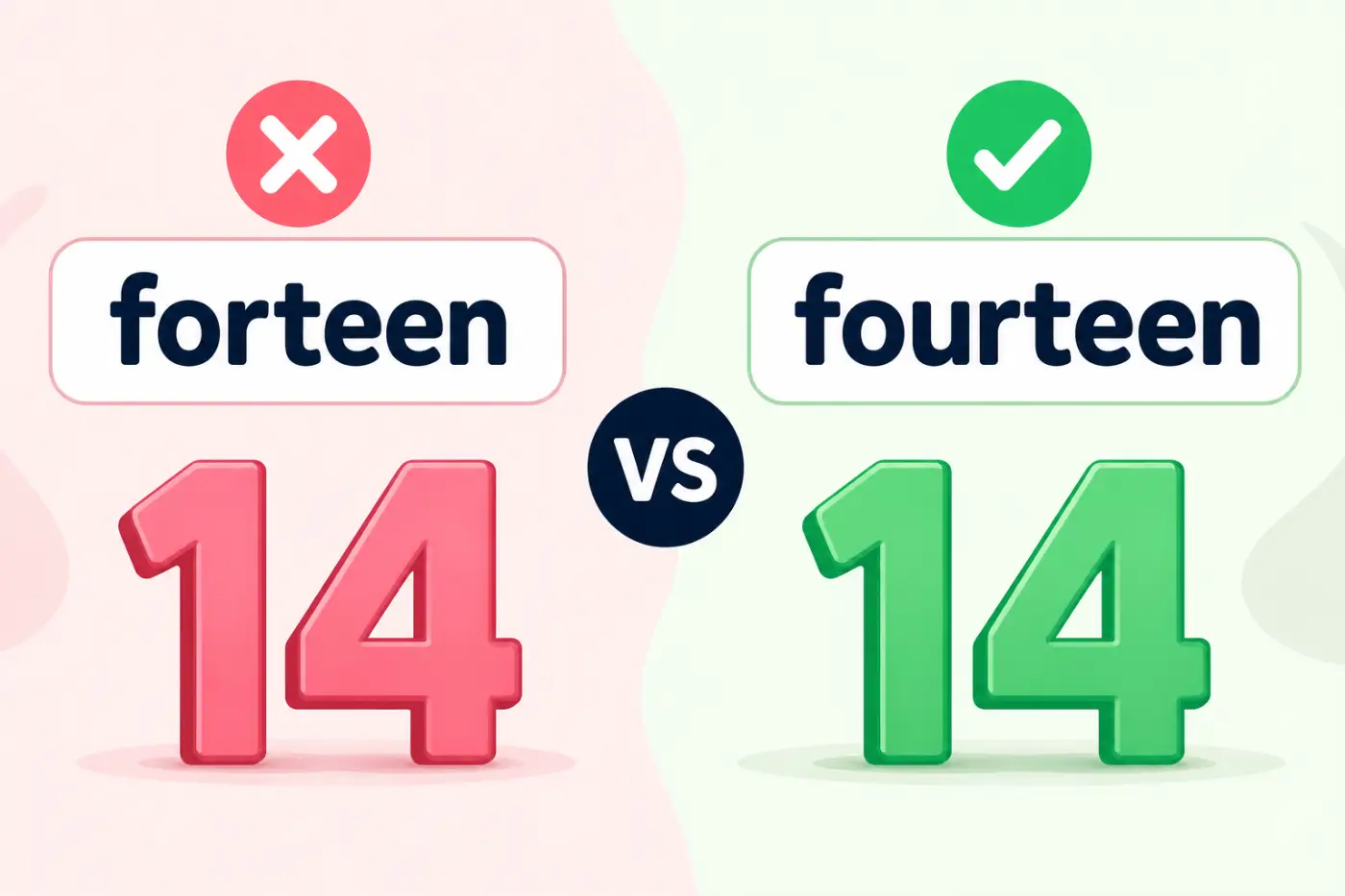
The correct spelling is fourteen. Forteen is a misspelling. The confusion makes sense because fourteen often sounds like “forteen” when people say it quickly. That sound can make the wrong spelling feel natural.
This guide explains why fourteen is correct, why forteen is wrong, how to remember the spelling, and how fourteen fits with other number words such as thirteen, fifteen, forty, and fourteenth. You’ll also see simple examples that show how to use the word in everyday writing.
Quick Definition
Fourteen is the correct English spelling for the number 14. Forteen is not the standard spelling and should not be used in formal or everyday writing. The word fourteen follows the number word four with teen added to it.
Direct Answer
Fourteen is correct. Forteen is incorrect. Use fourteen when you write the number 14 in words.
Comparison Table
Why Fourteen Is the Correct Spelling
The simplest way to understand the spelling is to start with the base number four.
Four is spelled with a u after the o. When you form the number fourteen, that spelling stays in place:
four + teen = fourteen
The word does not become forteen. The u does not disappear.
This gives you a useful pattern:
- four
- fourteen
- fourteen students
- fourteen days
- fourteen dollars
- fourteen years
The spelling may look slightly different from the way the word sounds. That happens often in English. Spoken English and written English do not always match letter for letter.
When people say fourteen quickly, the first part can sound close to “for.” The middle vowel may be less clear in normal speech. As a result, someone who has mostly heard the word spoken may naturally write forteen.
That does not make the spelling correct. Standard written English uses fourteen.
The Spelling Comes From Four
Think of the word as a combination of four and teen.
Four tells you the base number. Teen tells you that the number belongs to the group from 13 through 19.
The same idea appears in several familiar number words:
- thirteen
- fourteen
- fifteen
- sixteen
- seventeen
- eighteen
- nineteen
Fourteen keeps the spelling of four more clearly than some other teen numbers keep the spelling of their base words.
For example, three becomes thirteen. Five becomes fifteen. Six becomes sixteen. Seven becomes seventeen. Eight becomes eighteen.
The spelling changes in some cases because English number words have developed over a very long period. Still, the spelling of fourteen is easy to check once you connect it with four.
Why the Wrong Spelling Feels Natural
The main problem is pronunciation.
In many American accents, the word fourteen can sound close to “forteen.” The first syllable is not always pronounced with the full sound you hear when someone says the word four by itself.
That creates a common spelling trap.
You might hear:
fourteen
But your brain may quickly turn the sound into:
forteen
This happens with many English words. We often spell words from memory based on how they sound. That method works sometimes, but it can fail when English spelling keeps letters that are less noticeable in speech.
The letter u in four is easy to miss when you say fourteen at normal speed. It still belongs in the written word.
How to Spell Fourteen Correctly
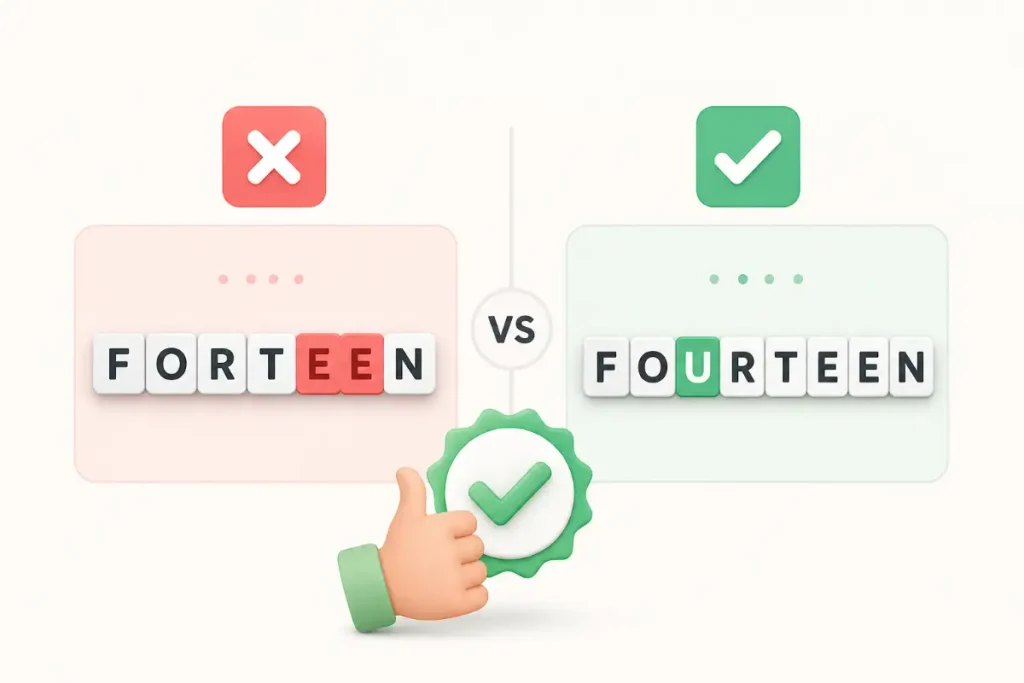
If you need to write 14 in words, use this spelling:
fourteen
You can remember it as:
four + teen
Then remove the space.
That gives you:
fourteen
Do not change it to:
forteen
A quick spelling check is to look at the word four. If you can see four at the start of fourteen, you’re on the right track.
A Simple Memory Trick
Think of the sentence:
Four teens are waiting.
The phrase four teens sounds like fourteen.
Now connect the two ideas:
four teens → fourteen
This is a useful memory trick because it keeps the word four visible in your mind.
You can also picture four teenagers standing together. The number is fourteen. The spelling starts with the same four letters as four.
Another simple trick is to ask yourself:
Does four have a u?
Yes.
Does fourteen keep that u?
Yes.
So write:
fourteen
That takes only a second and can save you from the most common spelling mistake.
Forteen vs Fourteen in Real Sentences
Seeing the correct spelling in context makes it easier to remember.
Here are natural examples:
- I bought fourteen apples for the party.
- She has fourteen minutes left.
- There were fourteen students in the room.
- My brother is fourteen years old.
- The book has fourteen chapters.
- We waited fourteen days for the package.
- He scored fourteen points in the game.
- The class starts at fourteen hundred hours.
- I counted fourteen chairs in the hall.
- They sold fourteen tickets before noon.
- Each team received fourteen cards.
- The hotel has fourteen rooms on this floor.
These examples all use fourteen because they refer to the number 14.
Fourteen With Nouns
When fourteen comes before a noun, the noun normally stays plural.
For example:
- I have fourteen books.
- She bought fourteen eggs.
- We need fourteen chairs.
- He answered fourteen questions.
- They planted fourteen trees.
The number tells you how many items exist. Since the amount is greater than one, the noun takes its plural form.
- You would not normally write:
- I have fourteen book.
- The natural form is:
- I have fourteen books.
This point matters because spelling questions often appear inside larger grammar questions. Learning the correct number word is only part of writing the sentence correctly.
Fourteen With Age
You can use fourteen to describe a person’s age.
For example:
- My daughter is fourteen years old.
- He turned fourteen last month.
- She has been playing soccer since she was fourteen.
- At fourteen, many students begin thinking more seriously about high school.
- You can also use the numeral 14 in some settings:
- My daughter is 14 years old.
Both forms can be correct. The choice often depends on the writing style and the context.
Fourteen in Dates
Fourteen can also appear in dates when you write the day as a word.
For example:
The meeting is on the fourteenth of May.
Her birthday is on the fourteenth.
The event takes place on May 14.
In American English, dates are commonly written with the numeral 14 rather than the word fourteen. When you spell out the date in a sentence, the ordinal form is fourteenth, not fourteen.
That difference is worth remembering.
Fourteen means the number 14.
Fourteenth means the position or date associated with 14.
Fourteen and Fourteenth Are Different
- A common mistake is to use fourteen when you need fourteenth.
- The two words are related but serve different purposes.
- Use fourteen for the number itself:
- I have fourteen dollars.
- There are fourteen people here.
- She is fourteen years old.
- Use fourteenth for order or position:
- She finished fourteenth in the race.
- My birthday is on the fourteenth.
- He lives on the fourteenth floor.
- The same pattern appears with other numbers.
- Thirteen becomes thirteenth.
- Fourteen becomes fourteenth.
- Fifteen becomes fifteenth.
- Sixteen becomes sixteenth.
The ending changes because the word is now an ordinal number. Ordinal numbers tell you where something comes in a sequence.
Cardinal and Ordinal Numbers
You do not need to memorize the terms to use them correctly, but the difference is useful.
A cardinal number tells you how many.
Fourteen students attended the meeting.
An ordinal number tells you the position in a sequence.
The fourteenth student arrived late.
So:
14 = fourteen
14th = fourteenth
This distinction can help you avoid another common writing error.
Why Fourteen Is Not Spelled Forteen
English spelling does not always follow pronunciation.
That is the main reason this mistake happens.
When you hear fourteen, the word can sound as though it starts with for rather than four. If you write only what you hear, you may leave out the u.
But English spelling often preserves parts of words that are less obvious in speech.
The word four is still visible in fourteen:
fourteen
The incorrect form removes the u:
forteen
That missing letter is the whole problem.
The good news is that you do not need to understand the history of English spelling to get this right. You only need to remember the connection between four and fourteen.
Common Mistakes With This Number
The most obvious error is writing forteen instead of fourteen.
However, people make a few other mistakes around this number.
Mistake One
Forteen
This is the incorrect spelling.
Correct:
Fourteen
Mistake Two
Fourty
This is another common number spelling error. The correct word for 40 is forty, not fourty.
Notice the difference:
fourteen
forty
This can feel confusing because fourteen keeps the spelling of four, while forty does not.
The safest approach is to remember each word separately.
Mistake Three
Fourteens
This form can be correct in some contexts, but it does not mean the number 14 itself.
For example:
People in their early fourteens.
Here, fourteens refers to ages from 14 to 16 in a general way. It is a less common expression and usually needs context.
If you mean the number 14, use:
fourteen
Mistake Four
Fourteen’s
The apostrophe is not needed when you simply mean more than one instance of the word.
For example:
I wrote fourteen on the form.
You would not add an apostrophe just because you are talking about the number.
An apostrophe has other jobs in English, such as showing possession or forming certain contractions.
The Difference Between Fourteen and Forty
Fourteen and forty often cause confusion because they look and sound related.
They are related to the number four, but their spellings are different.
- Fourteen means 14.
- Forty means 40.
The spelling of forty drops the u from four.
That can make learners wonder why fourteen keeps the u while forty does not.
English number words do not always follow a single spelling rule. Some forms have historical spellings that you simply need to learn.
A useful pair to memorize is:
- Four → fourteen.
- Four → forty.
- The first keeps the u.
- The second does not.
You should never write fourty for 40 in standard English.
Fourteen and Forty in Sentences
Here are a few examples:
- I have fourteen dollars.
- I have forty dollars.
- She read fourteen pages.
- She read forty pages.
- The class has fourteen students.
- The school has forty teachers.
The difference is easy to miss when people speak quickly. In writing, the spelling gives you the exact number.
Related Number Spellings
Understanding the words around fourteen can make the spelling easier to remember.
- The teen numbers are:
- Thirteen.
- Fourteen.
- Fifteen.
- Sixteen.
- Seventeen.
- Eighteen.
- Nineteen.
- The number 14 sits between thirteen and fifteen.
- You may notice that several words change slightly from their base numbers.
- Three becomes thirteen.
- Five becomes fifteen.
- Eight becomes eighteen.
These changes are part of standard English spelling. You do not need to force every number into a single pattern.
Instead, learn the standard spelling of each common number.
Why Fifteen Does Not Become Fiveteen
This is another useful comparison.
- You do not write:
- Fiveteen.
- You write:
- Fifteen.
The spelling changes when five combines with teen.
Likewise, eight becomes eighteen rather than eightteen.
Four is different. It combines with teen as:
Fourteen.
So the safest strategy is not to create a spelling rule that covers every teen number. Learn the standard spelling of each common number.
Is Forteen a Word
Forteen is not the standard English spelling of the number 14.
If you see it in a text, it is almost certainly a spelling mistake unless the writer is intentionally reproducing an error or using a name or other special term.
For schoolwork, business writing, applications, websites, and everyday messages, use fourteen.
A spell checker may catch the mistake, but you should still know the correct form yourself. Automatic tools can help, but they should not replace basic spelling knowledge.
How Pronunciation Causes the Mistake
The connection between sound and spelling is worth looking at more closely.
Say the word four slowly:
four
Now say fourteen slowly:
four teen
You can hear the connection more clearly when you slow down.
Now say fourteen at normal speed.
The first part becomes less noticeable. The word may sound closer to “for teen.” That reduced sound can lead people to spell it as forteen.
This is a classic example of a spelling mistake caused by pronunciation.
It does not mean your pronunciation is wrong. It means spoken language often compresses sounds.
You can find similar problems in many English words. Some letters are easy to hear. Others blend into nearby sounds.
That is why spelling often needs visual memory as well as sound memory.
When to Use Fourteen in Formal Writing
Use fourteen whenever you need the word form of 14.
For example:
- The report lists fourteen recommendations.
- The survey received fourteen responses.
- The program runs for fourteen days.
- The student completed fourteen lessons.
In formal writing, consistency matters more than choosing the word form every time.
A style guide or organization may have its own rules for spelling numbers. Many styles spell out small whole numbers and use numerals for larger numbers. Some styles use numerals in technical or data heavy writing.
- If the style calls for a word, use fourteen.
- If the style calls for a numeral, use 14.
The incorrect form forteen is not a valid substitute.
When to Use 14 Instead
You do not always have to spell the number.
The numeral 14 is often better in tables, schedules, measurements, statistics, lists, and technical information.
For example:
- Age: 14.
- Quantity: 14.
- Score: 14.
- Page: 14.
- Date: May 14.
In ordinary prose, either fourteen or 14 may work depending on the style.
The key point is simple: if you choose the word form, spell it fourteen.
A Fast Way to Check the Spelling
If you are writing quickly and suddenly question the spelling, use this three second check.
First, write four.
Next, add teen.
Then remove the space.
You get:
four + teen = fourteen
That is it.
If you write forteen, look at the beginning of the word. The missing u becomes obvious when you compare it with four.
This method is much easier than trying to remember a complicated spelling rule.
A Useful Visual Memory Trick
Picture the number 4.
Then spell the word:
four
Now imagine the word teen standing right next to it.
Put them together:
fourteen
You can even remember the phrase:
Four teens make fourteen.
The phrase is not meant to be a grammar rule. It is simply a memory hook.
Small spelling tricks like this can be surprisingly effective. They give your brain a clear image instead of asking it to memorize a random sequence of letters.
Fourteen in Everyday American English
You will see fourteen in many ordinary situations.
Someone may say:
- I’ll be there in fourteen minutes.
- A parent may say:
- My son is fourteen.
- A teacher may say:
- There are fourteen students in this group.
- A store sign may say:
- The item costs fourteen dollars.
- A sports report may say:
- The team scored fourteen points.
- A travel plan may say:
- The trip lasts fourteen days.
These sentences show why the spelling matters. Number words appear everywhere. A small spelling mistake can make otherwise clear writing look careless.
The good news is that fourteen is easy to get right once you connect it with four.
Does Fourteen Have a Silent Letter
The u in fourteen is not best understood as a simple silent letter in the same way as the k in know.
The spelling reflects the connection to four, while normal speech can make the vowel sound less obvious.
So if you are trying to learn the word, do not focus too much on labeling the u as silent. Focus on remembering the spelling:
fourteen
That approach is more useful because it gives you the form you actually need when writing.
How to Teach the Spelling to a Child
If you are helping a child learn number words, keep the explanation simple.
- Start with four.
- Write:
- four
- Then add teen:
- four + teen
- Show the result:
- fourteen
- Next, show the common mistake:
- forteen
- Ask the child what changed.
- The missing u is the clue.
- You can then practice with short sentences:
- I am fourteen.
- I have fourteen crayons.
- There are fourteen cats.
- The book has fourteen pages.
Short examples work better than long explanations for early learners. Once the spelling becomes familiar, the child will recognize it without having to build the word every time.
How to Avoid the Mistake in Your Own Writing
The best way to avoid a spelling error is to build a quick mental check into your writing.
When you need the word for 14, think:
four
Then:
teen
That gives you fourteen.
You can also use the visual shape of the word. After seeing fourteen several times, the correct form starts to look familiar. The incorrect form begins to look strange.
This is how many spelling skills develop. You see the right word often enough that your brain begins to recognize it instantly.
Reading helps too. Every time you read fourteen in a book, article, email, or message, you reinforce the correct spelling.
A Note About Spell Checkers
Spell checkers are useful for catching mistakes, but they are not perfect.
Some tools may flag a misspelled word. Others may miss it in unusual contexts. Autocorrect can also make unwanted changes.
That is why it helps to know the correct spelling yourself.
If you are unsure, check a trusted dictionary or a reliable language reference. For a simple word like fourteen, you can also use the base word four as your memory clue.
Good writing does not depend on one tool. It comes from knowing the basics and checking details when needed.
Fourteen in School Writing
Students often need number words in essays, answers, stories, and assignments.
If your teacher asks you to write 14 as a word, write:
fourteen
For example:
Fourteen students joined the science club.
If you are writing a date, use the form that fits the date structure.
For example:
- The test is on May 14.
- If you spell out the date in a sentence, you may write:
- The test is on the fourteenth of May.
Notice that the second example uses fourteenth because it describes the day’s position in the month.
Knowing this difference can make your writing cleaner and more accurate.
Fourteen in Business Writing
The same spelling applies in professional documents.
You might write:
- The company received fourteen applications.
- The contract covers fourteen months.
- Fourteen customers responded to the survey.
- The team completed fourteen training sessions.
- If a business style guide asks for the numeral, use 14 instead.
- The style choice can change. The spelling does not.
Never switch to forteen just because it sounds natural when spoken.
Fourteen in Creative Writing
Writers use number words in stories and dialogue all the time.
For example:
- “I waited fourteen days for your answer.”
- “I counted fourteen stars.”
- “She was fourteen when she moved to the city.”
In dialogue, writers sometimes spell numbers out to make speech feel natural. In other cases, numerals may be more suitable.
The same standard spelling applies in both cases.
If the number is 14 and you spell it out, write fourteen.
What Readers Notice
A single spelling mistake may not stop someone from understanding your meaning. Most readers will know that forteen is supposed to mean fourteen.
Still, the error can affect how your writing feels.
In schoolwork, it may cost you points.
In a job application, it can make your writing look less careful.
On a website, repeated spelling errors can reduce trust.
That is why small words deserve attention. A correct spelling takes almost no extra effort, but it gives your writing a cleaner finish.

A Simple Rule to Remember
You do not need a long spelling rule.
Remember this:
Four has a u. Fourteen has a u.
That single connection solves the problem.
If you see:
forteen
stop and ask:
Where is the u from four?
Add it back:
fourteen
This is one of those spelling questions that becomes easy once you have the right mental hook.
FAQs
Forteen vs Fourteen Which Is Correct?
Forteen is incorrect in standard English. The correct spelling is fourteen. Use fourteen whenever you write the number 14 as a word.
How Do You Spell 14 in Words?
The correct spelling is fourteen. It contains the word four followed by teen. Do not remove the u from four.
Why Do People Spell Fourteen as Forteen?
The mistake usually comes from pronunciation. In normal speech, fourteen can sound close to “forteen,” especially when spoken quickly. That makes the incorrect spelling feel natural even though it is not standard English.
Is Fourteen One Word or Two Words?
Fourteen is one word. You should not write four teen when you mean the number 14. The standard written form is fourteen.
What Is the Difference Between Fourteen and Fourteenth?
Fourteen is the number 14. Fourteenth is the ordinal form used for position or order, such as the fourteenth person or the fourteenth day of the month.
Is Forteen in the Dictionary?
Forteen is not the standard spelling for the number 14. Some specialized names or unusual uses could appear in reference works, but they do not change the standard spelling used in normal English.
Is Fourteen the Same as 14?
Yes. Fourteen is the word form of the numeral 14. They represent the same number.
How Can I Remember How to Spell Fourteen?
Connect it to the word four. Think of four plus teen, then write the result as one word: fourteen. The key is to keep the u from four.
Conclusion
The spelling keeps the u from four. That is the detail people often miss because the spoken word can sound different from the written form.
When you write the number 14, use fourteen. When a style calls for numerals, simply use 14.
The easiest memory trick is four plus teen. Keep the word four in your mind, add teen, and write fourteen.
Next time you hesitate, do not guess from the sound. Think of four. The correct spelling will come naturally.

Dr. Arthur Pendelton is a veteran historical linguist and grammar expert with over 30 years of experience in academic editing. A retired professor, Arthur specializes in the etymology and evolution of the English language. He is passionate about “unpacking the history behind the rules,” helping readers understand why we spell, punctuate, and phrase things the way we do today. Whether he’s settling debates on archaic usage or explaining complex linguistic shifts, Dr. Pendelton brings scholarly precision to every article.
3 thoughts on “Forteen vs Fourteen: Which Spelling Is Correct?”