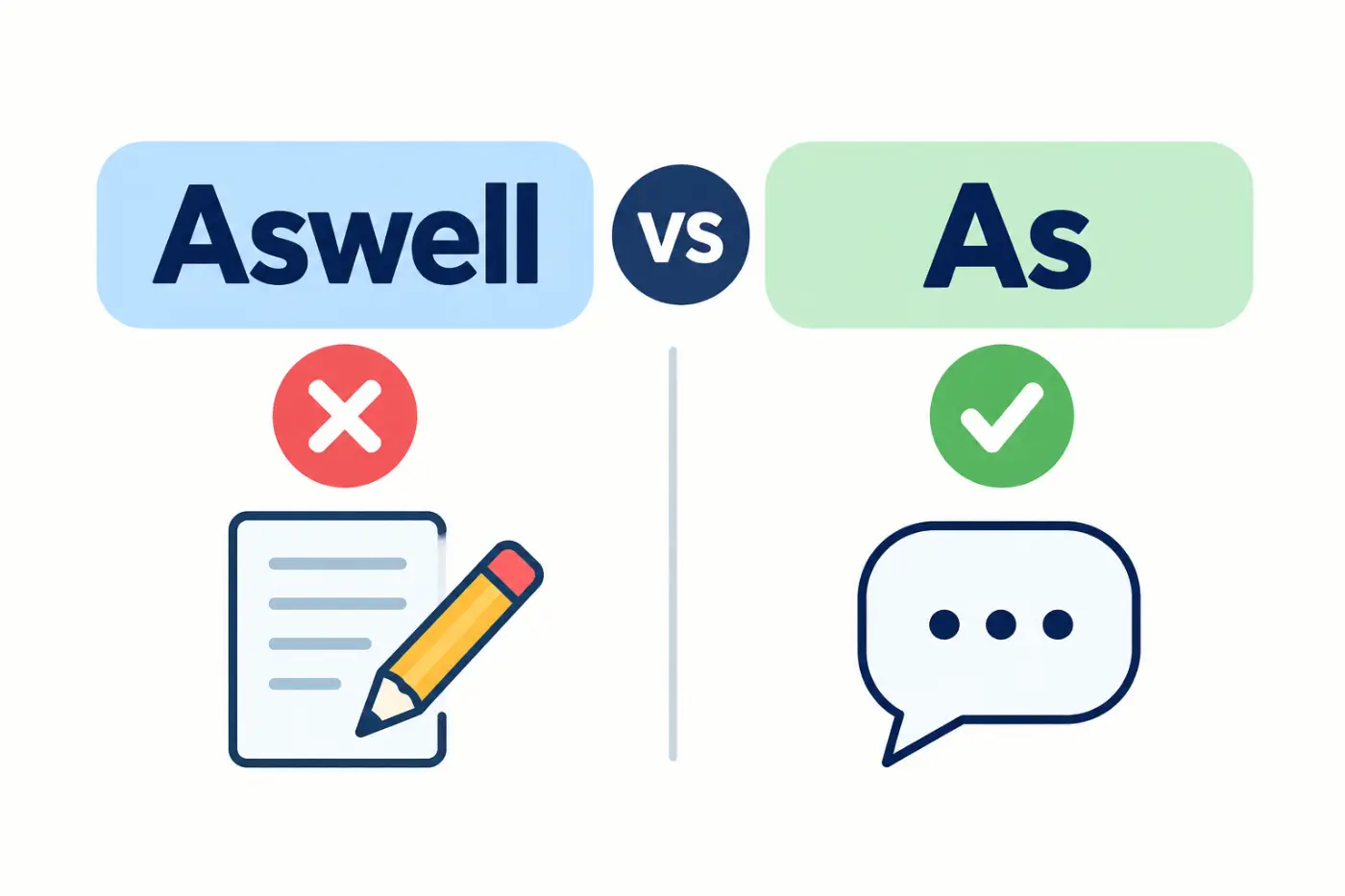
If you have ever stopped while writing and wondered about aswell vs as well, you’re not alone. The two forms look almost identical, so it’s easy to assume they might both be correct.
The answer is simple. As well is the correct form in standard English. Aswell is not a standard English word.
You’ll often see the one word form in quick messages, social posts, comments, and informal writing. That can make it look normal. But when you’re writing an email, school paper, article, report, application, or professional message, you should use as well as two separate words.
The good news is that this is one of those English questions you can settle in a few seconds. Once you understand how the phrase works, you won’t need to stop and think about it every time.
This guide explains the correct spelling, meaning, grammar, punctuation, sentence placement, common mistakes, and a few easy ways to remember the rule. You’ll also see plenty of natural examples so you can recognize the phrase in real writing.
Quick Definition
As well is a two word phrase that usually means also, too, or in addition. It commonly appears at the end of a sentence, although it can appear in other positions in some structures. Aswell is not the standard spelling and should be avoided in formal and edited English.
Direct Answer
The correct form is as well. Always write it as two words when you mean also or too.
Comparison Table
| Word or Phrase | Meaning | Example Sentence | When to Use It |
|---|---|---|---|
| as well | also or too | I want to go as well. | Standard English |
| aswell | Not a standard English form | I want to go aswell. | Avoid it |
| as well as | in addition to or together with | She sings as well as dances. | Use it when connecting two things |
| well | in a good or satisfactory way | He plays well. | Use it when describing how something is done |
Why The Confusion Happens
The confusion comes from the way people pronounce the phrase.
When someone says as well in normal conversation, the two words can sound like one smooth unit. English speakers often connect words when they talk. That makes a phrase such as “I want one as well” sound almost like a single word.
Writing works differently.
English has many phrases made from separate words that sound connected when spoken. As well is one of them. The fact that the phrase sounds like one unit does not mean it should be written as one word.
Think about phrases such as “a lot,” “of course,” and “at least.” People say them quickly, but we still write the words separately.
The same rule applies here.
Spoken English Can Hide The Spelling
Speech gives us very few clues about word boundaries.
Imagine someone says:
- “I’d like some too.”
- Now imagine:
- “I’d like some as well.”
The second sentence sounds natural because as well works much like too. In casual speech, the words can blend together.
That sound can lead writers to create the spelling aswell by mistake.
This happens with many English expressions. People often spell a phrase based on how it sounds instead of how it is conventionally written.
English spelling doesn’t always follow pronunciation in a neat way. That’s one reason checking the written form matters.
Online Writing Adds To The Problem
The internet makes this confusion even easier to spot.
People write quickly in text messages, comments, gaming chats, social media posts, and online forums. Informal writing often contains shortened forms, missing punctuation, spelling mistakes, and words joined together.
If you see aswell often enough, your brain may start to treat it as familiar.
Familiarity doesn’t make a spelling correct.
You may also see other nonstandard forms repeated online. A search engine can show thousands of results for a misspelled word. That doesn’t automatically make the spelling acceptable in standard English.
When accuracy matters, use the established form.
As Well Is The Correct Form
The standard phrase is as well.
It usually adds another person, thing, action, or idea to a sentence. In many cases, you can replace it with also or too without changing the basic meaning.
Consider these examples.
- “I want to come as well.”
- “I want to come too.”
- “I also want to come.”
All three sentences communicate a similar idea.
Here are a few more examples.
- “She bought a notebook as well.”
- “She bought a notebook too.”
- “She also bought a notebook.”
- “He speaks Spanish as well.”
- “He speaks Spanish too.”
- “He also speaks Spanish.”
The exact position can change, but the basic meaning stays similar.
As Well Means Also
One of the easiest ways to understand the phrase is to connect it with the word also.
If someone says:
- “I like coffee as well.”
- They mean:
- “I also like coffee.”
The phrase tells the reader that the speaker shares the same preference as someone or something already mentioned.
For example:
“Maria likes hiking. I like hiking as well.”
The second sentence adds the speaker to the group of people who like hiking.
You could also write:
- “Maria likes hiking. I like hiking too.” Or:
- “Maria likes hiking. I also like hiking.”
All three are grammatically sound.
As Well Means Too
In many sentences, as well works just like too.
Compare these sentences.
- “I’ll take a sandwich as well.”
- “I’ll take a sandwich too.”
- “We need to invite Sarah as well.”
- “We need to invite Sarah too.”
- “He wants to join us as well.”
- “He wants to join us too.”
The meaning is clear in each case.
This makes too a useful replacement when you’re unsure about the phrase. If you can naturally use too at the end of the sentence, as well will often work in the same spot.
How To Use As Well In A Sentence
The most common use of as well comes at the end of a sentence.
For example:
- “I enjoyed the movie as well.”
- “She wants to come with us as well.”
- “We need more chairs as well.”
- “They sell fresh bread as well.”
- “You can call me tomorrow as well.”
This position is especially common when the phrase means too.
It sounds natural and clear.
As Well At The End Of A Sentence
For everyday writing, placing the phrase at the end is often the easiest choice.
Consider:
“I ordered the pasta as well.”
This means the speaker ordered pasta in addition to something already discussed.
Another example:
“David applied for the job as well.”
The phrase adds David to a group of people who applied.
You can also use it after a verb phrase.
- “She wants to learn French as well.”
- “He plans to attend the meeting as well.”
- “We should check the website as well.”
The phrase doesn’t need special punctuation in these sentences.
As Well In Other Positions
Although the end position is common, as well can appear in other structures.
For example:
“She as well as her brother attended the event.”
Here, the phrase is part of as well as, which has a different grammatical role.
You might also see:
“As well as studying, he works part time.”
In this structure, the phrase doesn’t simply mean too at the end of a sentence. It connects ideas and can mean something close to in addition to.
That distinction matters because as well and as well as aren’t always interchangeable.
As Well Compared With As Well As
This is one of the most useful distinctions to understand.
As well often means also or too.
As well as often connects two people, things, actions, or ideas.
Look at these examples.
“I bought a jacket as well.”
Here, as well means too.
Now look at:
“I bought a jacket as well as a pair of shoes.”
Here, as well as connects the jacket and the shoes.
The sentence tells us that the person bought both items.
Examples With As Well
- “I want dessert as well.”
- “She knows the answer as well.”
- “We visited the museum as well.”
- “He plays guitar as well.”
These sentences use the phrase to add information.
Examples With As Well As
- “She speaks English as well as French.”
- “He works as well as studies.”
- “The hotel offers breakfast as well as dinner.”
- “We need a laptop as well as a printer.”
In each example, as well as connects two elements.
That’s a useful clue.
- If you mean too, as well is usually the form you need.
- If you are connecting two items or actions, as well as may be the right structure.
Aswell vs As Well In Real Sentences
When people search for aswell vs as well, they usually want a quick answer. But seeing the phrase in real sentences makes the rule much easier to remember.
Here are some common examples.
Correct Examples
- “I’ll bring some snacks as well.”
- “She wants to attend the party as well.”
- “We need to finish this task as well.”
- “He ordered coffee as well.”
- “They invited my sister as well.”
- “I enjoyed the book as well.”
- “Please send me the details as well.”
- “You can use my computer as well.”
- “We should check the other room as well.”
- “John is coming with us as well.”
Each sentence uses the standard two word form.
Incorrect Examples
- “I’ll bring some snacks aswell.”
- “She wants to attend the party aswell.”
- “We need to finish this task aswell.”
- “He ordered coffee aswell.”
- “They invited my sister aswell.”
These examples use the nonstandard one word spelling.
In edited English, replace aswell with as well.
Common Mistakes With As Well
The spelling mistake is the biggest problem, but it isn’t the only one.
Writers sometimes use the phrase in places that make a sentence sound awkward. Others confuse it with also, too, or as well as.
Knowing the differences will make your writing cleaner.
Mistake One Writing Aswell
This is the most direct error.
Incorrect:
“I want to come aswell.”
Correct:
“I want to come as well.”
The fix is simple. Keep the two words separate.
Mistake Two Confusing As Well With As Well As
These phrases have related meanings, but they don’t always perform the same job.
Incorrect:
“I like pizza as well my brother.”
Correct:
“I like pizza as well as my brother.”
However, the meaning of the corrected sentence may not be what you intended.
If you mean that you and your brother both like pizza, a clearer sentence is:
“My brother likes pizza, and I do as well.”
Or:
“My brother likes pizza, and I like it too.”
Clear writing beats complicated wording.
Mistake Three Adding Extra Words
Sometimes writers create awkward combinations because they try to use several similar expressions together.
For example:
“I also want to come as well too.”
This sentence contains three ways to express addition.
You only need one.
Better:
“I also want to come.”
Or:
“I want to come as well.”
Or:
“I want to come too.”
Pick the version that sounds most natural for your sentence.
Mistake Four Using Too Many Similar Expressions
A sentence can be grammatically correct and still feel clumsy.
For example:
“She also wants to attend the meeting as well.”
This is possible in some contexts, but it usually sounds repetitive because also and as well perform the same basic job.
A cleaner version is:
“She also wants to attend the meeting.”
Or:
“She wants to attend the meeting as well.”
Good editing often means removing words that don’t add meaning.
As Well And Also
Both as well and also can mean too or in addition.
The main difference often comes down to position and style.
As well commonly appears at the end of a sentence.
Also can appear before the main verb, after a form of be, or in other positions.
Compare these sentences.
- “I like jazz as well.”
- “I also like jazz.”
Both work. Now consider:
“She is also a teacher.”
You generally wouldn’t replace also with as well in the same position.
You could say:
“She is a teacher as well.”
That works, but the sentence structure changes.
This is why you shouldn’t treat the two expressions as exact replacements in every sentence.
When As Well Sounds More Natural
In casual American English, as well often sounds natural at the end of a sentence.
- “I’ll have one as well.”
- “That sounds good as well.”
- “We can meet tomorrow as well.”
- “Thanks for your help as well.”
It has a friendly and conversational feel.
When Also Works Better
Also can be useful when you want to add information earlier in a sentence.
- “She also works from home.”
- “They also offer free parking.”
- “He also knows how to cook.”
You could rewrite some of these with as well, but the sentence may need to change.
- “She works from home as well.”
- “They offer free parking as well.”
- “He knows how to cook as well.”
Both forms are useful. Choose the one that fits the sentence naturally.
As Well And Too
Too is another close match.
In many sentences, too and as well are almost interchangeable.
- “I want to go too.”
- “I want to go as well.”
- “She likes it too.”
- “She likes it as well.”
- “We need more time too.”
- “We need more time as well.”
There can be a small difference in tone. Too is often shorter and more casual. As well can sound a little more polished while still remaining natural.
Neither is automatically better.
The important point is that as well stays as two words.
Is Aswell Ever Correct
For standard English writing, you should treat aswell as incorrect when you mean as well.
You may find it in user names, website addresses, informal posts, comments, or other places where people don’t follow standard spelling rules.
That doesn’t make it a standard English spelling.
If you’re writing for readers in the United States, especially in school, work, publishing, business, or professional communication, use as well.
There is no useful reason to choose the one word form in normal edited writing.
What About Dictionaries
A standard English dictionary is a useful source when you want to confirm a word or phrase.
The established phrase is as well.
The fact that people sometimes write aswell online is not enough to make it standard.
This is an important lesson for English learners. Search results show what people write. Dictionaries and style references help show what standard English accepts.
Those aren’t always the same thing.
Is As Well One Word Or Two
- It is two words.
- That answer is worth remembering on its own.
- Write:
- as well
- Not:
- aswell
You can think of it like a small team of two words. They work together, but they still keep their own spaces.
This is similar to many common English phrases.
- We write:
- “of course”
- “a lot”
- “at least”
- “in fact”
- “as well”
The words work together as expressions, but they remain separate words.
Does As Well Need A Comma
Usually, as well does not need a comma when it appears naturally at the end of a sentence.
For example:
- “I want to come as well.”
- No comma is needed.
- “She bought a ticket as well.”
- No comma is needed.
- “We should invite Mark as well.”
Again, no comma is needed.
Punctuation can change when as well as introduces a larger phrase or when another grammatical structure requires punctuation.
The key point is that the phrase as well itself does not automatically require a comma.
Examples Without A Comma
- “I’ll call you later as well.”
- “We need to buy milk as well.”
- “She wants to learn Spanish as well.”
- “He enjoyed the concert as well.”
These are clean and natural.
Is As Well Formal Or Informal
As well works in both casual and formal English.
- You can use it in a text message.
- “I’ll be there as well.”
- You can use it in an email.
- “I’d be happy to attend as well.”
- You can use it in academic writing when the sentence calls for it.
- “The study examined income levels as well.”
- You can also use it in professional writing.
- “The report includes sales data as well.”
- It is not slang. It is a standard English phrase.
The choice between too, also, and as well often depends on sentence structure and tone.
How To Remember The Correct Spelling
The easiest memory trick is simple.
As well means too, and too is one word. As well has two words.
You can also remember the phrase as a small addition.
Something is being added to the sentence. The phrase itself contains two separate words that add information.
Another useful trick is to replace the phrase with also.
If the sentence still makes sense, you probably have the right meaning.
For example:
“I want to come as well.”
Replace it:
“I also want to come.”
The meaning stays clear.
Now remember the spelling. Keep as and well separate.
A Simple Visual Reminder
Think:
AS + SPACE + WELL
That space matters.
If you are typing quickly, slow down for one second when you reach the phrase. It can save you from an easy spelling mistake.
Why Standard Spelling Matters
You might wonder if one small space really matters.
Sometimes it does.
A spelling mistake can distract readers from your message. One mistake probably won’t ruin a casual text. But repeated errors can make professional writing look careless.
Imagine reading a business proposal that contains several obvious spelling mistakes. You may start questioning the care that went into the rest of the document.
The same thing happens with articles, resumes, school assignments, cover letters, and client emails.
Small details build trust.
That doesn’t mean you need perfect English every second. Everyone makes mistakes. The goal is to know the common rules that are easy to follow.
- This one is especially easy.
- Write as well as two words.
Related English Spelling Confusions
The question about this phrase belongs to a larger group of English spelling problems.
English contains many phrases that people sometimes combine incorrectly.
A Lot And Alot
The standard form is a lot.
Incorrect:
“I have alot of work.”
Correct:
“I have a lot of work.”
This is similar to the issue here. The words sound closely connected, but standard writing keeps them separate.
At Least And Atleast
The standard phrase is at least.
Incorrect:
“Atleast we tried.”
Correct:
“At least we tried.”
Again, the phrase contains separate words.
Of Course And Ofcourse
The standard form is of course.
Incorrect:
“Ofcourse I remember.”
Correct:
“Of course I remember.”
These examples show why spelling based only on sound can cause trouble.
Awhile And A While
This one is different because both forms can be correct in different structures.
For example:
- “Stay awhile.”
- “I stayed for a while.”
This is a good reminder that English spelling questions sometimes need context.
The situation with as well is simpler. The standard phrase is two words when it means also or too.
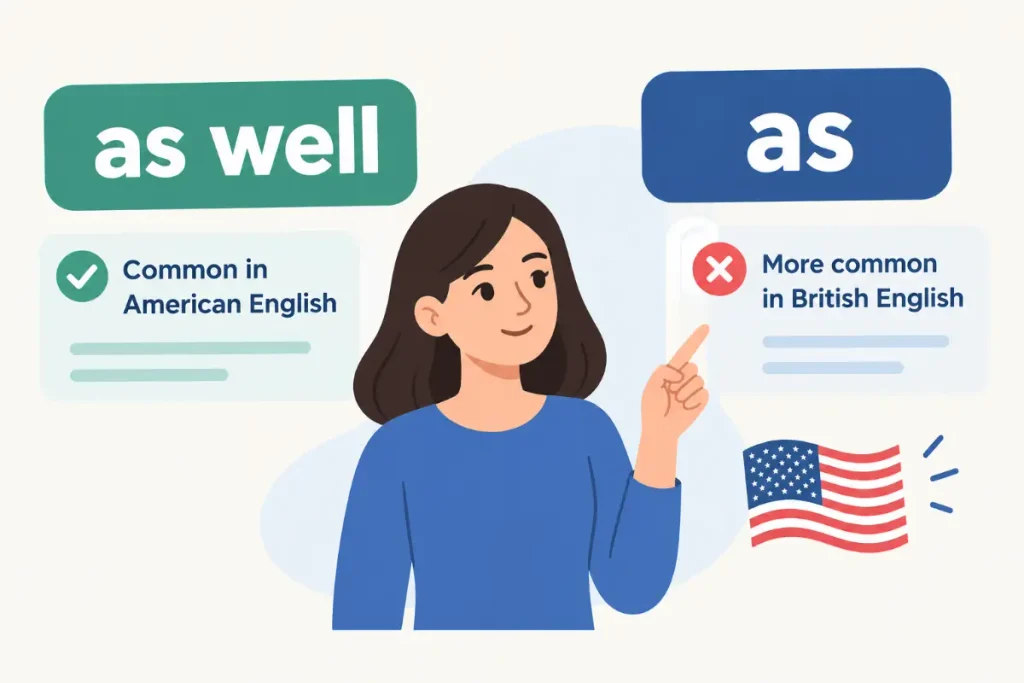
How American English Uses As Well
American English uses as well naturally in everyday speech and writing.
You may hear:
- “I’ll take one as well.”
- “She wants to come as well.”
- “We should tell him as well.”
- “I enjoyed it as well.”
The phrase is common and easy to understand.
American English also uses too very often in these situations.
- “I’ll take one too.”
- “She wants to come too.”
- “We should tell him too.”
- Both styles are natural.
The important spelling point stays the same. The phrase uses two words.
Examples For Work And School
If you’re learning English or improving your writing, it helps to see the phrase in settings where accuracy matters.
Workplace Examples
- “Please send the updated file as well.”
- “I’ll review the budget as well.”
- “The manager needs a copy as well.”
- “We should contact the client as well.”
- “She attended the meeting as well.”
School Examples
- “The students completed the assignment as well.”
- “I read the second chapter as well.”
- “The teacher discussed the results as well.”
- “We need to study this section as well.”
- “He submitted his paper as well.”
Email Examples
- “Thanks for sending the information as well.”
- “I’d like to attend the meeting as well.”
- “Please let me know if you need anything else as well.”
- “I appreciate your help as well.”
These examples show how flexible the phrase is. It works in everyday communication and more formal settings.
Examples From Everyday Conversation
Natural conversation often makes the phrase feel very easy.
- “I’m tired as well.”
- “Come with us as well.”
- “I want some pizza as well.”
- “She knows him as well.”
- “I saw that movie as well.”
- “You can sit here as well.”
- “We can leave now as well.”
These are short sentences, but they show the main use clearly.
When you mean too, keep the phrase separate.
A Quick Test You Can Use
If you’re still unsure, use this quick test.
Ask yourself:
Am I trying to say also or too?
If the answer is yes, as well is likely the phrase you want.
Then check the spelling.
As well.
Two words.
For example:
“I want to join as well.”
You can replace the phrase with too.
“I want to join too.”
The sentence still works.
That gives you a quick meaning check and a spelling check at the same time.
FAQs
Is aswell vs as well a spelling question?
Yes. The standard form is as well, written as two words. The one word form is not standard English when you mean also or too.
Is aswell a real English word?
You may see it online, but it is not the standard spelling of the phrase as well. In normal edited English, write the phrase as two separate words.
Should I write as well or aswell?
Write as well. Use it when you mean also, too, or in addition.
Can I use as well at the end of a sentence?
Yes. This is one of its most common positions. For example, “I’d like to come as well” is natural and grammatically correct.
Is as well the same as too?
In many sentences, yes. Both can mean that something or someone is included in addition to something already mentioned.
Is as well the same as also?
They often have the same basic meaning, but they don’t always fit into the same place in a sentence. Also often appears before the main verb, while as well commonly appears at the end.
Is as well as different from as well?
Yes. As well often means also or too. As well as usually connects two things or actions and can mean in addition to.
Does as well need a comma?
Usually no. When it naturally appears at the end of a sentence, you normally don’t put a comma before it.
Conclusion
The answer to aswell vs as well is clear. Use as well when you mean also, too, or in addition. Keep the two words separate.
The one word form may appear in informal online writing, but that doesn’t make it standard. If you’re writing an article, email, school paper, report, resume, or professional message, choose the accepted form.
Remember the simple rule. As well is two words. If you can replace it with too or also, you’re probably using the phrase in its common sense.
The next time you pause over the spelling, don’t overthink it. Write as well, keep the space, and move on with your sentence.

Dr. Arthur Pendelton is a veteran historical linguist and grammar expert with over 30 years of experience in academic editing. A retired professor, Arthur specializes in the etymology and evolution of the English language. He is passionate about “unpacking the history behind the rules,” helping readers understand why we spell, punctuate, and phrase things the way we do today. Whether he’s settling debates on archaic usage or explaining complex linguistic shifts, Dr. Pendelton brings scholarly precision to every article.
2 thoughts on “Aswell vs As Well Which Is Correct”