
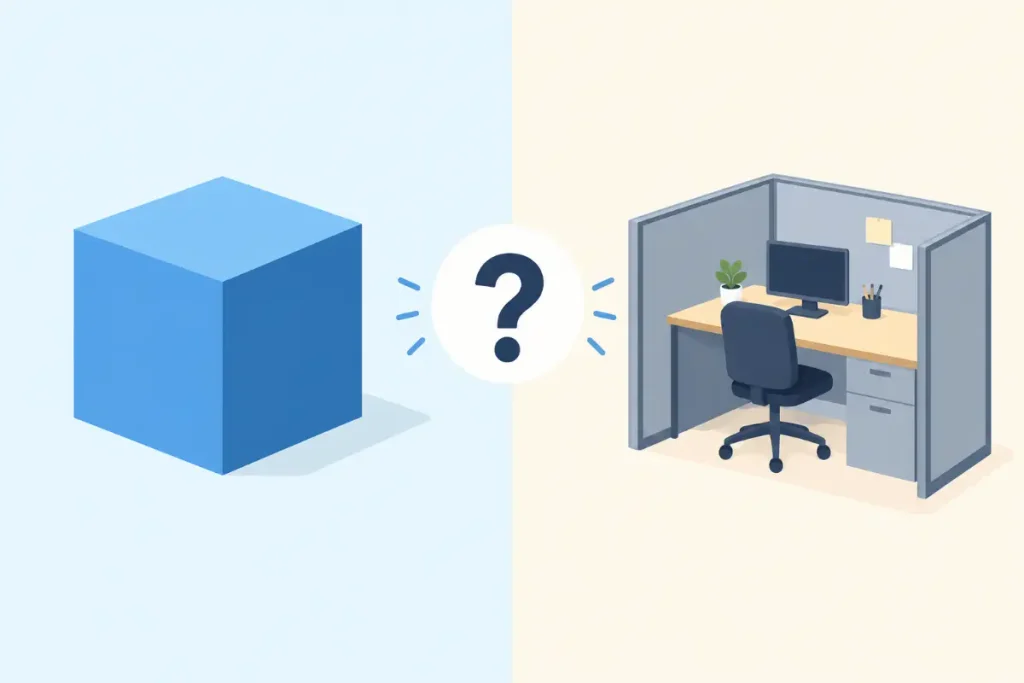
If you’re asking about cubical vs cubicle, the correct word depends on what you mean. Cubicle is the noun for a small enclosed space such as an office area, changing space, or bathroom stall. Cubical is an adjective that describes something shaped like a cube or related to a cube.
The two words look and sound almost the same, so the confusion is understandable. They also come from the same basic word family. Still, they do different jobs in a sentence.
If you mean a small private work area at an office, the word you want is cubicle. If you’re describing the shape of an object, cubical can be the right choice.
This guide explains the difference in plain English. You’ll see clear definitions, natural examples, common mistakes, memory tricks, and answers to related questions so you can use both words with confidence.
Quick Definition
Cubicle is a noun that means a small separate space inside a larger room or area. A workplace cubicle is a small office space divided from nearby work areas by walls or panels. Cubical is an adjective that means shaped like a cube or having qualities related to a cube.
Direct Answer
Use cubicle when you mean a small enclosed space such as an office area or changing space. Use cubical when you need an adjective that describes something as cube shaped.
Comparison Table
| Word or Phrase | Meaning | Example Sentence | When to Use It |
|---|---|---|---|
| Cubicle | A small enclosed or divided space | Maya works in a cubicle near the window. | Use it for a small office space or similar enclosed area. |
| Cubical | Shaped like a cube or related to a cube | The artist built a cubical structure from wood. | Use it when describing shape or form. |
| Cubic | Related to a cube or three dimensional measurement | The box has a cubic volume of two feet. | Use it for volume, mathematics, or three dimensional measurements. |
| Cube | A solid shape with six equal square faces | The child played with a wooden cube. | Use it for the actual geometric shape or a similar object. |
Why These Words Cause Confusion
The main problem is that cubical and cubicle are built from the same root. They also have very similar spellings and pronunciations.
When people hear the word spoken, the difference can be easy to miss. The ending sounds close in everyday speech. That can lead someone to write one word when they mean the other.
The meaning of the sentence usually gives you the answer.
Consider this sentence.
I cleaned my cubicle before leaving work.
The sentence talks about a small work area. It needs a noun because the speaker is naming a place.
Now consider this sentence.
The table has a cubical design.
This sentence describes the shape of the table. It needs an adjective because the word explains what the design is like.
That simple difference is the key.
- A cubicle is a thing.
- Cubical describes a thing.
Think of the difference between office and office shaped. The first names something. The second describes something. The same basic idea helps separate these two words.
What Cubicle Means
A cubicle is a small space separated from a larger room or area. It often has low walls, panels, curtains, or other dividers.
In American English, the word commonly refers to a small workspace in an office. Cambridge defines a work cubicle as a small room or space inside a larger area. Its business dictionary also describes a cubicle as an office space formed by putting up low walls in a larger room.
The word can also describe spaces used for privacy.
For example, a store may have changing cubicles. A bathroom may contain shower cubicles. A hospital or other facility may use cubicles to separate patients or provide private areas.
- The basic idea stays the same.
- A larger space is divided into smaller areas.
- Here are some natural examples.
- My new cubicle is next to the conference room.
- She decorated her cubicle with family photos.
- The office has twenty cubicles.
- I left my notebook in the cubicle.
- The employee moved to a larger cubicle.
- Each cubicle has a desk and a small filing cabinet.
- The changing room has six private cubicles.
Notice that the word names a space. That is why it works as a noun.
You can put articles before it.
- a cubicle.
- the cubicle.
- one cubicle.
- You can also make it plural.
- cubicles.
That is another useful clue. If you can naturally say a cubicle or several cubicles, you’re using the noun correctly.
What Cubical Means
Cubical is an adjective. It describes something that has the shape of a cube or is related to a cube.
A cube is a three dimensional shape with six square faces. A cubical object is therefore cube shaped or roughly cube shaped.
For example.
- The building has a cubical design.
- The sculpture consists of several cubical forms.
- The machine sits inside a cubical frame.
- The child built a cubical tower with blocks.
- The room contains a large cubical structure.
In these sentences, cubical gives more information about another noun. It tells the reader something about shape or form.
That is the biggest grammatical difference.
- A cubicle is a noun.
- Cubical is an adjective.
The words may look like close spelling cousins, but they have different jobs.
Cubical vs Cubicle in Real Sentences
The easiest way to learn the difference is to see the words in context.
Examples With Cubicle
- I spend most of my workday in a cubicle.
- Here, cubicle names the space where the person works.
- Her cubicle is across from mine.
- Again, the word identifies a physical workspace.
- The manager asked him to move to another cubicle.
- The word refers to another small office space.
- Someone left a coffee cup in my cubicle.
- The word names the location.
- The office cubicles were arranged in rows.
- Here, cubicles refers to multiple small work areas.
- I can hear the printer from my cubicle.
- The word still names the speaker’s work space.
Examples With Cubical
- The designer created a cubical lamp.
- Cubical describes the shape of the lamp.
- The sculpture has a cubical form.
- The adjective tells us that the form resembles a cube.
- The room contains a large cubical object.
- The word describes the object’s shape.
- Scientists examined the cubical structure.
- The adjective describes the structure.
- The artist used several cubical shapes in the installation.
- The word describes the shapes.
- The package has a nearly cubical shape.
- The adjective explains the shape of the package.
The difference becomes much clearer once you stop looking at the spelling and focus on the job each word performs.
The Grammar Difference Matters
Many word pairs become easier when you identify the part of speech.
Cubicle is a noun.
A noun names a person, place, thing, or idea. In this case, it names a physical space.
Cubical is an adjective.
An adjective describes a noun. In this case, it describes shape or form.
Compare these sentences.
The cubicle is small.
In this sentence, cubicle is the noun. Small is the adjective.
Now look at this sentence.
The cubical structure is small.
Here, structure is the noun. Cubical describes the structure. Small also describes the structure.
You can test the word by asking a simple question.
Are you naming a space?
If yes, cubicle is probably the word you need.
Are you describing something as cube shaped?
If yes, cubical may be the right word.
This test works in most everyday situations.
Why Cubical Is Less Common
There is another reason people often choose cubicle by mistake.
Cubical is a real English word, but it is not nearly as common in everyday conversation as cubicle. Cambridge currently lists examples of cubical usage but does not provide a full dictionary definition on its main English entry. Its corpus examples show the word being used to describe cube shaped objects and structures.
In ordinary English, people often use cubic or simply cube shaped instead.
For example, you might hear:
- The box is cube shaped.
- You could also write:
- The box has a cubical shape.
- Both communicate the basic idea.
In technical writing, mathematics, science, architecture, and other specialized fields, cubical can appear more often because writers may need a precise adjective related to a cube.
So don’t assume that cubical is wrong simply because it sounds less familiar.
It has a legitimate use.
The important point is that it does not normally mean a small office space.
Cubicle Is Not About Shape
One common mistake is assuming that a cubicle must be cube shaped.
That is not true.
An office cubicle does not have to look like a perfect cube. It may be rectangular, open on one side, taller than it is wide, or arranged in a larger group of connected workspaces.
The word refers to the function and structure of the space, not its exact geometric shape.
For example, imagine a typical office with desks separated by panels. Each worker has a small area. That area can be called a cubicle even if it is clearly not shaped like a cube.
This distinction matters because the words have developed different meanings.
Cubicle refers to a small divided space.
Cubical refers to shape.
So you should not use the shape of an office cubicle as a rule for choosing the word.
Where the Word Cubicle Is Commonly Used
Cubicle has several common uses in American English.
Office Cubicles
This is probably the use most readers recognize.
A cubicle is a small work area separated from nearby workers.
For example.
I have a meeting at two and then I’ll return to my cubicle.
Her cubicle is decorated with colorful plants.
The company replaced the old cubicles with larger work areas.
Bathroom Cubicles
The word can also refer to a private section of a bathroom.
For example.
The public restroom has several toilet cubicles.
In American English, stall is often more common for a toilet area. Still, cubicle is understood and appears in English varieties and specific contexts.
Shower Cubicles
A shower cubicle is a small enclosed area used for showering.
For example.
The hotel bathroom has a glass shower cubicle.
The word describes the separate space rather than the shape of the space.
Changing Cubicles
Stores and other places may provide cubicles where people can change clothes.
For example.
The customer asked for a larger changing cubicle.
Again, the word refers to a private area.
Study Cubicles
Libraries and study centers sometimes use small divided spaces for individual work.
For example.
I found a quiet study cubicle near the back of the library.
The idea remains the same. A larger room contains smaller separate spaces.
Where Cubical Is Commonly Used.
Cubical appears most often when the writer needs to describe shape, structure, or form.
Architecture
An architect might describe a building or section of a building as cubical.
For example.
The house has a simple cubical design.
The word describes the shape.
Art
Artists may create cubical sculptures or forms.
For example.
The gallery displayed several cubical sculptures.
Here, cubical describes the sculptures.
Mathematics
Mathematics uses words connected with cubes and three dimensional forms.
For example.
The model has a cubical shape.
The adjective tells us about the form.
Science
Technical writing can also use cubical to describe structures or objects that resemble cubes.
For example.
The sample was placed inside a cubical container.
The exact field can affect the preferred terminology. In some scientific contexts, writers may choose cubic, cuboidal, or another more precise term.
That choice depends on what they are describing.
Cubical and Cubic Are Not Exactly the Same
Another useful distinction is the difference between cubical and cubic.
Both words connect to the idea of a cube, but they are not interchangeable in every sentence.
Cubical generally describes something as cube shaped.
Cubic has several uses. It can describe something related to a cube, and it is also widely used when talking about volume and mathematical expressions.
For example.
The container has a cubical shape.
This focuses on appearance or form.
Now look at:
The container holds three cubic feet of material.
Here, cubic describes a unit of volume.
Cambridge gives examples such as cubic centimeter and cubic meter. It explains that cubic units describe measurements based on length multiplied by width and height.
You can remember the difference this way.
- Cubical often answers the question What shape is it?
- Cubic often answers the question How much three dimensional space does it contain?
That is a useful shortcut, especially in school or technical writing.
Common Mistakes With These Words
Knowing the definitions is helpful. Seeing the mistakes makes the difference stick.
Mistake One Using Cubical for an Office Space
Incorrect.
I left my laptop in my cubical.
Correct.
I left my laptop in my cubicle.
The speaker is naming a work area. That makes cubicle the correct noun.
Mistake Two Using Cubicle to Describe Shape
Incorrect
The artist created a cubicle sculpture.
This sentence suggests that the sculpture is a small enclosed space. It does not clearly describe a cube shape.
Better.
- The artist created a cubical sculpture.
- Now the adjective describes the sculpture’s form.
- Another natural option is:
- The artist created a cube shaped sculpture.
- That wording is especially clear for general readers.
Mistake Three Assuming Cubicle Means Cube Shaped
A cubicle does not need to be a geometric cube.
An office cubicle may be much wider than it is deep. It may have three panels and an open entrance. It may even connect with other workspaces.
The word refers to the divided space.
Mistake Four Treating the Words as Interchangeable
They are not interchangeable.
You cannot normally replace cubicle with cubical and keep the same meaning.
Compare:
This means she works in a small divided office space.
She works in a cubical.
This does not communicate the same idea.
The second sentence would need a different context and would sound incomplete or unusual to most readers.
A Simple Memory Trick
Here is an easy way to remember the difference.
Think of the final letters.
Cubicle ends with cle.
Think cubicle equals a little place.
The word contains the idea of a small space where someone can sit, work, change clothes, or have some privacy.
Now think about cubical.
It ends with cal.
Think cubical equals shape.
You can also connect cubical with cube.
- Cube.
- Cubical.
The connection is easy to see.
Another useful trick is to ask yourself what comes after the word.
If you can say:
- my cubicle.
- the cubicle.
- a cubicle.
You are probably naming a space.
If you can say:
cubical shape.
cubical structure.
You are probably describing something.
This kind of quick test is often more useful than memorizing a formal grammar rule.
How to Choose the Right Word Quickly
When writing an email, essay, report, or social post, you can solve the problem in a few seconds.
First, identify the meaning.
- If you mean a small room or separated area, use cubicle.
- If you mean cube shaped, use cubical.
- Then check the grammar.
If the word names something, cubicle works as a noun.
If the word describes something, cubical works as an adjective.
Finally, read the full sentence.
For example:
I decorated my cubicle.
This makes sense because a cubicle is a space that can be decorated.
Now:
I bought a cubical desk.
This can make sense if the desk has a cube like shape.
That final context check catches many mistakes.

More Natural Examples to Learn From
Context makes vocabulary easier to remember. Here are more examples using both words naturally.
- My cubicle is next to the window.
- The office gave each employee a private cubicle.
- She moved her computer into the new cubicle.
- I keep my headphones in my desk drawer at the cubicle.
- Several cubicles were empty after the company moved offices.
- The library has quiet cubicles for individual study.
- The designer created a cubical room for the display.
- The sculpture has several cubical sections.
- The box has an almost cubical shape.
- The architect used cubical forms throughout the design.
- The machine sits inside a cubical frame.
- The artist arranged three cubical blocks in the center of the room.
- Notice the pattern.
- The first group names spaces.
- The second group describes shapes or forms.
- Once you recognize that pattern, the spelling becomes much easier.
Related Words You Should Know.
The word family around cube can create more confusion, so it helps to know a few related terms.
Cube
A cube is a three dimensional shape with six square faces.
For example:
The child held a wooden cube.
Cubic
Cubic can describe something connected with a cube. It is also common when describing volume.
For example:
The tank holds ten cubic feet of water.
Cubical.
Cubical describes something that is cube shaped or related to a cube.
For example:
The building has a cubical form.
Cuboid
A cuboid is a three dimensional shape with six rectangular faces. A box is a familiar example.
This word matters because not every box shaped object is a true cube. A cube has equal side lengths. A cuboid can have different lengths, widths, and heights.
That distinction can matter in technical writing.
Cuboidal
Cuboidal means shaped like a cuboid or related to a cuboid. The term appears in specialized fields such as anatomy and biology. Cambridge uses it for descriptions of box shaped cells.
You probably won’t need this word in everyday writing, but knowing it can prevent confusion if you come across it in a science text.
When to Use Cube Shaped Instead
Sometimes cube shaped is better than cubical.
Why?
It is simple and immediately clear.
For general readers, this phrase can be easier to understand.
For example:
- The building has a cube shaped design.
- You could also write:
- The building has a cubical design.
- Both can communicate a similar idea.
The first option is more conversational. The second is more compact.
If you are writing for a general audience, choose the wording that makes your meaning easiest to understand.
Clear writing does not always require the shortest word. It requires the clearest word.
Why Context Is More Important Than Spelling
Many spelling questions become easier when you stop comparing letters and start comparing meanings.
The endings cle and cal may look close. That visual similarity creates the problem.
- But the meanings are quite different.
- Imagine two boxes.
- The first box contains a small work area separated from a large office. That area is a cubicle.
- The second box is an object shaped like a cube. You might describe it as cubical.
- The physical picture changes, so the word changes.
This is a good general lesson for English vocabulary. Words that look similar are not always interchangeable. A small spelling difference can signal a different grammatical role or meaning.
Tips for Students
Students often encounter these words in writing assignments, reading passages, science classes, and math lessons.
A simple strategy can help.
- Write the word cubicle when you mean a small enclosed space.
- Write cubical when you describe a cube like shape.
Then check the noun around the adjective.
For example:
- cubical object.
- cubical structure.
- cubical room.
If the word is describing a noun, the adjective makes sense.
Now check the article.
- a cubicle.
- the cubicle.
- my cubicle.
Those patterns show that the word is acting as a noun.
Students can also remember the related word cube.
Cube leads naturally to cubical.
Cubicle points to a small divided space.
Tips for Workplace Writing
The word cubicle is especially common in office writing.
You might use it in an email to describe a location.
I’ll be back at my cubicle after lunch.
You might use it in a workplace report.
The new layout gives each employee a larger cubicle.
You might use it in a casual message.
Can you stop by my cubicle when you have a minute?
In all these examples, the word identifies a physical workspace.
If you are describing the design of an object or structure, then cubical may be useful.
The display uses several cubical forms.
That is a completely different meaning.
Tips for Formal Writing
Formal writing rewards precision.
If you mean a small office area, use cubicle.
If you mean a shape, use cubical or a clearer phrase such as cube shaped.
Do not choose a word simply because it sounds more formal.
For example, replacing cubicle with cubical does not make a sentence more professional. It changes the meaning.
Good formal writing is precise first.
A simple word used correctly is stronger than a complicated word used incorrectly.
FAQs
Is cubical or cubicle correct?
Both words are correct, but they have different meanings. Cubicle is a noun for a small separated space. Cubical is an adjective that describes something as cube shaped or related to a cube.
Is a work cubicle or cubical correct?
The correct term for a small office workspace is cubicle. A work cubicle is a small area separated from the surrounding office by panels or low walls. Cambridge lists work cubicle as an American English use for a small room or space within a larger area.
Is cubical a real word?
Yes. Cubical is a real English adjective. It describes something that has a cube like shape or is related to a cube. It is less common in everyday speech than cubicle.
What does cubical mean?
Cubical means shaped like a cube or having a form related to a cube. For example, you can describe a sculpture as cubical if its form resembles a cube.
What does cubicle mean?
A cubicle is a small space separated from a larger room or area. In American English, it commonly refers to a small office workspace. It can also refer to other enclosed or divided spaces used for privacy.
Can cubical describe an office?
It can describe an office or structure if you are talking about its shape. For example, a cubical office could describe an office that has a cube like form. It does not mean an ordinary office cubicle.
Is cubicle related to cube?
Yes. The words share the same basic root connected with the idea of a cube or small compartment. Their modern meanings have developed in different directions, so cubicle now commonly names a small divided space while cubical describes shape.
What is the difference between cubical and cubic?
Cubical usually describes something as cube shaped. Cubic has broader uses and is especially common for mathematical ideas and measurements of volume, such as cubic feet or cubic meters.
Conclusion
The difference between cubical vs cubicle comes down to meaning and grammar. Cubicle is a noun that names a small separated space. Cubical is an adjective that describes something as cube shaped or related to a cube.
If you’re talking about a desk area at work, write cubicle. You can say, “My cubicle is near the window.” If you’re describing the shape of an object, use cubical. You can say, “The sculpture has a cubical form.”
The fastest memory trick is simple. A cubicle is a place. Cubical describes a shape. Once you connect each word with its job, the spelling becomes much easier to remember.
So before you choose the word, ask what you are trying to say. Are you naming a small space? Use cubicle. Are you describing something that looks like a cube? Use cubical. That quick check will help you choose the right word every time.

Dr. Arthur Pendelton is a veteran historical linguist and grammar expert with over 30 years of experience in academic editing. A retired professor, Arthur specializes in the etymology and evolution of the English language. He is passionate about “unpacking the history behind the rules,” helping readers understand why we spell, punctuate, and phrase things the way we do today. Whether he’s settling debates on archaic usage or explaining complex linguistic shifts, Dr. Pendelton brings scholarly precision to every article.