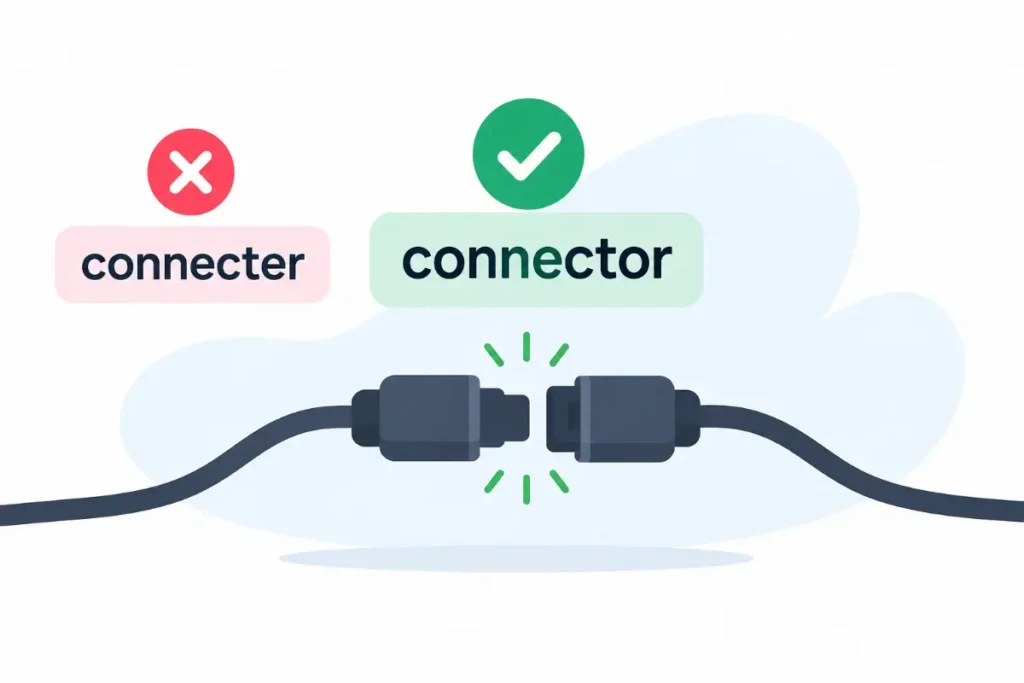
If you’re unsure about connector or connecter, the correct spelling in standard American English is connector. It’s the word you use for a person or thing that connects two things. For example, a cable connector joins a cable to another device.
The confusion is easy to understand. The verb is connect, so it may seem natural to add er and write connecter. English spelling does not always work that neatly, though. In this case, connector is the standard spelling.
This guide explains why connector is correct, what the word means, and how to use it naturally. You’ll also see examples from everyday English, technology, writing, and grammar. By the end, you’ll know which spelling to choose and why.
Quick Definition
A connector is a person, device, part, or word that connects things. It can describe a physical object, such as a cable connector, or a person who brings people together. In grammar, a connector can also be a word or phrase that links ideas in a sentence or paragraph.
Direct Answer
Connector is the standard and correct spelling in American English. Connecter is generally considered a misspelling and should not be used in standard writing.
Comparison Table
| Word or Phrase | Meaning | Example Sentence | When to Use It |
|---|---|---|---|
| Connector. | A person, thing, part, or word that connects two or more things. | This connector joins the two cables. | Use this spelling in standard English. |
| Connecter. | A nonstandard spelling that appears because people apply a simple spelling pattern to connect. | The manual contains a spelling error and uses connecter. | Avoid it in normal writing. |
| Connect. | To join or link things together. | Please connect the printer to your computer. | Use it as a verb. |
| Connection. | A link or relationship between things or people. | The internet connection is stable. | Use it for the link itself. |
| Connected. | Joined or linked to something. | The two devices are connected. | Use it as an adjective or past participle. |
Why Connector Is The Correct Spelling
The simplest answer is that English has established connector as the standard noun formed from connect.
The verb connect means to join or link one thing to another. The noun connector refers to something or someone that performs that connecting role.
For example:
The USB connector fits into the port.
Here, the connector is a physical part. It allows one device or cable to connect to another device.
You can also use the word for people.
Maria is a natural connector who introduces people with similar interests.
In this sentence, Maria brings people together. She acts as a social connector.
The spelling may look a little surprising at first because connecter seems to follow a familiar English pattern. Many nouns use er to describe a person or thing that performs an action.
For example.
- teach becomes teacher.
- write becomes writer.
- drive becomes driver.
- run becomes runner.
So it’s understandable that someone might think connect should become connecter.
English has many spelling patterns that look simple but have exceptions or established forms. Connector is one of those cases. Standard usage has settled on the spelling with or.
What Connector Means
The word connector has several related meanings. The basic idea stays the same in all of them.
A connector links something to something else.
That link can be physical. It can also be social, logical, grammatical, or technical.
Connector As A Physical Part
In technology, a connector is often a physical part that joins two components.
You may see connectors in computers, phones, televisions, audio equipment, cars, appliances, and other devices.
For example.
- The technician replaced the damaged connector.
- Make sure the connector is firmly attached.
- This cable has a different connector on each end.
A connector can carry electrical signals, power, data, sound, or other forms of communication between components.
The exact type of connector depends on the equipment.
Connector As A Person
A connector can also be a person who brings people together.
For example.
- James is a great connector in the business community.
- This means James knows many people and often introduces them to one another.
- The word can describe someone who helps create relationships.
- You might also hear it in social or professional settings.
- She became a connector between local artists and small businesses.
- The person acts as a bridge between two groups.
Connector In Writing
In writing, a connector is a word or phrase that links ideas.
Common examples include and, but, because, so, however, and therefore.
For example.
- I wanted to go, but I was too tired.
- The word but connects two related ideas.
Another example is.
- It started raining, so we went inside.
- The word so connects the cause and the result.
Some writers use the broader term connector for these linking words. Other teachers and grammar books may call them linking words, transition words, conjunctions, or cohesive devices.
The exact label can change, but the basic purpose stays similar. The word helps connect one idea to another.
Why People Write Connecter
The spelling connecter usually comes from a reasonable but incorrect spelling assumption.
A person sees the verb connect and wants to turn it into a noun that means someone or something that connects.
They may think.
Connect plus er equals connecter.
That pattern works with many English words. It just doesn’t give the standard spelling here.
The problem becomes more obvious when you compare the word with common nouns ending in or.
For example.
- act becomes actor.
- inspect becomes inspector.
- direct becomes director.
- operate becomes operator.
- create becomes creator.
English uses both er and or to form nouns. The choice depends on the word and its history.
That means you can’t always create a correct noun by applying one spelling rule to every verb.
The safest approach is to learn the established spelling.
Connector Or Connecter In American English
In standard American English, connector is the spelling you should use.
If you’re writing an email, school assignment, report, article, product description, technical document, or professional message, choose connector.
For example.
Please check the connector before replacing the cable.
Not.
Please check the connecter before replacing the cable.
The second form may appear online or in user generated material, but seeing a spelling online doesn’t make it the standard form.
English contains many misspellings that appear repeatedly because people copy them from other sources. A repeated error can look familiar without becoming correct standard usage.
That’s one reason spelling questions can be tricky.
Connector Or Connecter In Technical Writing
Technical writing makes the distinction especially important.
The word connector is common in technology. It can refer to a component that allows cables, wires, circuits, or devices to join.
For example.
- The power connector is loose.
- This connector is designed for high speed data transfer.
- The technician cleaned the connector before testing the device.
- The cable uses a different connector than the older model.
In technical documents, consistency matters. A misspelled technical term can make instructions harder to understand and can make a document look less reliable.
If you’re writing product instructions, repair notes, specifications, or technical content, use connector.
Common Types Of Connectors
The word appears in many areas of technology.
A connector can refer to a part used with cables, electrical systems, computer equipment, audio systems, and other devices.
Some familiar examples include USB connectors, audio connectors, power connectors, network connectors, and display connectors.
The exact design depends on the job.
For example.
- Check the USB connector before plugging in the device.
- The audio connector is damaged.
The network cable has a different connector than this port requires.
The important point is not the specific connector type. The spelling stays the same.
Connector In Grammar
The word connector has another useful meaning in language.
A connector can join words, phrases, sentences, or ideas.
Consider this example.
I stayed home because I was sick.
The word because connects the main idea with its reason.
Now look at this example.
She studied hard, so she passed the exam.
The word so connects an action with its result.
Connectors help readers understand how ideas relate to each other.
They can show addition, contrast, cause, result, time, condition, or explanation.
Addition Connectors
Words such as and, also, and in addition can add information.
For example.
- The room is clean, and it is comfortable.
- She speaks Spanish and also understands Portuguese.
These connectors tell the reader that the second idea adds information to the first.
Contrast Connectors
Words such as but, however, and although can show contrast.
For example.
I wanted to buy the jacket, but it was too expensive.
The task was difficult. However, we finished it on time.
These words signal a difference between ideas.
Cause Connectors
Words such as because and since can explain a reason.
For example.
- We left early because the weather was getting worse.
- The connector tells the reader why the action happened.
Result Connectors
Words such as so and therefore can show a result.
For example.
- The store was closed, so we came back later.
- The connector makes the relationship between the two ideas clear.
Connector As A Transition Word
A connector can also help a paragraph move smoothly from one idea to another.
For example.
The first plan was expensive. However, the second plan fit our budget.
The word however helps the reader see that the second idea contrasts with the first.
Without a useful transition, the ideas may still make sense. The relationship just may not be as clear.
Good connectors work like road signs for readers. They show how one thought relates to the next.
Still, you don’t need to add a connector to every sentence. Too many can make writing feel forced.
Use one when it improves clarity.
Common Mistakes With Connector
The most common mistake is simple.
People write connecter when they mean connector.
But spelling is not the only possible source of confusion. Writers sometimes use the word incorrectly because they don’t understand its meaning.
Let’s look at a few common problems.
Mistake One
- The connecter joins the two wires.
- The spelling is wrong in standard English.
- A better version is.
- The connector joins the two wires.
Mistake Two
This device is a connection.
- This sentence may be incorrect if you mean the physical part that joins two components.
- A better sentence would be.
- This device is a connector.
A connection is the link or relationship. A connector is the person, part, or thing that creates or provides that link.
Mistake Three
The cable is connector to the computer.
- This is incorrect because connector is a noun.
- The correct form is.
- The cable is connected to the computer.
- Here, connected describes the state of the cable.
Mistake Four
Please connector the cable.
This is also incorrect.
The verb is connect.
Write.
Please connect the cable.
The related words have different jobs in a sentence.
Connector Vs Connection
These two words are closely related but they don’t mean exactly the same thing.
- A connector is the person, object, part, or word that creates a link.
- A connection is the link itself.
Consider this example.
- The connector joins the two cables.
- The connector is a physical component.
Now consider.
- The connection between the two cables is secure.
- The connection is the relationship created by the joined cables.
You can remember it this way.
- Connector is the thing that connects.
- Connection is the link that results.
Connector Vs Connected
These words are also related but serve different purposes.
Connector is mainly a noun.
The connector is damaged.
Connected is usually an adjective or a past participle.
The printer is connected to the computer.
The difference is easy to see when you place the words in similar sentences.
- The connector is loose.
- The device is connected.
The first sentence names a part.
The second sentence describes a condition.
Connect Vs Connector
Connect is the verb.
It describes the action of joining or linking things.
Connect the cable to the monitor.
Connector is the noun.
It describes the person or thing that performs or provides the connection.
The connector is attached to the cable.
Think about the basic word family.
- Connect.
- Connected.
- Connecting.
- Connection.
- Connector.
These words are related, but they don’t all perform the same grammatical job.
How To Remember The Correct Spelling
A simple memory trick can help.
Think of connector as a word related to actor and creator.
These words use or at the end.
Act becomes actor.
- Create becomes creator.
- Connect becomes connector.
This isn’t a universal rule for English spelling. It’s simply a useful way to remember this particular word.
Another trick is to connect the word with technology.
Picture a cable with a small connector at its end.
- The connector creates the link.
- You can also remember the phrase.
- A connector creates a connection.
The two words belong together. Once connector becomes familiar, the spelling becomes much easier to recognize.
Is Connecter Ever Used
You may encounter connecter in dictionaries, historical texts, specialized sources, user generated content, or older material. Its appearance does not mean it is the preferred spelling in modern standard American English.
The standard choice for normal writing is connector.
If you’re editing a professional document and find connecter, changing it to connector will usually be the appropriate correction.
There can be rare cases where a particular source, product name, historical document, or proper name uses an unusual spelling. Proper names follow their own rules.
For ordinary English writing, though, connector is the form to choose.
Why English Spelling Can Feel Inconsistent
This spelling question points to a larger issue with English.
English spelling often has patterns, but those patterns aren’t perfectly predictable.
Words entered English from different languages and developed over long periods. Pronunciation also changed over time while spelling often stayed more stable.
That history created many spelling patterns that learners have to memorize.
For example, English has both writer and creator.
- It has teacher and actor.
- It has driver and operator.
You can see why a learner might try to build connecter from the same pattern as writer.
The problem is that English doesn’t let you choose the ending based only on logic. Established usage matters.
That’s why reading widely helps. The more often you see connector, the more natural the spelling becomes.
Real Examples With Connector
Seeing the word in context is one of the best ways to remember it.
Here are several natural examples.
- The connector is too small for this port.
- I need a new connector for this cable.
- Check the connector before turning on the machine.
- The technician replaced the damaged connector.
- This connector supports the older device.
- The connector between the two pipes needs to be tightened.
- She became a connector between the two community groups.
- Use a transition connector to show the relationship between these ideas.
- The sentence needs a connector to make the relationship clearer.
- The cable connector is covered with dust.
- Notice how the same spelling works in different contexts.
- The word can refer to a physical component, a person, or a language tool.
- The central idea stays the same.
- Something is creating or providing a link.
How To Use Connector In A Sentence
You can use connector as a normal countable noun.
For one item, use a connector or the connector.
I need a connector for this cable.
For more than one, use connectors.
The box contains several connectors.
You can also use descriptive words before it.
- electrical connector.
- cable connector.
- audio connector.
- network connector.
- power connector.
- social connector.
- sentence connector.
The exact meaning comes from the words around it.
Connector In Everyday Speech
You don’t have to use the word only in technical writing.
People use connector in everyday situations too.
For example.
I need a connector because the two cables have different ends.
Or.
Sarah is a connector who knows almost everyone in town.
The word is useful because it describes something that creates a link.
It works in casual speech and formal writing.
Connector In Business Writing
In business writing, connector can describe a person who helps people form relationships.
For example.
David serves as a connector between local suppliers and retailers.
This sentence says David helps bring those groups together.
The word can also describe a tool or part.
The connector allows the two systems to communicate.
You don’t need complicated language to use it correctly.
A clear sentence is usually the strongest sentence.
Connector In Academic Writing
Students may encounter the term connector when learning how to organize essays.
Teachers sometimes use connector to describe words that link ideas.
For example.
- First, the study examines the problem.
- However, the second study reaches a different result.
- Therefore, the researchers recommend further testing.
- These words help readers follow the logic of an argument.
Some academic resources use terms such as transition words or linking words instead. The terminology can vary from one teacher or textbook to another.
The function is what matters.
The word or phrase helps connect ideas.
How Connectors Improve Writing
Good connectors make relationships between ideas easier to understand.
Compare these two versions.
The road was flooded. We turned around.
The meaning is clear enough.
Now add a connector.
The road was flooded, so we turned around.
The word so makes the cause and result explicit.
Here’s another example.
The product was expensive. I bought it anyway.
Now compare.
The product was expensive, but I bought it anyway.
The connector but makes the contrast more obvious.
This is why connectors matter in writing. They give readers useful clues about how sentences and ideas fit together.
Don’t Overuse Connectors
Connectors are helpful, but too many can make writing sound unnatural.
For example.
However, the store was closed. Therefore, we went home. Furthermore, we had already finished our shopping. Therefore, there was no reason to return.
This feels stiff.
A more natural version would be.
The store was closed, so we went home. We had already finished our shopping anyway.
The second version sounds more like normal English.
Good writing doesn’t need a transition word at every turn.
Use connectors when they make the relationship between ideas clearer.
A Simple Rule For Connector
If you’re unsure about the spelling, remember one basic rule.
- Use connector for the noun.
- Use connect for the verb.
- Use connected to describe something that has been joined.
- Use connection for the link or relationship.
Here are the four forms together.
- Connect the cable.
- The cable is connected.
- The connector is damaged.
- The connection is weak.
This small set of examples covers many everyday situations.
A Quick Spelling Test
Try placing the word into this sentence.
I need a new ______ for this cable.
The correct answer is connector.
Now try this sentence.
Please ______ the cable to the device.
The answer is connect.
Try another.
The cable is already ______ to the device.
The answer is connected.
Finally.
The ______ between the devices is stable.
The answer is connection.
Learning the word family can make the spelling easier than memorizing one word in isolation.
How To Correct Connecter In Your Writing
If you find connecter in your own writing, simply replace it with connector in most standard English contexts.
For example.
- Incorrect.
- The connecter is broken.
- Correct.
- The connector is broken.
- Incorrect.
- Replace the connecter before using the machine.
- Correct.
- Replace the connector before using the machine.
- Incorrect.
- This connecter links the two systems.
- Correct.
- This connector links the two systems.
You don’t need to change the meaning of the sentence. The spelling is the main correction.
Connector In Product Descriptions
Product descriptions often use the word connector.
For example.
- This cable includes a durable connector for reliable use.
- The package contains two replacement connectors.
- The connector fits standard ports.
- Check the connector type before ordering the cable.
If you write product content, make sure the spelling stays consistent throughout the page.
A product page with inconsistent technical terms can confuse readers.
It can also make the content look less carefully edited.
Connector In Technical Instructions
Instructions need especially clear wording.
For example.
- Insert the connector into the port.
- Make sure the connector is fully seated.
- Disconnect the connector before removing the cable.
These sentences are short and direct.
That style works well for instructions because the reader needs to know exactly what action to take.
Connector And Port Are Not The Same
Another common technical confusion involves connector and port.
A connector is usually the part that plugs into something.
A port is the opening or socket that accepts the connector.
For example.
Plug the connector into the port.
This sentence shows the relationship clearly.
The connector and port work together, but they are not the same part.
This distinction can help when you’re writing about cables and electronic devices.
Connector And Adapter Are Not The Same
A connector and an adapter can also serve different roles.
A connector usually joins compatible components.
An adapter can allow components with different designs or interfaces to work together.
For example.
The connector fits the port directly.
But.
The adapter lets me use this older cable with the new device.
The exact meaning can vary by technical field, but the general distinction is useful.
FAQs
Is connector or connecter correct?
Connector is the standard spelling in American English. Connecter is generally treated as a nonstandard spelling. Use connector in school, work, technical, and everyday writing.
Why is connector spelled with or?
English has established connector as the standard noun form of connect. The ending does not always follow a simple rule. You need to learn the accepted spelling of the individual word.
Is connecter a real word?
You may find connecter in some sources or user written material. It is not the standard spelling you should normally choose in modern American English. For regular writing, use connector.
What does connector mean?
A connector is a person, part, device, or word that links things together. A cable connector joins components, while a social connector brings people together. In writing, a connector can link ideas.
What is the difference between connector and connection?
A connector is the thing that creates or provides a link. A connection is the link itself. For example, a connector can join two cables, while the connection describes the relationship created by joining them.
Is connector a noun or a verb?
Connector is a noun. It names a person, thing, device, part, or language element that connects things. The related verb is connect.
How do you use connector in a sentence?
You can use connector to describe something that links two things. For example, you could write, The connector joins the cable to the device. You can also use it for a person who brings people together.
What is the correct spelling of connector or connecter?
Connector is the correct standard spelling. If you’re writing a normal English sentence and need the noun for something that connects, choose connector.
Conclusion
The spelling question has a simple answer. Connector is the standard spelling in American English. Connecter may appear in some sources, but it isn’t the form you should normally use in standard writing.
The word connector can describe many things. It can mean a physical part that joins two components, a person who brings people together, or a word that links ideas in writing.
Remember the related forms too. Connect is the verb. Connected describes something that has been joined. Connection names the link. Connector names the person, thing, or part that creates or provides that link.
So the next time you stop at connector or connecter, choose connector. That spelling is clear, standard, and ready for everyday English, school writing, professional documents, and technical content.

Dr. Arthur Pendelton is a veteran historical linguist and grammar expert with over 30 years of experience in academic editing. A retired professor, Arthur specializes in the etymology and evolution of the English language. He is passionate about “unpacking the history behind the rules,” helping readers understand why we spell, punctuate, and phrase things the way we do today. Whether he’s settling debates on archaic usage or explaining complex linguistic shifts, Dr. Pendelton brings scholarly precision to every article.