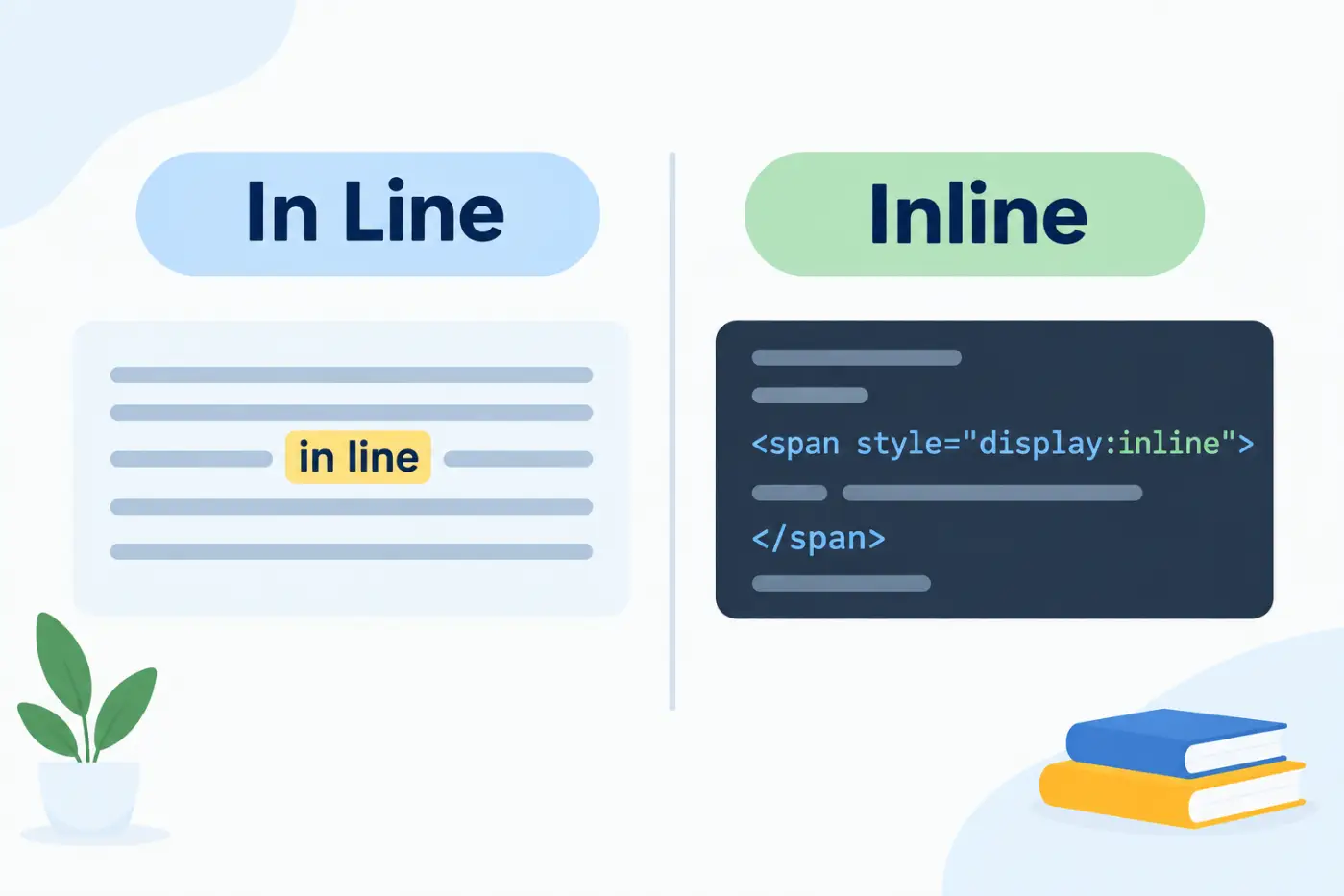
If you’re stuck on in line or inline you’re not alone. These two forms look almost identical. Yet they don’t always mean the same thing or work in the same places.
The simple answer is that in line is usually written as two words when you mean being in a row or following a line or standard. Inline is usually one word when it works as an adjective or adverb with a specific meaning. The right choice depends on how the phrase works in your sentence.
This small spelling difference can change the meaning of a sentence. For example, you can stand in line at a store. You can also use inline images in a document. In the first sentence, the words describe a position. In the second, the single word describes something included directly in the surrounding content.
This guide explains the difference in plain English. You’ll learn the main rules, see natural examples, discover common mistakes, and get a few simple tricks that make the choice much easier.
Quick Definition
In line is normally a two word phrase that describes something positioned in a row or aligned with something else. It can also describe agreement with a rule, plan, or standard. Inline is normally one word when it describes something contained directly within another thing or placed on the same line.
Direct Answer
Use in line when you mean being in a row, waiting in a queue, or being consistent with something. Use inline when the word acts as an adjective or adverb to describe something built into or placed directly within another thing.

In Line or Inline in Everyday English
The easiest way to understand these forms is to look at what you mean.
When you say that people are in line, you usually mean they are standing one behind another while waiting. You might also mean that something matches a plan or agrees with a rule.
For example:
We stood in line for tickets.
Here, the people are waiting in a queue. The phrase needs two words.
You could also say:
Her decision was in line with company policy.
Now the phrase means consistent with or in agreement with something. Again, you need two words.
The single word inline has a different job. It often describes something that is included directly within another piece of content or placed along the same line.
For example:
The editor added an inline comment to the paragraph.
The comment appears directly within the text instead of sitting somewhere separate.
You might also see:
The website uses inline images.
Here, inline describes images that appear directly within the flow of the content.
That basic difference handles most everyday cases.
When In Line Means A Row
Use in line when people or things form a row.
This is one of the most common uses in American English.
Consider these examples:
We waited in line outside the theater.
Several customers were already in line.
Please stand in line behind the last person.
The children walked in line behind their teacher.
In each sentence, the phrase describes position.
You can picture people standing one after another. That mental image makes the spelling easy to remember.
The same idea works with objects.
The chairs are in line along the wall.
The cars were parked in line near the entrance.
The two words work because the sentence describes physical placement.
When In Line Means In Agreement
In line can also mean consistent with something.
This use is common in business writing, everyday conversation, news writing, and formal communication.
For example:
The new plan is in line with our goals.
Her actions were in line with the rules.
The results are in line with our expectations.
The price is in line with similar products.
In these examples, nobody is standing in a row. The phrase means something is consistent with or matches another thing.
That meaning is another strong clue.
If you can replace in line with consistent with, the two word form is usually the right choice.
For example:
The policy is in line with federal guidelines.
You could rewrite it as:
The policy is consistent with federal guidelines.
The meaning stays almost the same.
When In Line Means Waiting
American English often uses in line for people waiting for something.
For example:
I’ve been in line for twenty minutes.
We got in line before the doors opened.
There were fifty people in line.
She left the line to get some water.
This use is especially common in the United States.
The phrase stand in line is also very common.
We had to stand in line for coffee.
They stood in line outside the store.
The related phrase get in line means to join a queue.
Please get in line and wait your turn.
There is also a figurative use.
Get in line if you want to speak with the manager.
In that sentence, the phrase still suggests joining a queue.
When Inline Is One Word
Inline is one word when it has a specialized descriptive meaning.
One common use appears in technology and digital content.
An inline element or item appears directly within a larger piece of content. It does not stand apart as a separate block.
For example:
The writer inserted an inline image into the article.
The developer added inline CSS to the page.
The document contains several inline links.
The editor left an inline comment.
In each case, inline acts as a single descriptive word.
It tells you that something sits directly inside or along the main content.
The word is especially common in web development, publishing, design, and software.
You don’t need to know technical terms to understand the basic idea. Think of inline as meaning included directly in the flow.
How The Grammar Changes The Spelling
Grammar gives you another useful clue.
In line is a phrase made from the preposition in and the noun line.
For example:
The students are in line.
Here, in tells us about position and line names the row.
The two words have their own jobs.
Inline, on the other hand, works as a single word. It commonly acts as an adjective or adverb.
For example:
We added an inline image.
Here, inline describes the noun image.
You could ask, What kind of image?
The answer is an inline image.
That is a strong sign that the one word form works.
You can also see the difference in these sentences:
The workers stood in line.
The workers used an inline tool.
The first sentence describes where the workers stood. The second describes the type of tool.
The meaning and grammar point you toward the correct form.
Adjective Use
Inline commonly works as an adjective before a noun.
For example:
The developer used inline styles.
The article contains an inline image.
The software supports inline editing.
The report includes inline citations.
The word directly modifies the noun that follows it.
By contrast, in line often follows a verb or appears before a phrase that explains what something aligns with.
The students stood in line.
The decision is in line with the policy.
The numbers are in line with our forecast.
That pattern is worth learning because it appears again and again.
Adverb Use
Inline can also describe how an action happens.
For example:
The editor changed the text inline.
You can edit the file inline.
The system displays the message inline.
Here, the word describes the way the action happens.
The meaning is roughly directly within the surrounding content or at the same point in the flow.
Prepositional Phrase Use
In line often functions as a prepositional phrase.
For example:
The customers waited in line.
The picture is in line with the others.
The proposal is in line with the budget.
This structure explains why the two words remain separate.
You are using in as a preposition and line as a noun.
That’s very different from the single word inline.
Common Examples You Can Copy
The fastest way to build confidence is to see the forms in real sentences.
Here are some examples using in line.
We waited in line for the new product.
The students stood in line outside the classroom.
Your request is in line with our current policy.
The results are in line with what we expected.
The new design is in line with the brand guidelines.
Please stay in line until your name is called.
His actions were in line with the agreement.
The cars moved forward in line.
Now look at examples using inline.
The article includes an inline image.
You can make inline edits in the document.
The developer added inline CSS.
The page contains inline links.
The software supports inline comments.
The editor placed the note inline with the paragraph.
The tool allows users to edit text inline.
The difference becomes much clearer when you compare the meaning instead of focusing only on spelling.
Why People Mix Them Up
The confusion comes from the fact that in line and inline sound almost identical in normal speech.
English has many expressions that began as separate words and later developed a single word form for a specific meaning. That makes visual spelling harder to predict.
There is another reason for the confusion. Both forms can relate to position.
A person can stand in line. An image can appear inline. Both describe location or placement. The difference lies in the kind of relationship being described.
The two word form usually describes a position in a row or a relationship of agreement.
The one word form usually describes something that sits directly within another thing or operates inside the same flow.
That distinction is more useful than trying to memorize a long spelling rule.
A Simple Test For Choosing The Right Form
Try replacing the phrase with a simpler expression.
If you mean in a row, use in line.
The students are in line.
You could say:
The students are in a row.
If that replacement works, use the two word form.
If you mean consistent with, use in line.
The decision is in line with the rules.
You could say:
The decision is consistent with the rules.
Again, use the two word form.
If you mean inside the flow of content, use inline.
The editor added an inline comment.
You could think of it as a comment placed directly within the text.
That points to the one word form.
This test is quick and works in most situations.
Common Mistakes To Avoid
Many mistakes happen because writers focus on how the words sound instead of what they mean.
Mistake One
We stood inline for twenty minutes.
This is usually incorrect in standard everyday English when you mean that people were waiting in a queue.
Write:
We stood in line for twenty minutes.
The phrase describes a queue. Use two words.
Mistake Two
The editor added an in line comment.
In a technical or digital context, inline comment is normally written as one word.
Write:
The editor added an inline comment.
Here, the word describes a comment placed directly within the content.
Mistake Three
The new policy is inline with our goals.
This form is often seen online, but in line with is the standard choice for the meaning consistent with or matching.
Write:
The new policy is in line with our goals.
The phrase has a well established two word structure in this use.
Mistake Four
The image appears in line with the paragraph.
This sentence can be correct in some contexts. However, the intended meaning matters.
If you mean the image is directly integrated into the text flow, inline may be more natural.
The image appears inline with the paragraph.
If you mean the image is aligned with something else, in line with can make sense.
The image is in line with the other images.
The context tells you which form communicates your meaning more clearly.
In Line With And Inline With
This is one of the areas that causes the most confusion.
The phrase in line with is very common.
It usually means consistent with, matching, or aligned with.
Examples include:
- The decision is in line with company policy.
- The results are in line with our forecast.
- Her behavior was in line with the rules.
- The proposal is in line with our original plan.
Here, in line with is the correct form.
The phrase can also describe physical alignment.
The picture is in line with the other pictures.
That means the picture is aligned with the others.
Inline with is much less common in general writing. You may see it in technical contexts where inline is already being used as a single adjective.
For ordinary writing, don’t combine inline with with simply because the phrase sounds similar to in line with.
When you mean consistent with something, use in line with.
In Line And In A Line
These phrases are related but not always interchangeable.
In line commonly means waiting in a queue.
We stood in line for tickets.
In a line can describe objects or people arranged in a row.
The chairs were placed in a line.
The article a changes the structure and can slightly change the focus.
Compare these:
The customers stood in line.
The customers stood in a line.
Both can describe a row of people. The first is more natural when talking about waiting.
That distinction matters in everyday American English.
In Line Or Inline For Technology
Technology is one area where the single word form appears often.
You may see terms such as:
- inline image.
- inline link.
- inline code.
- inline style.
- inline editing.
The basic idea stays the same. The item appears directly within the surrounding material or can be changed directly in place.
For example:
The editor lets you make inline changes.
This means you can change the content directly where it appears.
Another example is:
The page displays an inline image.
The image appears as part of the content flow instead of being presented as a separate item.
Technical writing uses the word often because it gives writers a short way to describe this type of placement.
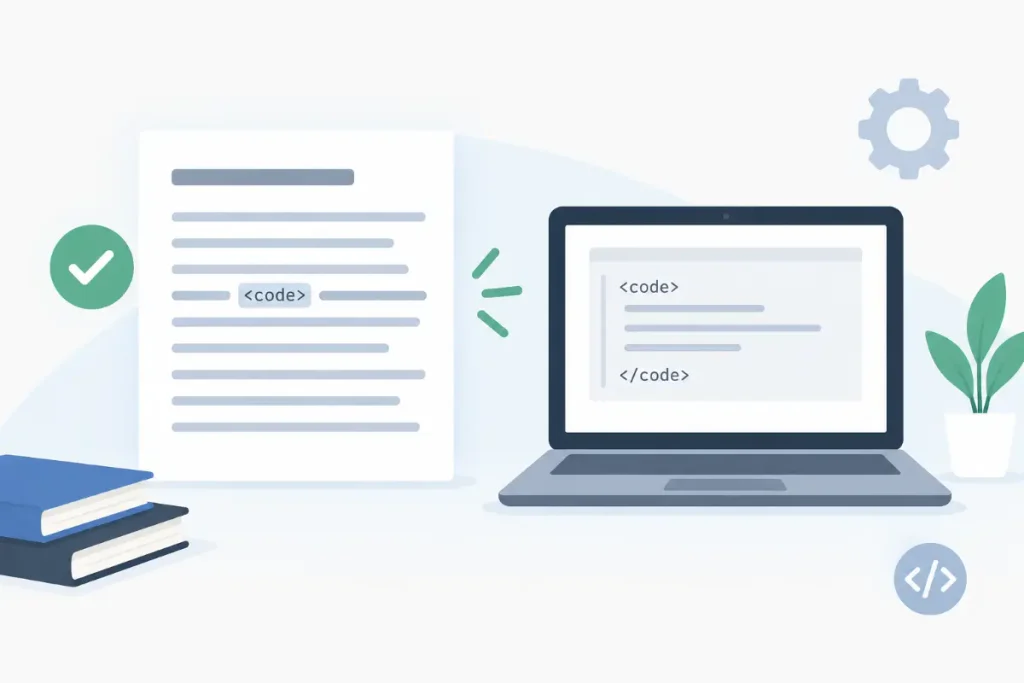
Inline Code And Code On Its Own
You may encounter inline code in programming guides and technical articles.
Inline code appears within a sentence or paragraph.
For example:
Use the print function to display the message.
The code appears as part of the sentence.
A separate block of code works differently. It occupies its own area.
You don’t need to be a programmer to understand the distinction. The key idea is placement.
Inline content stays within the normal flow of text.
Separate content stands apart from that flow.
This same concept appears in writing, web design, documentation, and publishing.
Inline Editing
Inline editing is another common technical phrase.
It means changing content directly where it appears.
For example:
The website supports inline editing of product names.
You can click the name and change it without opening a separate editing screen.
The one word spelling works because inline describes the type of editing.
You wouldn’t normally write in line editing when this is the established technical term.
Inline Images And Links
Digital content also uses inline image and inline link.
An inline image appears within the normal content flow.
For example:
The article uses an inline image to explain the process.
An inline link appears directly within a sentence.
For example:
You can find the full guide through the inline link.
The single word form helps show that these elements are part of the surrounding content.
When In Line Is Better In Technical Writing
Technical writing doesn’t always require inline.
If the meaning is alignment or consistency, keep in line as two words.
For example:
The output should be in line with the expected result.
The columns must stay in line with the header.
The system behavior is in line with the documented rules.
These sentences are technical, but the meaning still calls for the ordinary phrase.
The subject area does not automatically make inline correct.
Meaning comes first.
A Memory Trick That Actually Helps
Here is a simple way to remember the difference.
Think of in line as describing a line you can picture.
- People wait in line.
- Cars move in line.
- Students stand in line.
A decision can also be in line with a rule because it follows the same direction or standard.
Now think of inline as one thing sitting inside the flow.
- An inline image sits inside text.
- An inline link sits inside a sentence.
- Inline editing happens directly inside the content.
- The space between the words is a useful visual clue.
- In line often describes a position or relationship.
- Inline often describes something built into the surrounding content.
That simple contrast covers most cases.
A Quick Editing Checklist
Before choosing the spelling, ask yourself three questions.
First, am I talking about people or objects forming a row?
If yes, use in line.
Second, am I saying that something agrees with or matches another thing?
If yes, use in line.
Third, am I describing something that appears directly inside the flow of content?
If yes, use inline.
This takes only a few seconds.
For example:
The customers are ___ outside the store.
They are waiting in a queue.
Use:
The customers are in line outside the store.
Now try:
The page contains an ___ image.
The image is part of the content flow.
Use:
The page contains an inline image.
Finally:
The new rule is ___ with the existing policy.
The rule is consistent with the policy.
Use:
The new rule is in line with the existing policy.
The pattern becomes easy once you focus on meaning.
Related Terms That Cause Similar Confusion
English has many word pairs that create confusion because a phrase can sometimes become a single word with a related but more specific meaning.
A few examples can help you spot the pattern.
In Person And Inperson
The standard phrase is in person.
I spoke with the manager in person.
The form inperson is not standard English.
This is different from inline, which is an established single word with its own uses.
In House And Inhouse
In house is often written as two words when used as a phrase.
The company handles the work in house.
In house can also appear before a noun in styles that vary by publication.
The company has an in house design team.
Some style guides and dictionaries have different preferences for compounds like this. That’s why a dictionary or style guide can help in formal work.
The important point is that English does not turn every phrase beginning with in into one word.
On Line And Online
Online is now the standard single word for internet related activity.
I bought the product online.
The phrase on line has other uses and can still appear in specific contexts.
For example:
Put your signature on line five.
That means on a particular line of a document.
This comparison can help explain why context matters. English spelling often follows meaning and established usage rather than sound alone.
In Side And Inside
Inside is one word in standard English.
The keys are inside the drawer.
You don’t write in side when you mean the interior.
This shows why you should learn established words as complete units instead of assuming that every in + noun phrase follows the same pattern.
Style Guide And Dictionary Advice
For everyday writing, the meaning based rules in this article will handle most situations.
For professional writing, technical documentation, or publishing, your style guide may have specific preferences.
Some fields develop their own standard terms. Technology is a good example.
If you’re writing for a company, school, publication, or website, follow that organization’s style guide when it gives a clear preference.
A dictionary can also help confirm established usage.
Still, don’t let style rules make a simple question seem harder than it is. In ordinary American English, the core distinction remains straightforward.
Use the two word phrase for a row or for consistency.
Use the single word for the specialized meaning of something included directly within a larger flow.
Examples With Explanations
Let’s look at several sentences and explain why each form works.
- The family waited in line at the restaurant.
- Use in line because the family is waiting in a queue.
- The new policy is in line with federal guidance.
- Use in line because the policy is consistent with the guidance.
- The editor inserted an inline image.
- Use inline because the image appears directly within the content.
- The students stood in line before entering the room.
- Use in line because the students formed a queue.
- The website allows inline editing.
- Use inline because users can edit content directly in place.
- The results are in line with last year’s numbers.
- Use in line because the results are consistent with the earlier numbers.
- The document includes inline citations.
- Use inline because the citations appear within the main text.
- The cars moved in line through the narrow road.
- Use in line because the cars were arranged one behind another.
- The developer used inline styles.
- Use inline because the styles are placed directly in the relevant content or markup.
These examples show why spelling alone isn’t enough. You need to identify the meaning first.
Why Context Matters More Than Sound
If you hear the phrase spoken aloud, you may not know which spelling the writer should use.
That’s normal.
English has many words and phrases that sound alike but have different meanings or grammatical roles.
The solution is to look at the sentence around the phrase.
Ask what the phrase is doing.
Is it describing a queue?
Use in line.
Is it saying that something matches a rule or plan?
Use in line.
Is it describing content placed directly within other content?
Use inline.
This approach is more reliable than trying to hear the difference because the pronunciation is often the same or very close.
FAQs
Is in line or inline correct?
Both forms are correct. In line usually describes a row or something that agrees with a rule or plan. Inline usually describes something placed directly within another piece of content or the same flow.
Is in line one word or two words?
In common uses such as waiting in a queue or being consistent with something, in line is two words. For example, you can stand in line or say that a decision is in line with a policy.
Is inline always one word?
When inline has its established descriptive meaning, it is written as one word. Common examples include inline images, inline links, inline editing, and inline code.
Should I write inline with or in line with?
Use in line with when you mean consistent with, matching, or aligned with something. For example, The plan is in line with our goals.
Is in line with grammatically correct?
Yes. In line with is a standard phrase. It commonly means consistent with, in agreement with, or aligned with something.
What does inline mean in writing?
In writing and digital content, inline usually means placed directly within the surrounding text or content flow. An inline image or inline comment appears as part of the main material instead of sitting separately.
Is it stand in line or stand inline?
For a queue, the natural phrase is stand in line. For example, you might say, We had to stand in line for tickets.
How can I remember the difference between in line and inline?
Think of in line as a phrase connected to a visible row or a standard. Think of inline as something built directly into the flow of content. That simple image will help in most situations.
Conclusion
The difference between in line or inline comes down to meaning and grammar. In line is normally two words when you mean being in a row, waiting in a queue, or being consistent with something. Inline is normally one word when it describes something included directly within another piece of content.
Use in line in sentences such as, We waited in line for tickets. You can also write, The proposal is in line with our goals. Both examples describe a position or relationship.
Use inline in terms such as inline image, inline link, inline editing, and inline code. In these cases, the single word acts as a specific descriptive term for something that sits directly within the main flow.
The easiest rule is simple. If you can think of a row or agreement with a standard, choose in line. If you mean something built directly into the surrounding content, choose inline. Keep that distinction in mind and this common spelling problem becomes much easier to handle.

Dr. Arthur Pendelton is a veteran historical linguist and grammar expert with over 30 years of experience in academic editing. A retired professor, Arthur specializes in the etymology and evolution of the English language. He is passionate about “unpacking the history behind the rules,” helping readers understand why we spell, punctuate, and phrase things the way we do today. Whether he’s settling debates on archaic usage or explaining complex linguistic shifts, Dr. Pendelton brings scholarly precision to every article.