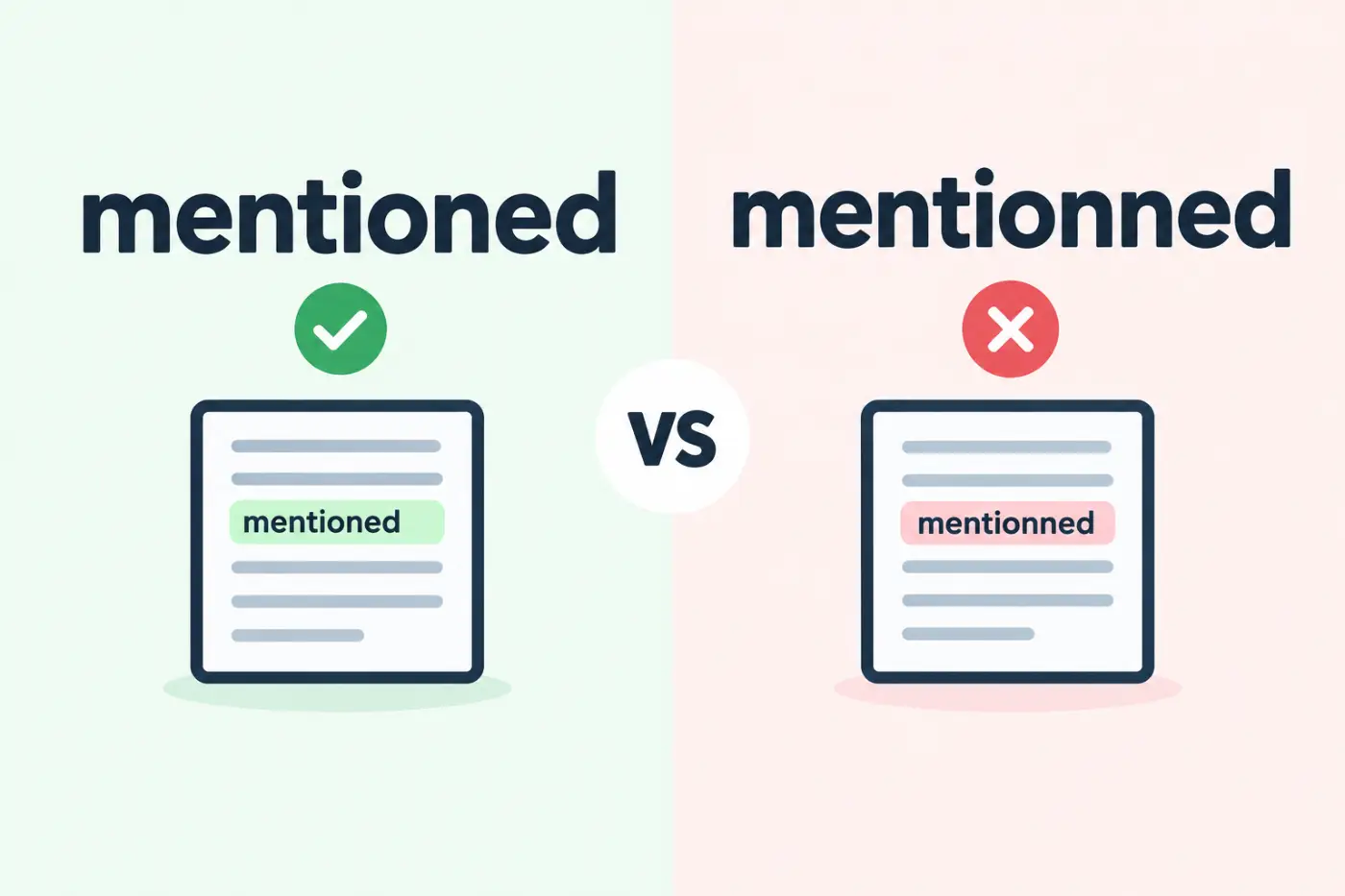
If you have ever stopped while writing and wondered about mentioned vs mentionned, you are not alone. The two spellings look close, but only one is correct in standard English.
The correct spelling is mentioned. It is the past tense and past participle of the verb mention. The spelling mentionned is incorrect in English.
This small spelling mistake often happens because English has many words that double their final consonant before certain endings. Words such as stopped, planned, and preferred follow that pattern. However, mention does not work that way.
Once you understand the spelling rule behind this word, the difference becomes easy to remember. You will also see how to use mentioned in everyday sentences, formal writing, emails, schoolwork, and professional communication.
Quick Definition
Mentioned is the correct spelling in English. It means that someone referred to a person, thing, idea, fact, or subject in speech or writing. Mentionned is not a standard English spelling.
Direct Answer
The correct spelling is mentioned. You should not write mentionned in standard English.
Comparison Table
| Word or phrase | Meaning | Example sentence | When to use it |
|---|---|---|---|
| Mentioned | Past tense or past participle of mention | She mentioned your name yesterday. | Use it when talking about a past reference or a completed action. |
| Mentionned | Incorrect spelling | She mentionned your name yesterday. | Do not use this spelling in standard English. |
Why The Correct Spelling Is Mentioned
The confusion comes from the final letters of the word mention.
The base verb is:
mention
When you add ed to form the past tense, you get:
mention + ed = mentioned
Nothing else changes.
You do not add another n before the ending. The correct form keeps the original spelling and simply adds ed.
That gives us:
mention → mentioned
The incorrect form changes the spelling like this:
mention → mentionned
That extra n does not belong there.
This may seem like a tiny detail, but spelling errors often happen because writers apply a familiar pattern to a word that does not follow it. English has many spelling rules, and some of them look similar on the surface.
For example, consider these words:
- stop → stopped
- plan → planned
- admit → admitted
- refer → referred
These words double their final consonant before certain endings. That can make writers think the same thing should happen with mention.
It does not.
The word mention ends in n, but that does not mean the final n should be doubled when you add ed.
The correct form remains:
mentioned
The Base Word Is Mention
To understand the spelling, start with the base verb.
Mention means to talk about something briefly or refer to it.
For example:
- She mentioned the meeting.
- He mentioned your name.
- I mentioned the problem to my manager.
- They mentioned the new policy.
In each sentence, the verb is in its basic form because the sentence talks about a current or general action.
When the action happened in the past, add ed.
- She mentioned the meeting yesterday.
- He mentioned your name during the call.
- I mentioned the problem last week.
- They mentioned the new policy at the meeting.
- The spelling is simple.
- mention + ed = mentioned
There is no second n.
Why The Extra N Looks Tempting
The incorrect spelling looks believable because English does double consonants in many words.
Think about:
- stop → stopped
- shop → shopped
- plan → planned
- drop → dropped
- refer → referred
- prefer → preferred
Seeing these patterns can create a false rule in your mind.
A writer may see the final n in mention and think that adding ed requires another n. That leads to mentionned.
But the spelling pattern depends on the structure of the base word. You cannot simply double the last consonant every time you add ed.
That is one of the reasons English spelling can feel tricky.
The important point here is simple. The verb mention does not double its final consonant when it becomes mentioned.
How Mentioned Works In A Sentence
Mentioned is the past tense of mention.
It tells the reader that someone referred to something in the past.
For example:
- Maria mentioned the issue during lunch.
- The sentence tells us that Maria referred to the issue at some point in the past.
- Here is another example:
- David mentioned that the store would close early.
- Again, the reference happened in the past.
- You can use mentioned with a person, object, idea, fact, event, place, or subject.
- She mentioned her brother.
- He mentioned the new restaurant.
- The teacher mentioned the test.
- My friend mentioned your article.
- The report mentioned several problems.
- The customer mentioned the delay.
- The doctor mentioned the possible cause.
- The manager mentioned the change during the meeting.
The word is flexible because people mention all kinds of things.
Mentioned As A Past Tense Verb
The simplest use of mentioned is as the past tense of mention.
- Consider this sentence:
- I mentioned your suggestion yesterday.
- The base form is mention.
- The past form is mentioned.
Compare these examples:
- I mention your suggestion often.
- I mentioned your suggestion yesterday.
- The first sentence describes a present or repeated action.
- The second describes an action that happened in the past.
Here are more examples:
- She mentioned the problem.
- He mentioned the deadline.
- We mentioned your idea.
- They mentioned the price.
- You mentioned that name earlier.
All of these sentences use the correct spelling.
Mentioned As A Past Participle
Mentioned can also work as a past participle.
A past participle is a verb form that often appears with words such as has, have, had, is, was, or been.
For example:
- She has mentioned your name before.
- I have mentioned this problem several times.
- They had mentioned the issue earlier.
- The topic was mentioned during the meeting.
- His name was mentioned in the report.
In each example, mentioned is spelled the same way.
There is still no extra n.
This is useful because some learners think the spelling might change based on the sentence. It does not.
The form stays:
mentioned
Real Examples You Can Copy
One of the easiest ways to learn a spelling is to see it in natural sentences.
Here are examples from everyday situations.
Everyday Conversation
I mentioned your name yesterday.
- She mentioned that she was tired.
- He mentioned a good place to eat.
- You mentioned something about a new job.
- My friend mentioned the movie last night.
School And College
The teacher mentioned the assignment during class.
- The professor mentioned several important points.
- The student mentioned the problem in her essay.
- The textbook mentioned the event in an earlier chapter.
- The instructor mentioned that the exam would cover five topics.
Work And Business
My manager mentioned the deadline during the meeting.
- The client mentioned a concern about the contract.
- Sarah mentioned the issue in her email.
- The report mentioned several areas that need attention.
- Our team mentioned the delay during the call.
Emails
You mentioned this in your previous email.
- As you mentioned, the meeting starts at nine.
- I wanted to follow up on the issue you mentioned.
- You mentioned that you needed the file today.
- The customer mentioned a problem with the order.
Formal Writing
- The study mentioned several possible causes.
- The report mentioned a significant change in demand.
- The author mentioned this point in the introduction.
- The article mentioned several examples of the problem.
- The committee mentioned the need for further review.
These examples show how common the word is. You will see mentioned in casual conversation, professional writing, academic work, reports, and online communication.
Mention And Mentioned Are Different Forms
A useful way to avoid spelling mistakes is to understand the relationship between the base word and its past form.
The base verb is:
mention
The past tense is:
mentioned
The present form might appear in sentences such as:
I mention it often.
She mentions the problem.
They mention your name.
Notice that mentions has an s because the subject and tense require it.
For the past tense, use:
I mentioned it.
She mentioned the problem.
They mentioned your name.
The spelling remains clear and predictable.
You can remember the basic pattern like this:
mention → mentions → mentioned → mentioning
Each form is built from the same base word.
The only form that might look slightly different is mentioning, because English drops the final e before adding ing in some verbs. But that spelling change has nothing to do with the past tense.
Why English Does Not Double The N
The key issue is the spelling rule for adding ed.
English sometimes doubles a final consonant before a suffix. This usually happens with short words that have a certain stress and vowel pattern.
For example:
- stop becomes stopped.
- plan becomes planned.
- admit becomes admitted.
But the rule does not apply to every word that ends with a consonant.
The word mention has more than one syllable and does not fit the pattern that would require doubling the final n.
So the spelling stays simple:
mention + ed = mentioned.
You should think of the spelling as adding the ending rather than changing the base word.
That gives you a reliable mental pattern.
- mention
- mentioned
The base word stays intact.
Common Words That Look Similar
Many spelling mistakes become easier to avoid when you compare the target word with related words.
Consider these examples.
- mention → mentioned
- question → questioned
- position → positioned
- function → functioned
- option → optioned
The spelling pattern is not identical in every word, but these examples help show that a final n does not automatically get doubled before ed.
Now compare that with words that do double a consonant.
- plan → planned
- stop → stopped
- admit → admitted
- refer → referred
The difference comes from the spelling and sound structure of the base word.
That is why memorizing one broad rule such as double the last letter before ed can cause trouble.
English spelling needs a little more care than that.
Common Mistakes With Mentioned
The most common mistake is adding an unnecessary n.
Incorrect:
She mentionned your name.
Correct:
- She mentioned your name.
- Another mistake is changing the vowel pattern.
Incorrect:
She mentined your name.
Correct:
- She mentioned your name.
- Some writers may also leave out the final ed.
Incorrect:
She mention your name yesterday.
Correct:
- She mentioned your name yesterday.
- The correct spelling has three key parts:
men + tion + ed
You can hear the word as men shund in normal American speech. The spelling does not exactly match the way it sounds, which is common in English.
When To Use Mentioned
The word mentioned has several common uses. Understanding them will help you use the word naturally instead of simply memorizing its spelling.
Referring To Something In Conversation
You can use mentioned when someone referred to something during a conversation.
For example:
- You mentioned a new restaurant yesterday.
- The speaker is referring to something the listener said earlier.
Another example:
- She mentioned that she wanted to move.
- The person referred to her desire to move.
- You can also use mentioned with direct objects.
He mentioned the problem.
- She mentioned the meeting.
- I mentioned your name.
- They mentioned the weather.
- The structure is simple.
- Subject + mentioned + object
For example:
John mentioned the project.
- John is the subject.
- mentioned is the verb.
- the project is the object.
Referring To Something In Writing
Mentioned also works when a person refers to something in a written source.
For example:
- The report mentioned a rise in costs.
- The article mentioned the company.
- The letter mentioned the problem.
- The study mentioned several possible causes.
This use is common in academic and professional writing.
It tells the reader that a subject appeared in a source without necessarily saying that the source focused on it.
That distinction can be useful.
If a report is mainly about housing prices but briefly refers to interest rates, you could write:
The report mentioned interest rates.
You are not saying interest rates were the main subject. You are simply saying the report referred to them.
Mentioned Does Not Always Mean Explained
This is an important point about meaning.
When you say someone mentioned something, you usually mean they referred to it. You do not necessarily mean they explained it in detail.
For example:
- The teacher mentioned the new rule.
- This tells us that the teacher referred to the rule.
- It does not tell us how much the teacher explained.
Compare that with:
The teacher explained the new rule.
Now the sentence says the teacher gave information about the rule.
The difference is small but useful.
- Mention means to refer to something.
- Explain means to make something clear by giving information.
- Discuss usually means to talk about something in more detail.
- Describe means to give details about what something is like.
These verbs can overlap, but they are not exact substitutes.
Mentioned And Said Are Not Always The Same
Writers sometimes use mentioned and said as if they mean exactly the same thing. They can overlap, but their use differs.
Consider:
- She said that she was tired.
- This focuses on what she communicated.
Now:
She mentioned that she was tired.
- This suggests that her tiredness came up as part of the conversation.
- Mentioned often feels less central. It can suggest a brief reference.
For example:
- He mentioned the weather before leaving.
- The weather was probably not the main topic.
- You could also say:
- He talked about the weather for twenty minutes.
- That gives a very different picture.
The choice of verb helps the reader understand how much attention the subject received.
Mentioned And Referred To
The phrase referred to is closely related to mentioned.
For example:
- She mentioned the problem.
- She referred to the problem.
- Both can be correct, but the tone can differ.
- Mentioned is usually simpler and more natural in everyday English.
Referred to can sound more formal and is common in academic, legal, and professional writing.
For example:
- The report referred to several earlier studies.
- That sentence has a formal tone.
- You could also write:
- The report mentioned several earlier studies.
- That version sounds more direct.
Neither word needs the extra n found in the incorrect spelling.
Mentioned In Professional Writing
Professional writers use mentioned frequently.
You might see:
- As mentioned earlier, the project will begin next month.
- As you mentioned in your email, the deadline is Friday.
- The client mentioned concerns about the schedule.
- The manager mentioned the issue during the meeting.
- The report mentioned a change in the policy.
- These sentences are natural in workplace communication.
- One common structure is as mentioned earlier.
For example:
- As mentioned earlier, the deadline is Friday.
- This means the writer already talked about the deadline.
Another common structure is:
As you mentioned.
For example:
As you mentioned, the meeting has been moved to Monday.
This politely connects the current statement to something the other person previously said.
Is As Mentioned Correct
Yes.
As mentioned is a correct and common phrase.
For example:
- As mentioned earlier, the office will close at five.
- As mentioned in the report, sales increased last year.
The phrase uses mentioned as a past participle.
- You should not write:
- As mentionned earlier.
- The correct spelling is:
- As mentioned earlier.
This phrase is common enough that learning it can help reinforce the correct spelling.
Is Mentioned A Verb
Yes.
Mentioned is a verb form.
It can function as the simple past tense of mention.
For example:
- She has mentioned the problem before.
- The same spelling works in both cases.
- This is similar to many regular English verbs.
For example:
- talk → talked.
- work → worked.
- ask → asked.
- mention → mentioned.
The ending ed is doing the work.
Is Mentioned An Adjective
In some sentences, mentioned can also describe something in a way that functions like an adjective.
For example:
- The mentioned issue needs further review.
- This sentence is grammatically possible, but it sounds stiff and unnatural in many situations.
- A more natural choice would be:
- The issue mentioned in the report needs further review.
- That sentence clearly tells the reader which issue you mean.
This is a good example of why grammar and natural style both matter. A sentence can be technically possible but still sound awkward.
In everyday English, writers often use phrases such as the issue mentioned above or the person mentioned earlier.
For example:
- Please review the information mentioned above.
- That sounds natural in formal writing.
The Difference Between Mentioned And Mentions
This distinction is also important.
Mentions is normally used with a singular third person subject in the present tense.
For example:
- She mentions your name often.
- He mentions the issue in every meeting.
- The report mentions several problems.
Mentioned is the past form.
For example:
- She mentioned your name yesterday.
- He mentioned the issue at the meeting.
- The report mentioned several problems.
- A quick comparison makes the pattern clear.
| Form | Example |
|---|---|
| Mention | I mention the issue. |
| Mentions | She mentions the issue. |
| Mentioned | She mentioned the issue yesterday. |
| Mentioning | She is mentioning the issue now. |
Learning the complete set can make the spelling much easier.
Mentioned vs Mentionned And Other Spelling Errors
The incorrect spelling is part of a larger problem. English writers often add letters because a word reminds them of another spelling pattern.
This happens with doubled consonants, silent letters, vowels, and endings.
The best solution is not to guess based on appearance.
Instead, return to the base word.
For this word:
mention
Then add the regular past ending:
ed
That gives:
mentioned
This method works well because it keeps you focused on the actual word rather than a spelling pattern that may not apply.
Why Spelling Matters
A spelling mistake does not automatically make writing bad. Everyone makes mistakes, especially when typing quickly.
Still, correct spelling helps your message look polished.
Compare:
- I mentioned this in my last email.
- I mentionned this in my last email.
- The first version looks natural.
The second version immediately catches the eye of many readers.
In casual texting, a typo may not matter much. In a job application, report, article, or formal email, accuracy carries more weight.
Good spelling also helps readers trust the information you provide.
That is especially useful when you are writing for customers, students, coworkers, or a public audience.
How To Check The Spelling Quickly
If you are unsure, use a simple three step check.
First, find the base word.
mention
Second, identify the tense.
If the action happened in the past, use the past form.
Third, add ed without doubling the n.
mentioned
You can also replace the word with another familiar past tense.
For example:
- I mentioned the issue yesterday.
- The word tells us that the action is complete.
If you are still unsure, type the base word into a trusted dictionary or spelling tool. Seeing the correct form a few times will help it stick.
Pronunciation Can Cause Confusion
Spelling and pronunciation do not always match perfectly in English.
Mentioned is generally pronounced something like MEN shund in American English.
The final ed does not sound like a separate full syllable.
That can make the spelling harder to predict from speech.
You may hear something close to:
- men shund
- But you write:
- mentioned
- This is normal.
English has many words whose pronunciation does not give you every letter directly.
That is another reason it helps to learn the written form as a complete word.
Mentioned In American English
The spelling mentioned is standard in American English.
It is also standard in British English and other major forms of English.
Unlike some vocabulary differences between American and British English, this word does not change spelling across the two varieties.
- American English:
- She mentioned the issue.
- British English:
- She mentioned the issue.
- The spelling stays the same.
So if you are writing for a US audience, use mentioned.
Mentioned In Academic Writing
Academic writing often uses mentioned when referring to information that appeared earlier in a source or discussion.
For example:
- The study mentioned several factors that may affect the result.
- The author mentioned this issue in the second chapter.
- The researchers mentioned a possible limitation.
- The article mentioned earlier evidence.
- Still, academic writers should choose the verb carefully.
If a source gives a detailed analysis, discussed or examined may be more precise.
For example:
- The study discussed the effects of sleep.
- That sounds more detailed than:
- The study mentioned the effects of sleep.
Mentioned usually suggests a reference rather than a full treatment of the subject.
Precise word choice makes academic writing stronger.
Mentioned In Business Emails
Business emails often contain this word because people need to refer back to earlier conversations.
For example:
- As you mentioned, the report is due Friday.
- You mentioned that the customer needed an update.
- I wanted to follow up on the issue you mentioned.
- The client mentioned a concern about delivery.
- These structures are polite and natural.
- However, you do not need to use mentioned in every sentence.
- Too much repetition can make an email sound stiff.
Instead, vary your wording.
For example:
- You noted that the report is due Friday.
- You said the customer needed an update.
This keeps the writing natural while preserving the meaning.
Related Words And Their Forms
Learning related forms can make spelling easier.
The word family includes:
- mention
- mentions
- mentioned
- mentioning
- The noun mention can also refer to an act of referring to something.
- For example:
- His name received a brief mention in the article.
- Here, mention is a noun.
- The verb form is:
- She mentioned his name.
- The noun form is:
- There was a brief mention of his name.
Both are useful, but their grammar is different.
Mentioning Is Also Correct
The present participle and gerund form is mentioning.
For example:
- She is mentioning the problem again.
- He kept mentioning your name.
- I remember mentioning the issue.
Notice that the final e is not part of the base word anyway. The spelling simply becomes:
mention + ing = mentioning
There is no extra n.
This gives you another useful word family pattern:
- mention.
- mentioned.
- mentioning.
- mentions.
All of these forms keep the single n before the ending.
A Few More Examples
Here are natural examples using the correct form.
- The manager mentioned the new schedule.
- I mentioned your idea during the meeting.
- She mentioned that she needed more time.
- He mentioned the restaurant you recommended.
- The article mentioned several common mistakes.
- The teacher mentioned the assignment before class ended.
- My friend mentioned your name.
- The customer mentioned a problem with the order.
- The report mentioned a drop in sales.
- The doctor mentioned several possible causes.
- The speaker mentioned the issue briefly.
- As you mentioned, the deadline is tomorrow.
- The point was mentioned during the discussion.
- The subject had been mentioned earlier.
- None of these sentences needs a second n.
A Useful Editing Habit
When editing your own work, do not only look for large errors.
Small spelling patterns deserve attention too.
If you often type the wrong version, create a simple mental correction.
- Wrong in your head:
- mentionned.
- Correct in your head:
- mentioned.
Then connect it with a sentence you use often:
- I mentioned it earlier.
- As mentioned above.
- As you mentioned.
- The issue was mentioned.
Repeated exposure makes the correct spelling feel natural.
Eventually, the incorrect version will look strange.
What If You See Mentionned Online
You may occasionally see mentionned on websites, social media, forums, or informal posts.
That does not make it a correct English spelling.
Online writing contains many typos and nonstandard spellings. Some writers also use English as a second language, which can lead to predictable spelling errors.
If you encounter the incorrect form, understand it as a misspelling of mentioned.
FAQs
Is Mentioned The Correct Spelling?
Yes. Mentioned is the correct English spelling. It is the past tense and past participle of mention.
Is Mentionned Ever Correct In English?
No. Mentionned is not the standard spelling in English. If you mean the past form of mention, write mentioned.
Why Does Mentioned Have Only One N?
The base word is mention. You form the regular past tense by adding ed, giving you mentioned. The final n is not doubled.
How Do You Spell The Past Tense Of Mention?
The past tense is spelled mentioned. For example, you can write, She mentioned the problem yesterday.
Is Mentioned A Past Tense Word?
Yes. Mentioned is the simple past form of mention. It can also serve as a past participle in forms such as has mentioned and was mentioned.
Can I Use Mentioned In A Formal Email?
Yes. Mentioned is common and natural in formal emails. Phrases such as As you mentioned and As mentioned earlier are widely used.
What Is The Difference Between Mention And Mentioned?
Mention is the base form of the verb. Mentioned is the past form, so use it for an action that happened in the past.
How Can I Remember The Correct Spelling?
Start with the base word mention and simply add ed. Think of the phrase I mentioned it to remind yourself that the word has only one n before the ending.
Conclusion
The answer is simple. Mentioned is the correct English spelling, while mentionned is a misspelling. The word comes from the verb mention. To make its regular past tense, you add ed to the base word. You do not double the final n. The easiest pattern to remember is:
mention → mentioned
Use mentioned when someone referred to a person, thing, idea, fact, or subject in the past. You will see it in everyday speech, emails, reports, schoolwork, articles, and professional communication. So the next time you pause over mentioned vs mentionned, choose mentioned. One n is all you need.

Dr. Arthur Pendelton is a veteran historical linguist and grammar expert with over 30 years of experience in academic editing. A retired professor, Arthur specializes in the etymology and evolution of the English language. He is passionate about “unpacking the history behind the rules,” helping readers understand why we spell, punctuate, and phrase things the way we do today. Whether he’s settling debates on archaic usage or explaining complex linguistic shifts, Dr. Pendelton brings scholarly precision to every article.