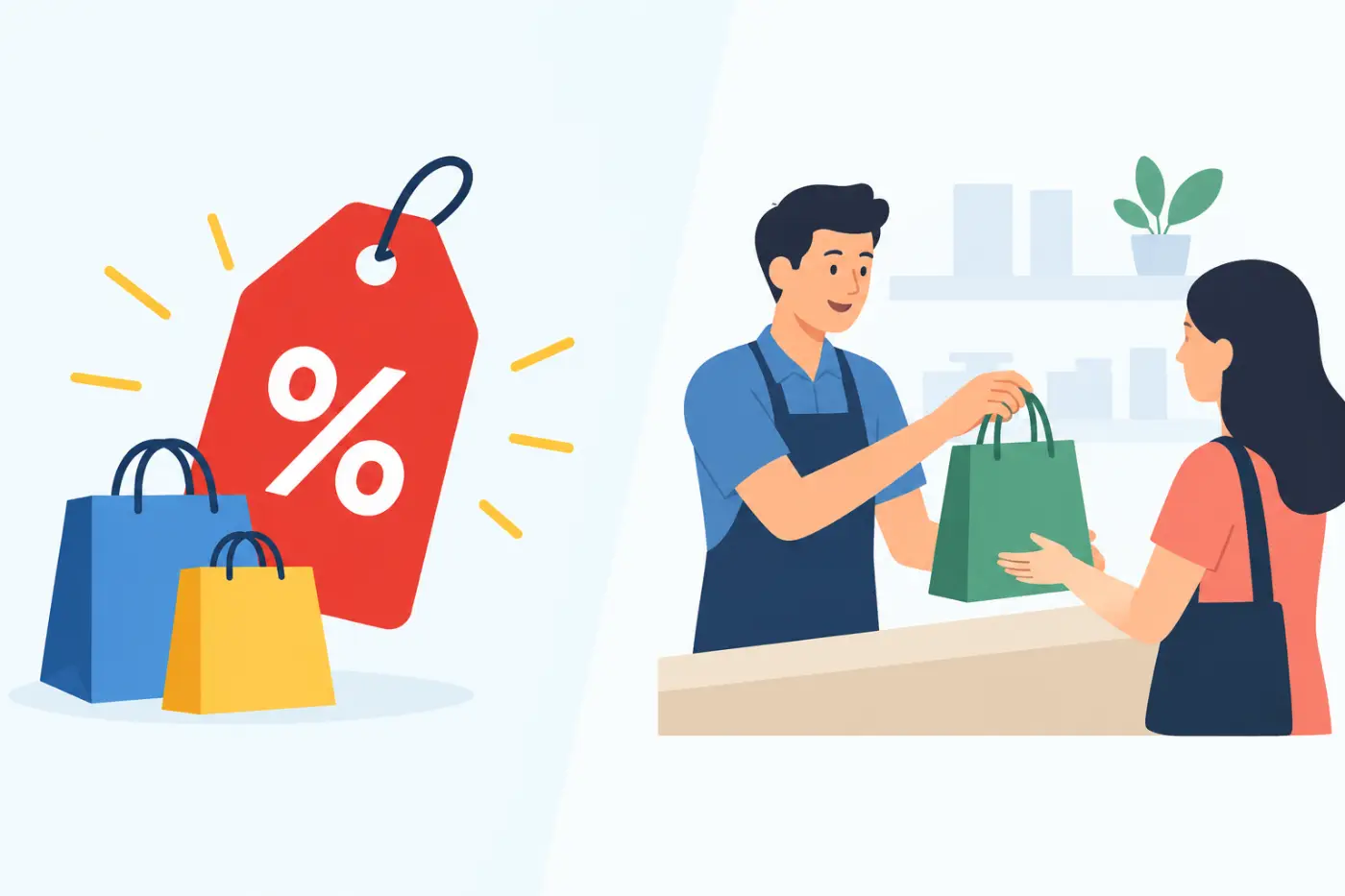
If you’re confused by sale vs sell, you’re not alone. These two words are closely related, sound similar, and both connect to buying and selling. The main difference is simple: sale is usually a noun, while sell is usually a verb.
Use sell when you’re talking about the action of giving something to someone for money. Use sale when you’re talking about the transaction itself or an event where products are offered for purchase. Once you understand that basic difference, most sentences become easy to fix.
For example, you can say, “I want to sell my car.” You can also say, “The sale of my car was completed yesterday.” The first sentence describes an action. The second sentence talks about the transaction.
This guide explains the difference in plain English. You’ll learn how each word works, see natural examples, understand common phrases such as for sale and on sale, and learn a simple trick that can help you choose the right word quickly.
Quick Definition
Sale is a noun that refers to an act of selling, a transaction, or an event where goods are offered at a lower price. Sell is mainly a verb that means to give something to another person in exchange for money. Cambridge Dictionary gives the same basic distinction, defining a sale as an act of exchanging something for money and sell as giving something to someone else in return for money.
Direct Answer
Use sell for the action and sale for the transaction or event. Say “I want to sell my bike” but “The bike is for sale.”
Comparison Table
| Word or Phrase | Meaning | Example Sentence | When to Use It |
|---|---|---|---|
| Sale | An act or transaction involving selling | The sale of the house was completed. | When you need a noun |
| Sell | To give something in exchange for money | I want to sell my house. | When you need a verb |
| For sale | Available to buy | The house is for sale. | When something is available for purchase |
| On sale | Available at a lower price or available for purchase | These shoes are on sale today. | When talking about a store offer or availability |
| Sold | Past form of sell | She sold her old laptop. | When the selling action already happened |
| Seller | A person or business that sells something | The seller answered my questions. | When talking about the person or business doing the selling |
| Sales | The activity or amount of goods sold | Sales increased last month. | When discussing business activity or results |
Sell Is Usually A Verb
A verb tells us what someone does. Since sell describes the act of giving something to someone in exchange for money, it normally works as a verb.
Consider these examples.
- “I want to sell my old phone.”
- “They sell fresh bread every morning.”
- “Are you going to sell your car?”
- “She sells handmade jewelry online.”
- “We sold our tickets yesterday.”
In each sentence, the word tells us about an action.
You can change the tense of the verb as needed.
“I sell books.”
“I am selling books.”
The form changes, but the basic idea stays the same.
The past tense of sell is sold, not saled. This is another point that sometimes causes confusion.
Correct:
“I sold my bike last week.”
Incorrect:
“I saled my bike last week.”
The word sold is an irregular past tense. It does not follow the normal pattern used by verbs such as walk and walked.
Sale Is A Noun
A noun names a person, place, thing, idea, or event. Sale works as a noun because it names the transaction or event connected with selling.
Look at these examples.
- “The sale was completed yesterday.”
- “The house is ready for sale.”
- “We made a sale this morning.”
- “The store is having a big sale.”
- “The company reported strong sales.”
Notice that nobody is performing an action with the word sale itself. The word names the transaction or event.
That is the key.
You can make a sale.
You can complete a sale.
For example, this sentence is wrong.
“I want to sale my car.”
The correct sentence is:
“I want to sell my car.”
The reason is simple. The sentence needs a verb after want to. Sell is the verb. Sale is not.

The Fastest Way To Choose
When you are unsure, look at the words around the blank.
If the sentence needs an action, use sell.
If the sentence needs a thing, event, or transaction, use sale.
Compare these examples.
“I plan to sell my house.”
“The sale of my house took three months.”
The first sentence tells us what the person plans to do. The second sentence names the transaction.
Here is another pair.
“They sell furniture.”
“The furniture sale starts Friday.”
Again, sell describes what the business does. Sale names the event.
This simple test works in most everyday situations.
Why The Words Get Confused
The confusion makes sense because both words come from the same basic idea. They are closely connected in meaning, and they often appear in the same conversations.
A customer might ask about a sale. A store employee might sell the product. A seller might complete a sale. A customer might buy something that was on sale.
The words sit close together in everyday English.
That can make them feel interchangeable. They are not.
English has many pairs like this.
- Decide and decision.
- Advise and advice.
- Choose and choice.
- Speak and speech.
Sell and sale belong to the same general pattern. One commonly describes an action, while the other commonly names a related thing or event.
A Simple Memory Trick
Remember this sentence:
People sell things. Stores have sales.
That gives you two useful patterns.
- “I sell clothes.”
- “The store has a sale.”
You can also remember:
Sell is an action. Sale is a thing.
When you see a sentence that asks what someone does, sell will often be the answer.
When you see a sentence that names the transaction or event, sale will often fit.
This is not a complicated grammar rule. It is a practical way to recognize the role each word plays.
Sell With An Object
Sell can take a direct object. That means someone can sell something.
Examples include:
- “I sold my laptop.”
- “She sells handmade candles.”
- “They sell fresh vegetables.”
- “We need to sell the extra tickets.”
- “He sold his old truck.”
In each sentence, the thing being sold comes after the verb.
You can also mention the person who receives the item.
- “She sold me her laptop.”
- “She sold her laptop to me.”
Both structures are possible.
The first uses two objects. The second uses the item followed by the person receiving it.
Cambridge Dictionary gives examples such as selling a car to someone and selling something for a stated price.
Sell With A Price
You can use sell with for when you want to state the price.
- “I sold the table for $100.”
- “She sold her car for $8,000.”
- “They sell these shirts for $25.”
The word for introduces the amount received or charged in these examples.
You can also use sell with at in some contexts.
“The store sells coffee at $3 a cup.”
Both forms appear in everyday English, but they serve slightly different sentence patterns.
For personal transactions, for is especially common.
“How much did you sell it for?”
“I sold it for $50.”
That is a natural question and answer.
Sell For A Certain Price
English speakers also use sell to describe the price something normally brings.
“That house sells for about $400,000.”
“These paintings sell for thousands of dollars.”
“The tickets sell for $40 each.”
Here, the subject does not have to be a person.
A house can sell for a certain price. A product can sell well. A ticket can sell quickly.
That may seem strange at first because a house cannot perform an action. In this structure, sell means that buyers purchase the item at the stated price.
For example:
“These cookies sell for $5 a box.”
This means customers buy the cookies for $5 a box.
Sell Well And Sell Quickly
Sell can also describe how easily or successfully something is bought.
- “The new shoes are selling well.”
- “Her paintings sell quickly.”
- “Those toys sold out in one day.”
You may also hear:
- “The book sells well.”
- “This product doesn’t sell well.”
These sentences focus on demand.
The seller may not be the main focus. The sentence can simply describe how popular the item is with buyers.
Sell An Idea
Sell does not always involve a physical product.
You can sell an idea, plan, argument, or proposal.
For example:
- “She sold the idea to her manager.”
- “He needs to sell his plan to the board.”
- “The coach sold the team on the new strategy.”
In these examples, sell means persuade someone to accept or support something.
You are not exchanging the idea for money in a literal sense. You are convincing someone that the idea is worth accepting.
This use is common in everyday English.
You might say:
“I like the plan, but you still have to sell it to the team.”
That means the person needs to persuade the team to support the plan.
Sell Yourself
Another common expression is sell yourself.
This means presenting your skills or qualities in a way that makes other people want to hire you, support you, or choose you.
For example:
“You need to sell yourself during the interview.”
That does not mean you are literally selling yourself. It means you should clearly explain why you are a strong candidate.
This expression appears often in job interviews, business, sports, and other competitive situations.
Sell Out
The phrase sell out has several meanings.
In a store or event, it can mean that all available items or tickets have been sold.
- “The concert sold out in two hours.”
- “The store sold out of the popular shoes.”
Sell out can also describe someone who gives up their principles for money or personal gain.
“He refused to sell out.”
The meaning depends on context.
This is a good reminder that sell can appear in many expressions beyond the basic idea of exchanging an item for money.
Section Three How Sale Works In Real Sentences
Sale has several common uses. Knowing them will help you avoid mistakes and understand everyday English more easily.
Sale Means A Transaction
The first major meaning is the act or transaction of selling something.
For example:
- “The sale of the property was completed.”
- “The sale took longer than expected.”
- “The contract covers the sale of the equipment.”
- “The company announced the sale of its building.”
In each example, sale refers to the transaction.
You are not saying that someone is performing the action at that exact moment. You are naming the event or process.
This is why the noun works naturally after words such as the, a, this, that, and the.
- “The sale was successful.”
- “A sale was completed.”
- “That sale caused problems.”
Sale Can Mean A Store Event
Sale has another meaning that many shoppers know well.
A sale can be an event when products are offered at lower prices than usual.
For example:
- “The store is having a summer sale.”
- “I bought these shoes during a sale.”
- “The holiday sale starts tomorrow.”
- “The furniture sale ends Sunday.”
Cambridge Dictionary defines this use as an occasion when goods are sold at a lower price than usual.
This is one reason the word can feel confusing.
A sale can mean the act of selling itself. It can also mean a special shopping event.
Context tells you which meaning is intended.
For Sale
For sale means something is available for someone to buy.
You might see:
- “House for sale.”
- “Used car for sale.”
- “Tickets for sale.”
- “Paintings for sale.”
In a full sentence, you could say:
- “The house is for sale.”
- “This bike is for sale.”
- “They have several used cars for sale.”
The phrase does not mean the item has already been sold. It means someone is offering it to buyers.
This distinction matters.
- If a house is for sale, people can still buy it.
- If a house was sold, the transaction already happened.
Compare:
- “The house is for sale.”
- “The house was sold last week.”
The first sentence describes availability. The second describes a completed transaction.
On Sale
On sale has two common meanings in American English.
First, it can mean that an item is being offered at a lower price than normal.
For example:
- “These shoes are on sale for $40.”
- “The jackets are on sale this week.”
- “Everything is on sale today.”
Second, on sale can simply mean available for purchase.
For example:
“Tickets are now on sale.”
This sentence does not necessarily mean the tickets have a lower price. It means people can now buy them.
Cambridge Dictionary also lists these two uses. It defines on sale as available to buy and also as being sold for a lower price than usual.
Context makes the meaning clear.
“The tickets go on sale Friday.”
Here, tickets become available to buy on Friday.
“The tickets are on sale for $20.”
Here, the phrase can suggest a reduced price.
Make A Sale
The phrase make a sale is common in business and retail English.
It means successfully sell something.
For example:
- “The salesperson made three sales today.”
- “We made our first sale online.”
- “She was happy after making a big sale.”
Notice the grammar.
You make a sale.
You do not make a sell.
That is because sale is the noun used after make.
The related verb would be:
“She sold three products today.”
Both sentences describe a successful transaction, but they use different grammar.
Close A Sale
You may also hear close a sale.
This phrase means successfully finish a sales transaction.
For example:
- “The salesperson closed the sale before lunch.”
- “They’re close to closing the sale.”
The phrase is common in business settings.
It is useful to know because it shows how naturally sale works as a noun.
Sales As A Business Term
The plural form sales has several important uses.
A company may talk about its sales.
- “Our sales increased this year.”
- “Sales are down this month.”
- “She works in sales.”
“The sales team called several customers.”
Sales can refer to the number or value of products sold. It can also refer to the business activity or department responsible for selling products and services. Cambridge Dictionary lists these business meanings separately.
This is why you may hear phrases such as:
“sales team”
“sales manager”
All of these use sales as a business noun.
Mistake One Using Sale After Want To
Incorrect:
“I want to sale my car.”
Correct:
“I want to sell my car.”
After want to, English normally uses the base form of a verb.
You say:
- “I want to go.”
- “I want to buy.”
You do not say:
“I want to sale.”
Sale is a noun, so it does not fit this structure.
Mistake Two Saying Make A Sell
Incorrect:
“We made a sell today.”
Correct:
“We made a sale today.”
The noun is sale.
The verb is sell.
You can sell something.
You can make a sale.
That distinction is worth remembering.
Mistake Three Saying I Saled It
Incorrect:
“I saled my old phone.”
Correct:
“I sold my old phone.”
The past tense of sell is sold.
The three basic forms are:
- Sell.
- Sold.
- Sold.
Examples:
- “I sell cars.”
- “I sold my car.”
- “I have sold my car.”
Do not add ed to sell.
Mistake Four Confusing For Sale And Sold
These phrases describe different situations.
- For sale means available to buy.
- Sold means someone already bought it.
Compare:
- “The house is for sale.”
- “The house was sold yesterday.”
If you see a sign that says “For Sale,” the owner is looking for a buyer.
If the sign says “Sold,” the transaction has already happened.
Mistake Five Using Sale As A Verb
Incorrect:
“They sale furniture online.”
Correct:
“They sell furniture online.”
The sentence needs a verb because it tells us what the company does.
Sell is the verb.
You could say:
“Their furniture sales are growing.”
Now sale has become sales, which is a noun.
The grammar changes because the sentence structure changes.
Mistake Six Confusing On Sale With For Sale
These expressions overlap, but they are not always identical.
- For sale means available to buy.
- On sale can mean available to buy or offered at a lower price.
Compare:
“The painting is for sale.”
This simply tells us that someone can buy it.
“The painting is on sale for $200.”
This gives us the price and suggests a special offer.
You should pay attention to context.
Sale Vs Sell In Everyday Questions
People often ask questions such as:
- “Is this car for sale?”
- “Are you selling this car?”
Both are correct, but they focus on different things.
“Is this car for sale?” asks if the car is available to buy.
“Are you selling this car?” asks if the owner is willing to sell it.
Another example:
“Is this jacket on sale?”
This usually asks if the jacket has a reduced price.
“Does this store sell jackets?”
This asks if the store offers jackets as a product.
The choice depends on the idea you want to express.
Sale Vs Sell In Business Writing
Business writing often uses both words in the same paragraph.
For example:
“The company sells software to small businesses. Its software sales increased by 12 percent this year. The company expects sales to grow after its new product launch.”
Notice how the words work together.
- Sells describes the company’s action.
- Sales describes the business results.
This pattern appears often in reports, marketing materials, financial documents, and company websites.
Understanding the difference helps you write clearly and avoid basic grammar errors.
Sale Vs Sell In Real Estate
Real estate gives us several useful examples.
- “The house is for sale.”
- “The owner wants to sell the house.”
- “The sale of the house was completed last week.”
- “The house sold for $450,000.”
Each sentence uses a different form.
The first says the property is available.
The second describes the owner’s plan.
The third names the transaction.
The fourth describes the price at which the property changed hands.
These sentences show why choosing the right word matters.
Sale Vs Sell In Online Shopping
Online shopping uses these words constantly.
A product page might say:
- “Now on sale.”
- “Sale price.”
- “Items for sale.”
- “Best selling product.”
“Products sold by independent sellers.”
Each phrase has its own job.
- Sale price means the current price offered during a sale or promotion.
- For sale means available to buy.
- Best selling describes a product that sells in large numbers.
- Seller identifies the person or company offering the product.
The same basic grammar rule continues to work.
Related Words You Should Know
Learning sale and sell becomes easier when you also understand a few related words.
Seller
A seller is a person or business that sells something.
- “The seller shipped the package yesterday.”
- “The seller accepted my offer.”
Buyer
A buyer is a person or organization that buys something.
- “The buyer inspected the house.”
- “The buyer paid in cash.”
Sold
Sold is the past tense and past participle of sell.
- “She sold her car.”
- “The tickets have sold out.”
Salesperson
A salesperson is someone whose job involves selling products or services.
“The salesperson explained the different plans.”
Sales
Sales can refer to products sold, the money generated from selling, or the business activity of selling.
- “Sales increased last quarter.”
- “He works in sales.”
These words belong to the same family, but each has a different grammatical role.

A Simple Sentence Test
When you need to choose between sale and sell, ask yourself one question:
Am I naming the action or naming the transaction or event?
If you are naming the action, choose sell.
“I need to sell my car.”
If you are naming the transaction, choose sale.
“The sale of my car was completed.”
Then check the grammar around the word.
After to, use sell.
“I want to sell it.”
After a or the, sale may be correct.
“The sale was successful.”
After make, use sale.
“We made a sale.”
For an action in the past, use sold.
“We sold the car.”
This small checklist can prevent most mistakes.
How To Remember The Difference
Picture a store.
A salesperson stands behind the counter and sells a product.
The customer buys it.
The transaction is a sale.
That mental picture makes the difference easier to remember.
You can also use this short formula:
Sell is something you do.
Sale is something you make or complete.
For example:
- “I sell shoes.”
- “I made a sale.”
- “She sold a dress.”
- “The sale was successful.”
Once these patterns become familiar, you probably won’t need to think about the rule every time.
Common Phrases With Sell
Here are some useful expressions you may see in everyday English.
Sell something for a price
“I sold the chair for $50.”
Sell something to someone
“She sold the car to her neighbor.”
Sell well
“This book sells well.”
Sell out
“The concert sold out quickly.”
Sell yourself
“You need to sell yourself during the interview.”
Sell someone on something
“He sold me on the idea.”
Sell off
“The company plans to sell off its unused equipment.”
These phrases show that sell has a wider range than simply exchanging a product for money.
Common Phrases With Sale
You will also see sale in many fixed expressions.
For sale
“The house is for sale.”
On sale
“These jeans are on sale.”
Make a sale
“She made a sale this morning.”
Close a sale
“The team closed the sale yesterday.”
Sale price
“The sale price is $30.”
Sales tax
“The final price includes sales tax.”
Sales team
“She joined the sales team.”
House sale
“The house sale took several months.”
These phrases become much easier once you recognize sale as a noun.
A Few Tricky Examples
Some sentences can look confusing because the same idea appears in different grammatical forms.
Consider:
- “The company sells cars.”
- “Car sales are strong.”
The first sentence focuses on the action.
The second focuses on the business activity and results.
Now consider:
- “They are selling the house.”
- “The house is for sale.”
Both sentences tell us the property is available to buyers, but the first focuses on the owner’s action while the second focuses on the property’s status.
Another pair:
- “She sold her old phone.”
- “The sale of her old phone was easy.”
The first is direct and natural for everyday conversation.
The second is more formal and focuses on the transaction.
Neither sentence is wrong. The best choice depends on what you want the reader to notice.
Why Context Matters
Grammar gives you the basic rule, but context helps you choose the most natural expression.
For casual conversation, people often prefer simple verbs.
“I sold my car.”
That sounds natural and direct.
A formal report might say:
“The sale of the vehicle was completed on Monday.”
The second sentence is not better because it uses a noun. It simply has a different purpose.
Good writing is not about choosing the more formal word. It is about choosing the word that fits the sentence.
That is especially useful when writing for customers, readers, or coworkers. Clear language usually beats complicated language.
FAQs
Is sale a noun or a verb?
Sale is mainly a noun. It names an act of selling, a transaction, or an event where products are offered at lower prices. Sell is mainly a verb.
What is the main difference between sale vs sell?
The main difference is grammatical. Sell describes the action of giving something to another person in exchange for money, while sale names the transaction or event connected with that action.
Should I say sell my car or sale my car?
Say “sell my car.” Sell is the verb needed after the phrase want to or another structure that requires an action. Sale is a noun, so “sale my car” is incorrect.
Is it correct to say I made a sell?
No. The natural phrase is “I made a sale.” You can also say “I sold something” when you want to use the verb form.
What is the difference between for sale and on sale?
For sale means something is available to buy. On sale can mean something is available to buy, but it often means the item is being offered at a lower price than usual. Context tells you the intended meaning.
What is the past tense of sell?
The past tense of sell is sold. You say “I sold my car yesterday,” not “I saled my car.”
Can sale mean a discount?
Yes. Sale can describe an event where products are sold at lower prices than usual. For example, “The store is having a summer sale” usually means customers can find special lower prices.
Can sell be used for ideas?
Yes. Sell can mean persuade someone to accept an idea, plan, or proposal. For example, “She sold her idea to the team” means she convinced the team to support it.
Conclusion
The easiest way to remember sale vs sell is to focus on grammar. Sell is mainly a verb that describes the action of giving something to someone in exchange for money. Sale is mainly a noun that names the transaction or an event where goods are offered for purchase.
Use sell in sentences such as “I want to sell my car” and “They sell furniture online.” Use sale in sentences such as “The sale was completed” and “The store is having a sale.”
Keep the related phrases in mind too. Something can be for sale when it is available to buy. Something can be on sale when it is available at a special price or is now available for purchase. A person can make a sale, but a person cannot make a sell.
If you remember only one rule, remember this: you sell something, but you make a sale. That simple pattern will help you choose the right word in most everyday sentences.

Dr. Arthur Pendelton is a veteran historical linguist and grammar expert with over 30 years of experience in academic editing. A retired professor, Arthur specializes in the etymology and evolution of the English language. He is passionate about “unpacking the history behind the rules,” helping readers understand why we spell, punctuate, and phrase things the way we do today. Whether he’s settling debates on archaic usage or explaining complex linguistic shifts, Dr. Pendelton brings scholarly precision to every article.