If you’re unsure about home made or homemade, you’re not alone. The two forms look almost identical, and both seem to make sense at first glance. Still, American English has a clear preference when the word describes something made at home.
The standard spelling is homemade as one word. You’ll use it to describe food, gifts, crafts, furniture, decorations, and other things made at home instead of bought from a store. Major American English dictionaries list homemade as an adjective.
The confusion often comes from the way the word is built. Home is a word by itself, and made is also a word by itself. Put them together, though, and they form a familiar compound adjective. English has many words that work this way.
This guide explains the spelling, meaning, grammar, and everyday use of the word. You’ll also see clear examples that show how homemade works in real sentences. By the end, choosing the right form should feel as easy as choosing the right ingredient for a recipe.
Quick Definition
Homemade is an adjective that means made at home instead of being bought from a store or made in a factory. It can describe food, clothing, crafts, furniture, decorations, and many other things.
Direct Answer
Homemade is the standard one word spelling in American English when you mean made at home. The two word form is not the usual choice when you use the expression as an adjective before a noun.
Home Made or Homemade
| Word or phrase | Meaning | Example sentence | When to use it |
|---|---|---|---|
| Homemade | Made at home rather than bought from a store | My grandmother makes homemade bread every Sunday. | Use it as the standard adjective in American English. |
| Home made | A literal combination of home and made rather than the usual compound adjective | The cake was made at home. | Avoid using it as the standard adjective spelling. |
| Made at home | Made in a person’s home | These cookies were made at home. | Use this natural phrase when you want to describe the action. |
Why Homemade Is One Word
English often turns two familiar words into one word when they work together as a single idea. This process creates what is called a compound word.
For example, bedroom combines bed and room. Breakfast combines break and fast. Homework combines home and work. Homemade follows the same general pattern.
The word doesn’t simply describe something that happens in a home. It describes the nature or source of an object. A homemade pie is a pie made at home. A homemade card is a card created at home.
That small difference matters because grammar depends on the job a word performs in a sentence.
Consider these two sentences.
- I made the cookies at home.
- I brought homemade cookies to the party.
The first sentence uses made as a verb. It tells us what happened. The second sentence uses homemade as an adjective. It describes the cookies.
That is one of the easiest ways to understand the difference.
What Homemade Means
Homemade usually means that a person made something at home instead of buying the finished product from a store. Cambridge defines the American English form as something made at home rather than bought from a store. Oxford gives a similar definition and describes it as something made at home instead of being produced in a factory and bought in a store.
The word often carries a warm and personal feeling.
A homemade meal may suggest that someone cooked it in their own kitchen. A homemade birthday card may suggest that someone created it by hand.
Still, the word doesn’t always mean something was made completely by hand.
For example, someone can use a bread machine to make homemade bread. Someone can use a sewing machine to make a homemade dress. Someone can use a computer and printer to create a homemade invitation.
The important idea is that the product was made at home rather than purchased as a finished product.
Homemade Works as an Adjective
Homemade is most often used as an adjective.
An adjective gives information about a noun. It tells us what something is like or what kind it is.
Look at these examples.
- She served homemade soup for lunch.
- We brought homemade cookies to the office.
- He gave me a homemade birthday card.
- They sell homemade candles at the local market.
- My uncle makes homemade furniture.
- The word homemade describes soup, cookies, card, candles, and furniture.
You can usually spot this use because homemade appears directly before a noun or after a linking verb.
For example:
- The bread is homemade.
- The bread is an adjective describing the bread.
- You can also place the adjective before the noun.
- The homemade bread smells wonderful.
Both sentence patterns are common.
Homemade Before a Noun
When homemade comes before a noun, it works just like many other descriptive adjectives.
Here are some natural examples.
- My mother made homemade pizza for dinner.
- We served homemade lemonade at the picnic.
- She gave everyone homemade cookies.
- I bought a jar of homemade jam at the farmers market.
- He brought homemade salsa to the party.
- They sell homemade candles online.
- She wore a homemade costume for the school play.
- We decorated the room with homemade ornaments.
- The children made homemade cards for their parents.
- The bakery is known for its homemade pies.
In each sentence, homemade tells the reader where or how the item was made.
It also helps create a more specific picture. Homemade pizza sounds different from frozen pizza.
Homemade After a Linking Verb
You can also use it after verbs such as is, are, was, and were.
For example:
- The bread is homemade.
- These cookies are homemade.
- The decorations were homemade.
- Her dress was homemade.
- The sauce is completely homemade.
- The gifts were homemade by the children.
In these sentences, homemade still functions as an adjective. The verb connects the subject to the description.
This pattern is useful when you want to focus on the finished item rather than the person who made it.
Compare these sentences.
- I made the cake at home.
- The cake is homemade.
The first sentence focuses on the action. The second focuses on the cake.
Home Made or Homemade in Everyday Writing
In everyday American writing, homemade is the form you should reach for when you need the adjective.
This applies to casual messages, school assignments, blog posts, recipes, product descriptions, menus, social media captions, and most other types of writing.
For example, these sentences sound natural.
- I love homemade bread.
- We made a homemade pizza last night.
- She brought homemade brownies to work.
- He gave me a homemade gift.
- My dad makes homemade ice cream.
- They served homemade soup at the event.
- The children made homemade decorations.
A homemade meal can be simple or elaborate. The word only tells you that it was made at home.
You don’t need to use homemade only for food. That’s a common misconception.
Homemade Is Not Just for Food
Food is probably the most common thing people associate with homemade. That makes sense because cooking at home is a familiar activity.
Still, the word can describe many other things.
- You can have a homemade card.
- You can make a homemade gift.
For example:
- The students built a homemade model for the science fair.
- She gave me a homemade picture frame.
- We used homemade decorations for the birthday party.
- He repaired the chair with a few homemade tools.
- The children made homemade puppets from paper bags.
The meaning stays the same. The object was made at home rather than purchased as a finished item.
Homemade Compared With Store Bought
Homemade is often used as the opposite of store bought.
If you make cookies in your kitchen, you can call them homemade cookies. If you buy a package of cookies from a store, you normally wouldn’t call them homemade.
Consider this example.
- I made homemade bread this morning.
- The bread came from my kitchen.
- Now compare it with this sentence.
- I bought bread from the grocery store.
- The bread wasn’t made by me at home.
This contrast explains why the word is so useful. It gives readers information about the source of a product without needing a long explanation.
You can also use the word when someone else in your home made the item.
My sister brought homemade cookies.
The speaker may not have made the cookies. The word simply tells us that the cookies were made at home.
Homemade Compared With Handmade
Homemade and handmade are related, but they don’t mean exactly the same thing.
A homemade item is made at home.
A handmade item is made by hand rather than mainly by machine.
These ideas can overlap.
For example, someone might make a homemade scarf by hand. The scarf is both homemade and handmade.
But an item can be handmade without being homemade.
A craftsperson might make handmade jewelry in a professional studio.
Likewise, something can be homemade without being entirely handmade.
Someone might use an electric mixer to make homemade bread.
So don’t treat the two words as perfect synonyms. They highlight different parts of the process.
Homemade Compared With DIY
DIY means do it yourself. It usually describes making, repairing, building, or decorating something without paying another person to do the work.
Homemade has a narrower meaning.
For example, you might make a homemade cake. That’s something made at home.
You might also have a DIY project where you build a shelf in your garage.
The two terms can overlap, but they focus on different ideas.
Homemade points to the place and source of production.
DIY points to the fact that the person did the work themselves.
A homemade cake could be a family activity. A DIY shelf could be a home improvement project.
Common Mistakes With Homemade
The most common mistake is separating the word into two parts when you need the adjective.
For example, a writer might type:
I made home made cookies.
In standard American English, the natural form is:
I made homemade cookies.
Another mistake is assuming that two familiar words must remain separate because they have separate meanings.
That isn’t how compound words work.
Words such as bedroom, classroom, newspaper, and homemade combine smaller words into a new word with its own meaning and grammatical role.
The best way to avoid the mistake is to think about the function of the expression.
If you’re describing something made at home, homemade is the simple choice.
Common Sentences With Homemade
Seeing the word in real sentences makes the pattern easier to remember.
Here are several examples you can use as models.
- I prefer homemade bread to packaged bread.
- She brought homemade cookies to the family gathering.
- We made homemade pizza for dinner.
- My grandmother is famous for her homemade jam.
- He gave me a homemade birthday card.
- The children made homemade decorations for the party.
- We served homemade lemonade on the porch.
- She sells homemade candles at weekend markets.
- He enjoys making homemade furniture.
- They prepared a homemade meal for their guests.
- The restaurant serves homemade pasta.
- I bought some homemade salsa from the market.
- She made a homemade costume for her daughter.
- We used homemade decorations for the holiday party.
- His homemade soup tasted wonderful.
Notice that the spelling never changes because of the noun that follows it.
- You write homemade bread.
- You write homemade cookies.
The adjective stays the same.
Can Homemade Describe a Person
Homemade normally describes something that was made at home. It isn’t usually used to describe a person.
You wouldn’t normally say:
She is homemade.
That sentence doesn’t communicate the intended idea.
Instead, you could say:
- She grew up making things at home.
- She learned to cook from her mother.
The word describes an object, product, meal, or creation more naturally than it describes a person.
Can Homemade Describe a Business Product
Yes. A small business can sell homemade products.
For example:
- The shop sells homemade candles.
- They offer homemade soap.
- The market features homemade crafts.
- The bakery sells homemade pies.
The word can describe a product sold by a person or small business if the product was actually made at home.
However, the word can also carry a different tone in marketing. Some businesses use homemade to suggest that a product feels personal, traditional, or made in small batches.
That doesn’t automatically prove how the product was made. The actual meaning depends on the context.
For careful writing, use homemade when you have a clear reason to describe something as made at home.
Homemade and From Scratch
Homemade and from scratch are close in meaning, but they aren’t identical.
From scratch tells us that the maker prepared the item using basic ingredients or materials rather than relying heavily on a prepared product.
For example:
- I made homemade soup from scratch.
- This sentence gives us two pieces of information.
- The soup was made at home.
- The soup was prepared from basic ingredients.
- You can also have homemade food that isn’t completely from scratch.
- Someone might make homemade pizza using a store bought crust.
- The finished pizza can still be homemade because the pizza was prepared at home.
This distinction matters in recipes and food writing.
Homemade and Fresh
Fresh and homemade also have different meanings.
Fresh describes the condition or recent preparation of something. Homemade describes where it was made.
- A restaurant can serve fresh bread that isn’t homemade.
- A person can make homemade bread that was baked yesterday.
So the two words can work together.
We had fresh homemade bread for breakfast.
Here, fresh tells us something about the bread’s condition. Homemade tells us where it was made.
Homemade and Home Cooking
Home cooking is another related expression.
It usually refers to food prepared at home in a traditional or familiar way.
For example:
I miss my mother’s home cooking.
We enjoyed some good home cooking during the visit.
Homemade focuses more directly on the item itself.
She made homemade chicken soup.
Home cooking focuses more on the activity or style of preparing food.
The expressions are close, but they aren’t interchangeable in every sentence.
How to Remember the Correct Spelling
A simple memory trick can make this easy.
Think of homemade as one idea.
If you’re describing an item that someone made at home, treat the description as one adjective.
- Homemade cookies.
- Homemade bread.
You can also connect it with other familiar compound words that begin with home.
- Homework is one word.
- Homeroom is one word.
- Homecoming is one word.
Homemade follows a similar pattern.
Once you recognize the word as a compound adjective, the spelling becomes much easier to remember.
When to Use Made at Home Instead
Sometimes the best choice isn’t homemade at all.
If you’re describing the action of making something at home, made at home may sound more natural.
Compare these examples.
- We made the cookies at home.
- The cookies are homemade.
Both sentences are correct, but they do different jobs.
The first sentence tells us where the action happened.
The second sentence gives the cookies a quality or description.
This distinction can make your writing smoother.
Use homemade when you want a compact adjective.
Use made at home when you want to emphasize the action or location.
A Simple Grammar Test
If you’re stuck, ask yourself one question.
Am I describing a thing, or am I describing an action?
If you’re describing a thing, homemade will often be the right choice.
She brought homemade bread.
The bread is the thing being described.
If you’re describing an action, a phrase such as made at home may work better.
She made the bread at home.
The sentence tells us what she did and where she did it.
This test won’t solve every possible sentence, but it works well for everyday writing.
Regional Spelling Differences
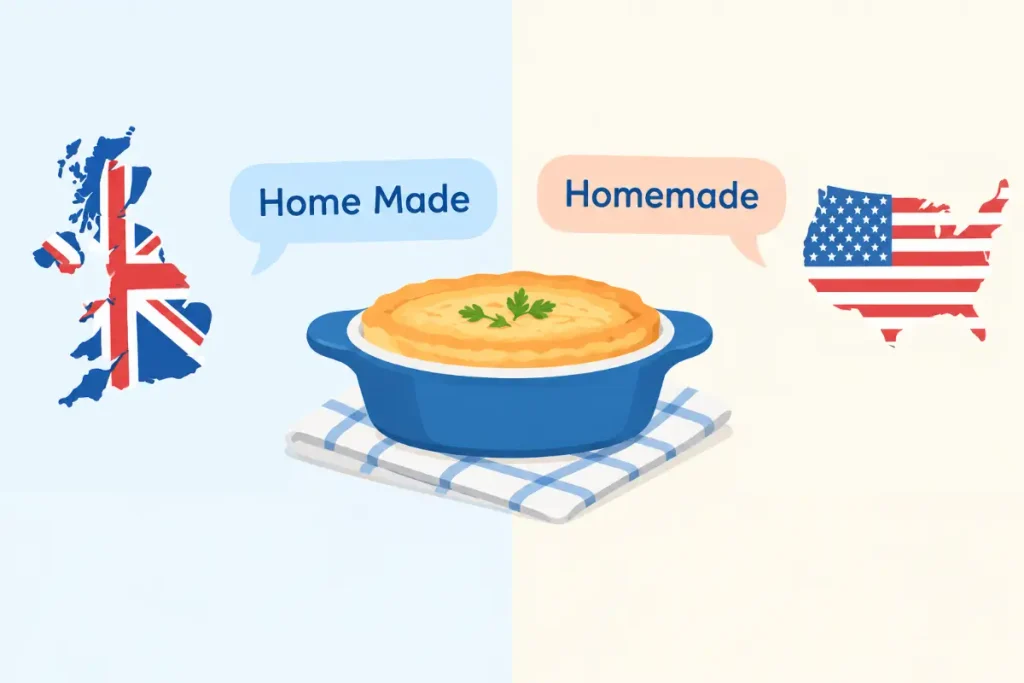
American English generally uses homemade as one word. Major American English dictionary sources such as Cambridge and Oxford list this form.
Some British English dictionary resources also recognize a hyphenated version. Cambridge’s learner and business resources show that British usage can include that alternative form.
That regional difference can explain some of the spelling variation you see online.
If you’re writing for a US audience, homemade as one word is the safest and most natural choice.
You don’t need to copy every spelling variation you encounter. English has many regional differences, and dictionaries sometimes record more than one accepted form.
For American readers, consistency matters most.
Why Online Examples Can Be Confusing
A quick internet search can make the issue look more complicated than it is.
You may see homemade written as one word. You may also find older sources or British sources that use a different form.
Search results can also include user generated content. A form appearing on a website doesn’t automatically make it the preferred spelling in standard American English.
That’s why dictionary sources are useful for questions like this.
They give you a reliable reference point for standard usage.
For US writing, the practical choice is straightforward. Use homemade when you need the adjective meaning made at home.
Homemade in Formal Writing
Homemade is perfectly acceptable in formal writing when it fits the meaning.
You can use it in essays, reports, articles, business descriptions, recipes, product pages, and other professional writing.
For example:
- The program teaches students how to prepare homemade meals.
- The study examined consumer preferences for homemade products.
- The community center hosts a homemade crafts market.
- The report describes the benefits of preparing homemade food.
There is no need to replace homemade with a more complicated phrase simply because the writing is formal.
Clear writing usually benefits from familiar words.
Homemade in Business Writing
Businesses often use homemade to describe products that are prepared in a home kitchen, home studio, or small workshop.
For example:
We sell homemade candles.
- Our market offers homemade baked goods.
- The event features homemade crafts from local artists.
- The term can create a friendly and personal feeling.
Still, writers should use it accurately. If a product is mass produced in a factory, calling it homemade could give readers the wrong impression.
Good content isn’t just about sounding appealing. It should also give readers accurate information.
That is especially important for product descriptions and advertising.
Homemade in Recipe Writing
Recipes use homemade constantly because the word quickly tells readers that the finished food is prepared at home.
You might see phrases such as:
- homemade bread
- homemade pizza
The word is especially useful in recipe titles.
For example:
- Easy Homemade Tomato Soup.
- Simple Homemade Bread.
- Classic Homemade Chocolate Cake.
- Creamy Homemade Pasta Sauce.
These titles are clear because homemade immediately tells the reader what kind of food the recipe produces.
Homemade in Product Descriptions
The same principle works in product writing.
Imagine a seller describing a handmade candle.
You could write:
- This homemade candle is made with natural ingredients and a simple design.
- The adjective gives the reader a quick idea about the product’s source.
- Still, writers should avoid making claims that the word doesn’t support.
Homemade doesn’t automatically mean healthier.
- It doesn’t automatically mean safer.
- It doesn’t automatically mean cheaper.
Those are separate claims that need separate evidence.
This is a useful writing lesson. A descriptive word can tell readers one thing without proving several other things.
FAQs
Is homemade one word in American English?
Yes. Homemade is the standard one word spelling in American English when it functions as an adjective meaning made at home. American English dictionary sources from Cambridge and Oxford list homemade in this form.
Is home made grammatically correct?
The two word form is not the standard spelling of the adjective in American English. If you want to describe something made at home, use homemade as one word.
Is homemade an adjective?
Yes. Homemade is an adjective. It describes a noun by telling readers that the item was made at home rather than bought as a finished product.
Can I say homemade food?
Yes. Homemade food is a common and natural phrase. It means food prepared at home rather than purchased as a finished food item.
Is homemade the same as handmade?
No. Homemade describes where something was made. Handmade describes how something was made. An item can be both homemade and handmade, but the words focus on different ideas.
Is homemade the same as from scratch?
Not always. Homemade means made at home, while from scratch usually means prepared from basic ingredients or materials instead of relying heavily on prepared products. Something can be homemade without being completely made from scratch.
Can homemade describe things other than food?
Yes. Homemade can describe many kinds of things, including gifts, cards, furniture, decorations, clothing, crafts, tools, and equipment. The word simply indicates that the item was made at home.
Should I use homemade in a US English article?
Yes. Homemade is the natural choice for US English when you need the adjective meaning made at home. It is clear, familiar, and widely recognized by American readers.
Conclusion
The answer to home made or homemade is simple for American English. Use homemade as one word when you need an adjective that means made at home.
The word can describe much more than food. You can talk about homemade gifts, homemade furniture, homemade decorations, homemade clothing, homemade crafts, and many other items. The key idea stays the same. The item was made at home instead of being purchased as a finished product.
Remember the difference between an adjective and an action. In the sentence I made the cookies at home, made is part of the verb phrase. In the sentence I brought homemade cookies, homemade describes the cookies.
When you’re writing for a US audience, keep the choice simple. If you mean an item made at home, write homemade as one word. That small spelling choice will make your writing cleaner and more natural.

Dr. Arthur Pendelton is a veteran historical linguist and grammar expert with over 30 years of experience in academic editing. A retired professor, Arthur specializes in the etymology and evolution of the English language. He is passionate about “unpacking the history behind the rules,” helping readers understand why we spell, punctuate, and phrase things the way we do today. Whether he’s settling debates on archaic usage or explaining complex linguistic shifts, Dr. Pendelton brings scholarly precision to every article.
2 thoughts on “Home Made or Homemade Which Is Correct”