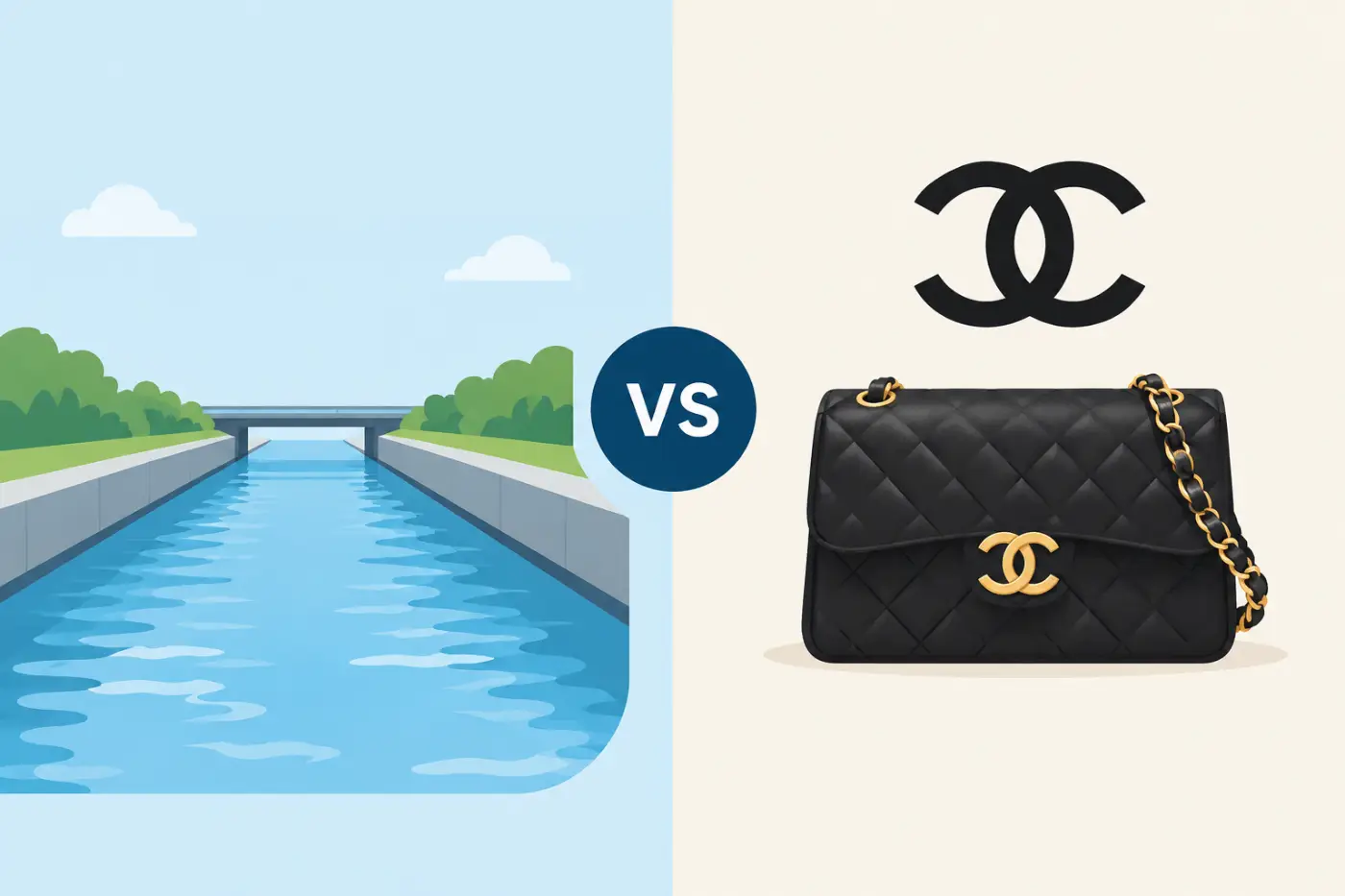
If you’ve ever typed channel vs chanel into Google, you’re probably dealing with a simple spelling mix up. The two words look almost identical, but they have completely different meanings.
Channel is a regular English word. It can describe a TV station, a communication path, a waterway, or a route used to move something from one place to another. Chanel is a proper name best known as the French luxury fashion and beauty brand founded by Gabrielle Chanel.
So, if you’re talking about changing the TV station, you need channel. If you’re talking about the famous fashion brand, you need Chanel.
The difference comes down to one letter. That tiny spelling change completely changes the word. This guide explains the meaning, pronunciation, history, common mistakes, and everyday uses of both terms so you can choose the right one without stopping to think twice.
Quick Definition
Channel is an English word for a route, passage, means of communication, or TV or radio station. Chanel is a proper name associated with the French fashion and beauty house created by Gabrielle Chanel.
Direct Answer
Use channel when you mean a communication route, TV station, waterway, or similar passage. Use Chanel when you mean the French luxury fashion and beauty brand or the surname Chanel.
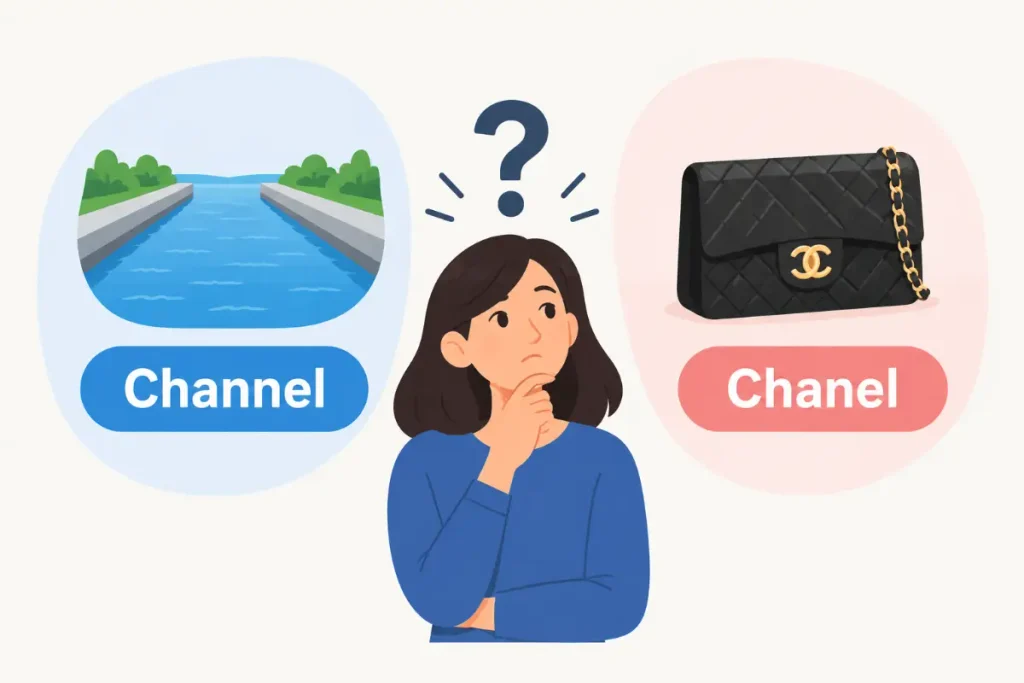
Why These Two Words Cause Confusion
The spelling is the main reason people confuse these terms.
Both words contain the same first five letters. They also have similar shapes when written quickly. The final letters create the key difference.
Channel has two n letters.
Chanel has one n.
That extra n matters. It separates an everyday English word from a famous proper name.
Imagine writing a sentence about television.
You might say:
I changed the channel.
That sentence uses the common English noun. The word describes the TV station or frequency you selected.
Now consider a sentence about fashion.
She wore a Chanel jacket.
Here, the word refers to the luxury fashion house and its products.
The sentence would lose its meaning if you switched the spellings. You wouldn’t normally write about changing a Chanel on your television. You also wouldn’t write that someone bought a channel handbag.
The two words simply live in different parts of the language.
What Channel Means
Channel has several meanings in English. That’s one reason it appears so often in everyday writing.
At its most basic level, a channel is a path or route.
The path can be physical. It can also be used for information, communication, business, or entertainment.
For example:
- The river flows through a narrow channel.
- The ship entered the channel safely.
- The company opened a new sales channel.
- Send the message through the proper channel.
- I watched the news channel last night.
The teacher created a private communication channel for parents.
Although these sentences use the same word, the meaning changes based on context.
That flexibility makes channel a common and useful word.
Channel As a TV Station
One of the most familiar uses of channel refers to television.
When you turn on a TV and select a station, you choose a channel.
For example:
- What channel is the game on.
- I changed the channel during the commercial.
- This channel shows local news.
- My favorite cooking channel starts at seven.
In this context, channel refers to a television station or a numbered selection on a TV service.
The same idea applies to radio in some contexts. A radio channel can refer to a specific frequency or communication path.
Channel As A Communication Path
Channel can also describe a way information moves from one person or group to another.
For example:
- Email is our main communication channel.
- The manager created a new channel for customer support.
- The team uses several channels to share updates.
- Here, the word doesn’t describe a physical passage. It describes a means of communication.
- Think of it as a path for information.
A phone call can be a communication channel. Email can be another. A meeting can also serve as a communication channel.
Channel As A Waterway
The word has a physical meaning too.
A channel can be a passage through water. It may form naturally or be created or maintained for navigation.
For example:
- The boat moved slowly through the channel.
- The channel became too shallow for large ships.
- The crew followed the marked channel into the harbor.
You may also see channel used when talking about rivers, seas, harbors, and coastal areas.
This meaning is older and more physical than the modern communication meaning. Both uses come from the basic idea of a passage or route.
Channel As A Route For Business
Businesses often use channel to describe the way they sell products or reach customers.
For example:
- The company sells directly through its website.
- Retail stores are another sales channel.
- Social media has become an important marketing channel.
- In these examples, channel means a method or route.
The company isn’t talking about a TV station. It’s talking about how its message or product reaches people.
This use is common in business writing, but the basic idea remains simple. A channel is a path that helps something move from one place to another.
Channel Can Be A Verb
Many people first learn channel as a noun, but it can also work as a verb.
When channel is used as a verb, it can mean to direct something toward a particular place, person, or purpose.
For example:
- The organization channeled its funds into local schools.
- She channeled her anger into exercise.
- The company channeled more resources into research.
- The word suggests direction. Something is being guided toward a specific goal.
This gives you another useful clue when deciding how to spell the word.
If you can replace the word with direct, route, or guide, you probably need channel.
For example:
- She channeled her energy into writing.
- She directed her energy into writing.
- The meanings are close.
Common Meanings Of Channel
You’ll usually see channel used in one of these ways.
- A television station.
- A radio or communication route.
- A physical passage for water.
- A method of communication.
- A route for selling or distributing products.
- A way of directing energy, money, effort, or attention.
The context tells you which meaning applies.
That’s why channel is much more than a TV word.
What Chanel Means
Chanel is a proper name.
Most often, it refers to the French luxury fashion and beauty house associated with Gabrielle Chanel, who was widely known as Coco Chanel.
The name appears on fashion, fragrance, makeup, accessories, and other luxury products.
For example:
- She bought a Chanel perfume.
- He recognized the Chanel logo.
- The store sells Chanel handbags.
Chanel is known around the world for fashion and fragrance.
The important point is simple. Chanel is not the regular English word for a TV station, waterway, or communication path.
It is a name.
Because it is a proper name, it normally begins with a capital letter.
- You would write:
- Chanel perfume.
- You would not normally write:
- chanel perfume.
The capital letter helps show that you’re referring to a specific name.
Who Was Gabrielle Chanel
Gabrielle Chanel was a French fashion designer who became one of the most influential figures in twentieth century fashion.
She was born in 1883 and became known professionally as Coco Chanel.
Her work helped shape modern women’s fashion. Her designs emphasized comfort, simplicity, and a more relaxed approach to clothing compared with many styles common during her era.
The Chanel name later became closely linked with luxury fashion and beauty.
That history explains why Chanel appears in a very different set of sentences from channel.
You might read about Chanel in an article about fashion, perfume, handbags, watches, clothing, or beauty.
You might read about channel in an article about television, communication, waterways, business, or technology.
The surrounding words usually make the intended meaning obvious.
Chanel As A Brand Name
When people mention Chanel today, they may be talking about the company, the fashion house, or one of its products.
For example:
- She bought a Chanel fragrance.
- He gave her a Chanel wallet.
- The magazine featured a Chanel collection.
- She wore a Chanel dress to the event.
The brand name remains capitalized because it comes from a proper name.
You may also see the name used in phrases such as Chanel fashion, Chanel perfume, Chanel makeup, and Chanel bags.
In each case, the spelling stays the same.
Chanel As A Surname
Chanel can also be a person’s surname.
That’s another reason you should treat it as a proper name.
A surname identifies a person or family. It doesn’t function like an ordinary English noun.
This is similar to many other names that can resemble common words.
For example, Rose can be a person’s name or the name of a flower. May can be a person’s name or the name of a month. Chanel can refer to a surname and is strongly associated with the famous fashion house.
Context tells you what the writer means.
The Pronunciation Difference
Spelling isn’t the only difference. The pronunciation is different too.
Channel is commonly pronounced like CHAN uhl.
The first part sounds like the word chan followed by a softer uhl sound.
Chanel is commonly pronounced like shuh NEL in American English.
The second word has a stronger ending sound.
You can hear the difference clearly when the words are spoken aloud.
- Channel.
- Chanel.
They may look similar on a page, but they don’t sound the same.
Pronunciation can actually help you remember the spelling.
If you hear a word that sounds like CHAN uhl, think of the English word channel.
If you hear the French fashion name pronounced shuh NEL, think Chanel.
A Simple Spelling Trick
There’s an easy way to remember the difference.
Think of channel as a path with two lanes.
The word has two n letters.
Channel.
The extra n can remind you of a path with more room or two sides.
For Chanel, remember the name is shorter.
- Chanel.
- One n.
This isn’t a language rule. It’s simply a memory trick. Still, small tricks like this can help when two spellings keep getting mixed up.
Another useful trick is to connect each word with a familiar phrase.
- TV channel.
- Chanel perfume.
Once you associate the words with those phrases, the spelling becomes easier to recall.
Channel Vs Chanel In Real Sentences
Seeing the words in context is one of the fastest ways to understand the difference.
Consider these examples.
- I switched to another channel.
- The news channel reported the story.
- This channel has better reception.
- The ship moved through a narrow channel.
- We need a better channel for customer support.
- She bought a Chanel fragrance.
- The actress wore a Chanel gown.
- He gave her a Chanel handbag.
- The store carries several Chanel products.
- The magazine published a story about Chanel fashion.
- Notice how little room there is for confusion once the rest of the sentence is visible.
- A television sentence almost always points toward channel.
- A sentence about luxury fashion points toward Chanel.
Common Mistakes People Make
The most common mistake is leaving out the second n in channel.
For example:
- I changed the chanel.
- That spelling is incorrect when you mean a TV station.
- The correct sentence is:
- I changed the channel.
- The opposite mistake also happens.
- Someone may write:
- She bought a channel bag.
- That doesn’t make sense if the writer means the luxury fashion brand.
- The correct sentence is:
- She bought a Chanel bag.
The capital C also matters because Chanel is a proper name.
Mistake With TV And Media
People sometimes spell the word based on how it sounds.
- That can lead to:
- What chanel is the football game on.
- The correct form is:
- What channel is the football game on.
- Remember that the TV word contains two n letters.
Mistake With Fashion
The fashion name is sometimes written as channel because people recognize the sound but don’t remember the brand spelling.
For example:
- She is wearing a channel perfume.
- The intended meaning is clear, but the spelling is wrong.
Write:
She is wearing Chanel perfume.
Mistake With Capitalization
Even if you remember the spelling, capitalization can still cause trouble.
Channel is normally lowercase when it is a common noun.
For example:
I changed the channel.
Chanel is capitalized when it refers to the name.
For example:
She bought Chanel perfume.
This distinction is useful in formal writing, schoolwork, business content, and product descriptions.
Why Context Solves The Problem
English contains many words that look or sound similar. You don’t always need to memorize a long rule for each pair.
Context does much of the work.
Look at the words around the term.
If you see TV, station, radio, signal, water, river, communication, sales, or distribution, channel is likely the correct choice.
If you see perfume, fashion, handbag, designer, luxury, makeup, clothing, or fragrance, Chanel is likely the intended word.
This approach is useful because it lets you understand the meaning before you focus on spelling.
Ask yourself one simple question.
Am I talking about a route or a name?
If you mean a route, path, station, or method, use channel.
If you mean the fashion name, use Chanel.
How To Choose The Right Word
When you’re unsure, don’t stare at the two spellings and guess.
Start with the meaning.
Step One
Ask what you’re talking about.
If you’re talking about television, communication, water, business, or direction, you probably need channel.
If you’re talking about the luxury fashion house or its products, you need Chanel.
Step Two
Check the spelling.
Channel has two n letters.
Chanel has one n.
Step Three
Check capitalization.
Use lowercase channel when it functions as a common English word.
Use capitalized Chanel when it functions as the proper name.
This three step check takes only a few seconds.
Words Related To Channel
Learning related words can make the meaning easier to remember.
- Some common phrases include:
- TV channel.
- News channel.
- Radio channel.
- Communication channel.
- Sales channel.
- Marketing channel.
- Distribution channel.
- Water channel.
- Shipping channel.
You’ll notice that all of these phrases describe some kind of route, station, passage, or method.
The exact meaning changes, but the central idea stays connected to a path.
Words Related To Chanel
Chanel appears in a very different group of phrases.
Common examples include:
- Chanel perfume.
- Chanel fragrance.
- Chanel handbag.
- Chanel makeup.
- Chanel lipstick.
- Chanel clothing.
- Chanel fashion.
- Chanel accessories.
- Chanel collection.
These phrases point toward fashion and beauty.
That makes the context clue very strong.
If the sentence mentions lipstick and fragrance, you almost certainly aren’t talking about a TV channel.
Related Spelling Confusions
The difference between these words is part of a larger group of spelling problems.
English has many pairs that look almost identical but have different meanings.
For example:
- Station and stationery.
- Principal and principle.
- Advice and advise.
- Affect and effect.
- Accept and except.
These pairs can cause trouble because one small spelling or sound difference changes the meaning.
The best solution isn’t simply memorizing lists. It’s learning how each word works in a sentence.
The same approach works with channel and Chanel.
Channel And Chanel In Search Queries
People often search both spellings because search engines can understand what they mean from context.
- You might type:
- channel meaning.
- Chanel meaning.
- channel spelling.
- Chanel perfume.
- TV channel.
- Chanel brand.
Those searches may look similar at first, but they represent different intentions.
A person searching for channel spelling probably wants help with the English noun.
Someone searching for Chanel perfume is looking for information about a brand or product.
For writers and editors, this distinction matters. Good content should answer the intended question instead of treating similar spellings as the same word.
Channel In Everyday American English
Channel is extremely common in American English.
You’ll hear it in homes, offices, classrooms, stores, newsrooms, and technical settings.
For example:
- Which channel is the game on.
- Turn to channel five.
- The news channel is covering the storm.
- Use another communication channel.
- The company needs a better sales channel.
- The river has a deep channel.
- The manager asked us to use the official channel.
These examples show why channel is a useful word to know well.
It can describe a physical route or an abstract path.
Chanel In Everyday American English
Chanel is much more specific.
You’ll mainly encounter it in fashion, beauty, luxury retail, celebrity style, and discussions about the history of fashion.
For example:
- She wore Chanel to the event.
- The store sells Chanel cosmetics.
- He bought a Chanel fragrance as a gift.
- The article discusses Chanel’s influence on fashion.
Because the word refers to a specific name, it doesn’t take the broad range of meanings that channel does.
Is Chanel A French Word
Chanel is primarily known as a French surname and proper name.
- The famous fashion house takes its name from Gabrielle Chanel.
- That means you shouldn’t treat Chanel as a French version of the English word channel.
- They are separate words with different histories and meanings.
- Their similar appearance is mostly what creates the confusion for English speakers.
Is Channel The Same As Chanel
No.
- Channel is a common English word with several meanings.
- Chanel is a proper name associated with Gabrielle Chanel and the luxury fashion and beauty house.
- They are not alternate spellings of the same word.
- They also differ in pronunciation.
If you remember that point, you’ve already solved most of the confusion.
Which Spelling Is Correct
Both spellings are correct, but they are correct in different situations.
- Use channel for the English noun or verb.
- Use Chanel for the proper name.
For example:
- Correct: I changed the channel.
- Correct: She bought Chanel perfume.
- Incorrect: I changed the chanel.
- Incorrect: She bought a channel perfume.
- The right spelling depends on the meaning you want.
A Quick Memory Test
Try completing these sentences.
- I changed the _____ because the show was boring.
- The answer is channel.
- She bought a bottle of _____ perfume.
- The answer is Chanel.
- The boat entered the narrow _____.
- The answer is channel.
- The designer founded the _____ fashion house.
- The answer is Chanel.
If you can connect each sentence with its meaning, the spelling becomes much easier.
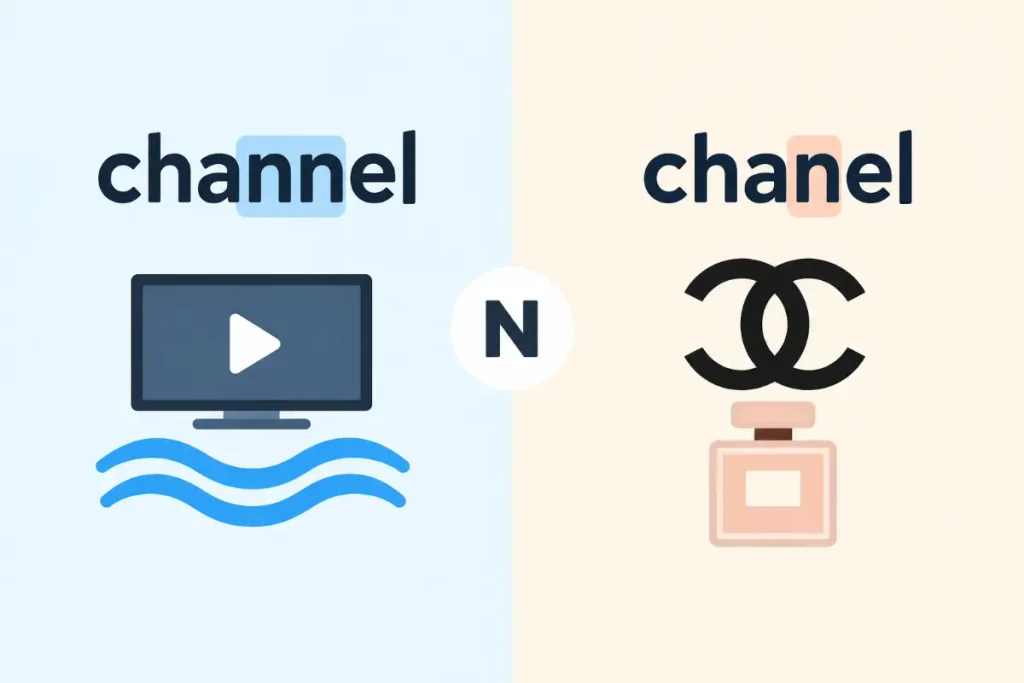
Why The Extra N Matters
The extra n in channel may seem like a tiny detail, but spelling often works this way.
One letter can change a word completely.
- Consider:
- Plane and plan.
- Later and latter.
- Quiet and quite.
- Channel and Chanel.
These differences may look small on a screen. Their meanings can be miles apart.
That’s why proofreading matters.
A spelling checker may catch some mistakes, but context still matters. A tool might not understand that you meant the fashion name instead of the common noun if both forms appear in its dictionary.
A human reader needs to look at meaning too.
How Editors Handle The Difference
An editor usually checks three things.
- First, the meaning.
- Second, the spelling.
- Third, capitalization.
- Suppose an article says:
- The celebrity wore channel perfume.
An editor would recognize that the context points to the fashion brand. The sentence should use Chanel with a capital C.
Now suppose the sentence says:
The celebrity changed the chanel during the interview.
If the person is talking about television, the editor should change it to channel.
The correction seems small, but it improves accuracy and credibility.
How To Avoid The Mistake In Your Own Writing
You don’t need a complicated grammar rule.
Use this shortcut.
Channel has two n letters because it is the common English word.
Chanel has one n because it is the proper name.
Then check the meaning.
If it’s a TV station, communication route, water passage, business method, or path, write channel.
If it’s the fashion and beauty name, write Chanel.
That’s enough for most everyday situations.
Examples You Can Copy
Here are more natural examples showing the difference.
Examples With Channel
- Please change the channel.
- What channel is the baseball game on.
- The news channel interrupted the program.
- The boat stayed inside the marked channel.
- Email is our main communication channel.
- The company added another sales channel.
- The team created a private channel for project updates.
- The engineer studied the flow of water through the channel.
- She channeled her frustration into productive work.
- The charity channeled donations toward local families.
Examples With Chanel
She wore a Chanel dress to the event.
- He bought her Chanel perfume.
- The magazine featured a Chanel collection.
- She loves Chanel makeup.
- The store displays several Chanel handbags.
- The designer became closely associated with the Chanel name.
- The article explores Gabrielle Chanel’s influence on fashion.
- These examples reinforce the central distinction.
- One word describes a path or method.
- The other identifies a name.
When To Use Channel In Professional Writing
Channel is especially useful when you’re discussing communication or business.
For example:
- Please send the request through the proper channel.
- The company uses email as its main customer service channel.
- The marketing team added social media as a new communication channel.
- The retailer sells through several distribution channels.
- These sentences sound natural because channel expresses the idea of a route.
- You could often replace it with path, method, or route, depending on the sentence.
- That gives you another useful test.
- If route makes sense, channel may be the right word.
When To Use Chanel In Product Writing
Chanel is common in product descriptions and fashion writing.
For example:
- The Chanel fragrance has a distinctive scent.
- She paired the Chanel bag with a simple black dress.
- The article reviews several Chanel beauty products.
- The collection reflects the fashion house’s classic style.
- Because this is a brand name, accuracy matters.
- Never remove the capital letter when you mean the name.
FAQs
Is channel or Chanel correct?
Both are correct spellings, but they have different meanings. Channel refers to a route, TV station, communication method, waterway, or similar path. Chanel is a proper name associated with the French fashion and beauty house.
Is Chanel the same as channel?
No. They are different words. Channel is an English word, while Chanel is a proper name most commonly associated with the luxury fashion brand founded by Gabrielle Chanel.
How do you spell the TV word?
The correct spelling is channel. It has two n letters. For example, you can say, I changed the channel.
How do you spell the fashion brand?
The correct spelling is Chanel. It has one n letter and begins with a capital C because it is a proper name. For example, you can say, She bought Chanel perfume.
Why do people confuse channel and Chanel?
The two words look very similar when written. They also share most of the same letters. The extra n in channel and the different pronunciation of Chanel create the main distinction.
How do you pronounce channel?
In American English, channel is commonly pronounced like CHAN uhl. The first syllable is stronger than the second. It sounds different from the fashion name Chanel.
How do you pronounce Chanel?
Chanel is commonly pronounced like shuh NEL in American English. The final syllable receives more emphasis. The pronunciation can help you separate it from channel.
Is channel a noun or a verb?
Channel can be both a noun and a verb. As a noun, it can mean a TV station, communication path, waterway, or route. As a verb, it can mean to direct something toward a particular purpose or place.
Should Chanel always have a capital letter?
Yes, when you mean the proper name Chanel, it should be capitalized. The word identifies a specific person, name, or fashion and beauty house rather than a general object or idea.
What is an easy way to remember the spelling?
Think of channel as a path with two n letters. Then remember Chanel as the shorter proper name with one n. Connecting each word to a familiar phrase such as TV channel and Chanel perfume makes the difference easier to remember.
Conclusion
The easiest way to remember channel vs chanel is to focus on meaning first.
Use channel when you mean a TV station, communication route, waterway, business method, or another kind of path. It has two n letters.
Use Chanel when you mean the famous fashion and beauty name connected with Gabrielle Chanel. It has one n and begins with a capital C.
The two words may look nearly identical, but they serve completely different purposes. Once you connect each spelling with its meaning, the confusion becomes much easier to avoid.
Before you hit publish, send a message, or finish your sentence, ask yourself what you mean. If you’re talking about a route or path, use channel. If you’re talking about the fashion name, use Chanel. That quick check will keep this common spelling mistake out of your writing.

Dr. Arthur Pendelton is a veteran historical linguist and grammar expert with over 30 years of experience in academic editing. A retired professor, Arthur specializes in the etymology and evolution of the English language. He is passionate about “unpacking the history behind the rules,” helping readers understand why we spell, punctuate, and phrase things the way we do today. Whether he’s settling debates on archaic usage or explaining complex linguistic shifts, Dr. Pendelton brings scholarly precision to every article.