
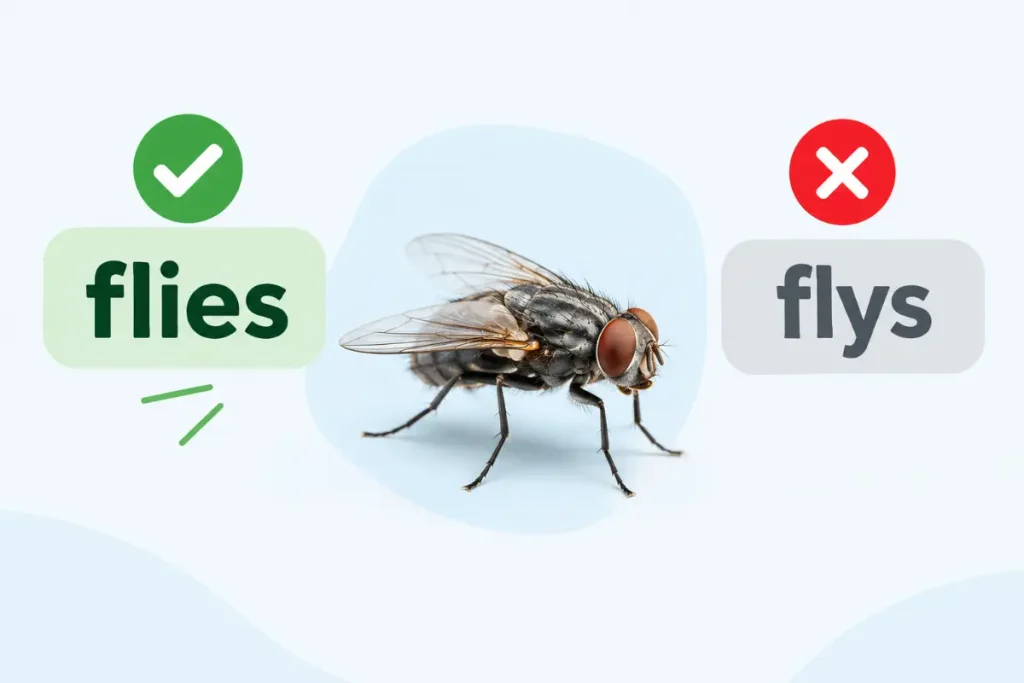
If you’re unsure about flies or flys, the correct spelling in standard English is flies. The word flys is not the standard spelling for the plural of fly or the present tense form of the verb.
This small spelling question causes confusion because many English words simply take s when they become plural or change for a third person subject. For example, we write cats, books, runs, and jumps. But fly follows a different spelling pattern.
The good news is that the rule is easy once you see it. When a word ends in a consonant followed by y, the y usually changes to i before you add es. That gives us fly → flies.
This guide explains why that change happens, when to use flies, how the verb works, and which related forms you should use in everyday writing. You’ll also see simple examples that make the pattern easier to remember.
Quick Definition
Flies is the standard spelling used as the plural of the noun fly and as the third person singular form of the verb fly. For example, you can say, Many flies are in the kitchen, or She flies to Chicago every month. Flys is not the standard form for these uses. Oxford lists the plural noun as flies and gives flies as the he, she, and it form of the verb fly.
Direct Answer
The correct spelling is flies. Use flies when you mean more than one fly or when the subject is he, she, or it and the verb is fly.
Comparison Table
| Word or Phrase | Meaning | Example Sentence | When to Use It |
|---|---|---|---|
| Fly | One insect or the base form of the verb | A fly landed on the window. | Use it for one insect or with I, you, we, and they when using the verb. |
| Flies | More than one insect or the third person singular verb form | The flies are near the food. | Use it for several insects or with he, she, or it as a present tense verb. |
| Flys | Nonstandard spelling in ordinary English | Flys is not the standard form. | Avoid it in normal English writing. |
| Flew | Past tense of fly | She flew home yesterday. | Use it for a completed action in the past. |
| Flown | Past participle of fly | They have flown across the country. | Use it with helping verbs such as have, has, or had. |
| Flying | Present participle and gerund form | The birds are flying south. | Use it for an action in progress or as a noun or modifier. |
Why Flies Is The Correct Spelling
The spelling change from fly to flies follows a common English rule. When a noun or verb ends in a consonant plus y, English often changes the y to i before adding es.
Fly ends with y. The letter before y is l. That makes the ending consonant plus y.
So the spelling changes like this.
Fly becomes flies.
The same pattern appears in many other English words.
- Try becomes tries.
- Cry becomes cries.
- Carry becomes carries.
- Study becomes studies.
- Reply becomes replies.
The change helps preserve the spelling pattern of the word while adding the ending. It also gives us the standard pronunciation and spelling used in modern English.
Oxford lists the plural of the noun fly as flies. It also gives the present tense forms as I, you, we, and they fly, while he, she, and it flies.
That distinction is the key to understanding the whole issue.
The Rule For Words Ending In Y
English spelling rules can feel messy because they have many exceptions. This particular rule is much easier.
When a word ends in a consonant plus y, change the y to i and add es when the grammatical form requires that ending.
For example.
- Baby becomes babies.
- City becomes cities.
- Party becomes parties.
- Company becomes companies.
- Family becomes families.
- Fly becomes flies.
Notice the common pattern. The final y does not simply stay in place.
There is one major contrast you should remember. If a word ends in a vowel plus y, the y usually stays.
For example.
- Day becomes days.
- Boy becomes boys.
- Key becomes keys.
- Toy becomes toys.
- Enjoy becomes enjoys.
- Play becomes plays.
The difference is the letter directly before the y.
Fly has l before y. L is a consonant. So fly becomes flies.
Play has a before y. A is a vowel. So play becomes plays.
That one detail explains many spelling questions that look unrelated at first.
Why Fly Becomes Flies
The word fly can work as both a noun and a verb.
As a noun, fly can mean a small flying insect. When you have more than one, the plural is flies.
For example.
- There is one fly in the room.
- There are three flies in the room.
As a verb, fly means to move through the air or travel by aircraft. When he, she, or it performs the action in the present tense, the form becomes flies.
For example.
- I fly to Boston every summer.
- She flies to Boston every summer.
- They fly to Boston every summer.
The word changes because English grammar requires a different verb form with a third person singular subject.
This is why flies can look confusing. It isn’t just one word with one meaning. It has more than one grammatical job.
Cambridge lists flies as the plural of fly when referring to the insect. Oxford also lists flies as the plural noun and gives flies as the third person singular form of the verb.
Flies As A Noun
When flies is a noun, it refers to more than one fly.
A fly is one insect.
Flies means two or more of those insects.
Here are some natural examples.
The flies are gathering near the trash can.
Several flies entered through the open window.
I saw two flies on the kitchen counter.
The screen keeps flies out of the house.
Those flies are making a lot of noise.
The word can also appear in common expressions and special uses.
For example, English has the expression no flies on someone. It describes a person who is clever and not easily fooled. Oxford lists this as an informal expression.
You may also hear phrases such as like flies and a fly in the ointment. These expressions have meanings that go beyond the literal insect.
Still, the basic plural spelling remains the same.
- One fly.
- Two flies.
- Ten flies.
- A swarm of flies.
Flies As A Verb
Flies can also be a verb.
The base verb is fly.
With I, you, we, and they, use fly in the simple present.
- I fly every month.
- You fly often.
- We fly on Fridays.
- They fly across the country.
- With he, she, and it, use flies.
- He flies every month.
- She flies on Fridays.
- The plane flies over the mountains.
This is the same subject verb pattern you see with many English verbs.
- I work.
- She works.
- I walk.
- He walks.
- I study.
- She studies.
- I fly.
- She flies.
The final form changes because the subject is third person singular.
Common Examples In Everyday English
The easiest way to learn the spelling is to see it in real sentences.
Here are examples using the noun.
The flies are all over the kitchen.
A few flies landed on the fruit.
The restaurant uses screens to keep flies away.
We closed the window because flies kept coming inside.
The children tried to catch the flies with a net.
Now look at the verb.
She flies to Seattle twice a year.
He flies home every Friday.
The bird flies over the lake each morning.
My brother flies for work quite often.
The airline flies to several cities from this airport.
These examples show why context matters. The same spelling can represent a noun or a verb.
When To Use Fly Instead
A common mistake is using flies with every subject.
That isn’t correct.
Use the base form fly after I, you, we, and they in the simple present.
- I fly to New York every summer.
- You fly faster than I do.
- We fly home on Sunday.
- They fly from Miami.
- Do not write I flies or they flies.
- Those forms don’t match the subject.
The same idea applies when fly follows modal verbs such as can, will, should, and might.
- I can fly tomorrow.
- She can fly tomorrow.
- They will fly tomorrow.
- He should fly home tonight.
The verb stays in its base form after these helping verbs.
You don’t write she can flies or they will flies.
That rule is worth remembering because it applies far beyond fly.
- She can walk.
- He will study.
- They should leave.
- We might stay.
- You can fly.
When To Use Flew
Flies is not the past tense of fly.
The past tense is flew.
For example.
- She flies to Denver every month.
- She flew to Denver last month.
- The bird flies over the lake every morning.
- The bird flew over the lake yesterday.
This is an irregular verb. It does not form the past tense by simply adding ed.
- You don’t write flyed.
- You write flew.
Oxford identifies flew as the past tense of fly.
That gives you a simple three part pattern for the common verb.
- Fly.
- Flew.
- Flown.
For example.
- I fly to work.
- I flew to work yesterday.
- I have flown to work many times.
The form flown needs a helping verb such as have, has, or had.
She has flown to California.
They had flown home before the storm arrived.
He has flown across the country.
When To Use Flown
Flown is the past participle of fly.
- You normally use it with a helping verb.
- I have flown on that airline before.
- She has flown across the Atlantic.
- They had flown home before the airport closed.
- We have flown together several times.
- Do not use flown alone as the simple past tense.
- She flown to Chicago yesterday is incorrect.
- She flew to Chicago yesterday is correct.
- She has flown to Chicago is also correct.
The difference is grammatical rather than just a spelling detail.
The Difference Between Fly And Flies
The easiest way to understand the difference is to focus on the subject.
- Use fly with I, you, we, and they.
- Use flies with he, she, and it.
Compare these sentences.
- I fly to work.
- She flies to work.
- We fly every week.
- He flies every week.
- They fly at night.
- The plane flies at night.
This pattern is simple once you start looking for the subject first.
Ask yourself who or what is doing the action.
If the answer is he, she, or it, flies may be the correct present tense form.
If the answer is I, you, we, or they, use fly.
There are other grammatical situations where the base form remains fly. Modal verbs are one example.
- She can fly.
- He will fly.
- They might fly.
- We should fly.
The verb does not become flies after those helping verbs.
Common Mistakes With Flies
Spelling mistakes often happen because people apply a general rule too quickly.
One common mistake is writing flys because many words form their plural by adding s.
For example.
- Car becomes cars.
- Book becomes books.
- Dog becomes dogs.
But fly does not follow that simple pattern.
Another mistake is writing flyed for the past tense.
The correct form is flew.
A third mistake is using flies after every subject.
- I flies to work is incorrect.
- I fly to work is correct.
A fourth mistake is using fly when the subject is he, she, or it.
- She fly to work is incorrect.
- She flies to work is correct.
These errors are easy to fix once you identify the role of the word in the sentence.
Why People Write Flys
The spelling flys looks logical at first glance.
That is exactly why people use it.
English has many words that form plurals by adding s. It also has many verbs that add s for a third person singular subject.
So a writer may naturally think that fly should become flys.
The problem is that spelling rules sometimes change the base word before the ending is added.
Fly is one of those words.
The same thing happens with try.
- You don’t write trys.
- You write tries.
The same pattern appears with cry.
- You don’t write crys.
- You write cries.
This makes fly easier to remember when you connect it to familiar words.
- Try becomes tries.
- Cry becomes cries.
- Fly becomes flies.
Once you notice the pattern, the spelling starts to feel natural.
A Simple Memory Trick
Use this short memory trick.
If you see consonant plus y, think change the y to i.
- Then add es.
- Fly becomes flies.
- Try becomes tries.
- Cry becomes cries.
- Study becomes studies.
If you see vowel plus y, keep the y.
- Play becomes plays.
- Enjoy becomes enjoys.
- Stay becomes stays.
The word before the ending gives you the clue.
You don’t need to memorize hundreds of separate spellings. Learn the pattern and apply it.
Flies Or Flys In A Sentence
When you need to choose between the two forms, read the sentence and ask what the word is doing.
If it means several insects, use flies.
The flies are near the window.
If it describes an action performed by he, she, or it in the simple present, use flies.
She flies to work every Monday.
If the subject is I, you, we, or they, use fly.
They fly to work every Monday.
If the action happened in the past, use flew.
They flew to work yesterday.
If you use have, has, or had to describe a completed action, use flown.
They have flown to several cities.
This small checklist solves most problems quickly.
More Examples With The Correct Forms
Here are more examples to make the pattern familiar.
- The fly is sitting on the wall.
- The flies are sitting on the wall.
- My sister flies to Texas for work.
- My sisters fly to Texas for work.
- The bird flies over the garden.
- The birds fly over the garden.
- He flew home last night.
- They flew home last night.
She has flown to Los Angeles several times.
They have flown to Los Angeles several times.
- I can fly tomorrow.
- She can fly tomorrow.
- You will fly with us.
- He will fly with us.
The subject changes the present tense form. The time of the action changes the past and participle forms.
Related Words That Follow The Same Pattern
The fly and flies pattern belongs to a larger spelling group.
Words ending in consonant plus y often change in the same way.
- Study becomes studies.
- A student studies every night.
- Copy becomes copies.
- She copies the information carefully.
- Apply becomes applies.
- He applies for several jobs.
- Reply becomes replies.
- The company replies within two days.
- Carry becomes carries.
- She carries a small bag.
- Worry becomes worries.
- He worries about the weather.
These examples help show that the spelling is not random.
The y to i change follows a common English pattern.
Words That Keep The Y
Now compare those words with words that have a vowel before y.
- Day becomes days.
- Boy becomes boys.
- Toy becomes toys.
- Key becomes keys.
- Play becomes plays.
- Stay becomes stays.
- Enjoy becomes enjoys.
The y stays because a vowel comes before it.
Compare fly and play.
- Fly becomes flies.
- Play becomes plays.
The difference is not the final y alone. Look at the letter directly before the y.
- Fly has l.
- Play has a.
- That is the clue.
Noun And Verb Uses Can Overlap
One reason this word can feel tricky is that flies works as both a noun and a verb.
Consider this sentence.
The flies fly around the room.
The first word refers to insects.
The second word describes their movement.
The sentence may look repetitive, but it is grammatically correct.
Here is another example.
The flies fly toward the light.
Again, the first word is a plural noun. The second word is a verb.
Now change the subject.
The fly flies toward the light.
The first fly means one insect.
The second flies is the third person singular verb.
This is a useful way to see the grammar clearly.
Pronunciation Of Flies
The word flies is pronounced with a long i sound followed by a z sound.
It sounds like flyz.
The plural noun and the third person singular verb have the same pronunciation.
For example.
- The flies are outside.
- She flies every week.
In both sentences, flies has the same basic sound.
The spelling changes from fly to flies, but the pronunciation stays closely connected to the base word.
Cambridge gives the pronunciation of flies as /flaɪz/ in both British and American English.
Is Flys Ever Correct
In standard modern English, flys is not the normal spelling for the plural noun or the present tense verb.
For ordinary writing, use flies.
You may occasionally see unusual spellings in names, trademarks, usernames, titles, or other proper names. A name can use a spelling that differs from standard dictionary English.
That does not make flys the standard grammatical form.
If you’re writing an email, school assignment, article, report, website page, or everyday message, use flies.
The standard dictionaries support flies for the plural noun and the third person singular verb form.
Flies In American English
The spelling flies is standard in American English.
The same spelling applies in British English and other major forms of standard English.
The meaning can change based on context, but the spelling remains flies.
For American readers, common examples include these.
The flies are outside.
She flies to Chicago every month.
Time flies when you’re having fun.
The plane flies over the city.
That consistency makes the spelling easy to use once you know the rule.
A Note About The Word Fly
Fly has several meanings in English.
It can mean an insect.
I saw a fly on the table.
It can mean moving through the air.
Birds fly south in winter.
It can mean traveling by aircraft.
We fly to Florida every summer.
It can also describe controlling an aircraft.
She learned to fly a plane.
It appears in many expressions too.
Time flies is a common expression meaning that time seems to pass quickly. Oxford lists several idioms involving fly, including time flies and on the fly.
The meaning changes with context, but the spelling rules remain clear.
How To Choose The Right Form
When you’re writing quickly, don’t guess based on how the word sounds.
Look at the sentence.
First, decide if you need a noun or a verb.
- If it is a noun and you mean more than one insect, use flies.
- If it is a verb, check the subject and the tense.
- For he, she, and it in the simple present, use flies.
- For I, you, we, and they in the simple present, use fly.
- For the simple past, use flew.
- For the past participle, use flown.
- For an ongoing action, use flying.
This gives you a useful word family.
- Fly.
- Flies.
- Flew.
- Flown.
- Flying.
Learning the family is more useful than memorizing one spelling in isolation.
A Quick Grammar Test
You can test the correct form by replacing the subject.
- Take this sentence.
- She flies to work.
- Replace she with they.
- They fly to work.
That change tells you why flies was correct in the first sentence.
Now try a noun.
- One fly is on the wall.
- Several flies are on the wall.
Again, the form changes because the number changes.
This simple test works in many situations.
Why The Y Changes To I
The y to i spelling pattern helps English words form certain endings in a consistent way.
When a word ends in consonant plus y, the final y usually changes to i before endings such as es.
That gives us forms such as flies, tries, cries, carries, and studies.
There are related spelling patterns in English, but you don’t need to memorize every grammar term to use this one correctly.
Think of it as a visual rule.
Consonant plus y.
Change y to i.
Add es.
Fly becomes flies.
This is a practical spelling habit that can save you from second guessing the word.
What Happens With Plural Nouns
For nouns, the change happens because you are making the word plural.
- One fly.
- Two flies.
- One city.
- Two cities.
- One baby.
- Two babies.
- One story.
- Two stories.
The same basic pattern appears across many common words.
But not every word ending in y follows it.
- One boy.
- Two boys.
- One day.
- Two days.
- One toy.
- Two toys.
Again, check the letter before y.
That is the small detail that controls the spelling.
What Happens With Present Tense Verbs
The same spelling pattern appears with verbs when you use he, she, or it in the simple present.
I try.
- She tries.
- I study.
- He studies.
- We carry.
- She carries.
- They fly.
- He flies.
The grammar changes because English marks the third person singular in the present tense.
You can spot the pattern in everyday writing.
- She studies English.
- He carries the bags.
- The plane flies over the city.
- The child cries when he is tired.
- The teacher replies to the email.
Each verb changes in a similar way.
Common Search Questions About The Spelling
People often ask this question in several different ways.
- They may wonder if the plural is flies or flys.
- They may ask if the verb should be flys or flies.
- They may search for the spelling of flys.
- They may also ask why fly becomes flies instead of flys.
All of these questions point to the same basic rule.
The standard form is flies.
- Use it as the plural noun.
- Use it as the third person singular present tense verb.
- Use fly for the base form.
- Use flew for the simple past.
- Use flown for the past participle.
Once you separate those forms, the confusion usually disappears.
Examples From Everyday Situations
Imagine you’re writing about insects in your home.
You could write.
There are flies in the kitchen.
Several flies are near the trash.
The flies disappeared after we cleaned the room.
Now imagine you’re writing about travel.
You could write.
I fly to Denver twice a year.
She flies to Denver twice a year.
They fly to Denver twice a year.
He flew to Denver last week.
He has flown to Denver many times.
Notice how the form changes based on grammar.
That is why context matters more than simply looking at the word by itself.
Examples In School Writing
Students often lose confidence with words like this because they seem too simple to check.
Don’t let a small spelling question slow you down.
Use the grammar around the word.
For example.
- The birds fly south in winter.
- The bird flies south in winter.
- The birds flew south last week.
- The birds have flown south already.
- Each sentence is correct.
The word changes because the subject or tense changes.
This approach works in essays, homework, exams, and everyday writing.
Examples In Professional Writing
The same rule applies in formal writing.
The company flies employees to its main office.
The airline flies to several international destinations.
The executive flies to New York every month.
Several aircraft fly from this airport each morning.
The team flew to Dallas for the meeting.
The team has flown to Dallas several times.
Professional writing doesn’t require a different spelling rule.
The same standard English grammar applies.
Examples In Creative Writing
You may also see these forms in stories and other creative work.
A flock of birds flies across the evening sky.
Several birds fly over the lake.
A single fly buzzes near the lamp.
Dozens of flies gather near the window.
The plane flew through the clouds.
The birds have flown away.
Good writing often depends on small details like these. A correct spelling keeps the sentence smooth and lets the reader focus on the idea.
A Fast Way To Remember The Difference
Think of three words.
- Try.
- Cry.
- Fly.
Now make each one fit with he.
- He tries.
- He cries.
- He flies.
That gives you a strong memory pattern.
- All three end in consonant plus y.
- All three change y to i and add es.
If you remember those three words together, you can often recall the rule without thinking about grammar terms.
What Not To Write
Avoid these forms in standard English.
- I flies to work.
- They flies every week.
- She fly to Boston.
- The birds flyed away.
- The birds have flew away.
These sentences use the wrong verb forms.
Instead, write.
- I fly to work.
- They fly every week.
- She flies to Boston.
- The birds flew away.
- The birds have flown away.
The difference becomes clear once you focus on subject and tense.
A Practical Editing Trick
If you’re editing your own writing, search for fly and check every form.
Look at the subject.
Then look at the time of the action.
- If the subject is he, she, or it and the action happens regularly or is generally true, check for flies.
- If the subject is I, you, we, or they, check for fly.
- If the action happened in the past, check for flew.
- If the sentence uses have, has, or had, check for flown.
This quick review catches most errors.
It also helps you avoid relying on spell check alone.
Spell check can identify many misspellings, but grammar still depends on the sentence.
Why Spell Check May Not Teach The Rule
A spelling tool may tell you that flys is wrong. That’s useful, but it doesn’t explain why.
Understanding the rule gives you something more valuable.
You can apply it to new words.
If you know that try becomes tries, you can understand why fly becomes flies.
If you know that play becomes plays, you can understand why fly does not follow the same pattern.
That kind of knowledge stays with you longer than simply memorizing a correction.
FAQs
Is flies the correct spelling?
Yes. Flies is the standard spelling for the plural of fly and for the third person singular present tense form of the verb fly. Standard dictionaries list flies for both uses.
Is flys ever correct?
Flys is not the standard spelling for the plural noun or the ordinary present tense verb. In standard English writing, use flies instead. A special name or brand may use a nonstandard spelling, but that is a separate case.
Why does fly change to flies?
Fly ends with a consonant followed by y. When this spelling pattern takes the es ending, the y changes to i. That gives us flies.
Is flies a noun or a verb?
It can be either. As a noun, flies means more than one fly. As a verb, flies is the present tense form used with he, she, or it.
What is the past tense of fly?
The simple past tense is flew. For example, She flew home yesterday. The past participle is flown, as in She has flown home.
Do you say the birds fly or the birds flies?
You say the birds fly. Birds is plural, so the base verb fly is used. You would say the bird flies because bird is singular.
Do you say she fly or she flies?
You say she flies. She is a third person singular subject, so the present tense form is flies.
Is flies the plural of fly?
Yes. When fly refers to the insect, its plural form is flies. For example, One fly is on the wall becomes Two flies are on the wall.
Conclusion
The correct answer to flies or flys is simple. In standard English, use flies. It is the plural form of the noun fly and the third person singular present tense form of the verb fly.
Remember the spelling rule behind it. When a word ends in consonant plus y, the y often changes to i before es. That is why fly becomes flies, just as try becomes tries and cry becomes cries.
For the verb, keep the forms clear. Use fly with I, you, we, and they. Use flew for the simple past and flown with helping verbs such as have, has, and had.
The next time you hesitate, look at the sentence instead of guessing. Check the subject, check the tense, and remember the y to i pattern. Once you see that pattern, flies becomes one of those spellings you rarely have to think about again.

Dr. Arthur Pendelton is a veteran historical linguist and grammar expert with over 30 years of experience in academic editing. A retired professor, Arthur specializes in the etymology and evolution of the English language. He is passionate about “unpacking the history behind the rules,” helping readers understand why we spell, punctuate, and phrase things the way we do today. Whether he’s settling debates on archaic usage or explaining complex linguistic shifts, Dr. Pendelton brings scholarly precision to every article.