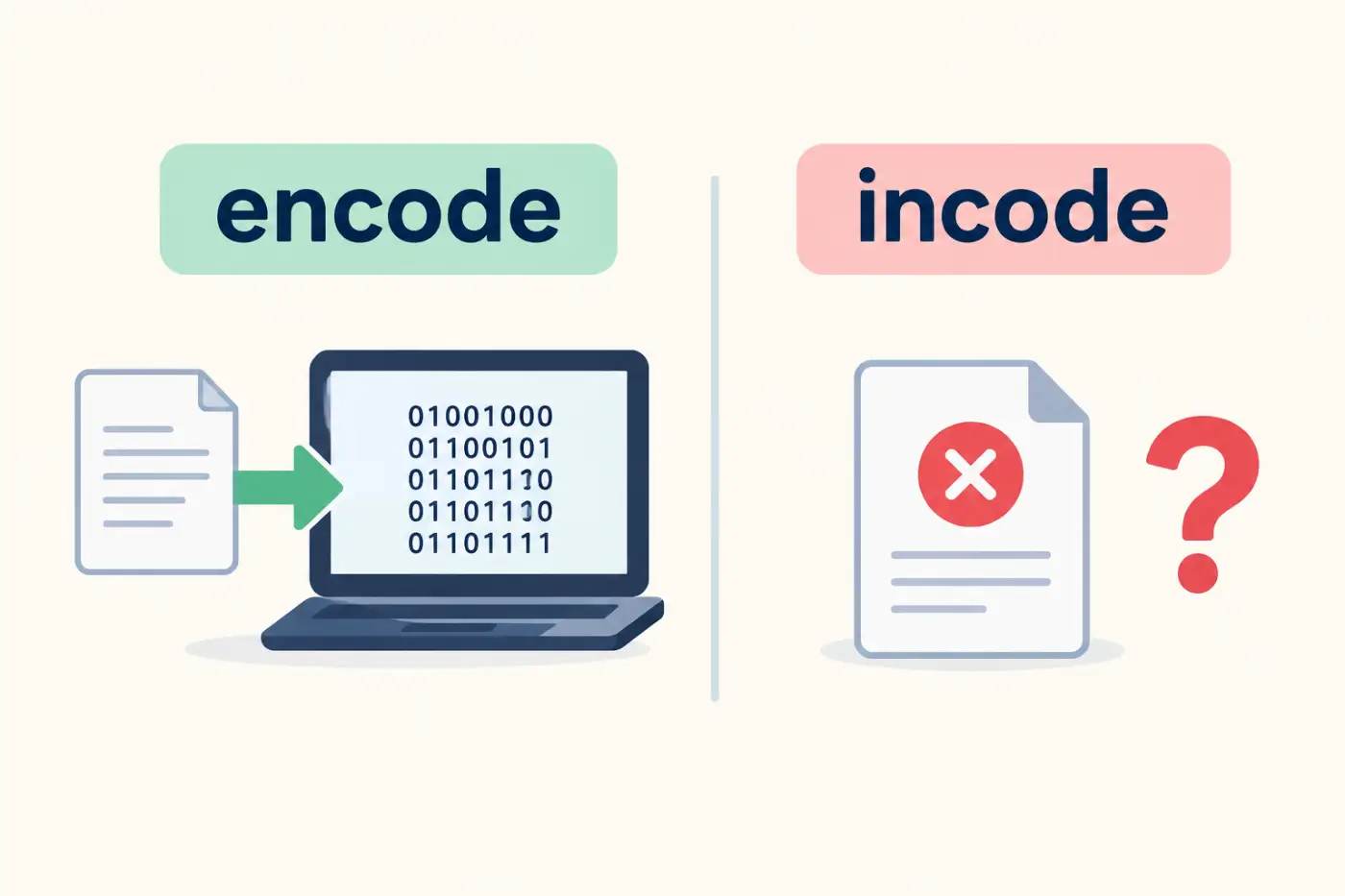
If you searched for encode vs incode you’re probably trying to figure out which spelling belongs in your sentence. The answer is simple. Encode is the correct English word when you mean to convert information into a particular form or system. Incode is not a standard English word for that meaning.
This confusion often happens because encode sounds like it could be built from the word in. It also looks close to other word pairs where a small spelling change creates a different word. That makes the mistake easy to make, especially when you’re typing quickly.
The good news is that you only need one main rule to remember. Use encode when you mean to convert, represent, or store information in a coded form. If you mean the phrase in code, write those words separately.
The difference becomes even clearer when you see the words in real sentences. This guide explains the meaning of encode, why incode causes confusion, how the words are used in technology, and which related terms are easy to mix up.
Quick Definition
Encode is a verb that means to change information into a particular format, code, or system. For example, software can encode a message so a computer can process or store it.
Incode is not normally used as a standard English word with this meaning. If you mean something written inside a code system, you may need the separate phrase in code.
Direct Answer
Encode is the correct word. Incode is generally incorrect when you mean to convert information into a coded or specific format.
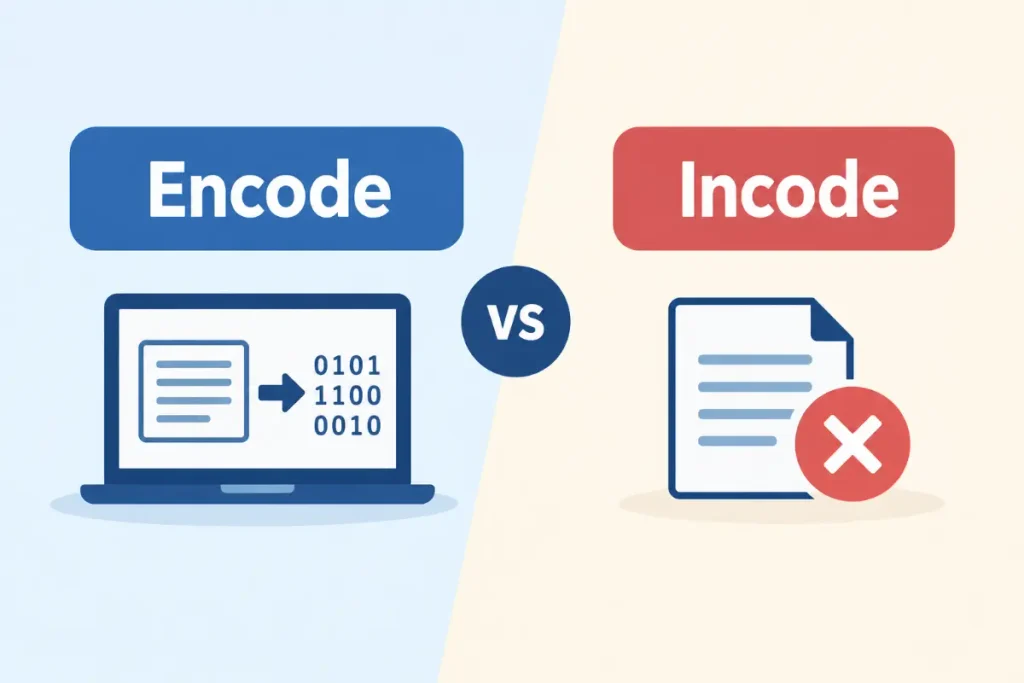
Comparison Table
| Word or Phrase | Meaning | Example Sentence | When to Use It |
|---|---|---|---|
| Encode | Convert information into a code or format | The program will encode the data. | Use it for changing information into a particular form. |
| Incode | Not a standard English word for this meaning | The software will encode the file. | Avoid it when you mean encode. |
| In code | Inside or using a code | The message was written in code. | Use it when talking about something expressed through a code. |
Understanding The Correct Word
What Does Encode Mean
Encode is a real English verb. It has several connected meanings, but they all involve putting information into a particular form.
At its simplest, to encode something means to change it from one form into another form that follows a set system.
For example, a computer may encode text into a format that it can store and process. A video file may also use encoding to compress and organize digital information.
You can also use encode outside technology.
A person might encode a message into symbols. A writer might encode an idea through a story or image. In each case, information is being represented in a particular form.
Here are some natural examples.
- The app encodes the user’s data before storing it.
- The camera encodes the video into a digital format.
- The system needs to encode the file before it can send it.
- The message was encoded so only the intended reader could understand it.
- The computer uses a special method to encode the information.
These examples show the basic pattern. Someone or something takes information and changes it into a coded or organized form.
Encode Is Usually A Verb
One useful way to remember the word is to focus on its grammar.
Encode is normally used as a verb.
You can say:
- The program encodes the image.
- The device encoded the signal.
- We need to encode the data.
- The system will encode the message.
You generally cannot replace the verb with incode.
For example, this sentence is incorrect.
- The program will incode the file.
- The correct version is:
- The program will encode the file.
That small spelling difference can make a sentence look unfamiliar to a reader. In technical writing, it can also create confusion because encode has a specific meaning in computing and data systems.
Why People Confuse These Spellings
The confusion has a logical source. English contains many words that begin with in. Words such as include, insert, inspect, and install all use that beginning.
Because of this pattern, someone may assume that incode should be a word too.
- It looks possible.
- It sounds possible.
But English does not work only by following patterns that look logical. A spelling can look natural and still not be a standard word.
There is another reason for the mistake. People often hear the phrase in code and connect it to the verb encode.
These expressions are related in meaning, but they work differently in a sentence.
Consider these two examples.
- The software will encode the message.
- The message was written in code.
The first sentence describes an action. The software changes the message into a coded form.
The second sentence describes the form of the message. It says that the message exists in code.
That distinction helps explain why incode can feel tempting. The ear hears encode and in code as related sounds. On the page, though, they have different grammatical roles.
What Does In Code Mean
The phrase in code contains two separate words.
In is a preposition.
Code is a noun.
Together, they can describe something expressed through a code system.
For example:
- The spy wrote the message in code.
- The instructions were written in code.
- They communicated in code so other people couldn’t understand them.
- The symbols were arranged in code.
- The phrase can also appear in programming discussions.
For example:
The function appears in code on the next page.
That example has a different meaning. It simply points to something that exists inside a section of programming code.
- This is why spacing matters.
- Encode is one word.
- In code is two words.
Incode should not normally replace either one.
When To Use Encode
Use encode when you are describing the act of changing information into a particular representation.
The object can be many things.
You can encode data.
You can encode text.
The exact process can differ depending on the field, but the basic idea stays the same.
For example, a video file may need to be encoded into a format that a particular device can play. A computer system may encode characters so they can be stored and displayed correctly.
The word also appears in fields such as genetics, communications, information theory, and psychology.
That broader use matters because encode is not just a computer word. It has a long history in English and applies to many kinds of information.
Encode In Everyday English
You don’t need to work in technology to use the word correctly.
Imagine that you want to send a secret message using a set of symbols. You change each letter into a symbol based on a rule.
You have encoded the message.
The original message contained one form of information. Your symbol system represents that information in another form.
You could write:
She encoded the message using a simple symbol system.
You wouldn’t write:
- She incoded the message using a simple symbol system.
- The first sentence is natural English. The second uses a nonstandard form.
- This same idea appears in everyday communication.
- A person can encode an idea into a picture.
- A musician can encode meaning through sound.
- A designer can encode information through visual symbols.
- A writer can encode a message in a story.
The details change, but the central idea stays the same. Information gets represented through a system.
Encode In Technology
Technology is where you’ll see encode most often.
Computers deal with information in structured forms. Text, images, audio, video, and other data need specific representations so software and hardware can handle them.
Encoding is part of that process.
For example, a computer can encode characters into a character encoding system. This allows text to be represented as data that computers can store and process.
Video software also uses encoding.
When you create a video, the raw material may need to be processed into a format that can be stored, shared, or played by another device. Encoding helps create that digital representation.
Audio works in a similar way.
An audio system can encode sound information into digital data. The exact method depends on the format and purpose.
This explains why the word appears so often in technical writing.
You may see sentences such as:
- The server encodes the video before delivery.
- The application encodes the text using a standard character system.
- The device can encode high quality audio.
- The file was encoded in a format supported by the player.
- These are all normal uses of the word.
Encoding And Decoding
One of the most useful related terms is decoding.
Encoding and decoding describe opposite parts of a communication process.
Encoding changes information into a particular representation.
Decoding interprets or converts that representation back into a usable form.
Think of it like packing and unpacking a box.
- Encoding is the packing stage.
- Decoding is the unpacking stage.
For example, a device might encode a signal before sending it. Another device can decode the signal after receiving it.
You may see this pattern in many technical contexts.
- The sender encodes the information.
- The receiver decodes the information.
This relationship makes encode easier to remember.
If decode is the accepted opposite of encode, then incode doesn’t fit the same pattern.
The standard pair is encode and decode.
Encode And Code Are Not The Same
Another common source of confusion comes from the word code itself.
Code is a noun and a verb.
As a noun, it can mean a system of symbols or rules.
For example:
- The message uses a secret code.
- As a verb, code can mean to write instructions for a computer.
For example:
- She codes websites for a living.
- Encode has a more specific meaning. It focuses on converting information into a particular coded form.
- So these sentences have different meanings.
- The developer codes the application.
- The application encodes the data.
- The first sentence describes writing computer instructions.
- The second describes converting information into a particular representation.
That difference is worth learning because both words appear frequently in technology.
A Simple Way To Remember The Difference
Try this memory trick.
- Think of encode as an action.
- You encode something.
- You encode a message.
Then think of in code as a location or state.
- Something can be in code.
- A message can be in code.
- An instruction can be in code.
- A symbol can appear in code.
- The two forms have different jobs.
If you can put the phrase “to convert” before the idea, encode is often the word you need.
For example:
- To convert the data into another format.
- Encode the data.
- If you are describing the form something already has, you may need in code.
- The message is in code.
This simple test won’t cover every technical use, but it works well for everyday writing.
Common Mistakes With This Word
Using Incode As A Verb
The most common mistake is treating incode as the verb form of in code.
For example:
- Incorrect: The program will incode the data.
- Correct: The program will encode the data.
The problem is not just spelling. The incorrect form creates a word that standard English does not normally use for this purpose.
Writing In Code As One Word
The opposite mistake also happens.
Someone may write incode when they really mean the two word phrase in code.
For example:
- Incorrect: The message is incode.
- Correct: The message is in code.
Here the sentence describes the state or form of the message. It does not describe an action performed on the message.
Confusing Encode With Code
Some writers use encode and code as if they were interchangeable.
- They aren’t.
- You can code a program.
- You can encode data.
A programmer can write code that encodes data.
That last sentence shows how closely the terms can appear together without having the same meaning.
Assuming Every Possible Spelling Is A Word
English contains many words that look as though they should exist but don’t.
A familiar prefix and a familiar word don’t always combine into a standard English term.
This is a useful lesson beyond this particular spelling question.
If a word looks strange, check its accepted usage instead of relying only on how it sounds.
Real Sentence Examples
Seeing the correct form in different settings makes the rule easier to remember.
Data And Files
The application encodes the data before saving it.
- The server encoded the file before sending it.
- The system needs to encode the information in a supported format.
- The tool can encode several types of digital files.
- The developer changed the settings to improve the encoding process.
Messages
The software encoded the message before transmission.
- The message was written in code.
- The team created a system to encode short messages.
- The receiver decoded the message after getting it.
Images
- The program encodes the image before storing it.
- The image was encoded in a format the device supports.
- The application can encode images for web use.
Audio
- The recorder encodes audio into a digital file.
- The system uses a specific method to encode sound.
- The audio was encoded before it was uploaded.
Video
- The editor encodes the video after processing it.
- The video must be encoded before the platform can play it.
- The software can encode the video into several formats.
Programming
The developer wrote code to encode the data.
- The value appears in the source code.
- The program encodes the information before sending it.
- The instructions are in code on the following page.
- Notice how the correct form changes based on the meaning.
That is the key point.
The Grammar Behind Encode
Encode follows normal verb patterns.
- The base form is encode.
- The present tense can be encodes.
- The past tense is encoded.
- The present participle is encoding.
- The related noun is encoding.
- The related person noun is encoder.
Here are examples.
- I encode the file.
- She encodes the file.
- They encoded the file.
- We are encoding the file.
- The encoding process takes several seconds.
- The encoder converts the information into the required format.
- These forms are all built around the same standard word.
- There is no need to create a verb such as incode.
Encode In Different Fields
The word has broad use because many fields work with information and representation.
Computing
In computing, encode commonly refers to converting data into a particular representation.
This can apply to text, media, files, or other information.
Communications
In communications, a sender may encode information into a signal before transmission.
The receiver then decodes the signal.
Genetics
The word has a different but related scientific use in genetics.
A gene can encode a protein. In this context, encode means that the genetic information provides the instructions or information needed to produce a particular biological product.
For example:
This gene encodes a protein involved in cell function.
That sentence has nothing to do with computer files, yet encode is still the correct word.
Psychology
Encoding can also describe how the brain processes information during memory formation.
For example, a psychology text might discuss how people encode new information into memory.
Again, the central idea involves information being represented in a particular form.
This broad range of uses shows why encode is an established English word rather than a technical spelling created only for computers.
Is Incode Ever Used
You may occasionally see incode in a company name, product name, username, brand name, or specialized context.
That doesn’t make it the standard English verb.
Proper names can use unusual spellings. Companies often create names that don’t follow ordinary dictionary rules. A specific technical system may also use a term in a special way.
- If you are writing ordinary English and mean to convert information into a coded format, use encode.
- If you mean something exists inside code, use in code.
Context always matters, but standard English usage should be your default in general writing.
Why Spelling Matters In Technical Writing
A spelling mistake can be more than a small cosmetic problem in technical content.
Technical readers expect words to carry precise meanings. A made up or nonstandard term can make a sentence harder to understand. Imagine reading:
The system will incode the data before transmission.
A reader familiar with computing will probably understand what the writer intended. Still, the word looks wrong because the standard verb is encode.
Now compare it with:
- The system will encode the data before transmission.
- The second sentence is clear and familiar.
Good technical writing doesn’t need complicated language. It needs accurate language.
Using the accepted term helps readers understand the process without stopping to question the wording.
How To Choose The Right Form
When you face this spelling question, ask yourself what you are trying to say.
- If you mean to convert information into a code or format, use encode.
- If you mean something is expressed inside a code system, use in code.
That gives you three useful choices.
- Encode the data.
- The message is in code.
- Code the application.
- Each sentence has a clear purpose.
- The trick is to focus on meaning first and spelling second.
Related Words You Should Know
Learning a few related words can make this entire group easier to understand.
Encode
Encode means to convert or represent information using a particular code or format.
Example:
The system encodes the data.
Encoding
Encoding is the process of converting information into a particular form.
Example:
The encoding process takes a few seconds.
Encoded
Encoded describes information that has already been converted into a particular form.
Example:
The file contains encoded data.
Decoder
A decoder is a tool or system that converts encoded information into a usable form.
Example:
The receiver uses a decoder to process the signal.
Decode
Decode means to interpret or convert encoded information.
Example:
The software decodes the message.
Code
Code can refer to a system of symbols or to instructions written for a computer.
Example:
The developer wrote the code.
In Code
In code is a two word phrase that means inside or using code.
Example:
The message appears in code.
These terms connect naturally, but they don’t all have the same grammatical role.
Encode Versus Encrypt
Another useful distinction involves encryption.
People sometimes treat encoding and encryption as the same thing. They aren’t.
Encoding changes information into another representation. The main goal is often compatibility, storage, transmission, or processing.
Encryption changes information into a protected form so unauthorized people cannot read it easily.
For example, a file can be encoded into a particular data format without being secret.
- An encrypted file is transformed for security.
- This distinction matters in technical writing.
- You shouldn’t call every encoded file encrypted.
- You also shouldn’t assume that encoding automatically protects information.
- A simple example makes the difference clear.
- The application encodes the image so it can store it correctly.
- The application encrypts the file to protect private information.
Those sentences describe two different processes.
Encode Versus Convert
Encode and convert are close in meaning, but encode is more specific.
Convert is a broad word.
- You can convert miles to kilometers.
- You can convert a document from one file format to another.
Encode usually suggests that information is being represented using a particular coding system or format.
For example:
- The program converts the document to PDF.
- The program encodes the data.
Both verbs describe transformation, but the technical details differ.
When the process involves a defined coding or representation system, encode is often the more precise choice.
Why The Correct Form Is Easy To Miss
Some spelling errors survive for a long time because they make sense at first glance.
Incode is one of those forms.
A reader can look at it and understand the intended meaning. The brain fills in the gap.
That makes the mistake easy to overlook during proofreading.
The best defense is not memorizing a complicated rule. It is learning the standard form and seeing it often.
- Encode.
- Encoded.
- Encoding.
- Decoder.
- Decode.
Once those words become familiar, incode starts to look out of place.
A Quick Editing Test
If you’re proofreading your own writing, try this three step check.
First, find the word incode. Second, ask what you mean.
- If you mean to change information into a coded or specific format, replace it with encode.
- If you mean something exists inside a code system, separate the words and write in code.
Third, read the full sentence aloud.
For example:
- The application will incode the image.
- Ask what the sentence means.
If the answer is “the application will convert the image into a particular coded format,” write:
The application will encode the image.
This method is quick and works well during editing.
FAQs
Is Encode A Real Word?
Yes. Encode is a standard English verb. It means to convert or represent information in a particular code or format.
Is Incode A Correct English Word?
Incode is generally not the standard English word used for this meaning. In normal writing, use encode for the verb or in code as a two word phrase when that is what you mean.
Is Encode Or Incode Correct?
Encode is the correct choice when you mean to convert information into a coded or specific format. If you are describing something that exists inside a code, use the separate phrase in code.
Can I Say Encode A Message?
Yes. You can say encode a message when you mean to convert the message into a coded form. For example, “The program will encode the message before sending it” is correct.
Is In Code One Word Or Two?
In code is normally written as two words. For example, “The message is written in code” uses the correct form.
What Is The Opposite Of Encode?
The usual opposite is decode. Encoding changes information into a particular representation, while decoding interprets or converts that representation back into a usable form.
Is Encode Only Used In Computers?
No. Encode is also used in communications, genetics, psychology, and other fields. The general idea is still connected to representing information in a particular form.
Is Encoding The Same As Encryption?
No. Encoding changes information into another representation, while encryption is designed to protect information from unauthorized access. An encoded file isn’t automatically secure.
Conclusion
The answer to encode vs incode is straightforward. Encode is the standard English word when you mean to convert information into a code, format, or other representation. Use encode as a verb. The program encodes the data. The device encoded the signal. The software is encoding the video. Use in code when you mean something is expressed inside a code system. The message is in code.
The instructions appear in code. The symbols were written in code. Keep the three ideas separate and the spelling becomes much easier. Encode describes an action. In code describes a state or form. Code can describe a system or computer instructions.
If you spot incode in your own writing, don’t overthink it. Check the meaning, then choose the standard form. In most cases, the word you want is encode.

Dr. Arthur Pendelton is a veteran historical linguist and grammar expert with over 30 years of experience in academic editing. A retired professor, Arthur specializes in the etymology and evolution of the English language. He is passionate about “unpacking the history behind the rules,” helping readers understand why we spell, punctuate, and phrase things the way we do today. Whether he’s settling debates on archaic usage or explaining complex linguistic shifts, Dr. Pendelton brings scholarly precision to every article.
1 thought on “Encode vs Incode Which Word Is Correct”