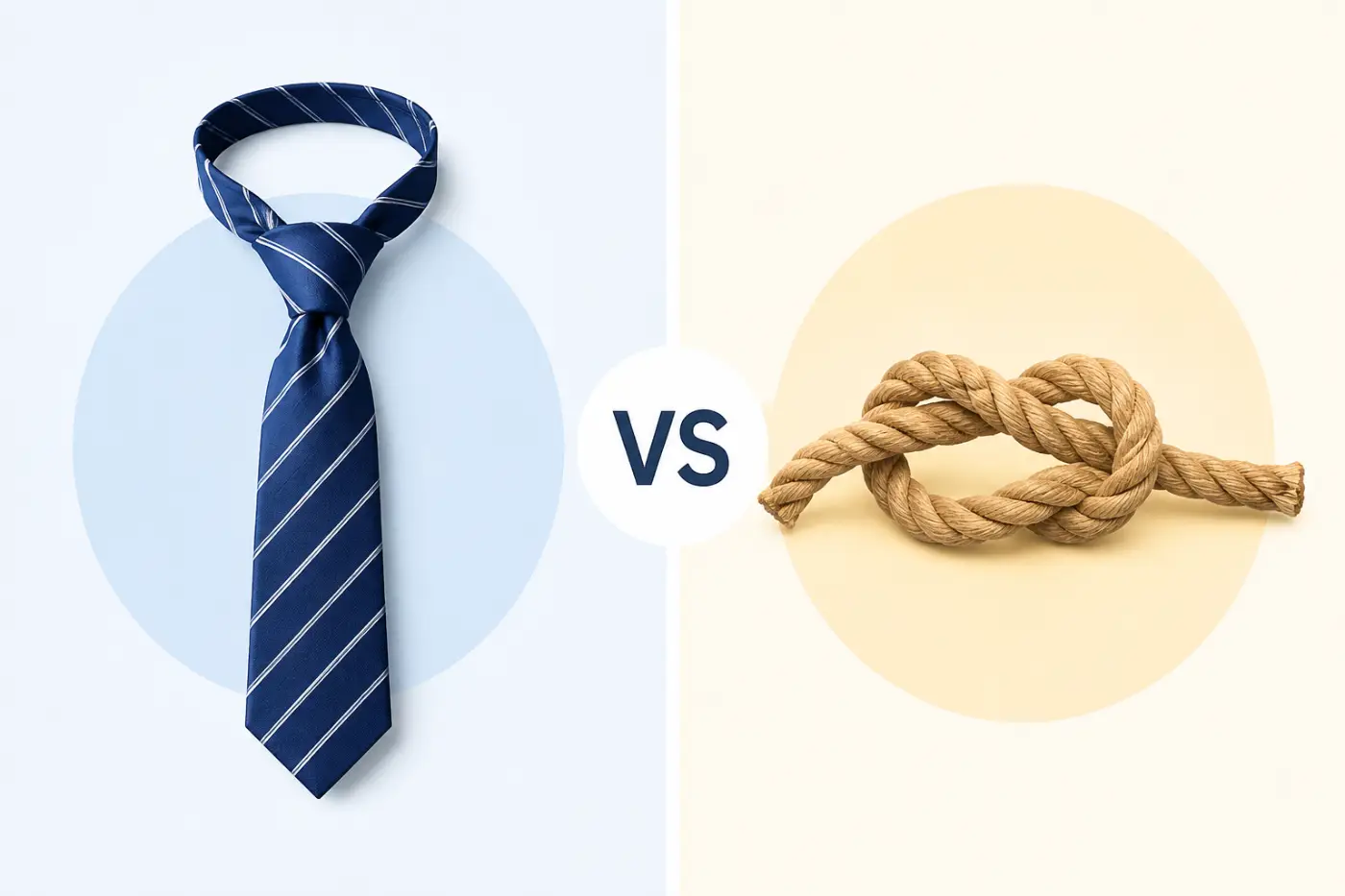
If you are searching for tie vs tye, the answer is simple for normal American English. Tie is the correct spelling for the common word. You use it for fastening things together, making a knot, connecting people or ideas, or describing the piece of clothing worn around the neck. Cambridge lists tie as a standard English word with these meanings.
Tye is a real English word, but it is rare and usually appears in old, regional, mining, or nautical contexts. It can also appear as a name. Merriam Webster lists several specialized meanings for tye, including a nautical rope or chain and an old term for a small box.
That small difference causes a lot of confusion because the two words sound the same. In everyday American writing, though, you almost always want tie. If you write about tying your shoes, wearing a tie, tying a package, or two teams tying a game, use tie.
This guide explains the difference in plain English. You will see how each spelling works, when tye can be correct, common mistakes to avoid, and simple ways to remember the right spelling.
Quick Definition
Tie is the normal modern spelling used in everyday English. It can be a verb meaning to fasten something or a noun meaning a necktie, a connection, or an equal result in a contest.
Tye is a rare word with specialized or historical meanings. It can refer to a nautical rope or chain, a mining trough, or an old form of tie.
Direct Answer
For normal American English, use tie. Use tye only when you specifically mean the rare word with its historical, regional, mining, or nautical meaning.
Quick Comparison
| Word | Meaning | Example Sentence | When to Use It |
|---|---|---|---|
| Tie | To fasten or connect something | Please tie your shoes. | Everyday English |
| Tie | A piece of clothing worn around the neck | He wore a blue tie. | Everyday English |
| Tie | An equal result | The game ended in a tie. | Sports and contests |
| Tie | A connection or relationship | The two countries have strong ties. | General writing |
| Tye | A specialized nautical rope or chain | The sailor checked the tye before raising the yard. | Nautical writing |
| Tye | A trough used in mining | The ore was washed in a tye. | Historical or mining writing |
| Tye | An old or obsolete form of tie | The old text uses tye instead of tie. | Historical texts |

Why The Confusion Happens
The main reason people confuse these spellings is simple. Tie and tye are pronounced the same in standard English. Both are generally pronounced like the word sky without the s.
English has many words that sound alike but have different spellings and meanings. These words are called homophones. For example, you hear the same sound in right and write, but the words have different meanings. The same basic idea applies here.
When someone says, Please tie the box, you cannot hear the spelling. You only hear the sound. The problem appears when you have to put the word on paper or type it into a message.
That is why tye can look familiar even when it is not the word you need.
The spelling also feels logical at first glance. English contains many words with y and e together. Words such as type, style, and rhyme can make tye look like a possible spelling of tie. But English spelling does not always work by simple sound rules.
Cambridge points out that English spelling does not always match pronunciation and that learners need to remember some exceptions.
In this case, the easiest approach is not to search for a complicated spelling rule. Remember the standard word tie and treat tye as a special word that you will rarely need.
The Correct Everyday Spelling
If you are writing for an American reader, tie is the spelling you should choose in almost every normal situation.
- You tie your shoes.
- You tie a knot.
- You tie a ribbon.
- You tie your hair back.
- You tie a package with string.
- You tie two pieces of rope together.
- You can also use tie as a noun.
- He wore a red tie.
- The teams finished in a tie.
- There is a strong tie between the two families.
The word can also appear in common phrases and expressions. For example, you can tie something up, tie something down, tie something together, or tie something in with another idea. Cambridge lists several common forms of the verb and shows examples involving shoelaces, ribbons, hair, and other things.
This makes tie a very common word. You will see it in casual conversation, school writing, business writing, news articles, books, sports reports, and everyday messages.
Tie As A Verb
As a verb, tie usually means to fasten something.
For example:
- Please tie the bag before you leave.
- She tied the ribbon around the gift.
- I need to tie my shoes.
- He tied the rope to the post.
- The children tied the balloons together.
- The verb can also describe a connection.
- The two ideas tie together nicely.
- Her story ties into the main point.
- The evidence ties the suspect to the scene.
- The word can also describe an equal score.
- The two teams tied at two goals each.
- The teams are tied for first place.
Notice how one word can cover several related ideas. The basic sense is connection. You fasten things together. You connect ideas. You connect people through relationships. In sports, two sides connect at the same score.
Tie As A Noun
- Tie also works as a noun.
- The most familiar meaning for many American readers is a necktie.
- He wore a tie to the wedding.
- My new suit looks better with a dark tie.
- He loosened his tie after dinner.
- The word can also mean an equal result.
- The game ended in a tie.
- Neither team could break the tie.
- The election ended in a tie and required another vote.
- A tie can also mean a relationship or connection.
- The company has close ties with local schools.
- She has strong family ties to the area.
- The two communities have cultural ties.
- These meanings are all standard and common. None requires the unusual spelling tye.
When Tye Is Actually Correct
This is where the answer gets more interesting.
Tye is not simply a misspelling in every situation. It is a real word. The problem is that most people do not need it in ordinary writing.
Merriam Webster lists several meanings of tye. One is a nautical term for a chain or rope used to raise or lower a yard on a sailing ship. Another refers to a British mining term for a structure or trough used in washing ore. The dictionary also records older meanings connected with a small box and a piece of enclosed land.
Collins gives a related British dialect meaning for tye as a trough used in mining to separate valuable material from waste. It also records tye as a verb connected to that mining process.
So tye has a legitimate place in English. It just does not belong in most everyday sentences.
Think of it like an old tool in a workshop. The tool is real. Someone might still need it for a specific job. But you would not reach for it every time you repair something around the house.
Tye In Nautical Writing
- The nautical meaning is one of the clearest modern examples of tye as a specialized word.
- A tye can refer to a rope or chain used as part of a system for raising or lowering a yard on a sailing ship. Merriam Webster gives this meaning in its dictionary entry.
- You might see a sentence like this in a book about sailing:
- The crew inspected the tye before raising the yard.
- That sentence uses tye correctly because the writer is talking about a specific piece of sailing equipment.
- You would not replace it with tie just because the two words sound alike.
- The meaning tells you which spelling belongs there.
- This is a useful lesson for spelling in general. A word that looks unusual is not always a typo. Some words belong to specific trades, historical periods, or regional forms of English.
Tye In Mining
Tye also has a historical connection to mining.
In British mining terminology, a tye could refer to a trough used to wash or separate ore. Collins describes this meaning as a trough used to separate valuable material from waste.
Merriam Webster also records tye as a British term connected with washing ores.
You are unlikely to encounter this meaning in a normal American conversation. It is more likely to appear in historical writing, old technical material, or discussions about traditional mining.
For example:
- The miners used a tye to wash the ore.
- That sentence is very different from:
- The miners tied the rope to the cart.
- The first sentence uses a specialized noun. The second uses the everyday verb tie.
- Context makes the difference clear.
Tye As An Old Spelling
Another reason you may find tye in old books is that it has been used as an older form of tie.
Wiktionary records tye as an obsolete form of tie and gives historical examples where writers used the spelling in older English texts.
This means you might open an old book and see a sentence containing tye where a modern writer would use tie.
That does not mean modern English speakers should copy the old spelling.
Language changes over time. Spellings become less common. Some disappear from normal use while others survive in special fields.
If you are quoting an old source, studying historical English, or discussing the history of a word, preserving the original spelling may make sense.
If you are writing a modern email, article, school assignment, social media post, or business document, use tie for the ordinary meaning.
Tie And Tye In Real Sentences
Seeing the words in context makes the difference much easier to remember.
Here are common examples with tie:
- I need to tie my shoes before we leave.
- Please tie the package securely.
- She used a ribbon to tie the flowers together.
- He wore a black tie with his suit.
- The game ended in a tie.
- The two countries have strong economic ties.
- The evidence ties the two events together.
- The teacher tied the lesson to a real world example.
- Now compare those with specialized uses of tye:
- The sailor repaired the tye before raising the yard.
- The historical text uses tye as an old spelling of tie.
- The miners used a tye to wash the ore.
- The difference becomes obvious once you focus on meaning.
- If you are talking about shoes, knots, clothes, relationships, scores, or connections, choose tie.
- If you are reading about old English, sailing ships, or historical mining terms, tye may be the right word.
Common Mistakes With These Spellings
The most common mistake is using tye when you mean tie.
For example, this is wrong in standard modern English:
- I need to tye my shoes.
- The correct sentence is:
- I need to tie my shoes.
- Another common mistake appears in phrases involving clothing.
- He bought a new tye.
- For modern English, write:
- He bought a new tie.
- People also sometimes use tye in sports writing.
- The game ended in a tye.
- The correct spelling is:
- The game ended in a tie.
The same issue can appear with expressions such as tie together, tie up, tie down, and tie in.
Mistake With Shoelaces
- One of the easiest examples is shoelaces.
- You tie your shoelaces.
- You do not normally tye your shoelaces.
- This is a good memory example because most people use the phrase often.
Mistake With Neckties
The clothing meaning also always points you toward tie in modern American English.
- He straightened his tie.
- She bought him a new tie.
- The dress code requires a shirt and tie.
- Writing tye in these sentences would look like a spelling mistake to most readers.
Mistake With Sports Scores
- Sports provide another useful example.
- The teams tied at three to three.
- The game ended in a tie.
- They are tied for first place.
- All three uses rely on tie.
- You would not normally use tye in sports reporting.
Tie Vs Tye For American English
- For an American audience, the practical rule is very short.
- Use tie for normal modern English.
- That covers almost every situation you will meet in daily life.
- Use tye only when a specialized source or subject calls for it.
American English does not normally use tye as an alternative spelling for the everyday word tie. If you are writing for a US audience, tye will usually look like an error unless your context clearly involves an uncommon historical or technical meaning.
- This matters in professional writing too.
- Suppose you are writing an email to a customer:
- Please tie the package securely before returning it.
That is correct.
- Suppose you are writing a school paper:
- The teams were tied at halftime.
Again, correct.
- Now imagine you are writing a history paper about sailing ships:
- The crew used the tye to raise the yard.
- Here, the unusual spelling makes sense because the word has a specific nautical meaning.
- The subject controls the spelling.
Is Tye A Misspelling
Sometimes yes.
If someone writes tye when they mean the normal verb tie, the spelling is a mistake.
For example:
Please tye your shoes.
Most modern readers would recognize the intended meaning, but the spelling is still incorrect.
However, calling every use of tye a mistake would be too broad. Dictionaries record tye as a genuine word with specialized meanings. Merriam Webster, for example, lists nautical, mining, and historical meanings.
- So the best rule is based on context.
- If the writer means to fasten something, use tie.
- If the writer means a necktie, use tie.
- If the writer means an equal score, use tie.
- If the writer means a relationship or connection, use tie or ties.
- If the writer is using a historical or specialized term, tye may be correct.
Why English Has Both Spellings
English has a long history of spelling changes.
Modern English developed from several older forms of English and borrowed words from many languages. Over time, writers and publishers helped standardize spelling, but older forms did not disappear overnight.
That history helps explain why dictionaries sometimes contain words that look familiar but feel strange.
Tye belongs to that group.
Wiktionary records it as an obsolete form of tie in one sense while also listing separate historical and specialized meanings.
You can find similar patterns with many English words. A spelling can survive in a particular region, profession, historical text, or technical field even after the everyday form becomes standard.
This is one reason you should not assume that an unfamiliar spelling is automatically wrong.
At the same time, you should not treat every dictionary entry as an invitation to use the word in ordinary writing.
A dictionary tells you that a word exists. Context tells you if it belongs in your sentence.
A Simple Memory Trick
If you want one quick way to remember the answer, connect tie with the idea of tying something together.
- You tie shoes.
- You tie knots.
- You tie ribbons.
- You tie ropes.
- You tie ideas together.
- You tie a game.
- You wear a tie.
All of these use the same basic spelling.
- You can think of the i in tie as the normal everyday choice.
- Tye is the rare specialist. It shows up in old or technical contexts.
- Another trick is to remember the phrase:
- Tie your shoes.
- It is short and familiar. If you remember that phrase, you will have the correct spelling ready for most situations.
Related Words You Should Know
The spelling question becomes easier when you understand the common forms of tie.
- The base verb is tie.
- The present participle is tying.
- The past tense is tied.
- The noun can be tie.
- The plural noun is ties.
Examples make the pattern clear.
- I tie my shoes every morning.
- She is tying the ribbon.
- He tied the rope to the post.
- He wore a tie to work.
- The two teams have equal scores and are tied.
- The countries have close ties.
Notice that tying changes the spelling from tie to tying. The final e disappears before ing is added.
Cambridge gives tying as the present participle and tied as the past tense and past participle of tie.
Tie And Tying
A common spelling error is writing tieing.
That form is not the standard spelling.
Write:
She is tying her shoes.
Not:
She is tieing her shoes.
The reason is simple. When tie takes the ing ending, the final e changes to y before the ending is added.
You can see the same pattern in words such as lie and die.
Lie becomes lying.
Die becomes dying.
Tie becomes tying.
Tie And Tied
The past form is tied.
For example:
- She tied the ribbon.
- He tied his shoes.
- They tied the game.
- Do not write tye or tieed.
- The correct form is tied.
Knowing these related forms can help prevent mistakes because you start to see the word as a small family rather than one isolated spelling.
Tie In Common Expressions
- Tie appears in many familiar expressions.
- Tie the knot means to get married.
- Tie up loose ends means to finish the remaining small tasks.
- Tie someone down means to limit someone’s freedom or ability to move.
- Tie something together means to connect separate parts.
- Tie in means to connect one thing with another.
For example:
- The final paragraph ties the main ideas together.
- We need to tie up a few loose ends before the project ends.
- Her experience ties in with the main point of the article.
- These expressions all use tie.
- You will not normally replace the spelling with tye.
- Cambridge also lists tie in as a phrasal verb for ideas or statements that agree or connect closely.
How To Choose The Right Word Fast
- When you are unsure, do not stare at the two spellings for too long.
- Ask yourself what the word means.
- If you mean fasten, choose tie.
- If you mean connect, choose tie.
- If you mean a necktie, choose tie.
- If you mean an equal score, choose tie.
- If you mean a relationship or connection, choose tie.
If you are working with a historical sailing term or a specialized mining term, check the source and context. Tye may be correct in that setting.
This approach is faster than trying to memorize a long grammar rule.
- Meaning first.
- Spelling second.
- That habit works for many confusing words.
When You Should Check A Dictionary
Most of the time, you do not need a dictionary for tie.
It is a common English word with a familiar spelling.
You should check a dictionary if you encounter tye in an unusual source and need to know why the writer used it.
This is especially useful in historical research.
For example, you might find tye in a book about old sailing ships. Instead of assuming the author made a mistake, look at the surrounding paragraph. The word may refer to a specific part of the ship.
You might also see it in material about British mining history. Again, the context can explain the spelling.
A good dictionary gives more than a simple yes or no. It can show pronunciation, part of speech, meaning, usage labels, and examples. Cambridge notes that its dictionaries provide definitions and real examples of how words are used.
That extra information can save you from correcting a word that is actually being used correctly.
What About Names
- Tye can also appear as a personal name or surname.
- That is different from using tye as a normal English word.
- Names do not always follow standard word spelling rules. If someone’s name is Tye, you should spell it Tye.
For example:
- Tye called me yesterday.
- That is correct because Tye is the person’s name.
- You should not change a person’s name to Tie just because tie is the common English word.
- The same principle applies to business names, place names, titles, and other proper names.
- Always respect the established spelling of a name.
What About Tye Dye
You may also come across the spelling tye in searches for tye dye.
In modern American English, the standard phrase is tie dye.
The word tie refers to the way fabric is tied before it is dyed. You might tie sections of a shirt with rubber bands or string and then apply dye to create patterns.
So write:
She made a tie dye shirt.
The word tye in this phrase is normally a spelling mistake.
This is a useful example because online searches can reinforce misspellings. A word can appear many times on the internet and still not be the standard spelling.
Search results alone do not decide correct English. Reliable dictionaries and established usage give you a better guide.
Tie Vs Tye In Formal Writing
If you are writing a resume, school paper, website article, email, report, or business document, use tie for the normal meaning.
For example:
- The report ties the results to the original research.
- The teams were tied at the end of the game.
- Please tie the documents together.
- He wore a tie during the interview.
- These sentences are clear and standard.
- Using tye in them would distract the reader.
That is especially true in formal writing. Readers notice unusual spellings quickly. A single wrong letter can make an otherwise polished sentence look careless.
You do not need fancy vocabulary to sound professional. Correct everyday words usually work better.
A Quick Editing Test
If you are editing a sentence and see tye, stop for a second.
Ask what the writer means.
If the answer is fasten, connect, neckwear, equal score, or relationship, change it to tie.
If the answer involves an old sailing term, historical text, or mining term, keep it only after checking the context.
For example:
Please tye the rope.
Change it to:
Please tie the rope.
But:
The sailor used the tye to raise the yard.
Can be correct because the word has a specific nautical meaning.
This simple test catches most errors in seconds.
FAQs
Is tie or tye correct?
Tie is correct for normal modern English. Tye is a real but rare word used for certain historical, regional, mining, and nautical meanings.
Is tye a real word?
Yes. Tye appears in major dictionaries with several specialized meanings. It can refer to a nautical rope or chain and can also describe a mining trough or an old form of tie.
Should I write tie or tye for shoelaces?
Use tie. The correct sentence is, I need to tie my shoelaces. Tye would be a spelling mistake in this everyday use.
Is tie or tye correct for a necktie?
Use tie. The standard American English word for the piece of clothing worn around the neck is tie. Cambridge lists this meaning as a common noun.
Is tie or tye correct in sports?
Use tie. If two teams have the same score, the game can end in a tie. You can also say that two teams are tied for first place.
Is tye an old spelling of tie?
Yes. Tye has been used as an obsolete or historical spelling of tie. Historical texts can contain the older form even though modern writers normally use tie.
Is tye correct in nautical language
Yes. Tye is a specialized nautical term for a rope or chain used in raising or lowering a yard on a sailing ship. This meaning is recorded by Merriam Webster.
Is tie dye spelled tie dye
Yes. The standard modern spelling is tie dye. The first word comes from the act of tying parts of the fabric before applying dye. Tye dye is normally a spelling error.
Conclusion
The short answer to tie vs tye is easy. Use tie for almost all normal English writing. That includes tying shoes, tying knots, wearing a tie, describing an equal score, and talking about relationships or connections.
Tye is not completely wrong. It is a rare word with specialized meanings. Dictionaries record it as a nautical term, a mining term, and an older form of tie.
For everyday American English, you can safely remember one rule. If you mean to fasten or connect something, spell it tie.
When you see tye in an old book or technical source, do not automatically call it a typo. Check the context first. It may be a genuine word with a very specific meaning.
The practical takeaway is simple. Tie is your everyday spelling. Tye belongs to rare or specialized contexts. If you are writing about shoes, clothes, knots, scores, or connections, tie is the word you want.

Dr. Arthur Pendelton is a veteran historical linguist and grammar expert with over 30 years of experience in academic editing. A retired professor, Arthur specializes in the etymology and evolution of the English language. He is passionate about “unpacking the history behind the rules,” helping readers understand why we spell, punctuate, and phrase things the way we do today. Whether he’s settling debates on archaic usage or explaining complex linguistic shifts, Dr. Pendelton brings scholarly precision to every article.
4 thoughts on “Tie vs Tye 2026 Guide to the Correct Spelling”