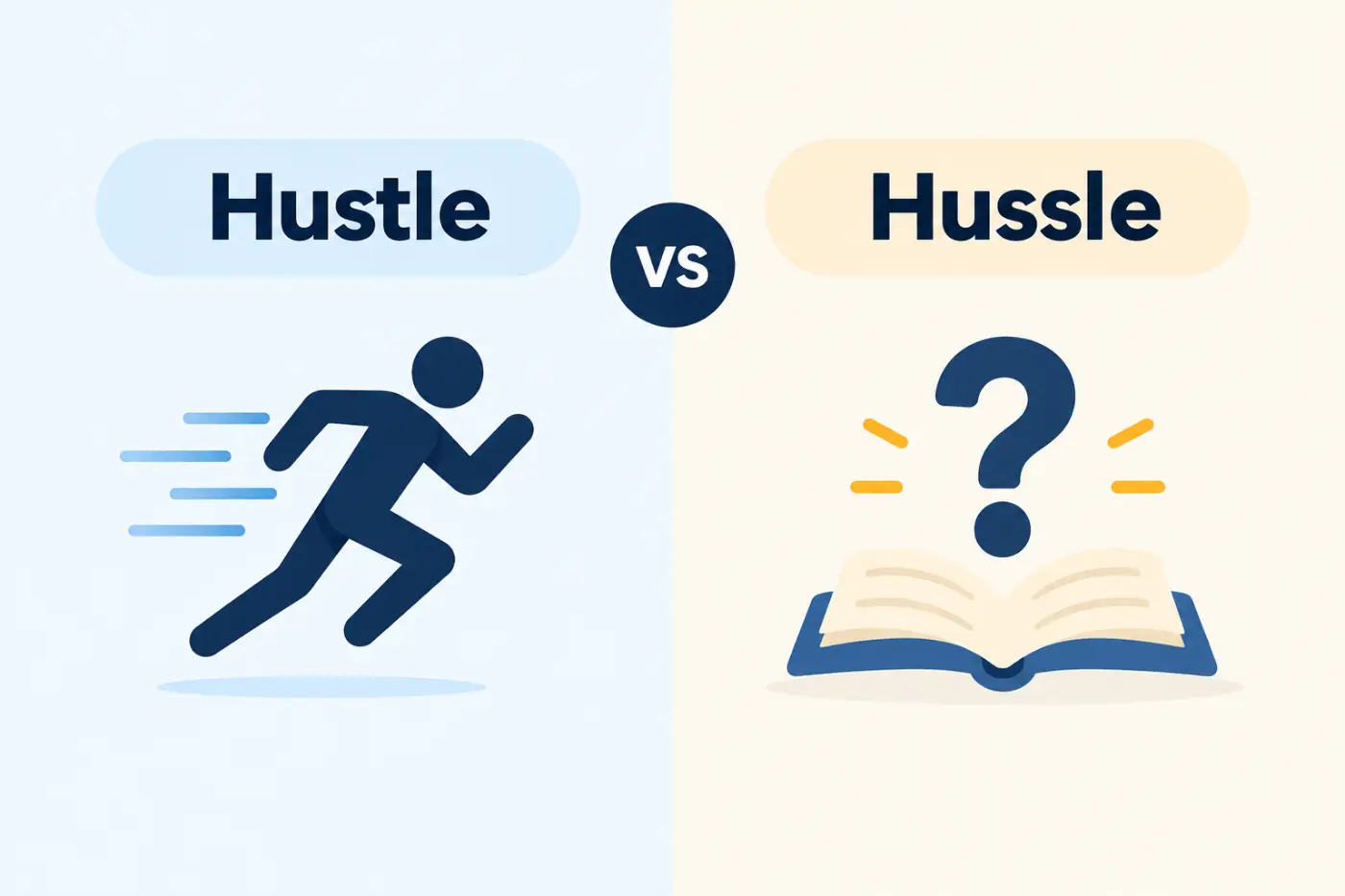
If you are stuck between Hustle or Hussle, the correct standard English spelling is hustle. The spelling hussle is not the normal English spelling of the word, although you may see it used as a name, brand, nickname, or intentional variation.
The confusion is easy to understand. Both versions sound the same when spoken, and the missing letter can be hard to notice when you see them quickly. This is especially true online, where shortened spellings and creative names are common.
The word hustle has several meanings. It can describe working hard, moving quickly, pushing or urging someone, or making money through energetic effort. In some situations, it can also describe aggressive or dishonest ways of making money.
So, which spelling should you use in school, work, emails, articles, or normal writing? Use hustle. Save hussle for cases where it is part of a specific name or chosen spelling.
This guide explains the difference, shows how to use the word in real sentences, explains why the extra s appears in some names, and covers common questions about pronunciation, slang, grammar, and meaning.
Quick Definition
Hustle is the standard English spelling. It can mean to move quickly, work with energy, push someone to act, or make money through active effort.
Hussle is generally a nonstandard spelling. It may still be correct when it appears as a person’s name, business name, username, title, or deliberate spelling choice.
Direct Answer
The correct standard spelling is hustle. Hussle is usually a misspelling unless it is being used as a proper name or intentional brand spelling.
Hustle And Hussle Compared
| Word or Phrase | Meaning | Example Sentence | When To Use It |
|---|---|---|---|
| Hustle | Standard English word | She hustles every day to grow her business. | Use it in normal English writing. |
| Hussle | Usually a nonstandard spelling or proper name | The artist used Hussle as part of his stage name. | Use it only when the specific name or title uses this spelling. |

Why The Spelling Causes Confusion
The main reason for the confusion is pronunciation. In ordinary speech, hustle and hussle can sound almost identical.
When we hear a word instead of seeing it written, we do not always know which letters belong in the spelling. English has many words where the sound does not give us a perfect guide to the written form.
There is another reason for the confusion. People often create usernames, company names, stage names, and product names by changing the spelling of familiar words. Adding or removing a letter can make a name look unique.
That does not change the standard spelling of the original word.
For example, a person could choose Hussle as a username. That does not mean dictionaries have changed the spelling of hustle.
Think of it like a person’s name. Someone might be named Jon instead of John. Both spellings can identify real people, but that does not mean the two spellings are interchangeable in every sentence.
The Correct Spelling Is Hustle
The standard word is spelled with one s before the t and one s after it.
The spelling is:
H U S T L E
Here are some natural examples.
She had to hustle to catch the bus.
I need to hustle if I want to finish this project tonight.
He started hustling after losing his job.
The coach told the players to hustle back to the field.
She has a strong work ethic and knows how to hustle.
These sentences use the normal English word.
What Hustle Means
The meaning of hustle depends on how it is used.
It can describe physical movement.
For example:
Hustle up or we will miss the train.
Here, hustle means to move quickly.
It can also describe hard work.
She hustled to build her small business from scratch.
Here, it means she worked with energy and determination.
The word can also describe earning money.
He started hustling to earn extra money after college.
In this use, the word may simply suggest active effort. However, context matters because hustle can sometimes refer to questionable or dishonest ways of making money.
The word can also mean pushing someone.
The salesperson hustled us into buying a more expensive package.
Here, hustle has a more negative meaning. It suggests pressure or aggressive persuasion.
Hustle As A Verb
The most common grammatical use is as a verb.
A verb describes an action, and hustle describes several kinds of action.
Hustle Means Move Quickly
Someone might tell you to hustle when you are taking too long.
For example:
- Hustle. We only have five minutes left.
- The students hustled across the parking lot before the rain started.
- I had to hustle home before the store closed.
In these examples, the word is connected to speed.
Hustle Means Work Hard
The word can also describe energetic effort.
- She hustled all summer to save enough money for college.
- He hustled to find new customers for his business.
- They hustled through the busy season without giving up.
This meaning is common in casual American English.
Hustle Means Push Or Pressure
The word can have a negative meaning too.
- The salesman tried to hustle me into paying for an upgrade.
- Tourists should be careful around people who try to hustle them.
In this context, the word suggests tricking, pressuring, or taking advantage of someone.
Hustle As A Noun
Hustle can also work as a noun.
In casual speech, people often use it to describe energetic work or effort.
- Her side hustle brings in extra income.
- Success takes patience, skill, and hustle.
- He has plenty of hustle but still needs more experience.
One of the most common modern phrases is side hustle.
A side hustle is work someone does in addition to their main job. It might involve freelance writing, selling products, tutoring, photography, online work, delivery work, or another source of income.
For example:
- My side hustle helps me pay for college.
- She turned her baking hobby into a profitable side hustle.
- He started a weekend side hustle selling handmade furniture.
What Hussle Means
Unlike hustle, hussle is not the standard spelling of the ordinary English word.
- You should not normally write:
- I need to hussle to work.
- The standard sentence is:
- I need to hustle to work.
- You should also not normally write:
- She is hussling to finish the project.
- The correct form is:
- She is hustling to finish the project.
- Still, Hussle can appear intentionally in names.
A famous example is the stage name Nipsey Hussle. In that context, Hussle is part of a proper name and should be written exactly as the person used it.
That is different from using the ordinary verb.
Why People Use Hussle
There are several reasons you may encounter the spelling hussle.
It May Be A Name
A person may deliberately choose Hussle as a stage name, nickname, or username.
Names do not always follow ordinary dictionary spelling rules.
It May Be A Brand
A company may choose a creative spelling to make its name stand out.
A business could call itself Hussle Media, for example. The unusual spelling would be part of the brand identity.
It May Be A Username
Online usernames often use unusual spellings because the normal version has already been taken.
Someone who wants the username “hustle” might choose “hussle” instead.
That does not make the second spelling the standard English form.
It May Simply Be A Typo
Sometimes there is no special reason at all.
A writer may accidentally type an extra s. Since the two spellings look and sound similar, the mistake can easily go unnoticed.
Hussle Is Not The Normal Past Tense
A common mistake is changing hustle to hussle when writing quickly.
The correct forms are:
- Hustle
- Hustles
- Hustled
- Hustling
Notice that the spelling changes slightly when endings are added, but the base word remains hustle.
Examples include:
- She hustles every morning.
- He hustled to finish the job.
- They are hustling to meet the deadline.
Do not replace the normal spelling with hussle simply because you hear the same sound.
Hustle Versus Hustling
Another useful distinction is between hustle and hustling.
- Hustle is the base form.
- Hustling is the present participle or gerund form.
For example:
- I need to hustle.
- I am hustling to finish the work.
The final e is removed before adding ing.
This is similar to other English verbs.
- Make becomes making.
- Take becomes taking.
- Hustle becomes hustling.
The spelling does not become hussling.
Hustle Versus Hustled
The past tense is hustled.
For example:
- She hustled to catch the flight.
- We hustled all weekend to finish the event setup.
- He hustled through the crowd to reach the exit.
Again, the standard form is based on hustle, not hussle.
Examples Of Hustle In Everyday Sentences
Seeing the word in context makes the difference much easier to remember.
- I had to hustle because I was running late.
- She hustles between two jobs every week.
- The team hustled to complete the project on time.
- He built a successful side hustle from his hobby.
- You need some hustle if you want to grow a small business.
- The players hustled back after losing the ball.
- She has the hustle and discipline needed to succeed.
- He spent years hustling before his business became profitable.
- The manager told everyone to hustle because the store was closing.
- She used her photography skills to create a side hustle.
Each sentence uses the standard spelling.
Examples Of Hussle As A Proper Name
The unusual spelling can be correct when it belongs to a specific name.
For example:
Nipsey Hussle was an American rapper and entrepreneur.
Here, Hussle is not being used as the ordinary English verb. It is part of a proper name.
You should preserve the spelling of a person’s chosen name.
The same principle applies to businesses, organizations, websites, usernames, artistic titles, and other names.
If an official name uses Hussle, changing it to Hustle could make the name inaccurate.
Is Hustle A Slang Word
Hustle is a standard English word, but it is also widely used in informal speech and slang.
The informal sense often relates to working hard, making money, or finding opportunities.
For example:
She is always on the hustle.
This can mean she is constantly working or looking for ways to earn money.
Another common expression is:
Keep hustling.
This usually means keep working hard and do not give up.
The word can sound positive in one sentence and negative in another.
He hustled to build his company.
This suggests determination and hard work.
The stranger tried to hustle tourists out of their money.
This suggests dishonest behavior.
Context gives the word its tone.
What Does Hustle Mean In Business
In business, hustle often refers to energy, persistence, sales effort, and the willingness to take action.
An entrepreneur might say:
You need hustle to get your first customers.
The speaker probably means that success requires effort and persistence.
The term business hustle is often associated with sales, networking, marketing, freelancing, entrepreneurship, and side businesses.
Still, hustle is not a magic formula for business success. Skill, planning, money management, customer service, market demand, and good decisions also matter.
What Does Side Hustle Mean
A side hustle is a way of earning money outside a person’s main job or primary source of income.
Some common examples include:
- Freelance writing.
- Graphic design.
- Tutoring.
- Photography.
- Online selling.
- Home baking.
- Pet sitting.
- Consulting.
- Video editing.
- Handmade crafts.
For example:
Maria works full time but runs a small photography side hustle on weekends.
The phrase has become common because many people use more than one income source.
What Does Hustle Mean In Sports
In sports, hustle usually has a positive meaning.
It describes players who work hard, move quickly, chase the ball, defend with effort, and keep going even when a play looks difficult.
A basketball coach might say:
We need more hustle on defense.
That means the players need to put in more effort.
A baseball commentator might say:
He showed great hustle on that play.
The phrase praises the player’s energy and determination.
What Does Hustle Mean In Music And Popular Culture
The word has a strong presence in music and popular culture.
It is often connected with ambition, street life, entrepreneurship, persistence, and making money.
Artists and writers may use the word to describe the effort required to succeed.
The spelling Hussle is also widely recognized because of the late rapper and entrepreneur Nipsey Hussle.
His chosen stage name is one reason some people see Hussle and assume it is another accepted spelling of the English word. It is better to think of it as a name variation rather than the standard spelling.
Common Mistakes With The Word
Several spelling and usage mistakes appear often.
Mistake One Using Hussle In Normal Writing
Incorrect:
I need to hussle to finish my work.
Correct:
I need to hustle to finish my work.
Use the standard spelling when you are writing the ordinary English word.
Mistake Two Writing Hussling
Incorrect:
She is hussling to make money.
Correct:
She is hustling to make money.
The correct form is hustling.
Mistake Three Assuming Hussle Is Always Wrong
That is also too simple.
If Hussle is part of someone’s official name, it should not be changed.
For example, a person’s chosen name may use the unusual spelling. Proper names have their own spelling rules.
Mistake Four Treating Every Use Of Hustle As Positive
The word can have a negative meaning.
Hustle can describe hard work, but it can also describe deception or aggressive money making.
Always read the surrounding sentence to understand the intended meaning.
How To Remember The Correct Spelling
A simple memory trick can help.
Think of the word hustle as containing ST in the middle.
HU + ST + LE
That gives you:
HUSTLE
If you write hussle, the T disappears.
You can remember the sentence:
Hard work needs a T in hustle.
This is not a grammar rule. It is simply a quick memory aid.
Another trick is to connect hustle with common words that have a similar spelling pattern.
- Hustle.
- Bustle.
Both words contain STL near the end.
Seeing the pattern can make the spelling easier to remember.
Hustle And Bustle
The phrase hustle and bustle is another reason the word is easy to remember.
It describes busy activity, movement, noise, and excitement.
For example:
- I love the hustle and bustle of downtown.
- The market was full of hustle and bustle before the holiday.
In this phrase, the correct spelling is hustle.
You would not normally write hussle and bustle.
Hustle And Bustle Meaning
The two words have related sounds but different meanings.
- Hustle can mean energetic movement or effort.
- Bustle can describe busy activity and movement.
Together, hustle and bustle creates a vivid picture of a busy place.
For example:
- The hustle and bustle of the city kept me awake.
- This phrase is common in everyday English and formal writing.
Is Hustle Always About Money
No.
This is a common misunderstanding.
The word can describe movement or effort without any connection to money.
Hustle to the door.
Here, the meaning is simply to move quickly.
The players showed hustle during the final quarter.
Here, it means energy and effort.
She hustled to complete her assignment.
Here, it means she worked quickly and actively.
Money is only one possible meaning.

Can Hustle Be Used In Formal Writing
Yes, but the meaning and tone matter.
The word is common and recognized in standard English. Still, some uses are more casual than others.
For formal academic writing, a phrase such as persistent effort or determined work may be clearer.
For example:
Casual:
The team hustled to finish the project.
More formal:
The team worked diligently to complete the project.
Neither is automatically better. The right choice depends on the audience and purpose.
For everyday articles, conversations, marketing copy, sports writing, and casual business writing, hustle is perfectly natural.
Is Hussle A Word In The Dictionary
You may find hussle in some specialized contexts, name databases, slang references, or records of proper names. That does not make it the standard spelling of the common English word.
For ordinary writing, the safe choice is hustle.
If you are writing about a person, company, title, or brand that officially uses Hussle, keep its original spelling.
The key difference is between a dictionary word and a proper name.
A proper name can use a creative spelling without changing the spelling of the underlying English word.
How To Choose The Right Spelling
Ask yourself one simple question.
Am I using the ordinary English word or referring to a specific name?
If you mean working hard, moving quickly, making money through effort, or pushing someone, use hustle.
If you are referring to a person, company, brand, username, or artistic name that specifically uses Hussle, keep Hussle.
This rule solves most cases immediately.
More Examples To Make The Difference Clear
Here are some side by side examples.
- Correct: I need to hustle if I want to finish today.
- Incorrect: I need to hussle if I want to finish today.
- Correct: Her side hustle became a full time business.
- Incorrect: Her side hussle became a full time business.
- Correct: The players showed great hustle.
- Incorrect: The players showed great hussle.
- Correct: He was hustling to find new customers.
- Incorrect: He was hussling to find new customers.
But:
Correct: Nipsey Hussle was the artist’s stage name.
The last example uses Hussle because it is part of a proper name.
When To Use Hustle
Use hustle when you are talking about:
- Working hard.
- Moving quickly.
- Making money through active effort.
- A side business.
- Energetic effort.
- Pressuring or tricking someone.
- Sports effort.
- Busy activity in certain expressions.
Examples include:
- I need to hustle.
- She has a successful side hustle.
- The team needs more hustle.
- We had to hustle to catch the train.
- He is hustling to grow his business.
When To Use Hussle
Use Hussle only when the spelling is intentionally part of a specific name or title.
Examples may include:
- A person’s stage name.
- A company name.
- A brand name.
- A username.
- An artistic title.
A fictional character’s chosen name.
If you are not referring to a specific name, hustle is almost always the spelling you want.
A Simple Rule For Students
Students often encounter this question when writing essays, assignments, or social media captions.
The easiest rule is:
Write hustle unless Hussle is a proper name.
For example:
- The athlete showed hustle during the game.
- The entrepreneur used his hustle to build a business.
- Nipsey Hussle was known by that stage name.
This rule keeps your standard English spelling correct while still respecting names.
A Simple Rule For Writers
Editors can use the same test.
- First, identify the role of the word.
- If it is a common noun or verb, use hustle.
- If it is a proper noun, check the official spelling.
- Do not “correct” a person’s chosen name simply because it looks unusual.
- At the same time, do not copy an unusual name spelling into ordinary sentences.
For example, writing about an artist may require Hussle, while describing a person’s work ethic requires hustle.
FAQs
Is Hustle Or Hussle Correct?
Hustle is the correct standard English spelling. Hussle is generally a nonstandard spelling unless it is part of a proper name, brand, username, or other intentional name.
Is Hussle A Correct Spelling?
Hussle can be correct as a proper name or deliberate spelling choice. It is not the standard spelling of the common English word for working hard or moving quickly.
Is Hussle A Word Or A Name?
It can be used as a name or intentional spelling. A well known example is the stage name Nipsey Hussle. For the ordinary English word, use hustle.
What Does Hustle Mean In Slang?
In slang and casual speech, hustle often means working hard, making money, or actively pursuing an opportunity. It can also refer to dishonest or aggressive money making, so the exact meaning depends on context.
How Do You Spell Hustling?
The correct spelling is hustling. It comes from hustle, with the final e removed before adding ing.
Is Hustle A Positive Or Negative Word?
It can be either. Saying someone has hustle can praise their energy and determination, while saying someone tried to hustle another person can suggest deception or pressure.
Is Hustle The Same As A Side Hustle?
A side hustle is work done outside someone’s main job to earn money or build another source of income. It is one specific modern use of the broader word hustle.
Why Do People Spell Hustle As Hussle?
People may use Hussle because of a proper name, brand, username, creative spelling, or simple spelling mistake. The pronunciation can also make the two forms easy to confuse.
Conclusion
The answer to Hustle or Hussle is simple for normal English writing: use hustle. It is the standard spelling for the word that can mean working hard, moving quickly, making money, or pushing someone.
Hussle has a different role. It can appear as an intentional spelling in a person’s name, brand, username, or artistic identity. In those cases, keep the original spelling instead of changing it to the dictionary form.
The easiest memory trick is to remember the ST in hustle. If you are writing about effort, speed, a side business, or energetic work, choose hustle. If you are copying a specific proper name that uses Hussle, preserve that spelling.
When in doubt, ask yourself whether you are describing an action or naming something. An action is usually hustle. A specific name may be Hussle.

Dr. Arthur Pendelton is a veteran historical linguist and grammar expert with over 30 years of experience in academic editing. A retired professor, Arthur specializes in the etymology and evolution of the English language. He is passionate about “unpacking the history behind the rules,” helping readers understand why we spell, punctuate, and phrase things the way we do today. Whether he’s settling debates on archaic usage or explaining complex linguistic shifts, Dr. Pendelton brings scholarly precision to every article.