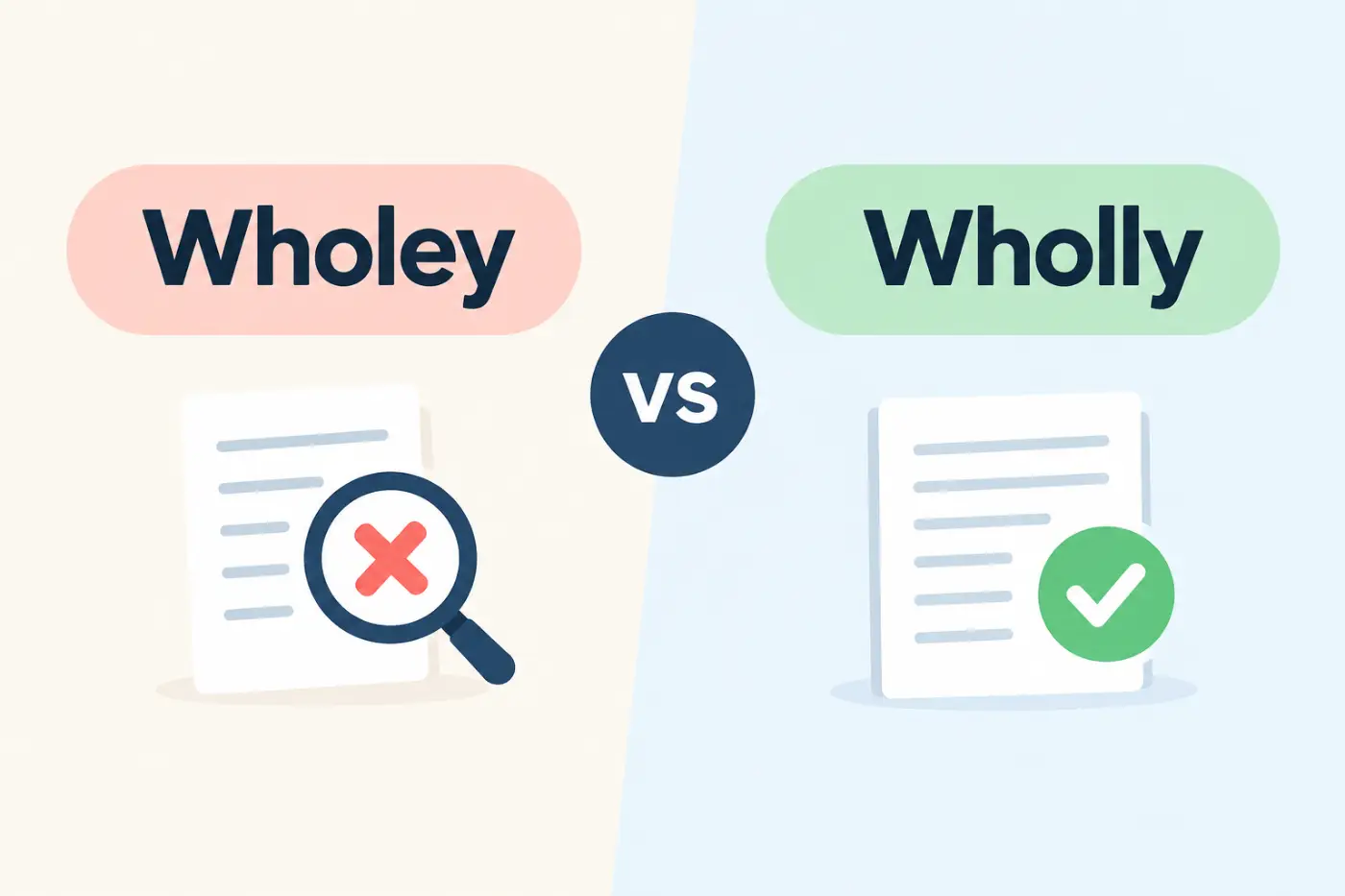
Confused about wholey vs wholly? You’re not alone. These two spellings look almost identical, but only one is the standard English word. The correct spelling is wholly. It means completely, entirely, or fully.
The word wholey is generally a spelling mistake when someone intends to write wholly. The confusion comes from the familiar word whole, which means complete or entire. Adding the ending ly can make wholey seem like the natural choice.
Once you understand the difference between whole and wholly, the spelling becomes much easier to remember. This guide explains the correct word, its meaning, pronunciation, common mistakes, and how to use it naturally in everyday writing.
Quick Definition
Wholly is an adverb that means completely, entirely, or fully. It describes something done in a complete way or something that is true in every part. For example, The decision was wholly unexpected means the decision was completely unexpected.
Whole is an adjective that means complete or undivided. The spelling wholey is not the standard form of the adverb derived from whole. In ordinary English writing, use wholly instead.
Direct Answer
The correct spelling is wholly when you mean completely or entirely. Wholey is generally an incorrect spelling in that context.
Why People Confuse These Spellings
The main source of confusion is the word whole. It already means complete, so many writers assume that adding ly should produce wholely or wholey. English spelling does not always follow the pattern people expect.
The correct adverb is wholly. It has a slightly different spelling from the adjective whole. This is similar to other English words that change their form when an ending is added.
For example:
- Whole becomes wholly.
- Sole becomes solely.
- True becomes truly.
- Full becomes fully.
These changes may seem small, but they matter in formal and everyday writing. A single missing letter can make a word look unfamiliar or incorrect.
The good news is that you don’t need to memorize a long spelling rule. You only need to remember that the standard word for completely is wholly, with two l letters before the final y.
Understanding the Meaning of Wholly
The best way to use wholly correctly is to understand what it adds to a sentence. The word tells the reader that something is complete. It can describe a feeling, an opinion, a result, a decision, or a state of being.
Think of wholly as a word that means all the way. It shows that nothing is left out of the description.
Wholly Means Completely
When wholly means completely, it shows that something is true in full.
For example:
- The project was wholly successful.
- I wholly support your decision.
- The room was wholly silent.
- Her explanation was wholly convincing.
- The company is wholly responsible for the mistake.
In each sentence, wholly strengthens the meaning of the word that follows it. A wholly successful project was completely successful. A wholly silent room had no sound at all.
The word doesn’t always mean that something is perfect. It simply shows that the stated quality or condition applies in full.
Consider this sentence:
The plan was wholly practical.
This means the plan was completely practical. It doesn’t necessarily mean the plan was the best plan ever created. It only describes the plan as practical in every relevant way.
Wholly Means Entirely
Wholly can also mean entirely. This use often appears when a person talks about responsibility, belief, ownership, or dedication.
Look at these examples:
- The decision was wholly mine.
- The building is wholly owned by the company.
- He was wholly focused on his studies.
- The outcome depended wholly on careful planning.
- She devoted herself wholly to the task.
In the first sentence, the speaker takes complete responsibility for the decision. In the second, the company owns the entire building.
This meaning is especially useful when you want to show that something belongs completely to one person or depends entirely on one factor.
Wholly Can Strengthen an Opinion
People often use wholly to express strong agreement or disagreement.
For example:
- I wholly agree with your point.
- The argument is wholly unconvincing.
- That explanation is wholly inadequate.
- We were wholly mistaken about the timing.
These sentences sound more formal than simple alternatives such as I completely agree or We were totally wrong. Still, wholly is perfectly natural in many kinds of writing.
In a friendly conversation, you might say:
- I completely agree with you.
- In a formal letter, you might write:
- I wholly agree with your recommendation.
Both sentences express complete agreement. The difference is mainly one of tone.
Whole and Wholly Have Different Jobs
The words whole and wholly are related, but they do not perform the same job in a sentence. Knowing their grammatical roles will help you avoid spelling mistakes.
Whole Is Usually an Adjective
An adjective describes a person, place, thing, or idea. Whole usually describes something that is complete or undivided.
Examples include:
- I read the whole book.
- She spent the whole day studying.
- He ate the whole sandwich.
- The whole family attended the event.
- We need to examine the whole problem.
In each sentence, whole describes a noun. It tells us that the speaker means the complete book, the entire day, the entire sandwich, the entire family, or the complete problem.
The word can also appear after a linking verb.
The apple is whole.
Here, whole describes the apple. It means the apple is complete and has not been cut or damaged.
Wholly Is an Adverb
An adverb can describe a verb, an adjective, or another adverb. Wholly usually explains the degree to which something happens or the extent to which something is true.
Examples include:
- She wholly accepted the result.
- The claim was wholly false.
- He was wholly prepared for the exam.
- The team was wholly committed to the project.
- I wholly understand your concern.
In these sentences, wholly describes the extent of an action or condition. It means completely or entirely.
Compare these two examples:
She read the whole report.
Here, whole describes the report. She read the complete report.
She wholly understood the report.
Here, wholly describes the degree of her understanding. She understood it completely.
The two words are connected in meaning, but they cannot always replace each other.
Why Wholey Looks Like a Possible Word
English has many adjectives that become adverbs when we add ly. That pattern makes whole and wholey look like a natural pair.
For instance:
- Quick becomes quickly.
- Careful becomes carefully.
- Slow becomes slowly.
- Complete becomes completely.
A writer may see whole and assume that wholey follows the same pattern. However, the accepted spelling is wholly.
English contains many spelling patterns that developed over time. Some words follow a simple pattern, while others have a form that must be learned separately. Wholly belongs to the second group.
You can think of it as a word that has its own established spelling. Trying to build it from whole by simply adding y leads to the common error.
How to Spell Wholly Correctly
The spelling of wholly becomes easier when you pay attention to its letters.
The word is written:
W H O L L Y
It contains:
- The letters w, h, o, and l.
- A second l.
- The final letter y.
The most common mistake is leaving out one of the two l letters. Some writers also add an extra e and produce wholey.
Neither mistake gives you the standard spelling of the adverb.
A Simple Spelling Trick
Remember this sentence:
Wholly means completely and has two l letters.
The repeated l can remind you that the word is related to the idea of being full or complete.
Another useful trick is to connect wholly with fully. Both words express the idea of completeness.
- Wholly prepared means fully prepared.
- Wholly responsible means fully responsible.
- Wholly correct means completely correct.
If you remember the meaning of fully, you can often recall the spelling of wholly.situation.
Examples of Wholly in Natural Sentences
Learning a spelling is useful. Seeing the word in real sentences is even better. The examples below show how wholly works in common situations.
Examples in Everyday Writing
- I wholly agree with your suggestion.
- The result was wholly unexpected.
- She was wholly responsible for organizing the event.
- The team was wholly focused on winning the match.
- His explanation was wholly accurate.
- We were wholly unaware of the change.
- The decision was wholly independent of outside pressure.
- The room was wholly empty when we arrived.
- They were wholly committed to helping the community.
- The plan was wholly different from the original idea.
Each sentence uses wholly to express a complete degree. It tells the reader that the description applies fully.
Examples in Academic Writing
Wholly can be useful in essays, reports, and other formal writing. It helps express a clear position without adding unnecessary words.
For example:
- The conclusion was wholly based on the available evidence.
- This means the conclusion relied entirely on the evidence that was available.
- The study was not wholly conclusive.
- This means the study did not provide a complete or final answer.
- The theory is not wholly accepted by researchers.
- This means researchers do not all accept the theory completely.
- The argument was wholly unrelated to the main topic.
This means the argument had no meaningful connection to the topic.
Notice that wholly can appear in both positive and negative sentences. It can describe something that is complete, but it can also show that a complete condition is absent.
Examples in Professional Writing
In business letters, reports, and workplace messages, wholly can express responsibility, ownership, or agreement.
For example:
- The company is wholly responsible for repairing the damaged equipment.
- The new policy was wholly approved by the board.
- Our decision was wholly based on customer feedback.
- The department is wholly committed to improving service quality.
- The delay was not wholly caused by the weather.
These examples are clear and professional. Still, you should use the word only when it adds meaning. If completely or entirely sounds more natural, those words may be a better choice.
Examples in Formal and Literary Writing
The word wholly also appears in formal prose and literature. Writers use it to express strong feelings or complete states.
Examples include:
- She was wholly absorbed in the music.
- He gave his attention wholly to the task.
- The village was wholly transformed after the storm.
- His actions were not wholly without reason.
- The experience left her wholly changed.
These sentences have a more polished tone. They may suit a personal essay, a formal description, or a piece of literary writing.
Common Mistakes With Wholly
Most mistakes with this word involve spelling. However, writers sometimes confuse it with other words that look or sound similar.
Mistake One Writing Wholey
Incorrect:
I wholey agree with your opinion.
Correct:
I wholly agree with your opinion.
The first spelling is not the standard form of the adverb. The second is correct.
This mistake often happens because the writer starts with whole and adds an ending without checking the established spelling.
Mistake Two Writing Wholely
Incorrect:
The project was wholely successful.
Correct:
The project was wholly successful.
The spelling wholely contains an extra e. It may look logical, but it is not the standard spelling of the word meaning completely.
Remember that the correct form is wholly. There is no e between the l letters and the final y.
Mistake Three Using Whole Instead of Wholly
Incorrect:
I whole agree with you.
Correct:
I wholly agree with you.
The adjective whole cannot replace the adverb wholly in this sentence. The word describing the degree of agreement needs to be an adverb.
However, whole is correct in a sentence such as:
I read the whole article.
The difference is grammatical. Whole describes the article. Wholly describes the degree of agreement.
Mistake Four Using Wholly When Whole Is Needed
Incorrect:
She ate the wholly cake.
Correct:
She ate the whole cake.
The sentence refers to the complete cake. It does not describe the degree of an action or quality.
The correct word is whole because it describes the noun cake.
Another example:
He spent the wholly afternoon at home.
Correct:
He spent the whole afternoon at home.
The word whole describes the complete afternoon. Wholly would not fit this sentence.
Mistake Five Confusing Wholly With Holy
The words wholly and holy sound similar in some accents, but they have different meanings.
Wholly means completely or entirely.
Holy means sacred or connected with religion.
Examples:
- The plan was wholly successful.
- The church is a holy place.
- I wholly support the decision.
- They visited a holy site.
The spelling matters because the meanings are completely different. A missing w can change the meaning of the sentence.
Mistake Six Confusing Wholly With Whole
The word whole refers to something complete or undivided. The word wholly means completely.
Compare:
- I ate the whole pizza.
- This means I ate the entire pizza.
- I wholly enjoyed the meal.
- This means I enjoyed the meal completely.
Both sentences are correct, but the words serve different purposes.
When to Use Wholly Instead of Completely
The words wholly and completely have nearly the same basic meaning. In many sentences, you can use either one.
For example:
- The statement was wholly correct.
- The statement was completely correct.
Both sentences say that the statement was correct in full.
Another pair:
- She was wholly surprised by the news.
- She was completely surprised by the news.
Both sentences express a strong degree of surprise.
The main difference is tone. Completely is very common in everyday American English. Wholly is also correct, but it can sound more formal, literary, or emphatic.
When Completely Sounds More Natural
In casual speech, many people prefer completely.
For example:
- I’m completely exhausted.
- That movie was completely unexpected.
- I completely forgot about the meeting.
These sentences sound natural and familiar.
You could replace completely with wholly in some cases:
- I am wholly exhausted.
- The movie was wholly unexpected.
- I wholly forgot about the meeting.
However, the replacements may sound less natural. The last example is especially unusual because wholly forget is not a common everyday expression.
A correct word still needs to fit the sentence naturally. Good writing is not only about spelling. It is also about choosing the word that expresses your meaning clearly.
When Wholly Is a Good Choice
Wholly works well when you want to emphasize complete responsibility, complete agreement, or a total condition.
Examples include:
- The decision was wholly mine.
- The property is wholly owned by the trust.
- I wholly support the proposal.
- The result was wholly unexpected.
- The evidence was not wholly convincing.
It can also help create a more formal tone without making the sentence difficult to understand.
Related Words and Spelling Patterns
Understanding related words can help you remember wholly. English has several words that look similar but change spelling when they take an adverb ending.
Whole and Wholly
These are the most closely related words in this topic.
- Whole means complete or undivided.
- Wholly means completely or entirely.
Examples:
- The whole team attended the meeting.
- The team was wholly prepared.
The first sentence describes the complete team. The second describes the degree of the team’s preparation.
Full and Fully
These words have a similar relationship.
Full is an adjective that means containing as much as possible or complete in amount.
Fully is an adverb that means completely.
Examples:
- The glass is full.
- I fully understand the instructions.
The spelling changes from full to fully, but the meaning remains connected to completeness.
Sole and Solely
Sole means only or belonging to one person or group.
Solely means only or entirely.
Examples:
- She was the sole owner of the business.
- The decision was based solely on the evidence.
This pair shows that English adverbs do not always follow the simplest spelling pattern. The word solely keeps the e, while wholly does not.
True and Truly
True describes something that is correct or accurate.
Truly means genuinely or really.
Examples:
- The statement is true.
- I truly appreciate your help.
The spelling changes when the ending is added. This is another reminder that you should learn common adverb forms individually rather than assume every word follows the same pattern.

A Practical Way to Choose the Right Word
When you’re unsure about the spelling, ask yourself what you mean.
- If you mean complete or entire, use whole.
- She read the whole chapter.
- If you mean completely or entirely, use wholly.
- She wholly understood the chapter.
- If you mean sacred or religious, use holy.
- They visited a holy place.
- If you are trying to spell the adverb meaning completely, do not use wholey or wholely. Write wholly.
- This simple check can prevent most mistakes.
More Examples to Build Confidence
The best way to remember a word is to see how it works in different settings. The following examples show how wholly can describe opinions, actions, conditions, and responsibilities.
Wholly in Personal Opinions
When you agree with someone completely, wholly can express the strength of your opinion.
- I wholly agree with your advice.
- She wholly rejected the suggestion.
- He was wholly convinced by the explanation.
- We wholly support the decision to protect the park.
These sentences make the speaker’s position clear. They show complete agreement, rejection, or belief.
In casual American English, completely or totally may sound more natural. Still, wholly is correct and useful in formal writing.
Wholly in Descriptions
Writers can use wholly to describe a complete condition.
- The area was wholly covered in snow.
- The house was wholly destroyed by the fire.
- The room was wholly dark.
- The village was wholly dependent on farming.
- The result was wholly unexpected.
In these examples, the word emphasizes the extent of the condition. It tells the reader that the description applies fully.
Be careful with context. A sentence such as The house was wholly destroyed makes a strong claim. Use it only when the evidence supports that meaning.
Wholly in Responsibility and Ownership
This word is especially useful when discussing responsibility, control, or ownership.
- The company is wholly responsible for the damage.
- The property is wholly owned by her family.
- The decision was wholly his responsibility.
- The project was funded wholly by private donations.
- The outcome depended wholly on careful preparation.
In these sentences, wholly shows that responsibility, ownership, funding, or dependence is complete.
Wholly in Negative Sentences
You can also use wholly with words such as not to show that something is incomplete or only partly true.
For example:
- The explanation was not wholly convincing.
- This means the explanation had some convincing points, but it was not convincing in every way.
- I am not wholly satisfied with the result.
- This means the speaker has some concerns about the result.
- The decision was not wholly unexpected.
- This means the decision was not a complete surprise.
These sentences are useful because they allow you to express a balanced opinion. You don’t have to say something is entirely good or entirely bad. You can explain that a statement is only partly true.
Is Wholly Always the Best Choice
No. Wholly is correct, but the best word depends on the sentence.
English gives us several words that express completeness. These include completely, entirely, fully, and totally. They overlap in meaning, but they don’t always sound equally natural.
Consider the following examples:
- I completely understand your concern.
- I fully understand your concern.
- I wholly understand your concern.
All three are grammatically possible. The first two are more common in everyday conversation. The third has a more formal or deliberate tone.
Now consider this sentence:
The decision was wholly mine.
This sounds natural because wholly clearly emphasizes complete responsibility.
You could say:
The decision was completely mine.
That sentence is understandable, but it may sound less natural than The decision was wholly mine.
The lesson is simple. Use wholly when it fits the meaning and tone. Don’t replace every instance of completely with it just to sound formal.
FAQs
Is wholey a real English word?
Wholey is not the standard spelling of the adverb meaning completely. In ordinary English writing, use wholly instead. Some unusual names or specialized uses may contain the spelling wholey, but that does not make it the correct replacement for wholly.
Is wholly the same as completely?
Yes. Wholly and completely usually mean the same thing. Both express the idea of something being complete or entire. The main difference is that completely is more common in casual American English.
How do you spell wholly correctly?
The correct spelling is wholly. It contains two l letters and ends with y. The incorrect forms wholey and wholely should not be used when you mean completely.
Why does wholly have two l letters?
The spelling of wholly developed as an established form of the adverb related to whole. It does not simply follow the pattern of adding ly to the adjective. The double l is part of the standard spelling and must be learned.
Can wholly and whole be used in the same sentence?
Yes. The two words have different grammatical roles, so they can appear together.
For example:
- She wholly understood the whole argument.
- Here, wholly means completely, while whole describes the complete argument.
Is wholly more formal than completely?
Often, yes. Wholly can sound more formal, polished, or emphatic than completely. However, both words are correct, and the best choice depends on the sentence. Completely is usually the more natural choice in casual speech.
What is the difference between wholly and holy?
Wholly means completely or entirely. Holy means sacred or connected with religion.
For example:
The plan was wholly successful.
Can I use wholly in academic writing?
Yes. Wholly is suitable for academic essays, reports, and formal explanations. Use it to express complete agreement, responsibility, dependence, or a condition. Make sure the word accurately reflects the evidence and meaning of your sentence.
Conclusion
The correct spelling is wholly. It means completely, entirely, or fully. The spelling wholey is generally a mistake when you intend to use this adverb.
The word whole is different. It usually describes a complete or undivided thing, such as a whole book or a whole meal. Wholly describes the degree to which something happens or is true, such as wholly prepared or wholly responsible.
The easiest way to remember the difference is to connect wholly with fully. Both words express completeness, and wholly contains two l letters.
Next time you wonder about wholey vs wholly, choose wholly when you mean completely. If you mean an entire object or group, use whole. That small distinction will help you write with greater accuracy and confidence.

Dr. Arthur Pendelton is a veteran historical linguist and grammar expert with over 30 years of experience in academic editing. A retired professor, Arthur specializes in the etymology and evolution of the English language. He is passionate about “unpacking the history behind the rules,” helping readers understand why we spell, punctuate, and phrase things the way we do today. Whether he’s settling debates on archaic usage or explaining complex linguistic shifts, Dr. Pendelton brings scholarly precision to every article.