
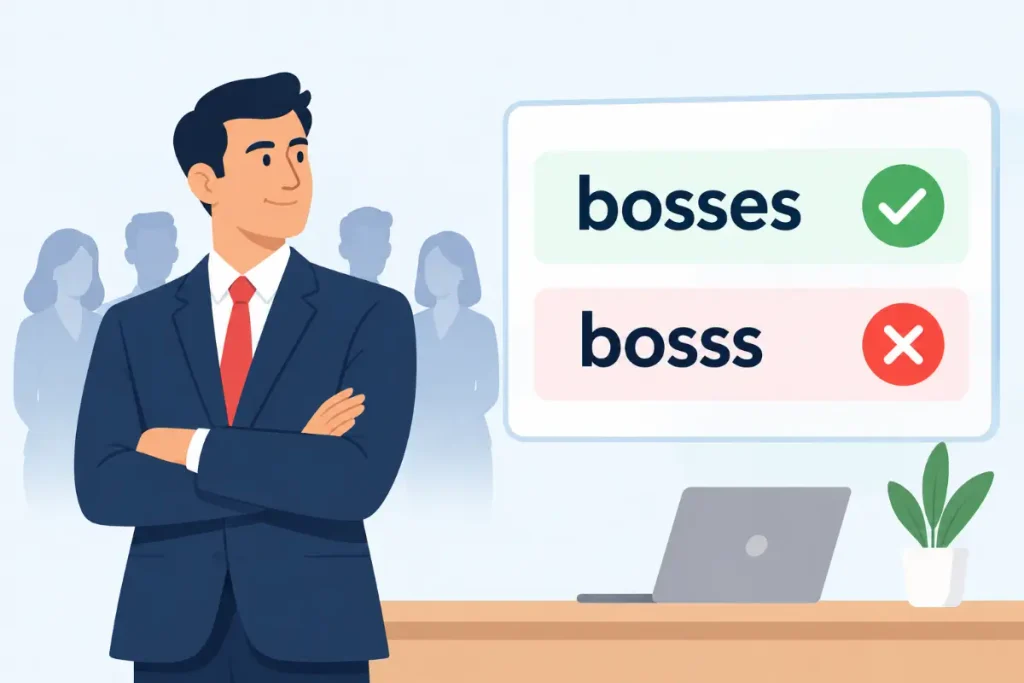
If you’re unsure about bosses or bosss, the correct spelling is bosses. The word bosss is not a standard English spelling. If you mean more than one boss, write bosses.
This confusion usually comes from a simple spelling rule. The singular word is boss, and its plural form changes to bosses. You add es because the word already ends in ss.
The good news is that this is easier to remember than it may seem. Once you understand why the extra letters appear, you can use the same idea with other words that end in sounds like s, ss, sh, ch, and x.
This guide explains the correct plural form, the spelling rule behind it, common mistakes, pronunciation, examples, and related words. By the end, you’ll know exactly when to use bosses and why bosss should be avoided.
Quick Definition
Bosses is the plural form of boss. It means two or more people who have authority over workers or who manage a person, team, or business. Bosss is not the standard plural spelling of boss.
Direct Answer
The correct spelling is bosses. Use bosses when you are talking about more than one boss.
Comparison Table
| Word or Phrase | Meaning | Example Sentence | When to Use It |
|---|---|---|---|
| boss | One person who manages or directs others. | My boss approved my vacation request. | Use it for one person. |
| bosses | Two or more people who manage or direct others. | My bosses approved the new schedule. | Use it for more than one person. |
| bosss | An incorrect spelling in standard English. | I spoke with my bosss yesterday. | Do not use this spelling. |
Why Bosses Is The Correct Spelling
The easiest way to understand the plural form is to start with the singular noun.
The singular word is boss. It refers to one person who has authority over you at work or who manages a business or group.
For example.
- My boss called me this morning.
- She asked her boss for a day off.
- His boss gave him a new assignment.
When you talk about two or more people in that role, you need the plural form. English often makes nouns plural by adding s. For many words, that works perfectly.
For example.
- One book becomes books.
- One car becomes cars.
- One teacher becomes teachers.
- One friend becomes friends.
However, English has another common plural pattern. Some words need es instead of only s.
That is what happens with boss.
You do not simply add another s to create the standard plural. Instead, you add es.
So the spelling changes like this.
boss + es = bosses.
That gives you the correct plural form.
The spelling bosss does not follow the standard plural pattern. It simply adds another s to the existing ending. That may look logical at first glance, but it is not the accepted spelling.
Why Bosss Looks Like It Could Be Right
The incorrect form can be confusing because the singular word already ends in two s letters.
You may think that making the word plural should mean adding one more s.
That would give you bosss.
The problem is that English plural spelling does not always work by simply attaching one letter to the end. Some endings use es to make the plural easier to spell and pronounce.
- Think about the word class.
- One class becomes classes.
- It does not become class with another s added.
- The same pattern appears with glass.
- One glass becomes glasses.
- It also appears with dress.
- One dress becomes dresses.
The word boss follows the same basic pattern.
One boss becomes bosses.
This is why learning the pattern is more useful than trying to memorize the word by itself. Once you see several examples together, the spelling starts to feel natural.
The Plural Rule For Words Ending In S
Many nouns ending in s or a similar sound form their plural with es.
This happens because adding only s can create an awkward spelling or pronunciation.
Consider these examples.
- One bus becomes buses.
- One class becomes classes.
- One glass becomes glasses.
- One dress becomes dresses.
- One kiss becomes kisses.
- One address becomes addresses.
- One boss becomes bosses.
The same idea also appears with some words ending in sh, ch, x, and z.
For example.
- One dish becomes dishes.
- One church becomes churches.
- One box becomes boxes.
- One quiz becomes quizzes.
The exact spelling rule has some details and exceptions. Still, the basic pattern is useful for everyday English.
When a noun ends in a sound that makes a simple s awkward to say, English often uses es for the plural.
That gives the word an extra syllable in many cases.
For example, boss has one syllable.
Bosses has two syllables.
You pronounce it roughly like boss iz.
That extra sound helps separate the singular and plural forms when you speak.
How To Pronounce Bosses
Spelling and pronunciation work together here.
The singular word boss has one syllable.
The plural word bosses has two syllables.
You can think of the pronunciation as.
- boss.
- boss iz.
The final es creates an extra syllable. This is one reason English uses the es ending in this word.
The same pattern appears in words such as classes, glasses, and dresses.
You do not say the plural by simply adding a hard s sound to the end. The ending has a vowel sound before the final consonant sound.
For example.
- Classes.
- Glasses.
- Dresses.
- Bosses.
Hearing the word can help you remember the spelling. If you say bosses aloud, the extra syllable gives you a clue that the plural has more than a single added s.
When To Use Boss
Use boss when you mean one person.
For example.
My boss is in a meeting.
I need to ask my boss a question.
Her boss works in the main office.
His boss gave him some helpful advice.
The word can also describe someone who has authority outside a normal workplace.
For example, a person may use boss for a manager, supervisor, team leader, or owner.
The exact role depends on the situation.
In casual American English, people also use boss in a few other ways. Someone might call another person boss as a friendly form of address. For example, a customer might say, Thanks, boss.
That use does not change the plural spelling rule. If you are talking about several people who are called bosses, the standard plural is still bosses.
When To Use Bosses
Use bosses when you mean two or more bosses.
For example.
My bosses are meeting this afternoon.
The company has several bosses in different departments.
Both of my bosses approved the request.
The managers spoke with their bosses before making a decision.
The word can also refer to several people who have authority over different groups.
For example.
The store has three bosses who manage different shifts.
The employees met with their bosses to discuss the new policy.
She has worked with many bosses during her career.
Notice how the plural form fits naturally into each sentence. The word bosses tells the reader that more than one person is involved.
Common Sentences With Bosses
Seeing the word in real sentences can make the spelling easier to remember.
Here are some natural examples.
My bosses expect everyone to arrive on time.
The two bosses had different ideas about the project.
I have worked with several bosses over the years.
Her bosses praised her for finishing the work early.
The employees asked their bosses for more information.
Both bosses attended the meeting.
Some bosses give clear instructions from the start.
Good bosses listen to their employees.
New bosses sometimes need time to learn how a team works.
The company asked its regional bosses to attend the training session.
The employees met with their bosses after lunch.
Several bosses approved the final plan.
These sentences show an important point. The plural form works just like other plural nouns. It can appear as the subject, object, or possessive form of a sentence.
Bosses In Possessive Forms
There is another spelling point that can cause confusion.
The plural word bosses can also become possessive.
For example.
The bosses’ office is on the second floor.
The bosses’ meeting lasted two hours.
Here, the apostrophe comes after the s because bosses is already plural.
Compare that with the singular possessive form.
The boss’s office is on the second floor.
The boss’s decision surprised the staff.
The difference is simple.
- Boss’s means something belongs to one boss.
- Bosses’ means something belongs to more than one boss.
This distinction matters in writing because the apostrophe changes the meaning.
For example.
- The boss’s car is outside.
- This means one boss owns or uses the car.
- The bosses’ cars are outside.
- This means two or more bosses have cars outside.
The spelling can look complicated at first, but the pattern is consistent.
Bosses Versus Boss’s
Do not confuse the plural form with the singular possessive form.
- Bosses means more than one boss.
- Boss’s means something belonging to one boss.
Look at these examples.
My bosses are friendly.
This sentence talks about more than one boss.
My boss’s office is upstairs.
This sentence talks about one boss and the office connected to that person.
The apostrophe is the key difference in the second sentence.
There is also a plural possessive form.
The bosses’ offices are upstairs.
Now the sentence talks about several bosses and offices connected to them.
These three forms have different jobs.
- Boss.
- Bosses.
- Boss’s.
- Bosses’.
Learning these forms together can prevent many common spelling and grammar mistakes.
Why English Uses Es In Bosses
The spelling rule has both a spelling and a sound side.
English developed plural patterns that help words remain easy to pronounce. Nouns that end in certain sounds often take es instead of a simple s.
The word boss ends with the sound represented by ss.
If you simply added another s, you would get an unusual spelling that does not represent the normal plural form.
English instead uses es.
That gives us bosses.
The same pattern appears in many familiar words.
- Glass becomes glasses.
- Class becomes classes.
- Pass becomes passes.
- Kiss becomes kisses.
- Dress becomes dresses.
- Address becomes addresses.
The pattern is not limited to words ending in ss. You can see related plural endings in other words.
- Box becomes boxes.
- Brush becomes brushes.
- Church becomes churches.
- Dish becomes dishes.
- Quiz becomes quizzes.
These examples help show why memorizing one spelling at a time is not the best approach. It is more useful to recognize the larger pattern.
A Simple Memory Trick
Here is an easy way to remember the correct form.
Think of boss as a word that already has a busy ending.
When you make it plural, give it es instead of another s.
So remember.
- One boss.
- Two bosses.
Not one boss and two bosss.
You can also connect it with class.
- One class.
- Two classes.
- One boss.
- Two bosses.
The endings follow the same pattern.
Another useful trick is to say the plural aloud.
Bosses has two syllables.
The extra syllable can remind you that the plural needs es.
If you see bosss in your writing, pause and check the ending. The standard spelling should be bosses.
Common Mistakes With The Plural Form
Several errors appear when people try to spell this plural.
The first is bosss.
This happens when someone assumes that plural nouns always take one extra s. That approach works for many words but not for this one.
The second mistake is bosses being written with only one s before the ending.
Some writers may produce a form such as boses. That is incorrect because the singular word is boss. The original double s must remain.
The correct form is bosses.
Another mistake involves the possessive form.
Someone may write bosses when they mean that something belongs to one boss.
For example.
- Incorrect for one person.
- My bosses car is outside.
Correct.
My boss’s car is outside.
If the car belongs to several bosses, you would write.
The bosses’ cars are outside.
These forms look similar, so checking the meaning can help you choose the right spelling.
Bosses In Formal And Casual Writing
The word bosses is normal in both casual and formal English.
You can use it in everyday conversation.
My bosses are pretty understanding.
You can also use it in workplace writing.
Several department bosses attended the meeting.
However, the exact word you choose can depend on the tone of your writing.
In a formal business document, managers, supervisors, or department heads may sometimes be more precise.
For example.
The department heads approved the proposal.
That does not mean bosses is incorrect. It simply means that a more specific word may fit the context better.
In normal conversation, bosses is completely natural.
Bosses And Managers
The words bosses and managers can overlap, but they are not always identical.
A boss is generally a person who has authority over someone.
A manager is usually a person responsible for directing people, work, or a department.
For example.
- My boss asked me to finish the report.
- My manager asked me to finish the report.
Both sentences can sound natural.
The exact meaning depends on the workplace.
A company can have many managers. A person may call several of them bosses because they have authority over different workers.
Still, the words are not perfect synonyms in every situation.
The important spelling point stays the same. The plural of boss is bosses.
Bosses And Supervisors
A supervisor is someone who oversees the work of other employees.
In some workplaces, a supervisor may be considered a boss.
For example.
My supervisor checked my work.
My boss checked my work.
Both can describe the same person in some situations.
However, boss is a broader and more casual word. Supervisor often describes a specific workplace role.
Again, this difference affects meaning but not spelling.
If you are talking about several people who supervise employees and you choose the word boss, use bosses.
Bosses And Owners
A boss and an owner can also be different people.
An owner has ownership of a business or property.
A boss has authority over workers.
Sometimes the owner is also the boss.
For example.
- The business owner is my boss.
- In another company, the owner may hire a manager to supervise employees.
- That manager can be the workers’ boss even though the manager does not own the company.
- This distinction helps you use the right word in context.
If there are several people who act as bosses, bosses is the correct plural.

Bosses In American English
Bosses is a common word in American English.
You will hear it in everyday workplace conversations, movies, television shows, books, emails, and informal messages.
For example.
My bosses want the report by Friday.
I have had three bosses at this company.
Her old bosses still speak highly of her.
The employees met with their bosses after the announcement.
The word is not unusual or highly formal. It is part of ordinary English.
If you are writing for a US audience, bosses is the natural plural spelling for boss.
How To Check The Spelling Quickly
If you are writing quickly and forget the plural, use a simple three step check.
First, write the singular form.
Boss.
Next, ask yourself if you mean one person or more than one person.
If you mean one person, use boss.
If you mean more than one person, use bosses.
Finally, check the ending.
The correct plural keeps the original ss and adds es.
Boss plus es becomes bosses.
This quick check takes only a few seconds.
It can also help when proofreading an email, school assignment, article, report, or social media post.
Related Words That Follow The Same Pattern
The spelling pattern becomes easier when you compare boss with similar words.
- Consider class.
- One class becomes classes.
- Consider glass.
- One glass becomes glasses.
- Consider dress.
- One dress becomes dresses.
- Consider kiss.
- One kiss becomes kisses.
- Consider pass.
- One pass becomes passes.
- Consider address.
- One address becomes addresses.
These words all keep their original ending and add es.
That is a useful pattern to remember.
You can also look at words ending in other sounds that often use es.
- One box becomes boxes.
- One dish becomes dishes.
- One church becomes churches.
- One match becomes matches.
- One quiz becomes quizzes.
The exact spelling of the plural ending can vary by word, but the general idea is similar.
When Adding S Works Instead
It is useful to know that not every noun needs es.
Many nouns simply take s.
For example.
- One job becomes jobs.
- One book becomes books.
- One chair becomes chairs.
- One phone becomes phones.
- One table becomes tables.
- One teacher becomes teachers.
- One employee becomes employees.
The difference depends on the ending and sound of the singular word.
That is why you should not use a blanket rule such as all plural nouns take s.
English has several plural patterns.
For boss, the standard pattern is es.
Is Bosses A Verb
Yes, bosses can also be a verb form.
The noun boss can become a verb in informal English.
To boss someone means to give them orders in a forceful or controlling way.
For example.
He bosses his younger brother around.
She always bosses everyone around.
In these sentences, bosses is not a plural noun. It is a verb used with a singular subject.
This is an important grammar point.
In the sentence My bosses are helpful, the word is a plural noun.
In the sentence He bosses everyone around, the word is a verb.
The spelling happens to be the same, but the grammatical job is different.
Context tells you which meaning applies.
Bosses Around As A Phrase
You may also see bosses around in everyday English.
It means someone gives other people too many orders or tries to control them.
For example.
- He bosses everyone around at work.
- She hates it when her brother bosses her around.
- The manager does not boss the team around.
- This phrase is usually informal and can sound critical.
- Still, it is common in spoken American English.
The word bosses in this use comes from the verb boss, not the plural noun.
Is Bosss Ever Correct
In standard English, bosss is not the normal spelling for the plural of boss.
You may occasionally see unusual spellings online. People can make typing errors, create usernames, use intentional wordplay, or write something in a nonstandard way.
Those uses do not make bosss the standard plural form.
For normal writing, use bosses.
That applies to schoolwork, workplace emails, articles, business documents, applications, and other standard English writing.
How Spelling Tools Can Help
A spelling checker will often catch an unusual form such as bosss.
Still, you should not depend entirely on automatic correction.
Spell checkers focus on patterns and word lists. They may not understand the meaning of every sentence.
For example, a spelling tool might recognize both boss and bosses but cannot always tell you if you meant a plural or a possessive form.
That is why understanding the rule matters.
If you know that one person is a boss and several people are bosses, you can make the right choice yourself.
A Quick Practice Test
Try choosing the correct form in each sentence.
I have two ______ at work.
The correct answer is bosses.
My ______ asked me to finish the report.
The correct answer is boss.
Several ______ attended the meeting.
The correct answer is bosses.
My ______ office is near the entrance.
The correct answer is boss’s if one boss owns or uses the office.
The ______ offices are on different floors.
The correct answer is bosses’ if the offices belong to several bosses.
This small test shows why spelling and grammar are connected.
You are not only choosing letters. You are showing the reader what the sentence means.
FAQs
What is the plural of boss?
The plural of boss is bosses. The spelling keeps the original double s and adds es.
Is bosses or bosss correct?
Bosses is the correct standard spelling. Bosss is not the standard plural form.
Why does boss become bosses?
The word boss forms its plural with es. This follows a common English pattern used with words that end in sounds such as s, ss, sh, ch, x, and z.
How do you spell more than one boss?
Spell it bosses. For example, you can write, My bosses approved the plan.
Is boss’s the plural of boss?
No. Boss’s is the singular possessive form. It usually means something belongs to one boss, as in my boss’s office.
What is the plural possessive form of boss?
The plural possessive form is bosses’. For example, the bosses’ meeting means a meeting connected to two or more bosses.
How do you pronounce bosses?
Bosses has two syllables. It sounds roughly like boss iz, with an extra syllable at the end.
Can bosses be a verb?
Yes. Bosses can be the third person singular form of the verb boss. For example, He bosses everyone around.
Conclusion
If you came here wondering about bosses or bosss, the answer is simple. Use bosses for the plural of boss. The form bosss is not standard English.
Remember the pattern with familiar words such as classes, glasses, dresses, and kisses. These words use es to form the plural. Bosses follows the same useful pattern.
Also keep the possessive forms separate. Boss’s refers to something connected to one boss. Bosses’ refers to something connected to several bosses. A small apostrophe can change the meaning.
The next time you need the plural, write bosses with confidence. One boss becomes two bosses. That simple pattern is all you need to remember.

Dr. Arthur Pendelton is a veteran historical linguist and grammar expert with over 30 years of experience in academic editing. A retired professor, Arthur specializes in the etymology and evolution of the English language. He is passionate about “unpacking the history behind the rules,” helping readers understand why we spell, punctuate, and phrase things the way we do today. Whether he’s settling debates on archaic usage or explaining complex linguistic shifts, Dr. Pendelton brings scholarly precision to every article.
1 thought on “Bosses or Bosss Which Spelling Is Correct.”