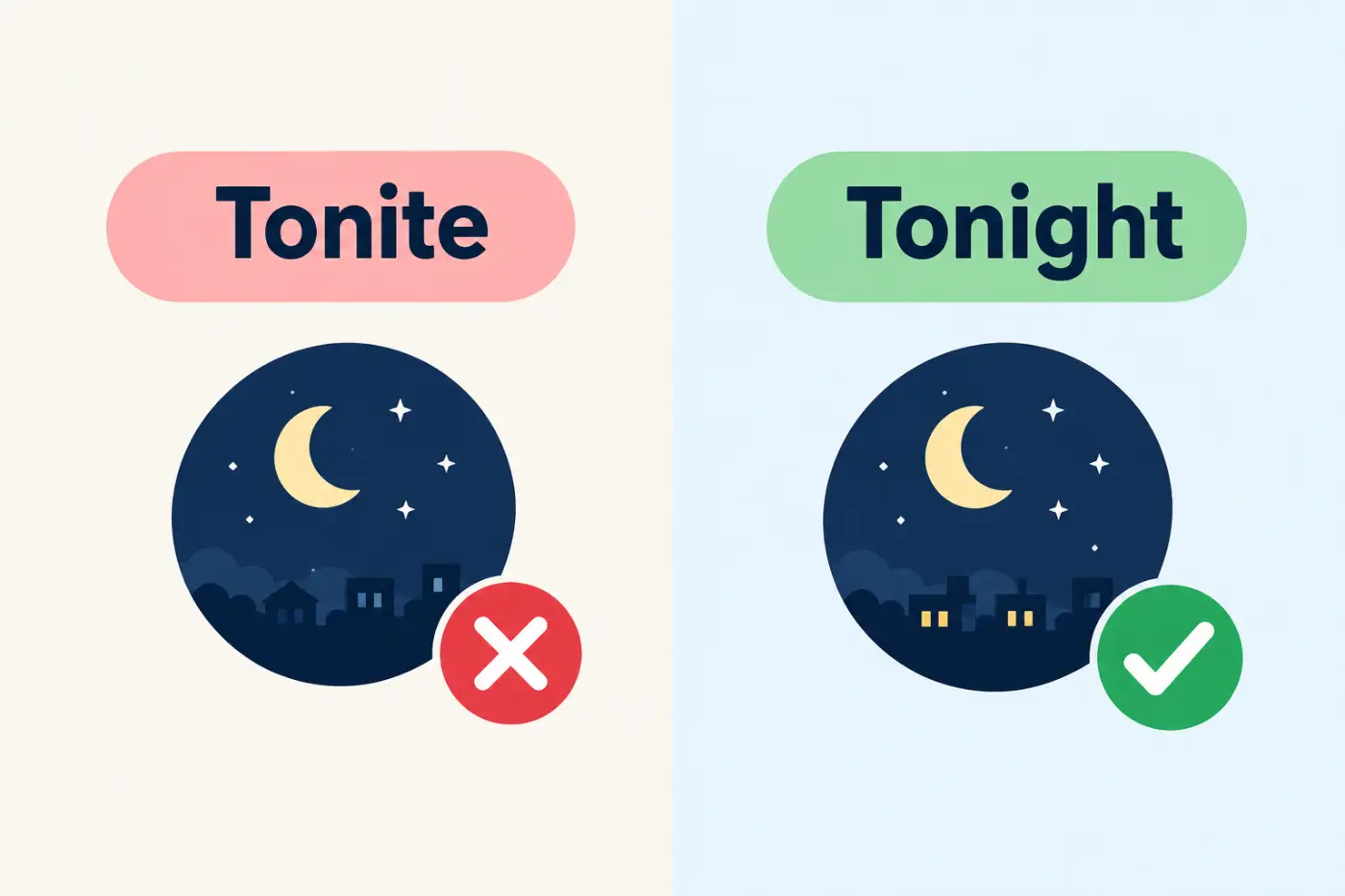
If you’ve ever wondered about tonite or tonight, you’re not alone. Both spellings appear in messages, song titles, advertisements, and casual online posts. That can make it hard to know which one belongs in proper English writing.
The good news is that the answer is simple. One spelling is the standard form used in dictionaries and formal writing. The other is an informal variation that appears mainly in casual communication and creative work.
Choosing the right spelling matters because small details can affect how clear and polished your writing looks. A quick text to a friend has different rules from a school essay, a business email, or a published article.
This guide explains the difference between the two spellings, shows how to use them in natural sentences, and covers common mistakes. You’ll also learn where the unusual spelling comes from and how to remember the standard form.
Quick Definition
Tonight is the standard English word for the present evening or the evening of the current day. Tonite is an informal spelling that represents the same word and meaning. It often appears in text messages, advertising, song titles, and other casual settings.
Direct Answer
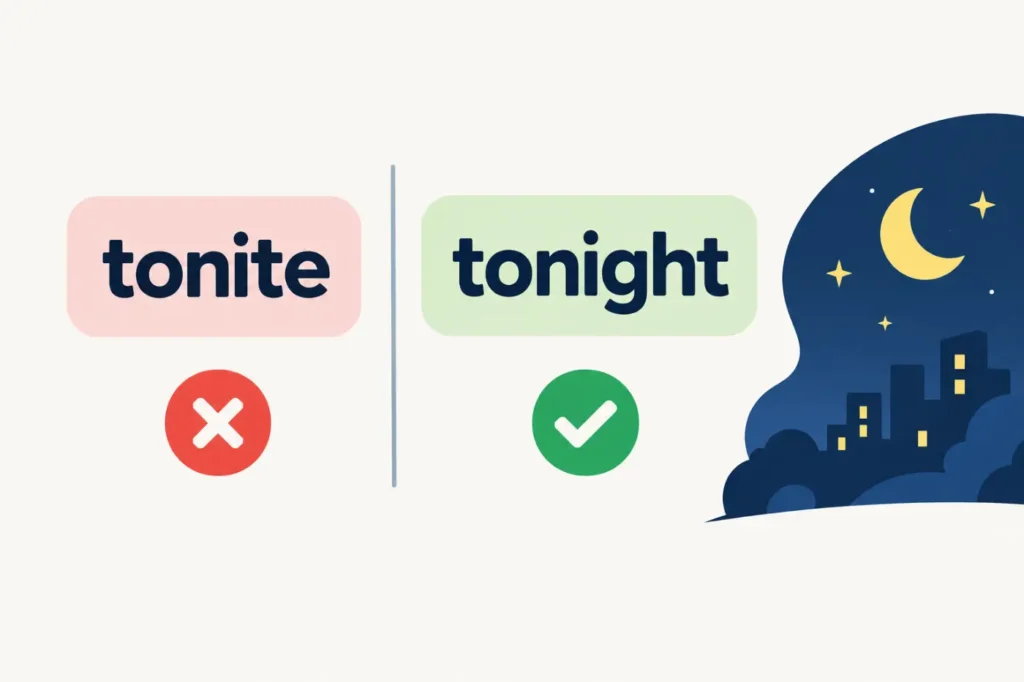
Tonight is the correct standard spelling. Use it in schoolwork, professional writing, formal messages, and most published content. Tonite is an informal alternative that can work in casual communication or creative writing when a relaxed style is intended.
Why People Confuse These Spellings
The confusion comes from the way English sounds when people speak. In normal conversation, the word tonight often sounds like two quick syllables. The middle sound can be easy to miss.
When people write messages quickly, they may spell words according to the way they hear them. Tonite looks shorter and feels natural in a text. It also resembles other shortened spellings that have become common in casual communication.
For example, people sometimes write:
- Gonna instead of going to.
- Wanna instead of want to.
- Thru instead of through.
- Tonite instead of tonight.
These forms may be familiar to readers, but familiarity doesn’t automatically make a spelling standard. Some shortened forms are accepted in specific contexts. Others remain informal alternatives.
The spelling tonight has a long history in English. It developed from older expressions that combined the ideas of this and night. Over time, the words joined together into the single form people use today.
Tonite developed as a simplified spelling. It removes the letters gh, which aren’t pronounced in the modern word. That makes the alternative look more closely connected to its sound.
Still, English spelling isn’t based only on pronunciation. Many standard words contain letters that aren’t spoken aloud. Those letters can be part of the accepted spelling even when they seem unnecessary.
That is why the shorter form can look reasonable and still be unsuitable for formal writing.
The Correct Spelling of Tonight
The standard spelling is tonight. It is one word that refers to the evening of the current day or the night that follows the present day.
You can use it in almost any ordinary sentence about the evening. It works in casual conversations, school assignments, workplace emails, news articles, and books.
Consider these examples.
- I have a dentist appointment tonight.
- Are you staying home tonight.
- We are planning to watch a movie tonight.
- The restaurant is offering a special dinner tonight.
- I need to finish my homework tonight.
Each sentence uses the standard spelling. The word fits naturally into everyday English.
What Tonight Means
Tonight usually refers to the evening or night connected to the current day.
If you say, I will call you tonight, you mean that you plan to call later on the same day. The exact time depends on the situation. It could mean early evening, late evening, or sometime during the night.
For example, imagine that you are speaking to a friend on Sunday afternoon.
You might say:
I will send you the photos tonight.
Your friend will understand that you plan to send the photos later on Sunday.
The word can also refer to an event happening during the evening.
- The concert starts tonight.
- We have a family dinner tonight.
- The team is playing tonight.
- I am not working tonight.
The meaning stays the same even when the sentence changes.
Is Tonight One Word
Yes. Tonight is written as one word in standard modern English.
Some learners mistakenly write this night when they mean tonight. The two expressions can overlap in meaning, but they aren’t always used in the same way.
Compare these sentences.
- I am going to the gym tonight.
- I am going to the gym this night.
The first sentence sounds natural in ordinary conversation. The second sounds unusual because English speakers generally use tonight for this particular time reference.
This night can appear in special contexts. A writer might use it for emphasis, contrast, or a poetic effect.
For example:
- This night will be remembered for generations.
That sentence gives the word night extra emphasis. In everyday writing, though, tonight is usually the better choice.
Tonite or Tonight in Formal Writing
Formal writing calls for the standard spelling tonight. The informal version can look careless or overly casual in situations that require polished English.
The choice matters most in writing that represents you professionally or academically.
School Assignments
Use tonight in essays, homework, reports, and written answers for class.
For example:
- I will complete my science project tonight.
- The story takes place during a stormy night.
- Our teacher assigned a reading task for tonight.
Using the standard spelling helps your work follow accepted spelling rules. A teacher might understand tonite, but that doesn’t make it the best choice for an assignment.
Business Emails
Professional emails should normally use tonight.
Consider this message:
- Hi Sarah.
- I will send you the updated report tonight.
- Thank you.
The spelling looks clean and appropriate.
Now consider the same message with the informal form.
- Hi Sarah.
- I will send you the updated report tonite.
- Thank you.
The meaning is still clear. However, the spelling may make the message seem rushed or less polished. In professional communication, there is little reason to use the informal version.
Articles and Website Content
Published articles should use the standard spelling unless the informal form serves a clear purpose.
For example, a grammar article should explain the accepted spelling as tonight. A news report should also use tonight when referring to the evening.
An advertisement, on the other hand, might use tonite to create a friendly or youthful tone.
The difference comes down to the purpose of the writing. Clear communication should guide your choice.
Formal Invitations
Use tonight in invitations, announcements, and event notices that need a polished appearance.
For example:
- Join us tonight for a special dinner.
- The school play begins tonight at seven.
- Our community meeting takes place tonight.
An event organizer might choose the shorter spelling for a playful poster or a creative campaign. That choice is stylistic rather than a change to the standard spelling.
When Tonite Can Be Used
Tonite is an informal spelling of tonight. It is widely understood by English speakers, but it isn’t the preferred form in standard writing.
You may see it in several settings.
Text Messages.
Friends sometimes use tonite in quick messages.
- Are you free tonite.
- Want to grab pizza tonite.
- I will see you tonite.
These messages are informal. The shorter spelling may fit the relaxed tone.
Still, using tonight in a text is perfectly natural. You don’t need to shorten the word to sound friendly.
For example:
- Are you free tonight.
This version is just as clear and conversational.
Social Media Posts
People sometimes use tonite in social media captions or posts to make their writing look casual.
A post might say:
- Live music tonite.
- Movie night tonite.
- Big announcement coming tonite.
The spelling may be part of the writer’s style. It can also help a short message fit a particular design.
However, social media writing doesn’t require the informal form. Tonight remains the standard choice.
Advertising
Businesses sometimes use tonite in promotional material. The spelling may create a sense of energy or informality.
For example:
- Special offer tonite.
- Free entry tonite.
- Live entertainment tonite.
This style can work on a casual poster or a short promotional message. A formal business announcement would usually use tonight instead.
Song Titles and Creative Work
Artists may choose tonite for a song title, poem, fictional character, or other creative work.
A songwriter might select the spelling because it fits the rhythm of a title. A designer might choose it because the shorter form fits better on a sign.
Creative work often allows unusual spelling for a specific effect. That doesn’t mean the spelling has become the standard form.
If you’re discussing a particular song or title, preserve the original spelling. If you’re writing a sentence about the evening, use tonight.
Examples of Tonight in Natural Sentences
Learning a spelling rule is easier when you see it in real situations. The following examples show how tonight works in everyday English.
Talking About Plans
- I am meeting my cousins tonight.
- We are going to order takeout tonight.
- She has a class tonight.
- They are coming over tonight.
- I need to buy groceries tonight.
These sentences describe plans for the evening.
Asking Questions
- What are you doing tonight.
- Are you coming to the party tonight.
- Do you have time to talk tonight.
- Is the game on tonight.
- Where are you going tonight.
The word can appear at the beginning, middle, or end of a sentence.
Making Promises
- I will call you tonight.
- I will finish the work tonight.
- I will check the schedule tonight.
- We will discuss the problem tonight.
In these sentences, tonight tells the reader when the action will happen.
Describing an Event
- The show starts tonight.
- The store is closing early tonight.
- The weather may change tonight.
- A new episode airs tonight.
- The city is hosting a festival tonight.
The word can describe a scheduled event or something expected to happen later.
Talking About Feelings
- I feel tired tonight.
- I am excited about tonight.
- She seems happy tonight.
- I don’t want to go out tonight.
- He is nervous about tonight’s presentation.
Notice the form tonight’s in the last example. The apostrophe and s show possession or connection. The phrase means the presentation happening tonight.
Common Mistakes With Tonight
Many spelling mistakes happen because people write quickly or rely on sound. Understanding the common errors can help you avoid them.
Mistake One Using Tonite in Every Situation
Some people assume that tonite is simply a shorter version of tonight and can replace it anywhere.
That isn’t a good rule. The informal spelling is understandable, but tonight is the accepted choice for standard writing.
Correct:
- I have an important meeting tonight.
Informal alternative:
- I have an important meeting tonite.
The first sentence is the better choice for professional or academic use.
Mistake Two Writing To Night
Some learners separate the word into two parts.
Incorrect in standard modern English:
- I will see you to night.
Correct:
- I will see you tonight.
The word is normally written together. The separate form may appear in historical texts or special creative writing, but it isn’t the usual modern spelling.
Mistake Three Writing This Night in Everyday Speech
This night isn’t always grammatically wrong. However, it often sounds unnatural when used in place of tonight.
For example:
- I am staying home tonight.
This is the natural everyday sentence.
The phrase this night can be useful when a writer wants to emphasize a particular night. It can also appear in literature or formal storytelling.
Mistake Four Confusing Tonight With Tomorrow Night
Tonight refers to the evening connected to the current day. Tomorrow night refers to the evening of the next day.
Imagine that today is Tuesday.
- I am going to the gym tonight. This means Tuesday evening.
- I am going to the gym tomorrow night. This means Wednesday evening.
The words are different because they point to different days.
Mistake Five Adding an Extra Letter
Some people write tonigth or tonigh because they are unsure about the order of the letters.
The correct spelling is tonight.
A useful way to remember it is to recognize the two parts of the word. It begins with to and ends with night.
How to Remember the Correct Spelling
A simple memory trick can help you choose the standard form without stopping to think.
Remember the Word Night
The word tonight contains the full word night.
Think of it as:
To plus night equals tonight.
The spelling includes the letters n, i, g, h, and t in the correct order. The gh is silent, but it remains part of the standard spelling.
You don’t need to pronounce every letter to spell a word correctly. English has many words with silent letters.
For example:
- Light.
- Right.
- Night.
- Sight.
- Might.
These words all contain gh. The letters are not pronounced in the usual way, but they remain in the spelling.
Use a Simple Sentence
Try remembering this sentence:
- I will use tonight in my writing tonight.
The repetition may sound playful, but it helps connect the spelling to its meaning.
You can also make a quick note:
Tonight is standard. Tonite is informal.
That short reminder is enough for most everyday situations.
Think About Your Audience
Ask yourself who will read your writing.
If you’re sending a quick message to a friend, an informal spelling may be understood. If you’re writing for a teacher, customer, manager, or general audience, choose tonight.
This habit is more useful than memorizing a long list of spelling rules. It helps you make the right choice in real situations.
The History Behind the Spelling
Understanding how a word developed can make its spelling easier to remember. The history of tonight explains why the standard form contains letters that aren’t pronounced.
How Tonight Developed
The modern word tonight comes from an older English expression meaning on or during this night. Over time, people began combining the words into a single expression.
English has many examples of words that developed from older combinations.
For example:
- Today developed from the older expression this day.
- Tonight developed from the older expression this night.
- Tomorrow developed from the older expression to morrow.
A morrow was an old word for the following day. As English changed, these expressions became the familiar words people use today.
The spelling tonight reflects this long development. It isn’t simply a modern attempt to represent the sound of the word.
Why the Letters Gh Remain
The letters gh appear in many English words, including night, light, and right. In modern pronunciation, they are usually silent.
English spelling often preserves letters from earlier forms of words. Pronunciation changes over time, but spelling doesn’t always change along with it.
That explains why tonight contains the letters gh even though speakers don’t say them.
Tonite removes those letters to create a spelling that looks closer to the sound. This makes it easy to understand, but it doesn’t make it the standard form.
The difference is similar to the difference between a traditional spelling and a shortened spelling in other parts of English. A shorter version may be useful in a casual setting, but the full spelling remains the usual choice.

Tonight in American English
The word tonight is common in American English. People use it in everyday speech, writing, announcements, and entertainment.
There is no special American spelling rule that changes tonight to tonite. The standard form remains the same.
Everyday American Expressions
Here are some natural phrases you may hear in the United States.
- What are you doing tonight.
- See you tonight.
- Are you working tonight.
- I have plans tonight.
- We are eating out tonight.
- I am staying in tonight.
- Tonight sounds good to me.
- Let’s talk tonight.
These expressions are common in casual conversation. They sound natural because tonight is the usual word for this time of day.
Tonight in American Media
Television programs, newspapers, websites, and radio announcements commonly use tonight.
For example:
- The program airs tonight at eight.
- The weather forecast will be updated tonight.
- The team returns to action tonight.
- The late show begins tonight.
A media company may choose tonite in a particular title or advertisement. That choice depends on its style. It doesn’t change the standard spelling.
Related Words and Expressions
Knowing related time words can help you use tonight more accurately. These words often appear together in everyday conversations.
Today
Today means the current day.
- I am working today.
- The store is open today.
- We have a meeting today.
Tonight refers specifically to the evening or night connected to today.
- I am working tonight.
- The store is open tonight.
- We have a meeting tonight.
The two words can describe different parts of the same day.
Tomorrow
Tomorrow means the day after today.
- I will call you tomorrow.
- We are leaving tomorrow.
- The test is tomorrow.
next night means the evening of the next day.
- I will call you tomorrow night.
- We are leaving tomorrow night.
- The test is tomorrow night.
This distinction helps prevent confusion when making plans.
Last Night
Last night refers to the previous night.
- I watched a movie last night.
- It rained last night.
- I didn’t sleep well last night.
The word tonight refers to the current evening. Last night refers to the evening that has already passed.
This Evening
This evening is another standard expression for the current evening.
- I will finish the report this evening.
- We are meeting this evening.
- The event begins this evening.
- Tonight is generally more common in casual speech, while this evening may sound slightly more formal in some situations.
At Night
At night refers to a general time when it is dark or when people usually sleep. It doesn’t always refer to one particular night.
- I like to read at night.
- The streets are quiet at night.
- Some animals are active at night.
Compare that with tonight.
- I am going to read tonight.
- The streets are quiet tonight.
- We are visiting the zoo tonight.
At night describes a general time. Tonight points to a specific evening.
How to Use Tonight in Different Sentence Positions
Tonight is flexible. You can place it at the beginning, middle, or end of a sentence.
At the Beginning
Starting with tonight can emphasize the time.
- Tonight, we are having dinner with friends.
- Tonight, the city will celebrate the holiday.
- Tonight, I plan to finish my reading.
When tonight begins a sentence, a comma may be used to separate it from the rest of the sentence. The comma is optional in some short sentences, but it can make the meaning easier to read.
In the Middle
Tonight can appear after the subject or before the main verb.
- I tonight plan to study.
This sentence is grammatically possible in a special or formal style, but it sounds unnatural in ordinary conversation.
A more natural version is:
- I plan to study tonight.
In everyday English, tonight usually sounds best at the beginning or end of a sentence.
At the End
This is one of the most common positions.
- I am going home tonight.
- She is cooking dinner tonight.
- We will talk about it tonight.
- They are watching the game tonight.
The word fits naturally at the end because it tells the reader when the action will happen.
Is Tonite Ever a Spelling Error
The answer depends on the context.
If you are writing a formal essay and use tonite instead of tonight, the spelling would normally be considered an error. Standard writing expects the accepted form.
If you are writing a casual text message, the informal spelling may be understood without difficulty. Some people use it intentionally.
If you are copying the exact title of a song, event, or advertisement, you may need to preserve the original spelling. In that situation, changing the spelling could change the title.
The key point is that a spelling can be informal without being meaningless. Tonite communicates the same idea as tonight, but it doesn’t have the same status in standard English.
FAQs
Is Tonite or Tonight Correct?
Tonight is the correct standard spelling. Tonite is an informal alternative that has the same meaning. Use tonight for schoolwork, professional writing, and most published content.
Is Tonite a Real Word?
Tonite is a recognized informal spelling of tonight. It appears in casual messages, advertisements, song titles, and creative writing. It is not the preferred spelling in standard English.
Can I Use Tonite in a Text Message?
Yes. You can use tonite in a casual text message if the relaxed style fits the conversation. However, tonight is also perfectly natural and is the safer choice when you want standard spelling.
Why Do People Spell Tonight as Tonite?
People often use tonite because it looks closer to the way tonight sounds. The shorter form also saves a couple of letters in quick messages. It has become familiar through casual communication and popular culture.
Is Tonite Acceptable in Formal Writing?
Tonite is generally not recommended in formal writing. Use tonight in essays, business emails, reports, official notices, and professional content. The standard spelling gives your writing a more polished appearance.
Is Tonight One Word or Two?
Tonight is one word in modern standard English. The form to night is not the normal spelling for the everyday meaning of the current evening. Use tonight in ordinary sentences.
Can Tonite Be Used in a Song Title?
Yes. An artist may use tonite in a song title for creative or stylistic reasons. If you’re referring to a specific title, keep its original spelling. In your own standard writing, use tonight.
What Is the Difference Between Tonight and This Evening?
Both expressions can refer to the current evening. Tonight is more common in everyday speech, while this evening can sound slightly more formal in some contexts. The best choice depends on the sentence and the tone you want.
Conclusion
The answer to tonite or tonight is straightforward. Tonight is the standard English spelling for the current evening or night. Tonite is an informal spelling that means the same thing.
Use tonight in school assignments, business emails, articles, reports, and most other writing. It is clear, accepted, and appropriate for almost every audience.
Tonite can appear in casual texts, advertisements, song titles, and creative work. It may suit a relaxed style, but you don’t need it to make your writing sound friendly.
The easiest way to remember the standard form is to keep the full word night in mind. When you’re unsure, choose tonight. It will almost always be the right choice.

Dr. Arthur Pendelton is a veteran historical linguist and grammar expert with over 30 years of experience in academic editing. A retired professor, Arthur specializes in the etymology and evolution of the English language. He is passionate about “unpacking the history behind the rules,” helping readers understand why we spell, punctuate, and phrase things the way we do today. Whether he’s settling debates on archaic usage or explaining complex linguistic shifts, Dr. Pendelton brings scholarly precision to every article.