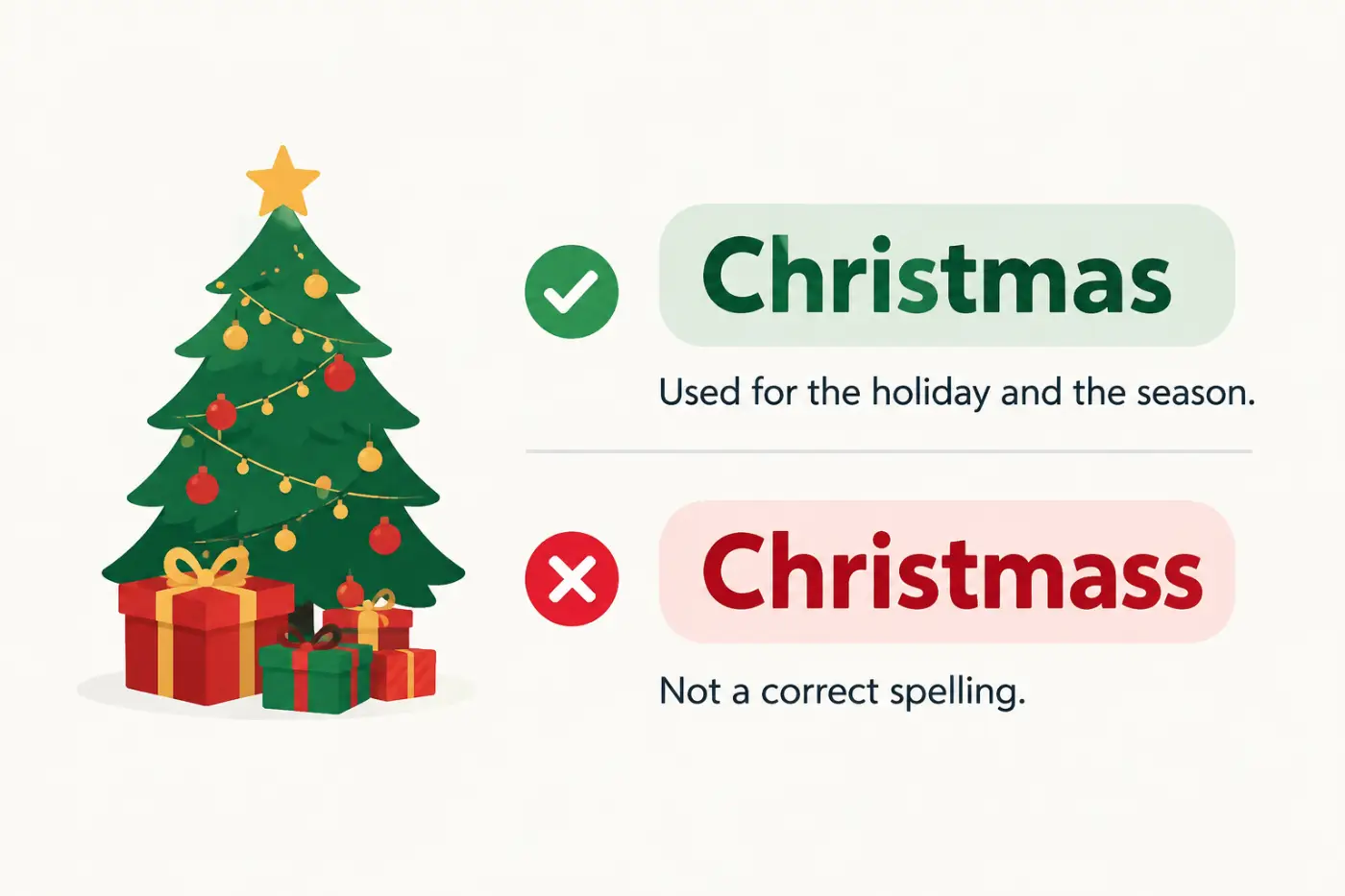
If you are searching for christmases or christmass, the correct spelling depends on what you are trying to say. The plural form of Christmas is Christmases. Christmass is not the standard spelling of the holiday name, so it is normally a spelling mistake.
This confusion is easy to make because English has many words that form their plural by adding s, while words ending in certain sounds need es. Christmas is one of those words. If you are talking about more than one Christmas, write Christmases.
The good news is that you only need to remember one simple rule. Christmas is the singular noun, and Christmases is the plural noun. The word Christmass does not work as the normal plural form.
In this guide, I will explain the correct spelling, why the plural takes es, how to use both forms in real sentences, and the common mistakes that cause this confusion. I will also cover related words such as Christmas Eve, Christmas Day, Christmases past, and the possessive form.
Quick Definition
Christmas is the name of the Christian holiday celebrated on December 25. Christmases is the plural form used when talking about two or more Christmas celebrations. Christmass is generally an incorrect spelling when you mean either the holiday or its plural form.
Direct Answer
The correct plural spelling is Christmases, not Christmass. Use Christmas for one holiday and Christmases for more than one holiday.
Christmas And Christmases Compared
| Word or Phrase | Meaning | Example Sentence | When To Use It |
|---|---|---|---|
| Christmas | One holiday or Christmas season | We spent Christmas with our family. | Use for one Christmas |
| Christmases | More than one Christmas | We remember the Christmases of our childhood. | Use for multiple Christmas celebrations |
| Christmass | Usually a misspelling | Christmass is not the standard plural. | Avoid it in normal writing |
| Christmas Day | December 25 | We opened gifts on Christmas Day. | Use for the specific day |
| Christmas Eve | December 24 | We went to church on Christmas Eve. | Use for the day before Christmas |
| Christmases Past | Christmas celebrations from earlier years | She often thinks about Christmases past. | Use when referring to earlier Christmases |
Why Christmases Is The Correct Plural
The simplest way to understand the spelling is to start with the singular word.
The word is Christmas.
When you mean one holiday, you use the singular form.
For example:
We celebrate Christmas with our family.
But if you are talking about several Christmas celebrations, you need the plural.
- The plural is:
- Christmases.
- So you can write:
- We spent three Christmases in different cities.
The ending es is added because of the sound at the end of the word. Christmas ends with an s sound. In English, many nouns ending in an s, sh, ch, x, or z sound form their plural with es.
Consider these examples:
- bus → buses
- class → classes
- dish → dishes
- church → churches
- box → boxes
- Christmas → Christmases
The pattern becomes easier to remember once you say the words aloud. Christmases is pronounced with an extra syllable at the end. The plural sounds roughly like Christmas iz.
That extra sound helps explain why simply writing Christmass does not work.
Why Christmass Is Usually Wrong
The spelling Christmass looks tempting because the word Christmas already contains the letters mas near the end. Someone may think that adding another s creates the plural.
It does not.
English plural spelling does not work by simply adding a second final letter in this case.
- The singular word is:
- Christmas
- The plural is:
- Christmases
- Not:
- Christmass
The word Christmass can sometimes appear as a typo or an unusual creative spelling, but it is not the standard English plural of Christmas.
For schoolwork, business writing, websites, greeting cards, and other formal or public writing, avoid that spelling.
The Singular Form Christmas
Before learning the plural, it helps to understand the singular form.
Christmas is a proper noun because it names a specific holiday. It normally begins with a capital C.
Here are some natural examples:
- Christmas is my favorite holiday.
- We are traveling home for Christmas.
- The children are excited about Christmas.
- Our office will close for Christmas.
- I bought gifts for Christmas.
- They decorated the house before Christmas.
- She sent a Christmas card to her grandparents.
These sentences all refer to one holiday period or one Christmas celebration.
You do not need an s at the end when you are talking about a single Christmas.
For example, this is correct:
We had a wonderful Christmas.
This is not correct:
We had a wonderful Christmases.
The second sentence incorrectly uses the plural form with a singular meaning.
The Plural Form Christmases
Use Christmases when you are talking about more than one Christmas.
This can mean different Christmas celebrations across several years, different Christmas experiences, or Christmas celebrations involving different people or places.
For example:
I remember the Christmases I spent at my grandparents’ house.
The sentence refers to multiple Christmas celebrations over the years.
Here are more examples:
Our family has shared many happy Christmases together.
The children remember their early Christmases with great affection.
We spent the last two Christmases in Florida.
Those Christmases were full of laughter and good food.
She looks back on her childhood Christmases with a smile.
We have celebrated many Christmases as a family.
The family gathered together for several Christmases.
The plural form is especially useful when discussing memories.
A person may say:
My favorite Christmases were the ones spent at home.
That means the person has more than one favorite Christmas experience.
Why The Extra Es Matters
The ending es is not just a spelling detail. It changes the grammar of the word.
Compare these two sentences:
- We had a wonderful Christmas.
- We had many wonderful Christmases.
The first sentence describes one holiday.
The second describes several holidays.
If you write Christmass instead, readers may understand what you mean, but the spelling is still incorrect in standard English.
Correct spelling matters in school assignments, professional writing, articles, captions, greeting messages, and published content.
A small spelling error can also make writing look less polished.
How To Use Christmases In A Sentence
The plural form often appears when people talk about memories, traditions, or repeated celebrations.
Talking About Family Memories
- Our family has enjoyed many Christmases together.
- The Christmases of my childhood are some of my favorite memories.
- We spent many Christmases at our grandparents’ home.
- Those Christmases taught us to value family time.
Talking About Different Years
- The past three Christmases have been very different.
- We traveled during the last two Christmases.
- She has spent several Christmases away from home.
- The last few Christmases have been unusually warm.
Talking About Different Places
- We have celebrated Christmases in several countries.
- Their Christmases in New York were very different from those in California.
- The family enjoyed Christmases both at home and abroad.
Talking About Traditions
- Some families have Christmases filled with large gatherings.
- Our Christmases usually include a big family dinner.
- Their Christmases are simple but meaningful.
- We have created many traditions across the Christmases we have shared.
These examples show that Christmases works naturally when the idea involves repetition or more than one celebration.
Christmases In Everyday Conversation
Native speakers do use the plural form when talking about multiple holiday celebrations, but they may choose other wording depending on the sentence.
For example, instead of saying:
- We spent many Christmases together.
- Someone might also say:
- We spent many Christmas holidays together.
- Both can work.
- The shorter form sounds natural when the context is clear.
Another example is:
- I remember those Christmases.
- This sounds natural when both speakers already know which Christmas celebrations are being discussed.
- You could also say:
- I remember those Christmas holidays.
- The second version is slightly more explicit.
Christmases Past Meaning
You may have seen the phrase Christmases past in books, songs, stories, or nostalgic writing.
It means Christmas celebrations from earlier years.
For example:
She often thinks about Christmases past.
This means she remembers Christmas celebrations that happened in previous years.
The phrase has a warm and nostalgic feeling. It can refer to childhood memories, family traditions, old gatherings, or earlier stages of life.
Another example is:
Christmases past seemed simpler.
Here, the writer is comparing Christmas celebrations from earlier years with the present.
You can also write:
He smiled as he remembered Christmases past.
The plural form is correct because the writer is referring to multiple Christmas celebrations.
Christmas Vs Christmas Holiday
There is another small language point worth understanding.
Christmas can refer to the holiday itself, the Christmas season, or the general celebration.
For example:
- We are spending Christmas at home.
- You do not need to add the word holiday.
However, Christmas holiday can be useful when talking about a vacation period connected to Christmas.
For example:
The students are excited about their Christmas holiday.
In the US, people may also say Christmas break when talking about the school vacation around the holiday.
For example:
School starts again after Christmas break.
These expressions have related meanings, but they are not interchangeable in every sentence.
Christmas Day And Christmas Eve
Christmas has several related terms that are often confused.
Christmas Day means December 25.
Example:
We will have dinner together on Christmas Day.
Christmas Eve means December 24, the evening or day before Christmas Day.
Example:
We usually open one gift on Christmas Eve.
Christmas season refers to the wider period around Christmas.
Example:
Many stores become busy during the Christmas season.
These terms stay singular when you are referring to one specific occasion.
If you talk about several years, you can use plural forms in the appropriate way.
For example:
I remember the Christmas Eves of my childhood.
Here, Christmas Eves refers to several Christmas Eve celebrations.
Common Spelling Mistakes
Many people make the same few mistakes when writing about Christmas.
Mistake One Writing Christmass
This is the most direct spelling mistake.
Incorrect:
We had three Christmass together.
Correct:
We had three Christmases together.
The plural needs es.
Mistake Two Using Christmases For One Holiday
Incorrect:
I hope you have a happy Christmases.
Correct:
I hope you have a happy Christmas.
The singular form is required when you mean one Christmas.
Mistake Three Adding An Apostrophe
Some writers may create a plural with an apostrophe.
For example:
Christmas’s are wonderful.
That is incorrect if you simply mean more than one Christmas.
The correct plural is:
Christmases are wonderful.
An apostrophe is not normally used to create a plural.
Mistake Four Confusing Plural And Possessive Forms
A plural tells us there is more than one.
A possessive shows ownership or association.
For example:
Christmases can be very different.
Here, Christmases is plural.
But:
Christmas’s meaning has changed for some people.
Here, Christmas’s is a possessive form referring to the meaning associated with Christmas.
The two forms have different jobs.
Christmases Or Christmas’s
This is another common confusion.
Christmases means more than one Christmas.
Example:
We spent several Christmases together.
Christmas’s is a possessive form. It is used when something belongs to or is associated with Christmas.
Example:
Christmas’s religious meaning is important to many Christians.
However, many writers can avoid the awkward possessive construction by rewriting the sentence.
Instead of:
Christmas’s history is long.
You could write:
The history of Christmas is long.
That version often sounds smoother.
Christmases Or Christmas’
Another possible mistake is writing Christmas’ when you mean several Christmas celebrations.
That is not the normal plural.
For example:
We remember our childhood Christmas’.
This is incorrect.
Write:
We remember our childhood Christmases.
The ending es is needed because you are talking about multiple Christmas celebrations.
How To Remember The Correct Spelling
A simple memory trick can make this much easier.
Think about the word class.
- One class.
- Two classes.
- Now think about Christmas.
- One Christmas.
- Two Christmases.
Both words have an s sound at the end, so the plural adds es.
You can also remember this short pattern:
- One Christmas
- Two Christmases
- Many Christmases
Another useful trick is to say the plural aloud.
When you pronounce Christmases, you can hear the extra syllable. That helps remind you that the spelling needs more than a second s.
Is Christmases A Real Word
Yes. Christmases is a standard English plural noun.
It appears in normal writing when someone refers to more than one Christmas.
For example:
The Christmases we spent with our grandparents remain special memories.
There is nothing unusual or incorrect about the plural form.
Some people rarely use it because they normally talk about Christmas as a yearly holiday. That can make the plural look strange when they first see it.
But it follows a regular English plural pattern.
Why People Rarely See The Plural
There is a practical reason this spelling can cause confusion.
Most people talk about Christmas as a single annual event.
They say:
Merry Christmas.
They say:
What are you doing for Christmas?
They say:
We are decorating for Christmas.
They do not always need to say Christmases.
The plural becomes useful when someone compares different years or talks about several celebrations.
For example:
The last five Christmases have been very memorable.
That sentence needs the plural because it refers to five separate Christmas celebrations.
Christmases In Formal Writing
In formal writing, use the standard spelling Christmases.
This includes:
- School assignments.
- College essays.
- Business documents.
- Website articles.
- News writing.
- Social media posts.
- Holiday cards.
- Invitations.
- Emails.
- Marketing content.
Standard spelling helps readers trust the quality of your writing.
For example:
Our company has supported local families during the past five Christmases.
That sentence is clear and grammatically correct.
Christmases In Social Media Captions
The plural form can also work well in captions about memories.
For example:
- So many Christmases, so many beautiful memories.
- Looking back at the Christmases that brought us closer.
- The Christmases may change, but family memories stay.
- Missing the Christmases we spent together.
Here is to many more Christmases with the people we love.
These captions work because they connect several holiday celebrations with memories and relationships.
Christmases In Nostalgic Writing
Writers often use the plural when they want to look back over a person’s life.
For example:
The Christmases of my childhood still feel magical.
This sentence refers to several Christmas celebrations from childhood.
Another example:
As the years passed, our Christmases changed, but our family traditions remained.
The plural gives the sentence a sense of time and history.
You can use the same idea in personal essays, family stories, blogs, or social media posts.
Christmases In Family Traditions
Family traditions often repeat every year, so the plural form can fit naturally.
For example:
Our Christmases always include a large family dinner.
This means the family has a repeated tradition across many Christmas celebrations.
You could also write:
The best part of our Christmases is having everyone together.
Again, the plural refers to repeated celebrations.
Another natural example is:
Our Christmases have become quieter as the children have grown older.
The sentence compares several Christmas celebrations over time.
Christmases In Stories And Literature
The plural form can have a strong storytelling effect.
A writer might say:
The Christmases of her youth remained vivid in her memory.
This sounds reflective and personal.
Another example:
Years of Christmases had created a long family tradition.
The plural shows that the tradition developed over many celebrations.
The word can also appear in titles or phrases about memories and history.
For example:
- Christmases Long Ago
- Christmases With Grandma
- Our Family Christmases
These are natural uses of the plural form.
Does Christmas Ever Need A Lowercase Letter
As the name of the holiday, Christmas is capitalized.
Correct:
We celebrate Christmas in December.
Incorrect in standard writing:
We celebrate christmas in December.
The same applies to the plural.
Correct:
We remember our childhood Christmases.
The first letter stays capitalized because the word comes from the proper name of the holiday.
However, words connected with Christmas are not automatically capitalized.
For example:
- Christmas dinner
- Christmas decorations
- Christmas music
- Christmas cookies
In these phrases, Christmas is capitalized, but the common noun after it is usually lowercase unless another rule requires capitalization.
Is Christmases Grammatically Correct
Yes.
The word is grammatically correct when used as the plural of Christmas.
For example:
We have enjoyed many Christmases together.
The sentence has a clear plural meaning.
The same structure appears in many English words that end with an s sound.
For example:
- one bus, two buses
- one class, two classes
- one Christmas, two Christmases
The spelling may look longer than expected, but the rule is consistent.
Why Christmas Has An S At The End
The spelling of Christmas comes from the historical phrase Christ’s Mass, referring to a Christian religious celebration associated with Christ.
Over time, the phrase developed into the single word Christmas.
The modern spelling is now standard.
Understanding this history is not necessary to use the word correctly, but it helps explain why the word already contains an s before the plural ending.
When you make it plural, you add es to the existing word:
Christmas + es = Christmases
You do not replace the ending.
You do not add another single s.
A Simple Grammar Rule
Here is the rule you can keep handy.
When you mean one, use:
Christmas
When you mean more than one, use:
Christmases
When you mean something connected with one Christmas, use the singular in a phrase.
For example:
Christmas dinner
When talking about several Christmas celebrations, use the plural.
For example:
Christmases with my family
This simple distinction solves most spelling questions around the word.
More Examples Of Correct Usage
Here are natural examples you can use as models.
- Christmas is a special time for our family.
- We spent Christmas at home.
- I love Christmas traditions.
- The last two Christmases were very different.
- Our childhood Christmases were full of excitement.
- She remembers many happy Christmases.
- Those Christmases brought the whole family together.
- We have celebrated ten Christmases in this house.
- The Christmases of the past still make him smile.
- Our family Christmases always include homemade cookies.
- These Christmases have been especially meaningful.
- They spent several Christmases with their grandparents.
- I miss the simple Christmases of my childhood.
- Every Christmas feels special, but some Christmases stay with you forever.
- The family’s Christmases became smaller over the years.
Each sentence uses the plural correctly when the meaning involves more than one celebration.
When To Use Christmas Instead
Do not use the plural simply because the holiday happens every year.
This is a common mistake.
For example:
Christmas comes every year.
You would not write:
Christmases comes every year.
The sentence is talking about Christmas as a recurring holiday in general, not naming several individual celebrations.
Another example:
I love Christmas.
This means you enjoy the holiday as a general idea or celebration.
You do not need the plural.
But:
I love the Christmases I spent with my grandparents.
Now you are talking about several specific Christmas celebrations, so Christmases is appropriate.
Christmases And Years
A useful clue is the presence of numbers or words such as many, several, two, three, past, and last.
These words often signal that the plural form is needed.
For example:
- We spent three Christmases in Texas.
- The last two Christmases were unforgettable.
- I remember many Christmases from my childhood.
- The past five Christmases have been busy.
- Several Christmases have passed since we last met.
The meaning becomes very clear because these sentences refer to multiple occasions.
A Quick Test For Yourself
If you are unsure about the spelling, ask yourself one question.
Am I talking about one Christmas or more than one?
If it is one, write:
Christmas
If it is more than one, write:
Christmases
Then check the ending.
If you wrote Christmass, change it to Christmases when you mean several holidays.
This quick test works in almost every normal situation.
FAQs
Is Christmases The Correct Plural Of Christmas?
Yes. Christmases is the standard plural form of Christmas. Use it when referring to two or more Christmas celebrations.
Is Christmass Correct Spelling?
No, not as the standard spelling of the holiday or its plural. If you mean more than one Christmas, use Christmases.
Why Does Christmas Become Christmases?
Christmas ends with an s sound, so its plural takes es. The same pattern appears in words such as bus and class, which become buses and classes.
How Do You Spell Christmases?
The correct spelling is Christmases. It is spelled Christmas followed by es.
Can I Say Many Christmases?
Yes. The phrase many Christmases is grammatically correct when you are talking about several Christmas celebrations across different years.
Is Christmases A Proper Noun?
Christmas is a proper noun because it names a specific holiday. Christmases remains capitalized when it refers to multiple celebrations of that holiday.
What Is The Difference Between Christmas And Christmases?
Christmas refers to one holiday or Christmas as a general celebration. Christmases refers to multiple Christmas celebrations, usually across different years.
Is Christmases Or Christmass Correct?
Christmases is correct when you mean more than one Christmas. Christmass is normally a spelling error and should be avoided in standard English.
Conclusion
The spelling question is much simpler than it first appears. If you are choosing between christmases or christmass, choose Christmases when you mean more than one Christmas. The singular form is Christmas.
Think of the pattern as one Christmas, two Christmases. The extra es is the key. It follows the same basic plural pattern found in words such as class and classes and bus and buses.
You should also remember that Christmass is not the standard plural spelling. It may appear online as a typo, but it is not the form to use in careful writing.
When you are writing about a single holiday, use Christmas. When you are looking back at several holiday celebrations, use Christmases. For example, “I remember the Christmases of my childhood” is correct.
That one rule will keep your spelling clean in school assignments, articles, emails, captions, cards, and everyday writing. If you see Christmass when you mean several celebrations, replace it with Christmases.

Dr. Arthur Pendelton is a veteran historical linguist and grammar expert with over 30 years of experience in academic editing. A retired professor, Arthur specializes in the etymology and evolution of the English language. He is passionate about “unpacking the history behind the rules,” helping readers understand why we spell, punctuate, and phrase things the way we do today. Whether he’s settling debates on archaic usage or explaining complex linguistic shifts, Dr. Pendelton brings scholarly precision to every article.