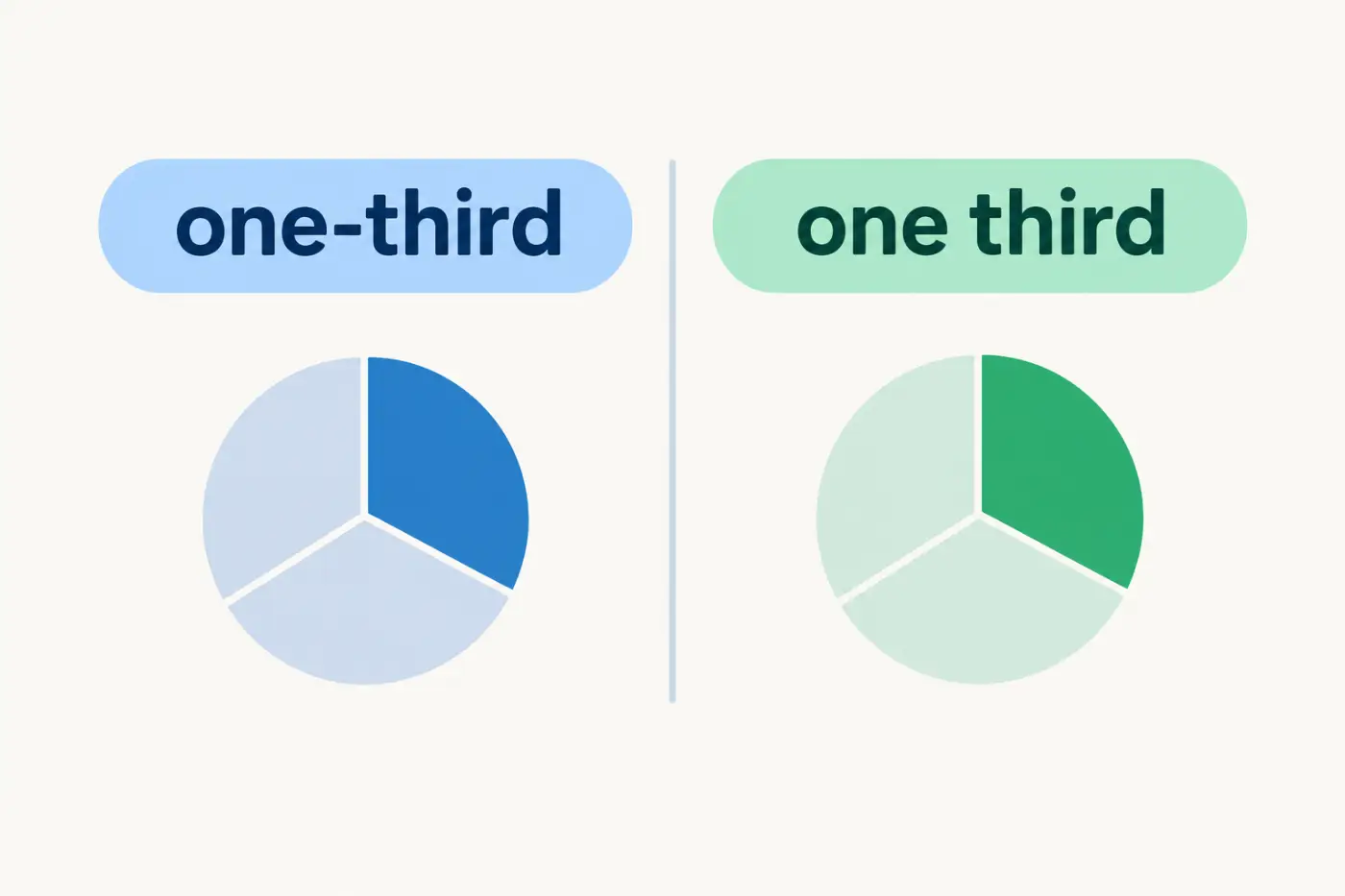
If you’re stuck on one-third or one third, the answer depends on how the fraction works in your sentence. When the fraction stands alone, one third is normally written as two separate words. When it directly describes a noun, one-third is usually hyphenated.
For example, you can write, I ate one third of the cake. The fraction stands on its own in that sentence. You can also write, She owns a one-third share of the company. Here, the fraction describes the noun share, so the words work together as one adjective.
This small punctuation choice can feel confusing because the meaning stays the same. The difference comes from grammar and sentence structure. The fraction itself does not change. Only the way it functions in the sentence changes.
This guide explains the rule in plain English. You’ll learn when to use one third, when to use one-third, how fractions work before nouns, and how to avoid common mistakes. You’ll also see plenty of natural examples that show how the rule works in everyday writing.
Quick Definition
One third means one part out of three equal parts. Use one third when the fraction acts as a noun or follows a phrase such as of the. Use one-third when the fraction works with another word to describe a noun.
Direct Answer
One third is usually correct when the fraction stands alone. One-third is usually correct when it acts as a compound adjective before a noun.
Comparison Table
| Word or Phrase | Meaning | Example Sentence | When to Use It |
|---|---|---|---|
| one third | One part of three equal parts | One third of the students arrived early. | Use it when the fraction stands alone. |
| one-third | One part of three equal parts | He owns a one-third share of the business. | Use it when the fraction describes a noun. |
How Fractions Work in English
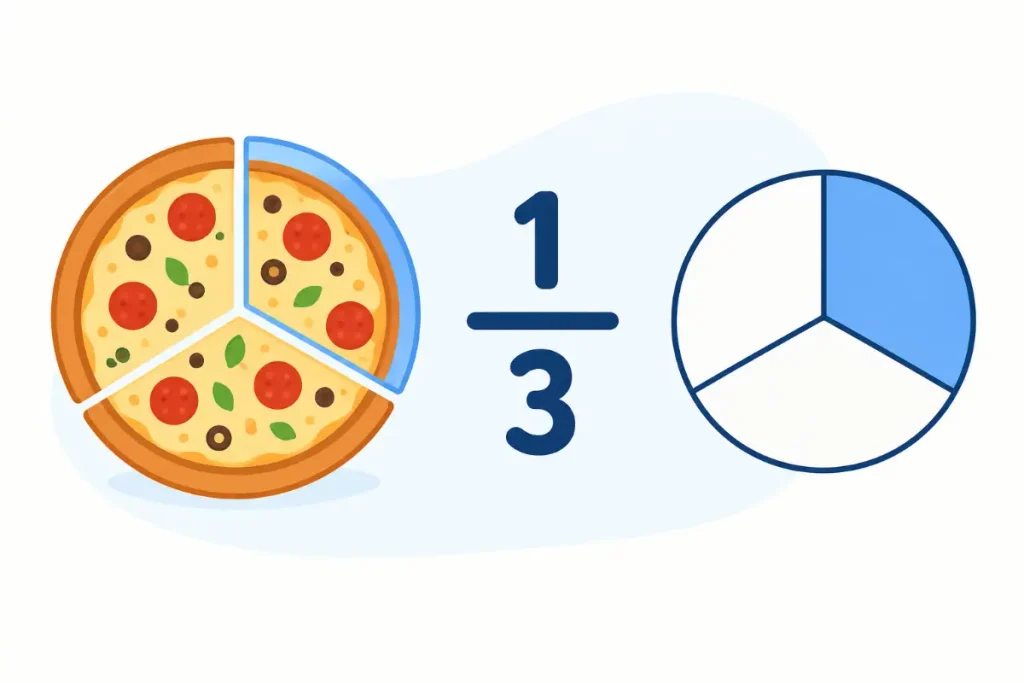
A fraction tells us about part of a whole. One third means that something has been divided into three equal parts and one of those parts is being discussed.
Think about a pizza cut into three equal slices. One slice is one third of the pizza. Two slices make up two thirds. All three slices make the whole pizza.
The grammar becomes easier once you separate the mathematical meaning from the grammatical job. The meaning stays the same. The writing changes based on how the fraction fits into the sentence.
Consider these two examples.
- I ate one third of the pizza.
- I ate a one-third slice of the pizza.
Both sentences describe the same basic fraction. In the first sentence, one third stands alone as the amount eaten. In the second sentence, one-third describes the noun slice.
That difference is the key to the entire rule.
When the Fraction Stands Alone
When a fraction functions as a noun, you normally leave it open.
Here are some examples.
- One third of the class was absent.
- She spent one third of her savings.
- About one third of the cake is gone.
- He completed one third of the project.
- One third of the voters supported the proposal.
- The first one third of the book was easy to read.
In each sentence, the fraction identifies an amount or portion. It does not directly modify a noun that comes immediately after it.
The phrase one third often appears with of.
- One third of the water was used.
- One third of the students passed.
- One third of the land is protected.
- One third of the budget went to repairs.
This is one of the easiest patterns to recognize. If you see one third followed by of, you will usually write the fraction as two words.
When the Fraction Describes a Noun
The form changes when the fraction works as an adjective before a noun.
For example.
She received a one-third share of the profits.
He owns a one-third interest in the property.
- The recipe needs a one-third cup of sugar.
- The company sold a one-third stake in the business.
- The project requires a one-third increase in funding.
In these sentences, one-third does not simply name an amount. It helps describe another noun.
- A one-third share means a share equal to one part out of three.
- A one-third interest means an interest equal to one part out of three.
- A one-third increase means an increase equal to one part out of three.
The hyphen makes the relationship between the words easier to see. It shows that one and third work together as a single modifier.
One-third or One Third in Everyday Writing
The most useful question is simple.
Ask yourself what the fraction is doing in the sentence.
If it names an amount on its own, use one third.
If it describes a noun directly, use one-third.
Compare these sentences.
- The team completed one third of the work.
- The team completed a one-third portion of the work.
In the first sentence, one third identifies the amount of work completed. In the second sentence, one-third describes portion.
Here is another pair.
- I drank one third of the bottle.
- I drank a one-third bottle of juice.
The first version is more natural in ordinary conversation. The second version is grammatically possible but sounds less common because people usually say one third of a bottle rather than a one-third bottle.
This point matters because correct grammar and natural style are not always the same thing. A sentence can follow a rule and still sound awkward. Good writing considers both.
Why the Hyphen Matters
A hyphen can join words that work together as one modifier.
Consider this sentence.
The company owns a one-third share.
Without the hyphen, a reader can still understand the meaning. However, the hyphen clearly signals that one and third belong together as a single description of share.
You can think of the hyphen as a small bridge between words. It shows that the words are working as one unit.
The same pattern appears in many other expressions.
- A two-year-old child.
- A five-mile walk.
- A ten-page report.
- A three-hour meeting.
- A one-third share.
The exact grammar differs across these examples, but the basic idea is similar. Several words combine to describe a noun.
With fractions, the hyphen is especially useful when the fraction appears directly before the noun it modifies.
The Hyphen Does Not Change the Meaning
- The hyphen does not create a new mathematical value.
- One third and one-third both refer to the same fraction.
- The difference is grammatical rather than mathematical.
This distinction helps prevent a common mistake. Some writers think the hyphen means the fraction itself has a different value. It does not.
- The fraction is still 1 divided by 3.
- The decimal value is still about 0.333.
- The percentage is still about 33.3 percent.
- Only the sentence structure changes.
Common Examples of One Third
Here are natural examples where the open form works well.
- One third of the students chose the afternoon class.
- I used one third of the flour.
- She donated one third of her earnings.
- One third of the room was empty.
- He read one third of the novel.
- We have completed one third of the assignment.
- One third of the population lives in the area.
- The tree lost one third of its branches.
- The machine uses one third of the energy required by the older model.
- About one third of the budget is reserved for maintenance.
Notice the repeated pattern. The fraction usually appears as an amount followed by of and a noun.
This structure is common in speech and writing. It is also the form most people need in everyday sentences.
Common Examples of One-third
Now look at sentences where the hyphenated form describes a noun.
- The buyer made a one-third payment.
- She received a one-third share.
- The recipe calls for a one-third cup of milk.
- He owns a one-third interest in the property.
- The company reported a one-third increase in sales.
- They agreed to a one-third reduction in costs.
- The board approved a one-third cut in funding.
- The farmer planted a one-third acre plot.
- The project needs a one-third increase in staff.
- The contract gives him a one-third stake in the company.
In each example, one-third appears immediately before a noun that it describes.
The grammar is easier to spot when you identify that noun.
For example, in one-third share, the noun is share.
- In one-third increase, the noun is increase.
- In one-third reduction, the noun is reduction.
- In one-third stake, the noun is stake.
That is why the hyphen belongs there.
The Most Common Mistake
A common mistake is to hyphenate every use of the fraction.
For example, some writers may write:
I ate one-third of the cake.
This form is often seen and can appear in published writing. However, when following the basic rule for fractions used as nouns, one third of the cake is the clearer open form.
The reverse mistake also happens. A writer may leave the fraction open before a noun.
For example:
She received a one third share.
The meaning is clear, but the hyphenated form is generally preferred when the fraction acts as a compound modifier.
She received a one-third share.
The difference looks tiny. Still, it helps readers see how the sentence is organized.
A Simple Test You Can Use
Try removing the noun after the fraction.
If the fraction still makes sense on its own, you probably need the open form.
For example:
- She owns one third of the company.
- Remove company.
- She owns one third.
- The fraction still works.
- Now look at this sentence.
- She owns a one-third share.
- Remove share.
- She owns a one-third.
That sounds incomplete because one-third is acting as a modifier for share.
This test is not a rule for every possible sentence. It is a useful shortcut for everyday writing.
Another quick test is to look for of.
If you have a structure such as one third of the class or one third of the money, the open form is usually right.
If you have a structure such as a one-third share or a one-third increase, the hyphenated form is usually right.
Fractions Before Measurements
Fractions often appear before units of measurement. This can make the rule seem more complicated than it really is.
- Consider these examples.
- I drank one third of a cup of coffee.
- The recipe needs one-third cup of milk.
- She walked one third of a mile.
- The trail is a one-third-mile route.
The first examples use the fraction as an amount. The later examples use the fraction as part of a compound modifier.
The same idea works with other measurements.
- one third of a gallon
- a one-third-gallon container
- one third of a pound
- a one-third-pound burger
- one third of an inch
- a one-third-inch gap
Notice that a measurement phrase can contain more than one hyphen when it works as a compound modifier. The exact style can vary by publication, but the purpose remains the same. The words work together to describe the noun that follows.
In everyday writing, you can often avoid a complicated compound by rewriting the sentence.
Instead of writing:
We used a one-third-gallon container.
You could write:
We used a container that holds one third of a gallon.
The second version is longer but can feel more natural.
Good writing is not just about following punctuation rules. It is also about making the sentence easy to read.
Fractions With Nouns After Them
The position of the fraction is one of the best clues.
Look at these examples.
- One third of the cake is missing.
- A one-third piece of cake is missing.
In the first sentence, the fraction comes before of. It acts as an amount.
In the second sentence, the fraction directly modifies piece. That is why the hyphen appears.
Here is another pair.
One third of the workers joined the meeting.
A one-third group of workers joined the meeting.
The first sentence sounds natural. The second is grammatically understandable but less natural because one-third group is not a common phrase.
This shows why you should not force the hyphenated form into every sentence. Use the structure that sounds natural and clearly communicates the idea.
Fractions in Formal Writing
Formal writing often needs extra care because small punctuation choices can affect readability.
You may see fractions in contracts, reports, research papers, financial documents, school assignments, and technical material.
For example:
- The tenant will pay one third of the annual fee.
- The investor will receive a one-third share of the proceeds.
- The first sentence describes an amount. The second uses the fraction as part of a noun phrase.
Consistency also matters. If a document follows a particular style guide, follow that guide across the entire document.
Different style guides can have specific preferences for fractions and measurements. The general grammar rule remains useful, but a publication or organization may have its own house style.
If you are writing for a school, workplace, website, or publication, check its style rules when they are available.
Fractions in Academic Writing
Students often encounter fractions in essays and reports.
Here are a few examples.
- One third of the participants completed the survey.
- One third of the sample came from rural areas.
- The study found a one-third reduction in response time.
- The experiment produced a one-third increase in output.
The first two examples use the fraction as an amount. The last two use it as part of a modifier.
Academic writing also rewards clear sentence structure. If a fraction makes a sentence difficult to read, consider rewriting it.
For example:
The researchers observed a one-third increase in participation.
This is clear.
You could also write:
The researchers observed that participation increased by one third.
Both sentences communicate the same basic idea. The second version may feel more direct because it uses the fraction as an amount rather than as a modifier.
Fractions in Business Writing
- Business writing uses fractions in financial and ownership contexts.
- You might see sentences such as:
- She owns one third of the company.
- She owns a one-third stake in the company.
- The company sold one third of its shares.
- The buyer purchased a one-third interest in the property.
- These examples show the two forms working side by side.
- The first and third sentences use one third as an amount.
- The second and fourth sentences use one-third to describe stake or interest.
Business documents can contain sensitive legal or financial details. In those settings, clarity matters more than trying to make every sentence short.
If a fraction creates confusion, rewrite the sentence.
Instead of:
The agreement grants a one-third interest.
You could write:
The agreement grants an interest equal to one third of the property.
The second sentence makes the relationship explicit.
Fractions and Percentages
One third is roughly equal to 33.3 percent.
That gives you another way to understand the meaning.
If a group has three equal parts and you take one part, you have one third. If you express that fraction as a percentage, it is about 33.3 percent.
For example:
One third of the students attended.
About 33.3 percent of the students attended.
The meaning is similar, but the style is different.
Fractions can feel more natural when you are talking about simple parts. Percentages can feel more useful when you need exact comparison.
The spelling rule does not change because you know the percentage.
You still write one third when the fraction stands alone.
You still write one-third when it acts as a compound modifier.
Fractions and Plural Nouns
One third can be followed by a plural noun after of.
For example:
- One third of the students were absent.
- One third of the houses need repairs.
- One third of the employees work remotely.
The fraction describes part of a group.
The noun after of remains plural because the group contains multiple people or things.
You may also see a singular noun after one third.
For example:
- One third of the cake is gone.
- One third of the water was spilled.
- One third of the money was spent.
The verb depends on the noun after of and the meaning of the sentence.
This is separate from the hyphen rule. The fraction can be open in both cases.
Fractions and Verb Agreement
Writers sometimes focus so much on the hyphen that they miss another issue. Fractions can affect subject verb agreement.
Consider:
One third of the students are absent.
The noun students is plural, so are fits the sentence.
Now consider:
One third of the cake is gone.
The noun cake is singular or treated as a mass noun, so is fits the sentence.
This gives you a useful writing habit. After writing a fraction, look at the noun that follows of. That noun often tells you which verb form belongs in the sentence.
The fraction itself does not automatically determine the verb.
Fractions With Whole Numbers
Fractions can appear alongside whole numbers.
For example:
- One and one third hours passed.
- Two and one third miles remained.
The same basic distinction applies when the fraction works as an amount.
You can also see compound modifiers.
A two and one-third-hour meeting can appear in formal writing when the entire expression modifies meeting. However, this kind of construction can become hard to read.
A clearer option is often:
The meeting lasted two hours and twenty minutes.
Or:
The meeting lasted two and one third hours.
Clear writing does not always require the most compact structure. Sometimes a few extra words make the sentence much easier to understand.
How to Remember the Rule
You do not need to memorize a long grammar chart.
Remember one simple idea.
If the fraction stands alone, keep it open. If it describes a noun, connect it with a hyphen.
Think of the hyphen as a small link between the fraction and the noun.
- One third of the cake.
- A one-third piece.
- One third of the class.
- A one-third share.
- One third of the budget.
- A one-third reduction.
This pattern covers a large share of the situations you will meet in ordinary writing.
You can also remember the phrase of the as a useful clue.
When you see one third of something, the fraction is usually acting as an amount.
When you see a one-third something, the fraction is often acting as a modifier.
That shortcut will not solve every unusual sentence, but it works well for everyday writing.
Style Choices and Consistency
English punctuation can vary slightly between style guides. You may find published sources that use a hyphen in places where another source leaves the phrase open.
That does not mean the language has no rules. It means English style sometimes allows different conventions depending on the sentence and the publication.
The most useful approach is to follow the grammatical function first. Then follow the style guide used by your school, employer, publication, or client.
Do not switch randomly between forms in the same document.
For example, if your document consistently uses one third when the fraction stands alone and one-third when it modifies a noun, keep that pattern throughout.
Consistency makes writing easier to read.
Common Mistakes to Avoid
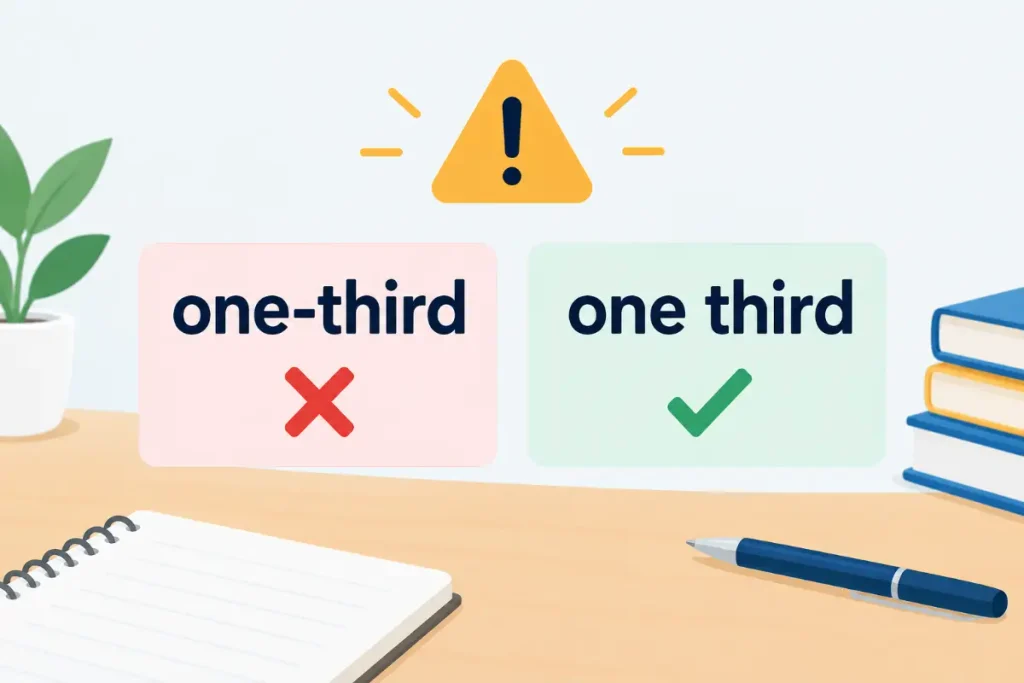
Hyphenating Every Fraction
A frequent mistake is adding a hyphen every time the fraction appears.
For example:
- One-third of the students attended.
- A cleaner general form is:
- One third of the students attended.
The fraction is an amount here. It does not directly modify students.
Leaving Compound Modifiers Open
The opposite mistake is leaving a compound modifier open.
For example:
She received a one third share.
The clearer form is:
She received a one-third share.
The hyphen shows that the fraction describes share as one unit.
Changing the Form Without Checking the Sentence
Some writers memorize one form and use it everywhere.
That approach creates problems because the sentence structure matters.
Do not simply choose one third or one-third based on habit. Look at the role of the fraction first.
Focusing Only on the Fraction
The fraction itself is only part of the sentence.
Look at the words around it. Ask what noun it describes. Check if it is followed by of. Then choose the form that fits the grammar.
Making the Sentence More Complicated Than Necessary
Sometimes writers become so focused on punctuation that they create an awkward sentence.
For example:
The company approved a one-third increase in the already one-third reduced budget.
This is difficult to read even though the grammar can be understood.
A clearer rewrite might be:
The company approved a 33.3 percent increase after the budget had already been cut by one third.
The best sentence is often the one that makes the idea easiest to understand.
One-third or One Third in Common Questions
The exact choice often depends on position.
- If you write, I used one third of the flour, the fraction stands alone.
- If you write, I used a one-third cup of flour, the fraction describes cup.
- If you write, the project took one third of the year, the fraction stands alone.
- If you write, it was a one-third-year project, the fraction modifies project.
The second form in that last example sounds awkward in normal conversation. A more natural sentence would be:
It was a project that lasted one third of a year.
That example is worth remembering because it shows that grammatical possibility does not always equal good style.
More Natural Rewrites
Sometimes the easiest way to solve a fraction problem is to rewrite the sentence.
Instead of:
The company made a one-third reduction in staff.
You can write:
The company reduced staff by one third.
Instead of:
The recipe requires a one-third cup of water.
You can write:
The recipe requires one third of a cup of water.
Both versions can work. The better choice depends on the sentence and the style you want.
Rewriting is especially useful when several compound modifiers appear close together.
Clear writing should feel smooth when read aloud. If a fraction creates a tangled phrase, step back and say the idea another way.
Examples From Everyday Situations
Fractions appear in ordinary conversation more often than you might think.
You might say:
- I ate one third of the sandwich.
- She watched one third of the movie.
- We used one third of the paint.
- He spent one third of his paycheck.
- One third of the seats were empty.
- One third of the class finished early.
These sentences all use the open form.
Now consider examples where the fraction describes a noun.
He ordered a one-third-pound burger.
She bought a one-third-acre lot.
- They agreed to a one-third share.
- The machine has a one-third-inch opening.
- The project needs a one-third increase in capacity.
- The first group treats the fraction as an amount. The second group uses the fraction as part of a description.
Once you see that difference, the rule becomes much easier.
A Practical Editing Checklist
When you are editing a sentence with this fraction, ask yourself three questions.
First, does the fraction stand alone as an amount?
If yes, use one third.
Second, does the fraction directly describe the noun that follows?
If yes, use one-third.
Third, does the sentence sound natural?
If it does not, consider rewriting it.
For example:
One third of the budget was spent.
This is clear.
A one-third portion of the budget was spent.
This is grammatical but less natural.
The first sentence is better for ordinary writing because it says the same thing more directly.
The goal is not to add punctuation simply because you can. The goal is to make the sentence clear.
Why Context Matters
Grammar rules are useful because they give you a reliable starting point. Context still matters.
A phrase may look correct in isolation but sound strange in a full sentence.
Take one-third share.
That phrase works naturally in:
She owns a one-third share of the company.
Now consider:
She owns one third of the company.
Both sentences work. The first treats share as the noun being modified. The second states the amount directly.
You can often choose between these structures based on what you want to emphasize.
The first emphasizes the type of ownership.
The second emphasizes the portion of the company.
That is a useful writing choice, not just a punctuation choice.
FAQs
Is one third or one-third correct?
Both forms can be correct. Use one third when the fraction stands alone as an amount. Use one-third when it directly modifies a noun as part of a compound adjective.
Is one third always two words?
No. The form depends on its role in the sentence. When the fraction stands alone, one third is normally written as two words. When it modifies a noun directly, one-third is normally hyphenated.
Should I write one third of a cake?
Yes. Write one third of a cake when the fraction describes the amount. The same pattern works in sentences such as one third of the class and one third of the money.
Should I write a one-third share?
Yes. A one-third share is the standard form because one-third works together to describe the noun share.
Is one-third of the cake wrong?
Not necessarily. You may see this form in published writing and different style systems. For the basic grammar rule used in general American English, one third of the cake is the standard open form when the fraction functions as an amount.
Do I hyphenate fractions before nouns?
Usually yes when the fraction directly works as a compound modifier before a noun. Examples include a one-third share, a one-half portion, and a two-thirds majority.
Is one third the same as 33 percent?
Not exactly. One third equals about 33.3 percent. Saying 33 percent gives a rounded value rather than the exact fraction.
Can I rewrite a sentence to avoid the hyphen?
Yes. Rewriting can make a sentence clearer. For example, instead of a one-third increase, you can write an increase of one third.
Conclusion
The choice between one-third or one third depends on the job the fraction does in your sentence. When it stands alone as an amount, write one third. When it directly describes a noun, use one-third as a compound modifier.
The easiest examples are one third of the cake and a one-third share. The first phrase names an amount. The second phrase describes a noun. That small difference explains the punctuation.
Keep the simple rule in mind. If the fraction stands alone, leave it open. If it works with a noun as one description, use the hyphen. Then read the sentence once to make sure the wording sounds natural.
You do not need to memorize dozens of special cases. Look at the words around the fraction and identify its role. Once you can spot the difference between an amount and a compound modifier, choosing the right form becomes almost automatic.

Dr. Arthur Pendelton is a veteran historical linguist and grammar expert with over 30 years of experience in academic editing. A retired professor, Arthur specializes in the etymology and evolution of the English language. He is passionate about “unpacking the history behind the rules,” helping readers understand why we spell, punctuate, and phrase things the way we do today. Whether he’s settling debates on archaic usage or explaining complex linguistic shifts, Dr. Pendelton brings scholarly precision to every article.