
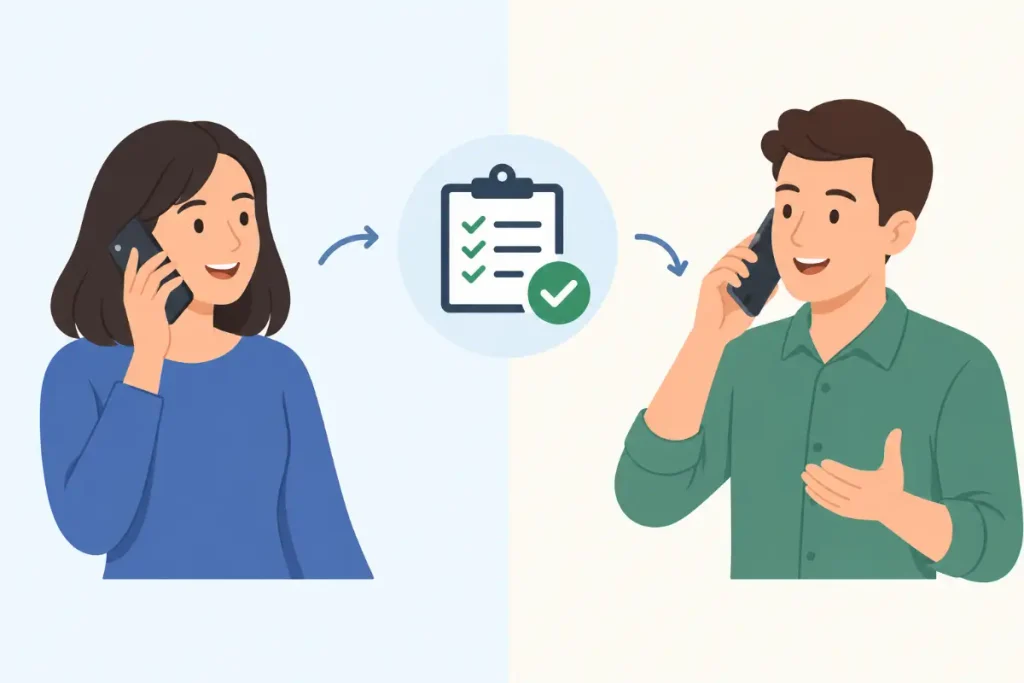
If you’ve wondered about talk on the phone or over the phone, both expressions are correct in American English. The difference is small and mostly depends on what you want to emphasize. Talk on the phone is the more common everyday expression when you mean having a phone conversation. Talk over the phone can also mean having a phone conversation, but it often puts more focus on the method of communication.
For example, you can say, “I talked to Sarah on the phone last night.” You can also say, “We talked over the phone about the project.” Neither sentence has a grammar error.
The real question is not which phrase is grammatically correct. Both work. The better choice depends on the sentence, the situation, and the meaning you want to highlight.
This guide explains the difference in plain English. You’ll see natural examples, common mistakes, useful alternatives, and simple ways to remember which expression sounds best in everyday American English.
Quick Definition
Talk on the phone usually means to have a conversation using a telephone. It is the most natural choice in many casual situations. Talk over the phone also means to communicate by telephone, but it can sound a little more focused on the phone as the method of communication.
Direct Answer
Both talk on the phone and talk over the phone are correct. In everyday American English, talk on the phone is usually the more natural and common choice when you simply mean having a phone conversation.
Comparison Table
| Word or Phrase | Meaning | Example Sentence | When to Use It |
|---|---|---|---|
| Talk on the phone | Have a phone conversation | I talked to Mike on the phone. | Everyday conversation |
| Talk over the phone | Communicate by telephone | We talked over the phone about the issue. | When the method of communication matters |
| Talk to someone on the phone | Have a conversation with a person by phone | I need to talk to my doctor on the phone. | Clear and natural everyday English |
| Talk with someone on the phone | Have a conversation with someone by phone | I talked with my sister on the phone. | Friendly or neutral situations |
| Speak on the phone | Communicate by telephone | She was speaking on the phone. | Common and slightly more formal |
| Speak over the phone | Communicate by telephone | We spoke over the phone yesterday. | Professional or formal situations |

Why The Two Phrases Cause Confusion
The confusion comes from the prepositions on and over. English uses both in connection with phone calls, but they can give the sentence a slightly different feel.
The word on is strongly connected with the idea of using a phone for communication. You can say someone is on the phone, talking on the phone, or speaking on the phone.
For example:
- “I’m on the phone right now.”
- “Jessica is talking on the phone.”
- “I spent an hour on the phone with my brother.”
These expressions are very common in American English.
The word over can describe communication through a particular method. You might say that two people talked over the phone, discussed something over email, or communicated over a video call.
For example:
- “We discussed the problem over the phone.”
- “They worked out the details over email.”
- “We talked over a video call.”
In these examples, over draws attention to the channel used for communication.
That difference is subtle. In many sentences, both expressions communicate the same basic idea.
What Talk On The Phone Means
Talk on the phone means to have a spoken conversation using a telephone.
It is a common phrase in everyday American English. People use it at home, at work, with friends, with family members, and in many other situations.
Consider these examples.
- “I talked to my mom on the phone this morning.”
- “Can I talk to you on the phone later?”
- “We talked on the phone for almost an hour.”
- “She doesn’t like talking on the phone.”
- “I was talking on the phone when you called.”
Each sentence sounds natural because on the phone is a standard English expression.
The phrase does not usually suggest anything special about the phone itself. It simply tells the reader or listener that the conversation happened by telephone.
That makes it a useful everyday choice.
What Talk Over The Phone Means
Talk over the phone also means to have a conversation by telephone.
The main difference is the emphasis. Over the phone can highlight the fact that the conversation happened through a phone rather than in person.
For example:
- “We talked over the phone about the new contract.”
- “I explained everything over the phone.”
- “They talked over the phone before meeting in person.”
In the last example, the contrast is especially clear. The people first communicated by phone and later met face to face.
You’ll often see over the phone in business writing and professional communication.
For example:
- “The customer confirmed the details over the phone.”
- “We discussed the payment options over the phone.”
- “The manager gave me the information over the phone.”
These sentences focus on how the information was exchanged.
Which One Sounds More Natural
For ordinary conversation, talk on the phone often sounds more natural.
Imagine a friend asks you what you did last night.
You might say:
“I talked to my cousin on the phone.”
That sounds completely normal.
You could also say:
“I talked to my cousin over the phone.”
That sentence is also correct. It simply places a little more attention on the phone as the way you communicated.
The difference is not large enough to cause concern in most situations.
Native speakers often choose between the two based on context rather than a strict grammar rule.
If you’re simply describing a phone conversation, on the phone is a safe and natural choice.
If you want to emphasize the communication method, over the phone works well.
How On And Over Work Differently
The easiest way to understand the difference is to think about what each preposition highlights.
On often describes the state of being connected to a phone conversation.
For example:
- “I’m on the phone.”
- “She’s on the phone with her boss.”
- “He spent the afternoon on the phone.”
Over often describes communication that happens through a particular channel.
For example:
- “We discussed it over the phone.”
- “They reached an agreement over the phone.”
- “I gave him the details over the phone.”
The distinction is similar to the difference between being on a call and doing something over a call.
The first expression describes participation in the call.
The second expression can focus more on what was communicated through that call.
Still, these meanings overlap. English does not always draw a hard line between them.
Section One Takeaway
Both expressions are grammatically acceptable. Talk on the phone is especially common in casual American English. Talk over the phone is also natural and often emphasizes the phone as the communication method.
You don’t need to worry about choosing the wrong phrase in ordinary conversation. Context usually makes the meaning clear.
When To Use Each Expression
Knowing the basic difference is helpful. Knowing how the phrases behave in real sentences is even better.
English becomes easier when you look at complete examples instead of trying to memorize isolated grammar rules.
Use On The Phone For Everyday Conversations
Use on the phone when you simply want to say that someone is having a phone conversation.
For example:
- “I’m talking to Dad on the phone.”
- “She talked to her friend on the phone.”
- “We were on the phone all morning.”
- “He spends a lot of time on the phone.”
- “I need to talk to you on the phone.”
These sentences sound relaxed and natural.
You’ll hear this expression often in everyday American speech.
It also works in informal writing.
For example:
“My sister called me last night, and we talked on the phone for two hours.”
That sentence sounds like something a person would naturally say.
Use Over The Phone To Highlight The Method
Use over the phone when you want to emphasize that the conversation or information exchange happened by telephone.
For example:
- “The interview was conducted over the phone.”
- “We discussed the problem over the phone.”
- “She gave me the instructions over the phone.”
- “The bank confirmed my information over the phone.”
These examples have a slightly different focus.
The key point is not simply that the people were talking. The point is that they used the phone to communicate.
This is one reason over the phone appears often in professional settings.
Professional Examples
Both forms can appear at work, but over the phone often fits professional sentences particularly well.
Consider these examples.
“I spoke with the client over the phone.”
- “We discussed the proposal over the phone.”
- “The issue was resolved over the phone.”
- “The customer placed the order over the phone.”
- “The manager explained the changes over the phone.”
These sentences sound natural in emails, reports, and workplace conversations.
You could also use on the phone.
- “I spoke with the client on the phone.”
- “We discussed the proposal on the phone.”
- “The customer gave us the information on the phone.”
Those sentences are correct too.
The choice often depends on the style of the sentence.
Casual Examples
In casual speech, on the phone is often the easiest choice.
Here are some natural examples.
- “I was on the phone with Jake.”
- “Can you talk on the phone tonight?”
- “She’s talking on the phone with her sister.”
- “I’ll call you so we can talk on the phone.”
- “We talked on the phone until midnight.”
- “I haven’t talked to him on the phone in weeks.”
These sentences feel conversational and familiar.
They work well when talking with friends, family, coworkers, or classmates.
Is Talk On The Phone Correct
Yes. Talk on the phone is grammatically correct.
The phrase follows a common English pattern in which on describes communication through a phone.
You can also say:
- “talk to someone on the phone”
- “talk with someone on the phone”
- “speak to someone on the phone”
- “speak with someone on the phone”
- “be on the phone”
All of these forms are standard.
For example:
- “I talked to Lisa on the phone.”
- “I talked with Lisa on the phone.”
The choice between to and with can depend on style and context, but both are widely used.
Is Talk Over The Phone Correct
Yes. Talk over the phone is also correct.
It is especially useful when the sentence focuses on communication through a phone.
For example:
- “We talked over the phone about the job.”
- “I talked to my uncle over the phone.”
- “They talked over the phone before the meeting.”
- “She talked with the customer over the phone.”
You can replace talk with speak, discuss, explain, confirm, or other verbs.
For example:
- “We discussed the issue over the phone.”
- “She explained the process over the phone.”
- “They confirmed the appointment over the phone.”
These examples show why over the phone can be useful in professional English.
Talk To Someone On The Phone
The phrase talk to someone on the phone is one of the most natural patterns in American English.
For example:
- “I need to talk to John on the phone.”
- “I talked to my teacher on the phone yesterday.”
- “Can I talk to you on the phone tonight?”
- “She talked to her doctor on the phone.”
The person you are speaking with usually comes after talk to.
Then on the phone tells us how the conversation happened.
The basic structure is:
talk to + person + on the phone
For example:
“I talked to Sarah on the phone.”
That structure is simple and useful.
Talk With Someone On The Phone
You can also use talk with.
For example:
- “I talked with Sarah on the phone.”
- “We talked with the manager on the phone.”
- “She talked with her parents on the phone.”
In American English, talk to and talk with are both common.
Some speakers use talk with when they want to highlight a two way conversation. Still, the distinction is not strict. In everyday speech, people often use both forms naturally.
Speak On The Phone
Speak on the phone is also correct.
For example:
- “I spoke with my boss on the phone.”
- “She was speaking on the phone when I arrived.”
- “We spoke on the phone yesterday.”
The verb speak can sound a little more formal than talk in some contexts.
That makes it useful in professional communication.
For example:
“I spoke with the client on the phone.”
This sounds polished but still natural.
You could also say:
“I talked to the client on the phone.”
That version sounds more casual.
Both are correct.
Speak Over The Phone
Speak over the phone is another standard expression.
For example:
- “We spoke over the phone last week.”
- “I spoke with the customer over the phone.”
- “She spoke to the manager over the phone.”
This phrase often appears in professional English.
For example:
“I spoke with the hiring manager over the phone before the interview.”
The sentence clearly tells the reader that the conversation happened by telephone.
Talk On The Phone Or Over The Phone In A Sentence
The best way to see the difference is to compare similar sentences.
“I talked to Mark on the phone.”
This simply tells us that you had a phone conversation with Mark.
“I talked to Mark over the phone.”
This also tells us that you had a phone conversation with Mark. The wording gives a little more attention to the phone as the method.
Here is another pair.
- “We discussed the issue on the phone.”
- “We discussed the issue over the phone.”
Both are understandable and grammatical.
The second sentence may sound slightly more natural when the writer wants to stress that the issue was handled by telephone.
That is why you might see over the phone in business communication.
Common Mistakes To Avoid
Most mistakes with these expressions come from trying to apply one preposition everywhere.
English does not always work that way.
For example, some learners think over the phone must always be more correct because it describes communication. That is not true.
Others think on the phone only works with the verb be.
That is also incorrect.
You can say:
“I’m on the phone.”
You can also say:
“I talked to her on the phone.”
Both are natural.
Another common mistake is adding unnecessary words.
For example:
“I talked with him through on the phone.”
That sentence is incorrect because through and on do not belong together in that structure.
Use one clear expression instead.
“I talked with him on the phone.”
Or:
“I talked with him over the phone.”
Simple is better.
Common Mistake With In The Phone
Learners sometimes say:
“I talked in the phone.”
- That is not the standard expression.
- Use on the phone instead.
- Correct:
- “I talked to her on the phone.”
- Incorrect:
- “I talked to her in the phone.”
The preposition on is part of the standard phrase.
- You’ll also hear:
- “He’s on the phone.”
- Not:
- “He’s in the phone.”
- That small preposition makes a big difference.
Common Mistake With By The Phone
By the phone has a different meaning.
It usually refers to physical location rather than the method of communication.
For example:
“She is sitting by the phone.”
This means she is sitting near the phone.
It does not mean she is having a phone conversation.
Compare these sentences.
- “She is on the phone.”
- She is having a phone conversation.
That distinction is useful because on, over, and by can create very different meanings.
Can You Say Talk Over A Phone
You may hear talk over a phone, but it is not the normal expression when you mean a general phone conversation.
In most cases, say:
“talk on the phone”
or
“talk over the phone”
You can use over a phone in special contexts when you are talking about a particular device or technology.
For example:
“They communicated over a satellite phone.”
That sentence focuses on the type of device.
For ordinary conversations, on the phone or over the phone sounds much more natural.
Can You Say Talk Through The Phone
Talk through the phone can appear in English, but it does not usually serve as the standard replacement for talk on the phone.
If you simply mean a normal telephone conversation, use:
“I talked to her on the phone.”
You can use through the phone when the wording focuses on something passing through the device or being communicated by means of it.
For example:
“I could hear his voice clearly through the phone.”
Here, through describes the sound reaching the listener through the device.
That is different from simply saying someone had a phone conversation.
A Simple Memory Trick
Here is an easy way to remember the difference.
Think of on as the normal everyday phone setting.
- You are on the phone.
- You talk on the phone.
Think of over as the communication route.
- You discuss something over the phone.
- You explain something over the phone.
This is not an absolute grammar rule. It is a practical pattern that can help you choose the phrase that sounds natural.
If you’re stuck, on the phone is usually a safe choice for everyday conversation.
Related Expressions You Should Know
English has several common expressions for phone communication.
On A Phone Call
You can say:
- “I’m on a phone call.”
- “She’s on a phone call with her doctor.”
This sounds natural when you want to describe the call itself.
On The Phone With Someone
You can say:
- “I’m on the phone with my brother.”
- “She was on the phone with her manager.”
This is especially common in everyday American English.
By Phone
By phone is often used when describing the method of contact.
For example:
- “Please contact us by phone.”
- “You can make a reservation by phone.”
- “I confirmed the appointment by phone.”
This wording can sound more formal.
Over The Phone
Over the phone also describes the method of communication.
For example:
- “We confirmed the details over the phone.”
- “I received the information over the phone.”
“The interview took place over the phone.”
On The Telephone
On the telephone is grammatically correct, but it can sound more formal or old fashioned than on the phone in casual American English.
For example:
“I spoke with him on the telephone.”
That sentence is perfectly correct.
Still, most people would probably say:
“I spoke with him on the phone.”
The shorter version is more natural in everyday speech.
How Native Speakers Usually Say It
Native speakers do not normally stop to think about the grammar behind these phrases. They choose the expression that fits the situation.
That is useful for English learners because it means you don’t need to memorize a complicated rule.
Focus on the common patterns.
- If you are describing the act of having a phone conversation, on the phone is very natural.
- If you are describing something that was communicated by telephone, over the phone often fits well.
For example:
- “I talked to my sister on the phone.”
- “We discussed the travel plans over the phone.”
Both sentences sound natural because each phrase fits its context.
Everyday Conversations
Imagine someone asks:
“What are you doing?”
You might answer:
“I’m talking to Mom on the phone.”
That is the natural everyday choice.
Now imagine someone asks:
“How did you discuss the issue?”
You might answer:
“We talked about it over the phone.”
The second answer focuses more on the method used to discuss the issue.
Again, the difference is small.
Workplace Conversations
At work, both expressions are useful.
For example:
- “I spoke with the client on the phone.”
- “We discussed the contract over the phone.”
- “The customer gave us the information over the phone.”
- “I was on the phone with the supplier for an hour.”
These sentences show how flexible the expressions are.
You don’t need to avoid on the phone in professional writing. It is completely standard.
Likewise, you don’t need to avoid over the phone in casual speech.
The context matters more than formality.
Phone Calls With Friends And Family
With friends and family, on the phone is usually the phrase you’ll hear most often.
For example:
- “I talked to Grandma on the phone.”
- “We talked on the phone all evening.”
- “I need to call him and talk to him on the phone.”
- “She was on the phone with her sister.”
These phrases sound relaxed and natural.
Formal Writing
In formal writing, you may want to choose a more precise verb instead of simply using talk.
For example:
- “We discussed the matter over the phone.”
- “The details were confirmed over the phone.”
- “I spoke with the representative over the phone.”
- “The appointment was arranged by phone.”
These sentences clearly explain how communication took place.
Still, there is no grammar rule that says formal writing must use over.
You can write:
“We discussed the matter on the phone.”
That sentence is correct too.
Talk On The Phone Or Over The Phone For Emails
Suppose you are writing an email after a phone call.
You could write:
“Thanks for talking with me on the phone today.”
Or:
“Thanks for speaking with me over the phone today.”
Both are correct.
The first feels more conversational.
The second can sound slightly more formal.
Here is another example.
“I enjoyed talking with you on the phone.”
That sounds friendly.
“I appreciated the opportunity to speak with you over the phone.”
That sounds more professional.
The difference comes from the overall tone, not from a grammar rule that makes one phrase right and the other wrong.
Which Phrase Should English Learners Choose
If you are learning English and want one easy default, use on the phone for ordinary conversations.
For example:
- “I talked to him on the phone.”
- “She’s on the phone.”
- “We talked on the phone yesterday.”
These patterns are common and easy to use.
Then learn over the phone as another useful option.
Use it when you want to focus on the phone as the way communication happened.
For example:
“We discussed the problem over the phone.”
That simple distinction will cover most situations.
Why Context Matters
English prepositions often depend on context.
That is why trying to translate each word directly from another language can cause problems.
A phrase that uses one preposition in another language may use a different preposition in English.
The best approach is to learn common phrases as complete patterns.
Instead of memorizing only the word on, remember:
“talk on the phone”
Instead of memorizing only over, remember:
“discuss something over the phone”
This approach makes your English sound more natural because you are learning the phrases people actually use.
Examples You Can Copy
Here are natural examples you can use in everyday English.
- “I talked to my brother on the phone last night.”
- “Can we talk on the phone later?”
- “She was talking on the phone when I arrived.”
- “I spoke with my manager on the phone this morning.”
- “We discussed the problem over the phone.”
- “They confirmed the details over the phone.”
- “I explained everything over the phone.”
- “The customer placed the order over the phone.”
- “I spent two hours on the phone yesterday.”
- “She’s been on the phone all morning.”
- “We talked over the phone before the meeting.”
- “I need to speak with you on the phone.”
Each sentence uses a standard English pattern.
A Practical Rule For Fast Decisions
When you need to choose quickly, ask yourself what you are trying to say.
- If you mean having a phone conversation, choose on the phone.
- If you mean communicating something by telephone, over the phone often sounds natural.
For example:
- “I talked to my friend on the phone.”
- “We solved the problem over the phone.”
That simple approach works in most everyday situations.
Why Both Forms Are Accepted
English has many phrases where two prepositions can work with slightly different shades of meaning.
Phone communication is one of those areas.
Language develops through regular use. Speakers do not always follow a single mechanical formula.
That is why dictionaries and common usage recognize both on the phone and over the phone.
The expressions overlap in meaning, but they are not always interchangeable in tone.
- On the phone feels very natural when describing a person who is currently engaged in a call.
- Over the phone often sounds natural when describing information, decisions, discussions, or arrangements made through a call.
For example:
“She’s on the phone.”
That sounds more natural than:
“She’s over the phone.”
But:
“We discussed the issue over the phone.”
- works perfectly.
- You could also say:
- “We discussed the issue on the phone.”
- That is correct too.
- This shows why context matters.
Talk On The Phone Or Over The Phone In American English
In American English, on the phone is extremely common in everyday speech.
You’ll hear people say:
- “I’m on the phone.”
- “Who were you talking to on the phone?”
- “I talked to him on the phone.”
- “She’s been on the phone all day.”
These patterns are deeply familiar to American speakers.
Over the phone is also common.
You’ll hear it in sentences such as:
- “We talked over the phone.”
- “I gave him the information over the phone.”
- “We arranged everything over the phone.”
It is especially useful when the sentence focuses on an action completed through the call.
Does The Choice Change The Meaning
Usually, the basic meaning stays the same.
If you say:
“I talked to Anna on the phone.”
Most people understand that you had a phone conversation with Anna.
If you say:
“I talked to Anna over the phone.”
People understand the same basic fact.
The difference is mainly one of emphasis and natural phrasing.
That means you do not need to worry about confusing someone by choosing one instead of the other.
The context usually does the heavy lifting.
Is One More Correct Than The Other
No. Both are correct.
Still, on the phone is often the more natural choice when you simply mean talking by telephone in everyday American English.
Over the phone is also standard and can be especially useful when you want to emphasize that something happened through a phone call.
The best phrase depends on the sentence.
That is the key point to remember.
Section Two Takeaway
Use on the phone as your everyday choice for phone conversations. Use over the phone when you want to focus more on communication happening through a telephone.
Both expressions belong to standard English. Neither one is a grammar mistake.
FAQs
Is talk on the phone or over the phone more natural?
Both are natural expressions. Talk on the phone is often more common in casual American English. Talk over the phone can put more emphasis on the phone as the method of communication.
Can I say I talked to him on the phone?
Yes. This is a very common and natural sentence in American English. It simply means that you had a conversation with him by telephone.
Can I say I talked to him over the phone?
Yes. The sentence is grammatically correct and widely used. It can sound slightly more focused on the phone as the way you communicated.
Is it correct to say talk in the phone?
No. The standard expression is talk on the phone. Use on when you mean that someone is participating in a phone conversation.
Is talk over the phone formal?
It can sound slightly more professional in some sentences, but it isn’t strictly formal. People use it in both casual and professional communication.
Should I use on the phone in everyday speech?
Yes. On the phone is a safe and natural choice for everyday American English. You can use it when talking about phone conversations with friends, family, coworkers, and other people.
Is speak on the phone correct?
Yes. Speak on the phone is correct and common. For example, you can say, “I spoke with my manager on the phone yesterday.”
Is speak over the phone correct?
Yes. Speak over the phone is also correct. It works well when you want to describe communication that happened through a phone call.
Can I use on the phone in professional writing?
Yes. There is nothing incorrect or informal about the phrase. For example, “I spoke with the client on the phone” is clear and professional.
Can I use over the phone with discuss?
Yes. Discuss something over the phone is a common structure. For example, “We discussed the contract over the phone.”
What is the difference between by phone and on the phone?
By phone often describes the method used to contact someone. On the phone usually describes someone participating in a phone conversation. For example, “Please contact us by phone” describes the method, while “She is on the phone” describes her current activity.
What is the easiest way to remember the difference?
Think of on the phone as the common phrase for being in a phone conversation. Think of over the phone as a phrase that can highlight communication through the phone. Both are correct, so context should guide your choice.
Conclusion
If you came here asking about talk on the phone or over the phone, the answer is simple. Both expressions are correct in American English. The main difference comes from emphasis and context rather than grammar.
Use on the phone when you’re talking about having a phone conversation. It is especially common in everyday speech. For example, “I talked to my sister on the phone last night” sounds completely natural.
Use over the phone when you want to focus more on the phone as the way communication happened. For example, “We discussed the problem over the phone” clearly shows that the discussion happened through a phone call.
You don’t need to worry about making a serious mistake with either expression. When you’re simply describing a phone conversation, on the phone is an easy and natural choice. When you’re describing information, plans, decisions, or discussions handled by phone, over the phone works well.

Dr. Arthur Pendelton is a veteran historical linguist and grammar expert with over 30 years of experience in academic editing. A retired professor, Arthur specializes in the etymology and evolution of the English language. He is passionate about “unpacking the history behind the rules,” helping readers understand why we spell, punctuate, and phrase things the way we do today. Whether he’s settling debates on archaic usage or explaining complex linguistic shifts, Dr. Pendelton brings scholarly precision to every article.