
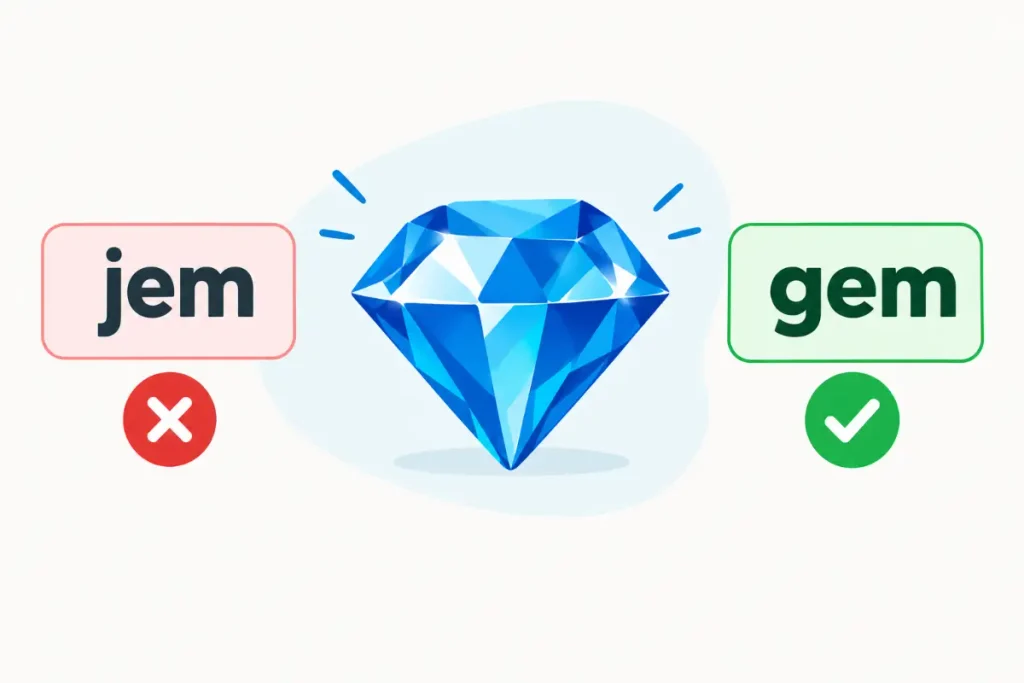
If you’re wondering about gem or jem, the correct spelling for the English word meaning a precious stone is gem. The spelling jem isn’t the standard spelling for a jewel or something valuable. It can appear as a name or in other languages, but you shouldn’t use it as the normal spelling of the English noun.
The confusion makes sense because both spellings sound the same. When you hear the word spoken, the first sound sounds like the letter J. That can make jem feel like the natural spelling. English has many words where pronunciation doesn’t give you a perfect guide to spelling.
In this guide, you’ll learn why gem is correct, what the word means, how to use it in everyday sentences, and why the other spelling causes confusion. You’ll also see how the word works in both literal and figurative situations.
By the end, you’ll have a simple way to remember the spelling. You’ll also know when Jem with a capital letter can be correct.
Quick Definition
Gem is the standard English spelling for a precious or valuable stone such as a diamond, ruby, or sapphire. The word can also describe something or someone that is especially valuable, beautiful, useful, or admired.
Jem is not the standard spelling for the English word meaning a jewel. In English, Jem can be used as a proper name or nickname.
Direct Answer
The correct spelling is gem when you mean a precious stone or something highly valued. Use Jem only in a proper name or another specific context where that spelling is intended.
Gem and Jem Comparison
| Word or Phrase | Meaning | Example Sentence | When to Use It |
|---|---|---|---|
| Gem | A precious stone or something highly valued. | The ring has a beautiful gem in the center. | Use it for the standard English word. |
| Jem | A proper name or nickname in English. | Jem was waiting outside the house. | Use it when referring to someone with that name. |
Why Gem Is the Correct Spelling
The standard English word is gem. It refers to a valuable stone that is often cut and polished for use in jewelry. The word can also describe something that people value for its beauty, quality, usefulness, or excellence.
For example, a diamond can be called a gem because it is a valuable stone used in jewelry.
You can also call a small restaurant a hidden gem if it is excellent but not widely known.
The same word works in both examples. The first meaning is literal. The second is figurative.
That second use is very common in American English. People often use gem to praise a person, place, book, movie, idea, or piece of information.
Consider these examples.
The jeweler showed us a rare gem.
That little bookstore is a hidden gem.
Her advice was a real gem.
We found a gem of a restaurant near the beach.
In every example, the spelling stays the same.
Why The Spelling Causes Confusion
The main reason people write jem is pronunciation.
The word gem is pronounced like jem. The letter G can have a soft sound before certain vowels. In gem, the G makes the same starting sound you hear in words such as gentle, giant, and genuine.
That can create a spelling trap.
A person hears the word and thinks about the letter that normally represents that sound. The letter J seems like an obvious choice. So they may write jem instead of gem.
English spelling doesn’t always work that way.
A sound can have more than one possible spelling. The same letter can also represent different sounds in different words.
For example, G has a hard sound in go, garden, and gold. But it has a soft sound in gem, gentle, and giant.
That difference is one reason spelling English can take practice.
The good news is that you don’t need to memorize a complicated rule for this word. Just remember that the precious stone is a gem.
What Does Gem Mean
The most basic meaning of gem is a precious or semiprecious stone. A gem is often cut, polished, or prepared for use as an ornament.
Common examples include diamonds, rubies, sapphires, emeralds, and other stones valued for their beauty and qualities.
Here are some natural sentences.
- She wore a necklace with a blue gem.
- The museum displayed a rare gem from the collection.
- The jeweler examined the gem under a bright light.
- The ring contains a small green gem.
- The word can refer to the stone itself or to a stone set into jewelry.
You might say:
The gem was set in a gold ring.
You might also say:
The ring was decorated with several gems.
The plural form is gems.
The store sells colorful gems from around the world.
The verb form also exists. To gem something means to decorate it with gems. This use is less common in everyday conversation but is a valid English use.
Gem Can Mean More Than a Stone
English speakers often use gem in a figurative way.
In this sense, a gem is something that is unusually good, valuable, beautiful, or useful.
For example:
That old camera is a real gem.
The speaker isn’t saying the camera is a gemstone. The speaker means the camera is special or valuable.
You can use the same idea for people.
Sarah is a gem.
This means Sarah is a wonderful person. She may be kind, helpful, thoughtful, or simply someone the speaker values greatly.
American English uses this figurative meaning often.
You might hear someone say:
He’s a gem of a teacher.
That means the teacher is especially good or valued.
You can also use the word for information.
She gave me a few gems of advice.
Here, gems means valuable pieces of advice.
The figurative meaning gives the word more range than a simple dictionary definition might suggest.
Gem as a Compliment
Calling someone a gem is generally a compliment.
Imagine a friend helps you move into a new apartment. They spend hours carrying boxes and setting up furniture.
You might say:
You’re a gem.
You’re not talking about jewelry. You’re saying the person is kind and valuable to you.
The expression can sound warm and natural in casual conversation.
Other examples include:
My neighbor is a gem. She always helps when someone needs it.
Your assistant is a gem. She solved the problem in minutes.
He’s such a gem for helping us at the last minute.
This use is informal but widely understandable.
Gem as a Hidden Find
Another common expression is hidden gem.
A hidden gem is a person, place, thing, or experience that is excellent but not widely known.
For example:
We found a hidden gem of a restaurant downtown.
The restaurant isn’t literally hiding. The phrase means it deserves more attention than it gets.
- You might call a small bookstore a hidden gem.
- You might call an underrated movie a hidden gem.
- You might call a quiet hiking trail a hidden gem.
- You might even describe a useful website as a hidden gem.
The expression works because a gemstone has value even when it isn’t immediately noticed. That idea carries naturally into the figurative meaning.
Where The Word Gem Comes From
The history of gem also explains why the spelling begins with G.
The English word comes through Middle English and Old French from the Latin word gemma, which meant a precious stone or jewel. American Heritage gives the same basic path and traces the English word to Middle English gemme, from Old French and Latin.
Dictionary sources date the English use of the word to the Middle English period. Dictionary.com gives an origin in the late thirteenth to early fourteenth century and connects it with the Latin word gemma.
That history matters because the standard spelling developed from older forms connected to the same root.
The spelling wasn’t created from the modern pronunciation of the letter J. It came through a much older history of the word.
Etymology Online also traces the noun through Old French gemme to Latin gemma.
So if you wonder why the word isn’t written with J even though it sounds like it starts with J, the answer is partly historical.
English spelling often preserves older forms of words long after pronunciation changes.
The Soft G Sound in Gem
One useful way to understand this word is to focus on the sound of G.
In English, G can have a hard sound or a soft sound.
A hard G appears in words such as:
- garden.
- gold.
- green.
A soft G appears in words such as:
- gem.
- gentle.
- giant.
- giraffe.
The soft G in gem sounds like the beginning of job or jelly.
That doesn’t mean the word should be spelled with J.
Think of pronunciation and spelling as two related systems. They work together, but they don’t always match letter for letter.
That’s especially true in English.
Common Examples With Gem
Seeing the correct spelling in different situations makes it easier to remember.
Jewelry
- She bought a necklace with a small blue gem.
- The ring has a diamond gem in the center.
- The jeweler carefully cleaned each gem.
- The earrings contain matching gems.
People
- My grandmother is a gem.
- You’re a gem for helping me with this project.
- Their new teacher is a real gem.
- He was a gem throughout the entire trip.
Places
- We found a hidden gem near the coast.
- That café is a local gem.
- The small hotel turned out to be a real gem.
Books and Movies
- The novel is a forgotten gem.
- That old film is a gem.
- I found a gem of a short story online.
Advice and Information
- She gave me a gem of advice.
- The article contains several useful gems of information.
- His comment was a little gem of wisdom.
Notice how the spelling never changes in any of these examples.
Common Mistakes With This Word
The most common mistake is simply replacing G with J.
For example:
Incorrect: She found a beautiful jem.
Correct: She found a beautiful gem.
Another common mistake happens in figurative expressions.
Incorrect: That restaurant is a hidden jem.
Correct: That restaurant is a hidden gem.
The mistake doesn’t change the pronunciation. That’s why spell check or careful proofreading matters.
A reader may understand what you mean immediately, but the spelling still isn’t standard for this meaning.
This matters more in formal writing.
A spelling error in a text message may pass unnoticed. In a school paper, article, resume, business email, or published piece, it can make the writing look less polished.
Why Spell Check May Not Save You
Some spelling mistakes are easy for software to catch because the wrong version isn’t recognized.
This particular confusion can be more complicated because Jem exists as a name.
That means a writing tool may treat the word as a possible proper noun instead of automatically changing it.
For example, Jem is a known English name and nickname. Wiktionary lists it as a diminutive form of names including James, Jeremy, Jeremiah, and Jemima.
So context matters.
If you type:
Jem walked into the room.
A spell checker may not flag it because it could be a person’s name.
But if you write:
The necklace contains a rare jem.
The intended meaning is clearly the precious stone. In standard English, gem is the correct spelling.
This is one reason it’s useful to understand the word instead of relying entirely on automated correction.
When Jem Can Be Correct
There is an important exception to the simple spelling rule.
Jem can be correct when it is used as a proper name.
A proper name identifies a specific person, place, organization, character, or other named thing.
For example, Jem is the name of a character in Harper Lee’s novel To Kill a Mockingbird. The character is commonly known as Jem Finch.
The spelling with J is correct because it is part of the character’s name.
You shouldn’t change it to Gem Finch.
That would change the name.
Jem can also appear as a nickname. Historical English sources show Jem as a shortened form of several given names.
So the simple rule is not that the letter combination J E M can never appear in English.
The useful rule is this.
Use gem for the standard English word meaning a precious stone or something highly valued.
Use Jem when the word is part of a specific name or title that uses that spelling.
Gem in Formal Writing
Use gem in formal writing when you’re talking about a gemstone or something highly valued.
For example:
The collection contains several rare gems.
That’s perfectly natural.
You can also use the figurative sense in polished writing.
The report contains several gems of useful information.
The word isn’t limited to casual speech.
Still, the best word depends on your sentence. If you’re writing a scientific or technical document, a more specific term such as mineral, crystal, or gemstone may be more precise.
For general writing, gem is clear and familiar.
Gemstone and Gem
People sometimes wonder how gem differs from gemstone.
A gemstone is a stone that is valued for use in jewelry or decoration. Gem can mean much the same thing, but it also has broader meanings.
For example:
The jeweler examined the gemstone.
This is direct and specific.
The jeweler examined the gem.
This is also correct.
But gem can go beyond stones.
That book is a gem.
You can’t normally replace gem with gemstone in that sentence.
You could say:
That book is a real gemstone.
But that would sound highly figurative and unusual.
The word gem is therefore more flexible.
Gem and Jewel
Gem and jewel are close in meaning, but they aren’t always identical in use.
A jewel can refer to a precious stone used in jewelry. It can also refer to an ornament or a valuable person or thing.
A gem can also refer to a precious stone and can describe something valued for excellence or beauty.
For example:
She wore a ruby jewel.
She wore a ruby gem.
The first sentence is less natural in many situations because jewel can carry a broader sense tied to jewelry.
A more natural sentence would be:
She wore a ruby set in her necklace.
Or:
Her necklace featured a beautiful ruby gem.
The key point is that both words can refer to valuable stones, but gem has a strong figurative use that makes it especially common in expressions such as hidden gem and gem of an idea.
Gem and Precious Stone
A precious stone is a broad descriptive term for a valuable stone used in jewelry or decoration.
A gem can refer to the same kind of object.
For example:
The ring contains a precious stone.
The ring contains a beautiful gem.
Both sentences make sense.
The second one sounds more natural in many everyday situations.
Again, context controls the best choice.
If you’re talking about geology, gemology, or jewelry making, a more exact term may be useful. In everyday conversation, gem is often enough.
A Simple Memory Trick
If you keep forgetting the spelling, use this memory trick.
Think of G for gem.
You can also connect the word with gold.
Gold starts with G and is commonly associated with valuable things. A gem starts with G too.
Another trick is to remember that gem is related to gemstone.
Once you remember the first word, the longer word reinforces the spelling.
You can also memorize this short sentence.
A gem is a valuable stone.
Both gem and gold start with G.
That’s enough to settle the spelling question for most situations.
Why English Has This Kind of Spelling
English has many words where spelling and pronunciation don’t line up neatly.
Consider these examples.
- giant begins with a soft G sound.
- gentle begins with a soft G sound.
- giraffe begins with a soft G sound.
- giant sounds like it could begin with J if you only relied on sound.
Yet its spelling is fixed.
The same thing happens with gem.
English borrowed words from many languages over centuries. Pronunciation changed over time, but spellings often kept older patterns.
That history created many spelling patterns that learners simply need to recognize.
The good news is that you don’t have to understand every historical change to spell the word correctly.
For everyday writing, recognition is enough.
Gem in Everyday Expressions
Several common expressions use gem in a figurative way.
Hidden Gem
A hidden gem is something excellent that isn’t widely known.
That small beach is a hidden gem.
A Gem of a Person
This describes someone who is especially kind or helpful.
Your sister is a gem of a person.
Gem of an Idea
This means a particularly useful or clever idea.
You just gave me a gem of an idea.
Gem of Advice
This describes advice that is especially useful.
My father gave me a gem of advice before I left.
A Real Gem
This is a simple way to praise someone or something.
That old car is a real gem.
These expressions show why the word is useful far beyond jewelry.
Is Jem Ever an English Word
Jem can appear in English as a proper name. It isn’t the standard spelling of the common noun gem.
This distinction is important.
A word can exist in English without being the correct replacement for another word.
For example, Jem can refer to a person with that name. That doesn’t make it an alternative spelling of gem.
Think about names such as John and Jon.
Both can be valid names. One isn’t automatically a misspelling of the other when used as someone’s actual name.
The same idea applies here.
If a person is named Jem, write Jem.
If you’re talking about a jewel, write gem.
Gem in American English
For a USA audience, gem is the standard spelling used for the word referring to a precious stone or something highly valued.
The spelling doesn’t change in American English.
- The noun is gem.
- The plural is gems.
- The verb is gem.
- The past tense can be gemmed.
The word also appears in common American expressions such as hidden gem and a real gem.
The spelling with G remains consistent across these uses.
How to Use Gem in a Sentence
If you want a quick test, ask yourself what you’re talking about.
If you’re talking about a precious stone, use gem.
The ring contains a blue gem.
If you’re talking about something excellent or valuable in a figurative sense, use gem.
That little restaurant is a hidden gem.
If you’re talking about a person named Jem, use Jem.
Jem is waiting by the door.
This simple context test works better than trying to connect the spelling to pronunciation.
Examples You Can Copy
Here are some natural sentences that show the correct use.
- The jeweler placed the gem carefully inside the ring.
- She received a beautiful gem as a birthday gift.
- The necklace has three small gems.
- The museum displayed a rare gem.
- That little café is a hidden gem.
- Your suggestion was a real gem.
- He gave me a gem of advice.
- She’s a gem for helping us so quickly.
- The old book turned out to be a forgotten gem.
- The movie is a hidden gem from the 1990s.
These examples cover the main meanings you’ll encounter in everyday writing.
FAQs
Is gem or jem the correct spelling?
Gem is the correct standard spelling for a precious stone or something highly valued. Jem is generally used as a proper name or nickname rather than as the standard spelling of this common noun.
Is jem a real word?
Jem can be a real English name or nickname. It isn’t the standard spelling for a jewel or precious stone. In that meaning, use gem.
Why does gem sound like jem?
The G in gem has a soft sound. It sounds like the J at the beginning of words such as job and jelly. That pronunciation makes the spelling easy to confuse.
What does gem mean?
A gem is a precious or semiprecious stone that is valued for its beauty or other qualities. The word can also describe a person, place, object, idea, or piece of information that is especially valuable or excellent.
Is Jem a name?
Yes. Jem can be a name or nickname in English. It has been used as a shortened form of several given names and is also known as the name of the character Jem Finch in To Kill a Mockingbird.
Is hidden gem correct?
Yes. Hidden gem is a common expression for something excellent that isn’t widely known or noticed. For example, you can call a small restaurant, book, movie, or travel spot a hidden gem.
What is the plural of gem?
The plural of gem is gems. For example, you can say, “The jewelry store displayed several beautiful gems.”
How do you remember the spelling of gem?
Remember G for gem. You can also connect it with gemstone, which uses the same spelling. If you’re talking about a precious stone or something highly valued, choose the spelling with G.
Conclusion
The answer to gem or jem is simple. Use gem when you’re talking about a precious stone or something that you value because it is especially good, beautiful, useful, or special. Major dictionary sources define gem in these literal and figurative senses.
The spelling Jem has a different role. It can be used as a name or nickname, so it isn’t simply a misspelling in every situation. For example, Jem is an established English name and the name of a character in To Kill a Mockingbird.
The easiest rule to remember is G for gem. If you’re writing about a diamond, ruby, necklace stone, hidden treasure, excellent restaurant, valuable idea, or wonderful person, gem is the spelling you want.
So next time the pronunciation makes you hesitate, don’t let the J sound fool you. Write gem, and you’ll have the standard English spelling right.

Dr. Arthur Pendelton is a veteran historical linguist and grammar expert with over 30 years of experience in academic editing. A retired professor, Arthur specializes in the etymology and evolution of the English language. He is passionate about “unpacking the history behind the rules,” helping readers understand why we spell, punctuate, and phrase things the way we do today. Whether he’s settling debates on archaic usage or explaining complex linguistic shifts, Dr. Pendelton brings scholarly precision to every article.