
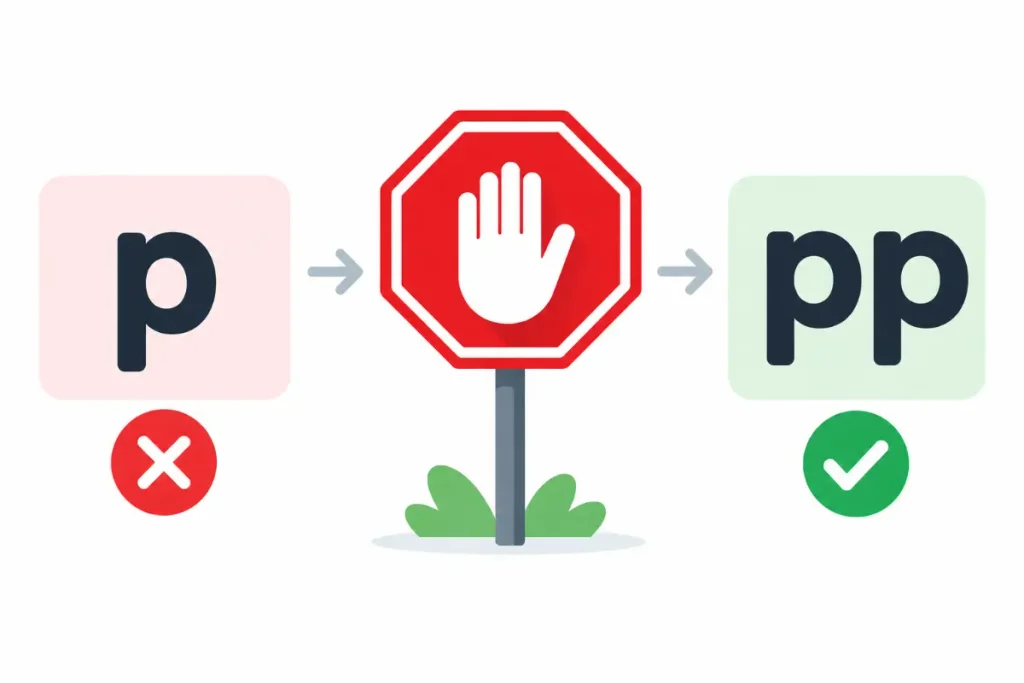
If you’re wondering about stoped or stopped, the correct spelling is stopped. The word stoped is not the standard spelling of the past tense or past participle of stop.
This small spelling mistake happens because English has a simple rule for many short verbs that end in one vowel followed by one consonant. When you add ed to a verb like stop, the final consonant is doubled. So stop becomes stopped, not stoped.
The same pattern appears in words such as planned, grabbed, dropped, and slipped. Once you understand the rule, this spelling becomes much easier to remember.
This guide explains why the extra p appears, how the doubling rule works, and how to use stopped in real sentences. You’ll also see common mistakes, related spelling patterns, and simple ways to remember the correct form.
Quick Definition
Stopped is the correct past tense and past participle of the verb stop. It means that an action ended, movement ended, or someone or something was brought to a halt. Stoped is a spelling error in standard English.
Direct Answer
The correct spelling is stopped with two p letters. Use stopped when you mean that someone or something ended an action or came to a halt.
Comparison Table
| Word or Phrase | Meaning | Example Sentence | When to Use It |
|---|---|---|---|
| Stop | To end an action or come to a halt. | Please stop talking. | Use it for the base form. |
| Stopped | The past tense or past participle of stop. | The car stopped suddenly. | Use it for a completed past action or after certain helping verbs. |
| Stoping | Incorrect spelling in standard English. | The sign was not stoping the traffic. | Do not use it. |
| Stopping | The present participle or gerund of stop. | The driver is stopping the car. | Use it for an action in progress or as a noun. |
Why The Correct Spelling Has Two Ps
The extra p in stopped comes from a common English spelling rule. When a short verb ends in one vowel followed by one consonant, the final consonant is often doubled before adding ed.
The base verb here is stop.
It has one syllable.
The final part of the word follows this pattern.
o + p
The o is the vowel, and the p is the final consonant. When we add ed, English doubles the final consonant.
So we get:
stop + ed = stopped.
The spelling isn’t stoped because English spelling uses the extra p to preserve the short vowel sound in the original word.
You can see the same pattern in several familiar verbs.
- plan → planned
- grab → grabbed
- drop → dropped
- slip → slipped
- shop → shopped
- step → stepped
- rob → robbed
- nod → nodded
These words follow the same basic pattern. The final consonant is doubled before the ending is added.
The Basic Doubling Rule
A useful starting point is this rule.
When a one syllable verb ends in one vowel followed by one consonant, double the final consonant before adding ed or ing.
For example:
- stop → stopped
- stop → stopping
- run → ran
The last example does not use ed, but it shows why spelling rules need to be learned alongside the exact form of each word.
More examples make the pattern easier to see.
- chat → chatted
- shop → shopped
- drop → dropped
- plan → planned
- clap → clapped
- slip → slipped
- rub → rubbed
- drag → dragged
In each case, the final consonant is doubled before the ending is added.
There is one important detail to remember. The rule does not apply to every verb that ends with a consonant. The sound and spelling pattern at the end of the base word matter.
For example, jump becomes jumped, not jumpped.
Why?
The verb jump ends in two consonant letters after the vowel sound. It does not have the same simple vowel plus single consonant pattern as stop.
That difference is useful because it prevents you from turning the doubling rule into a rule that applies everywhere.
Why English Doubles The Final Letter
English spelling can look strange at first, but many spelling rules exist to protect pronunciation.
Think about the word stop.
The vowel sound is short. When you add an ending, the doubled consonant helps keep the word connected to the same short vowel pattern.
Compare these forms.
- stop
- stopped
- stopping
The double p keeps the base word easy to recognize.
This pattern is common enough that native speakers usually write the doubled form without thinking about the rule. For learners, though, the extra letter can feel unnecessary.
That is why stoped can look tempting.
The writer may think:
stop + ed = stoped.
That seems logical if you simply attach the ending.
English spelling often requires one extra step.
stop + p + ed = stopped.
The same idea applies to stopping.
stop + p + ing = stopping.
Once you see the base word and the spelling change as separate steps, the pattern becomes much easier.
What Stopped Means
Stopped is the past form of stop.
The verb stop can have several related meanings. It can mean to end an action, cease movement, prevent something from continuing, or cause someone or something to halt.
For example:
The rain stopped at noon.
The rain was falling before noon. Then it ended.
The bus stopped near the school.
The bus was moving. Then it came to a halt.
She stopped talking.
She was talking before. Then she ended the action.
The guard stopped the car.
The guard caused the car to halt.
The exact meaning depends on the sentence, but the basic idea is the same. Something that was happening or moving came to an end.
Stopped As A Past Tense Verb
The most common use of stopped is as the simple past form of stop.
Use it when the action happened and ended in the past.
Examples include:
- I stopped at the store after work.
- He stopped the machine before leaving.
- We stopped for lunch on the way home.
- The children stopped playing when it started raining.
- She stopped the car outside the house.
- The music stopped suddenly.
- They stopped arguing after a few minutes.
Each sentence describes a completed action.
- The base form is stop.
- The past form is stopped.
- The present participle is stopping.
This gives you a useful word family.
- stop
- stopped
- stopping
Learning the whole family at once is often easier than memorizing one spelling in isolation.
Stopped As A Past Participle
Stopped can also work as a past participle.
A past participle is a verb form used with helping verbs or in certain other grammatical structures.
For example:
- The train has stopped.
- The machine had stopped before we arrived.
- The car was stopped by the police.
In these examples, stopped works with words such as has, had, and was.
The meaning still connects to the idea of ending movement or action.
The form stays the same.
stop → stopped
That makes this verb easier than some irregular verbs.
For example:
go → went → gone
But:
stop → stopped → stopped
The past tense and past participle have the same spelling.
Stoped Or Stopped Which Spelling Is Correct
The correct form is stopped. The form stoped is a misspelling.
This mistake usually happens because the writer adds ed directly to stop without applying the consonant doubling rule.
The correct formation is:
stop + p + ed = stopped
The incorrect formation is:
stop + ed = stoped
You may see the incorrect form in casual writing, online posts, text messages, or user generated content. That doesn’t make it standard English.
For schoolwork, professional writing, business communication, formal documents, and edited content, use stopped.
The same point applies to related forms.
- Write:
- stopping
- Not:
- stoping
- Write:
- stopped
- Not:
- stoped
- Write:
- stops
- Not:
- stopps
The spelling changes depend on the ending being added.
Examples With Stopped
Natural examples are one of the best ways to learn spelling.
Here are several sentences using the correct form.
- The train stopped at the next station.
- I stopped working at six o’clock.
- She stopped to answer the phone.
- The dog stopped barking after a few minutes.
- He stopped the video before the ending.
- The rain stopped before dinner.
- We stopped by the store on our way home.
- The teacher stopped the class for a short break.
- My phone stopped working this morning.
- The traffic stopped because of an accident.
Notice that stopped can describe both people and things.
A person can stop talking.
A car can stop moving.
A machine can stop working.
Rain can stop falling.
Music can stop playing.
A process can stop.
The word is flexible because stop has a broad meaning.
Stopped With Time Expressions
Past tense sentences often include a word or phrase that tells you when something happened.
For example:
- The store stopped accepting orders at 9 p.m.
- She stopped calling after a few weeks.
- The bus stopped running last night.
- I stopped eating before dessert.
- They stopped working two hours ago.
Common time expressions include:
- yesterday
- last night
- last week
- two hours ago
- earlier
- this morning
- a few minutes ago
These expressions often make it clear that stopped is the right verb form.
Still, you don’t always need a time expression.
The music stopped.
That sentence is complete on its own.
The past tense tells the reader that the music ended at some point before now or in the context of the story.
Stop And Stopped In Questions
Questions can make the difference between the base form and past form easier to understand.
Use stop after did.
- Did you stop at the store?
- Did she stop working?
Do not write:
Did you stopped at the store?
The helping verb did already carries the past tense. The main verb returns to its base form.
So:
Did + stop
Not:
Did + stopped
Compare these sentences.
She stopped the car.
Did she stop the car?
The first sentence uses the past form directly.
The second uses did, so the main verb uses the base form.
This rule applies to many regular verbs.
- He walked home.
- Did he walk home?
- She played tennis.
- Did she play tennis?
- They watched the movie.
- Did they watch the movie?
The same pattern works with stop.
Stop And Stopped In Negative Sentences
The same idea appears in negative sentences with did not or didn’t.
Write:
I didn’t stop.
Not:
I didn’t stopped.
Write:
She didn’t stop talking.
Not:
She didn’t stopped talking.
Write:
The car didn’t stop.
Not:
The car didn’t stopped.
The reason is simple.
Did already shows the past tense.
The main verb stays in its base form.
So the pattern is:
didn’t + stop
This is one of the most common grammar points connected to the word.
Stopped Versus Stopping
Many learners also confuse stopped with stopping.
The two forms are both correct, but they serve different purposes.
- Stopped usually describes a completed past action or works as a past participle.
- Stopping usually describes an action in progress or works as a gerund.
Compare these examples.
- The car stopped.
- The car came to a halt.
Here is another pair.
- She stopped talking.
- She ended the action.
This sentence can mean she is in the process of ending the action, although it sounds less natural in many situations. A speaker would often say She is going to stop talking or She is stopping now.
The spelling matters because the ending changes both grammar and meaning.
Why Stoped Looks Like A Possible Spelling
The misspelling feels natural because many regular verbs simply take ed.
For example:
- walk → walked
- talk → talked
- clean → cleaned
- open → opened
- help → helped
So it is easy to assume that:
stop → stoped
should work the same way.
The problem is that stop falls into a consonant doubling pattern.
The final p needs to be doubled before ed is added.
That gives us:
stopped
This is one reason spelling rules are useful. They explain why a word changes instead of forcing you to memorize every form separately.
Other Words That Follow The Same Pattern
If you remember only one idea from this article, connect stopped with other verbs that double their final consonant.
Here are some common examples.
- shop → shopped
- drop → dropped
- plan → planned
- clap → clapped
- grab → grabbed
- slip → slipped
- skip → skipped
- rub → rubbed
- drag → dragged
- hug → hugged
- trim → trimmed
- chat → chatted
The pattern becomes easier to spot after you see it several times.
For example, imagine this sentence.
I stopped at the shop and dropped my bag.
Both stopped and dropped use a doubled final consonant.
Another example is:
She planned the trip and packed her bags.
Here, planned follows the same pattern, while packed does not need a doubled consonant because its spelling pattern is different.
The goal isn’t to memorize a giant list. The goal is to recognize the pattern when you meet it.
When The Final Consonant Is Not Doubled
This is where many learners need extra care.
Not every verb ending in a consonant doubles its final letter.
Consider:
- jump → jumped
- help → helped
- wash → washed
- look → looked
- work → worked
You would not write jumpped, helpped, or workked.
Why?
The final letter pattern in these words doesn’t meet the same basic doubling condition.
The verb stop has one short vowel sound followed by one final consonant sound.
That gives us the familiar pattern:
stop → stopped
Another useful point is that longer words can follow slightly different rules based on stress.
For example:
- admit → admitted
- prefer → preferred
- begin → beginning
The final consonant is doubled because of the stress and spelling pattern.
But:
- visit → visited
- open → opened
These don’t double the final consonant.
So don’t assume that every verb gets a doubled final letter. Look at the word itself and learn the pattern.
A Simple Memory Trick
Here is an easy way to remember the spelling.
Think of stop as a word that comes to a complete halt.
When you add ed, the p also needs to stop and stay there twice.
So:
stop → stopped
You can also use a visual trick.
Imagine the word stop at a red traffic light.
The first p says stop.
The second p stays there to remind you that the action has already stopped.
It sounds a little playful, but simple memory tricks can work well when a spelling pattern keeps causing trouble.
Another method is to say the word slowly while writing it.
Stopped.
Then look at the middle.
sto pp ed
Seeing the two p letters together can help the correct spelling stick.
Common Mistakes To Avoid
The most obvious error is writing stoped.
But there are a few other mistakes worth watching.
Using Stopped After Did
Incorrect:
Did you stopped the car?
Correct:
Did you stop the car?
The word did already marks the past.
Using Stopped After Did Not
Incorrect:
She did not stopped working.
Correct:
She did not stop working.
Again, the main verb stays in its base form after did.
Writing Stoping
Incorrect:
The bus is stoping.
Correct:
The bus is stopping.
The final p is doubled before ing too.
Confusing Stopped And Stop
Incorrect:
I stop yesterday.
Correct:
I stopped yesterday.
The time expression yesterday shows that the action happened in the past.
Adding An Extra Letter In The Wrong Place
Incorrect:
Stoppped
Correct:
Stopped
Only one extra p is needed.
The spelling has two p letters total, not three.
How To Use Stop Correctly In Everyday English
The verb stop appears constantly in everyday American English.
- You might stop somewhere.
- You might stop doing something.
These patterns are worth learning because they help you use the verb naturally.
Stop Doing Something
Use stop followed by an ing form when you mean to end an activity.
For example:
I stopped watching the show.
She stopped eating sugar.
He stopped playing the game.
They stopped talking.
The structure is:
stop + verb ending in ing
The past form becomes:
stopped + verb ending in ing
For example:
I stopped watching the show.
The action of watching ended.
Stop To Do Something
There is another useful pattern.
stop to do something means that you pause one activity so you can do another activity.
For example:
I stopped to check my phone.
This means I paused what I was doing so I could check my phone.
Compare it with:
I stopped checking my phone.
This means I ended the habit or action of checking my phone.
The difference is small in form but large in meaning.
- stopped to check means paused another activity in order to check.
- stopped checking means ended the action of checking.
This distinction is useful in everyday writing and conversation.
Stop Someone From Doing Something
The verb stop can also mean preventing an action.
For example:
- The rain stopped us from playing outside.
- The teacher stopped the students from leaving early.
- A locked door stopped him from entering.
The common pattern is:
stop someone from doing something
More examples include:
- The warning stopped me from making the same mistake.
- The fence stopped the dog from running into the street.
- The security guard stopped the visitor from entering the room.
This structure is different from stop doing something, so paying attention to the word from can help.
Stop As A Noun
Although stop is most often a verb, it can also be a noun.
For example:
- The next stop is downtown.
- We made a quick stop at the grocery store.
- That was our final stop before the airport.
In these sentences, stop refers to a place or short visit.
The past form is still stopped when the word is used as a verb.
We stopped at the grocery store.
The difference comes from how the word works in the sentence.

Stop In Common Expressions
You will also see stop in many everyday expressions.
- stop by
- stop over
For example:
- I’ll stop by after work.
- We stopped off for coffee.
- The printer stopped working.
- She stopped talking when the teacher entered.
These expressions show how common the verb is in natural English.
British And American English
The spelling stopped is standard in both American and British English.
There is no American spelling that changes stopped into stoped.
The same doubled p appears in both major forms of English.
So if you’re writing for an American audience, use:
stopped
The same spelling is standard in British English too.
This makes the word easy to handle across different varieties of English.
Why Spellcheck May Not Catch Every Mistake
Many writing tools can catch stoped, but you shouldn’t rely completely on spellcheck.
Some systems use context to decide if a word is correct. Others may not catch every error, especially in informal writing.
A person might also type quickly and miss the correction.
That is why knowing the spelling rule is more useful than depending on software.
If you remember that stop doubles the final p before ed and ing, you’ll catch the mistake yourself.
A Quick Test
Try this simple test.
Complete the sentence:
Yesterday, the car ______ at the red light.
The answer is:
stopped
Now try:
The driver did not ______ at the red light.
The answer is:
stop
Try another:
The driver is ______ at the red light.
The answer is:
stopping
These three forms show the basic pattern.
- stop
- stopped
- stopping
If you can tell why each form works, you’ve understood the core rule.
A Practical Editing Tip
When proofreading, don’t look only for individual spelling mistakes.
Look at the verb and the words around it.
Ask yourself:
Is the action happening now?
Is it a completed past action?
This approach helps you choose the right form instead of guessing.
For example:
She stopped talking.
The action is finished.
She is stopping now.
The action is happening or changing at the present time.
Did she stop talking?
The helping verb did requires the base form.
She didn’t stop talking.
Again, didn’t takes the base form.
These small checks can prevent several common grammar mistakes.
Related Spelling Questions
People who search for one spelling often have trouble with similar words. The same consonant doubling rule appears in many of them.
Planned Or Planed
The standard past form of plan is planned.
For example:
We planned the trip months ago.
The final n is doubled before ed.
The word planed exists in English too, but it has a different meaning. It can refer to using a tool called a plane to smooth wood.
That means the two spellings are not always interchangeable.
Dropped Or Droped
The correct past form of drop is dropped.
For example:
She dropped her keys.
The final p is doubled.
Writing droped is a spelling mistake.
Planned Or Planed
The same spelling issue can appear with planned.
They planned the event carefully.
The double n is required.
This shows that consonant doubling isn’t unique to stop.
Hopped Or Hoped
This pair is especially useful because both spellings are real words.
- Hopped is the past form of hop.
- Hoped is the past form of hope.
Compare:
- The rabbit hopped across the yard.
- I hoped you would call.
The spelling changes the pronunciation and meaning.
This is a good reminder that one extra letter can make a major difference.
Tapped Or Taped
Both forms are also correct words.
- Tapped is the past form of tap.
- Taped is the past form of tape.
For example:
- She tapped on the window.
- He taped the note to the wall.
The final consonant doubles in tapped because of the spelling pattern.
The word taped does not need the extra p because its base word ends in silent e.
Is Stoped Ever Correct
In standard modern English, stoped is not the normal past tense or past participle of stop.
If you want to describe an action that ended in the past, use stopped.
For example:
- The engine stopped.
- She stopped talking.
- The rain stopped.
- We stopped for lunch.
If you see stoped in a sentence that intends this meaning, it is almost certainly a spelling error.
The correct form is stopped.
FAQs
Is Stoped Or Stopped The Correct Spelling?
The correct spelling is stopped with two p letters. Stoped is not the standard past tense or past participle of stop.
Why Does Stop Have Two Ps In Stopped?
The final consonant is doubled before ed is added because stop is a short verb that ends in one vowel followed by one consonant. This gives us stop + p + ed = stopped.
Is Stoped A Word?
Stoped is not the standard spelling used for the past form of stop. In normal English writing, use stopped instead.
Is Stopping Spelled With Two Ps?
Yes. The correct spelling is stopping with two p letters. The same consonant doubling pattern applies before the ing ending.
Do You Say Stopped Or Stoped?
You say and write stopped. The word has two p letters in its standard spelling.
Is It Stopped Working Or Stoped Working?
The correct phrase is stopped working. For example, you can write, My computer stopped working this morning.
Do You Use Stop Or Stopped After Did?
Use stop after did. For example, write Did you stop? rather than Did you stopped?
What Is The Past Tense Of Stop?
The past tense is stopped. The past participle is also stopped, as in The train has stopped.
Conclusion
The correct spelling is stopped. The form stoped is a common spelling mistake caused by adding ed directly to stop without doubling the final consonant.
The key rule is simple. A short verb such as stop can double its final consonant before an ending like ed or ing. That gives you stopped and stopping.
Remember the three main forms together: stop, stopped, and stopping. Also remember that after did or didn’t, the main verb returns to stop, as in Did you stop? and I didn’t stop.
So the next time you face stoped or stopped, choose stopped. If you connect it with words like planned, dropped, and slipped, the spelling rule becomes much easier to remember.

Dr. Arthur Pendelton is a veteran historical linguist and grammar expert with over 30 years of experience in academic editing. A retired professor, Arthur specializes in the etymology and evolution of the English language. He is passionate about “unpacking the history behind the rules,” helping readers understand why we spell, punctuate, and phrase things the way we do today. Whether he’s settling debates on archaic usage or explaining complex linguistic shifts, Dr. Pendelton brings scholarly precision to every article.
1 thought on “Stoped or Stopped Which Is Correct”