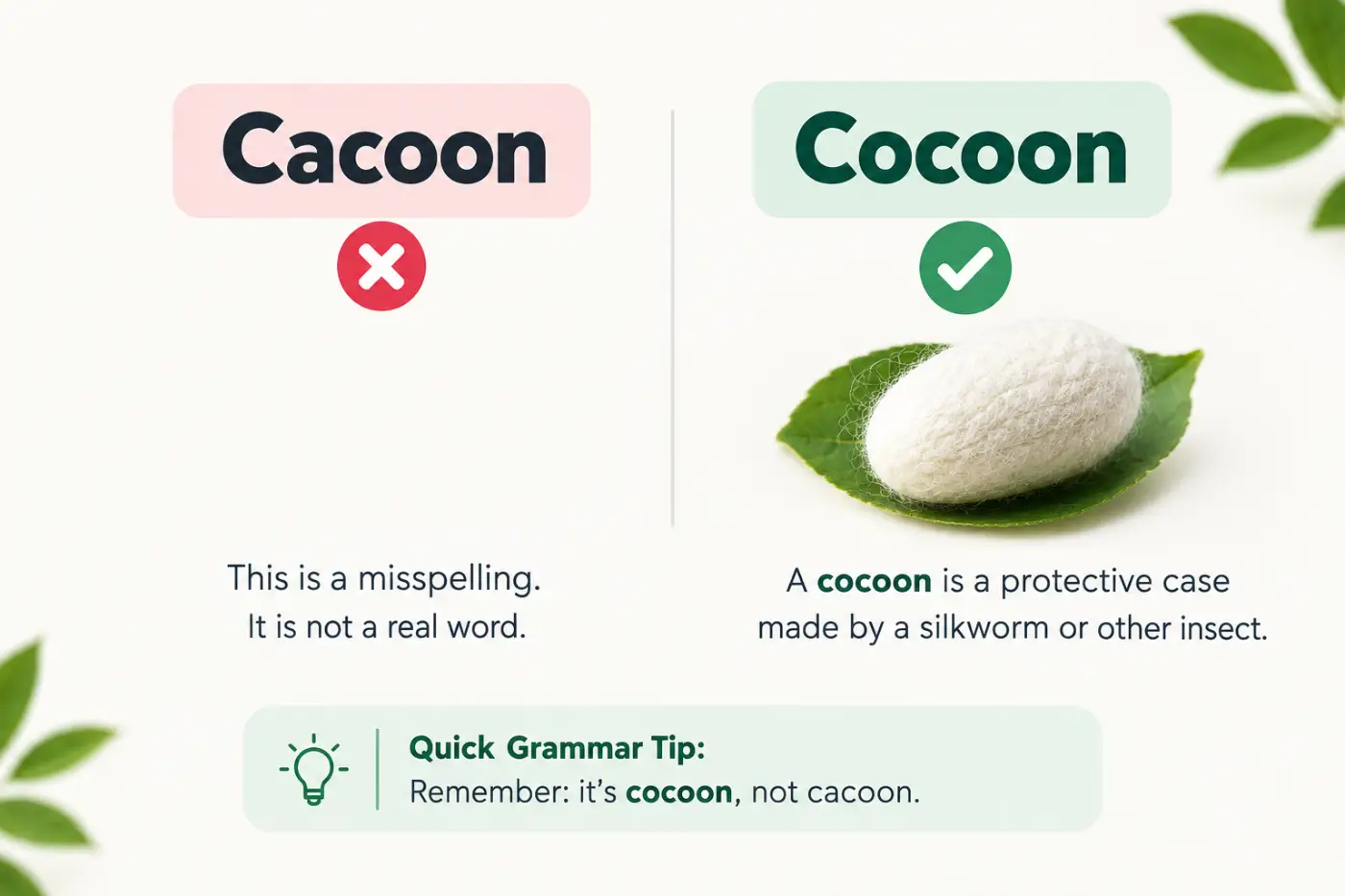
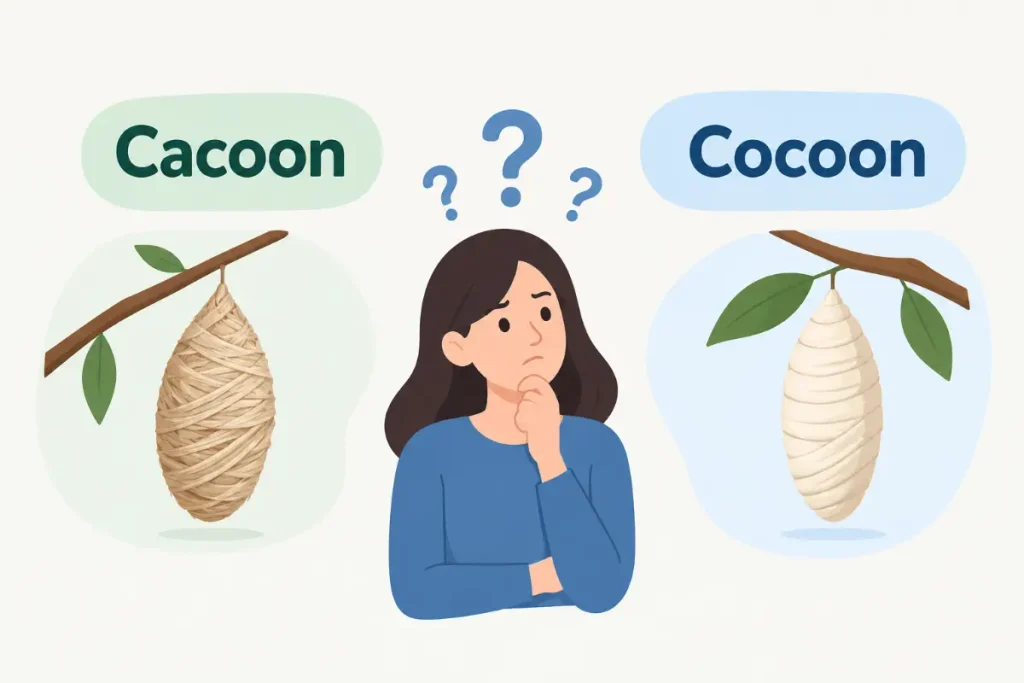
If you have ever typed Cacoon or Cocoon and stopped to wonder which one looks right, you are not alone. The correct spelling is cocoon. The spelling “cacoon” is a common mistake, but it is not the standard English spelling of the word.
A cocoon is a protective covering made by some insects, especially moths, before they change into their adult form. The word can also describe a safe, private, or comfortable place that protects someone from the outside world.
The tricky part is that the word does not sound exactly like it looks. When we say “cocoon,” the repeated “coo” sound can make the spelling feel less obvious. That is why people sometimes write “cacoon” by mistake.
This guide explains the correct spelling, meaning, pronunciation, history, grammar, and common uses of the word. You will also see plenty of natural examples that show how to use it in everyday English.
Quick Definition
The correct word is cocoon. A cocoon is a protective covering that some insects create around themselves while they develop, especially before becoming adults.
The word is also used in a figurative way. Someone might say they are “in a cocoon” when they are staying in a comfortable private space and avoiding the outside world.
Direct Answer
Cocoon is the correct English spelling. Cacoon is a misspelling and should not be used in standard English writing.
Spelling Comparison
| Word or Phrase | Meaning | Example Sentence | When To Use It |
|---|---|---|---|
| Cocoon | A protective covering made by certain insects | The moth remained inside its cocoon. | Use this spelling in standard English. |
| Cacoon | A common misspelling of cocoon | The student accidentally wrote cacoon. | Avoid this spelling. |
Why The Confusion Happens
The confusion usually comes from pronunciation. English spelling often does not match pronunciation in a simple way. The word “cocoon” is a good example.
When people hear the word, they may focus on the sound rather than the letters. The first vowel can sound closer to a short “uh” sound in normal speech, while the second part has a clear “oon” sound. Someone who has heard the word many times but has rarely seen it written may guess the spelling.
That guess can produce “cacoon.”
There is another reason for the mistake. English has many words that begin with “ca,” such as “cactus,” “cabin,” “camera,” and “canyon.” The spelling “cacoon” may therefore look familiar at first glance.
The correct form, however, begins with “co.” It is spelled c o c o o n.
A useful way to see the word is to separate it into two parts.
co + coon = cocoon.
The repeated “co” pattern makes the correct spelling easier to remember.
What Cocoon Means
A cocoon is a protective structure made by certain insects. Moths are the best known example.
Before becoming an adult, a moth goes through several stages of development. After the larval stage, commonly called a caterpillar, it changes into a pupa. Many moth species protect this stage by creating a silk covering around themselves.
That covering is called a cocoon.
The cocoon provides protection while the insect undergoes major physical changes. Inside, the insect develops into its adult form.
For example, you might read a sentence such as this.
“The caterpillar spun a silk cocoon around itself.”
The sentence describes a real biological process.
It is worth making one small distinction. People often use “cocoon” when talking about butterflies, but butterflies usually form a chrysalis rather than a true cocoon. Moths are more closely associated with silk cocoons.
This difference matters in science writing, but casual speech often uses the word more loosely.
How To Pronounce Cocoon
The standard pronunciation of cocoon is roughly kuh KOON.
The first part sounds like “kuh,” and the second part sounds like “koon.”
The stress usually falls on the second syllable.
Think of the word as having two beats.
kuh KOON.
The pronunciation can help you remember the spelling because the final “coon” part is easy to recognize. The main spelling challenge is the first part.
When speaking quickly, the first vowel may sound weak. That can make the word harder to spell from memory.
Cocoon Used As A Noun
The most common use of cocoon is as a noun.
A noun names a person, place, thing, or idea. In its literal meaning, a cocoon is a physical protective covering.
Here are some natural examples.
- “The moth disappeared inside its cocoon.”
- “The cocoon was attached to a small branch.”
- “We found an empty cocoon in the garden.”
- “The insect stayed inside the cocoon while it developed.”
- “She carefully observed the cocoon during the science project.”
- “The tiny cocoon was almost hidden among the leaves.”
- “The teacher showed the class a real moth cocoon.”
- “The cocoon looked fragile, but it protected the developing insect.”
In each sentence, the word refers to a thing.
Cocoon Used As A Verb
Cocoon can also be used as a verb.
As a verb, it means to surround or protect someone or something with a covering. It can also mean to place yourself in a comfortable or protected environment.
For example.
- “The blanket cocooned the sleeping child.”
- “Warm clothes cocooned him from the cold.”
- “She cocooned herself in a thick blanket during the storm.”
- “The quiet room cocooned him from the noise outside.”
This use is more figurative than the biological meaning.
The verb often creates an image of comfort, safety, and protection.
The Figurative Meaning Of Cocoon
The word has a useful figurative meaning in everyday English.
Imagine someone staying inside a warm room on a cold night. They have a blanket, a book, a cup of tea, and no desire to go outside. You might describe that person as being in a cocoon.
The person is not literally inside an insect structure. The word is being used as a metaphor.
A figurative cocoon can represent comfort, privacy, safety, isolation, or personal space.
For example.
- “After a stressful week, I wanted to spend Saturday in my own little cocoon.”
- “The small apartment became a peaceful cocoon away from the busy city.”
- “She created a cozy cocoon with blankets and soft lights.”
- “He stayed in his cocoon for a few days after the difficult experience.”
This use is common in lifestyle writing, personal essays, fiction, and everyday conversation.
Cocoon As A Metaphor For Personal Growth
The word also has a deeper meaning connected with change.
An insect inside a protective covering is going through a major transformation. For this reason, a cocoon can represent a period of growth before a new stage of life.
People sometimes use the image when talking about personal development.
For example, someone might say, “I spent a year in my cocoon and came out stronger.”
The sentence does not mean the person literally became an insect. It means they spent time away from distractions and focused on personal growth.
This metaphor can be useful when talking about education, recovery, creativity, career changes, or emotional development.
A writer might say that a student stayed in a “learning cocoon” while developing new skills. A business owner might describe a quiet planning period as a cocoon before launching a new project.
The basic idea is simple.
A cocoon represents protection during transformation.
Natural Example Sentences
Seeing a word in context is one of the easiest ways to understand it.
Here are examples using the word in different situations.
Nature Examples
- “The moth built a cocoon under the leaf.”
- “The cocoon was covered with fine strands of silk.”
- “Scientists studied how the insect developed inside the cocoon.”
- “The empty cocoon remained attached to the tree.”
- “We spotted a small cocoon in the garden.”
Everyday Examples
- “I spent Sunday in a cozy cocoon of blankets and books.”
- “Her bedroom became a quiet cocoon after a long day.”
- “The hotel room felt like a peaceful cocoon.”
- “He created a warm cocoon of comfort during the winter.”
- “The headphones gave her a cocoon of quiet in the noisy office.”
Creative Writing Examples
- “The forest felt like a green cocoon around the small cabin.”
- “Rain turned the house into a peaceful cocoon.”
- “The artist worked in a private cocoon of creativity.”
- “Music wrapped around him like a cocoon.”
- “The quiet library became her cocoon for study.”
These examples show how flexible the word can be.
Common Mistakes With Cocoon
Spelling errors often happen because people remember how a word sounds instead of how it looks.
The most common mistake is replacing the first “co” with “ca.”
For example, someone might write:
“The caterpillar made a cacoon.”
That sentence contains a spelling error.
The correct version is:
“The caterpillar made a cocoon.”
Another common mistake is leaving out one of the “o” letters.
A cocoon contains several “o” letters, so it is easy to type too few or put them in the wrong place.
The correct spelling is:
c o c o o n.
It has six letters.
The pattern can be remembered as:
co + coon.
A Simple Memory Trick
If spelling the word is difficult, use a visual trick.
Think of the word as two pieces.
CO + COON.
- The first part is “co.” The second part is “coon.”
- Put them together and you get cocoon.
Another trick is to remember that the word contains a cluster of “oo” sounds and letters.
You can picture the word like this.
COCOON
The middle looks almost like a pair of soft circles. That can remind you of the rounded shape of a cocoon.
A simple sentence can also help.
“The moth is safe in its cocoon.”
Write that sentence several times if you are learning the spelling. Seeing the word in a complete sentence makes it easier to remember than memorizing isolated letters.
Is Cocoon A Difficult Word
Cocoon is not a very difficult word in terms of meaning. Most learners can understand the basic idea quickly.
The spelling is the part that causes trouble.
This happens with many English words. A word may be familiar when we hear it but difficult to spell because English does not always follow predictable spelling patterns.
Cocoon is especially easy to confuse if someone has learned the word through conversation rather than reading.
The good news is that the correct spelling has a simple pattern.
COCOON.
Once you notice that pattern, the word becomes much easier.
Cocoon And Chrysalis
Cocoon and chrysalis are related words, but they do not mean exactly the same thing.
A cocoon is generally a protective silk covering made by an insect, especially a moth, around its pupal stage.
A chrysalis is the hard outer covering formed by a butterfly during its pupal stage.
The two words are often confused because both are connected with insect development.
Consider these examples.
- “The moth formed a cocoon.”
- “The butterfly formed a chrysalis.”
This distinction is useful in schoolwork and science writing.
In casual conversation, people sometimes use “cocoon” as a general word for the protected stage of insect development. Scientific descriptions are more precise.
Cocoon And Caterpillar
A caterpillar is the larval stage of a butterfly or moth.
It is the crawling insect that feeds on leaves and grows before entering the next stage of its life cycle.
A cocoon is not the caterpillar itself. It is a protective covering associated mainly with moth pupae.
A simple sequence for many moths is:
Egg → caterpillar → pupa inside a cocoon → adult moth.
The exact life cycle can vary among species, but this basic pattern is useful for understanding the word.
For butterflies, the familiar sequence is different in its terminology.
Egg → caterpillar → chrysalis → adult butterfly.
Knowing these terms can prevent confusion in biology assignments.
Cocoon And Pupa
The words pupa and cocoon are also different.
- A pupa is the developmental stage between the larva and adult insect.
- A cocoon is a protective covering that surrounds the pupa in some insects.
In other words, the pupa is the developing insect stage, while the cocoon is the outer covering.
Not every pupa is inside a cocoon.
This is another reason why the terms should not be treated as exact synonyms.
How Writers Use Cocoon In A Figurative Way
Writers often choose cocoon because it creates a strong image with very few words.
Suppose you write:
“She stayed home.”
That sentence gives basic information.
Now compare it with:
“She stayed in her quiet cocoon while the city rushed outside.”
The second sentence creates a stronger picture. It suggests comfort, privacy, and separation from the outside world.
This is why the word appears in fiction, poetry, blogs, lifestyle articles, and personal writing.
It can suggest several ideas at once.
Comfort
A cocoon can represent a warm and comfortable place.
Safety
It can describe a place where someone feels protected.
Privacy
It can suggest a private space away from other people.
Isolation
It can also suggest someone has withdrawn from society.
Transformation
It can represent a period of growth before major change.
The intended meaning depends on the context.
Positive And Negative Meanings
Cocoon does not always have a positive meaning.
In one sentence, it can describe a peaceful retreat.
“She created a cozy cocoon at home.”
That sounds positive.
In another sentence, it can suggest isolation.
“He became trapped in a social cocoon and stopped talking to friends.”
Here, the word suggests that the person has become too separated from others.
This flexibility makes the word useful.
The same image of protection can feel comforting or limiting depending on how it is used.
Cocoon In Modern Lifestyle Writing
The figurative use of cocoon has become common in lifestyle writing.
People may describe a bedroom, home, hotel, office, or personal routine as a cocoon.
For example, a writer may describe a quiet bedroom as a “sleep cocoon.” A travel writer may describe a private hotel room as a “comfortable cocoon.” A person working from home may describe their workspace as a creative cocoon.
These phrases are usually metaphorical.
They suggest that the space gives the person comfort and separation from outside distractions.
You can use the word naturally in your own writing without making the sentence sound overly formal.
For example:
“My room became my little cocoon during exam week.”
That sounds natural and conversational.
Cocoon In Technology And Culture
The metaphor has also appeared in discussions about technology and modern life.
People sometimes describe digital spaces as personal cocoons. Headphones, phones, games, streaming services, and online communities can create a sense of separation from the physical environment.
For example:
“Noise canceling headphones created a quiet cocoon around her.”
The sentence uses cocoon to describe a feeling rather than a physical object.
The word can also describe people who spend most of their time inside familiar digital spaces.
This use connects the original biological idea with modern social behavior.
Words Related To Cocoon
Understanding related vocabulary can make the word easier to use.
Chrysalis
A chrysalis is the pupal covering of a butterfly.
Pupa
A pupa is the developmental stage between the larval and adult stages of many insects.
Caterpillar
A caterpillar is the larval form of a butterfly or moth.
Moth
A moth is an insect closely associated with the formation of cocoons.
Butterfly
A butterfly is an insect that usually develops inside a chrysalis rather than a true cocoon.
Metamorphosis
Metamorphosis is a major physical change that occurs as an insect develops from one life stage to another.
Larva
A larva is an early developmental stage of an insect.
These words often appear together in science lessons and nature writing.
Common Phrases With Cocoon
The word appears in several natural phrases.
Cocoon Of Comfort
This phrase describes a place or situation that feels safe and comfortable.
Example:
“Her home became a cocoon of comfort after a difficult week.”
Cocoon Of Silence
This describes a quiet environment.
Example:
“The library offered a cocoon of silence.”
Cocoon Yourself
This means to withdraw into a private and comfortable environment.
Example:
“On cold evenings, I like to cocoon myself with a blanket and a good book.”
Cocoon Like Environment
This describes a setting that feels protected and enclosed.
Example:
“The small cabin created a cocoon like environment in the mountains.”
Safe Cocoon
This phrase emphasizes protection.
Example:
“The family home felt like a safe cocoon during the storm.”
These expressions show how the literal meaning has expanded into everyday language.
Is Cocoon Singular Or Plural
Cocoon is singular.
For example:
“The cocoon is small.”
The plural form is cocoons.
For example:
“The tree was covered with cocoons.”
The plural simply adds “s.”
Here are a few more examples.
- “One cocoon was hanging from the branch.”
- “Several cocoons were found near the tree.”
- “The researcher examined three cocoons.”
- “The garden contained many cocoons.”
This is a regular plural form.
Can Cocoon Be Used As An Adjective
Cocoon itself is mainly used as a noun or verb. However, it can appear before another noun as a noun modifier.
For example:
- “Cocoon stage.”
- “Cocoon structure.”
In these phrases, the word helps describe another noun.
You may also see related forms such as “cocooned.”
For example:
“The baby was cocooned in a soft blanket.”
Here, “cocooned” works as a verb form.
Cocooned Meaning
Cocooned means surrounded or protected as if inside a cocoon.
The word can be literal or figurative.
A person might be physically cocooned in blankets.
“She was cocooned under a warm blanket.”
The word can also describe emotional or social protection.
“He felt cocooned by the support of his family.”
The second sentence uses the word metaphorically. It suggests that family support created a feeling of safety.
Cocooning Meaning
Cocooning is another related form.
It can describe the act of staying at home or creating a comfortable private environment.
For example:
“Cocooning at home sounded perfect after a busy week.”
The word can also describe the act of surrounding or protecting something.
Its meaning depends on context.
In everyday lifestyle language, it often suggests staying home, relaxing, and avoiding outside activity.
Examples For Students
Students often need simple sentences when learning new vocabulary.
Here are useful examples.
- “The caterpillar made a cocoon.”
- “The moth came out of its cocoon.”
- “The cocoon protected the developing insect.”
- “I found an empty cocoon on a tree.”
- “The teacher explained how a cocoon forms.”
- “The cocoon was made from silk.”
- “The insect remained inside the cocoon.”
- “The butterfly formed a chrysalis.”
These sentences are short and easy to use in school assignments.
Examples For Everyday Conversation
You can also use the figurative meaning in casual conversation.
- “I just want to stay home in my cozy cocoon tonight.”
- “My bedroom feels like a little cocoon.”
- “I created a quiet cocoon for reading.”
- “After work, I like to cocoon myself with a movie.”
- “The rainy weather made me want to stay in my cocoon.”
- “My headphones give me a cocoon of silence.”
These examples sound natural because they connect the word with familiar experiences.
Examples For Social Media Captions
The word can work well in captions because it creates a short but vivid image.
- “Wrapped up in my little cocoon.”
- “Rainy day cocoon mode.”
- “Home is my favorite cocoon.”
- “Creating a cozy cocoon and ignoring the noise.”
- “Quiet mind, warm blanket, happy cocoon.”
- “Growing quietly in my own cocoon.”
- “Sometimes you need a cocoon before your next chapter.”
These captions use the figurative meaning rather than the scientific one.
Examples For Creative Writing
Cocoon is especially useful when writing about change.
- “The old room became her cocoon while she planned her next move.”
- “He spent months in a quiet cocoon of study.”
- “Inside that small room, a new dream was taking shape.”
- “She needed a cocoon before she was ready to face the world again.”
- “The winter months gave the garden a silent cocoon of rest.”
These examples use the word to suggest protection, preparation, and transformation.
When You Should Avoid The Word
Cocoon is useful, but it should not replace more precise words in every situation.
If you are writing a science report, use the correct biological terms. If you mean a butterfly’s pupal covering, “chrysalis” may be more accurate.
Cocoon works best when you want the image of protection or transformation.
Why Correct Spelling Matters
A spelling mistake may seem small, but it can affect how professional your writing looks.
If you are writing a school assignment, blog post, article, email, or social media post, using the standard spelling helps readers trust your work.
The word cocoon is widely recognized in standard English.
The incorrect spelling “cacoon” may still be understood because readers can guess what you mean. However, being understandable is not the same as being correct.
For formal writing, use the standard spelling every time.
A Quick Way To Check The Spelling
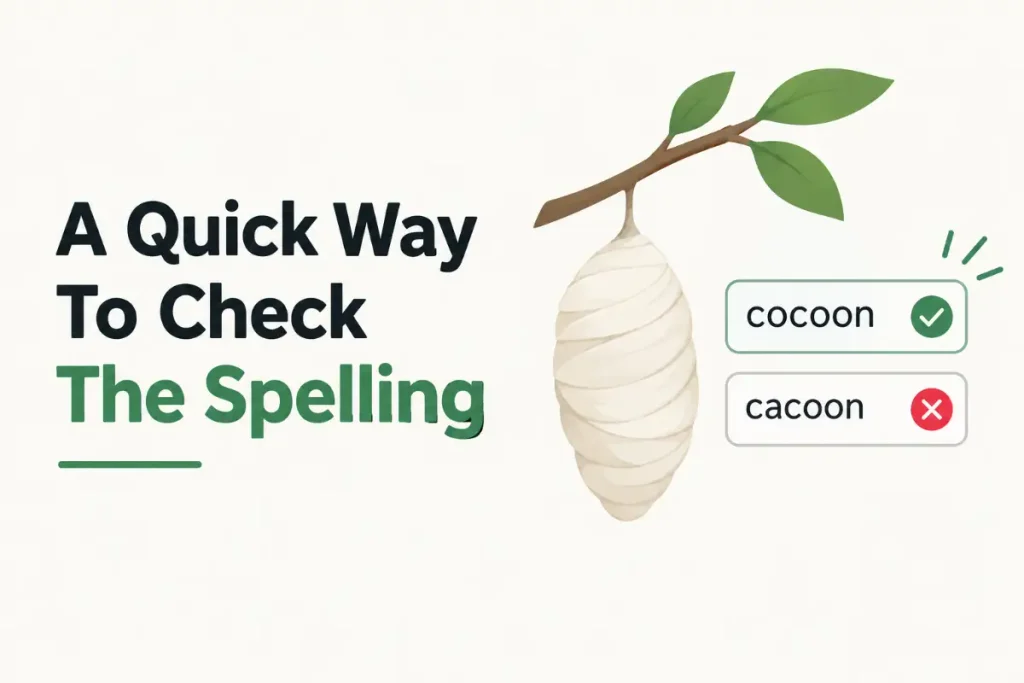
If you are unsure about the word, remember this pattern.
COCOON.
There are two “co” sections at the beginning.
CO + COON.
You can also connect the spelling with the idea of a round protective covering. Picture the rounded letters “oo” in the middle of the word.
If you see yourself typing “cacoon,” stop and check the first two vowels.
The correct beginning is co, not ca.
Other English Words With Similar Spelling Problems
The confusion around this word is part of a larger English spelling issue.
Many words are spelled differently from how learners expect them to sound.
For example, people sometimes confuse:
“receive” and “recieve.”
- “separate” and “seperate.”
- “definitely” and “definately.”
- “necessary” and “neccessary.”
- “occasion” and “occassion.”
These mistakes happen because English spelling has many patterns and exceptions.
The best way to improve is to read the correct forms often and use them in complete sentences.
The same method works for cocoon.
Why Reading Helps You Remember Cocoon
If you only memorize a spelling list, the word may disappear from memory quickly.
Reading gives your brain repeated exposure to the correct form.
You might see sentences such as:
- “The moth emerged from the cocoon.”
- “The cocoon was hidden beneath a leaf.”
- “The insect spent part of its development inside a cocoon.”
After seeing the word several times, its shape becomes familiar.
That is why reading books, articles, school materials, and reliable websites can improve spelling without requiring constant memorization.
A Simple Spelling Test
Try completing this sentence.
“The moth built a ______ around itself.”
The correct answer is:
cocoon.
Now try this one.
“She wrapped herself in blankets and created a cozy ______.”
Again, the answer is:
cocoon.
The first sentence uses the literal meaning. The second uses the figurative meaning.
If you can recognize both uses, you have a good grasp of the word.
FAQs
Is Cacoon Or Cocoon The Correct Spelling?
Cocoon is the correct spelling. “Cacoon” is a common spelling mistake and should be avoided in standard English writing.
What Is A Cocoon?
A cocoon is a protective covering made by some insects, especially moths, around their pupal stage. The word can also describe a safe, private, or comfortable environment in a figurative sense.
How Do You Spell Cocoon?
The word is spelled C O C O O N. A simple memory trick is to think of it as “co” plus “coon.”
Is Cacoon A Real Word?
“Cacoon” is not the standard English spelling of the insect covering. It is generally a misspelling of cocoon.
What Is The Difference Between A Cocoon And A Chrysalis?
A cocoon is usually a protective covering made by insects such as moths. A chrysalis is the pupal covering formed by butterflies.
Do Butterflies Have Cocoons?
Butterflies usually form chrysalises rather than true cocoons. Moths are more commonly associated with silk cocoons.
What Does Cocoon Mean In Slang?
Cocoon is not mainly a slang word. In informal speech, it can be used as a metaphor for staying in a private, comfortable, or protected space.
Can Cocoon Be Used As A Verb?
Yes. To cocoon means to surround or protect someone or something like a cocoon. It can also mean to withdraw into a comfortable private environment.
Conclusion
The answer to Cacoon or Cocoon is simple. Cocoon is the correct spelling, while “cacoon” is a common misspelling. The word refers literally to a protective covering made by some insects, especially moths.
The word also has a useful figurative meaning. A person can create a cocoon of comfort, privacy, or safety at home. Writers can use the image to describe personal growth, emotional protection, isolation, or a quiet period before a major change.
Remember the spelling by breaking it into two parts.
CO + COON = COCOON.
When you need the word in schoolwork, professional writing, or everyday communication, use cocoon. If you picture the word as a small protective space with “co” at the beginning and “coon” at the end, the correct spelling becomes much easier to remember.

Dr. Arthur Pendelton is a veteran historical linguist and grammar expert with over 30 years of experience in academic editing. A retired professor, Arthur specializes in the etymology and evolution of the English language. He is passionate about “unpacking the history behind the rules,” helping readers understand why we spell, punctuate, and phrase things the way we do today. Whether he’s settling debates on archaic usage or explaining complex linguistic shifts, Dr. Pendelton brings scholarly precision to every article.