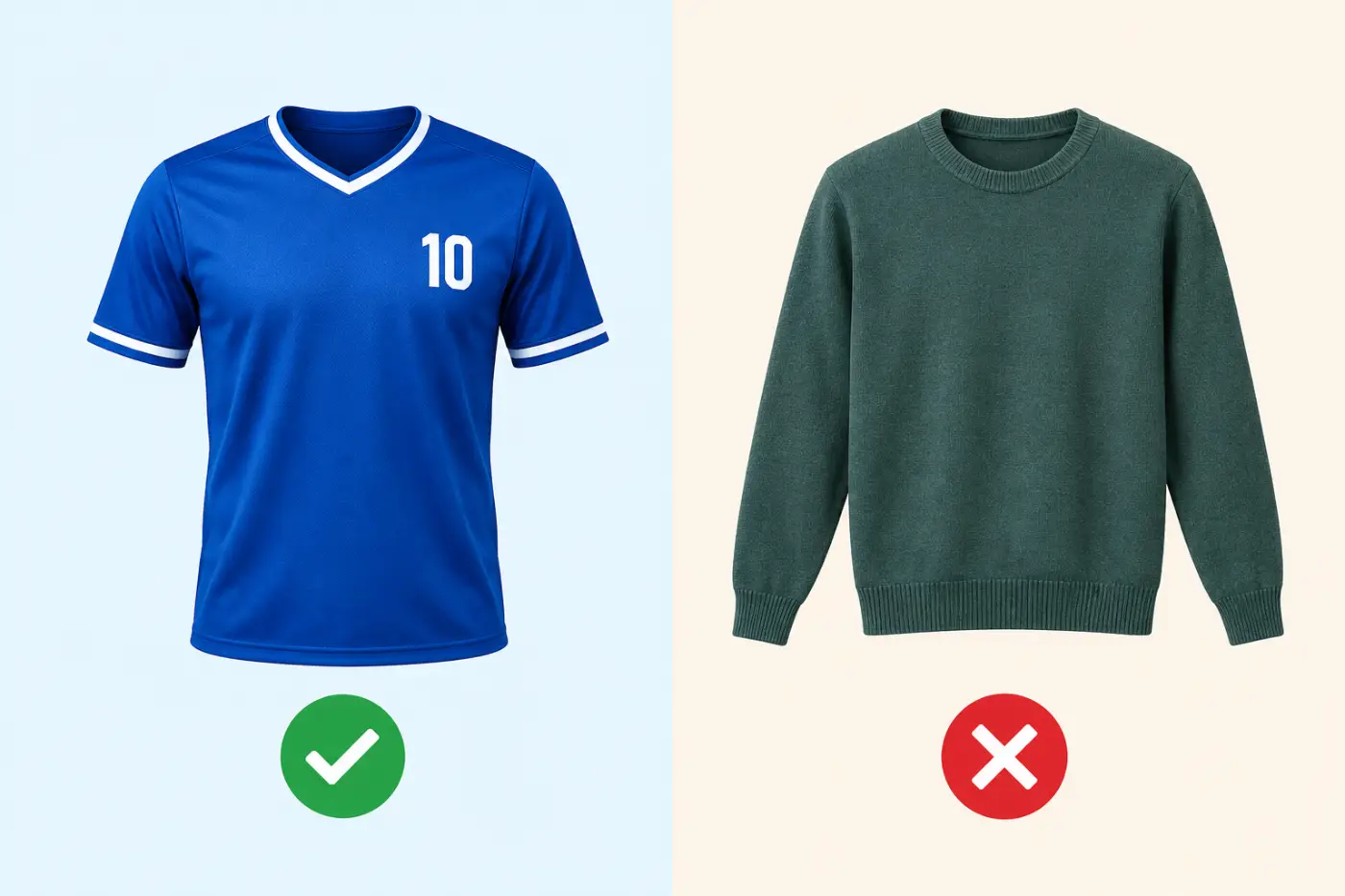
If you are unsure about jersies or jerseys, the correct spelling is jerseys. The word jersies is a common spelling mistake. Use jerseys when you mean more than one jersey.
A jersey can mean a sports shirt worn by a player. It can also describe a type of knitted fabric or a garment made from that fabric. The plural form is still jerseys.
The spelling can feel confusing because English has many words that change their ending when they become plural. Words such as city become cities, so it is easy to assume that jersey should become jersies. That rule does not apply here.
This guide explains why jerseys is correct, how to remember the spelling, and how to use the word naturally in American English. You will also see real sentence examples and answers to common questions about the word.
Quick Definition
Jerseys is the correct plural form of jersey. Jersies is not the standard spelling. Use jerseys when talking about two or more jerseys.
Direct Answer
The correct spelling is jerseys. The spelling jersies is incorrect in standard English.
Comparison Table
| Word or Phrase | Meaning | Example Sentence | When to Use It |
|---|---|---|---|
| Jersey | One jersey | I bought a new jersey. | Use it for one item. |
| Jerseys | More than one jersey | The team wore matching jerseys. | Use it for two or more items. |
| Jersies | Incorrect spelling | I bought three jersies. | Avoid this spelling. |

Why Jerseys Is Correct
The main reason is simple. Jersey does not follow the same plural pattern as words such as city or baby.
When a noun ends in a consonant followed by y, English often changes the y to ies in the plural.
For example:
- city becomes cities.
- baby becomes babies.
- party becomes parties.
In those words, the letter before y is a consonant. That helps create the ies plural pattern.
The word jersey is different. The letter before y is e, which is a vowel. When a word ends in a vowel followed by y, English normally keeps the y and adds s.
That gives us:
jersey → jerseys.
The same pattern appears in several other common nouns.
- key becomes keys.
- boy becomes boys.
- toy becomes toys.
- day becomes days.
- journey becomes journeys.
The pattern becomes easier once you look at the letter before the final y.
The Simple Spelling Rule
A useful rule is to check the letter directly before the final y.
If a word ends in a consonant plus y, the plural often changes y to ies.
For example:
- city → cities
- story → stories
- family → families
If a word ends in a vowel plus y, the plural usually keeps the y and adds s.
For example:
- day → days
- key → keys
- boy → boys
- jersey → jerseys
This is why changing the final y to ie in jersey creates the wrong spelling.
The word does not become jersie in the singular. It remains jersey. The plural simply adds s.
What Jersey Means
The word jersey has several related meanings.
In American English, one of the most common meanings is a shirt worn by an athlete. Basketball players wear jerseys. Football players wear jerseys. Hockey players wear jerseys. Soccer players wear jerseys too.
For example:
The player wore his new jersey during the game.
The store sells team jerseys for fans.
The coach handed the players their jerseys before the match.
The word can also refer to a knitted fabric. This meaning comes from the name of Jersey, an island in the English Channel. The fabric became associated with the island and later took the name jersey.
Today, you may see the word used for clothing made from soft knitted material.
For example:
She bought a jersey dress for the summer.
The shirt is made from lightweight jersey fabric.
Jersey can also refer to the garment itself even when it is not specifically a sports shirt.
The exact meaning depends on the sentence.
Why People Spell It Jersies
The most common reason is the spelling rule mentioned earlier.
People often remember that many words ending in y change to ies in the plural. They may learn examples such as city, baby, and country early in school.
Then they see jersey and apply the same rule.
That creates jersies.
The mistake makes sense from a spelling perspective. It is not a random error. The problem is that the person is using the wrong plural pattern.
English has many spelling patterns like this. A rule can help most of the time, but you still need to look at the letters before the final y.
Compare these examples:
- city → cities
- country → countries
- jersey → jerseys
- boy → boys
The last two words keep the y because a vowel comes before it.
Jerseys in Sports
Sports are probably the most common place you will see the plural form.
A jersey is usually a shirt that identifies an athlete, team, or sport. A team may have different jerseys for home games, away games, special events, or different seasons.
For example:
The players received their new jerseys before the season started.
Fans wore their favorite players’ jerseys at the game.
The team changed its jerseys for the new season.
The store has jerseys in several sizes.
Notice that jerseys refers to more than one shirt.
If you are talking about one shirt, use jersey.
I bought one jersey.
If you are talking about several shirts, use jerseys.
I bought three jerseys.
That basic singular and plural distinction solves most questions about the word.
Jerseys in Everyday Clothing
The word is not limited to professional sports.
You may see jersey used in clothing descriptions, product names, and fashion writing. In those cases, it can describe a fabric or a garment made from knitted material.
For example:
She wore a soft jersey top.
The dress is made from cotton jersey.
The company sells jersey clothing for warm weather.
The store carries several jersey dresses.
When the noun refers to more than one item, use jerseys.
The store sells several jersey dresses.
The company offers different jerseys for summer wear.
The fabric meaning can sometimes sound more technical, but the plural spelling does not change.
Singular and Plural Forms
The easiest way to avoid the spelling mistake is to learn the two forms together.
- Singular:
- jersey
- Plural:
- jerseys
You can think of the word as a simple add s plural.
- One jersey.
- Two jerseys.
- One team jersey.
- Two team jerseys.
- One jersey shirt.
- Several jersey shirts.
The final y stays exactly where it is.
That is the key detail.
Examples With Jersey
Here are some natural sentences using the singular form.
I bought a new jersey for the game.
That jersey belongs to my brother.
Her favorite jersey is signed by the player.
The blue jersey is hanging in the closet.
He wore his school jersey to practice.
This jersey is made from soft fabric.
The store has a red jersey in my size.
She washed the jersey after the game.
Each player received a new jersey.
My son wants a basketball jersey for his birthday.
In every sentence, the word refers to one item or one type of garment.
Examples With Jerseys
Now look at the plural form.
The players wore matching jerseys.
The store sells football jerseys.
We ordered two new jerseys.
- The fans bought team jerseys before the game.
- Those jerseys are available in several sizes.
- The players packed their jerseys before leaving town.
- The school ordered new jerseys for the team.
- The shop has jerseys for several sports.
- The children wore their jerseys during practice.
- The team gave away signed jerseys after the game.
- The spelling remains jerseys every time.
Common Mistakes With Jersey
Spelling errors often happen because people rely on a familiar pattern instead of looking at the exact word.
Here are some mistakes to avoid.
Changing Y to IES
The most common mistake is writing jersies instead of jerseys.
The incorrect form looks reasonable if you are thinking about words such as city and story. But jersey follows a different pattern.
Remember this pair:
jersey → jerseys
Not:
jersey → jersies
Adding Only S in the Wrong Place
Some people may also produce unusual spellings such as jersey’s when they mean the plural.
That apostrophe does not belong in a normal plural.
Use:
The team ordered new jerseys.
Do not use:
The team ordered new jersey’s.
An apostrophe usually shows possession or contraction. It does not normally make a regular noun plural.
Confusing Singular and Plural
Another common mistake is using jerseys for one item.
For example:
I bought one jerseys.
That sentence is incorrect.
Use:
I bought one jersey.
Use jerseys when you have more than one.
I bought two jerseys.
This may sound obvious, but number agreement matters in clear writing.
How to Remember the Spelling
A simple memory trick can make this much easier.
Think of jersey with key.
A key becomes keys.
A jersey becomes jerseys.
Both words keep the final y.
You can also remember the vowel rule.
Look at the letters before the final y:
jersey
The letter before y is e.
That means you keep the y and add s.
So:
jersey + s = jerseys.
You can use the same idea with:
- key + s = keys.
- boy + s = boys.
- toy + s = toys.
- day + s = days.
This gives you a useful pattern instead of forcing yourself to memorize one spelling in isolation.
A Fast Way to Check Yourself
When you are writing and you suddenly wonder about the spelling, pause for one second.
Look at the singular word first.
Is it jersey?
Yes.
Now make it plural by adding s.
jersey + s = jerseys.
That is all you need.
You do not need to invent a new spelling. You do not need to change the y.
This quick check works well when writing emails, school assignments, product descriptions, sports articles, or social media posts.
Why English Has Different Y Plurals
The confusion becomes easier to understand when you look at the larger spelling pattern.
English nouns that end in y do not all form plurals in the same way.
Consider these examples:
- city → cities
- party → parties
- company → companies
Now compare them with:
- boy → boys
- key → keys
- toy → toys
The difference is the sound and letter before the final y.
Words ending in a consonant plus y commonly change y to ies.
Words ending in a vowel plus y commonly keep the y and add s.
Since jersey ends in ey, it belongs with key, boy, and toy, not with city and party.
English spelling has exceptions in many areas, so this is not a rule you should treat as perfect in every situation. Still, it is a reliable guide for this word.
Related Words With Similar Spelling
Looking at related words can help you see the pattern more clearly.
Key
The plural of key is keys.
You need two keys to open the doors.
It does not become kies.
Boy
The plural of boy is boys.
Three boys were playing outside.
It does not become boies.
Toy
The plural of toy is toys.
The children put their toys away.
It does not become toies.
Day
The plural of day is days.
The trip lasted five days.
It does not become daies.
City
Now compare those words with city.
The plural is cities.
I have visited several cities.
Here, the consonant before the final y creates a different plural pattern.
Seeing these words side by side makes the spelling of jersey much easier to remember.
When to Use Jerseys
Use jerseys when the noun refers to two or more jerseys.
The simplest test is to ask yourself how many items you mean.
- One jersey.
- Two jerseys.
- Five jerseys.
- Several jerseys.
- Many jerseys.
The plural form stays the same no matter how large the number becomes.
For example:
The store received ten jerseys.
The players packed several jerseys.
Fans bought hundreds of jerseys during the season.
The school ordered enough jerseys for every player.
The word does not change after ten or several. It remains jerseys.
When to Use Jersey
Use jersey when you mean one item.
For example:
- I need a new jersey.
- She bought a basketball jersey.
- His jersey is hanging in the locker room.
- The player signed my jersey.
- The store has one jersey left in my size.
You can also use jersey before another noun to describe something.
For example:
- The team sells jersey material.
- She bought a jersey dress.
- The company makes jersey fabric.
In these examples, the word does not need to be plural because it works as a description.
When Jersey Acts as a Material Word
English sometimes uses jersey to describe fabric rather than a specific shirt.
A fabric noun can work differently from a countable clothing noun.
For example:
This shirt is made from jersey.
The dress uses soft jersey fabric.
Jersey feels comfortable against the skin.
In these sentences, you are talking about the material.
If you mean separate pieces of clothing, you can use the plural form.
The store sells several jerseys.
This difference is similar to other clothing and material words. Context tells the reader what you mean.
Jersey as a Place Name
There is another meaning worth knowing.
Jersey is also the name of an island in the English Channel. It is one of the Channel Islands.
The place name is always spelled Jersey.
For example:
Jersey is one of the Channel Islands.
She traveled to Jersey last summer.
The name of the island should not be changed to jerseys simply because you are talking about the place in some context.
If you are talking about more than one jersey garment, then jerseys is the correct plural.
This distinction matters because the same word can refer to different things.
Jersey in Sports Writing
Sports writing uses the word constantly.
You may see phrases such as:
- team jerseys
- basketball jerseys
- football jerseys
- hockey jerseys
- soccer jerseys
- baseball jerseys
- custom jerseys
- signed jerseys
- home jerseys
- away jerseys
These phrases all use the standard plural spelling.
For example:
- The team released its new jerseys before the season.
- Fans lined up to buy the new jerseys.
- The players wore their jerseys during the ceremony.
- The store has custom jerseys for local teams.
The word can appear in headlines, product descriptions, social posts, and everyday conversation.
Jersey and Team Uniforms
A jersey is usually part of a sports uniform. Depending on the sport, the full uniform may include shorts, pants, socks, shoes, and other gear.
The jersey is often the most recognizable part because it carries the team’s name, colors, logo, or player number.
For example:
The players changed into their game jerseys.
The team unveiled its new jerseys.
Fans wore matching jerseys in the stands.
The coach asked the players to bring clean jerseys.
The plural form is especially common because sports teams usually have many players and many garments.
Jersey Number and Player Name
Sports jerseys often display a player’s number and sometimes the player’s name.
That creates several common phrases.
His jersey number is twelve.
She bought a jersey with her favorite player’s name.
The team printed new numbers on the jerseys.
Fans collected jerseys from different players.
The spelling remains straightforward.
One jersey.
Several jerseys.
The number of players does not affect the spelling pattern.
Jersey Versus Uniform
These words are related but they are not always exact synonyms.
- A uniform usually means the complete set of clothing worn by members of a team or group.
- A jersey usually means the shirt or top worn as part of that uniform.
For example:
The team’s uniform includes jerseys, shorts, socks, and shoes.
The players put on their jerseys before the game.
So a jersey can be part of a uniform.
A uniform can include much more than a jersey.
This distinction can help you choose the right word in sports writing.
Jersey Versus Shirt
- A jersey is a type of shirt or top, but the words are not always interchangeable.
- A basic shirt can refer to many styles of clothing.
- A jersey often has a sports connection or refers to a particular knitted fabric.
For example:
He wore a shirt to work.
He wore his team jersey to the game.
The first sentence gives a broad description. The second tells you more about the kind of shirt.
That extra detail is why jersey can be the better word in a sports context.

How Jerseys Is Used in Online Shopping
You will often see the plural form in product categories.
Examples include:
- Men’s jerseys.
- Women’s jerseys.
- Youth jerseys.
- Basketball jerseys.
- Football jerseys.
- Custom jerseys.
- Team jerseys.
- Vintage jerseys.
The word is especially common when a store offers many products in one category.
A product page might say:
Shop jerseys for your favorite team.
Browse our collection of basketball jerseys.
Choose from several team jerseys.
These uses are grammatically simple. The noun is plural because the page refers to multiple products.
Jerseys in Casual Conversation
People often use the word casually.
For example:
- Did you see the new jerseys?
- I want one of those jerseys.
- Those jerseys look great.
- Where did you buy your jerseys?
- The team needs new jerseys.
You do not need formal language to use the word correctly. The spelling is the same in casual speech and formal writing.
This is useful to remember because many spelling questions come from everyday words that people hear more often than they read.
Why Pronunciation Can Cause Confusion
Spelling and pronunciation do not always line up perfectly in English.
When you hear jerseys, the ending may sound like a quick z sound. In normal conversation, you may not hear the individual letters clearly.
That can make it harder to know how the word is spelled.
The best approach is to connect the spoken form with the singular word.
Start with jersey.
Then add the plural ending.
jersey → jerseys.
The spelling becomes easier when you build the plural from the form you already know.
Is Jersies Ever Correct
In standard English, jersies is not the correct plural spelling of jersey.
You may find the spelling in informal posts, comments, messages, or other places where people make spelling mistakes. Seeing it online does not make it standard.
For school, work, professional writing, product descriptions, and published content, use jerseys.
If a search engine shows results for the incorrect form, that usually reflects what people have typed. Search results can contain misspellings because users make mistakes.
The standard written form remains jerseys.
Common Search Questions About Jersey
People who search for this spelling often have related questions.
They may wonder about the plural form.
They may wonder why the y stays in place.
These questions all point to the same basic issue. The spelling depends on the type of noun and the letters that come before the final y.
A Simple Grammar Check
You can check the plural in three steps.
First, write the singular form.
jersey
Next, look at the final two letters.
ey
The letter before y is a vowel.
Finally, add s.
jerseys
This method is quick and reliable for this word.
It also gives you a useful spelling habit. Instead of memorizing every plural as a separate word, look at the structure of the singular form.
Practice Examples
Try reading these sentences and notice the form of the word.
- The player wore one jersey.
- The team ordered twenty jerseys.
- My brother wants a new jersey.
- The store has several jerseys.
- Her jersey is blue.
- The players folded their jerseys after the game.
- I washed the jersey last night.
- The fans bought matching jerseys.
- The coach handed each player a jersey.
- The equipment manager counted all the jerseys.
The pattern is consistent.
One means jersey.
More than one means jerseys.
Fill In The Blank Practice
You can test yourself with these examples.
- I bought two new ______ for my sons.
- The answer is jerseys.
- She wore one ______ to the game.
- The answer is jersey.
- The store sells basketball ______.
- The answer is jerseys.
- He signed my ______ after the game.
- The answer is jersey.
- The players received their new ______ before practice.
- The answer is jerseys.
These examples reinforce the difference between singular and plural use.
A Memory Trick That Actually Works
Try this sentence:
One jersey. Two jerseys. The y stays.
It is short enough to remember and clear enough to use when you are writing.
You can also connect jersey with key.
- One key.
- Two keys.
- One jersey.
- Two jerseys.
Both words keep the y.
That comparison is useful because key is a very familiar word. Once you remember the pattern, you do not have to think about the spelling every time.
What About Jerseys In Formal Writing
The same spelling applies in every form of standard writing.
- Use jerseys in:
- School assignments.
- Work emails.
- Sports articles.
- News writing.
- Product descriptions.
- Blog posts.
- Social media posts.
- Business pages.
The word does not become more formal or less formal based on the type of writing.
If you mean more than one jersey, jerseys is the standard form.
What About Apostrophes
Apostrophes create another common mistake.
The plural of jersey does not need an apostrophe.
Correct:
The jerseys are new.
Incorrect:
The jersey’s are new.
The second version uses an apostrophe incorrectly.
An apostrophe can show possession.
For example:
The player’s jersey is blue.
Here, player’s means the jersey belongs to one player.
An apostrophe can also appear in contractions.
For example:
The jersey’s in the locker.
In that sentence, jersey’s can be a contraction for jersey is, although this form is usually less natural than simply writing the full phrase.
The important point is simple. Do not use an apostrophe just to make jersey plural.
Jersey Spelling In American English
American English uses jersey and jerseys in the standard way.
You may encounter different vocabulary choices in other English speaking regions, especially around sports and clothing. The spelling of the plural does not change for standard American English.
For an American audience, use:
- jersey
- jerseys
That is the form readers expect.
Why Correct Spelling Matters
A single spelling error may seem small, but it can affect how polished your writing looks.
If you are writing a sports article, the word may appear many times. If the spelling is wrong each time, the mistake becomes more noticeable.
The same is true for an online store.
A product category labeled Jersies looks like an error. A category labeled Jerseys looks professional and natural.
Correct spelling also helps readers understand your meaning without stopping to question the word.
Good writing should feel easy to read. Correct word forms help make that happen.
A Quick Rule To Keep
You do not need a long grammar lesson to remember this word.
Keep the rule simple:
Jersey becomes jerseys.
The y stays.
The final s creates the plural.
Do not change y to ie.
Do not add an apostrophe for the plural.
Once you remember those four points, this spelling question becomes easy.
FAQs
Is jersies or jerseys correct?
Jerseys is correct. Jersies is a spelling error in standard English. Use jerseys when you mean two or more jerseys.
Why is the plural of jersey jerseys?
The word jersey ends in a vowel followed by y. Words with this pattern usually keep the y and add s to form the plural. That gives us jerseys.
Is jersies ever a correct spelling?
No. Jersies is not the standard plural form of jersey. You may see it online because people sometimes misspell the word, but standard writing uses jerseys.
How do you spell more than one jersey?
Write jerseys. For example, you can say, The team ordered new jerseys.
Does jersey become jerseys or jersies?
It becomes jerseys. The final y stays because the letter before it is the vowel e.
Is jerseys singular or plural?
Jerseys is plural. The singular form is jersey. You use jersey for one item and jerseys for two or more.
Why does city become cities but jersey become jerseys?
City ends in a consonant plus y, so its plural commonly changes y to ies. Jersey ends in a vowel plus y, so it keeps the y and adds s.
Can I use jerseys for sports shirts?
Yes. Jerseys is commonly used for sports shirts. You can talk about basketball jerseys, football jerseys, hockey jerseys, baseball jerseys, and other team clothing.
Conclusion
If you came here wondering about jersies or jerseys, the answer is simple. Jerseys is the correct spelling. Jersies is not the standard plural form.
The reason is tied to the final letters of the singular word. Jersey ends in ey, so you keep the y and add s. The result is jerseys.
This is different from words such as city, party, and story, which change their final y to ies when they become plural. The letter before the y helps determine the pattern.
The easiest way to remember the word is to connect it with familiar words such as key, boy, and toy. You write keys, boys, and toys, so you write jerseys too. When you mean one item, use jersey. When you mean more than one, use jerseys.
The next time the spelling gives you pause, do not overthink it. Start with jersey, keep the y, and add s. That gives you the standard form every time.

Dr. Arthur Pendelton is a veteran historical linguist and grammar expert with over 30 years of experience in academic editing. A retired professor, Arthur specializes in the etymology and evolution of the English language. He is passionate about “unpacking the history behind the rules,” helping readers understand why we spell, punctuate, and phrase things the way we do today. Whether he’s settling debates on archaic usage or explaining complex linguistic shifts, Dr. Pendelton brings scholarly precision to every article.