less then or less than is a common English spelling question, and the answer is simple. Less than is the correct phrase when you are comparing an amount, number, size, time, or degree. Then is usually used when talking about time, order, or what happens next.
The confusion happens because then and than sound very similar when we speak. They have different jobs in a sentence, though. One helps us compare things, while the other usually tells us about time or sequence.
For example, you might say, “The box weighs less than five pounds.” You would not write “less then five pounds.” On the other hand, you might say, “We ate dinner, then watched a movie.” In that sentence, then is correct because it shows what happened next.
This guide explains the difference in plain English. You will learn the basic rule, see plenty of real examples, discover common mistakes, and get a few easy tricks for remembering which word to use.
Quick Definition
Less than is used to compare two amounts or values. It means a smaller amount or a lower degree than something else. Then usually refers to a time, a sequence, or the next action.
Direct Answer
The correct phrase for comparisons is less than. Use then when you mean a time or sequence, as in “first we studied, then we went home.”
Comparison Table
| Word or Phrase | Meaning | Example Sentence | When To Use It |
|---|---|---|---|
| Less than | A smaller amount or degree | I have less than ten dollars. | Use it for comparisons. |
| Then | At that time or next | We finished lunch, then left. | Use it for time or order. |
| Fewer than | A smaller number of countable things | She has fewer than five books. | Use it with countable nouns. |
| Less | A smaller amount | I need less water. | Use it mainly with uncountable amounts. |
The Correct Rule For Less Than
The easiest rule is this. Use than after a comparative word when you are comparing one thing with another.
You can think of than as a comparison signal. It tells the reader that two things, amounts, or ideas are being measured against each other.
Consider these examples.
- “I have less money than you.”
- “This road is less crowded than the highway.”
- “The movie was less exciting than I expected.”
- “She spent less than $20.”
- “He finished the job in less than an hour.”
Each sentence compares an amount, level, or degree with something else.
Less Than Shows A Smaller Amount
The phrase can compare amounts of money, food, water, time, distance, energy, or other things.
For example:
- “I drank less than two cups of coffee.”
- “The trip took less than three hours.”
- “The repair cost less than $100.”
- “There is less than one mile left.”
- “The bottle contains less than a liter of water.”
In every example, the writer is talking about an amount that is below a certain point.
Less Than Can Compare Degrees
The phrase is not limited to numbers. It can also compare qualities or degrees.
For example:
- “This task is less difficult than the last one.”
- “She seemed less nervous than yesterday.”
- “The new model is less powerful than the older one.”
- “The second chapter was less interesting than the first.”
- “The weather is less humid than it was last week.”
Here, the comparison is about degree rather than a simple number.
Less Than Can Compare Time
Time is often measured with this phrase.
- “He arrived in less than ten minutes.”
- “The meeting lasted less than an hour.”
- “I finished the assignment in less than two days.”
- “The store is less than five minutes away.”
- “She solved the problem in less than thirty seconds.”
The word than is still correct because each sentence compares the amount of time with a specific amount.
Why Then Is Different
Then has a different meaning. It commonly refers to time, sequence, or a result.
You might use it to explain what happened next.
- “First, wash the vegetables. Then, cut them into pieces.”
- “She finished her homework, then called her friend.”
- “We went to the restaurant and then returned home.”
The word tells us about order. One thing happened before another.
Then Can Refer To A Past Time
Then can also mean “at that time.”
For example:
- “I lived in Chicago then.”
- “We were younger then.”
- “The town was much smaller then.”
- “I didn’t understand the problem then.”
In these sentences, then refers to a particular time in the past.
Then Can Show A Result
Then can sometimes mean something close to “in that case” or “as a result.”
For example:
- “If you are tired, then you should rest.”
- “If the store is closed, then we can come back tomorrow.”
- “If that is your decision, then I will respect it.”
This use has nothing to do with comparison. That is another reason then cannot replace than in comparison sentences.
Less Then Or Less Than Explained Simply
If you are asking less then or less than, remember one question.
Are you comparing something?
If the answer is yes, use than.
- “I earn less than my brother.”
- “She is less confident than before.”
- “This costs less than $50.”
If you are talking about what happened next, use then.
- “We finished the test, then we left.”
- If you are talking about a past time, use then.
- “I was living there then.”
This simple test solves most problems.
Examples Of Less Than In Everyday English
People use this phrase constantly in normal conversation. You may hear it at home, at work, in stores, in classrooms, and during travel.
Money Examples
- “I paid less than $30 for the shirt.”
- “The meal cost less than expected.”
- “I have less than $10 in my wallet.”
- “The ticket was less than $50.”
- “She spent less than her sister.”
These examples all compare prices or amounts of money.
Time Examples
- “I’ll be there in less than twenty minutes.”
- “The class lasted less than an hour.”
- “He finished the work in less than a day.”
- “It takes less than five minutes to make.”
- “The package arrived in less than a week.”
The phrase is especially common when people want to show that something happened sooner than a stated limit.
Distance Examples
- “The school is less than two miles away.”
- “The store is less than a kilometer from here.”
- “We have less than ten miles left.”
- “The hotel is less than five minutes from the airport.”
- “The lake is less than a mile from our house.”
Number And Measurement Examples
- “Less than 100 people attended.”
- “The container holds less than five gallons.”
- “The temperature dropped to less than 40 degrees.”
- “The package weighs less than ten pounds.”
- “The company has fewer than 50 employees.”
The last example also shows an important grammar point. Fewer than is normally used for things that can be counted, while less than is normally used for amounts that cannot be counted as separate items.
Less Than And Fewer Than
This is another common source of confusion.
Use less than mainly with uncountable amounts.
“I have less water.”
- “She needs less time.”
- “We spent less money.”
- “They used less energy.”
- Use fewer than mainly with countable items.
- “I have fewer books.”
- “She bought fewer apples.”
- “We received fewer complaints.”
- “They hired fewer workers.”
A quick way to test the difference is to ask if you can count the items individually.
You can count books, apples, workers, and complaints. These usually take fewer.
You do not normally count water, time, money, or energy as separate objects. These usually take less.
A Useful Exception
Modern English sometimes uses less than with countable amounts, especially in signs, advertising, measurements, and everyday speech.
For example:
- “Less than 10 items.”
- “Less than 50 people.”
- “Less than 20 miles.”
These forms are widely understood and common in real English. Traditional grammar rules may prefer fewer than when individual items are being counted, but actual usage is more flexible.
Common Mistakes With Then And Than
The most common error is using then when a comparison requires than.
For example:
- Incorrect: “This bag is cheaper then that one.”
- Correct: “This bag is cheaper than that one.”
- Incorrect: “I have less then you.”
- Correct: “I have less than you.”
- Incorrect: “The test took less then an hour.”
- Correct: “The test took less than an hour.”
- Another mistake goes in the opposite direction.
- Incorrect: “We ate dinner, than watched TV.”
- Correct: “We ate dinner, then watched TV.”
The words are close in sound, but their meanings are different.
Why People Mix Up Then And Than
The main reason is pronunciation. In many accents, then and than sound very similar.
When we speak quickly, the difference can become even harder to hear. That makes spelling the words correctly more difficult.
The answer is not to rely on sound alone. Look at the meaning of the sentence.
- If the sentence compares two things, choose than.
- If the sentence shows time or order, choose then.
This meaning based approach is much more reliable.
A Simple Memory Trick
Here is an easy trick.
Think of the A in than as standing for comparison.
You can remember:
Than means comparison.
Then think of then as being connected to next.
You can remember:
Then means next or at that time.
For example:
- “Smaller than.”
- “Faster than.”
- “Better than.”
- “Less than.”
All of these involve comparison.
Now look at:
- “First this, then that.”
- “We ate, then left.”
- “I lived there then.”
These involve time or order.
The Than Comparison Test
Try putting the word compared with into the sentence.
- “I have less than you.”
- “I have less compared with you.”
The second version sounds awkward, but the meaning is clearly a comparison. That tells you than is needed.
Now try:
- “We ate dinner, then left.”
- “We ate dinner, compared with left.”
That makes no sense. The sentence is about sequence, so then is correct.
Less Than In Formal Writing
The phrase is completely normal in formal English.
You can use it in academic writing, business documents, reports, emails, and professional communication.
Examples include:
- “The project was completed in less than six months.”
- “The survey included less than 10 percent of the population.”
- “The machine uses less than half the energy of the previous model.”
- “The company reported less than $1 million in losses.”
There is no need to replace the phrase with a complicated alternative.
Simple English is often the clearest English.
Less Than In Mathematics
The phrase also has a direct meaning in mathematics.
If one number is smaller than another, we can say it is less than that number.
For example:
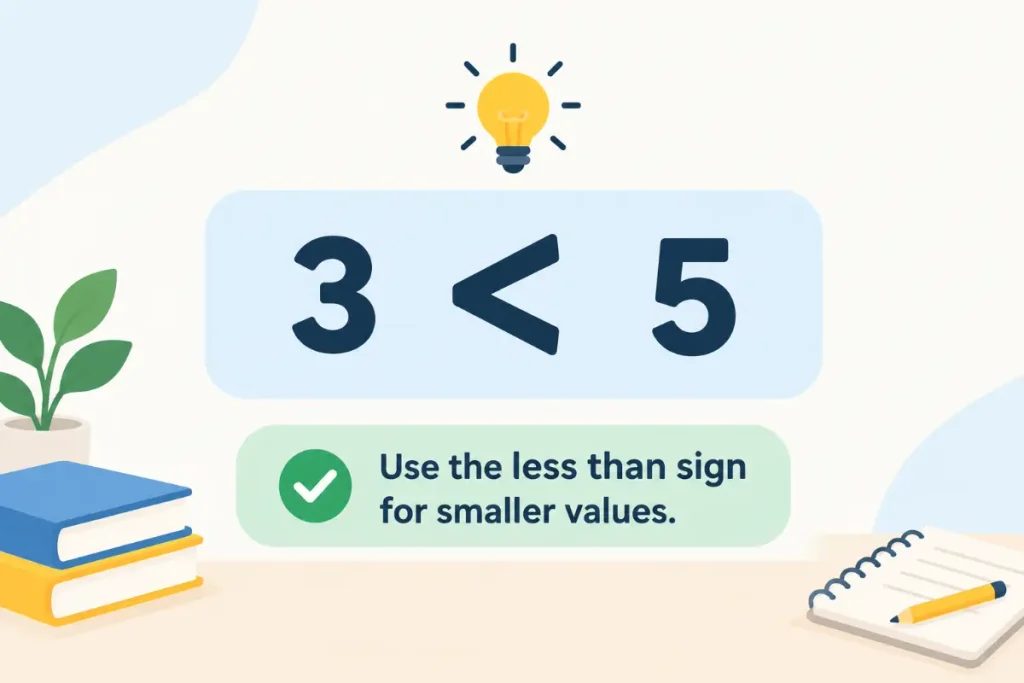
- “3 is less than 5.”
- “12 is less than 20.”
- “0 is less than 1.”
The mathematical symbol for less than is <.
So:
3 < 5
means:
3 is less than 5.
The symbol has a wide opening on the side of the larger number and a point toward the smaller number.
Less Than Versus Less Than Or Equal To
There is another useful distinction in mathematics.
Less than means the number must be smaller.
For example:
x < 10
This means x can be 9, 8, 7, or another value below 10. It cannot be 10.
Less than or equal to means the number can be smaller than 10 or exactly 10.
That is written as:
x ≤ 10
This difference matters in math, statistics, science, and technical writing.
Less Than In Negative Comparisons
The phrase can also appear in sentences involving negative ideas.
For example:
- “He is less worried than before.”
- “She is less likely to make the same mistake.”
- “The new plan is less expensive than the old one.”
- “This option is less risky than the first.”
The comparison still works in exactly the same way.
Less Than With Adjectives
You can use the phrase with many adjectives.
For example:
- “less expensive than”
- “less useful than”
- “less difficult than”
- “less important than”
- “less popular than”
- “less dangerous than”
- “less interesting than”
- “less crowded than”
These forms compare the degree of a quality.
For example:
- “Walking is less expensive than taking a taxi.”
- “This exercise is less difficult than the previous one.”
- “The park is less crowded than it was yesterday.”
Less Than With Verbs
The comparison can also relate to actions.
For example:
- “He talks less than his brother.”
- “She works less than she used to.”
- “They travel less than before.”
- “I worry less than I did last year.”
Here, than introduces the thing or period used for comparison.
The grammar remains the same even though the sentence does not contain a number.
Less Than With Nouns
You can also use the phrase before nouns.
- “I need less than a cup of sugar.”
- “She has less than a week to finish.”
- “We have less than a month before the deadline.”
- “He earns less than $2,000 a month.”
The phrase gives a lower amount than the stated point.
Can Less Than Mean Almost
Sometimes less than is used to express an amount below a certain level.
For example:
“It took less than ten minutes.”
This means the time was somewhere below ten minutes.
It could have been eight minutes, five minutes, or even two minutes.
Another example is:
“The box weighs less than five pounds.”
The exact weight is not given. We only know that it is below five pounds.
This is useful when the exact number is unknown or not important.
Can Less Than Mean Not Very
In some sentences, less than can be used in a more figurative way.
For example:
“His response was less than helpful.”
This means his response was not very helpful.
Another example is:
“The service was less than perfect.”
This means the service was not perfect.
This use does not necessarily involve a precise numerical comparison. It still carries the basic idea of being below an expected level.
Common Sentences With Less Than
Here are natural examples you can use as models.
- “I paid less than $20.”
- “The trip took less than two hours.”
- “She is less confident than her sister.”
- “This phone costs less than the other model.”
- “We have less than a week left.”
- “The room is less crowded today.”
- “He sleeps less than he used to.”
- “The job is less stressful than my previous one.”
- “The answer took less than a minute to find.”
- “This option is less expensive than the first one.”
- “The package weighs less than five pounds.”
- “The restaurant is less than a mile away.”
- “The new system uses less energy than the old one.”
- “She spends less money than she did last year.”
- “The second test was less difficult than the first.”
Each example uses than because a comparison is being made.
Common Sentences With Then
Now compare those examples with sentences using then.
- “First, finish your work, then take a break.”
- “We went shopping, then went home.”
- “I was living in New York then.”
- “Back then, phones were much simpler.”
- “Finish this page, then start the next one.”
- “She smiled, then walked away.”
- “We can eat first and then watch the movie.”
- “If you agree, then we can continue.”
- “He was younger then.”
- “I didn’t know that then.”
These sentences involve time, sequence, or a result. That is why then is correct.
Less Than And Then In The Same Sentence
Sometimes both words can appear in one sentence.
That can make the distinction easier to see.
“I finished in less than an hour, then went home.”
Here, less than compares the time with one hour.
Then shows what happened afterward.
Another example:
“If the trip takes less than two hours, then we can return before dinner.”
The first phrase gives a comparison. The second word shows a result.
This is a useful reminder that than and then are not interchangeable.
A Quick Editing Checklist
When you are unsure which word to use, stop and ask what the sentence is doing.
Check For A Comparison
Look for words such as:
- “more”
- “less”
- “better”
- “worse”
- “faster”
- “slower”
- “higher”
- “lower”
- “older”
- “younger”
These often introduce comparisons that use than.
Examples:
- “Better than before.”
- “Less than expected.”
- “Higher than average.”
- “Older than me.”
Check For Time Or Order
If the sentence explains what happened next, use then.
Examples:
- “First we ate, then we left.”
- “She called me, then sent an email.”
- If it means “at that time,” use **then.”
- “I didn’t know it then.”
Read The Sentence Again
Sometimes the answer becomes obvious when you read the full sentence slowly.
Do not choose based only on how the word sounds. Ask what the word means in that sentence.
Related Word Pairs That Cause Confusion
English contains many word pairs that sound similar but have different meanings. Learning then and than can help you spot the same pattern elsewhere.
Your And You’re
Your shows ownership.
- “That is your book.”
- You’re means “you are.”
- “You’re very kind.”
Their And There
Their shows ownership.
- “Their house is large.”
- There refers to a place or position.
- “Put the bag there.”
Its And It’s
Its shows ownership.
- “The dog wagged its tail.”
- It’s means “it is” or “it has.”
- “It’s raining.”
Affect And Effect
These two words can also cause confusion.
- Affect is usually used as a verb meaning to influence.
- “Lack of sleep can affect your mood.”
- Effect is usually a noun meaning a result.
- “The effect was immediate.”
The key lesson is simple. When two words look or sound alike, focus on their meaning and job in the sentence.
Is Less Than Always Followed By A Number
No. A number is common, but it is not required.
You can say:
- “She is less confident than before.”
- “This option is less useful than the other one.”
- “He speaks less than his brother.”
- “The movie was less exciting than I expected.”
The phrase can compare amounts, qualities, actions, or degrees.
Is Less Than Used In Questions
Yes.
- “How much less than last year did you spend?”
- “Is the package less than five pounds?”
- “Does it take less than an hour?”
- “Is this model less expensive than the other one?”
These questions use the phrase naturally.
Is Less Than Used In Negative Sentences
Yes.
- “I did not expect it to cost less than $100.”
- “She is not less capable than anyone else.”
- “We don’t have less than a week.”
The surrounding sentence can be positive or negative. The basic comparison rule stays the same.
Is Less Than Used With Time Expressions
Yes. This is extremely common.
- “Less than five minutes.”
- “Less than an hour.”
- “Less than a day.”
- “Less than a week.”
- “Less than a year.”
The word than remains correct because the phrase describes an amount below a stated time period.
Why Less Then Is Usually Wrong
The phrase less then is usually wrong when you are trying to compare an amount.
For example:
“I have less then you.”
The intended meaning is that one person has a smaller amount than another. Therefore, than is required.
Correct:
“I have less than you.”
Likewise:
“The job took less than an hour.”
Not:
“The job took less then an hour.”
The word then does not express this type of comparison.
A Practical Memory Trick For Everyday Writing
If you often make this mistake, use a two word memory rule.
Than compares. Then continues.
That is not a complete grammar rule for every possible use, but it is an excellent quick reminder.
- “Less than $50” compares an amount.
- “Eat, then sleep” shows sequence.
- “Better than before” compares.
- “Now and then” refers to time.
- “Fewer than ten” compares.
- “First this, then that” shows order.
Once this distinction becomes familiar, the spelling choice becomes almost automatic.
Examples For Students
Students often see these words in homework, essays, tests, and exams.
Here are useful examples.
- “The population is less than one million.”
- “Ali scored less than Sara.”
- “The second question was less difficult than the first.”
- “We had less than thirty minutes to finish.”
- “First, read the question, then write your answer.”
- “She studied for two hours, then went to bed.”
- “The school was smaller then.”
- “The new method is less expensive than the old one.”
The first group uses than for comparison. The second group uses then for time or sequence.
Examples For Work And Business
The same rule applies in professional writing.
- “The project took less than six months.”
- “The new process is less costly than the previous one.”
- “Sales were less than expected.”
- “The team completed the work, then submitted the report.”
- “First, review the data, then prepare the presentation.”
- “We had less than three days to meet the deadline.”
Clear spelling makes business communication easier to understand. A small word choice can still affect how polished your writing looks.
Examples For Social Media And Casual Writing
Informal writing follows the same basic rule.
- “Less than five minutes until the movie starts.”
- “This one is better than the old version.”
- “I have less than ten dollars left.”
- “Grab some food, then come over.”
- “I thought it would take less than an hour.”
- “Back then, everything felt different.”
Even in a text message, the difference between the two words remains the same.
A Mini Practice Test
Try choosing than or then in each sentence.
- This coffee costs less ___ the other one.
- We ate dinner and ___ watched a movie.
- The trip took less ___ three hours.
- I lived there ___.
- She is younger ___ her brother.
- Finish your homework, ___ you can play.
- The package weighs less ___ five pounds.
- The old system was less reliable ___ the new one.
- First, press the button, ___ wait ten seconds.
- He had less money ___ his friend.
The answers are:
- Than.
- Then.
- Than.
- Then.
- Than.
- Then.
- Than.
- Than.
- Then.
- Than.
Notice the pattern. Comparisons take than. Time and sequence take then.
FAQs
Is less then or less than correct?
Less than is correct when you are comparing an amount, number, size, time, or degree. Then is used for time, order, or sequence. For example, “The trip took less than an hour” is correct.
What is the difference between then and than?
Than is mainly used for comparisons, such as “smaller than me.” Then usually refers to time or order, such as “We ate, then left.”
Is less than grammatically correct?
Yes. Less than is standard English and is used to show that an amount or degree is below another amount or level. For example, “The repair cost less than $50.”
Should I use less than or fewer than?
Use less than mainly for uncountable amounts, such as money, time, water, and energy. Use fewer than mainly for things you can count individually, such as books, people, and apples.
Can then be used for comparison?
Normally, no. Then does not replace than in standard comparison sentences. Write “This costs less than that,” not “This costs less then that.”
How do I remember than and then?
A useful memory trick is than compares, then continues. If you are comparing two things, use than. If you are showing what happens next or referring to a time, use then.
Is less then ever correct?
The words can appear next to each other in unusual sentence structures, but less then is not the correct replacement for less than. If you mean a smaller amount or degree, use less than.
Is less than used in math?
Yes. In mathematics, less than means that one value is smaller than another. The symbol < represents this relationship, as in 3 < 5.
Conclusion
The answer to less then or less than is straightforward once you know what each word does. Use less than when you compare an amount, value, quality, degree, or measurement. Use then when you talk about time, sequence, or what happens next.
Think of than as your comparison word. “Less than,” “more than,” “better than,” and “faster than” all compare things. Think of then as your time and order word. “First this, then that” is a simple example.
When you are editing your writing, do not depend only on pronunciation. Ask yourself what the sentence means. If it makes a comparison, choose than. If it tells the reader what happened next or refers to a particular time, choose then.
Keep that one rule in mind and this common spelling mistake becomes much easier to avoid. The next time you pause over the two words, check the meaning first, make the comparison if there is one, and choose the spelling that fits the job.

Dr. Arthur Pendelton is a veteran historical linguist and grammar expert with over 30 years of experience in academic editing. A retired professor, Arthur specializes in the etymology and evolution of the English language. He is passionate about “unpacking the history behind the rules,” helping readers understand why we spell, punctuate, and phrase things the way we do today. Whether he’s settling debates on archaic usage or explaining complex linguistic shifts, Dr. Pendelton brings scholarly precision to every article.