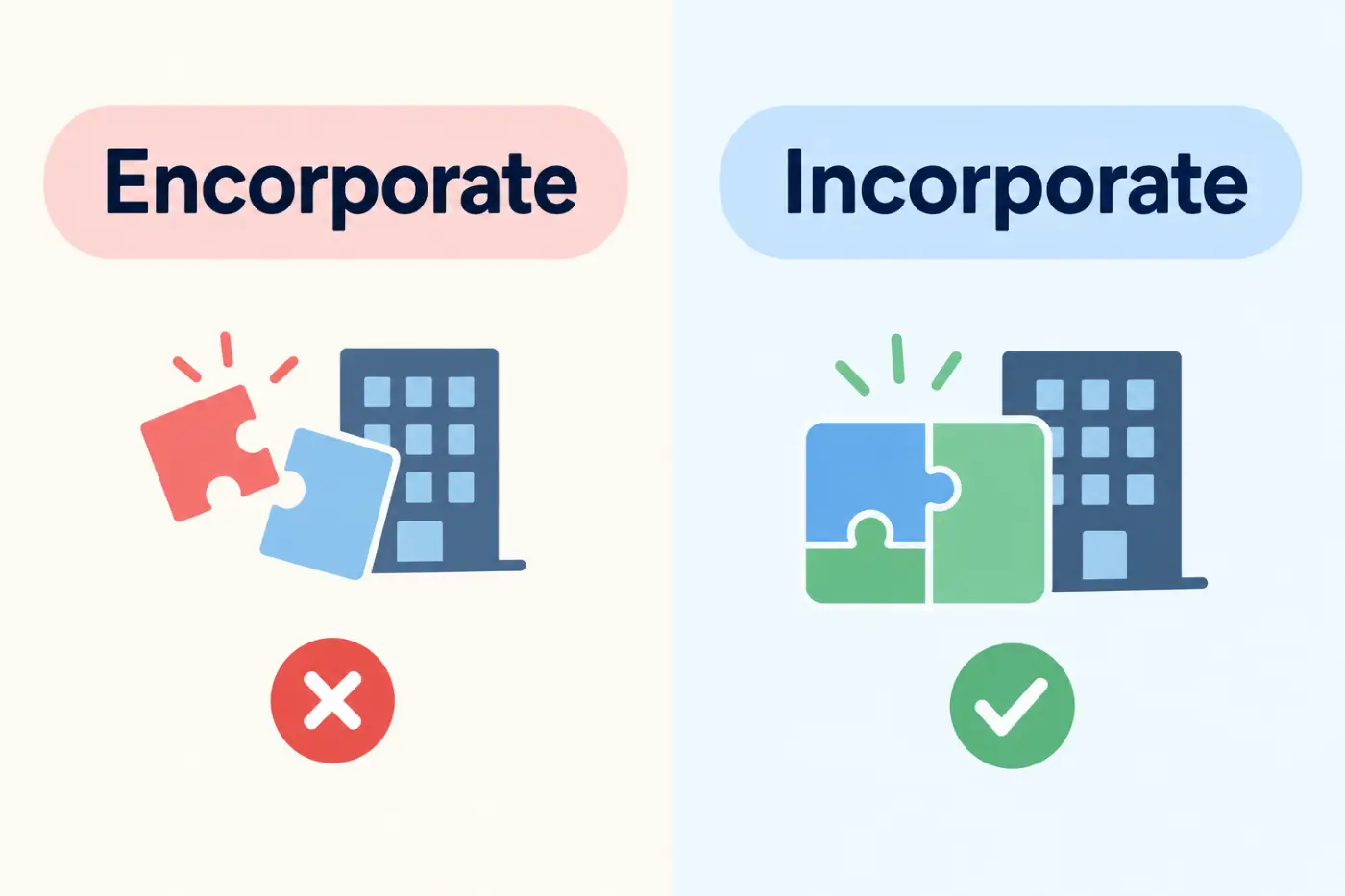
If you’ve ever paused over encorporate vs incorporate, you’re not alone. The two spellings look close enough to cause a quick second guess. One appears familiar because English has many words that begin with en. The other is the standard spelling you’ll find in dictionaries and professional writing.
The correct spelling is incorporate. The spelling encorporate is a misspelling in standard American English. If you mean to include something as part of a whole or combine something into an existing plan or system, use incorporate.
This small spelling mistake can matter more than it seems. You may use the word in an email, school paper, business document, report, application, or website copy. Using the standard form keeps your writing clear and polished.
This guide explains why the confusion happens, what incorporate means, how to use it as a verb and adjective, and how to avoid similar spelling mistakes. You’ll also see simple examples that show how the word works in everyday American English.
Quick Definition
Incorporate is the correct spelling. It means to include something as part of a larger whole or to combine something into an existing thing. Encorporate is not the standard spelling and should not be used in formal or edited writing.
Direct Answer
The correct word is incorporate, not encorporate. Use incorporate when you mean to include something in a larger whole or combine it with something that already exists.
Comparison Table
| Word or Phrase | Meaning | Example Sentence | When to Use It |
|---|---|---|---|
| Incorporate | To include something as part of a whole. | We should incorporate your ideas into the final plan. | Use this standard spelling in all normal writing. |
| Encorporate | Not a standard English word in this sense. | I need to incorporate the new details. | Do not use this spelling. |
Why The Spelling Causes Confusion
The main problem comes from the way English words are built. Many English words use the prefix en. Words such as encourage, enrich, enlarge, enable, and engage are common. Because of that pattern, encorporate can look reasonable at first glance.
There’s another reason the mistake feels natural. The word incorporate has a sound that can make the first vowel easy to mishear. When people hear the word in conversation, they may remember the beginning as en instead of in. Once that spelling gets stored in memory, it can show up again during writing.
English spelling doesn’t always match pronunciation perfectly. That creates plenty of traps. A person can know exactly what a word means and still spell it incorrectly.
That’s what happens with this word. The problem usually isn’t vocabulary. It’s spelling memory.
The good news is that you only need to remember one standard form.
Incorporate begins with in.
Think of the first part as the same beginning found in words such as include and insert. You’re putting something into a larger thing. That connection can make the spelling easier to remember.
What Incorporate Means
Incorporate has a few closely related meanings. They all center on the same basic idea of bringing something into a larger whole.
The most common meaning is to include something as part of another thing.
For example:
- The teacher decided to incorporate more group activities into the class.
- The group activities become part of the class.
You could also say:
We incorporated the customer’s suggestions into the new design.
The suggestions became part of the design process.
The word can also describe combining one thing with another.
For example:
- The recipe incorporates fresh herbs and roasted vegetables.
- The herbs and vegetables become part of the finished dish.
In business and legal writing, incorporate can have a more specific meaning. A company can incorporate when it becomes a corporation under the law.
For example:
- The founders decided to incorporate the business in Delaware.
- In this sentence, incorporate doesn’t simply mean include. It refers to forming a legal corporation.
So the word has more than one use. Still, the central idea remains easy to remember. Something is being brought into a larger structure.
The Correct Spelling Rule
There isn’t a special spelling rule that lets you build incorporate from encorporate. The best approach is to learn the word as a fixed spelling.
Write:
incorporate.
Not:
encorporate.
- The first vowel is an i.
- That small detail is the key.
You’ll also see related forms that keep the same spelling pattern.
They include:
- incorporated.
- incorporating.
- incorporation.
- incorporates.
Notice that the beginning stays consistent.
For example:
- The company is incorporated in Texas.
- The team is incorporating new research into the report.
- The incorporation of new data changed the results.
- She incorporates humor into her presentations.
The spelling remains connected across the word family. Learning the whole family can make the correct form easier to recognize.
Incorporate As A Verb
Most people encounter incorporate as a verb. A verb shows an action. In this case, the action involves adding something to a larger whole.
Here are some natural examples.
- Please incorporate these changes into the final draft.
- The chef incorporated local ingredients into the menu.
- We need to incorporate the latest sales figures into the report.
- She incorporated several useful ideas from the meeting.
- The new policy incorporates feedback from employees.
Each sentence describes something being added to something else.
The structure is often simple.
Incorporate + something + into something.
For example:
- Incorporate the new information into the report.
- Incorporate the changes into the design.
- Incorporate more examples into the lesson.
- This pattern is especially useful in professional and academic writing.
You can also use incorporate without the word into when the context makes the meaning clear.
The plan incorporates several safety measures.
Here, the phrase several safety measures acts as the object. The sentence tells us that those measures form part of the plan.
Incorporate As An Adjective
Incorporate can also work as an adjective, though this use is less common in everyday American English.
An adjective describes a noun. In this use, incorporate can describe something that has been formed into a whole or combined into another structure.
For most everyday writing, though, you’ll probably use incorporated or incorporation instead.
For example:
- The company is an incorporated business.
- That wording is common in legal and business contexts.
You may also see phrases such as incorporated company or incorporated association. The exact usage depends on the legal system and context.
For ordinary writing, the verb form is usually the one you need.
The Legal Meaning Of Incorporate
Business writing adds another layer to this word.
When a business incorporates, it creates a corporation under applicable law. The corporation becomes a legal entity separate from its owners.
For example:
They incorporated the company after several years of growth.
Here, the word has a legal business meaning.
This use is common in the United States. You may see it in business documents, state filings, company records, contracts, and financial discussions.
The noun form is incorporation.
For example:
The incorporation process took several weeks.
The adjective incorporated appears in company names and legal descriptions.
For example:
The company was established as an incorporated business.
This business meaning is different from the simple idea of adding something to a whole. Still, the spelling stays exactly the same.
The Difference Between Include And Incorporate
Include and incorporate are close in meaning, but they aren’t always interchangeable.
Include usually means that something is part of a group, list, collection, or whole.
For example:
- The price includes breakfast.
- That means breakfast is part of what the customer receives.
Incorporate often suggests that something is actively added or blended into a larger thing.
For example:
- The designer incorporated the client’s feedback into the final product.
- The feedback didn’t simply sit beside the product. It influenced the final result.
Another example makes the difference clearer.
- The report includes three charts.
- This simply tells us that three charts appear in the report.
- The report incorporates data from three recent studies.
- This suggests that the study data became part of the report’s analysis or content.
- The words overlap. Incorporate often gives a stronger sense of integration.
The Difference Between Combine And Incorporate
Combine means to join two or more things together.
For example:
Combine the flour and sugar in a large bowl.
Incorporate can also involve joining things. However, it often focuses on bringing one thing into an existing whole.
- Compare these examples.
- Combine the two ingredients.
This tells you to mix them together.
Incorporate the ingredients into the mixture.
This focuses on adding the ingredients so they become part of the mixture.
The difference can be subtle. Context often decides which word sounds more natural.
Encorporate vs Incorporate In Real Writing
Seeing the correct spelling in real sentences is one of the fastest ways to remember it.
Consider these examples.
- The editor asked me to incorporate more evidence into the article.
- This sentence means the writer needs to add more evidence as part of the article.
- The school plans to incorporate more technology into its classrooms.
- The technology will become part of the classroom approach.
- We should incorporate your suggestion into the final proposal.
- The suggestion will become part of the proposal.
- The new recipe incorporates several traditional ingredients.
- The ingredients form part of the recipe.
- Her presentation incorporates charts, photos, and customer data.
- The charts, photos, and data are integrated into the presentation.
- The architect incorporated large windows into the design.
- The windows became part of the building design.
- The software update incorporates several new security features.
- The new features have been added to the software.
- The committee incorporated public feedback into its recommendations.
- The feedback influenced the recommendations.
Notice how natural incorporate sounds in each example. It works well when something is added to an existing plan, system, design, product, document, or process.
Common Sentences With Incorporate
You can use the word in many everyday situations.
At Work
- Please incorporate the manager’s comments into the revised report.
- We incorporated the new pricing information into the presentation.
- The marketing plan incorporates several customer suggestions.
- I’ll incorporate your edits before sending the final version.
- The team incorporated the research findings into its strategy.
These examples are common in workplace writing. They sound direct and professional without being overly formal.
At School
- Students were asked to incorporate three sources into their essays.
- The teacher incorporated a short quiz into the lesson.
- The project incorporates information from several books.
- She incorporated historical examples into her presentation.
- The professor asked us to incorporate the latest research.
The word works naturally in academic writing because students and teachers often add sources, ideas, evidence, and examples to larger pieces of work.
In Everyday Conversation
Incorporate can sound slightly formal in casual speech, but Americans still use it often.
For example:
- I’m trying to incorporate more vegetables into my meals.
- That’s a very natural sentence.
You could also say:
- I’m trying to add more vegetables to my meals.
- The second version sounds more casual. The first is a little more polished.
- Another example is:
- We should incorporate some fun activities into the trip.
In casual conversation, add might sound simpler. Incorporate still works perfectly well.
Common Mistakes To Avoid
The biggest mistake is spelling the word with an e at the beginning.
Incorrect:
We need to encorporate these ideas into the plan.
Correct:
We need to incorporate these ideas into the plan.
Another common mistake is changing the spelling when adding an ending.
Incorrect:
The report is encorporated into the larger study.
Correct:
The report is incorporated into the larger study.
The same pattern applies to other forms.
Incorrect:
The team is encorporating new data.
Correct:
The team is incorporating new data.
Incorrect:
The encorporation of new rules caused confusion.
Correct:
The incorporation of new rules caused confusion.
Once you remember the root word, the related forms become easier.
A Simple Memory Trick
Here’s a useful way to remember the spelling.
Think of incorporate as in plus the whole.
Something goes in and becomes part of something larger.
You can connect it with the word include.
Both begin with in.
Include means something is part of a group.
Incorporate means something is brought into a larger whole.
This isn’t a strict spelling rule. It’s simply a memory aid.
Another useful trick is to picture the word visually.
INcorporate.
The word starts with IN.
That first part can remind you of the action itself. Something goes in.
You can also memorize one sentence and reuse it as your spelling model.
We need to incorporate the new information into the report.
If you can spell incorporate correctly in that sentence, you’ll have a strong pattern to follow in other situations.
Why People Write Encorporate
People rarely make this mistake because they don’t understand the word. Most of the time, it comes from sound and pattern.
English contains many words beginning with en. That makes encorporate look believable.
Words such as encourage and enrich reinforce that pattern.
There’s also a related word called encorporate in some historical or specialized sources. Older English forms and rare dictionary entries can create extra confusion. However, that doesn’t make encorporate the standard modern spelling for the common verb meaning to include or combine.
For normal American English, use incorporate.
That’s the form expected in edited articles, school assignments, business writing, professional communication, and most general publications.
Why Spelling Matters Here
A single letter can change how readers judge a piece of writing.
If you write an email with one minor spelling mistake, most readers will understand your meaning. Still, repeated errors can make your writing look rushed.
- That matters more in formal situations.
- A job application should look polished.
- A business proposal should be clean.
- An academic paper should use standard spelling.
- A website should present information clearly.
Using incorporate instead of encorporate is a small step, but it removes an unnecessary distraction.
The reader doesn’t need to stop and wonder if the spelling is correct.
How To Use Incorporate Naturally
The most useful structure is simple.
Incorporate something into something.
For example:
- Incorporate the new figures into the report.
- Incorporate customer feedback into the next version.
- Incorporate these ideas into your presentation.
- Incorporate more examples into the lesson.
You can also use the word directly with an object.
- The plan incorporates several new safety measures.
- The design incorporates natural materials.
- The program incorporates hands on activities.
The first structure highlights the action of adding something. The second describes something that already contains the added elements.
Both are correct.
Incorporate And Integrate
Integrate is another word that often appears beside incorporate.
Both words can mean bringing something into a larger whole.
Integrate often emphasizes making separate parts work together as one system.
For example:
- The company integrated its new software with the existing system.
- This suggests that two systems were connected so they could work together.
- Incorporate can be broader.
- The company incorporated new software into its existing system.
- This emphasizes the addition of the new software.
- The difference isn’t always sharp. In many contexts, either word may work.
Still, integrate often suggests connection and coordination. Incorporate often suggests inclusion or addition.
Incorporate And Add
Add is the simpler word.
- Add more examples to the report.
- Incorporate sounds more formal.
- Incorporate more examples into the report.
- Both sentences can communicate the same basic idea.
- Use add when you want plain everyday language.
Use incorporate when you want to emphasize that the new material should become part of the larger work.
Neither word is automatically better. Good writing depends on the situation.
Incorporate And Adopt
Adopt can also overlap with incorporate, especially when discussing ideas, methods, rules, or practices.
For example:
- The company adopted a new hiring policy.
- This means the company accepted and began using the policy.
You could also say:
- The company incorporated the new hiring policy into its employee handbook.
- Now the focus is on making the policy part of the handbook.
- Adopt focuses more on accepting or choosing something.
- Incorporate focuses more on adding something into a larger whole.
- That distinction can help you choose the right word.
Incorporate And Contain
Contain means something has something inside it.
For example:
- The box contains six books.
- Incorporate means something has been added or blended into a larger whole.
For example:
The design incorporates six new features.
A box can contain objects. A plan can incorporate ideas. A recipe can incorporate ingredients. A report can incorporate evidence.
The words can overlap in some contexts, but they don’t carry the same sense.
How To Proofread This Word
If you’re unsure about the spelling, don’t stare at the word for too long. Use a simple check.
First, ask what you mean.
If you mean add something to a larger whole, you probably need incorporate.
Next, look at the first part.
It starts with in.
Then check the related forms.
- Incorporate.
- Incorporated.
- Incorporating.
- Incorporation.
If your spelling suddenly begins with en, stop and check it.
This quick habit can prevent the mistake before it reaches the final version.
A Quick Editing Test
Take this sentence.
We should encorporate the customer comments into the final report. The meaning is clear, but the spelling is wrong.
Change it to:
We should incorporate the customer comments into the final report.
Now the sentence uses the standard spelling.
Try another one.
The new design encorporates several useful features.
Change it to:
The new design incorporates several useful features.
One more example.
She is encorporating feedback from the survey.
The correct version is:
She is incorporating feedback from the survey.
The spelling remains consistent across different forms.

Formal Writing And Professional Use
In professional writing, incorporate is a useful word because it describes a common action with precision.
- Managers incorporate feedback.
- Editors incorporate revisions.
- Designers incorporate ideas.
- Researchers incorporate evidence.
- Teachers incorporate activities.
- Companies incorporate new systems.
- Writers incorporate sources.
The word fits many fields without sounding overly technical.
Still, don’t use it just to make a sentence sound formal.
For example:
We need to incorporate a new chart into the report.
That’s clear.
But:
We need to incorporate a meeting into our schedule.
That may sound awkward if you simply mean schedule a meeting.
Good word choice depends on meaning. Incorporate works best when something becomes part of a larger thing.
When Not To Use Incorporate
Knowing when not to use a word is just as useful as knowing when to use it.
Suppose you mean that someone should put an item on a table.
You would say:
- Put the book on the table.
- You wouldn’t normally say:
- Incorporate the book onto the table.
The action has nothing to do with making the book part of a larger whole.
Suppose you mean that someone should call a friend.
You wouldn’t say:
- Incorporate your friend.
- That doesn’t express the intended meaning.
- Instead, use the direct verb that matches the action.
Incorporate is most useful when something is added to, blended into, or made part of something larger.
Why Context Makes The Meaning Clear
The surrounding words usually tell you which sense of incorporate is intended.
Consider:
The designer incorporated blue into the room.
Here, incorporate means added or blended into the design.
Now consider:
- The owners incorporated the company.
- Here, the business meaning is intended.
The word is spelled the same in both sentences. The context changes the meaning.
This is common in English. Many words have more than one meaning, and readers use the surrounding sentence to understand the intended one.
The Word Family
Learning a word family can make spelling easier.
- The base word is incorporate.
- From it, we get incorporated.
- The business is incorporated in California.
- We also get incorporating.
- The team is incorporating the new data.
- Then there is incorporation.
The incorporation of the business required legal paperwork.
And incorporates.
The new policy incorporates several changes.
The spelling stays tied to the same root.
This matters because spelling mistakes often happen when writers remember one form but guess another. Learning the family gives you a reliable pattern.
Pronunciation Can Add To The Confusion
Pronunciation is another reason the first vowel can cause trouble.
When people speak quickly, the beginning of a word may not sound as clear as it looks on the page. If you’ve mostly heard the word in conversation, you may have to reconstruct its spelling later.
That’s especially common with longer words.
The solution isn’t to rely entirely on pronunciation. Instead, connect the sound with the written form.
Say the word.
Then picture the spelling.
Incorporate.
The first part is in.
This small mental connection can make the correct spelling easier to recall.
Search And Writing Habits
If you’re writing online, spelling mistakes can also affect how professional your content looks.
Readers may overlook a single typo. Still, a word that appears several times with the wrong spelling can weaken trust.
That’s especially true in educational, legal, financial, technical, and business content.
You don’t need complicated editing tools to avoid this particular error.
Search your draft for encorporate.
If you find it, replace it with incorporate when you mean to include or combine something.
Then check related forms such as incorporated and incorporating.
This simple search can catch the mistake quickly.
Other Spelling Pairs Worth Knowing
The confusion around this word is part of a larger pattern in English. Some misspellings look convincing because they follow a familiar sound or letter pattern.
For example, people sometimes write separate as seperate.
- They may write definitely as definately.
- They may write receive as recieve.
- They may write occurrence as occurence.
These errors happen because English spelling has many patterns that aren’t perfectly predictable.
The best defense is repeated exposure to the correct form.
- Read good writing.
- Notice common words.
- Save useful spelling patterns.
- Then use those patterns in your own writing.
- For this particular word, the pattern is simple.
Incorporate starts with in.
A Practical Way To Remember The Difference
- Imagine you have a box.
- You place a new item inside it.
- The item goes in.
- Now imagine you have a report.
- You add new research to it.
- The research goes in and becomes part of the report.
- That mental picture connects the meaning with the spelling.
- Incorporate means bringing something in.
It isn’t a perfect dictionary definition for every use, but it’s an effective spelling reminder.
FAQs
Is encorporate a correct word?
Not in standard modern American English for the meaning of adding something to a larger whole. Use incorporate instead. Encorporate is generally treated as a misspelling in this context.
Is incorporate the correct spelling?
Yes. Incorporate is the standard spelling. It can mean to include something as part of a larger whole or to combine something with another thing.
What does incorporate mean?
Incorporate usually means to include something as part of a larger whole. For example, you can incorporate feedback into a report or incorporate new ingredients into a recipe.
How do you use incorporate in a sentence?
A common pattern is incorporate something into something. For example, you could write, The editor asked me to incorporate the new research into the article.
Is incorporate a verb?
Yes. Incorporate is commonly used as a verb. It describes the action of adding or combining something with a larger whole.
What is the difference between incorporate and include?
Include means that something is part of a group or whole. Incorporate often suggests that something has been actively added or blended into a larger thing.
What is the past tense of incorporate?
The past tense is incorporated. For example, you could write, The team incorporated the new data into its report.
Is encorporate vs incorporate a spelling question?
Yes. Encorporate vs incorporate is mainly a spelling question for most readers. The standard form for the common meaning is incorporate.
Conclusion
The answer is simple. Incorporate is the correct spelling when you mean to include something as part of a larger whole. Encorporate is not the standard spelling for this meaning.
The word works in many settings. You can incorporate ideas into a plan, evidence into an article, ingredients into a recipe, feedback into a design, or features into a product. In business language, incorporate can also mean to legally form a corporation.
If you tend to spell the word with an e at the beginning, remember the first two letters. Incorporate starts with in. Think of something going in and becoming part of a larger whole.
The next time you face the encorporate vs incorporate question, choose incorporate. That one spelling will keep your writing correct in everyday, academic, professional, and business contexts.

Dr. Arthur Pendelton is a veteran historical linguist and grammar expert with over 30 years of experience in academic editing. A retired professor, Arthur specializes in the etymology and evolution of the English language. He is passionate about “unpacking the history behind the rules,” helping readers understand why we spell, punctuate, and phrase things the way we do today. Whether he’s settling debates on archaic usage or explaining complex linguistic shifts, Dr. Pendelton brings scholarly precision to every article.