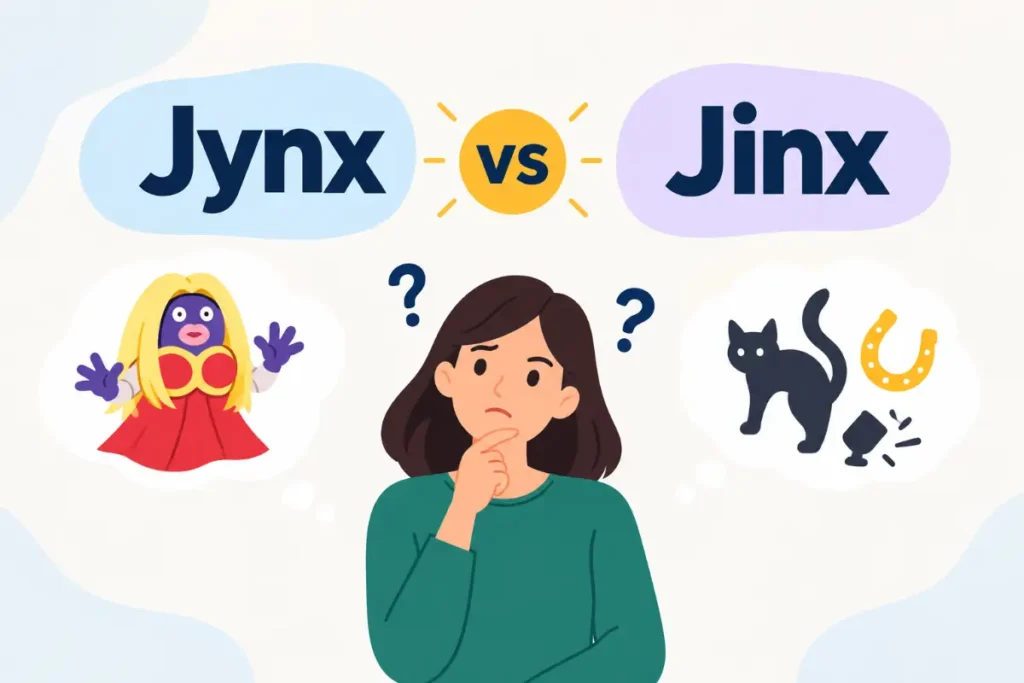
If you searched for jynx vs jinx, you probably want one simple answer. For normal English writing, jinx is the spelling you want when you mean bad luck or the act of causing bad luck.
Jynx is a real English word, but it has a different job. It can refer to a wryneck, a small bird in the woodpecker family, and it is also the name of a genus that contains the wrynecks. You may also see Jynx as a proper name, such as the name of a Pokémon character.
The two forms look almost the same and have the same pronunciation in common use. That makes the confusion easy to understand. The key is not the sound. It is the meaning and the context.
This guide explains the difference, shows you how to use each spelling, and covers the history behind the words. You will also see common sentences, memory tricks, related mistakes, and answers to questions people often ask.
Quick Definition
Jinx is the standard modern English word for a person, thing, or situation linked with bad luck. Jynx is a less common word connected to the wryneck bird and its scientific genus, and it can also be a proper name.
Direct Answer
Use jinx when you mean bad luck or causing bad luck. Use Jynx only when you mean the bird genus, a specific name, or another proper name that is intentionally spelled that way.
Comparison Table
| Word or Phrase | Meaning | Example Sentence | When to Use It |
|---|---|---|---|
| Jinx | A person, thing, or situation believed to bring bad luck. It can also mean to cause bad luck. | I did not want to jinx our chances. | Use it in normal English when talking about bad luck. |
| Jynx | A wryneck bird or the genus that contains wrynecks. It can also be a proper name. | The genus Jynx contains the wrynecks. | Use it for the bird or a specific name that uses this spelling. |
Where The Confusion Comes From
The main problem is that the two spellings sound alike. When people hear the word in conversation, they have no visual clue that tells them which spelling belongs on the page.
English has many words like this. A sound can point to more than one spelling, especially when one form is rare. Jynx is uncommon in everyday writing, while jinx is familiar to most American readers. If you know only the spoken form, it is easy to reach for the wrong letters.
The connection between the words also makes things more interesting. Modern jinx is thought to be related to the older form jynx. The older word referred to the wryneck bird and later became linked with magic and spells. Merriam Webster lists jynx as a word for the wryneck and as the name of a genus of woodpeckers. It lists jinx as the modern word for bad luck and as a verb meaning to bring bad luck.
So the spellings are not random lookalikes. They have a historical relationship, but modern English gives them different roles.
The Sound Does Not Give You The Answer
When you say the word aloud, both forms sound the same in ordinary English. That means pronunciation cannot help you choose the correct spelling.
This is one reason spelling questions often appear with words that people already know well. You may understand the meaning perfectly but still hesitate when you need to type the word.
The same problem appears with many English words that share a sound but have different spellings and meanings. In this case, the difference is especially small because both forms end with the same letter and differ by only one vowel.
The easiest solution is to connect each spelling with its meaning rather than its sound.
Jinx belongs to everyday conversations about luck.
Jynx belongs to more specific uses involving the bird, biology, history, or a proper name.
That small distinction removes most of the confusion.
The Correct Spelling For Everyday English
If you are writing an email, school paper, article, text message, social post, or business document and you want to talk about bad luck, write jinx.
For example.
I hope I do not jinx the team by saying they will win.
That sentence uses the word as a verb. The speaker believes that saying something too confidently might somehow bring bad luck.
You can also use it as a noun.
That stadium has a jinx.
Here, the word describes a person, place, thing, or situation believed to bring bad luck.
Another common pattern is put a jinx on something.
She thought talking about the perfect weather might put a jinx on the trip.
In everyday American English, this is the form readers will recognize immediately. It is also the spelling found in major English dictionaries for the bad luck sense. Merriam Webster gives both noun and verb uses, while Collins gives the same core meanings in American English.
Jinx As A Noun
As a noun, jinx refers to someone or something believed to bring bad luck. It can also refer to a spell or period of bad luck.
Consider these examples.
- He thinks that old jacket is a jinx.
- The team finally broke its playoff jinx.
- She believes the house has a jinx on it.
- That losing streak feels like a jinx.
The word does not always describe a literal supernatural force. People often use it in a playful or superstitious way.
For example, a fan might say.
Do not talk about the championship yet. You will jinx us.
The speaker does not have to believe in magic. The expression can simply be a lighthearted way to say that talking too soon might ruin the mood or make the speaker nervous.
Sports are especially common territory for this word. Merriam Webster notes that the modern noun appeared in American English in the early twentieth century, with early use tied to sports and baseball.
Jinx As A Verb
Jinx also works as a verb. To jinx something means to bring bad luck to it or cause an unwanted outcome through an act, often by saying something that feels too confident.
Here are natural examples.
- I do not want to jinx our chances.
- He jinxed the game by predicting an easy win.
- She was afraid to mention the good news because she thought she might jinx it.
- Do not jinx yourself before the interview.
- They joked that the lucky hat would jinx the next game if someone washed it.
The verb is especially common in casual speech. It often appears in phrases such as do not jinx it and I do not want to jinx it.
The verb forms are also easy to remember.
- Present form is jinx.
- Past form is jinxed.
- Present participle is jinxing.
- Third person singular is jinxes.
- Merriam Webster lists jinxed, jinxing, and jinxes as the standard forms.
Notice that the spelling stays with x. You do not need to change the final x to make the verb forms.
Jynx vs Jinx In Everyday Writing
The practical difference between the two forms becomes clear when you look at the setting.
- If you are talking about a bad prediction, use jinx.
- If you are talking about a lucky streak that keeps going wrong, use jinx.
- If you are warning someone not to talk too confidently about a future result, use jinx.
- If you are writing about a bird genus, use Jynx.
- If you are writing about a person, character, product, or other name that officially uses Jynx, keep that spelling.
This distinction is simple because the meanings rarely overlap in modern writing.
Examples That Make The Difference Clear
Seeing the words in context is often more useful than memorizing definitions.
- Suppose you are talking about a baseball game.
- I do not want to jinx our team.
- This is the standard spelling because you mean cause bad luck.
- Now imagine you are writing about birds.
- Jynx is a genus that includes wrynecks.
- Here the unusual spelling is correct because you are using a scientific name.
- Now imagine a character, product, username, or fictional figure has the name Jynx.
- Jynx is the name of the character.
- That spelling can be correct because proper names follow their own conventions.
The context does the heavy lifting. You do not have to guess from the sound alone.
Common Mistakes With Jinx
One common mistake is using jynx when you mean bad luck.
For example.
- Incorrect: I do not want to jynx our chances.
- Correct: I do not want to jinx our chances.
Another mistake is assuming that jynx is always wrong because it is less common.
That is not true. Jynx is a legitimate term in biology and can appear as a proper name. The problem comes when someone uses it in the wrong context.
A third mistake is changing the word to jinks.
Jinks is a different spelling that appears in some historical uses and in other expressions. It is not the standard modern spelling for the bad luck verb or noun. Merriam Webster notes that early evidence for the modern word includes jinks before the spelling shifted toward jinx.
Do not confuse the bad luck word with the phrase high jinks either. The jinks in high jinks has a separate history and does not mean a spell of bad luck. Merriam Webster specifically points out that this jinks is unrelated to jinx.
Jinx In Everyday American English
The word is common in casual American English. You may hear it in sports conversations, family talk, friendly teasing, and everyday discussions about luck.
A person might say.
I knew I would jinx it if I said anything.
- Someone might reply.
- You totally jinxed us.
These sentences do not sound formal. That is part of the word’s appeal. It is short, familiar, and easy to use.
The word can also be used when someone says the same thing as another person at the same moment. In some versions of a children’s game, the first person to call jinx claims the other person cannot speak until a rule is completed. Merriam Webster describes this game as a familiar use of the word.
That use is separate from the dictionary sense of a person or thing that brings bad luck, but both uses are widely recognizable.
Why Jynx Is Still A Real Word
A spelling can be uncommon and still be correct.
That point is worth remembering because online writing often treats rare words as mistakes. Jynx is a good example of why context matters.
The dictionary entry for jynx identifies the word as wryneck and also gives the capitalized scientific genus Jynx. The genus belongs to the woodpecker family and includes the wrynecks.
You are most likely to see the term in biology, bird guides, scientific writing, or discussions of word history.
You might also see Jynx as a name. For example, the Pokémon character Jynx uses that spelling as part of its official name. The name is also a play on the word jinx.
So if you encounter Jynx in a proper name, do not automatically correct it. Names belong to the person, character, company, product, or work that uses them.
When A Rare Spelling Is Correct
Good editing is not about changing unusual words into familiar ones. It is about making sure each word fits its purpose.
Suppose you edit a sentence about birds and see Jynx. Changing it to jinx would make the sentence less accurate.
Suppose you edit a sports article and see jynx used to mean bad luck. Changing it to jinx would improve the sentence.
The same principle applies to names. If a character is officially called Jynx, you should not change the spelling just because jinx is the common English word.
This is a useful habit for any writer. Before correcting an unusual spelling, check the meaning and context. A rare word may be exactly right.
Capitalization Matters Too
There is another small difference worth knowing.
When Jynx refers to the scientific genus, it is capitalized because genus names are written with an initial capital letter.
When jinx refers to bad luck, it is normally lowercase unless it begins a sentence or appears in a title where capitalization rules require it.
For example.
- The genus Jynx contains the wrynecks.
- I do not want to jinx the plan.
This difference gives readers another clue about the word’s role.
A capital J can also appear when Jynx is part of a proper name. In that case, capitalization follows the name rather than the ordinary bad luck word.
The History Behind The Two Spellings
The history is one of the most interesting parts of this word pair.
The older form jynx is connected to the wryneck bird. Merriam Webster traces it through Latin and Greek. The bird became associated with magic and divination because of beliefs about its strange behavior and use in ancient practices.
English later used jynx in the sense of a charm or spell. Etymonline dates that use to the 1690s. It also records the modern American spelling jinx in the early twentieth century and connects it to sports slang.
Merriam Webster gives the first known use of jinx as 1902 for the noun and 1913 for the verb. Its historical note says the noun may be an alteration of jynx.
The exact path is not completely settled. That is important because word histories can look neat after the fact even when the evidence is messy.
Merriam Webster’s history of the word points out that early baseball sources used jinks before jinx became the preferred spelling. It also discusses another proposed source involving a character named Jinks Hoodoo from a late nineteenth century musical comedy. The evidence does not give a single perfectly certain answer for how the modern spelling arose.
That uncertainty does not affect modern usage. Today, the practical rule is simple. Jinx is the normal English word for bad luck. Jynx belongs to more specific contexts.
The Bird Behind The Word
The wryneck gives this spelling question an unusual backstory.
Wrynecks are small birds related to woodpeckers. Their name is connected with their ability to twist and turn their necks in a distinctive way. The unusual movement helped create old beliefs around the bird.
The bird was associated with magic and divination in older traditions. That association helped connect its name with charms and spells.
Over time, words can move far from their original meanings. A word that once named a bird can become connected with a spell, then with bad luck, and eventually with a casual expression people use before a big game.
That is a good reminder that English vocabulary is not always built in a straight line.
The Sports Connection
Modern jinx became especially visible in American sports language.
Early twentieth century baseball writing used the word to describe an unlucky person, event, or influence. Merriam Webster records the noun as first known in 1902 and its history discusses baseball examples from the period.
Sports are a natural home for words about luck. Fans and players often have rituals, superstitions, lucky clothes, special routines, and ideas about bad streaks.
That makes phrases such as playoff jinx and team jinx easy to understand.
The word later spread far beyond sports. Today, people use it for work plans, trips, relationships, games, exams, conversations, and everyday situations.
A Simple Memory Trick
If you want an easy way to remember the difference, connect the x in jinx with bad luck.
- Think of it this way.
- Jinx means bad luck.
- Jynx means the bird or a special name.
You can also remember the common phrase I do not want to jinx it. This is one of the most useful forms to keep in your mental word bank.
If you are writing about a team, a test, a trip, a prediction, or a lucky streak, jinx is almost certainly the word you need.
If you are writing about a wryneck bird or the scientific genus, Jynx is the specialized term.
This trick will solve most spelling questions without making you memorize the full history.
A Quick Editing Test
When you are unsure, ask yourself one question. Am I talking about bad luck.
- If the answer is yes, use jinx.
- If you are talking about the bird genus, use Jynx.
- If the word is part of a name, copy the official spelling of that name.
This three part test works because it focuses on meaning instead of sound. It also keeps your writing natural. You do not need a long grammar rule to make the right choice.
Jinx And Similar Words
Several words sit close to jinx in meaning, but they are not always interchangeable.
Curse is broader and can suggest a spoken or supernatural act meant to cause harm or bad luck.
Hex usually suggests a magical spell or curse.
Omen refers to something believed to signal a future event. An omen can be good or bad.
Bad luck is the plainest phrase. It does not suggest that a person or action caused the misfortune.
Jinx is more casual. It often suggests that someone or something has a pattern of bad luck or that a person has caused bad luck by speaking too soon.
Compare these sentences.
- The broken mirror was seen as an omen.
- The witch placed a curse on the house.
- He thought someone had put a hex on the family.
- I do not want to jinx our plans.
The first three can sound more serious or supernatural. The last one is common everyday speech.
Jinx Compared With Curse
A jinx and a curse can both involve bad luck, but they do not always feel the same.
Curse often sounds stronger and more deliberate. It can suggest that someone intentionally caused harm through magic or a supernatural act.
Jinx usually sounds lighter. A person can accidentally jinx something just by making a confident prediction.
For example.
- The story says the family was under a curse.
- I hope I do not jinx the family vacation.
The first sentence suggests something serious and lasting. The second sounds casual and conversational.
Jinx Compared With Omen
An omen is a sign. A jinx is a source or cause of bad luck.
That difference is easy to miss.
- A dark cloud might be treated as an omen of a storm.
- A person who always seems to be around when things go wrong might be called a jinx.
- The two words can appear in the same conversation, but they describe different ideas.
- An omen points toward something.
- A jinx brings or seems to bring bad luck.
Can You Use Jynx In A Normal Sentence
Yes, but the sentence needs a reason for that spelling.
For example.
- The bird belongs to the genus Jynx.
- That is a normal sentence in a biology context.
- You could also write.
- The character is called Jynx.
- That is correct because the name itself uses that spelling.
- But this sentence would usually be wrong.
- I hope I do not jynx the presentation.
- If the writer simply means cause bad luck, the standard spelling is jinx.
The safest habit is to check the meaning before checking the spelling. Ask yourself what the word is doing in the sentence. If it describes bad luck or the act of bringing bad luck, use the familiar form. If it names the bird genus or a proper name, keep the special spelling.
Pronunciation Of Jinx And Jynx
The two forms are pronounced the same in ordinary English. Major dictionaries give the pronunciation with the sound represented roughly as jinks. Merriam Webster lists both jynx and jinx with the same pronunciation.
That explains why this spelling problem shows up so often.
You can hear the word correctly and still spell it incorrectly. The sound does not tell you which vowel belongs in the middle.
This is common in English. Many words have spellings that cannot be predicted perfectly from pronunciation. The best solution is to learn the spelling alongside the meaning.
- For jinx, attach the word to the phrase do not jinx it.
- For Jynx, attach it to the bird genus or the specific name.
That gives your brain two separate hooks instead of one confusing sound.
When To Choose Each Spelling
Choose jinx when you mean a source of bad luck.
He is a jinx.
- Choose jinx when you mean a spell or period of bad luck.
- The team is trying to end its playoff jinx.
- Choose jinx when you mean to cause bad luck.
- I do not want to jinx our chances.
- Choose Jynx when you mean the bird genus.
- Jynx contains the wrynecks.
- Choose Jynx when it appears as a proper name.
- Jynx is the character’s official name.
- That is the whole decision in a nutshell.
- The spelling depends on meaning and context, not pronunciation.
Why The X Matters
Both spellings end in x, so the middle letter creates the real difference.
- Jinx uses i.
- Jynx uses y.
In modern everyday English, the i spelling is the one tied to bad luck. The y spelling has a specialized role.
This small vowel change can make a big difference in written communication. Readers use spelling to understand meaning, especially when two words sound the same.
That is why spelling questions like this matter. A reader may understand your sentence from context, but the wrong form can still make your writing look careless.
For an article, school assignment, professional message, or website, the standard form gives readers confidence.
The same rule applies to many other word pairs. When two spellings sound alike, do not choose based only on what feels right. Check the meaning first.
Why This Matters For Writers
Writers often focus on grammar and forget that word choice carries just as much meaning.
Using the standard spelling makes your sentence easier to trust. It also helps search engines and readers understand the topic clearly.
- If your sentence says, I do not want to jinx it, the meaning is immediate.
- If you write, I do not want to jynx it, some readers may stop and wonder if you made a typo.
That small interruption can make a sentence feel less polished.
This is especially important online. People scan quickly. Voice assistants also depend on clear language and context. A clean, direct sentence usually serves both readers and machines better.
You do not need to repeat the same keyword again and again. Strong writing answers the question once, then builds useful context around it.
That is why the best approach is simple. Use the standard form when the meaning is standard. Save the rare form for the specific contexts where it belongs.
How Editors Should Handle The Word
Editors should avoid treating every uncommon spelling as an error.
- If a writer uses Jynx in a scientific article about wrynecks, the spelling is correct.
- If a writer uses Jynx as the official name of a character, changing it would be an editing mistake.
- If a writer uses jynx in a sentence about a team losing because someone made a prediction, the editor should change it to jinx.
The goal is accuracy, not familiarity.
That distinction matters in SEO content too. Searchers may type several versions of a word into a search engine. A useful article should explain the difference instead of simply declaring one form right and the other wrong.
The reader needs to leave knowing why the spellings differ. Once that connection is clear, the answer becomes much easier to remember.
Why Context Beats A Spelling Guess
Imagine you hear someone say the word during a conversation about a football game. You cannot see the spelling, but the meaning gives you a strong clue.
Now imagine hearing the same sound during a discussion about bird species. The surrounding words change the likely spelling.
This is how context works in language. Words rarely live alone. The words around them give us clues about meaning.
- The same principle helps with spelling.
- Instead of asking which spelling looks familiar, ask what the sentence means.
- If the sentence involves luck, prediction, or misfortune, jinx is the normal choice.
- If it involves wrynecks, taxonomy, or an official name, Jynx may be correct.
- That approach is more reliable than memorizing a rule without understanding it.
FAQs
Is jynx vs jinx a spelling question?
Yes. The two forms sound alike but have different uses. Jinx is the normal English spelling for bad luck, while Jynx has specialized uses connected with the wryneck bird, its genus, and some proper names.
Is jynx a misspelling of jinx?
Not always. Jynx is a legitimate word connected to the wryneck bird and the scientific genus Jynx. It can also appear as a proper name. If you mean bad luck in normal English, however, use jinx.
Is jynx or jinx correct for bad luck?
Jinx is correct for the normal meaning of bad luck or causing bad luck. Jynx has a different and more specialized meaning. Merriam Webster lists jinx as both a noun and a verb for the bad luck sense.
How do you use jinx in a sentence?
You can use jinx as a noun or a verb. For example, You are a jinx means the person is believed to bring bad luck. I do not want to jinx it means the speaker does not want to cause bad luck.
Is Jynx a real word?
Yes. Jynx is a dictionary word for a wryneck and the name of a genus containing wrynecks. It is also used as a proper name in some contexts.
Are jinx and jynx pronounced the same?
Yes. The two forms are pronounced the same in standard English. That shared pronunciation is one reason people often confuse their spellings.
Why is jinx spelled with an i?
The modern English spelling developed as the word entered American slang in the early twentieth century. Its exact history is not completely certain, but dictionaries connect it to the older form jynx and note early sports usage.
What does jynx mean in biology?
In biology, Jynx is the genus name for the wrynecks, which are birds related to woodpeckers. The name is capitalized because it is a scientific genus name.
Is jinx a noun or a verb?
Jinx can be both. As a noun, it means a person, thing, or situation believed to bring bad luck. As a verb, it means to bring bad luck to something or someone.
Conclusion
The answer to jynx vs jinx is simple once you separate everyday English from specialized use. Jinx is the standard spelling for bad luck and for the act of causing bad luck.
Jynx is still a real word. It refers to a wryneck and the genus that contains these birds, and it can appear as a proper name. That makes it correct in the right context, but it is not the normal spelling for the bad luck word.
The two forms sound the same, which explains the confusion. Still, you can remember the difference with one quick rule. Bad luck takes the i in jinx. The y form belongs to the bird, the scientific genus, or a name that uses that spelling.
The next time you want to write I do not want to jinx it, trust the familiar spelling. If you are talking about the bird genus or a specific name called Jynx, keep the y.

Dr. Arthur Pendelton is a veteran historical linguist and grammar expert with over 30 years of experience in academic editing. A retired professor, Arthur specializes in the etymology and evolution of the English language. He is passionate about “unpacking the history behind the rules,” helping readers understand why we spell, punctuate, and phrase things the way we do today. Whether he’s settling debates on archaic usage or explaining complex linguistic shifts, Dr. Pendelton brings scholarly precision to every article.
1 thought on “Jynx vs Jinx Which Spelling Is Correct”