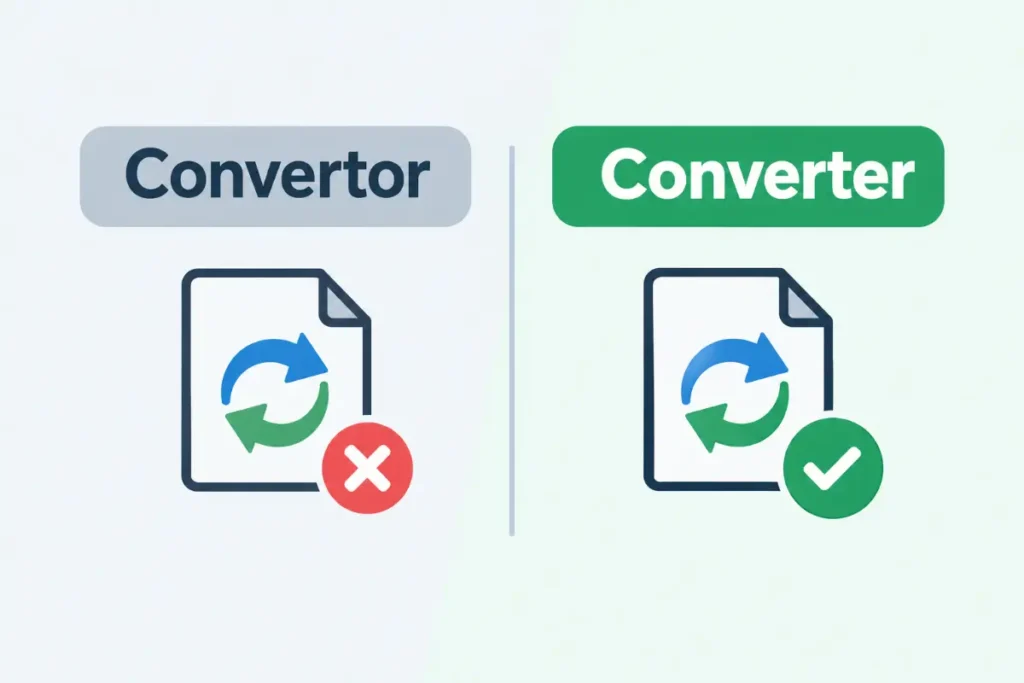
If you searched for convertor vs converter, you probably want one simple answer. The correct and standard spelling in modern American English is converter. It is the word you should use for a device, tool, program, or person that changes something from one form into another.
Convertor does exist, but it is much less common. Some dictionaries list it as another form of converter, especially in British English. Cambridge lists converter as the main word and also gives convertor as a variant.
That difference explains why the two spellings can feel confusing. Both forms can be found in English, but they do not have the same level of common use. If you are writing an email, article, school paper, product description, website page, or technical document for a US audience, converter is the safer choice.
This guide explains the difference in plain English. You will learn why converter is preferred, where convertor comes from, how to use converter in real sentences, and which related words often cause the same kind of spelling confusion.
Quick Definition
A converter is a person, device, tool, or program that changes something from one form into another. For example, a currency converter changes one currency into another, while a file converter changes a file from one format into another.
Convertor can also refer to something that converts, but it is a less common variant. In most everyday US writing, converter is the better choice.
Direct Answer
Converter is the preferred spelling in American English. Convertor is a recognized but much less common variant, so use converter in normal writing unless a specific name or technical source uses convertor.
Word Comparison
| Word | Meaning | Example Sentence | When to Use It |
|---|---|---|---|
| Converter | A person, device, tool, or program that changes something into another form | I used a currency converter to check the price. | Use this as the standard spelling in most writing. |
| Convertor | A less common form of converter | The old machine was called a convertor. | Use it only when a source, product name, or specific field uses this spelling. |
The Correct Word In Most Cases
For most readers, the answer is simple. Converter is the spelling you should choose.
The word appears in many familiar expressions. You probably use or see one without thinking about the spelling.
A car has a catalytic converter. A website may have a currency converter. A computer program can work as a file converter. An electronic device can contain a voltage converter. A digital system may use a data converter.
All of these examples use converter.
Cambridge defines converter as a machine or device that changes something into a different form. Its US dictionary entry also lists convertor as another form. That gives us an important clue. Convertor is not simply a random spelling mistake, but converter is the main form you are more likely to see and hear.
Why Converter Is The Better Choice
The main reason is common usage.
English often has more than one form for a word. One spelling may become much more common over time while another remains in limited use. That is what happened here.
If you type converter into a search engine, you will find it in common terms such as currency converter, catalytic converter, torque converter, file converter, and digital converter.
The word also fits naturally with the verb convert and the noun conversion.
- You convert something.
- The process is a conversion.
- The thing that performs the conversion is a converter.
- That pattern makes the spelling easy to remember.
A Simple Rule To Remember
Think of the word this way.
- Convert → conversion → converter.
- The verb is convert.
- The noun for the process is conversion.
- The noun for the person or thing doing the changing is converter.
You do not need a complicated spelling rule. Just remember that the common noun ends with er.
For example.
- The program can convert the file.
- The file conversion took a few seconds.
- The converter created the new file.
That family of words gives you a useful mental path when you are unsure.
Why Convertor Looks Correct
The confusion makes sense.
English speakers often create nouns for people or things that perform an action by adding or to a verb.
Think about words such as actor, creator, editor, operator, and translator.
So when someone sees convert, it is natural to think that convertor should be the noun.
There is another reason the spelling can look familiar. English already uses many words that end in or for devices and people. That pattern can make convertor feel perfectly normal.
And in fact, it is not completely wrong.
Some dictionaries recognize convertor as a variant of converter. Cambridge does this directly in its dictionary entry for converter.
The problem is not that convertor has no place in English. The problem is that it is not the spelling most readers expect in ordinary American writing.
That distinction matters.
A word can be valid without being the best choice for every situation.
Where Convertor May Appear
You may come across convertor in older writing, technical material, product names, or sources that favor the variant spelling.
You might also see it in writing influenced by British usage or in specialized contexts.
That does not mean you need to start using it.
If you are writing for a general US audience, converter will usually sound more natural.
Think of it like two roads that lead to the same place. One road is wide and familiar. The other exists but gets much less traffic. If you want the clearest route for most readers, take the familiar road.
That is converter.
A Variant Does Not Always Mean An Error
This point is worth remembering because English spelling can be messy.
When a dictionary lists two forms, it does not always mean both forms are equally common.
Some variants are common in one region and rare in another. Some belong to a particular field. Some survive in older texts. Others remain in dictionaries even though most modern writers rarely use them.
So seeing convertor in a dictionary does not automatically make it the best choice for your sentence.
It simply tells you that the form has a recognized place in English.
For practical writing, frequency and audience matter.
What Converter Means
A converter is something that changes one thing into another form.
The change can happen in many ways.
- A currency converter changes one monetary unit into another.
- A file converter changes a file from one format to another.
- A power converter changes electrical power from one form to another.
- A catalytic converter changes harmful gases from an engine into less harmful substances.
- A unit converter changes one measurement into another.
- A video converter changes a video file into a different format.
A person can also be called a converter in certain contexts. For example, someone who changes their beliefs or habits can be described using the related noun convert, although converter has a different meaning in most ordinary uses.
- The basic idea stays the same.
- Something changes.
- The converter is connected to that change.
Cambridge also defines conversion as the process of changing something from one thing into another.
Common Types Of Converters
The word becomes much easier to understand once you see how often it appears in everyday language.
Currency Converter
A currency converter helps you compare money from different countries.
For example.
- I used a currency converter to see how much 100 dollars would be in euros.
- The tool does not physically change your money. It simply calculates the equivalent value using an exchange rate.
The spelling remains converter because the tool converts one currency value into another.
Unit Converter
A unit converter changes one measurement into another.
For example.
- I used a unit converter to change miles into kilometers.
- You can convert inches into centimeters, pounds into kilograms, or Fahrenheit into Celsius.
The same word applies to the tool that performs the calculation.
File Converter
A file converter changes digital content from one format to another.
For example.
- I need a file converter to turn this document into a PDF.
- You might convert an image from PNG to JPEG or change an audio file from one format to another.
This is especially common in software and online tools.
Video Converter
A video converter changes a video file into another format.
For example.
- The video converter changed the large file into a format that my phone could play.
- Again, the standard spelling is converter.
Power Converter
A power converter changes electrical energy from one form to another.
For example.
- The device needs a power converter before it can work with this electrical supply.
- This term appears often in electronics and engineering.
Catalytic Converter
A catalytic converter is a vehicle component that helps reduce harmful pollutants in exhaust gases.
For example.
- The mechanic said the catalytic converter needed to be replaced.
- This is one of the most familiar uses of the word in American English.
If you remember catalytic converter, you already have a strong example of the standard spelling.
Converter In Technology
Technology uses the word converter constantly.
A program may convert one file type into another. A device may convert one kind of signal into another. A tool may convert data into a format that another system can read.
For example.
- The software converts the image into a smaller file.
- The converter creates a format that the older system can read.
- The audio converter changes the recording into another format.
- The digital converter processes the incoming signal.
- This usage also connects with the verb convert.
Cambridge gives examples of convert being used for changing computer data so that another program can read it.
- That gives you a useful pattern.
- The software converts the data.
- The conversion changes the data.
- The converter performs the conversion.
Once you understand that pattern, the spelling becomes much easier.
Converter In Everyday Writing
You do not need to limit converter to technical writing.
People use the word in ordinary conversations all the time.
Here are some natural examples.
- I need a currency converter before I book the hotel.
- Do you know a good file converter?
- My car needs a new catalytic converter.
- This adapter has a built in power converter.
- The online unit converter gave me the wrong result.
- I downloaded a video converter yesterday.
- The converter changed the file in less than a minute.
These sentences sound natural because converter is the familiar form.
Common Mistakes With Converter
Spelling confusion often happens because the word feels like it should follow a different pattern.
The most common mistake is writing convertor when you mean the standard noun converter.
Another mistake is assuming that a word ending in or must always be the correct form because the object performs an action.
- English does not work that neatly.
- Some words use er.
- Some use or.
- Some have both forms.
- Some have developed different meanings.
That is why it helps to learn common words as complete words instead of trying to create every noun from a fixed rule.
Mistake One
- I need a currency convertor.
- For standard US writing, write.
- I need a currency converter.
Mistake Two
This convertor changes the file format.
A more natural version is.
This converter changes the file format.
Mistake Three
The mechanic replaced the catalytic convertor.
Use.
The mechanic replaced the catalytic converter.
The final example is especially useful because catalytic converter is a very common phrase in American English.
Converter Or Convertor In American English
For a US audience, converter is the clear practical choice.
American English favors converter in common vocabulary, especially in technology, automotive writing, software, electronics, finance, and everyday speech.
That does not erase convertor from the English language.
It simply means that converter is the form that will look most familiar to most American readers.
This matters if you are writing online.
When people read a familiar spelling, they move through the sentence without stopping. When they see an unusual spelling, some readers may pause and wonder if it is a typo.
Good writing removes those small speed bumps.
That is one reason standard vocabulary matters in SEO content, product descriptions, manuals, emails, and educational material.
Is Convertor Wrong
Not exactly.
Calling convertor completely wrong would be too strong.
Some dictionaries recognize it as a variant of converter. Cambridge specifically lists convertor as another form of converter.
Still, there is a big difference between saying a word exists and saying it is the best choice.
If your goal is clear modern American English, choose converter.
If you are copying the official spelling of a product, organization, document, or technical system, keep the original spelling.
That is a different situation.
Proper names should not be silently changed just because another spelling is more common.
When The Original Spelling Matters
Suppose a company officially calls its product a Convertor.
- If you are discussing that exact product, you may need to preserve the official name.
- The same applies to a technical document that consistently uses convertor as a defined term.
- In that case, changing it to converter could create confusion.
- But if you are simply choosing a word for your own sentence, converter is the better default.
Convert And Converter
The verb and noun have closely connected meanings.
- Convert means to change something into another form.
- Converter refers to a person, device, tool, or program that performs that change.
For example.
- The program converts the image.
- The converter changes the image format.
Here is another example.
- We converted the dollars into euros.
- We used a currency converter to calculate the amount.
- The first sentence focuses on the action.
- The second focuses on the tool.
- That distinction is useful far beyond spelling.
Convert And Conversion
Conversion is the name for the process or result of converting something.
For example.
- The conversion from miles to kilometers was easy.
- The file conversion took five minutes.
- The conversion to digital records saved storage space.
Cambridge defines conversion as the process of converting something from one thing to another.
This creates a simple word family.
- Convert is the action.
- Conversion is the process.
- Converter is the thing or person that performs the change.
Learning the three together is much easier than memorizing each word separately.
Converter In Technical Writing
Technical writers often need to be especially careful with word choice.
A technical document may describe a device, process, system, or piece of software. Readers need to know exactly what each term means.
Converter works well because it is already widely understood.
Consider these examples.
The voltage converter reduces the input voltage.
- The signal converter changes the incoming signal.
- The data converter prepares the information for the new system.
- The protocol converter allows two systems to communicate.
- The file converter supports several common formats.
- Each sentence uses the same basic idea.
- Something enters in one form.
- The converter changes it.
- Something else comes out.
That simple pattern makes the word easy to understand even when the subject becomes technical.
Converter In SEO Writing
If you are writing a webpage around this spelling question, clarity should come before repetition.
People searching for convertor vs converter usually want to know one thing first.
- Which spelling should I use?
- Answer that immediately.
- Then explain the reason.
Then show examples.
That approach serves both readers and search engines.
The exact phrase should appear naturally. Related terms can then carry the rest of the topic.
Useful related terms include correct spelling, standard spelling, American English, British English, word choice, spelling variant, converter definition, convertor definition, convert, conversion, currency converter, file converter, unit converter, and catalytic converter.
You do not need to repeat the same phrase in every paragraph.
Search engines understand topics through context. Readers also appreciate writing that sounds natural.
How To Remember The Spelling
A good memory trick can save you from checking the dictionary every time.
- Think of the common phrase catalytic converter.
- Most people have seen or heard it many times.
- Now connect that word to the verb convert.
Convert becomes converter.
You can also remember this short chain.
- Convert.
- Conversion.
- Converter.
All three belong to the same word family.
Another trick is to think about a person or tool that performs an action.
A converter converts.
The ending er fits the idea of something that performs an action.
This is not a rule that works for every English word, but it is a useful memory aid for this one.
Examples You Can Copy
Sometimes the fastest way to learn a word is to see it used naturally.
Here are several examples with different meanings.
- The online converter changed the document into a PDF.
- I checked the exchange rate with a currency converter.
- The mechanic inspected the catalytic converter.
- This adapter includes a voltage converter.
- The software has a built in image converter.
- We need a unit converter to compare the measurements.
- The digital converter changed the signal before it reached the display.
- The file converter supports several common formats.
- The technician installed a new power converter.
- The website offers a free temperature converter.
These examples show why converter is so useful. It can describe a physical device, a digital tool, or a system that performs a change.
Related Spelling Pairs Worth Knowing
The confusion between convertor and converter belongs to a larger group of English spelling questions.
English has many words that look as if they should follow a simple pattern but do not.
For example, people often wonder about advisor and adviser.
Both forms exist.
- People also ask about creator and creator, but only creator is standard.
- Another common issue involves words such as editor, operator, translator, and generator.
- The endings can look similar, but you cannot always create a correct noun by guessing the ending.
- That is why dictionaries and established usage matter.
Learn Words In Context
Instead of memorizing a rule that says all action words need one ending, learn the word in a phrase.
For converter, useful phrases include.
- Currency converter.
- File converter.
- Unit converter.
- Catalytic converter.
- Power converter.
- Video converter.
- Signal converter.
Once these phrases become familiar, the spelling becomes automatic.
You are less likely to write convertor because your brain already recognizes the common form.
Does Convertor Have A Different Meaning
Usually, no.
In general use, convertor and converter refer to the same basic idea. They describe something that converts or changes something into another form.
- The main difference is usage and frequency.
- Converter is the common form.
- Convertor is a less common variant.
That is why this is mainly a spelling and usage question rather than a difference in meaning.
If you see convertor in a sentence, you can usually understand it as converter.
If you are writing the sentence yourself, converter is normally the better choice.
British English And American English
Regional English can sometimes explain spelling differences.
British and American English have several differences in vocabulary, spelling, and usage. But this particular word does not create a clean rule where one form belongs only to Britain and the other belongs only to the United States.
Cambridge lists converter as the main entry and gives convertor as a variant in both its UK and US dictionary presentations.
So it is better not to think of this as a simple British versus American spelling issue.
Think of it as a common form versus a less common variant.
For US readers, converter is the natural choice.
Why Standard Spelling Helps Readers
A spelling choice may seem tiny, but small choices add up.
Imagine reading a page full of unusual spellings. Even if every word is technically understandable, the page feels less polished.
Standard spelling builds trust.
This matters even more when you are writing instructions or explaining a technical topic. Readers should focus on the information, not wonder if a word is misspelled.
Using converter also makes your writing easier to scan.
A reader looking for information about a catalytic converter will recognize the phrase immediately.
Someone who sees catalytic convertor may still understand it, but the unusual form can create a moment of doubt.
Clear writing should make the path easy to follow.
When You Should Use Converter
Use converter when you mean a person, device, tool, program, or system that changes something from one form into another.
This includes most everyday situations.
- Use it in school writing.
- Use it in business writing.
- Use it in website content.
- Use it in product descriptions.
- Use it in technical explanations.
- Use it in software documentation.
- Use it in general American English.
For example.
- The website has a currency converter.
- The program includes a file converter.
- The car needs a new catalytic converter.
- The device contains a voltage converter.
- The tool converts measurements automatically.
- These are all safe and natural choices.
When You Might Keep Convertor
There are only a few practical reasons to keep the less common spelling.
- You may be quoting or referring to a source that uses that spelling.
- You may be discussing a product whose official name contains it.
- You may be working with a technical term that has been defined using that spelling.
- You may be reproducing an older text exactly.
- In those situations, consistency matters more than changing the spelling to match your personal preference.
FAQs
Is convertor or converter correct?
Converter is the preferred spelling in standard modern American English. Convertor is also recognized as a less common variant, but most general readers will expect converter.
Is convertor vs converter a spelling difference?
Yes. The two forms generally carry the same basic meaning. The main difference is that converter is much more common in everyday English, especially in American writing.
Why is converter spelled with er?
Converter comes from the verb convert and names something that performs the action of converting. English uses both er and or endings in words for people and things that perform actions, so the ending must be learned as part of the word.
Is convertor accepted in English?
Yes. Some dictionaries list convertor as a variant of converter. That does not make the two spellings equally common, so converter remains the better choice for most general writing.
Which spelling should I use in American English?
Use converter. It is the familiar and standard choice for common phrases such as currency converter, file converter, and catalytic converter.
Is a currency converter correct?
Yes. Currency converter is the standard phrase for a tool that calculates the value of one currency in another currency. It is a common example of how converter is used in everyday English.
Is catalytic converter correct?
Yes. Catalytic converter is the standard spelling for the vehicle component that helps reduce harmful substances in engine exhaust. It is one of the most familiar uses of the word in American English.
Can I use convertor in formal writing?
You can find convertor in formal and technical sources, but converter is usually the safer choice for your own writing. If you are writing for a broad US audience, converter will look more familiar and natural.
Conclusion
If you are stuck on convertor vs converter, choose converter in almost every normal writing situation. It is the standard and familiar form used for devices, tools, programs, and systems that change something from one form into another.
Convertor is not simply a made up word. It is recognized as a variant in some dictionaries, including Cambridge. Still, being recognized does not mean it is the best choice for everyday American English.
The easiest way to remember the difference is to connect converter with convert and conversion. You convert something, the conversion is the process, and the converter is the thing that performs the change.
So when you write about a currency tool, software tool, measurement tool, electrical device, or car part, stick with converter. It is clear, familiar, and unlikely to make your reader stop and question the spelling.

Dr. Arthur Pendelton is a veteran historical linguist and grammar expert with over 30 years of experience in academic editing. A retired professor, Arthur specializes in the etymology and evolution of the English language. He is passionate about “unpacking the history behind the rules,” helping readers understand why we spell, punctuate, and phrase things the way we do today. Whether he’s settling debates on archaic usage or explaining complex linguistic shifts, Dr. Pendelton brings scholarly precision to every article.
2 thoughts on “Convertor vs Converter Which Is Correct”