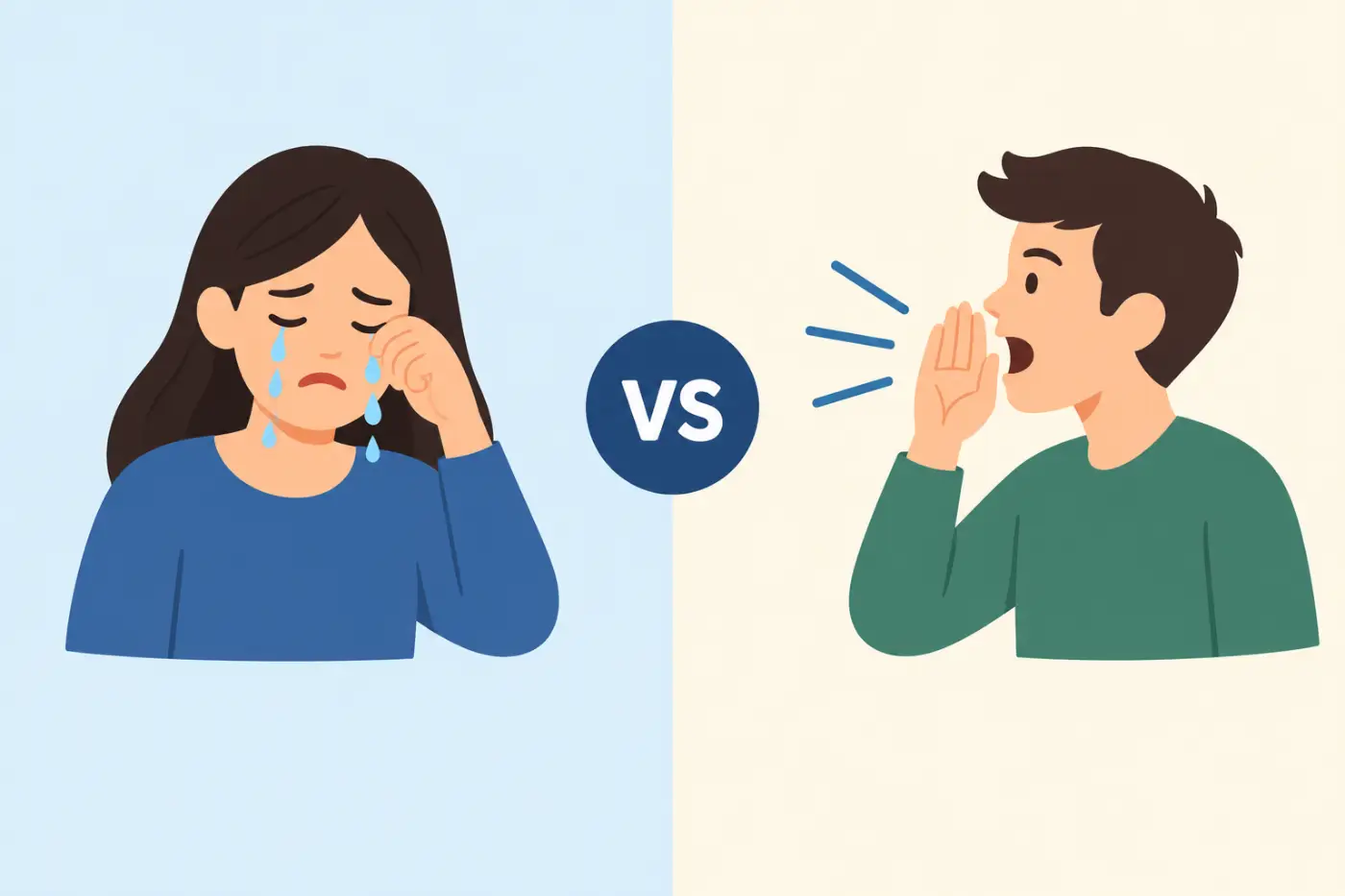
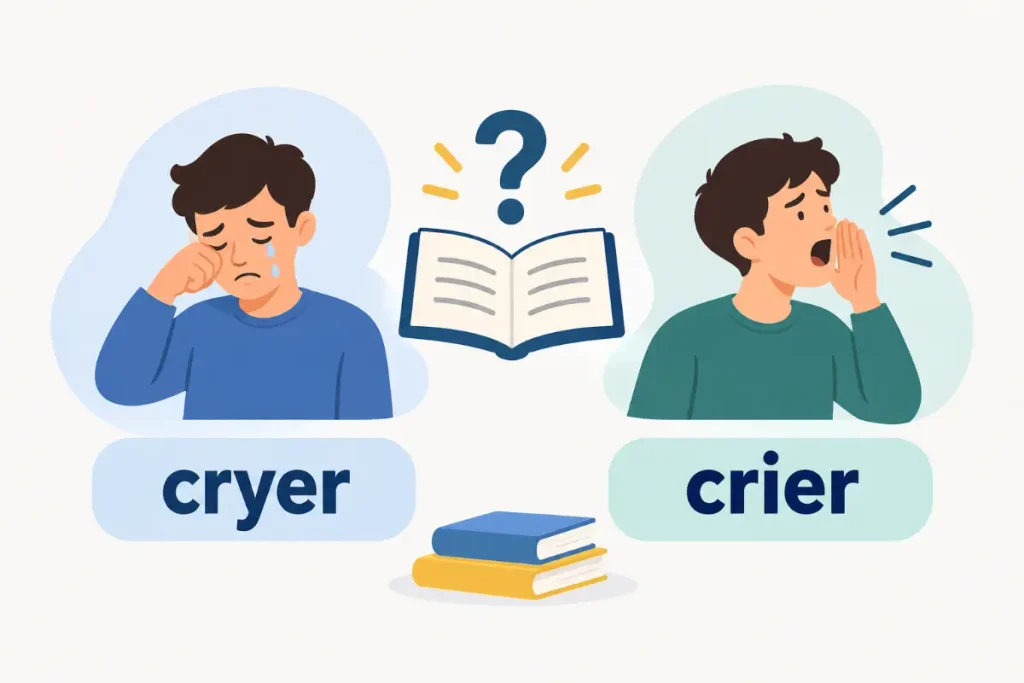
If you are stuck on cryer vs crier, the correct choice in modern standard English is usually crier. A crier is someone who cries or calls out loudly. It can also mean a person who makes public announcements, such as a town crier. Cryer exists too, but major dictionaries treat it as a variant spelling of crier rather than the usual form.
That small spelling difference can be confusing because both words come from the same basic idea. The verb cry can mean to shed tears, shout, call out, or make a public announcement. Add the ending er, and you get a noun for someone who performs that action. The spelling most readers expect today is crier.
So if you are writing an email, school assignment, article, story, or other everyday piece of American English, crier is the safer and more familiar choice.
There is still more to the story. The two spellings have a long history, and cryer is not simply a made up spelling. Older dictionaries recorded it, and modern Merriam Webster still lists it as a variant spelling. That makes the question more interesting than a simple right or wrong spelling mistake.
Quick Definition
Crier is the standard modern spelling for a person who cries or calls out. It can also describe someone who publicly announces news or orders. Cryer is a recognized variant spelling, but it is much less common in modern general writing.
Direct Answer
Use crier in most modern English writing. Cryer is a legitimate variant, but crier is the more established and familiar form in current dictionaries and everyday use.
Comparison Table
| Word or phrase | Meaning | Example sentence | When to use it |
|---|---|---|---|
| Crier | A person who cries or calls out | She is a loud crier when she gets upset. | Use this in normal modern writing. |
| Crier | A person who makes a public announcement | The town crier announced the news. | Use this for historical or official announcements. |
| Cryer | A variant spelling of crier | The old text used cryer instead of crier. | Use it mainly when preserving a historical spelling or following a specific source. |
| Cry | To shed tears, shout, call, or announce | The baby began to cry. | Use this as the verb. |
| Crying | The act of shedding tears or calling out | The crying stopped after a few minutes. | Use this as a noun or present participle. |

Why Crier Is Usually the Better Choice
The easiest rule is also the most useful one.
When you need a noun for someone who cries or calls out, write crier.
That spelling is supported by major modern dictionaries. Merriam Webster defines crier as someone who cries and also gives older or official meanings connected with court officers and town criers. Cambridge defines it as someone who cries and gives examples involving town criers and public announcements.
Oxford also lists crier as a noun. Its entry explains that the word can refer to a person whose job was to walk through a town shouting news or official announcements. Oxford traces the word to late Middle English and Old French.
That gives you a strong practical answer.
If you are choosing between the two spellings for normal American English, pick crier.
For example:
- She is an emotional crier.
- My brother was a loud crier as a baby.
- The town crier read the announcement in the village square.
- The court crier called the room to order.
- I am not much of a crier.
- All of these sentences use crier naturally.
Why The Ending Can Cause Confusion
The confusion comes from a spelling pattern that looks perfectly reasonable.
English often forms a noun by adding er to a verb. A person who runs is a runner. A person who teaches is a teacher. A person who sings is a singer. A person who drives is a driver.
So it is easy to look at cry and think the result should be cryer.
The problem is that English spelling does not always work in a perfectly regular way. Some words develop older spellings that become established over time. Crier is one of those words.
The spelling also reflects the history of the word. The modern verb cry has roots in Middle English and Anglo French. Merriam Webster traces the verb to Middle English and gives its earlier source as Anglo French crier.
That history helps explain why the spelling crier feels different from a simple rule such as adding er to a verb.
What Crier Means Today
The word has more than one useful meaning.
The first meaning is personal or emotional. A crier can be someone who cries easily or often.
For example:
- My daughter is a happy crier.
- He was a quiet crier after the movie ended.
- I was never much of a crier.
The second meaning involves calling out or making announcements.
A town crier was traditionally a person who announced news or official information in public. Oxford describes the historical role as someone who walked through a town shouting news and official announcements.
Merriam Webster also defines a crier as an officer who proclaims the orders of a court and as a town crier.
So the word is not limited to someone with tears in their eyes.
That is an important point because the verb cry has several meanings. It can describe tears, but it can also describe a loud call or public announcement.
Crier Can Mean Someone Who Cries
This is the meaning most people have in mind today.
If someone says, I am a crier, they usually mean they cry easily or tend to cry during emotional moments.
You might hear someone say:
- I am a big crier during sad movies.
- She is not a crier, so I knew something was wrong.
- He became a crier after the loss of his dog.
- The word can describe babies too.
- That baby is a heavy crier.
The parents said their newborn was a surprisingly calm crier.
In this use, the word has nothing to do with public announcements. It simply describes a person who cries.
The word can also be used informally to talk about how strongly someone reacts to emotional situations.
For example:
- I am a crier when I hear graduation speeches.
- She is a happy crier at weddings.
- He is the kind of crier who tries to hide his tears.
These sentences sound natural because crier is an ordinary noun built around the act of crying.
Crier Can Also Mean A Public Announcer
The older meaning of crier is still useful.
A town crier was a public announcer. In earlier times, this person would often walk through a town and call out important news. That could include government notices, public events, warnings, or other information.
The phrase town crier is still widely recognized today, even though the original job is no longer a normal part of everyday life.
For example:
The town crier announced the arrival of the royal guests.
A costumed town crier welcomed visitors to the historic district.
The museum hired a town crier for its colonial festival.
The word can also appear in legal or court settings.
Merriam Webster gives crier as a word for an officer who proclaims the orders of a court.
That older sense connects the word to another meaning of cry. In this context, crying does not mean shedding tears. It means calling out or proclaiming something aloud.
That distinction matters because English has kept both meanings of the verb.
The Verb Cry Has Several Meanings
Understanding cry makes the noun easier to understand.
The most familiar meaning is to shed tears.
For example:
- The child began to cry.
- She cried after hearing the news.
- I almost cried during the final scene.
- But cry can also mean to shout.
For example:
- He cried for help.
- She cried out when she saw the accident.
- The coach cried instructions from the sideline.
Merriam Webster lists both meanings. It defines cry as calling loudly or shouting and also as shedding tears, often noisily.
The verb can also mean to announce something publicly.
That use sounds old fashioned today, but you can still find it in historical writing and fixed expressions.
For example:
- The merchants cried their wares in the market.
- The town crier cried the news throughout the village.
This wider meaning explains why crier can describe an announcer as well as someone who sheds tears.
Why Cryer Is Not Simply Wrong
It would be too strong to call cryer an outright error.
Merriam Webster lists cryer as a variant spelling of crier.
Historical dictionaries also show that the spelling has been used for a long time. Noah Webster’s 1828 dictionary included cryer as a form related to crier. The same dictionary defined crier as one who cries or makes a proclamation.
So if you see cryer in an older book, historical document, family name, or quoted source, that does not automatically mean the writer made a spelling mistake.
Language changes over time. Spellings can compete for centuries before one becomes more common.
That is exactly the kind of situation you have here.
The practical issue is modern usage.
A word can be valid and still not be the best choice for ordinary writing. If most modern readers expect crier, using cryer may make them pause for a moment. Some readers may even assume it is a typo.
That is why crier is the better default.
When You Might See Cryer
There are several situations where cryer may appear.
The first is historical writing.
An old document may use cryer because that spelling was accepted or used at the time.
The second is a direct quotation.
If a historical source spells the word cryer, changing it to crier inside the quotation could alter the original wording. Editors may preserve the original spelling for accuracy.
The third is a name.
Cryer can appear as a surname. A person’s name does not need to follow the normal spelling rule for a common noun.
For example, if someone’s last name is Cryer, you should spell their name exactly that way.
The fourth is a specialized source or publication that follows a particular spelling tradition.
In those cases, the spelling may be intentional.
The key point is simple. Seeing cryer does not mean the word has no history or legitimacy. It means you need to look at the context.
Common Mistakes With These Words
The biggest mistake is using cryer in ordinary writing simply because it seems to follow the usual verb plus er pattern.
That logic is understandable, but English has many words that do not follow the simplest spelling pattern.
- Consider these sentences.
- She is a frequent cryer.
- She is a frequent crier.
The second sentence is the better choice in modern standard English.
Another common mistake is assuming that crier only refers to someone who cries emotionally.
It can also refer to a public announcer.
For example:
- The town crier announced the royal visit.
- Here, the word has nothing to do with tears.
A third mistake is assuming that cryer and crier have completely different meanings.
They generally do not. The main difference is spelling and usage preference. Merriam Webster specifically identifies cryer as a variant of crier.
Mistake One
Using cryer in formal writing when you simply mean someone who cries.
Better:
She is a frequent crier.
Mistake Two
Thinking that a crier must be emotional.
Better:
A town crier announces public information.
Mistake Three
Treating every appearance of cryer as a spelling error.
Better:
Check the context. It may be a historical spelling, a surname, or a variant form.
Mistake Four
Changing a person’s name from Cryer to Crier.
Better:
Keep personal names exactly as their owners spell them.
Crier In Real Sentences
Seeing the word in context is often the fastest way to understand it.
Here are natural examples.
- I am a crier, so keep the tissues nearby.
- She became a crier after watching the final scene.
- My dad is not much of a crier.
- The baby was a loud crier during the first few weeks.
- He laughed at himself for being such a crier.
- The town crier announced the festival at noon.
- The crier called the courtroom to order.
- The historical reenactor dressed as a town crier.
- The crowd waited for the crier to make the announcement.
- The old story describes a royal crier who traveled from village to village.
- Notice how the surrounding words make the meaning clear.
- In the first five examples, crier relates to emotional tears.
- In the remaining examples, it relates to calling out or making an announcement.
- That flexibility is one reason the word has survived.
Crier And Town Crier
The phrase town crier deserves special attention because it is one of the best known uses of the word.
A town crier was a person responsible for making public announcements. The crier would call out news so people nearby could hear it.
Before modern communication tools, loud public announcements were useful. A town could not send a text message, publish a website update, or post a notice on social media. A person with a strong voice could reach a crowd directly.
Oxford describes the historical town crier as someone whose job was to walk through a town shouting news and official announcements.
The phrase still appears in modern English, often in historical settings, festivals, books, movies, and figurative language.
For example:
- The town crier announced the opening of the fair.
- The actor played a town crier in the historical drama.
He became the town crier of the neighborhood by sharing every local update.
The last example is figurative. It compares a person who spreads information with the traditional public announcer.
Crier And Baby
You may also see crier used when people talk about babies.
A baby who cries often can be called a crier.
For example:
- Our son was a big crier as a newborn.
- She was a calm baby and hardly ever cried.
- That baby is a serious crier.
- This use is casual and common.
It does not mean the baby is doing anything wrong. Babies cry for many reasons, and the word simply describes the behavior.
The same basic idea applies to adults.
If someone says, I am a crier, they are describing themselves as someone who cries easily or often.
The phrase is especially common when people talk about emotional movies, weddings, speeches, books, family events, or difficult experiences.
Crier And Emotional Writing
The word also works well in casual conversation.
- Imagine a friend saying:
- I cried through the whole movie.
- You might answer:
- Same. I am such a crier.
That sounds natural in American English.
You can also use it in a more playful way.
- I am a happy crier.
- I am an ugly crier.
- I am a wedding crier.
These expressions are informal, but they show how flexible the word can be.
The noun lets you turn an action into a description of a person.
- She cries easily.
- She is a crier.
- He cries during sad movies.
- He is a crier.
- That pattern is simple and useful.
How To Remember The Correct Spelling
A good memory trick is to connect crier with the word crying.
The letters in crier keep the familiar sound of cry while using the established spelling of the noun.
You can also remember a few common words that end with ier.
Try:
- crier
- drier
- frier
- supplier
These examples are not all formed in exactly the same way, but they can help you become comfortable with the spelling pattern.
Another useful trick is to remember the phrase town crier.
If you picture a person standing in a town square and shouting the latest news, the spelling becomes easier to recall.
Think:
- Town crier.
- Not town cryer.
That phrase is so common that it can act as a mental anchor.
Is Crier A Real Word
Yes.
There is no question about that.
Major dictionaries list crier as a standard English noun. Merriam Webster defines it as one that cries and includes meanings connected with court officers and town criers. Cambridge also lists it as a noun for someone who cries and provides examples involving public criers.
The word has a long history too. Merriam Webster gives its first known use as the 14th century. Oxford traces its origin to late Middle English and Old French.
So this is not a new word created by modern slang.
It is an established English noun with several related meanings.
Is Cryer A Real Word
Yes, but it needs a little more context.
Cryer is listed by Merriam Webster as a variant spelling of crier.
That means you can find the spelling in dictionaries and historical sources. It also appears as a surname.
Still, recognition does not mean equal popularity.
For most modern readers, crier will look more familiar. If you write cryer in a normal sentence, some readers may wonder if you made a spelling mistake.
That is why writers should usually choose the more familiar form.
Think of it as a matter of practical writing rather than a simple dictionary battle.
How American English Treats The Two Spellings
For American readers, crier is the safest spelling.
Modern American dictionaries recognize the word, and common usage supports it. Merriam Webster’s current entry uses crier as the main form and lists cryer separately as a variant.
That gives you a useful writing rule.
If you are writing for a general American audience and you want the word to look natural at first glance, use crier.
This matters in web writing too.
Readers scan online text quickly. An unfamiliar spelling can interrupt that flow. If a familiar word has a standard form and a less common variant, the standard form usually gives readers a smoother experience.
That does not make the variant meaningless. It simply makes it less useful as your default choice.
Crier And Similar Words
A few nearby words can create additional confusion.
Crier And Crybaby
A crier is someone who cries.
A crybaby is a person who is seen as crying too easily or complaining too much. The second word often carries a negative or teasing tone.
For example:
- She is a crier.
- This simply describes her.
- She is a crybaby.
- This can sound insulting or critical.
- The words are not interchangeable.
Crier And Weeper
A weeper can describe someone who weeps, although it is less common in everyday American English.
For example:
- He was a quiet weeper.
- The word crier is much more natural in ordinary conversation.
Crier And Sobbing
A crier is a person.
Sobbing describes the action.
For example:
- She is a crier.
- She was sobbing after the accident.
These words describe related ideas but serve different grammatical roles.
Crier And Screamer
A screamer is someone who screams or makes a very loud sound.
A crier can be someone who cries or calls out, but the words do not always describe the same behavior.
A person can be both.
For example:
The baby was a loud crier and a frequent screamer.
The first word focuses on crying. The second focuses on loud screaming.
The Grammar Behind Crier
Understanding the grammar can help you use the word correctly.
Crier is a noun.
It names a person who performs an action connected with the verb cry.
For example:
- She cries.
- She is a crier.
- He cries.
- He is a crier.
The plural form is criers.
For example:
- The criers gathered outside the hall.
- The movie turned half the audience into criers.
- The town criers announced the news.
- Notice that the plural is formed by adding s.
- The same pattern works in both major meanings.
- A person who cries can be a crier.
- A person who makes a public call can also be a crier.
Pronunciation Of Crier
The pronunciation is another reason the spelling can feel confusing.
Cambridge gives the US pronunciation as /ˈkraɪ.ɚ/. The word begins with the same sound found in cry and ends with an unstressed sound similar to the ending in words such as driver or writer.
In simple terms, you can think of it as sounding like cry er.
The spelling crier may look unusual at first, but the pronunciation is straightforward.
You do not need to give the i a separate long sound. Say:
crier.
The word has two main sound parts.
That makes it easy to recognize when spoken aloud.
Why English Has Variant Spellings
English has many spelling variants because it developed from several languages and changed over hundreds of years.
Words were written by hand long before spelling became as standardized as it is now. Different writers and regions sometimes used different forms.
Over time, some spellings became more common.
Others survived as variants.
That helps explain why crier and cryer can both be found in dictionaries even though one is much more common today.
The same pattern appears in many areas of English.
A dictionary can recognize a word without recommending it as the best choice for every situation.
That distinction is useful for writers.
You do not need to treat language as a simple list of words that are either legal or illegal. Real English has history, variation, context, and patterns of use.
For practical writing, though, clarity comes first.
That brings us back to the main rule.
Choose crier unless you have a specific reason to use the variant spelling.
How To Choose The Right Word In Your Sentence
When you are unsure, ask yourself what you are trying to say.
If you mean someone who cries, use crier.
For example:
- She is an emotional crier.
- If you mean someone who makes a public announcement, use crier.
For example:
The town crier announced the event.
- If you are describing an old text that uses the spelling cryer, you can preserve that spelling.
- If you are writing someone’s surname, use the spelling the person actually uses.
- If none of those special cases applies, choose crier.
That simple rule will solve almost every everyday usage question.
A Simple Editing Test
Here is a quick test you can use when editing your own writing.
Find the word.
Ask what it means.
- If it means a person who cries or calls out, check the spelling.
- If you wrote cryer, ask yourself if there is a special reason for that spelling.
- If there is no special reason, change it to crier.
Then read the sentence aloud.
For example:
My sister is a big cryer.
Change it to:
- My sister is a big crier.
- That is the form most readers will recognize immediately.
This kind of quick edit can prevent a small spelling choice from distracting the reader.
Examples Of Correct Usage
Here are more examples you can use as models.
- She is a crier, especially during emotional movies.
- I never thought I would become such a crier.
- My brother was a crier when he was little.
- The crier announced the decision to the crowd.
- A town crier walked through the village.
- The historical festival featured a town crier.
- The court crier called the room to order.
- The audience laughed when the actor played an overly dramatic crier.
- She admitted that she is a happy crier.
- He became a crier after hearing the final song.
- The old document uses the spelling cryer.
- The family name is Cryer.
- The first group uses crier as the normal common noun.
- The last two examples show situations where cryer can still appear for a specific reason.
- That distinction is worth remembering.
When To Avoid Cryer
If you are writing for a broad audience, avoid cryer when you simply need the common noun.
This is especially useful in:
- School assignments.
- Business writing.
- Blog posts.
- News writing.
- Website copy.
- Social media posts.
- Personal essays.
- General nonfiction.
In these settings, crier is clearer and more familiar.
You do not gain anything by choosing the less common spelling unless the context calls for it. A good writer does not choose unusual forms just to sound different. The goal is to make the reader understand the sentence without stopping to decode it.
When Cryer Makes Sense
There are still times when cryer is exactly right.
- Use it if it is part of a person’s surname.
- Use it when you are reproducing an older source and want to preserve the original spelling.
- Use it if a particular title, name, or historical record uses that form.
- Use it when a publication has a specific style choice that calls for the variant.
In those cases, changing the spelling could create a new problem.
For example, changing a person’s surname from Cryer to Crier would simply be wrong.
- The same applies to a historical record.
- If the original document says cryer, an editor may keep it that way and explain the spelling if needed.
- So the best rule is not never use cryer.
The better rule is use crier as your normal modern spelling, and use cryer when the context gives you a reason.
FAQs
Is Crier Or Cryer Correct?
Crier is the standard choice in modern everyday English. Cryer is also recognized as a variant spelling, but it is less common.
Is Cryer A Real Word?
Yes. Merriam Webster lists cryer as a variant spelling of crier. It can also appear as a surname and in historical writing.
What Does Crier Mean?
A crier is someone who cries or calls out. The word can also describe a public announcer, such as a town crier or a court officer who announces orders.
Is Crier The Correct Spelling For Someone Who Cries?
Yes. Crier is the preferred spelling for modern general writing when you mean someone who cries. For example, you can say, She is an emotional crier.
Is Cryer An Old Spelling?
It can be. Cryer has a long history and appears in older dictionaries and texts. It is also still recognized as a variant spelling today.
What Is A Town Crier?
A town crier was a person who publicly announced news, orders, and other information by calling out in the streets. The term is still used today in historical settings and as a figurative expression.
How Do You Spell Someone Who Cries A Lot?
The usual spelling is crier. You can say, He is a big crier, or, She is an emotional crier.
Does Crier Mean Someone Who Shouts?
It can. The word comes from a verb that has meanings related to calling out and shouting as well as shedding tears. That is why crier can describe a public announcer as well as someone who cries.
Conclusion
The answer to cryer vs crier is simple for most modern writing. Choose crier when you mean a person who cries or someone who calls out a public announcement.
Cryer is not meaningless or invented. It is a recognized variant spelling, and it has appeared in historical dictionaries and writing. Merriam Webster still lists it as a variant of crier.
The reason the spelling causes confusion is easy to understand. English often creates nouns by adding er to a verb, so cryer looks logical. Yet established spelling and word history have made crier the more familiar modern form.
For everyday American English, keep it simple. Write crier when you mean someone who cries, and use town crier when you mean a public announcer. Save cryer for historical forms, specific names, or contexts where the variant spelling is intentional.

Dr. Arthur Pendelton is a veteran historical linguist and grammar expert with over 30 years of experience in academic editing. A retired professor, Arthur specializes in the etymology and evolution of the English language. He is passionate about “unpacking the history behind the rules,” helping readers understand why we spell, punctuate, and phrase things the way we do today. Whether he’s settling debates on archaic usage or explaining complex linguistic shifts, Dr. Pendelton brings scholarly precision to every article.
1 thought on “Cryer vs Crier Which Word Is Correct”