If you’ve ever wondered about emaculate vs immaculate, you’re not alone. These two spellings look close enough to cause a quick spelling mistake. The problem is that only one is the standard English word.
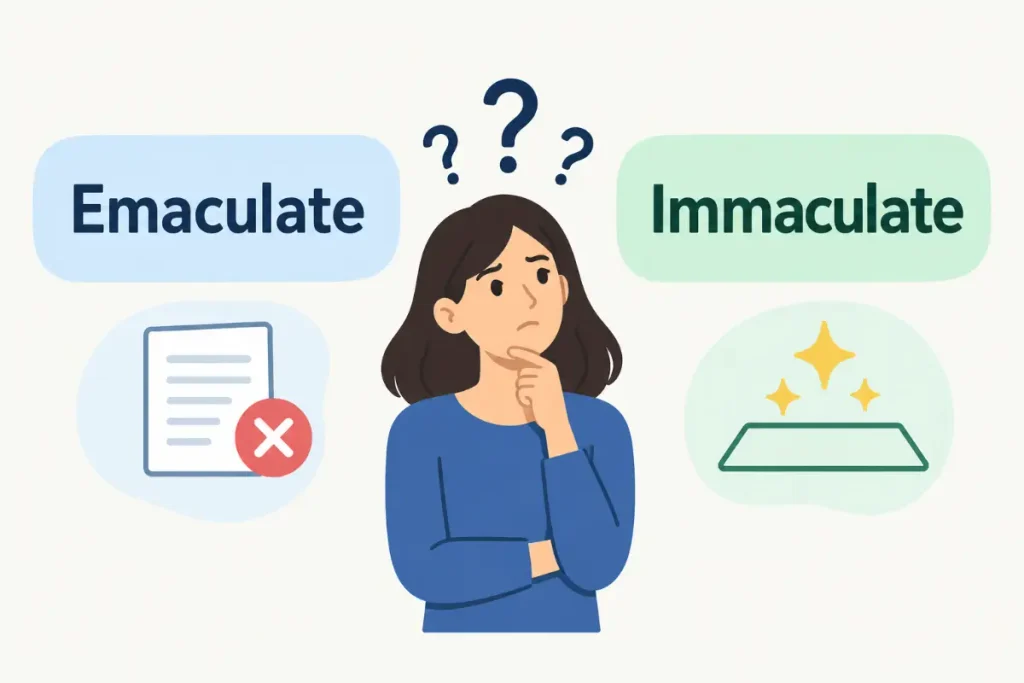
The correct spelling is immaculate. It means perfectly clean, neat, pure, or free from flaws. Emaculate is not the standard spelling of this word.
You’ll often see this mistake when someone writes the word from memory. The pronunciation can also make the first few letters easy to mix up. Once you know the correct form and where it comes from, though, the spelling becomes much easier to remember.
This guide explains the difference in plain English. You’ll learn what immaculate means, why emaculate is incorrect, how to use the correct word in real sentences, and how to avoid similar spelling mistakes.
Quick Definition
Immaculate is the correct English spelling. It describes something that is perfectly clean, neat, pure, or without any flaw. Emaculate is a common spelling mistake and should not be used in standard English writing.
Direct Answer
The correct spelling is immaculate. Use it when you mean perfectly clean, spotless, pure, or free from mistakes and flaws.
Comparison Table
| Word or Phrase | Meaning | Example Sentence | When to Use It |
|---|---|---|---|
| Immaculate | Perfectly clean, neat, pure, or flawless | Her kitchen was immaculate. | Use this in standard English |
| Emaculate | Not the standard spelling | Emaculate is incorrect in standard English. | Avoid this spelling |
Why People Confuse These Spellings
The confusion mainly comes from the way the word sounds.
When people hear immaculate in normal conversation, they may not clearly hear every letter. The first part can sound like a soft vowel followed by an m sound. That makes it easy for someone to guess that the word begins with em rather than im.
English spelling creates plenty of problems like this. A word can sound one way while its written form follows a pattern that isn’t obvious from pronunciation alone.
Immaculate is a good example.
The correct spelling begins with im. It isn’t spelled with em. If you write the word from memory and focus only on how it sounds, you may accidentally leave out the first m or replace the opening with emaculate.
That mistake is understandable. It is still incorrect in formal writing.
The easiest solution is to connect the spelling with the meaning. Immaculate often describes something that has no dirt, stains, damage, mistakes, or visible flaws.
- Think of a spotless white shirt.
- Think of a hotel room that looks perfectly clean.
- Think of a report with no errors.
- All of these situations can call for immaculate.
Once the spelling becomes familiar, the confusion usually disappears.
What Immaculate Means
Immaculate has several closely related meanings. The central idea is perfect condition with nothing wrong or dirty about it.
The word can describe physical cleanliness.
For example:
The bathroom was immaculate.
That sentence tells the reader that the bathroom was extremely clean. You can imagine clean floors, polished surfaces, fresh towels, and no visible mess.
The word can also describe appearance.
For example:
He arrived at the interview in an immaculate suit.
Here, immaculate doesn’t simply mean that the suit was clean. It suggests that the suit looked exceptionally neat and well cared for.
The word can also describe something that contains no errors.
For example:
- She kept an immaculate record of every payment.
- In this sentence, immaculate means the record was perfectly organized and accurate.
- The word can even describe moral or personal purity in some contexts.
For example:
The novel presents her as an immaculate figure.
In this use, the word suggests purity or freedom from wrongdoing. The exact meaning depends on the sentence.
So the word has a broader meaning than simply clean.
Its basic idea is perfection without a noticeable flaw.
The Main Meanings of Immaculate
Understanding the different meanings can make the word easier to use naturally.
Immaculate Means Extremely Clean
This is probably the most common everyday meaning.
If a room is immaculate, it is exceptionally clean and tidy.
For example:
- The living room was immaculate before the guests arrived.
- The chef keeps the kitchen immaculate.
- Her apartment is always immaculate.
These sentences describe a very high level of cleanliness.
You could use spotless in many of the same situations. However, immaculate can sound a little stronger. Spotless focuses mainly on the absence of dirt or marks. Immaculate can suggest cleanliness plus order and excellent condition.
Immaculate Means Perfectly Neat
The word can also describe something that looks carefully arranged.
For example:
His desk was immaculate.
This doesn’t necessarily mean someone tested the desk for germs. It means the desk looked extremely clean and organized.
You might see every paper stacked neatly. Pens could be arranged in a holder. The surface might be free from dust and clutter.
In this sense, immaculate is about presentation as well as cleanliness.
Immaculate Means Free From Errors
The word can describe work, records, performances, or results.
For example:
The accountant maintained an immaculate record of the company’s expenses.
Here, the record isn’t physically clean. The word refers to accuracy and careful organization.
Another example is:
The pitcher had an immaculate performance.
In sports writing, immaculate can describe a performance that was exceptionally clean or flawless.
The meaning comes from the idea of having nothing wrong with it.
Immaculate Means Pure
Immaculate can also carry the meaning of purity.
This use appears more often in formal, literary, or religious writing.
For example:
The painting shows the figure in an immaculate white robe.
Here, immaculate may suggest both physical cleanliness and symbolic purity.
This meaning connects with the history of the word. Its deeper sense involves something being free from stains or faults.
Why Emaculate Is Incorrect
The spelling emaculate looks reasonable at first glance. It follows a pattern found in other English words. For example, we have words such as emotion, embrace, and emerge.
- That can make emaculate seem natural.
- But English spelling isn’t always predictable.
- The standard word is spelled with imm at the beginning.
The first part is not em.
So if you are writing an essay, email, article, report, school assignment, resume, or professional document, use immaculate.
Writing emaculate can make the reader pause because it isn’t the accepted spelling of the word.
A spelling checker may also flag it.
That doesn’t mean the mistake is rare. People often create misspellings by changing the first vowel or dropping one of the repeated letters.
The important point is simple.
If you mean perfectly clean, flawless, pure, or exceptionally neat, write immaculate.
The Spelling Pattern to Remember
One useful way to remember the word is to focus on its opening letters.
The correct form is:
I M M A C U L A T E
Notice the two m letters after the first i.
That double m is easy to overlook.
Try breaking the word into smaller parts when you spell it:
im + maculate
The full word is still written as one word, but thinking about the opening as im can help you remember it.
Another useful memory trick is to connect the word with the phrase impossibly clean.
Both words begin with im.
You can think:
Immaculate means incredibly clean.
This isn’t the history of the word, but it can help you remember the spelling.
Another trick is to picture an immaculate object. Imagine a bright white sneaker with no dirt anywhere on it. Then picture the word written beside it.
The visual connection can make the spelling stick.
Where the Word Comes From
The history of immaculate helps explain its meaning.
The word comes from Latin roots connected with the idea of being stained or marked. The Latin word immaculatus means unspotted or undefiled.
The prefix in in Latin could express negation. Before certain sounds, that prefix could change form. The result contributed to the form we now recognize in English as immaculate.
The important idea is that the word has long been connected with being free from a stain or mark.
That explains why immaculate can describe both physical cleanliness and abstract perfection.
- A clean table can be immaculate.
- A perfect record can be immaculate.
- A person’s reputation can be described as immaculate.
All three uses share the same basic idea. There is nothing that spoils the condition being described.
Knowing the origin isn’t required to spell the word correctly. Still, it gives the word more logic and makes its different meanings easier to understand.
How to Use Immaculate in Everyday Sentences
The best way to learn a word is to see how people actually use it.
Here are natural examples.
Talking About a Home
- The house was immaculate when we arrived.
- She keeps her kitchen immaculate.
- His bedroom was surprisingly immaculate.
- The hotel room looked immaculate.
These examples use the word to describe cleanliness and order.
Talking About Clothes
- Her white dress was immaculate.
- He showed up wearing an immaculate suit.
- The shoes looked immaculate despite being several years old.
- The word works well when appearance matters.
Talking About Work
- The designer delivered an immaculate final draft.
- His handwriting was immaculate.
- She kept immaculate records throughout the project.
- The report was immaculate from start to finish.
These examples show how the word can move beyond physical cleanliness.
Talking About Cars
- The owner keeps the car immaculate.
- The vintage car was in immaculate condition.
- The interior remained immaculate after years of use.
- This is common in descriptions of cars for sale, classic vehicles, and carefully maintained personal belongings.
Talking About Performance
- The team gave an immaculate performance.
- She delivered an immaculate presentation.
- The athlete produced an immaculate routine.
- These sentences describe something that was executed with exceptional care or skill.
Immaculate Versus Clean
Clean and immaculate are close in meaning, but they aren’t always interchangeable.
Clean is the basic word.
If something is clean, it doesn’t have dirt or unwanted material on it.
Immaculate goes further.
It suggests an unusually high level of cleanliness, neatness, condition, or perfection.
Compare these sentences:
- The kitchen is clean.
- The kitchen is immaculate.
The first sentence gives a simple fact. The kitchen isn’t dirty.
The second sentence creates a stronger picture. The kitchen looks exceptionally clean and well maintained.
- That’s why immaculate often adds emphasis.
- You might say a room is clean without being impressed by it.
- You might call a room immaculate when its condition stands out.
Immaculate Versus Spotless
Spotless is another close synonym.
Both words can describe something that is extremely clean.
For example:
- The bathroom was spotless.
- The bathroom was immaculate.
- Both sentences work.
There is a small difference in tone.
Spotless strongly focuses on the absence of dirt, stains, and marks. Immaculate can include cleanliness but may also suggest order, perfection, or excellent condition.
Consider a resume.
You might describe someone’s record as immaculate. Spotless could work too, especially when talking about a person’s history or record.
For example:
- He has an immaculate professional record.
- She has a spotless driving record.
Both sound natural, but they aren’t exact substitutes in every situation.
The context decides which word sounds best.
Immaculate Versus Perfect
Perfect is broader.
It can describe almost anything that has reached an ideal standard.
Immaculate is more specific.
It often suggests something is clean, neat, pure, or free from flaws.
For example:
- The room was immaculate.
- This strongly suggests cleanliness and order.
- The room was perfect.
This could mean the room was clean, beautiful, comfortable, well designed, or ideal for the speaker’s needs.
So immaculate gives the reader a more specific image.
If you want to emphasize exceptional cleanliness or flawless condition, immaculate is often the stronger choice.
Immaculate Versus Pristine
Pristine is another useful comparison.
Pristine describes something that is in its original, fresh, or untouched condition.
For example:
The beach was pristine.
This can suggest that the beach was clean and largely untouched by people.
Immaculate focuses more strongly on perfect cleanliness, neatness, or condition.
For example:
The hotel room was immaculate.
You could describe a room as pristine too, but the feeling changes slightly. Pristine can suggest freshness or untouched condition. Immaculate can suggest careful cleaning and maintenance.
Both words are positive. They simply emphasize different things.
Common Sentences With Immaculate
Some phrases appear often enough that learning them can help you use the word naturally.
Immaculate Condition
This phrase means something is in excellent condition.
For example:
- The motorcycle is in immaculate condition.
- The house was sold in immaculate condition.
- The antique table remains in immaculate condition.
Immaculate Appearance
This phrase describes an exceptionally neat or polished appearance.
For example:
- She maintained an immaculate appearance at work.
- His immaculate appearance made a strong first impression.
Immaculate Record
This phrase describes a record with no mistakes, violations, losses, or other negative marks.
For example:
- The player has an immaculate record this season.
- She has an immaculate record as a driver.
Immaculate Reputation
This describes a reputation without serious criticism or wrongdoing.
For example:
- The organization has maintained an immaculate reputation for decades.
- The phrase is stronger than simply saying someone has a good reputation.
Common Spelling Mistakes With Immaculate
The incorrect spelling is not the only possible mistake. People may also leave out one of the m letters.
Some writers may produce forms such as imaculate.
Others may use emaculate.
These errors usually happen because the spelling doesn’t match the way the word sounds.
The safest approach is to remember the complete spelling rather than trying to rebuild it each time.
The word contains two m letters.
It also contains the sequence macul after those opening letters.
If you regularly use the word in writing, it will soon become familiar.
Why Double Letters Cause Problems
Double letters cause many English spelling mistakes.
When people pronounce a word, they usually don’t hear the difference between one consonant and two.
For example, saying immaculate doesn’t give you a strong signal that there are two m letters in the written form.
The same problem happens with many other words.
English learners often know how a word sounds long before they know how to spell it. Native speakers can make the same mistake when they have heard a word often but haven’t written it much.
That’s why spelling by sound can be risky.
A better method is to recognize common written patterns and memorize unusual spellings.
For immaculate, the key visual pattern is the opening imm.
Once you notice it, the word becomes much easier to recognize.
How to Remember the Correct Spelling
A simple memory method can save you from repeating the same mistake.
Start with the first three letters:
- IMM
- Then add:
- ACULATE
- Together they form:
- IMMACULATE
You can also use a sentence to lock it into memory.
Think:
- Immaculate means incredibly clean.
- The matching im beginning can act as a reminder.
- Another method is to associate the word with a spotless object.
- Imagine a freshly cleaned white kitchen. Nothing is out of place. Every surface shines.
- Then think of the word immaculate.
The stronger the mental image, the easier the word can become to remember.
You don’t need a complicated spelling trick. Repeated exposure and correct use usually do the job.
When to Use Immaculate in Formal Writing
Immaculate is perfectly acceptable in formal writing.
You can use it in academic writing, business writing, journalism, reviews, descriptions, and professional communication.
Still, choose it for a reason.
Don’t use immaculate simply to make a sentence sound more sophisticated.
For example:
- The office was immaculate.
- That’s clear and useful.
The office environment displayed an immaculate manifestation of organizational excellence.
That’s unnecessarily complicated.
Good writing doesn’t depend on fancy words. It depends on choosing the right word and putting it in a clear sentence.
Immaculate works best when you need to express exceptional cleanliness, neatness, purity, or flawlessness.
When Not to Use Immaculate
Sometimes a simpler word is better.
If you only mean that something isn’t dirty, clean is enough.
For example:
- Please make sure the table is clean.
- There is no need to say:
- Please make sure the table is immaculate.
The second sentence sounds stronger and may suggest a much higher standard.
Likewise, if you simply mean something is good, don’t automatically choose immaculate.
For example:
- She gave a good presentation.
- That’s perfectly clear.
- She gave an immaculate presentation.
This creates a stronger claim. It suggests that the presentation was exceptionally polished or flawless.
Strong words should match the strength of your meaning.
Immaculate in Different Types of Writing
The word can work across many forms of writing.
In Business Writing
You might use immaculate to describe records, presentation, organization, or work quality.
For example:
- The company maintains immaculate financial records.
- The showroom was kept immaculate.
Her professional presentation was immaculate.
In Creative Writing
The word can help create a vivid picture.
For example:
The mansion stood behind the gates with immaculate white walls.
That sentence gives the reader a strong visual impression.
In Reviews
Writers often use immaculate to praise condition or quality.
For example:
The restaurant’s dining room was immaculate.
The vehicle arrived in immaculate condition.
In Academic Writing
The word is less common but still useful when the meaning fits.
For example:
The study maintained an immaculate record of its observations.
However, academic writing often benefits from precise language. If you mean accurate, complete, or error free, one of those words may be clearer.
Does Immaculate Always Mean Clean
No.
Clean is one of its main meanings, but immaculate can also mean flawless, pure, exceptionally neat, or free from faults.
Context tells you which meaning applies.
Consider:
She has an immaculate record.
Nobody expects the record itself to be physically clean. The sentence means that the record has no negative marks or errors.
Now consider:
The bathroom is immaculate.
Here, physical cleanliness is the most likely meaning.
Then consider:
- He delivered an immaculate performance.
- This refers to quality and execution rather than physical cleanliness.
The common thread is the idea of nothing spoiling the thing being described.
Is Immaculate a Strong Word
Yes.
Immaculate usually carries strong praise.
Calling something immaculate tells the reader that it isn’t merely acceptable or reasonably clean. It stands out because it appears exceptionally clean, neat, pure, or flawless.
Compare these descriptions:
- The car is clean.
- The car is very clean.
Each sentence increases the strength of the description.
That makes immaculate useful when you want to create a strong positive impression.
Use it carefully, though. If everything you describe is immaculate, the word loses some of its impact.
Can Immaculate Describe a Person
Yes, but the meaning depends on context.
You can use immaculate to describe someone’s appearance.
For example:
- She looked immaculate at the ceremony.
- This means she looked extremely neat, polished, and well dressed.
You can also describe someone’s reputation as immaculate.
For example:
- He has an immaculate reputation in the industry.
- That means his reputation has no serious stains or faults.
The word can also have religious or moral meanings in certain contexts. Those uses are more specific and should be understood from the surrounding text.
Can Immaculate Describe Food
Yes, but this use depends on what you’re trying to say.
You could describe the presentation of food as immaculate.
For example:
The chef’s presentation was immaculate.
Here, the focus is on appearance and careful preparation.
You could also say:
The restaurant’s preparation area was immaculate.
That refers to cleanliness.
However, saying food itself is immaculate can sound unusual in everyday conversation unless you mean its presentation or quality is exceptionally flawless.
Natural word choice matters. A word can be grammatically possible while still sounding strange in a particular situation.
Can Immaculate Describe Nature
Yes.
For example:
We found an immaculate lake surrounded by mountains.
The word suggests the lake was extremely clean, clear, and untouched.
You might also see phrases such as immaculate beaches or immaculate wilderness.
In these cases, the word often emphasizes a lack of pollution, litter, damage, or human disturbance.
Still, pristine may be a better choice when you specifically want to emphasize that nature remains untouched.
Immaculate in British and American English
Immaculate is standard in both American English and British English.
The spelling does not change between the two varieties.
That makes it easy for American writers.
You don’t need a separate US spelling.
If you’re writing for a US audience, simply use immaculate.
The meaning also remains broadly the same.
This is different from some English words that have different spellings in American and British usage. Immaculate isn’t one of those cases.
What Part of Speech Is Immaculate
Immaculate is an adjective.
An adjective describes a person, place, thing, or idea.
For example:
- The room is immaculate.
- Here, immaculate describes the room.
- She wore an immaculate dress.
- Here, immaculate describes the dress.
- He has an immaculate record.
- Here, immaculate describes the record.
You can place the adjective before a noun or after a linking verb.
Before a noun:
- It was an immaculate kitchen.
- After a linking verb:
- The kitchen was immaculate.
- Both structures are natural.
What Is the Adverb Form
The adverb form is immaculately.
It describes how something is done.
For example:
- The room was immaculately cleaned.
- The garden was immaculately maintained.
- She was immaculately dressed.
- The adjective describes the thing itself.
- The adverb describes the way an action is performed.
Compare:
- The room was immaculate.
- The room was immaculately cleaned.
- The first describes the room.
- The second describes the cleaning.
What Is the Noun Form
The noun form is immaculateness.
It refers to the quality of being immaculate.
For example:
The immaculateness of the hotel impressed the guests.
That word is grammatically correct, but it isn’t common in everyday American English.
Most people would choose a simpler phrase such as:
- The hotel was exceptionally clean.
- The hotel was spotless.
Good writing often favors the familiar word when it carries the same meaning.

Related Words That Can Help You Remember It
Learning a small group of related words can make vocabulary easier.
Immaculate is closely connected in meaning to words such as:
- Clean.
- Spotless.
- Flawless.
- Pure.
- Perfect.
- Pristine.
- Unblemished.
- Untarnished.
- Neat.
- Polished.
These words aren’t exact substitutes in every sentence. Each one has its own shade of meaning.
- Clean focuses on the absence of dirt.
- Spotless focuses on the absence of spots or marks.
- Pristine suggests freshness or untouched condition.
- Flawless focuses on the absence of faults.
- Pure can focus on freedom from contamination or moral corruption.
Immaculate covers several of these ideas, especially cleanliness and freedom from flaws.
Related Spelling Confusions
The problem with one misspelling often points to a wider issue.
English contains many words that are easy to spell incorrectly because their pronunciation doesn’t fully reveal their written form.
For example, people sometimes confuse:
- Definitely and defiantly.
- Separate and seperate.
- Necessary and neccessary.
- Accommodation and accomodation.
Receive and recieve.
These mistakes don’t mean someone doesn’t understand the word. They often happen because English spelling contains patterns that aren’t always easy to predict.
The best response is to notice the correct form and use it repeatedly.
For immaculate, the key point is the opening imm.
How Spell Check Can Help
A spell checker can catch many mistakes, including incorrect versions of uncommon words.
Still, spell check shouldn’t replace your own understanding.
A computer can tell you that emaculate looks wrong. It may suggest immaculate. But you still need to know what the word means so you can choose it correctly.
This matters because some spelling mistakes create another real word.
A spell checker may not flag a word if the spelling is valid but the meaning is wrong.
For example, if you choose clean when you really mean flawless, the sentence may still be spelled perfectly.
Good editing combines spelling tools with careful reading.
How to Edit This Mistake
If you find emaculate in a draft, replace it with immaculate when you mean perfectly clean, neat, pure, or flawless.
Then read the whole sentence again.
Ask yourself what you are trying to describe.
- If you’re talking about physical cleanliness, immaculate may be right.
- If you’re talking about an untouched natural environment, pristine could be a better fit.
The goal isn’t just to fix spelling. The goal is to choose the word that expresses your exact meaning.
A Simple Test You Can Use
When you’re unsure about the spelling, ask yourself:
Am I describing something as exceptionally clean, neat, pure, or free from flaws.
If yes, the word you want is immaculate.
Then check the beginning.
It starts with imm.
- Not em.
- Not imac.
The complete spelling is:
immaculate
Once you’ve written it a few times, the spelling should become much more automatic.
Why Correct Spelling Matters
A single spelling mistake usually doesn’t destroy the meaning of a sentence.
Readers can often understand what you intended.
Still, correct spelling matters in professional and public writing.
A misspelled word can distract the reader. It can also make the writer appear less careful.
That matters even more when the word appears in a resume, website, school assignment, product description, business document, or published article.
Using immaculate correctly takes only a little attention.
The payoff is a cleaner and more trustworthy piece of writing.
Examples With the Correct Spelling
Here are several examples you can use as models.
- The hotel room was immaculate.
- His professional record remains immaculate.
- The beach looked immaculate after the cleanup.
- The report was immaculate and contained no obvious errors.
- The apartment was small but immaculate.
- Her handwriting was immaculate.
- The museum gallery was kept immaculate.
These examples show how flexible the word can be.
It can describe physical spaces, clothing, records, performances, appearances, and more.
A Quick Rule for Writers
If you remember only one rule from this article, make it this:
Immaculate has two m letters at the beginning.
The word begins with imm.
The incorrect spelling emaculate changes that opening and should be avoided.
The meaning is usually connected to exceptional cleanliness, neatness, purity, or freedom from flaws.
When you need a strong word for something that looks perfectly clean or carefully maintained, immaculate is a natural choice.
FAQs
Is emaculate a correct English word?
No. Emaculate is not the standard spelling of the word meaning perfectly clean or flawless. The correct spelling is immaculate.
What does immaculate mean?
Immaculate means perfectly clean, very neat, pure, or free from flaws. It can describe physical things such as rooms and clothes or abstract things such as records and reputations.
How do you spell immaculate correctly?
The correct spelling is immaculate. Remember the two m letters near the beginning. The word starts with imm rather than em.
Why do people spell immaculate as emaculate?
The mistake often comes from pronunciation. When people hear the word, they may not clearly notice the two m letters or the opening sound. Writing the word from memory can then lead to the incorrect em form.
Is immaculate the same as spotless?
They are close in meaning, especially when describing cleanliness. Spotless focuses strongly on the absence of dirt or marks, while immaculate can also suggest perfect condition, neatness, purity, or freedom from flaws.
Can immaculate describe a person?
Yes. It can describe a person’s appearance, clothing, reputation, or conduct depending on the context. For example, you can say someone looked immaculate when they appeared exceptionally neat and well dressed.
Is immaculate used in American English?
Yes. Immaculate is a standard word in American English. The spelling is the same in British English.
What is the opposite of immaculate?
The opposite depends on the context. Dirty, messy, flawed, stained, damaged, imperfect, or tarnished can work in different situations. The best opposite is the word that directly contrasts with the meaning you intend.
Conclusion
The answer to emaculate vs immaculate is simple. Immaculate is the correct spelling. It describes something that is exceptionally clean, neat, pure, or free from flaws.
The spelling mistake happens because pronunciation doesn’t make every letter obvious. The most useful detail to remember is the beginning of the word. It starts with imm, with two m letters.
Immaculate can describe much more than a clean room. You can use it for clothing, cars, homes, records, performances, appearances, reputations, and other things that show an unusually high level of care or perfection.
When you see emaculate in your writing, change it to immaculate if that is the meaning you want. Keep that simple spelling rule in mind and you’ll have one less common English spelling mistake to worry about.
Quick memory tip: Immaculate starts with imm. Think impossibly clean. That small connection can help you remember the spelling the next time you need it.

Dr. Arthur Pendelton is a veteran historical linguist and grammar expert with over 30 years of experience in academic editing. A retired professor, Arthur specializes in the etymology and evolution of the English language. He is passionate about “unpacking the history behind the rules,” helping readers understand why we spell, punctuate, and phrase things the way we do today. Whether he’s settling debates on archaic usage or explaining complex linguistic shifts, Dr. Pendelton brings scholarly precision to every article.
1 thought on “Emaculate vs Immaculate Which Is Correct”