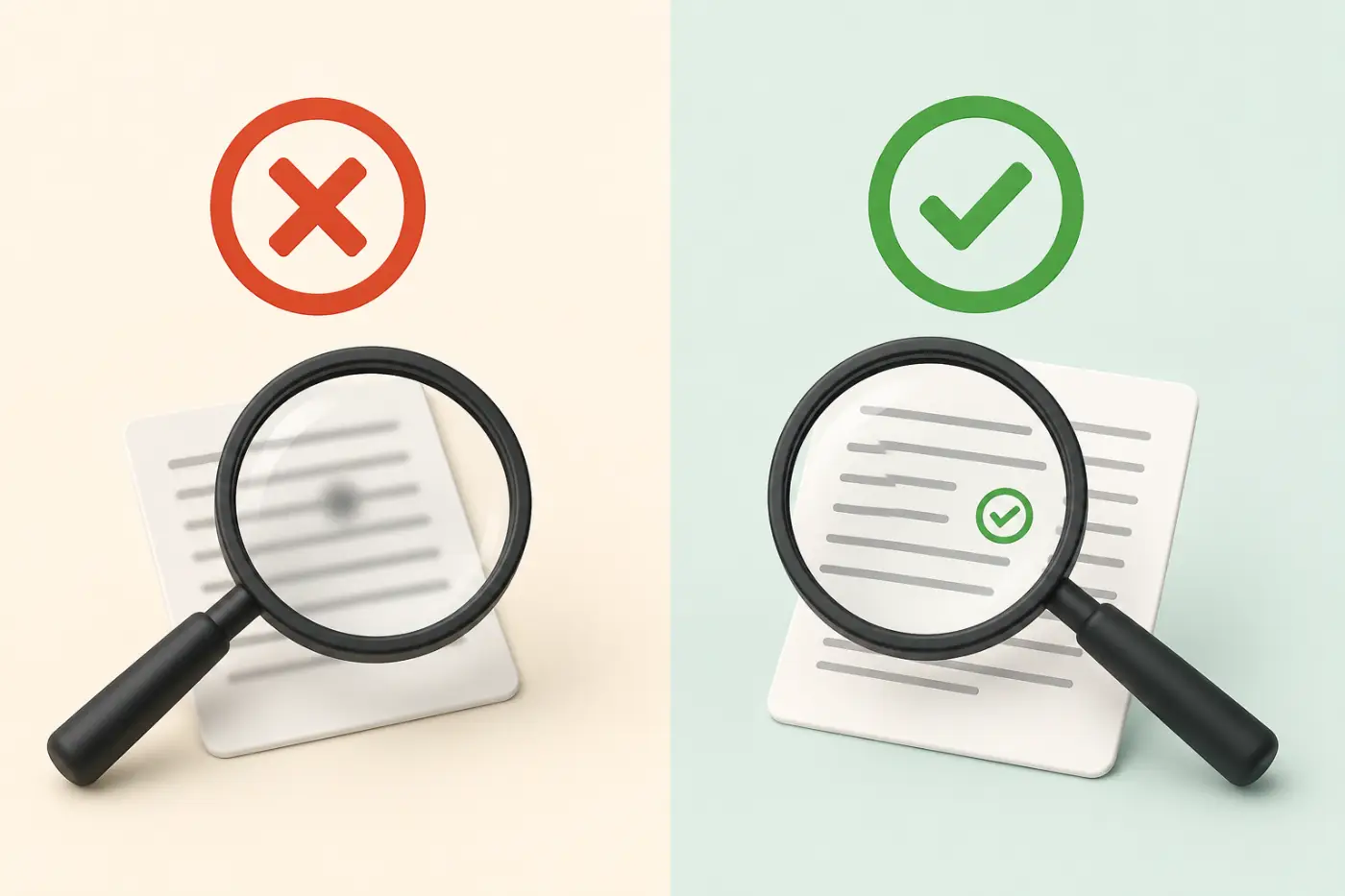
If you searched for oversite vs oversight, you probably want to know which spelling is correct. In most everyday writing, oversight is the word you want. It can mean a mistake caused by missing something, or it can mean supervision and control.
Oversite is a real word too, but it has a much narrower job. It is a construction term used for a layer of concrete beneath a building floor. That difference is easy to remember once you connect each spelling to its meaning.
The confusion comes from one small letter. Site and sight sound alike, so your ear cannot help much. The context has to do the work. If you are talking about a mistake, supervision, management, or control, use oversight. If you are talking about building work and a layer over prepared ground, oversite may be the right term.
This guide explains the difference, shows you how each word works in a sentence, and covers the mistakes people make most often. By the end, you should be able to choose the right spelling without stopping to second guess yourself.
Quick Definition
Oversight is a common English noun with two main meanings. It can describe supervision of a person, task, or process, or it can describe an unintentional mistake caused by failing to notice something. Oversite is a specialized construction term for a layer of concrete beneath a building floor.
Direct Answer
In normal writing, oversight is almost always the correct choice. Use oversite only when you are discussing the specialized construction meaning.
Comparison Table
| Word or phrase | Meaning | Example sentence | When to use it |
|---|---|---|---|
| Oversight | Supervision or control | The board has oversight of the project. | Management, government, work, education, and general writing |
| Oversight | An accidental mistake | Leaving her name off the list was an oversight. | Everyday writing when something was missed |
| Oversite | A construction layer beneath a floor | The crew installed the oversite before the floor work began. | Construction, building, and related technical work |
What Oversight Means
Oversight is the standard word you will see in general English. It has two meanings that seem almost opposite at first. One means watching or managing something. The other means failing to notice something.
That double meaning can feel strange. How can the same word describe careful supervision and a mistake caused by not paying attention?
Context makes the meaning clear.
When Oversight Means Supervision
In one use, oversight means responsibility for watching a process and making sure it is handled correctly. You will often see this meaning in business, government, law, education, finance, health care, and project management.
For example:
- The committee provides oversight of the new program.
- The manager has oversight of the hiring process.
- The agency is responsible for regulatory oversight.
- The board increased its oversight of company spending.
In each sentence, oversight means supervision or control. Nobody made a mistake. Someone is responsible for watching the work and checking that it is done properly.
Cambridge Dictionary gives this sense as responsibility for a job or activity and for making sure it is done correctly. It also lists management of an operation or process as an American English meaning.
This use is especially common with words such as government, regulatory, financial, legal, corporate, congressional, and independent.
For example:
- The agency needs stronger financial oversight.
- The committee provides independent oversight of the program.
- Congress has oversight of federal agencies.
- The school added more oversight to its testing process.
Notice how naturally the word fits into formal and professional sentences. Still, you do not need to write in a formal style to use it.
You can also say:
- I want more oversight of the project.
- She has oversight of the team.
- He was given oversight of the budget.
When Oversight Means A Mistake
The second meaning describes something that someone failed to notice. Usually, the mistake is unintentional.
For example:
- Leaving the date off the invitation was an oversight.
- I forgot to attach the file. It was an oversight.
- The missing signature was an oversight.
- The error happened because of a simple oversight.
In these examples, nobody is supervising anything. The word points to something that was missed.
Cambridge defines this meaning as a mistake caused by a failure to notice or do something.
This is a common use in everyday American English. You might hear it at work, in school, in customer service, or in a normal conversation.
For example, imagine that a store sends you an invoice but leaves out one item. You might write:
It looks like the extra charge was left off by oversight.
Or you could say:
The missing item was an oversight.
The word often sounds softer than mistake. That makes it useful when you want to admit that something was missed without making the situation sound dramatic.
Compare these sentences:
- I made a mistake on the report.
- I made an oversight on the report.
The first is direct. The second suggests that you missed something while handling the work. Both can be correct, but oversight can sound more specific and less harsh.
Why Oversight Has Two Meanings
The two meanings are connected by the idea of looking over something.
When you supervise a task, you watch it and make sure it is handled correctly. When you make an oversight, you fail to notice something that you should have caught.
So the two meanings grew around the same basic idea of watching.
This is why context matters so much.
Consider this sentence:
The manager has oversight of the project.
Here, the manager is supervising the project.
Now consider:
The manager made an oversight in the project report.
Here, the manager missed something.
The surrounding words tell you which meaning the writer intends. Native speakers usually understand the difference without thinking about it.
Oversite vs Oversight In Context
Oversite is not simply a shorter spelling of oversight. It has its own meaning.
In construction, oversite refers to a layer of concrete beneath the ground floor of a building. It can also refer to an oversite slab or a related layer laid over prepared ground.
The term appears in building work, architectural documents, engineering material, and construction reports. It is much less common in ordinary conversation.
For example:
- The builders poured the oversite before installing the floor.
- The engineer specified an oversite slab for the ground floor.
- The suspended floor sits above the concrete oversite.
A construction document may use oversite because the word has a specific technical meaning. In an email about a missed deadline, the same spelling would almost certainly be wrong.
Think of oversite as a word connected to a physical site. In construction, the term refers to something placed over prepared ground.
A professional building document from Premier Guarantee also uses concrete oversite for a concrete layer below a suspended timber floor. The document describes the oversite as part of the substructure and gives construction specifications for it.
Oversite In Construction
If you work in construction, the word deserves more attention because it can refer to a real part of a floor system.
A typical building floor has several layers or components. The exact design depends on the building, ground conditions, materials, and local requirements. Oversite may refer to the concrete layer laid over prepared ground within the building footprint.
The purpose can include creating a firm base and helping protect the floor area from ground conditions. The full floor design can also include other components such as compacted fill, a damp proof membrane, insulation, screed, and the final floor finish. The exact arrangement should come from the project design and applicable building requirements.
Oversite is not the same thing as the building foundation.
Foundations support the building and transfer loads into the ground. An oversite layer is associated with the floor area and ground preparation. The two can work together, but they serve different roles.
That distinction matters in technical writing. If a construction plan calls for an oversite, replacing the term with oversight would change the meaning completely.
The construction use is not just theoretical. Technical building guidance uses the term concrete oversite in descriptions of floor construction.
Oversite can also appear as part of phrases such as oversite concrete and oversite slab. In these phrases, the construction context makes the meaning clear.
For example:
- The contractor completed the oversite concrete before moving to the next stage.
- The oversite slab provides a prepared base for the floor construction.
- The inspection focused on the condition of the oversite.
- If you are not writing about construction, you probably will not need this word.
Oversight In Everyday Writing
- For most readers, oversight is the word that matters.
- You can use it in casual writing:
- That was an oversight on my part.
- I apologize for the oversight.
- We caught the oversight before the report went out.
- You can also use it in professional writing:
- The director has oversight of the department.
- The policy requires independent oversight.
- The project needs better financial oversight.
- The word works across many subjects because its meanings are broad.
- You might see it in:
- Business reports.
- Government documents.
- School policies.
- Legal writing.
- News articles.
- Customer service messages.
- Research papers.
- Project plans.
- Work emails.
The spelling stays the same in all of these settings.
Common Mistakes People Make
The most common mistake is using oversite when the writer means oversight.
For example:
Incorrect: The manager has oversite of the project.
Correct: The manager has oversight of the project.
The first sentence makes it sound like the manager is a layer of concrete. The second sentence says the manager supervises the project.
Another common mistake happens when someone writes:
Incorrect: It was an oversite that I forgot the attachment.
Correct: It was an oversight that I forgot the attachment.
The second sentence uses the standard word for an accidental omission.
A third mistake happens when a writer sees oversite in a construction document and assumes it is a spelling error.
That can also be wrong.
If the document is talking about concrete beneath a floor, oversite may be exactly what the writer intends. The word is uncommon, but it is used as a construction term.
The key is to check the subject before correcting the spelling.
- If the subject is a missed detail, supervision, or management, choose oversight.
- If the subject is a construction layer beneath a floor, oversite may be correct.
Oversight And Oversee Are Not The Same
Another source of confusion is the verb oversee.
Oversee means to watch, organize, or manage a job or activity and make sure it is done correctly. Cambridge lists oversee as a verb with this meaning and gives overseeing as its present participle.
For example:
- She will oversee the project.
- He oversees the construction team.
- The director oversees the department.
- The committee will oversee the review.
- The noun is oversight.
- The verb is oversee.
- This gives you a simple word family:
- Oversee means to supervise.
- Oversight can mean supervision.
- Oversight can also mean a missed detail.
- Oversite is the specialized construction term.
- The words look close, but they do different jobs.
A useful way to avoid mistakes is to decide what kind of word you need before you spell it. If you need an action, you may need oversee. If you need a noun for supervision or a missed detail, you may need oversight. If you are discussing a construction layer, you may need oversite.
How To Remember The Difference
A simple memory trick can save you from the spelling problem.
Think of sight as something connected to seeing.
Oversight contains sight. One meaning involves watching over something. The other meaning involves failing to see or notice something.
Now think of site as a place.
Oversite contains site. Its specialized meaning relates to a building site and a layer placed over prepared ground.
So remember:
- Sight connects to seeing.
- Site connects to a place.
- Oversight connects to supervision or a missed detail.
- Oversite connects to construction.
This is not a rule for every word that contains site or sight. It is simply a practical memory trick for these two spellings.
Examples In Real Sentences
Seeing the words in context makes the difference easier to understand.
Examples with oversight meaning supervision:
- The board has oversight of the company budget.
- The agency provides oversight of the program.
- The committee was created to provide independent oversight.
- The manager has oversight of the hiring process.
- The new policy gives the department more oversight.
- Examples with oversight meaning a mistake:
- Forgetting to send the invoice was an oversight.
- The missing page was an oversight.
- I apologize for the oversight in the report.
- The team caught the oversight before publication.
- The wrong date was a simple oversight.
Examples with oversite in construction:
- The crew poured the oversite before the floor was installed.
- The architect included an oversite slab in the floor design.
- The inspection covered the concrete oversite.
- The oversite sits below the ground floor construction.
- The contractor completed the oversite before moving on to the next stage.
Examples with oversee:
- She will oversee the final review.
- The project manager oversees the construction work.
- A senior editor will oversee the publication.
- The committee oversees the program.
- The supervisor oversees the daily operation.
These examples show why spelling alone is not enough. Meaning and context matter.
Oversight In Business And Government
You may see oversight often in business and government writing.
In these settings, the word usually refers to supervision, review, or control.
For example:
- The board provides oversight of executive decisions.
- The agency needs stronger regulatory oversight.
- The committee has oversight of the budget.
- Independent oversight can help identify problems.
Government oversight can involve reviewing programs, monitoring agencies, checking compliance, or examining how public resources are used. The exact role depends on the organization and the rules involved.
Cambridge lists business uses of oversight connected with systems or actions that control an activity and make sure it is done correctly and legally.
This explains why phrases such as regulatory oversight and congressional oversight are common.
In these cases, oversight has nothing to do with a mistake.
That is one reason the word can confuse learners. The same noun can point to careful supervision in one sentence and a missed detail in another.
Look at these two examples:
- The committee provides oversight of the agency.
- The committee apologized for an oversight in its report.
- The first means supervision. The second means a mistake.
- The context does the heavy lifting.
Oversight In School And Academic Writing
Students may use oversight when describing a missed detail.
For example:
- The missing citation was an oversight.
- I made an oversight when I submitted the paper.
- The teacher pointed out an oversight in the final paragraph.
- The word can also describe supervision:
- The research project operates under faculty oversight.
- The review process requires academic oversight.
- The same two meanings apply.
If you are writing an essay and want to say that you forgot something, oversight is the standard choice. If you want to describe supervision of a project, oversight also works.
Do not replace it with oversite unless you are actually discussing construction.
Oversight In Emails
- Email is another place where the correct spelling matters.
- Suppose you forgot to attach a file. You could write:
- Sorry about that. The missing attachment was an oversight. I have attached it now.
- That sounds natural and professional.
- You could also write:
- I apologize for the oversight. The revised file is attached.
- Now imagine you are writing to a construction team:
- Please confirm that the oversite has been completed before the next floor stage begins.
- In that sentence, oversite can be correct because the topic is construction.
- The difference is not about formal writing versus casual writing. It is about meaning.
Why The Error Is So Easy To Make
The two words are nearly identical.
They also sound very similar when spoken. In normal conversation, you may not hear the difference clearly.
That makes the problem more common for people who learn English through listening.
Spelling adds another layer of trouble. Site is a familiar word. Sight is also familiar. Both can fit naturally after over.
There is another reason the confusion lasts. Most people use oversight often but rarely encounter oversite unless they work around construction or read technical building documents.
That means your brain usually expects oversight. When it sees oversite, it may assume the writer made a typo.
Sometimes that assumption is right.
Sometimes it is not.
The best response is to check the context.
If the sentence says something like, “The team missed the deadline because of an oversite,” the writer almost certainly means oversight.
If the sentence says, “The contractor installed the concrete oversite beneath the floor,” the construction meaning supports oversite.
This small context check can prevent a wrong correction.
Related Word Confusions
English has many word pairs that look or sound similar but have different meanings. Site and sight are one example.
Site usually means a place or location.
For example:
- The company chose a new site for its office.
- The construction site opens at seven.
- The site is close to the highway.
Sight usually relates to seeing or something that can be seen.
For example:
- The mountain came into sight.
- The bright light hurt my sight.
- It was a beautiful sight.
- That distinction helps explain the spelling in the two words discussed here.
- Oversight uses sight.
- Oversite uses site.
- The spelling connects to the meaning.
- Another useful pair is advice and advise.
- Advice is a noun.
- She gave me good advice.
- Advise is a verb.
- I advise you to check the form.
Then there is practice and practise. American English normally uses practice as both the noun and verb.
These examples are different from oversight and oversite, but they show the same larger lesson. English contains many words that differ by one letter while carrying different meanings.
Do not rely only on how a word sounds. Look at the meaning and the sentence around it.
When Oversite Is The Right Choice
Use oversite when the subject is a construction layer or related building work.
Good examples include:
- The builder installed the oversite beneath the floor.
- The engineer specified a concrete oversite.
- The inspection found damage to the oversite.
- The project includes an oversite slab.
- The floor structure was built above the oversite.
In technical work, always follow the terminology used in the project plans and specifications. Construction terms can vary by region and by building system. If the project documents use oversite for a specific component, keep that term consistent in your reports.
Also remember that an oversite is not automatically the same as every type of slab or foundation. The exact construction system determines what the layer does and how it is built.
When Oversight Is The Right Choice
Use oversight when you mean supervision.
For example:
- The manager has oversight of the department.
- The board provides oversight of company spending.
- The agency has regulatory oversight.
- The committee offers independent oversight.
- Use oversight when you mean an unintentional mistake.
For example:
- The missing figure was an oversight.
- Forgetting the appointment was an oversight.
- The wrong address was an oversight.
- The error was caused by an oversight.
If you are writing a normal email, report, essay, article, message, or business document, oversight will usually be the word you need.
A Simple Decision Rule
Ask yourself one question.
- Am I talking about supervision, a missed detail, or construction?
- If you mean supervision, use oversight.
- If you mean a missed detail, use oversight.
- If you mean a construction layer beneath a floor, use oversite.
- That is the whole distinction in a few lines.
- You can make the rule even shorter:
- Supervision equals oversight.
- Mistake equals oversight.
- Construction floor layer equals oversite.
- This rule will handle most situations you are likely to face.
Do You Need A Hyphen
In standard usage, the words discussed here are written as single words.
- Oversight is one word.
- Oversite is one word.
- Oversee is one word.
You should not create a new spelling by separating the parts. The issue is the middle letter. You need sight for oversight and site for the construction term.
Pronunciation can still make the pair confusing because the sounds are close. That is another reason spelling the word from memory can be tricky.
If you are unsure, look at the meaning first. Then choose the spelling.
A Note For American Writers
American readers will recognize oversight as a normal English word. It appears often in business, government, education, and everyday writing.
Oversite is much less familiar to general American readers because its use is specialized. If you use it outside a construction context, readers may assume you made a spelling error.
That does not make oversite fake or automatically wrong. It simply means the word has a narrow field of use.
For a general audience, clarity should guide your choice. If you are talking about a missed detail or supervision, use the familiar standard word.
If you are writing a construction document for professionals who use oversite, use the technical term they recognize.
The goal is not to avoid unusual words. The goal is to use the right word for the right meaning.

A Final Check Before You Publish
If you are editing a sentence that contains one of these spellings, do not correct it on sight.
- Read the full sentence.
- Ask what the writer means.
Look at the words around it.
- If the sentence describes a mistake, the spelling should be oversight.
- If it describes supervision or management, the spelling should also be oversight.
- If it describes a concrete layer beneath a building floor, oversite can be correct.
For example:
- The missing invoice was an oversight.
- The director provides oversight of the department.
- The crew installed the concrete oversite before completing the floor.
- All three sentences are correct because each word matches its meaning.
- That is the simplest way to handle the confusion.
FAQs
What should I know about oversite vs oversight?
The difference is mainly meaning and context. Oversight is the common word for supervision or an accidental mistake. Oversite is a specialized construction term for a layer of concrete or related material beneath a building floor.
Is oversite a real word?
Yes. Oversite is a real English term used in construction. It can refer to a layer of concrete beneath a ground floor or an oversite slab laid over prepared ground. It is uncommon in everyday writing.
Is oversite a misspelling of oversight?
Sometimes it is. In everyday writing, a person who types oversite may simply have made a spelling error. In construction writing, however, oversite can be a legitimate technical term.
What does oversight mean?
Oversight has two main meanings. It can mean supervision or responsibility for monitoring an activity. It can also mean an unintentional mistake caused by failing to notice or do something.
Does oversight mean supervision?
Yes. Oversight can mean supervision, management, or responsibility for making sure a task or process is handled correctly. For example, “The board has oversight of the budget” means the board is responsible for monitoring the budget.
Does oversight also mean a mistake?
Yes. An oversight can be an accidental mistake caused by failing to notice something. For example, forgetting to include a name on a list can be called an oversight.
What does oversite mean in construction?
In construction, oversite can refer to a concrete layer beneath a building floor. It may also refer to an oversite slab or similar layer laid over prepared ground as part of floor construction.
How can I remember the correct spelling?
Think of sight as connected to seeing. Oversight can involve watching over something or failing to see a detail. Think of site as a place, so oversite connects to a building site and construction.
Conclusion
The oversite vs oversight question has a simple answer once you focus on meaning. Oversight is the normal word for supervision and for an accidental mistake. Oversite is a real but specialized construction term.
If you are writing an email, essay, report, article, or everyday message, oversight will almost always be the word you need. Use it for sentences such as “The missing attachment was an oversight” or “The board has oversight of the project.”
If you are reading a construction plan or writing about building floors, do not automatically treat oversite as an error. In that setting, it can describe a concrete layer beneath the floor.
The easiest memory trick is sight for seeing and site for a place. So supervision or a missed detail points to oversight, while a construction layer points to oversite. Keep that distinction in mind and this spelling problem becomes much easier.
Meta Description
Oversite vs oversight explained clearly. Learn the meaning, spelling, construction use, examples, common mistakes, and a simple way to remember the difference.

Dr. Arthur Pendelton is a veteran historical linguist and grammar expert with over 30 years of experience in academic editing. A retired professor, Arthur specializes in the etymology and evolution of the English language. He is passionate about “unpacking the history behind the rules,” helping readers understand why we spell, punctuate, and phrase things the way we do today. Whether he’s settling debates on archaic usage or explaining complex linguistic shifts, Dr. Pendelton brings scholarly precision to every article.
3 thoughts on “Oversite vs Oversight Explained Clearly”