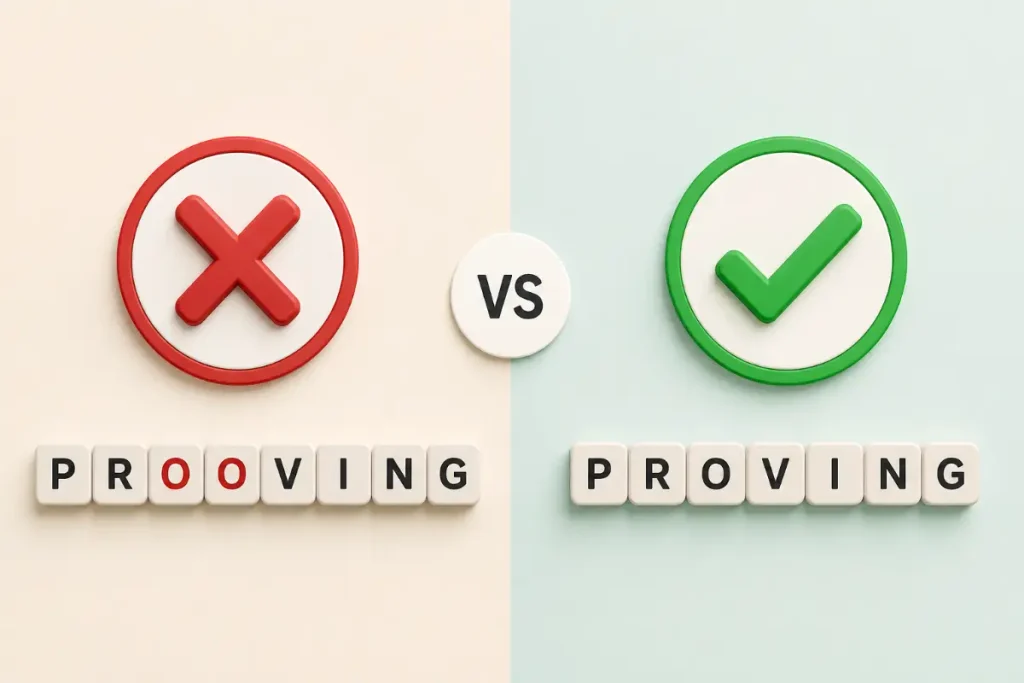
If you searched for prooving vs proving, the answer is simple. Proving is the correct spelling. Prooving is a common spelling mistake.
The confusion usually comes from the word prove. When you add ing, it can feel natural to keep the full spelling and write prooving. English does not work that way here. The final e drops before the ing ending, so prove becomes proving.
This small spelling rule shows up often in school writing, work emails, essays, reports, and everyday messages. Once you understand why the change happens, the correct form becomes much easier to remember.
This guide explains the rule behind proving, shows it in real sentences, compares it with similar verbs, and covers the mistakes that cause people to add an extra o. You will also see how the same spelling pattern works with other verbs that end in a silent e.
Quick Definition
Proving is the present participle and gerund form of prove. It means showing that something is true or correct. Prooving is not the standard English spelling.
Direct Answer
Proving is correct. Prooving is incorrect in standard English.
Comparison Table
| Word or Phrase | Meaning | Example Sentence | When to Use It |
|---|---|---|---|
| Proving | Showing that something is true or correct. | She is proving her point with clear evidence. | Use this form when you need the ing form of prove. |
| Prooving | A common spelling error. | He wrote prooving in his draft. | Do not use this spelling in standard English. |
| Prove | To show that something is true or correct. | We need to prove the claim with facts. | Use the base form after words such as to or after certain helping verbs. |
| Proved | Showed that something was true or correct. | The test proved the theory was wrong. | Use this past form for a completed action. |
Why Prooving Looks Like It Could Be Correct
The mistake makes sense at first glance. The base verb is prove. It has two vowel letters before the final consonant. When people add ing, they may simply attach the ending to the whole word. That creates prooving.
The problem is that English spelling rules often change a verb when an ending is added. The final silent e in prove does not stay in the word before ing. You remove the e and then add ing.
The pattern looks like this.
Prove becomes proving.
Make becomes making.
Take becomes taking.
Write becomes writing.
Give becomes giving.
Notice what happens in each example. The final e disappears before ing. The main sound of the word stays familiar, but the spelling becomes shorter.
That is why prooving is not just an alternate spelling. It breaks the normal spelling pattern for this verb.
The Correct Rule for Proving
A useful rule says that many verbs ending in a silent e drop the e before an ending that begins with a vowel. The ing ending begins with the vowel sound i. As a result, the final e is removed.
- Prove plus ing becomes proving.
- You can apply the same idea to many common verbs.
- Hope becomes hoping.
- Smile becomes smiling.
- Drive becomes driving.
- Use becomes using.
- Move becomes moving.
- Close becomes closing.
- Choose becomes choosing.
These examples help show that proving follows a familiar pattern. It is not an odd spelling that you simply have to memorize on its own.
There is one important point to keep in mind. English spelling has many exceptions and smaller rules. So you should not apply the final e rule blindly to every word you see. Still, for prove, the answer is clear. The standard form is proving.
Why The Extra O Is A Mistake
The extra o in prooving comes from treating prove as if the whole base word must remain unchanged. That approach works with some verbs but not with prove.
For example, look at read and reading. The base word stays intact because read does not end in silent e.
Now look at prove and proving. The final e disappears.
This difference matters because the spelling of an English word can change when you add a suffix. The suffix ing is not always added to the base word without any change.
Think of the final e as a letter that often steps out of the way when ing arrives. That simple image can help you remember the spelling without trying to memorize a complicated rule.
You do not need two os in the middle of proving. You only need one o after the pr.
The spelling is p r o v i n g.
Not p r o o v i n g.
Real Sentence Examples With Proving
The easiest way to learn a spelling is to see it in natural sentences. Here are examples that show how proving works in everyday English.
- She is proving that the plan can work.
- The new evidence is proving his claim correct.
- He kept proving his point with facts.
- The experiment is proving useful.
- The team is proving that hard work can pay off.
- You are proving your value through your actions.
- The results are proving more reliable than expected.
- They are proving the value of the new process.
- The witness is proving difficult to question.
- The test is proving that the device works.
In each sentence, proving describes an action that is happening or continuing. It can also act like a noun in some sentences.
For example, proving a claim takes more than making an assertion.
In that sentence, proving names the activity of showing that the claim is true. This use is called a gerund. You do not need to remember the grammar label to use the word correctly. You only need to recognize that proving can function in different ways.
Proving In Different Grammar Forms
Understanding the grammar behind the word can make the spelling easier to remember.
- The base form is prove.
- I need to prove my point.
- The third person singular form is proves.
- She proves her ideas with evidence.
- The past form is proved.
- The evidence proved his claim.
- The present participle and gerund form is proving.
- He is proving his point.
Proving is not the only form that changes from prove. The final e also disappears in some other forms and word combinations.
This gives you a useful family of forms.
- Prove.
- Proves.
- Proved.
- Proving.
The word proves keeps the e because it takes s rather than an ending that causes the silent e to drop. The word proved also keeps the e. The ing form is different because the final e is removed.
This is why it helps to learn related forms together instead of treating every spelling as a separate fact.
When To Use Proving
Use proving when you mean showing that something is true, correct, valid, or effective.
- You might use it when talking about evidence.
- The scientist is proving the theory with new data.
- You might use it when talking about a person or their actions.
- She is proving that she can handle the job.
- You might use it when talking about a product or method.
- The new system is proving useful for small businesses.
- You might also use it when talking about an argument.
- He is proving his point with a simple example.
The word often appears with phrases such as proving a point, proving a claim, proving a theory, proving a fact, proving useful, and proving effective.
These common combinations can help you recognize the correct spelling when you see it in context.
Proving A Point
One of the most common phrases is proving a point. It means giving enough evidence or showing enough facts to support an idea.
For example, you could write, She kept proving her point with clear examples.
You could also say, The results are proving my point.
The phrase is common in conversation and formal writing. It works well in essays, discussions, reviews, and everyday speech.
A related phrase is prove a point. That form uses the base verb.
He wants to prove a point.
When the sentence uses is, am, are, was, or were before the action, the ing form may be needed.
- He is proving a point.
- She was proving a point.
- They are proving a point.
This grammar pattern gives you another easy way to spot the correct spelling.
Proving A Claim
Proving a claim means showing that a statement is supported by reliable evidence.
For example, a researcher may be proving a claim by comparing data. A lawyer may be proving a claim by presenting evidence. A student may be proving a claim in an essay by explaining the facts behind it.
The key idea is evidence. If you say something is true without support, you are making a claim. If you show why it is true, you are proving it.
This is also why proving appears often in academic and professional writing.
A strong argument is not just about making a statement. It is about proving the statement with clear support.
Proving Something Is True
Another common use appears in the phrase proving something is true.
For example, The evidence is proving that the report was accurate.
- The phrase can also appear in a more general form.
- He spent years proving his critics wrong.
- She is proving herself capable of leading the team.
In these sentences, proving describes an action that demonstrates something through facts or behavior.
The meaning stays connected to the base verb prove. The spelling simply changes because the word now has the ing ending.
Common Mistakes With This Word
- The most common mistake is adding an extra o.
- Incorrect: The results are prooving the claim.
- Correct: The results are proving the claim.
- Another mistake is keeping the final e.
- Incorrect: The results are proveing the claim.
- Correct: The results are proving the claim.
- A third mistake is using the wrong verb form after a helping verb.
- Incorrect: She is prove the point.
- Correct: She is proving the point.
After is, am, are, was, or were, an ing form often follows when the sentence describes an action in progress.
There is also a common confusion between prove, proving, and proved.
- Incorrect: He is prove the claim.
- Correct: He is proving the claim.
- Incorrect: He has proving the claim.
- Correct: He has proved the claim.
The right form depends on the grammar of the sentence. Learning the spelling alone is not enough. You also need to look at the words around it.
Prove vs Proving
Prove is the base form of the verb. It usually appears after to or after certain helping verbs.
- I want to prove my point.
- We need to prove the claim.
- Can you prove it?
- They will prove the idea works.
- Proving is the ing form. It often follows forms of be when an action is in progress.
- I am proving my point.
- We are proving the claim.
- She is proving the idea works.
- They were proving the method effective.
The difference is simple once you focus on the sentence.
- If you say to prove, use prove.
- If you say is proving, use proving.
- If you say will prove, use prove.
- If you say are proving, use proving.
This small grammar check can prevent many spelling mistakes.
Proving vs Proved
Proving and proved describe different forms of the same verb.
- Proving usually shows an action in progress.
- She is proving her case.
- Proved usually shows a completed action.
- She proved her case.
- The distinction can be especially useful in writing because it changes the timing of the action.
- Consider these two sentences.
- The test is proving the device is safe.
- The test proved the device was safe.
The first sentence presents the process as ongoing. The second presents the result as completed.
Proving vs Prooves
Another spelling mistake sometimes appears as prooves. That form is also incorrect.
- The correct third person singular form is proves.
- He proves his point.
- She proves the claim.
- The test proves the theory.
The spelling does not become prooves. The word prove already has the needed vowel sound and simply takes s.
This is different from the ing form.
- Prove becomes proves.
- Prove becomes proving.
- Prove becomes proved.
Keeping these forms together can make the spelling pattern much easier to recall.
Related Verbs That Follow The Same Pattern
Proving is part of a much larger spelling pattern. Many common verbs lose their final silent e before ing.
- Bake becomes baking.
- Believe becomes believing.
- Change becomes changing.
- Dance becomes dancing.
- Excite becomes exciting.
- Imagine becomes imagining.
- Invite becomes inviting.
- Live becomes living.
- Make becomes making.
- Notice becomes noticing.
- Prepare becomes preparing.
- Save becomes saving.
- Share becomes sharing.
- Take becomes taking.
- Write becomes writing.
This pattern is useful because it lets you predict the spelling instead of guessing.
If you know that make becomes making, it becomes easier to see why prove becomes proving.
The final e is not needed before ing. Removing it gives you the standard form.
Cases That Look Similar But Work Differently
Not every verb follows the exact same spelling pattern. Some verbs double their final consonant instead of dropping an e.
For example, run becomes running.
- Sit becomes sitting.
- Plan becomes planning.
The spelling change here is different. These verbs do not end in silent e. They follow another rule that can require a doubled consonant.
Other verbs keep their final e in special cases because the e affects pronunciation or meaning. For example, dye becomes dyeing. The extra e helps distinguish dyeing from dying.
That is a good reminder that English spelling has patterns rather than one rule that solves every word.
Still, none of those special cases change the answer for prove. The standard ing form is proving.
How To Remember The Correct Spelling
A good memory trick is to connect prove with remove.
When ing comes after prove, remove the final e.
- Prove.
- Remove e.
- Add ing.
- Proving.
You can also remember the word as prove plus ing with one letter taken away.
Another quick trick is to say the spelling in parts.
- Pro.
- Ving.
- The word has only one o.
If you picture the word as prooving, the extra o stands out once you know the correct pattern.
- You can also connect it to familiar words.
- Make becomes making.
- Take becomes taking.
- Write becomes writing.
- Prove becomes proving.
The more examples you group together, the less likely you are to rely on guesswork.
Why This Mistake Happens So Often
People often spell words based on how they sound. That works surprisingly well in English, but it can also cause trouble.
Proving sounds close to what you might expect from prove plus ing. When you say the word aloud, you do not clearly hear a missing e. You also do not hear the exact number of vowel letters.
That means spelling the word from sound alone can lead to an extra o.
The same problem appears with many English words. Silent letters and changing suffixes make spelling less predictable than pronunciation.
Another reason is visual memory. You know the base word prove very well. Your brain may try to preserve its full spelling when you add ing.
Once you learn the pattern, your brain can recognize the change more quickly.
The goal is not to think about spelling rules every time you write the word. The goal is to practice the correct form enough that it starts to look natural.
Examples For School And Academic Writing
Students often need to use proving when explaining evidence or supporting an argument.
- The data is proving that the original claim was inaccurate.
- The experiment is proving the value of the new method.
- These results are proving the main argument.
- The author is proving the point through several examples.
- The evidence is proving useful in the final analysis.
In academic writing, proving often connects an idea to evidence. That makes it a useful word for essays and research papers.
Still, avoid using it simply because it sounds formal. Use prove, proving, or proved based on the grammar and meaning of the sentence.
Clear writing comes from using the right word at the right time.
Examples For Work And Business Writing
- You may also see proving in professional communication.
- The report is proving helpful to the sales team.
- The new process is proving more efficient.
- The numbers are proving that the change was worthwhile.
- The trial period is proving useful for the company.
- These sentences sound natural because proving describes a result or action that is still developing.
- If the action is complete, proved may be better.
- The trial proved that the new process worked.
The difference is small but meaningful. Good editing pays attention to these details.
Examples In Everyday Conversation
Proving is not limited to school or work. People use it in casual speech too.
- You are proving me right.
- He keeps proving everyone wrong.
- She is proving that she can do it.
- That story is proving harder to believe.
- The results are proving better than I expected.
These examples show how flexible the word can be. It can describe evidence, behavior, results, or a developing situation.
The word fits naturally into ordinary conversation because prove itself is a common English verb.
A Simple Editing Check
- If you are unsure about the spelling, use a quick three step check.
- First, find the base verb. The base verb is prove.
- Next, identify the ending. If you need the ing form, remove the final e.
- Finally, read the whole sentence aloud and check the grammar.
For example, start with prove.
- Add ing.
- Remove e.
- You get proving.
- Then place it into the sentence.
- She is proving her point.
That process takes only a few seconds. It is much safer than guessing from the sound.
How Dictionaries Treat The Spelling
Standard English dictionaries list prove as the base verb and proving as its ing form. They do not treat prooving as a standard alternative spelling.
That matters if you are writing for school, work, publishing, or any setting where standard English is expected.
You may still encounter the incorrect form online. A misspelling can spread simply because people copy what they see. Seeing prooving on a website does not make it correct.
The same principle applies to many common spelling errors. Frequency does not turn an error into a standard form.
If you are editing formal content, use proving.
When A Spell Checker Can Help
A spell checker can catch many instances of prooving. Still, it should not be your only line of defense.
Spell checkers can miss errors when a misspelled word looks like another valid word. They also do not always understand what you mean.
- For this particular mistake, the bigger issue is learning the pattern.
- Once you know that prove drops its final e before ing, you can correct the word yourself.
- That is better than depending on software for every small spelling choice.
- A tool can catch a mistake. Understanding can prevent it.
A Quick Test
Try these sentences.
- She is ___ her point with evidence.
- The experiment is ___ useful.
- He keeps ___ that his idea works.
The answers should all use proving.
Now try these.
- I need to ___ my point.
- They will ___ the claim.
- Can you ___ that statement?
These sentences need prove.
Finally, try these.
- The evidence ___ the claim.
- The test ___ the method was effective.
Those sentences need proved.
This exercise shows why spelling and grammar work together. You need the right spelling, but you also need the right form for the sentence.
FAQs
Is prooving vs proving a spelling question?
Yes. Proving is the correct standard spelling. Prooving is a misspelling caused by keeping the extra vowel pattern from the base word.
Why is proving spelled without an extra o?
The word prove loses its final silent e before the ing ending. That gives you proving rather than prooving.
Is prooving ever correct in English?
No. Prooving is not the standard English spelling of the ing form of prove. Use proving in school, work, and general writing.
Is proving the present tense of prove?
Proving is the ing form of prove. It can be a present participle or a gerund. The exact grammar role depends on how it appears in the sentence.
What is the difference between prove and proving?
Prove is the base form of the verb. Proving is the ing form used for an action that is happening or continuing, and it can also act as a noun.
Is proving a real word?
Yes. Proving is a standard English word and the correct ing form of prove. It means showing that something is true, correct, or valid.
What is the past tense of prove?
The usual past form is proved. For example, The evidence proved his claim.
How can I remember the spelling?
Remember that the final e in prove disappears before ing. Prove becomes proving. Think of it as remove the e before adding ing.
Conclusion
If you came here asking about prooving vs proving, you only need to remember one answer. Proving is correct, and prooving is a spelling mistake.
The reason is simple. Prove ends with a silent e. Before the ing ending, that e drops away. The result is proving.
You can use the same pattern with many familiar verbs. Make becomes making. Take becomes taking. Write becomes writing. Seeing the pattern makes the spelling easier to remember.
The next time you type this word, do not stop and guess. Start with prove, remove the final e, and add ing. You will get proving every time.

Dr. Arthur Pendelton is a veteran historical linguist and grammar expert with over 30 years of experience in academic editing. A retired professor, Arthur specializes in the etymology and evolution of the English language. He is passionate about “unpacking the history behind the rules,” helping readers understand why we spell, punctuate, and phrase things the way we do today. Whether he’s settling debates on archaic usage or explaining complex linguistic shifts, Dr. Pendelton brings scholarly precision to every article.
3 thoughts on “Prooving vs Proving Which Spelling Is Correct”