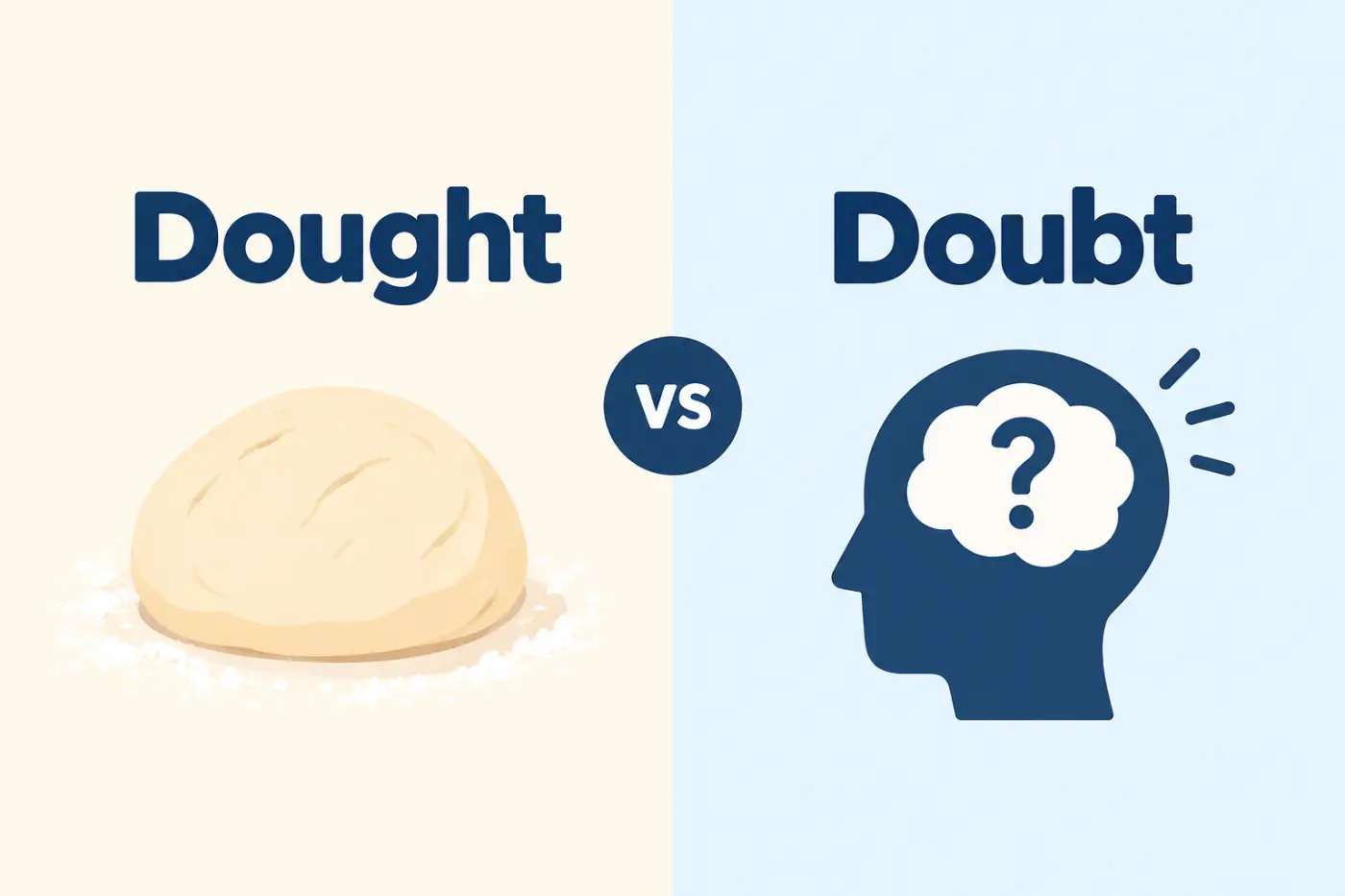
If you searched for dought vs doubt, you probably want to know one simple thing: which spelling should you use? In modern English, doubt is the correct word when you mean uncertainty, hesitation, or a lack of confidence. For example, you can say, I have some doubt about his story.
The spelling dought does exist, but it has a very different history and meaning. It appears in older and dialectal forms of English and is connected to words such as dow and doughty. It isn’t the spelling you should use when you mean uncertainty. Merriam Webster lists dought as a past form of the dialectal verb dow, meaning to be able or capable.
The confusion makes sense. English has many words that contain the letters ou and gh. Words such as thought, brought, bought, and fought can make dought look perfectly reasonable at first glance. The problem is that spelling patterns don’t always work the way our brains expect.
This guide explains the difference in plain English. You’ll learn what each word means, how to pronounce doubt, why the b is silent, where dought comes from, and how to avoid this spelling mistake in school, work, emails, and everyday writing.
Quick Definition
Doubt is a modern English noun and verb that describes uncertainty or a lack of confidence in something. Dought is a rare historical or dialectal word with different meanings and isn’t the standard spelling for uncertainty.
Direct Answer
If you mean uncertainty, hesitation, or a lack of belief, doubt is the correct spelling. Dought is a rare older word and shouldn’t replace doubt in modern standard English.
Comparison Table
| Word | Meaning | Example Sentence | When to Use It |
|---|---|---|---|
| Doubt | Uncertainty or lack of confidence | I doubt his story. | Use it in modern English when you mean uncertainty. |
| Dought | An old or dialectal word related to ability or strength | The word appears in older English texts. | Use it only when discussing historical or dialectal English. |
The difference is much easier to remember once you separate spelling from meaning. These aren’t two modern spellings of the same word. They belong to different parts of English history.
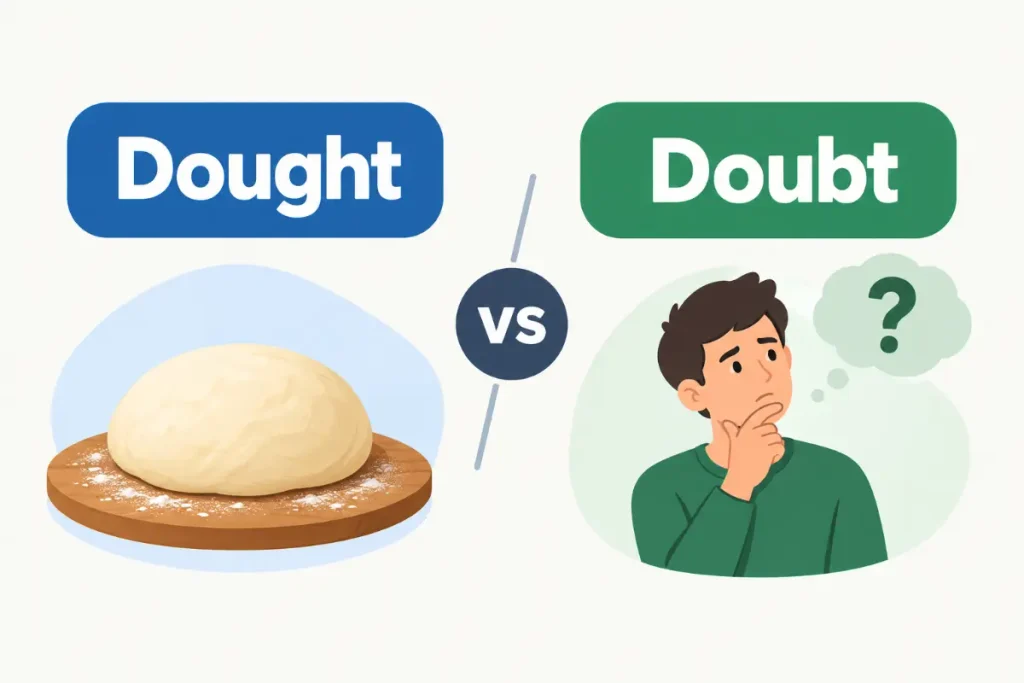
Why People Confuse These Two Words
The main reason is pronunciation.
Doubt is pronounced like dowt. The b isn’t pronounced at all. That can make the spelling feel strange, especially if you’re hearing the word before seeing it written.
When someone says, I doubt it, you hear something close to I dowt it. Nothing in the sound tells you that a b belongs in the middle.
That creates a common spelling trap. Your brain tries to build the written form from the sound. Since the sound doesn’t contain a b, you might leave it out. Or you might remember other words that end with ough and create a spelling that looks familiar.
English is full of silent letters, so this kind of mistake is easy to make.
Consider these examples.
I doubt that he knows the answer.
She had some doubt about the plan.
There is no doubt that they worked hard.
He began to doubt his decision.
In every one of these sentences, doubt has the same basic idea. Someone isn’t fully sure, doesn’t fully believe something, or has lost some confidence.
The spelling stays the same even though the word can work as both a noun and a verb.
What Doubt Means
Doubt is a common word in modern American English. It can act as a noun or a verb.
As a noun, it describes a feeling of uncertainty.
For example.
I have some doubt about the result.
She had doubts about his explanation.
There was no doubt in my mind.
The decision raised serious doubts.
As a verb, doubt means to question something, lack confidence in it, or think it may not be true.
For example.
I doubt his story.
She doubts that he will come.
They doubted the report.
He began to doubt himself.
Merriam Webster defines doubt as a state of uncertainty and also as the act of questioning the truth or likelihood of something. It can also describe a lack of trust or confidence.
That gives the word a fairly wide range of everyday uses.
You can doubt a claim.
You can doubt a person.
You can doubt a prediction.
You can doubt your own ability.
You can also have doubt about a choice or situation.
The central idea remains the same. You aren’t completely sure.
Doubt As A Noun
A noun names a person, place, thing, or idea. In this case, doubt names a feeling or state of uncertainty.
Here are some natural examples.
I still have doubts about the deal.
Her doubts disappeared after she saw the evidence.
There was little doubt about who had won.
His answer left me with more doubt than confidence.
The team entered the game with some doubt about its chances.
Notice how the word fits naturally into phrases such as a doubt, some doubt, many doubts, and no doubt.
The plural form is doubts.
For example.
I have several doubts about the proposal.
His doubts were understandable.
They expressed doubts about the safety of the plan.
One useful phrase is without a doubt. It means something is certain or clearly true.
For example.
She is without a doubt the best player on the team.
That was without a doubt the right choice.
Another common phrase is no doubt.
For example.
There is no doubt that she worked hard.
He will no doubt call tomorrow.
These expressions are common in everyday American English, so learning them helps you use the word naturally.
Doubt As A Verb
As a verb, doubt means to question something or believe that something may not be true.
For example.
I doubt that he told us everything.
She doubts his explanation.
We doubt the story is accurate.
They doubted the plan would work.
I doubt I’ll finish before noon.
The last example is especially common in conversation.
I doubt I’ll finish before noon.
This doesn’t always mean the speaker thinks finishing is impossible. It often means the speaker thinks it is unlikely.
That’s an important part of the word’s meaning.
If someone asks, Do you think John will come tonight?
You might answer, I doubt it.
That short answer means you don’t think John is likely to come.
Why The B In Doubt Is Silent
The silent b is one of the biggest reasons people misspell this word.
English spelling often preserves pieces of a word’s history even after pronunciation changes. Doubt came into English through Middle English forms connected to Anglo French and ultimately Latin. Merriam Webster traces the word to Middle English douten, Anglo French duter and douter, and Latin dubitare.
The modern spelling contains b even though modern speakers don’t pronounce it.
So you write doubt.
You don’t write dout when you mean uncertainty.
You also don’t write dought.
The silent letter isn’t a clue that changes the meaning. It is simply part of the established spelling.
This happens in many English words.
Think about debt.
The b is silent.
Think about subtle.
The b is silent.
Think about thumb.
The b is silent.
Think about doubt.
The b is silent.
You don’t need to pronounce every letter in English to spell the word correctly.
How To Pronounce Doubt
Doubt rhymes with words such as out, about, shout, and route in some American pronunciations.
The pronunciation is roughly dowt.
The b is completely silent.
You might hear someone say.
I doubt it.
It sounds close to.
I dowt it.
That can make the spelling harder to remember because the written word contains a letter that disappears when spoken.
If you’re learning English, don’t let the pronunciation control the spelling. Learn the word as one unit.
Think.
Doubt equals uncertainty.
The sound is dowt.
The spelling includes a silent b.
That simple connection can save you from many spelling mistakes.
Is Dought A Real Word
Yes, but this is where the story gets interesting.
Dought isn’t simply a wrong spelling that someone invented yesterday. Historical English records contain forms of the word, and modern dictionaries still record some rare uses.
Merriam Webster lists dought as a form of the verb dow. The verb is chiefly associated with Scotland and means to be able or capable. Its history goes back to Middle English and Old English forms.
The Middle English Dictionary also records forms related to dought. Historical English used spelling systems that were much less fixed than modern English spelling. Words could appear in forms that look unusual to modern readers.
Another dictionary source records dought as an obsolete noun meaning power, strength, or ability in Scottish and Northern English use. It also records dought as a dialectal past form of dow.
So dought has a legitimate place in the history of English.
But that doesn’t make it a suitable replacement for doubt.
That’s the key point.
If you’re writing a modern email and you want to say that you aren’t sure about something, use doubt.
If you’re reading a medieval text and see dought, the surrounding sentence may reveal an older meaning.
The context matters.
What Dought Means In Older English
Dought has had more than one historical use.
One recorded use connects it with the verb dow. In that setting, it could refer to being able or capable. Merriam Webster gives the example of dought as a form of dow.
Historical sources also connect dought with strength, ability, or prowess. Some older forms are related to doughty, a word that still survives in English, although it isn’t common in everyday American conversation.
This history explains why the two spellings shouldn’t be treated as simple competitors.
Doubt belongs to modern everyday English.
Dought belongs mainly to historical, dialectal, or specialized contexts.
Imagine finding an old English poem that uses dought. You shouldn’t automatically assume the writer made a spelling mistake. English spelling has changed a lot over the centuries.
The same thing happens with many old words. A form that looks strange today may have been normal in a particular period or region.
Dought Is Not The Modern Spelling Of Doubt
This is the point many readers want confirmed.
Dought isn’t an alternative modern spelling of doubt.
If you write, I have dought about his story, the sentence is incorrect in modern standard English.
The correct sentence is.
I have doubt about his story.
A more natural version would be.
I have some doubt about his story.
You could also say.
I doubt his story.
The second sentence uses doubt as a verb rather than a noun.
That distinction is useful because it helps you avoid another common problem. Sometimes people focus so much on spelling that they miss the grammar.
For example.
Incorrect: I dought he will come.
Correct: I doubt he will come.
Incorrect: I have dought about the plan.
Correct: I have doubt about the plan.
More naturally: I have some doubt about the plan.
The meaning stays clear when you choose the correct modern word.
Common Sentences With Doubt
The best way to learn a spelling is to see it working in real sentences.
Here are some everyday examples.
I doubt he’ll agree with us.
She had some doubt about the decision.
There is no doubt that he worked hard.
I never doubted your ability.
They began to doubt the accuracy of the report.
He looked at me with doubt in his eyes.
Her doubts disappeared after the meeting.
I seriously doubt that story is true.
We had our doubts, but the plan worked.
Don’t doubt yourself too quickly.
There was little doubt about the winner.
I doubt anyone will notice the mistake.
He has doubts about moving to another city.
The evidence left no room for doubt.
She began to doubt whether she had made the right choice.
In that last sentence, the word whether is common in normal English, but the core spelling lesson remains simple. The word you need is doubt.
Common Mistakes With Doubt
Spelling errors often happen because people rely on sound instead of the established spelling.
Here are some mistakes worth watching.
Writing Dout
Some people remove the silent b and write dout.
That spelling is not correct in standard modern English when you mean uncertainty.
Write doubt instead.
For example.
Incorrect: I dout he will come.
Correct: I doubt he will come.
The silent b doesn’t disappear from the written form just because it disappears from speech.
Writing Dought
This is the exact confusion behind the target phrase.
Dought looks believable because English has many common words ending in ough.
You may already know thought, bought, brought, fought, and sought.
That visual pattern can trick your brain into creating dought.
But doubt follows its own spelling.
The word contains ou followed by b and then t.
Doubt.
Writing Doubt Without The B
Another common mistake is forgetting the b completely.
You might write dout because that’s how the word sounds.
Remember that doubt belongs to the same broad group of English words with silent letters.
The spelling doesn’t always match the sound perfectly.
Confusing Doubt And Doubted
The past tense of doubt is doubted.
The b remains silent.
For example.
I doubted his story.
She doubted the results.
They doubted that the plan would work.
The spelling changes by adding ed, but the root remains doubt.
The pronunciation also changes slightly because the ending is pronounced as part of the full word.
Confusing Doubt And Doubting
The present participle is doubting.
For example.
She is doubting his explanation.
He is doubting himself.
They are doubting the decision.
Notice that the final t in doubt stays part of the spelling pattern, but the form becomes doubting.
Learning the word family together makes spelling much easier.
A Simple Memory Trick
You don’t need a complicated trick to remember the spelling.
Think of the phrase doubt has a silent b.
That’s enough for most people.
You can also connect doubt with dubious.
Both words are connected through the same older Latin family. Doubt means uncertainty, and dubious describes something that seems uncertain, questionable, or not fully trustworthy.
So when you see the b in dubious, it can remind you of the b in doubt.
Another useful trick is to remember this sentence.
I doubt it, but I can spell it.
The word sounds like dowt, but the written form is doubt.
You can also picture the silent b as a letter hiding inside the word.
D O U B T.
You don’t hear it.
You still write it.
That is often easier to remember than trying to memorize a complicated spelling rule.
Related Words In The Same Family
Learning related words can strengthen your spelling memory.
The main forms include doubt, doubts, doubted, doubting, doubter, and doubtful.
Here are some examples.
I doubt his explanation.
She has doubts about the plan.
They doubted the report.
He is doubting his choice.
The doubter asked several questions.
The result is doubtful.
These words all keep the same core spelling.
The silent b stays in the family.
That gives you a useful visual pattern.
Doubt.
Doubts.
Doubted.
Doubting.
Doubter.
Doubtful.
Once you recognize the family, you don’t have to rebuild the spelling every time you write the word.
Doubt Compared With Uncertainty
Doubt and uncertainty are close in meaning, but they aren’t always identical.
Uncertainty means you don’t know something for sure.
Doubt often suggests that you question something or lack confidence in it.
For example.
There is uncertainty about tomorrow’s weather.
I doubt the weather report.
The first sentence focuses on the lack of certainty.
The second suggests that the speaker questions the report.
The words overlap, but doubt can carry a stronger sense of questioning.
Other related words include skepticism, suspicion, disbelief, and mistrust. Merriam Webster lists these among common words related to doubt.
Still, you shouldn’t treat all of them as exact substitutes.
Skepticism often means a person isn’t ready to believe something without strong evidence.
Suspicion can suggest that you think something may be wrong or dishonest.
Mistrust focuses more on a lack of trust.
Doubt is broader.
You can doubt a claim.
You can doubt a prediction.
You can doubt your own ability.
You can have doubts about a decision.
That wide range is one reason the word appears so often in everyday English.
Doubt In Common Expressions
Some phrases with doubt are worth learning as complete expressions.
No Doubt
No doubt means something is very likely or clearly true.
For example.
There is no doubt that she earned the promotion.
He is no doubt proud of his daughter.
Without A Doubt
Without a doubt means certainly.
For example.
That was without a doubt the best meal we had all week.
She is without a doubt the right person for the job.
Beyond A Reasonable Doubt
This phrase is strongly associated with criminal law in the United States.
It refers to the high level of certainty required for a criminal conviction.
For example.
The jury must decide if the evidence proves guilt beyond a reasonable doubt.
This is a legal phrase, so it has a more specific meaning than ordinary doubt.
In Doubt
If something is in doubt, its result or status isn’t certain.
For example.
The future of the project is still in doubt.
His place on the team was in doubt after the injury.
Have Doubts
To have doubts means to feel uncertain or unconvinced.
For example.
I have some doubts about the proposal.
She had doubts before accepting the offer.
These expressions are useful because they show how naturally the word fits into everyday English.
How To Use Doubt In Professional Writing
Spelling matters more in professional writing because small errors can distract the reader from your message.
If you write an email to a customer, manager, teacher, client, or coworker, use the standard spelling.
For example.
I have some doubt about the figures in the report.
I doubt we can complete the project by Friday.
There is no doubt that the team made progress.
I had some doubts about the original plan, but the results changed my mind.
These sentences sound natural and professional.
Using dought in the same places would make the writing look incorrect because modern readers don’t normally use that word for uncertainty.
The issue isn’t about sounding formal. It’s about choosing the word that matches your meaning.
How To Use Doubt In School Writing
Students often encounter this spelling problem because English contains many words whose sounds don’t match their letters.
If you’re writing an essay, test answer, discussion post, or homework assignment, remember the standard form.
Doubt.
Not dout.
Not dought.
If you want to say that you aren’t sure about something, use doubt.
For example.
The evidence creates doubt about the original claim.
The character begins to doubt his decision.
There is little doubt that the event changed her life.
These examples also show that doubt works naturally in both academic and casual writing.
How To Check Yourself Before You Submit
If you aren’t sure about the spelling, stop and ask yourself one question.
Am I talking about uncertainty?
If the answer is yes, use doubt.
For example.
I doubt this is correct.
She has doubts about the answer.
There is no doubt about the result.
If you’re reading an old text and see dought, don’t automatically change it. First look at the historical context.
The word may have a completely different meaning.
This quick check works because it focuses on meaning rather than sound.
When you focus only on pronunciation, the missing b can cause trouble.
When you focus on meaning, the choice becomes much easier.
Why English Has Silent Letters
The spelling of doubt is part of a much larger pattern in English.
English has borrowed words from many languages over hundreds of years. Pronunciation changed over time, but spelling sometimes kept older forms.
That is why English contains words with letters that aren’t pronounced.
Think about knife.
The k is silent.
Think about write.
The w is silent.
Think about honest.
The h is silent.
Think about doubt.
The b is silent.
These spellings may look odd when you first learn them, but they become familiar with practice.
This is one reason reading helps spelling. The more often you see a word in context, the more natural its written form becomes.
You don’t have to sound out every letter to remember it.
Dought And Doughty
You may have seen the word doughty and wondered if it has anything to do with doubt.
It does have a historical connection to forms of dought, but it isn’t related to modern doubt in meaning.
Doughty means brave, determined, or courageous. Historical sources connect it with ideas such as strength and bravery. The Middle English Dictionary records doughty with meanings related to being brave, strong, or valiant.
For example.
The doughty knight defended the castle.
That sentence sounds old fashioned because doughty isn’t a common word in everyday American English.
Still, it can appear in historical writing, fantasy literature, or discussions of older English.
This is another reason context matters.
A strange looking word isn’t always a spelling mistake. Sometimes it belongs to an older stage of the language.
A Fast Way To Remember The Difference
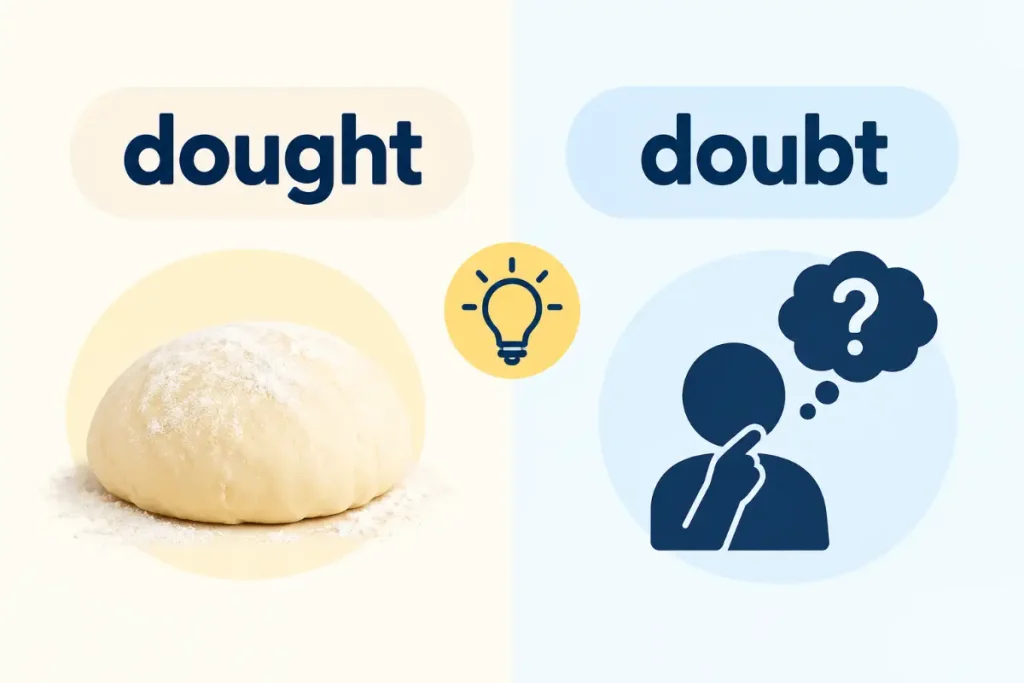
If you’re in a hurry, remember these three points.
Doubt means uncertainty.
Dought is an old or dialectal word with different meanings.
The b in doubt is silent.
That’s all you need for most everyday writing.
If you mean, I am not sure, use doubt.
If you mean, I question it, use doubt.
If you mean, I don’t believe it, use doubt.
If you’re writing about an old English text and encounter dought, check the historical context before deciding what it means.
The two forms may look similar, but modern English gives them very different roles.
FAQs
Is dought a correct spelling of doubt?
No. Dought isn’t the standard modern spelling of doubt. If you mean uncertainty or a lack of confidence, use doubt.
Is dought a real English word?
Yes. Dought appears in historical and dialectal English and has been recorded with meanings connected to ability, strength, or older forms of English verbs. It isn’t normally used in modern American English for uncertainty.
How do you spell doubt correctly?
The correct spelling is doubt. It contains a silent b and is pronounced roughly like dowt.
Why is the b silent in doubt?
The spelling preserves part of the word’s historical development even though modern pronunciation doesn’t include the b sound. The word ultimately traces back through Middle English and Anglo French to Latin dubitare.
What does doubt mean?
Doubt means uncertainty or a lack of confidence. As a verb, it can mean to question something, distrust it, or think it is unlikely to be true.
What is the difference between doubt and uncertainty?
Both words describe a lack of certainty. Doubt often adds the idea of questioning or lacking confidence in something, while uncertainty can simply mean that the answer or outcome isn’t known.
How do you pronounce doubt?
Doubt is pronounced roughly like dowt. It rhymes with out in standard American pronunciation, and the b is silent.
What are the forms of doubt?
Common forms include doubt, doubts, doubted, doubting, doubter, and doubtful. The silent b remains part of the spelling in the main word family.
Conclusion
When you’re asking dought vs doubt, the answer is simple for modern English. Use doubt when you mean uncertainty, hesitation, or a lack of confidence. The word works as both a noun and a verb, so you’ll see it in sentences such as I have some doubt and I doubt his story.
Dought is different. It has a real history in English, but its uses are rare, old, or dialectal. Historical sources connect it with ability, strength, and older forms of the verb dow.
The spelling problem usually comes from pronunciation. Doubt sounds like dowt because the b is silent. Don’t let that silent letter fool you. The correct modern spelling still includes the b.
So when you want to say that you’re unsure, remember one simple form: doubt. If you can connect the word with uncertainty, questioning, or a lack of confidence, you’ll know exactly which spelling belongs in your sentence.

Dr. Arthur Pendelton is a veteran historical linguist and grammar expert with over 30 years of experience in academic editing. A retired professor, Arthur specializes in the etymology and evolution of the English language. He is passionate about “unpacking the history behind the rules,” helping readers understand why we spell, punctuate, and phrase things the way we do today. Whether he’s settling debates on archaic usage or explaining complex linguistic shifts, Dr. Pendelton brings scholarly precision to every article.
1 thought on “Dought vs Doubt Which Spelling Is Correct”