
If you searched for kinesthesiology vs kinesiology, you probably noticed that the two words look almost identical. That makes the confusion easy to understand. One extra group of letters can make the terms seem like two names for the same subject.
The short answer is simple. Kinesiology is the standard and widely accepted term for the scientific study of human movement. The word kinesthesiology does exist in some dictionary sources, but it is rare and is not the usual name for the academic field.
The confusion gets bigger because another real word sits in the middle of this issue: kinesthesia. Kinesthesia refers to your sense of body movement and position. It helps explain how you can move your arm, bend your knee, or touch your nose without constantly looking at the body part.
So, if you are writing about a college major, a science, exercise, sports, physical activity, biomechanics, or human movement, kinesiology is usually the word you want. This guide explains why, shows how the terms differ, and gives you simple examples you can use with confidence.
Quick Definition
Kinesiology is the scientific study of human movement. It covers areas such as anatomy, biomechanics, exercise physiology, motor control, physical activity, and human performance.
Kinesthesiology is a rare term that has been recorded with a meaning related to the medical and therapeutic study of muscle and joint movement. It is not the standard name used for the modern academic field of kinesiology.
Direct Answer
Use kinesiology when you mean the established scientific field that studies human movement. Kinesthesiology is a rare term and is not the normal choice for academic, professional, or everyday writing about this field.
Comparison Table
| Word or phrase | Meaning | Example sentence | When to use it |
|---|---|---|---|
| Kinesiology | The scientific study of human movement | She studied kinesiology in college. | Use it for the academic field and science of movement. |
| Kinesthesiology | A rare term connected with the study of muscle and joint movement | The term appears in some dictionary sources. | Use it only when a specific source or context calls for it. |
| Kinesthesia | The sense of movement and body position | Kinesthesia helps you know where your arm is without looking at it. | Use it when discussing the body’s sense of movement. |
| Kinesthetic | Related to the sense of body movement | The athlete developed strong kinesthetic awareness. | Use it as an adjective when discussing movement sensation. |
| Kinesiologist | A person who works or studies in kinesiology | The kinesiologist analyzed her walking pattern. | Use it for a person working in kinesiology. |
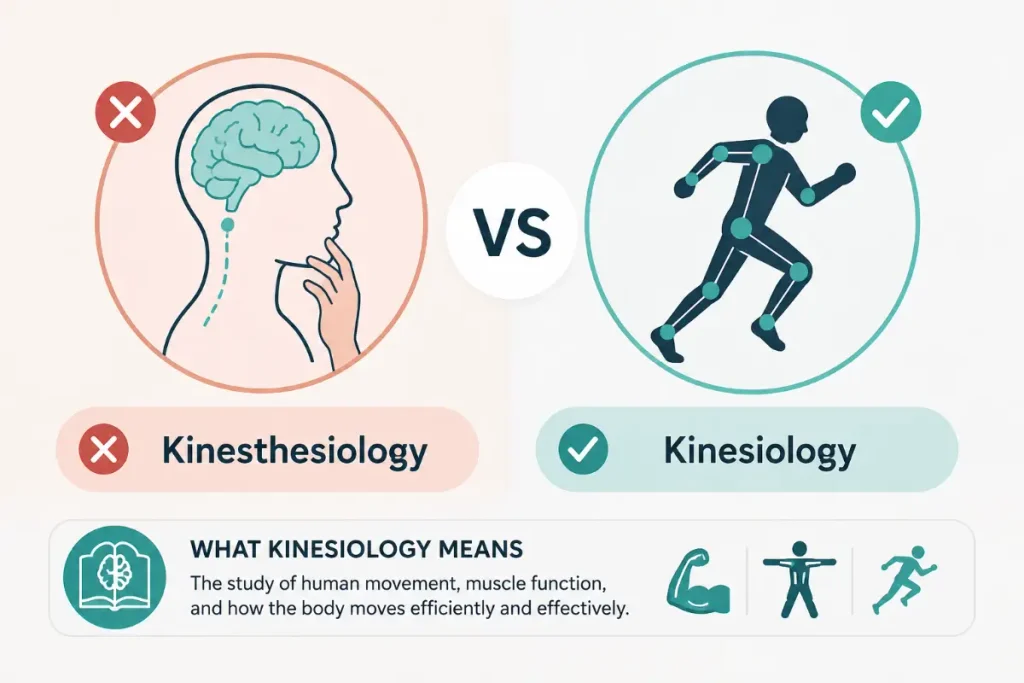
What Kinesiology Means
Kinesiology is the established term for the scientific study of human movement.
That definition sounds simple, but the field covers a lot of ground. Human movement involves bones, muscles, joints, nerves, energy systems, balance, coordination, and the brain. Kinesiology brings these pieces together to understand how people move and how movement affects health and performance.
The University of Michigan describes kinesiology as the scientific study of human movement and examines how physical activity and sport affect health and quality of life. Its programs include areas such as exercise science, movement science, athletic training, and sport management.
Arizona State University also describes kinesiology as an interdisciplinary field that looks at the biological, psychological, and physical sides of human movement. Its curriculum includes biomechanics, anatomy, physiology, motor behavior, and the effects of physical activity.
In plain English, kinesiology asks questions such as these.
- How does a person walk?
- Why does a runner change stride after an injury?
- How do muscles create movement?
- Why does exercise change the way the body works?
- How does the brain control movement?
What Kinesthesiology Means
Kinesthesiology is where things get tricky.
The word has been recorded as an English noun. Wiktionary defines it as the medical and therapeutic study of the movement of muscles and joints. YourDictionary also lists that definition.
That means it would be too strong to say the word does not exist at all.
The bigger issue is usage.
Kinesthesiology is not the standard term for the modern academic discipline that colleges call kinesiology. Universities offer kinesiology programs, departments, courses, and research programs. For example, the University of Michigan has a School of Kinesiology with undergraduate and graduate programs focused on human movement, physical activity, health, and related areas.
So, if you see the longer word in a casual article, search result, or online discussion, do not automatically assume it is the official name of a separate field.
Often, the writer may be mixing together kinesiology and kinesthesia.
That distinction matters.
What Kinesthesia Means
Kinesthesia is a real scientific concept.
It refers to the sense that helps you perceive your body’s movement and position. You do not need to watch every part of your body to know what it is doing.
- Close your eyes and lift your right hand.
- You can still tell that your hand is moving.
- You can bend your elbow without staring at your elbow.
- You can walk without watching your feet every second.
Your body receives information that helps your brain understand movement and position. Kinesthesia is part of that process. A National Institutes of Health research abstract describes kinesthesia as the sense of body movement that lets people feel the activity of their limbs without looking at them.
This is probably one of the main reasons people get tangled up with the longer word.
The words look related because they are related in meaning. But related does not mean interchangeable.
The Simple Way To See The Difference
Think of movement as a road.
Kinesiology studies the whole road system. It can look at how the body moves, why it moves, how forces affect movement, how exercise changes the body, and how movement can be improved.
Kinesthesia is more like the body’s internal sense of where it is on that road.
- You can think of it this way.
- Kinesiology studies movement.
- Kinesthesia senses movement.
Kinesthetic describes things related to that sense of movement.
Kinesthesiology is a rare term that appears to combine ideas connected with movement and kinesthesia, but it is not the standard label for the modern field of kinesiology.
That small distinction clears up most of the confusion.
The Spelling Looks Almost Right
Human brains are good at recognizing patterns.
When you see a familiar word such as kinesiology, a longer version such as kinesthesiology can look believable. It contains familiar pieces and seems to add a little more detail.
That can lead to a common mistake.
Someone may know the word kinesthesia. They may also know the word kinesiology. When the two ideas meet, they may create kinesthesiology without realizing that the longer term is rarely used in modern academic writing.
This happens with many technical words.
A word can look more precise simply because it is longer. That does not make it the preferred word.
Kinesiology Has A Clear Academic Identity
The strongest reason to choose kinesiology is its established use.
Kinesiology appears as the name of university schools, degree programs, courses, research areas, and professional education. The University of Michigan, for example, has an entire School of Kinesiology and offers programs connected to exercise science, movement science, athletic training, and sport management.
Arizona State University offers a Bachelor of Science in Kinesiology. The program covers biomechanics, exercise physiology, anatomy, physiology, motor behavior, and other areas related to human movement.
That gives you a practical rule.
- If you are naming the field, use kinesiology.
- If you are naming a college degree, use kinesiology.
- If you are writing about a kinesiology department, use kinesiology.
- If you are discussing the science of human movement, use kinesiology.
- If you are talking about the body’s sense of movement, use kinesthesia.
That rule will keep most of your writing accurate.
Kinesiology Covers More Than Exercise
Another common mistake is assuming kinesiology simply means exercise.
Exercise is part of the field, but kinesiology is broader.
A kinesiology student may study human anatomy. They may learn how bones and joints are structured. They may study how muscles produce force. They may examine how the nervous system controls movement. They may learn how the body responds to exercise.
Biomechanics is another major area.
Biomechanics looks at movement through the principles of mechanics. It can examine forces, motion, joint movement, muscle action, and the way the body interacts with its surroundings.
The University of Michigan course catalog includes biomechanics courses that examine the human musculoskeletal system, tissue mechanics, and quantitative analysis of human movement.
Exercise physiology is another area.
It looks at how the body responds and adapts to physical activity. That can include changes in heart rate, breathing, muscle function, energy use, and physical performance.
- Motor control and motor learning also fit into the picture.
- These areas look at how people control movement and how they learn physical skills.
- Think about learning to swing a baseball bat.
- At first, the movement may feel awkward.
- You have to think about your grip, stance, timing, and swing.
- With practice, the movement becomes more natural.
- Movement science can help researchers understand that process.
Where Kinesthesia Fits
Kinesthesia sits inside the larger story of movement.
- Suppose you are standing in a dark room.
- You raise your hand.
- You cannot see it, but you still know that your arm is moving.
- Your brain receives information from your body that helps you sense the movement.
- This kind of awareness is useful for everyday actions and skilled movement.
- It also matters in research involving motor control and movement.
- The distinction becomes easier when you separate the noun from the field.
- Kinesiology is a field of study.
- Kinesthesia is a sensory ability.
- Kinesthetic is an adjective.
Kinesthesiology is a rare term that has appeared in reference sources but is not the normal modern name for the field.
Real World Examples
Imagine a college student choosing a major.
- She wants to study exercise, movement, health, and human performance.
- Her major is likely to be called kinesiology.
- Now imagine a researcher studying how people sense the position of their limbs without looking at them.
- The researcher may discuss kinesthesia.
- Now imagine a physical activity coach describing an athlete’s awareness of body position during movement.
- The word kinesthetic may fit.
- These examples show why the extra letters matter.
- The words are connected, but they do different jobs.
Examples With Kinesiology
Here are natural examples of the standard term.
- She earned a degree in kinesiology before applying to physical therapy school.
- Kinesiology students learn about anatomy, exercise, and human movement.
- His kinesiology course included biomechanics and motor control.
- The university has a strong kinesiology program.
- She chose kinesiology because she wanted to understand how the body moves during exercise.
- Kinesiology research can help improve our understanding of movement and physical activity.
- The field combines knowledge from several areas of science.
- The word fits naturally in all of these sentences because they describe the established academic field.
Examples With Kinesthesia
- Now look at sentences that describe the sense of movement.
- Kinesthesia helps you sense the position of your arm without looking at it.
- Her kinesthesia helped her control the movement even with limited visual information.
- The study examined how kinesthesia contributes to movement control.
- A person can use kinesthesia to sense changes in body position.
- These examples describe sensory awareness rather than the name of a college field.
Examples With Kinesthetic
- Kinesthetic is often useful when you need an adjective.
- The dancer developed strong kinesthetic awareness.
- The exercise required good kinesthetic control.
- His kinesthetic sense helped him adjust his posture.
- The therapist used movement tasks to improve the patient’s body awareness.
- Again, the key idea is movement sensation and awareness.
A Common Writing Mistake
- A sentence such as this can create confusion.
- She is majoring in kinesthesiology.
- If the writer means the standard college field, kinesiology is the better choice.
- Write this instead.
- She is majoring in kinesiology.
- Another example is this.
- He wants to study kinesthesiology at a university.
- If he means the established science of human movement, write this.
- He wants to study kinesiology at a university.
The correction is simple, but it can make your writing look much more informed.
What About Medical And Therapeutic Contexts
This is where you need a little care.
Some dictionary sources do record kinesthesiology with a medical or therapeutic meaning related to muscle and joint movement.
So calling every use of the word a simple spelling mistake would be too broad.
At the same time, modern health and movement education commonly uses established terms such as kinesiology, kinesthesia, biomechanics, motor control, and movement science.
The American Physical Therapy Association, for example, discusses human movement through the concept of the movement system and describes movement as an interaction among body systems that generate and maintain movement.
That means context matters.
If you are editing an academic article, college page, medical resource, or professional document, do not replace a standard term with a rare one simply because it sounds more specialized.
Clear writing usually wins.
Is Kinesthesiology A Separate Field
For most readers, the answer is no.
There is no need to treat kinesthesiology as a separate modern academic field alongside kinesiology.
The evidence for this comes from how established institutions name and organize their programs. Universities use kinesiology for departments and degree programs focused on human movement.
At the same time, the word kinesthesiology does appear in dictionary sources. So the most accurate statement is not that the word is impossible or meaningless.
The better statement is this.
Kinesthesiology is a rare term with an attested meaning related to movement, muscles, and joints. Kinesiology is the standard modern term for the established scientific field of human movement.
That wording gives readers the full picture without oversimplifying it.
Use Kinesiology For A Field Of Study
If you are talking about an academic subject, kinesiology is the safest and clearest choice.
- Use it in sentences such as these.
- I am studying kinesiology.
- She has a bachelor’s degree in kinesiology.
- The kinesiology department offers several undergraduate programs.
- He teaches kinesiology at a university.
- The course covers the science of human movement.
- She wants to use her kinesiology degree as preparation for physical therapy school.
- This is the normal pattern readers will recognize.
Use Kinesthesia For Movement Awareness
Choose kinesthesia when the focus is on sensing movement or body position.
For example.
- Kinesthesia lets you sense the movement of your arm without looking at it.
- The experiment tested changes in kinesthesia.
- The athlete relied on kinesthesia to adjust the position of her foot.
- These sentences are about perception.
- That is the main clue.
If your sentence asks how the body knows where it is or how it is moving, kinesthesia may be the better term.
Use Kinesthetic As An Adjective
Kinesthetic works when you need to describe something connected with movement sensation.
You might write:
- The athlete showed strong kinesthetic awareness.
- The exercise required good kinesthetic control.
- The dancer had excellent kinesthetic awareness of her body position.
- The child learned the movement through repeated physical practice.
- The adjective form can sound more natural than trying to force a noun into the sentence.
A Simple Memory Trick
You do not need to memorize a complicated definition.
Use this shortcut.
- Kinesiology equals the study of movement.
- Kinesthesia equals the sense of movement.
- Kinesthetic equals related to movement sensation.
- Kinesthesiology equals a rare term that you should not use as the normal name for the academic field.
- Think of kinesiology as the big umbrella.
- Under that umbrella, you can find many areas related to movement.
- Kinesthesia is one important concept within the wider study of movement and motor control.
This mental picture makes the difference easier to remember.
Why The Extra Letters Cause Problems
Look closely at the words.
- Kinesiology.
- Kinesthesiology.
The second word contains an extra sound and a group of letters that can make it appear more closely tied to kinesthesia.
- That is exactly where many people get caught.
- They know that kinesthesia has something to do with sensing movement.
- They know that kinesiology has something to do with studying movement.
- Then they see a longer word that appears to combine both ideas.
It sounds logical.
But language does not always work like a math equation.
You cannot always combine two related words and create the standard technical term.
That is why established usage matters.
What To Write In Academic Content
If you are writing a research paper, college article, website, resume, or educational guide, use the term that your audience will recognize.
For the academic field, that is kinesiology.
The American academic system has established kinesiology programs at major universities. The University of Michigan offers degrees and research programs in kinesiology and movement science, while Arizona State University offers a Bachelor of Science in Kinesiology.
This matters for students in particular.
If you are searching for a degree, searching for kinesiology programs will lead you to the established academic field.
Searching for the longer rare term may produce scattered definitions and inconsistent explanations.
The same rule helps writers.
Use the standard term first.
What To Write In Health And Fitness Content
Fitness writing often uses kinesiology when discussing how the body moves.
For example:
Kinesiology helps us understand how muscles and joints work during exercise.
A kinesiology student may study exercise physiology and biomechanics.
Kinesiology can provide a foundation for careers connected with exercise, movement, health, and rehabilitation.
That does not mean every fitness professional is a kinesiologist.
Professional titles can vary by location and job. Some roles also require separate education, certification, or state licensing.
So avoid making broad claims about what every person with a kinesiology degree can legally do.
A degree in kinesiology can prepare students for several paths, but the exact career options depend on the person’s education, training, credentials, and local rules. ASU, for example, lists paths that can lead toward advanced study and careers in areas such as physical therapy, occupational therapy, and orthopedics.
That is a useful EEAT point for anyone writing health related content.
Do not turn a general academic degree into a promise of a specific professional license.
Common Questions About Spelling
People often ask if kinesthesiology is simply a longer spelling of kinesiology.
It is not best to treat it that way.
The words are related in subject matter, but kinesiology is the established term used for the academic study of human movement.
Another common question is why kinesthesiology appears in dictionaries.
The answer is that dictionary records can include rare words. A word can exist in the language without being the most common or preferred term in a particular professional field.
That distinction is useful far beyond this one example.
Dictionary existence and standard professional usage are not always the same thing.
Is Kinesthesiology Wrong
Calling it simply wrong misses an important detail.
The word has been recorded as a noun in dictionary sources. One listed meaning connects it with the medical and therapeutic study of muscle and joint movement.
However, that does not make it the normal modern term for the academic field.
If your goal is clear professional writing, kinesiology is the better choice for the established science of human movement.
That is the distinction worth remembering.
Is Kinesiology Only About Sports
No.
Sports are one part of kinesiology, but the field reaches much further.
Kinesiology can include exercise physiology, biomechanics, motor control, anatomy, physical activity, movement science, and health related research. University programs also connect the field with areas such as athletic training and rehabilitation.
- A kinesiology researcher might study how older adults walk.
- Another researcher might study how exercise affects the body.
- Another might analyze running mechanics.
- Another might study how the brain controls movement.
So if you think kinesiology means only sports, you are leaving out a large part of the field.
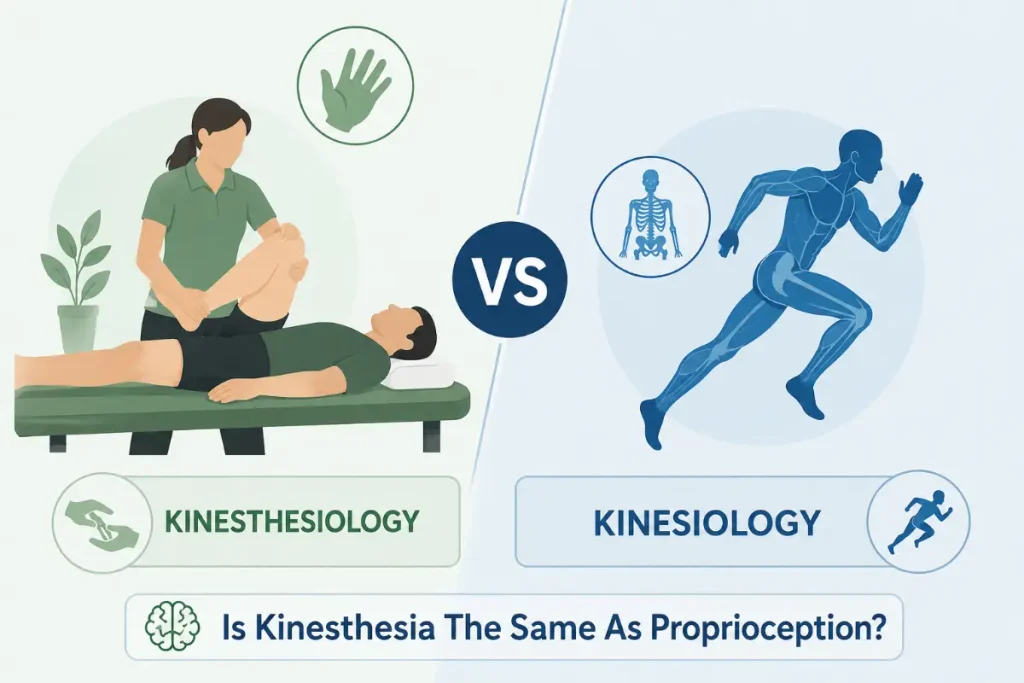
Is Kinesthesia The Same As Proprioception
These terms are closely related, but they are not always used as perfect synonyms.
Kinesthesia generally refers to the sense of movement and awareness of body movement.
Proprioception is a broader term often used for the body’s sense of position and movement.
You may see the terms discussed together because both involve sensory information that helps the brain understand the body’s position and movement.
For simple writing, you can remember this.
Kinesthesia is strongly connected with sensing movement.
Proprioception is a broader concept involving awareness of body position and movement.
The exact wording can vary across scientific fields and sources, so technical writing should follow the terminology used in the research you are discussing.
Why This Difference Matters For Students
Students searching for careers or degrees need the standard term.
Suppose someone searches for a college program because they want to study human movement.
Kinesiology is the useful search term.
Universities use it in program names, course catalogs, department pages, and degree descriptions. The University of Michigan, for example, lists kinesiology programs and movement science research at both undergraduate and graduate levels.
That makes the word useful not only for correct writing but also for practical research.
The right word gets you to the right information faster.
Why This Difference Matters For Writers
Writers have another reason to care.
A reader who sees kinesiology on a university page knows the writer is referring to an established academic field.
A reader who sees kinesthesiology may stop and wonder if the writer means kinesiology, kinesthesia, or another movement related concept.
That creates friction.
- Good technical writing should remove that friction.
- You do not need the fanciest word.
- You need the right word.
A Quick Editing Test
When you edit a sentence, ask yourself what the word is doing.
- If it names the science or academic field, use kinesiology.
- If it describes the sense of movement, use kinesthesia.
- If it describes something connected with that sense, use kinesthetic.
- If you see kinesthesiology, check the source and context before changing it. If the writer clearly means the modern academic field, kinesiology will usually be the clearer choice.
This simple test takes only a few seconds.
More Example Sentences
Here are a few examples that show the difference in natural English.
Correct for the academic field.
- She decided to major in kinesiology.
- The kinesiology department studies human movement.
- He is taking a kinesiology course this semester.
- Her kinesiology degree helped prepare her for graduate study.
- The research team used kinesiology and biomechanics to examine running form.
Correct for movement sensation.
- Kinesthesia helps you know where your hand is without looking.
- The researchers measured changes in kinesthesia during the task.
- The patient had trouble sensing the movement of the affected limb.
Correct adjective use.
- The dancer showed strong kinesthetic awareness.
- The activity required good kinesthetic control.
- The coach used drills to improve the athlete’s kinesthetic awareness.
Use caution with the rare term.
- The word kinesthesiology appears in some reference sources.
- The author used kinesthesiology to describe the study of movement.
Those sentences report the word’s usage. They do not claim that it is the standard name of the academic field.
That is a useful difference.
The Best Rule To Remember
If you remember only one rule from this article, remember this.
- Use kinesiology for the science and academic study of human movement.
- Use kinesthesia for the sense of movement.
- Use kinesthetic when you need the adjective.
Treat kinesthesiology as a rare term rather than the normal modern name of the field.
That rule handles most situations without making the subject harder than it needs to be.
FAQs
Is kinesthesiology a real word?
Yes. Some dictionary sources record kinesthesiology as a noun connected with the medical and therapeutic study of muscle and joint movement. However, it is a rare term and is not the usual name for the modern academic field of human movement.
Is kinesiology the correct term?
Yes, if you mean the established scientific field that studies human movement. Universities such as the University of Michigan and Arizona State University use kinesiology as the name of academic programs focused on human movement, exercise, health, and related subjects.
What is the difference between kinesthesiology vs kinesiology?
The main difference is usage and scope. Kinesiology is the established field of human movement science, while kinesthesiology is a rare term that has been recorded with a movement related medical and therapeutic meaning.
Is kinesthesiology a misspelling of kinesiology?
It can be used as an incorrect substitute for kinesiology, but it is not accurate to call the word itself a simple misspelling. The term has been recorded in dictionary sources, although it is rare and is not the standard name of the academic field.
What does kinesthesia mean?
Kinesthesia is your sense of body movement and position. It helps you know how your body is moving without needing to watch every part of it.
Is kinesiology the same as exercise science?
They overlap, but they are not always identical labels. Kinesiology is a broad field that can include exercise physiology, biomechanics, motor control, anatomy, physical activity, and other areas of human movement science.
What do you call a person who studies kinesiology?
A person who studies or works in the field may be called a kinesiologist. The exact professional title and scope of practice can vary by location and job, so the term should not be treated as a universal license or protected title.
Should I use kinesiology in a college application?
Yes, if you are referring to the established academic field. If a university offers a kinesiology program, use the spelling and name shown by that institution.
Conclusion
The confusion around kinesthesiology vs kinesiology comes from more than spelling. The terms are connected to movement, and kinesthesia adds another layer because it refers to the body’s sense of movement and position.
For most modern academic and professional writing, kinesiology is the clear choice when you mean the scientific study of human movement. Universities use the term for degree programs, departments, courses, and research that cover subjects such as biomechanics, exercise physiology, anatomy, motor control, physical activity, and human performance.
Kinesthesiology is a different case. It has been recorded in dictionary sources with a movement related medical and therapeutic meaning, so it should not be dismissed as a nonexistent word. Still, it is rare and is not the standard name for the modern academic field.
For everyday writing, keep the rule simple. Use kinesiology for the field. Use kinesthesia for the sense of movement. Use kinesthetic as the adjective. If you come across kinesthesiology, check the context before assuming it is the term you need.

Dr. Arthur Pendelton is a veteran historical linguist and grammar expert with over 30 years of experience in academic editing. A retired professor, Arthur specializes in the etymology and evolution of the English language. He is passionate about “unpacking the history behind the rules,” helping readers understand why we spell, punctuate, and phrase things the way we do today. Whether he’s settling debates on archaic usage or explaining complex linguistic shifts, Dr. Pendelton brings scholarly precision to every article.