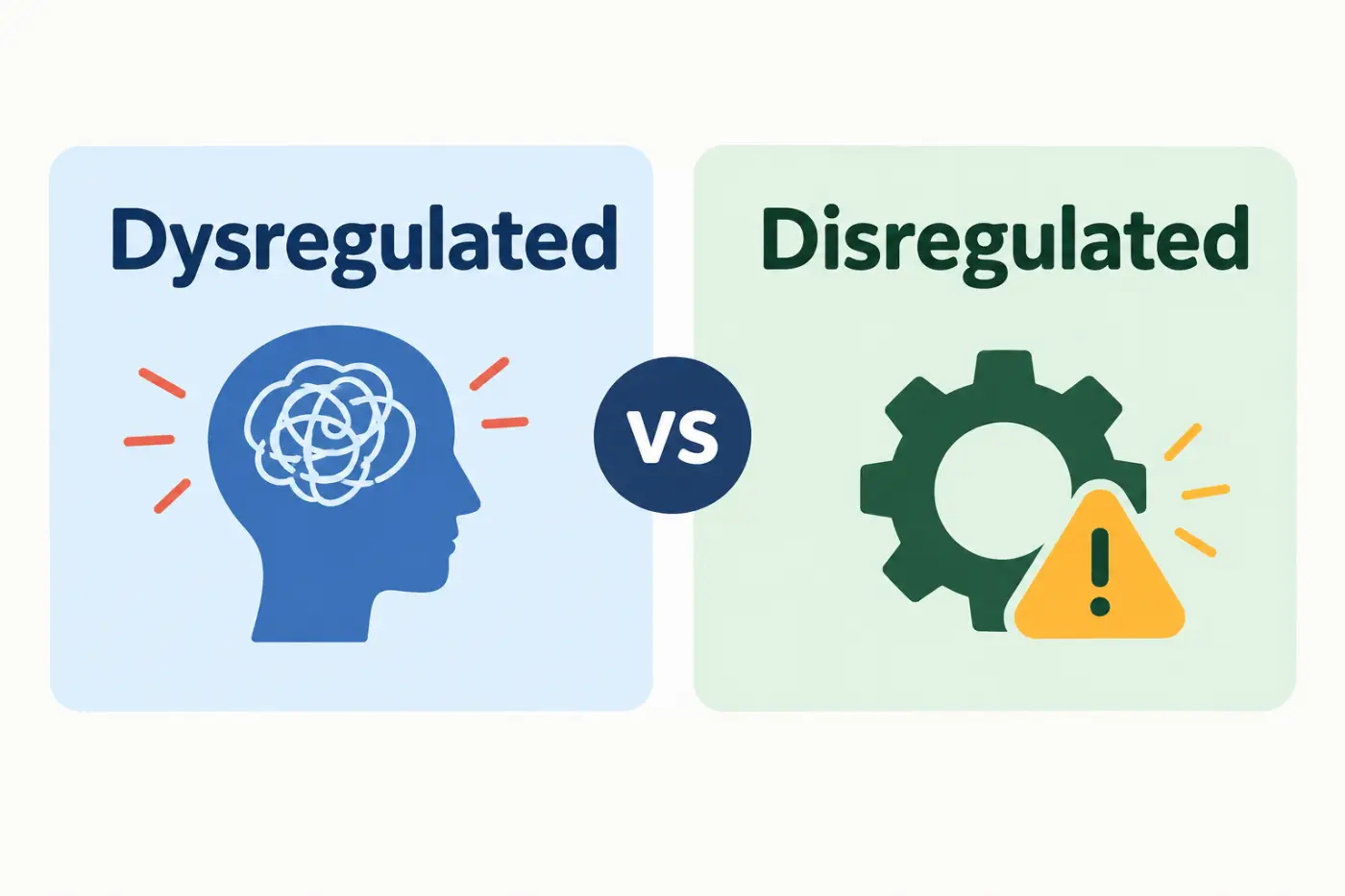
If you’re searching for dysregulated vs disregulated, you probably want one simple answer. The correct word for something that is not regulating or functioning properly is dysregulated. The spelling disregulated appears occasionally, but it is not the standard form used in modern medical, psychological, and scientific writing.
That small spelling difference matters because these words look almost identical. The prefixes also sound similar when people say them quickly. It’s easy to reach for dis instead of dys, especially if you already know words such as disorder, disconnect, and disagree.
In this guide, you’ll learn what dysregulated means, why dysregulated is the standard choice, and why disregulated can look correct even when it usually isn’t. You’ll also see examples from psychology, medicine, biology, and everyday writing.
By the end, you should be able to choose the right word without stopping to second guess yourself.
Quick Definition
Dysregulated describes something that is not being controlled or managed properly. It can describe emotions, body processes, behavior, hormones, immune activity, or other systems. The related noun is dysregulation.
Direct Answer
Dysregulated is the standard and preferred word in modern English. Disregulated is generally treated as a nonstandard spelling, although it can appear in a few specific names or older and specialized uses.
Comparison Table
| Word or phrase | Meaning | Example sentence | When to use it |
|---|---|---|---|
| Dysregulated | Not controlled or functioning properly | Her emotions became dysregulated after the stressful event. | Use this in general, medical, psychological, and scientific writing. |
| Disregulated | A rare or nonstandard form in most current usage | The report used the unusual term disregulated in its title. | Usually avoid it unless you are reproducing a specific source or name. |
| Dysregulation | Poor or impaired regulation | Emotional dysregulation can affect how a person responds to stress. | Use it when you need the noun form. |
| Dysregulate | To cause poor or abnormal regulation | Chronic stress can dysregulate normal body processes. | Use it as the verb form. |
| Regulated | Controlled or kept within a normal range | The body regulated its temperature. | Use it for normal control or management. |
| Unregulated | Not controlled by rules or a regulating system | The market was largely unregulated. | Use it when the main idea is a lack of rules or control. |
Why The Spelling Causes Confusion
The confusion starts with two very familiar prefixes.
English uses dis in many common words. Think about disagree, disconnect, disorder, disapprove, and disappear. Because dis appears so often, it feels natural to attach it to regulate.
The problem is that English does not build every word by simply combining a familiar prefix with a familiar base word. Many scientific and medical terms come from older Greek or Latin word parts. Dysregulated belongs to that group.
The prefix dys is used to describe something abnormal, impaired, difficult, or poorly functioning. Merriam Webster traces dys to Greek and gives meanings such as abnormal, difficult, impaired, and bad.
That meaning fits dysregulated very well.
A system can still be present and active while its regulation is not working properly. That is the basic idea behind dysregulation.
For example, imagine a thermostat that keeps turning the heat too high and then too low. The thermostat still works. The heating system still works. The problem is that the control process is not working properly.
That is closer to the meaning of dysregulated.
Now consider the prefix dis. It has several meanings, including apart, away, opposite, absence, and not. Merriam Webster and Collins both describe these uses in their entries for dis.
That does not mean dis can never appear before a word related to regulation. English has plenty of unusual formations. It simply explains why disregulated is not the expected standard form for the medical and psychological meaning people usually have in mind.
Dys Means Impaired
A useful way to remember dys is to connect it with problems in normal function.
You see the same idea in words such as dysfunction and dyslexia.
Dysfunction refers to a problem with normal function. Dyslexia refers to a learning difference involving reading and language processing. Dysphagia refers to difficulty swallowing.
MedlinePlus also lists dys as meaning difficult or abnormal and dis as meaning separation or taking apart in its guide to medical word parts.
So when you see dysregulated, think:
The regulation is there, but something is going wrong with it.
That simple idea will help you remember the spelling.
Dis Has A Different Job
The prefix dis often points toward separation, reversal, opposition, or absence.
For example:
She disagreed with the decision.
The phone disconnected.
The two groups became disorganized.
The company discontinued the service.
The meanings are different, but the common thread is easy to see. Something is being separated, reversed, removed, or described as not being the expected state.
That pattern makes dis feel tempting in front of regulate. Still, the established medical and psychological term is dysregulate.
The word choice is not based only on what seems logical in English. It is also based on established usage.
That is an important point for anyone writing articles, school papers, reports, health content, or professional documents.
The Sound Adds To The Problem
There is another reason this spelling error sticks around.
Dysregulated and disregulated sound very similar. In normal conversation, people often hear the difference less clearly than they see it on a page.
If someone says the word quickly, the first syllable may not give you enough information to identify the spelling.
That creates a common pattern.
You hear a word.
You know it has something to do with regulation.
You remember that dis is a common English prefix.
Your brain fills in the rest.
That is how spelling mistakes happen. It does not mean the writer does not understand the idea. The writer may understand the meaning perfectly and simply choose the wrong word form.
This is also why the mistake can show up in otherwise polished writing.
What Dysregulated Means In Real Use
Dysregulated is not limited to one field. It appears across psychology, medicine, biology, neuroscience, and other areas where researchers describe systems that are not being controlled in a normal or expected way.
Cambridge Dictionary defines dysregulated in medical use as a process that is not controlled in the way it normally should be. It also uses the word in psychology for people or behavior involving difficulty controlling emotions.
Merriam Webster Medical gives a similar meaning. It defines dysregulation as an impairment of a physiological regulatory mechanism and lists dysregulated as the related adjective.
That gives us a broad rule.
If a process is being regulated poorly, dysregulated is usually the right adjective.
Emotional Dysregulation
One of the most common uses appears in psychology.
Emotional dysregulation refers to difficulty managing emotional responses. The response may be stronger, longer, faster, or less suited to the situation than expected.
The APA Dictionary of Psychology defines dysregulation as an excessive or poorly managed mechanism or response. It gives emotional dysregulation as an example.
Consider these examples.
Her emotions became dysregulated after the argument.
The child appeared dysregulated after several hours of poor sleep.
The therapist helped him develop better ways to manage emotional responses.
The first sentence describes a state. The second describes behavior. The third uses a different structure but expresses the same general idea of improving emotional control.
Notice that none of these examples needs the spelling disregulated.
Dysregulated Behavior
You may also see the phrase dysregulated behavior.
This can describe behavior that appears difficult to control or unusually intense in a particular setting.
For example:
The teacher noticed dysregulated behavior after the schedule changed.
The child showed dysregulated behavior during the stressful transition.
The report described periods of dysregulated behavior during the observation.
The term does not automatically mean that someone has a mental disorder. That distinction matters.
Dysregulated is a descriptive word. It can describe a behavior or response without giving a diagnosis.
A person can have a difficult emotional response without having a specific psychological condition.
The APA Dictionary also notes that dysregulation can occur in several contexts. Its definition includes emotional responses and notes associations with conditions and experiences that can affect psychological functioning.
So avoid turning the adjective into a diagnosis.
Dysregulated Nervous System
The phrase dysregulated nervous system is common in health and wellness discussions.
It generally describes nervous system activity that is thought to be poorly regulated or not responding in an expected way.
For example:
The article discussed signs of a dysregulated stress response.
The patient showed signs of an altered stress response.
The research examined changes in nervous system regulation.
The first sentence uses a common modern phrase. The second and third examples show how you can express the same general idea in more precise language when the context calls for it.
That matters because popular health writing sometimes uses dysregulated very broadly.
A good writer should explain what is being regulated and what evidence supports the claim.
Simply calling something dysregulated does not explain the cause.
Dysregulated Hormones
The word also appears in discussions about hormones and other body processes.
For example:
Researchers studied dysregulated hormone signaling.
The condition can affect normal metabolic regulation.
The study examined dysregulated glucose metabolism.
Cambridge gives medical examples involving dysregulated glucose metabolism and cell signaling.
Merriam Webster Medical also describes dysregulation in terms of physiological regulatory mechanisms, including processes involving metabolism, immune response, and organ function.
This shows why the word has a much wider meaning than emotional regulation.
It is not a mental health word alone.
It is a general term for impaired regulation.
When Disregulated Appears
Now we need a little nuance.
It would be too simple to say that the spelling disregulated can never appear anywhere.
It does appear in published material.
For example, PubMed records a 2011 research article titled Disregulated Alcohol Related Behavior Among College Drinkers. The article also describes a measure called the Disregulated Alcohol Related Behaviors Inventory.
That is a real published use.
So why tell readers to use dysregulated?
Because a specific occurrence in a research title or named measure does not establish disregulated as the preferred general spelling for modern English.
Think of it like a company name.
A company might spell a common word in an unusual way. That does not mean everyone should copy that spelling in normal writing.
The same principle applies to a study title, instrument name, quoted material, or other fixed term.
If you are citing a source, reproduce its official title accurately.
If you are writing your own sentence, use the standard form that your readers and major dictionaries recognize.
That distinction gives you a more accurate answer than simply calling every appearance of disregulated a typo.
When You Should Keep The Original Spelling
Suppose you’re writing:
The researchers used the Disregulated Alcohol Related Behaviors Inventory.
If that is the official name of the instrument in the source, changing the spelling would make your reference inaccurate.
The same applies to a direct title.
You may write:
The study was titled Disregulated Alcohol Related Behavior Among College Drinkers.
You are not endorsing the spelling as your preferred general word choice. You are identifying a published work.
That is different from writing:
Her emotions were disregulated after the argument.
In that sentence, you are choosing the word yourself. The standard choice is dysregulated.
Rare Usage Does Not Make A Better General Choice
English contains many rare forms.
Some appear in old books. Some survive in narrow fields. Others occur because a writer coined a term for a specific purpose.
That does not mean a rare form is the best choice for everyday professional writing.
When your goal is clear communication, use the form that your audience will recognize immediately.
Dysregulated meets that test.
It appears in major dictionaries and professional psychology resources. Cambridge lists it as a specialized medical and psychological adjective. Merriam Webster Medical lists the adjective alongside dysregulation. The APA Dictionary includes dysregulation as a psychology term.
That combination gives the word strong support across the fields where people use it most.
Common Mistakes To Avoid
Knowing the right spelling is useful. Knowing the common mistakes around it is even better.
Mistake One
Writing Disregulated In A Normal Sentence
Incorrect:
Her emotions were disregulated after the stressful meeting.
Better:
Her emotions were dysregulated after the stressful meeting.
The second version uses the established adjective.
Mistake Two
Treating Dysregulated As A Diagnosis
Incorrect:
He is dysregulated, so he has a mental disorder.
Better:
He showed signs of emotional dysregulation during the stressful event.
The second sentence describes an observed response without turning one word into a diagnosis.
This distinction is especially important in health content.
Mistake Three
Using Dysregulated Without Explaining The System
A sentence such as this can be vague:
The body became dysregulated.
A reader may ask, what became dysregulated?
The immune system?
Blood glucose?
Temperature control?
Stress response?
Hormone signaling?
Good writing names the process when the information is available.
For example:
The study found changes in immune regulation.
Researchers observed dysregulated glucose metabolism.
The patient showed an altered stress response.
Specific language makes your writing stronger.
Mistake Four
Assuming Dysregulated Always Means Emotional
This is another common misunderstanding.
Dysregulated can describe emotional responses, but it can also describe biological and physiological processes.
Cambridge lists both medical and psychological meanings. Merriam Webster Medical also uses the term in relation to physiological regulation.
So the context matters.
A dysregulated immune response is not the same thing as emotional dysregulation.
The shared idea is poor or abnormal regulation.
Assuming Unregulated And Dysregulated Mean The Same Thing
They do not always mean the same thing.
Unregulated often means that no effective rules, controls, or regulatory system are in place.
Dysregulated suggests that a regulatory process exists but is impaired, abnormal, poorly controlled, or not working as it should.
Consider a thermostat again.
If a building has no thermostat at all, the temperature may be unregulated.
If the thermostat exists but keeps producing the wrong temperature because its control system is malfunctioning, the process may be described as dysregulated.
That simple comparison can help you see the difference.
Dysregulated Compared With Related Words
The word becomes easier to understand when you compare it with nearby terms.
Regulated
Regulated means controlled or kept within an expected range.
Example:
The body regulated its temperature during the exercise.
This suggests normal control.
Dysregulated
Dysregulated means the normal regulation is impaired or not working properly.
Example:
The study examined dysregulated temperature control.
This points to a problem with the regulatory process.
Unregulated
Unregulated means not controlled by rules or a regulating system.
Example:
The industry was largely unregulated at the time.
This focuses on the absence of regulation rather than a faulty regulatory process.
Deregulated
Deregulated is another word that can cause confusion.
It usually means that rules or controls have been removed or reduced.
For example:
The government deregulated the industry.
That is different from dysregulated.
Deregulation can be an intentional policy choice. Dysregulation usually describes a problem with normal control.
The difference is small on the page but large in meaning.
Dysregulation
Dysregulation is the noun form.
Example:
The study focused on emotional dysregulation.
It can describe the problem itself.
Dysregulate
Dysregulate is the verb.
Example:
Certain conditions can dysregulate normal immune activity.
The verb describes the action or process of causing regulation to become abnormal or impaired.
Dictionary.com defines dysregulate as disrupting a physical or psychological system’s ability to adapt or respond appropriately to stimuli.
Dysregulated
Dysregulated is the adjective and also the past participle of dysregulate.
Example:
The researchers observed dysregulated immune activity.
Dictionary.com lists dysregulated as the past participle of dysregulate and also as an adjective.
Seeing the family together makes the spelling much easier to remember.
Regulate.
Dysregulate.
Dysregulated.
Dysregulation.
That pattern is consistent.
Examples You Can Use
Real examples are often the fastest way to make a spelling rule stick.
Here are natural examples across different contexts.
Psychology
The patient reported difficulty managing intense emotions.
The therapist discussed emotional dysregulation with the family.
The child appeared dysregulated after a major change in routine.
The study examined patterns of emotional regulation.
Education
The teacher noticed that the student became dysregulated during noisy activities.
The staff helped the student return to a calmer state.
The report described several episodes of dysregulated behavior.
Medicine
Researchers found evidence of dysregulated immune activity.
The disease can affect normal metabolic regulation.
The study examined dysregulated glucose metabolism.
Biology
The researchers identified dysregulated gene expression.
The mutation was linked to altered cell signaling.
The paper examined pathways involved in dysregulation.
Everyday Writing
I felt dysregulated after a long and stressful day.
The sudden change left him struggling to regulate his emotions.
She needed a quiet break before she could focus again.
Notice something important.
You don’t always need the word dysregulated.
Sometimes plain English is better.
Instead of saying:
I became dysregulated during the meeting.
You could write:
I became overwhelmed during the meeting.
Or:
I had trouble calming down after the argument.
The best word depends on the audience and purpose.
If you are writing a clinical or academic text, dysregulated may be the precise term.
If you’re writing for a general audience, a simpler phrase may communicate the idea faster.
Good editing is not about using the most technical word available. It is about choosing the clearest word for the reader.
How To Remember The Correct Spelling
A simple memory trick can save you from making this mistake again.
Think of dys as a sign that something is not working properly.
Dysfunction means impaired function.
Dysregulation means impaired regulation.
Dysregulated means poorly regulated.
That gives you a clean chain.
Function.
Dysfunction.
Regulation.
Dysregulation.
The other useful trick is to connect dys with medical terms.
You already know words such as dyslexia, dysphagia, and dysfunction.
They all contain the same basic idea of difficulty, abnormality, or impaired function.
Merriam Webster defines dys as a prefix meaning abnormal, difficult, impaired, or bad.
So when you mean that regulation is not working properly, dys is the stronger memory cue.
A Quick Sentence Test
When you are unsure, complete this sentence in your head:
The system is not regulating properly.
If that is the meaning you want, dysregulated is usually your answer.
Try it with a few examples.
The immune system is not regulating properly.
Dysregulated immune activity.
The emotions are not being regulated properly.
Dysregulated emotions.
The metabolic process is not being regulated properly.
Dysregulated metabolism.
This test will not solve every possible terminology question in English. It will solve this spelling confusion most of the time.
Why Major Dictionaries Matter
When two spellings look possible, dictionary evidence gives you a useful starting point.
Cambridge lists dysregulated as a specialized adjective in medical and psychological contexts.
Merriam Webster Medical lists dysregulation and gives dysregulated as the related adjective.
The APA Dictionary of Psychology has a dedicated entry for dysregulation and uses the term in its explanation of emotional responses.
That matters because these are not random websites choosing one spelling over another.
They reflect established usage in the fields where this word appears most often.
Dictionary evidence also helps you avoid a common mistake in online grammar writing.
A word appearing somewhere on the internet does not automatically make it the standard form.
The internet contains drafts, typos, copied text, informal writing, old terminology, proper names, and specialized terms.
Good language advice needs to look at established usage, not just search results.
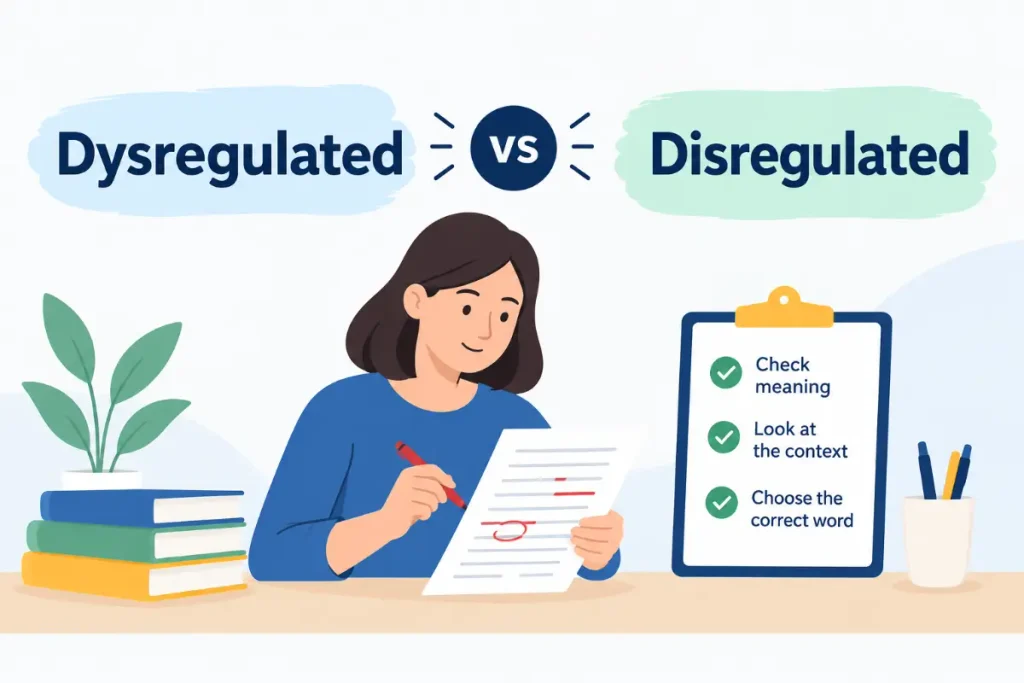
What Editors Should Do With Disregulated
If you’re editing a general article, report, blog post, or school assignment, the safest approach is simple.
Change disregulated to dysregulated when the writer is describing impaired or abnormal regulation.
For example:
Original:
The patient became disregulated after the procedure.
Edited:
The patient became dysregulated after the procedure.
Original:
Emotional disregulation can make stress harder to manage.
Edited:
Emotional dysregulation can make stress harder to manage.
The second example also fixes a related spelling problem.
The noun is dysregulation, not disregulation, in the standard psychological terminology used by the APA and major dictionaries.
When Editors Should Not Change It
There is one important exception.
If disregulated appears inside the official title of a published work or the formal name of a research tool, don’t silently change it.
Instead, preserve the source’s wording.
The PubMed record for the 2011 article mentioned earlier provides a clear example. The published title uses Disregulated Alcohol Related Behavior, and the study names a related measurement tool with the same spelling.
In that situation, changing the spelling would alter the title.
An editor’s job is not to rewrite established names simply because another spelling is more common.
The better rule is:
Use dysregulated for your own writing.
Preserve disregulated when it is part of an exact title or official name.
That gives you both accuracy and consistency.
How To Use The Word In Professional Writing
If you’re writing for a professional audience, clarity should come first.
Don’t use dysregulated simply because it sounds scientific.
Use it when you mean that a regulatory process is impaired, abnormal, unstable, or poorly controlled.
For example:
The study found dysregulated immune signaling.
That sentence tells the reader what process is involved.
Compare it with:
The study found dysregulated things in the immune system.
The second sentence is vague.
The word is correct, but the sentence does not tell the reader enough.
Strong writing pairs precise terminology with precise nouns.
You can also avoid unnecessary medical language.
Instead of:
The intervention improved dysregulation of emotional responses.
You might write:
The intervention helped participants manage their emotional responses.
Both sentences may describe a similar idea. The second is easier for a general reader.
This is especially useful in health content.
Readers should not have to translate every sentence into plain English.
FAQs
Is dysregulated the correct spelling?
Yes. Dysregulated is the standard form used in modern medical, psychological, and scientific writing. Major dictionaries and the APA Dictionary of Psychology recognize dysregulation and dysregulated.
Is disregulated a real word?
It appears in published and informal material, but it is not the standard spelling most writers should choose for the general meaning of impaired regulation. A specific published title or named research measure may use that spelling, so context matters.
What does dysregulated mean in psychology?
In psychology, dysregulated usually describes an emotional or behavioral response that is poorly managed or difficult to control. The APA Dictionary of Psychology describes dysregulation as an excessive or poorly managed mechanism or response.
Is emotional dysregulation the same as being upset?
Not exactly. Everyone gets upset, stressed, or angry, and those normal emotions do not automatically indicate dysregulation. Emotional dysregulation refers to difficulty managing emotional responses in a way that can make the response unusually intense, prolonged, or hard to control.
What is the difference between dysregulated and unregulated?
Dysregulated usually suggests that a regulatory process exists but is not working properly. Unregulated often means that something is not controlled by rules or a regulating system. The right choice depends on the specific situation.
What is the noun form of dysregulated?
The main noun is dysregulation. For example, you can write emotional dysregulation, metabolic dysregulation, or immune dysregulation. The verb is dysregulate.
Can I use disregulated in academic writing?
You generally should not use it as your own spelling when you mean impaired regulation. Use dysregulated instead, unless disregulated is part of an exact title, name, or specialized term that you need to reproduce accurately.
Why do people spell dysregulated as disregulated?
The mistake likely comes from the strong familiarity of the prefix dis and the similarity between the sounds of dis and dys. People also see many common words beginning with dis, so the spelling can feel natural even when it is not the established form for this term.
Conclusion
The answer to dysregulated vs disregulated is straightforward for most writing.
Use dysregulated when you mean that a system, process, emotion, or behavior is not being regulated properly.
Use dysregulation for the noun.
Use dysregulate for the verb.
Those three forms belong to the same word family and are widely established in psychology, medicine, and biology.
The spelling becomes easier to remember once you understand the prefix. Dys carries the idea of abnormal, difficult, or impaired function. That fits the meaning you normally want when describing poor regulation.
Disregulated can still appear in published material. The important point is that a rare occurrence or a fixed title does not make it the preferred spelling for your own sentence. If you’re writing from scratch, dysregulated is the clear choice.
So the next time you pause over the spelling, keep one simple idea in mind.
If the regulation is present but isn’t working properly, dysregulated is the word you want.

Dr. Arthur Pendelton is a veteran historical linguist and grammar expert with over 30 years of experience in academic editing. A retired professor, Arthur specializes in the etymology and evolution of the English language. He is passionate about “unpacking the history behind the rules,” helping readers understand why we spell, punctuate, and phrase things the way we do today. Whether he’s settling debates on archaic usage or explaining complex linguistic shifts, Dr. Pendelton brings scholarly precision to every article.
1 thought on “Dysregulated vs Disregulated: 5 Simple Rules”